DIY cat enrichment ideas for apartments should be simple, compact, and easy to inspect. The best projects give an indoor cat a safe way to search, scratch, hide, observe, or play without filling the room with permanent equipment.
This guide includes 15 low-cost projects made from common household materials. Every new project should be introduced under supervision. Remove it if your cat chews off pieces, swallows material, becomes frustrated, guards the activity from another cat, or uses it in an unsafe way.
DIY enrichment supports normal behavior, but it is not a treatment for sudden inactivity, aggression, appetite change, overgrooming, house soiling, or other health and behavior changes. Contact your veterinarian when a change is sudden, severe, or accompanied by physical symptoms.
Quick Answer
Good DIY cat enrichment ideas for apartments include easy food searches, open cardboard feeders, handle-free paper bags, floor-level box mazes, cardboard scratch trays, paper-ball chase games, hiding tents, window observation stations, and supervised wand play.
Start with one project that matches something your cat already enjoys. Keep food activities easy at first, build cardboard structures at floor level, remove string-like toys after play, and count all food used in enrichment as part of the cat’s normal daily intake.
Table of Contents
Safety Rules Before You Build
No DIY cat toy is risk-free. A safe setup depends on the individual cat, the materials, the way the project is built, and whether it is supervised.
Do not use:
- rubber bands, hair ties, yarn, fishing line, dental floss, or loose string;
- staples, exposed wire, sharp plastic, splintered wood, or broken cardboard edges;
- balloons, Mylar strips, aluminum foil pieces, loose feathers, pom-poms, or small craft decorations;
- essential oils, potpourri, scented adhesives, or unidentified plants;
- boxes contaminated with food, chemicals, moisture, mold, or heavy residue;
- unstable towers, furniture balanced on books, or structures with only one exit;
- tape or glue in an area the cat can lick or chew.
Use clean materials, make openings large enough for the cat to move through comfortably, and inspect each project before and after use. Store interactive toys securely when no one is supervising.
Food puzzles need additional care. Use a measured portion of the cat’s normal food, wash food-contact surfaces, and stop if the activity reduces food intake or causes distress. Ask your veterinarian before changing meal timing or using food puzzles for a cat with a prescribed diet, diabetes, dental pain, gastrointestinal disease, kidney disease, food allergies, or a weight-loss plan.
For a broader review of climbing, scratching, hiding, feeding, and routine, use our indoor cat enrichment checklist.
All 15 Projects at a Glance
| # | Project | Main purpose | Supervision |
|---|---|---|---|
| 1 | Open Paper Tube Feeder | Easy food search | First uses |
| 2 | Muffin Tin Food Search | Pawing and problem-solving | First uses |
| 3 | Paper Cup Treasure Hunt | Scent and food search | Yes |
| 4 | Open Egg Carton Feeder | Easy foraging | Yes |
| 5 | Flat-Towel Food Search | Sniffing and pawing | Yes |
| 6 | Handle-Free Paper Bag Hideout | Hiding and exploration | First uses |
| 7 | Single-Box Retreat | Rest and security | First uses |
| 8 | Floor-Level Box Maze | Exploration and choice | Yes |
| 9 | Cardboard Scratch Tray | Scratching | Inspect regularly |
| 10 | Large Paper-Ball Chase | Chase and batting | Yes |
| 11 | Peek-Hole Box Hunt | Pawing and hunting play | Yes |
| 12 | Cardboard Scent Choice | Olfactory exploration | Yes |
| 13 | Treat Trail Search | Searching and movement | Yes |
| 14 | Chair-and-Blanket Hideout | Hiding and rest | First uses |
| 15 | Supervised Fleece Wand | Interactive hunting play | Always |
Choose projects according to your cat’s age, mobility, confidence, health, and chewing habits. A kitten, senior cat, or cat that eats non-food objects may need a different setup or may not be suitable for some projects.
Category 1: Easy Food and Foraging Projects
Food projects should begin at an easy level. The cat should be able to find and eat an appropriate amount without prolonged frustration. Use part of a normal measured meal rather than adding unlimited treats.
1. Open Paper Tube Feeder
Use one clean, plain cardboard toilet-paper tube and a small portion of dry food.
- Place the tube on its side.
- Add a few pieces of food while leaving both ends open.
- Let the cat roll or paw the tube so the food falls out easily.
Do not fold both ends closed. A sealed tube encourages some cats to tear and swallow cardboard before reaching the food. Discard the tube if it becomes wet, crushed, heavily chewed, or torn into pieces.
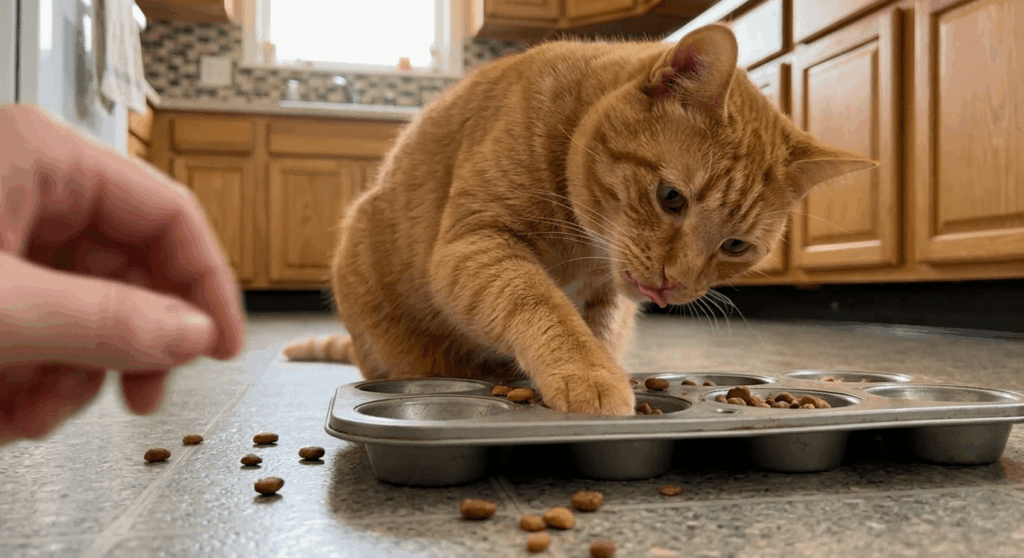
2. Muffin Tin Food Search
Use a clean muffin tin, a measured portion of dry food, and several large paper cups that cannot fit inside the cat’s mouth.
- Place food in several muffin cups.
- Leave some cups uncovered for the first session.
- Turn a large paper cup upside down over one or two food compartments.
- Increase the number of covered compartments only if the cat moves the cups without distress.
Avoid small balls, bottle caps, and detachable objects. Wash the muffin tin after use and stop if the cat bites pieces from the paper cups.
3. Paper Cup Treasure Hunt
Use three or four clean, unscented paper cups and part of the cat’s normal dry-food portion.
- Place the cups upright on a nonslip floor.
- Drop food into one or more cups while the cat watches.
- Lay one cup on its side if the upright version is too difficult.
- Move the cups to a slightly different arrangement during a later session.
Choose cups wide enough that the cat cannot get its head stuck. Do not use plastic cups that crack into sharp pieces.
4. Open Egg Carton Feeder
Use a clean, dry cardboard egg carton with all labels and loose material removed.
- Cut off the lid and discard it.
- Place food in several open compartments.
- Set the carton on a washable mat.
- Let the cat remove the food without having to open or tear the carton.
Do not use a visibly soiled carton. Remove the project if the cat chews or swallows cardboard instead of eating the food.
5. Flat-Towel Food Search
Use a clean, flat-woven towel without loose loops, fringe, holes, or damaged threads.
- Lay the towel flat.
- Scatter a small amount of dry food across one half.
- Fold the other half loosely over the food.
- Leave an edge open so the first pieces are easy to find.
Supervise the activity. Do not use a towel that catches the cat’s claws, and wash it after food use. For more feeding options, compare our guide to the best cat puzzle feeders.
Category 2: Cardboard and Paper Projects
Use plain, clean cardboard and paper. Remove staples, plastic windows, labels that peel off, loose tape, packing straps, and adhesive residue. Keep box structures at floor level rather than building a tall tower.
6. Handle-Free Paper Bag Hideout
Use one large paper grocery bag.
- Remove both handles completely.
- Open the bag and lay it on its side.
- Fold the open rim outward if it collapses inward.
- Place it in a quiet area with the entrance unobstructed.
Never use a plastic bag. Remove the paper bag if the cat becomes tangled, tears off pieces, or tries to eat it.
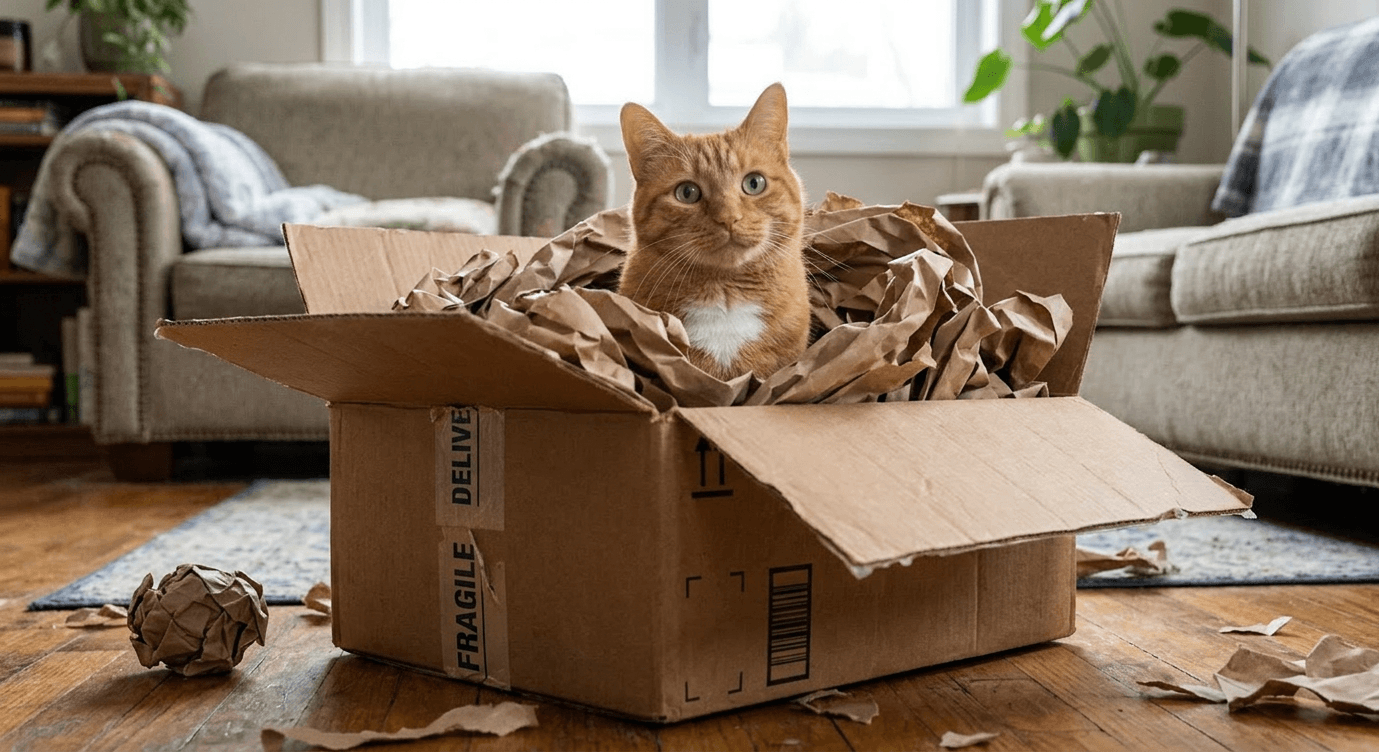
7. Single-Box Retreat
Use one sturdy cardboard box that is large enough for the cat to turn around inside.
- Remove staples, loose tape, and shipping material.
- Keep the top open or cut one large entrance in a side.
- Add a clean folded towel only if the cat does not chew fabric.
- Place the box on the floor away from heaters and busy walkways.
A retreat should let the cat enter and leave voluntarily. Do not reach inside to force interaction when the cat is resting.
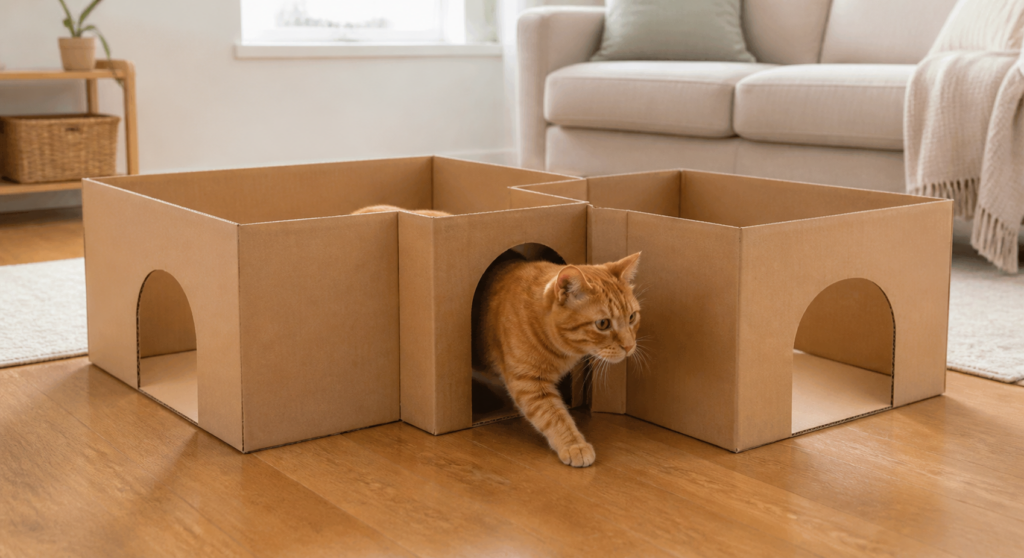
8. Floor-Level Box Maze
Use two or three sturdy boxes of similar height.
- Arrange the boxes side by side on the floor.
- Cut wide connecting doorways with smooth edges.
- Leave at least two exits from the combined structure.
- Connect boxes only on exterior surfaces the cat cannot chew, or keep them pressed together without adhesive.
Do not stack the boxes. Test every wall and opening by hand before allowing access, and dismantle the maze if it shifts when the cat enters.
9. Cardboard Scratch Tray
Use a shallow open box and several flat pieces of corrugated cardboard cut to fit tightly inside it.
- Remove all tape and staples.
- Place the cardboard layers flat inside the shallow box.
- Press them together so they do not slide.
- Put the tray beside a location where the cat already scratches.
Do not use exposed glue, pins, or wire to hold the layers together. Replace the cardboard when it develops loose strips or sharp damaged edges.
10. Large Paper-Ball Chase
Use plain, unscented packing paper or printer paper.
- Crumple one sheet into a firm ball larger than the cat can swallow.
- Roll it across the floor during supervised play.
- Put it away when the session ends.
Use paper rather than aluminum foil. Discard the ball immediately if it becomes wet, flattened, torn, or small enough to fit in the cat’s mouth.
For more information about safe box use, read why cats like boxes.
Category 3: Hunting, Scent, and Hiding Projects
These projects depend more heavily on supervision. Avoid essential oils and unidentified outdoor materials. A cat should always be able to walk away from the activity.
11. Peek-Hole Box Hunt
Use a sturdy, open-top cardboard box and a supervised toy that is too large to be swallowed.
- Cut two or three smooth paw-sized openings in the sides.
- Check that no cut edge is sharp or folded inward.
- Move a large toy past the openings from outside the box.
- Let the cat stalk and paw through the holes.
Keep the top open and never leave a string or wand toy inside the box after play.
12. Cardboard Scent Choice
Use two clean pieces of cardboard. Leave one plain and apply a small amount of a cat-specific dried scent product, such as catnip, to the other only if your cat has used it safely before.
- Put the two pieces several feet apart.
- Allow the cat to approach, sniff, rub, or ignore either option.
- Remove both pieces after the session.
Do not use essential oils, concentrated extracts, potpourri, garden plants, or outdoor soil. Cats vary in their response, and participation should remain voluntary.
13. Treat Trail Search
Use a small measured portion of dry food and several clean, accessible locations in one room.
- Place the first piece where the cat can see it.
- Space the remaining pieces along an easy route.
- Keep all food on washable surfaces and away from cords, plants, and narrow gaps.
- Count the pieces afterward so none remain hidden.
Do not hide food where one cat can guard another or where a mobility-limited cat must jump. Stop if the search causes competition, anxiety, or reduced meal intake.
14. Chair-and-Blanket Hideout
Use a stable chair and a lightweight blanket without holes, fringe, or loose threads.
- Place the chair on a nonslip floor.
- Drape the blanket over the seat so at least two sides remain open.
- Make sure the blanket cannot pull the chair over.
- Allow the cat to enter and leave without being touched or blocked.
Do not use a folding chair that can collapse or a heavy blanket that traps heat. Remove the setup if the cat chews fabric or catches a claw.
15. Supervised Fleece Wand
Use a smooth wooden dowel and one wide strip of tightly woven fleece that is too large to swallow. Avoid fishing line, wire, elastic, ribbon, feathers, Mylar, pom-poms, and glued decorations.
- Attach the fleece securely to one end of the dowel using a tight method with no exposed sharp hardware.
- Pull firmly before every session to check the attachment.
- Move the fleece away from the cat in short, irregular movements.
- Allow several catches and end before the cat becomes exhausted or frustrated.
- Lock the entire toy away immediately after play.
Never leave a homemade wand accessible without supervision. Discard it if the fleece frays, the attachment loosens, or the wood splinters. For other play options, see our indoor cat exercise routine.
How to Rotate DIY Enrichment Without Creating Clutter
There is no universal rotation schedule. Some cats continue using a familiar scratcher or food activity, while others lose interest in a temporary toy. Keep essential resources stable and rotate only optional enrichment.
A practical apartment system is:
- keep one food activity and one non-food activity available;
- store string-like interactive toys after every session;
- remove projects that are ignored, damaged, dirty, or difficult to maintain;
- reintroduce a stored paper or cardboard project only after inspecting it;
- change one item at a time so you can observe the cat’s response;
- keep familiar beds, scratchers, litter boxes, food, and water locations predictable.
The goal is not constant novelty. The goal is a manageable selection of safe choices that the cat uses voluntarily.
How to Adapt the Projects
Kittens
Kittens explore with their mouths and may climb unstable objects. Use large simple materials, supervise closely, keep all structures at floor level, and remove projects as soon as pieces loosen.
Senior Cats and Cats With Limited Mobility
Choose activities that do not require jumping, fast turning, or prolonged standing. Use nonslip surfaces and easy food access. A new reluctance to move, jump, play, or use stairs should be discussed with a veterinarian rather than assumed to be normal aging.
Multi-Cat Apartments
Offer activities in separate areas so one cat cannot guard every puzzle, retreat, or route. Supervise for staring, blocking, chasing, or one cat waiting until another leaves. Food games may need to be used in separate rooms.
Cats That Chew or Swallow Non-Food Objects
Paper, cardboard, and fabric projects may not be appropriate. Ask your veterinarian about persistent ingestion of non-food material and use professionally manufactured options selected for the individual cat when DIY materials cannot be used safely.
Common DIY Enrichment Mistakes
Making the First Puzzle Too Difficult
If the cat cannot obtain the food easily, simplify the project. Enrichment should provide an achievable choice rather than force prolonged effort.
Using Small Craft Supplies
Pom-poms, feathers, bells, beads, elastic, ribbon, foil, and balloon material can detach or be swallowed. Decorative detail is not worth increasing ingestion risk.
Building Upward Without Structural Support
Cardboard is useful for floor-level exploration, but a taped box tower is not a substitute for furniture designed to carry a cat’s weight. Keep DIY box structures on the floor.
Assuming Natural Means Safe
Outdoor leaves, flowers, grass clippings, soil, pine cones, and branches may contain toxic plants, pesticides, mold, parasites, or sharp material. Use known clean indoor materials instead.
Leaving Interactive Toys Out
A wand or fabric lure that is appropriate during supervised play can become an entanglement or ingestion hazard when left unattended. Store it in a closed cabinet after use.
When to Stop a Project
Remove the project when:
- the cat chews off or swallows material;
- cardboard, paper, or fabric becomes wet, frayed, sharp, or unstable;
- food cannot be obtained or food intake decreases;
- a claw, tooth, head, paw, or collar could become trapped;
- the cat pants, stumbles, hides, guards the activity, or becomes unusually agitated;
- another cat is blocked from food, litter, water, rest, or movement;
- the project cannot be cleaned adequately.
Contact a veterinarian if the cat may have swallowed string, ribbon, elastic, foil, plastic, fabric, or another foreign object. Do not pull visible string from the mouth or anus. Seek veterinary advice promptly if the cat vomits repeatedly, stops eating, becomes weak, has abdominal pain, or strains to pass stool.
Frequently Asked Questions
Are cardboard boxes safe for cats?
Plain, clean cardboard can be useful for many cats, but it is not appropriate for every cat. Remove tape, staples, plastic, and loose labels; keep structures stable and at floor level; and discard damaged cardboard. Stop using it if the cat swallows pieces rather than only scratching or shredding.
What is the easiest DIY enrichment project for a beginner?
An open paper-tube feeder or an uncovered muffin-tin food search is easy to set up and easy to supervise. Use measured food and keep the first version simple enough for the cat to succeed.
How many DIY projects should be available at once?
There is no required number. In a small apartment, one or two optional projects may be easier to inspect and maintain than a crowded collection. Essential resources such as litter boxes, water, resting places, and scratchers should remain reliably available.
Can DIY enrichment replace interactive play?
No single project meets every behavioral need. Food searches and cardboard exploration can complement, but not automatically replace, appropriate social contact, hunting-style play, scratching, climbing, observation, and rest.
Can I use essential oils or outdoor plants for scent enrichment?
Do not use essential oils or unidentified outdoor plant material in a DIY cat project. Plant material can cause gastrointestinal upset, and some plants are toxic to cats. Use only known cat-specific products as directed and allow the cat to walk away.
How often should I replace a cardboard project?
Replace it based on condition rather than a fixed schedule. Discard cardboard that is wet, dirty, heavily chewed, unstable, moldy, or breaking into pieces.
Related Apartment Guides
- Audit the full environment with our Indoor Cat Enrichment Checklist.
- Plan the room with Indoor Cat Enrichment in Small Apartments.
- Compare reusable food activities in Best Cat Puzzle Feeders.
- Understand safe box use in Why Do Cats Like Boxes?.
- Build an appropriate play routine with Indoor Cat Exercise Routine.
Final Thoughts
The best DIY cat enrichment ideas for apartments are not the most elaborate. They are the projects you can supervise, inspect, clean, and remove before the materials become hazardous.
Begin with one easy food search or floor-level cardboard project. Watch how your cat uses it, keep only the ideas that support voluntary normal behavior, and adapt the setup for age, mobility, health, chewing habits, and other cats in the home.
References
- Ellis, S. L. H., et al. (2013). AAFP and ISFM Feline Environmental Needs Guidelines. Journal of Feline Medicine and Surgery, 15(3), 219–230.
- Herron, M. E., & Buffington, C. A. T. (2010). Environmental Enrichment for Indoor Cats. Compendium: Continuing Education for Veterinarians, 32(12), E1–E5.
- International Cat Care. Playing With Your Cat.
- ASPCA Animal Poison Control Center. Toxic and Non-Toxic Plants.