Published by IndoorCatExpert.com | Indoor Cat Health & Behavior
Last week, a reader emailed me about her Ragdoll cat tearing up a velvet sofa in a 500-sq-ft studio. My answer wasn’t to buy a new sofa, but to look up. Here’s why…
Your cat doesn’t need a mansion. But it absolutely needs a world.
This is the single biggest misconception among urban cat owners. I used to think the same way. When I first moved into a 600-square-foot apartment with my slightly chubby orange tabby, Oliver, I watched him grow increasingly lethargic and anxious. After diving deep into feline behavioral science, I realized a core truth: your cat doesn’t need 2,000 square feet of floor space, but it desperately needs 3D space.
A cat confined to a 600-square-foot apartment with nothing but a sofa and a food bowl on the floor may experience far greater psychological stress than a cat living in a 300-square-foot studio with a thoughtfully built vertical environment. Floor space is two-dimensional. A cat’s cognitive world is three-dimensional. Ignoring this distinction is the root cause of chronic anxiety, destructive behavior, and declining mental health in millions of indoor cats worldwide.
This guide is here to change that.
Quick Answer: How to Enrich a Small Apartment for an Indoor Cat?
To achieve optimal indoor cat enrichment in small apartments, focus on utilizing 3D vertical space rather than floor space. Provide a tall cat tree or wall shelves, set up a dedicated window viewing perch, engage in two 10-minute interactive play sessions daily to simulate hunting, and establish a predictable daily routine.
What Is Indoor Cat Enrichment — And Why Does It Matter?
Enrichment isn’t a buzzword. In behavioral science, environmental enrichment refers to deliberate modifications to an animal’s living space that stimulate natural behaviors, reduce stress, and improve overall welfare. For indoor cats specifically, enrichment addresses a fundamental tension: cats are hardwired as solitary hunters with large territorial ranges, yet we ask them to thrive in spaces that are, by wild standards, extraordinarily small and stimulus-poor.
The consequences of insufficient enrichment are well-documented. Studies published in the Journal of Veterinary Behavior and Applied Animal Behaviour Science link under-stimulated indoor environments to increased cortisol levels, redirected aggression, inappropriate elimination, compulsive grooming, and obesity. These aren’t behavioral “quirks” — they are distress signals.
The good news? You don’t need to move. You need to think vertically, creatively, and consistently.
Pillar 1: Vertical Space — Break the Ground-Floor Ceiling
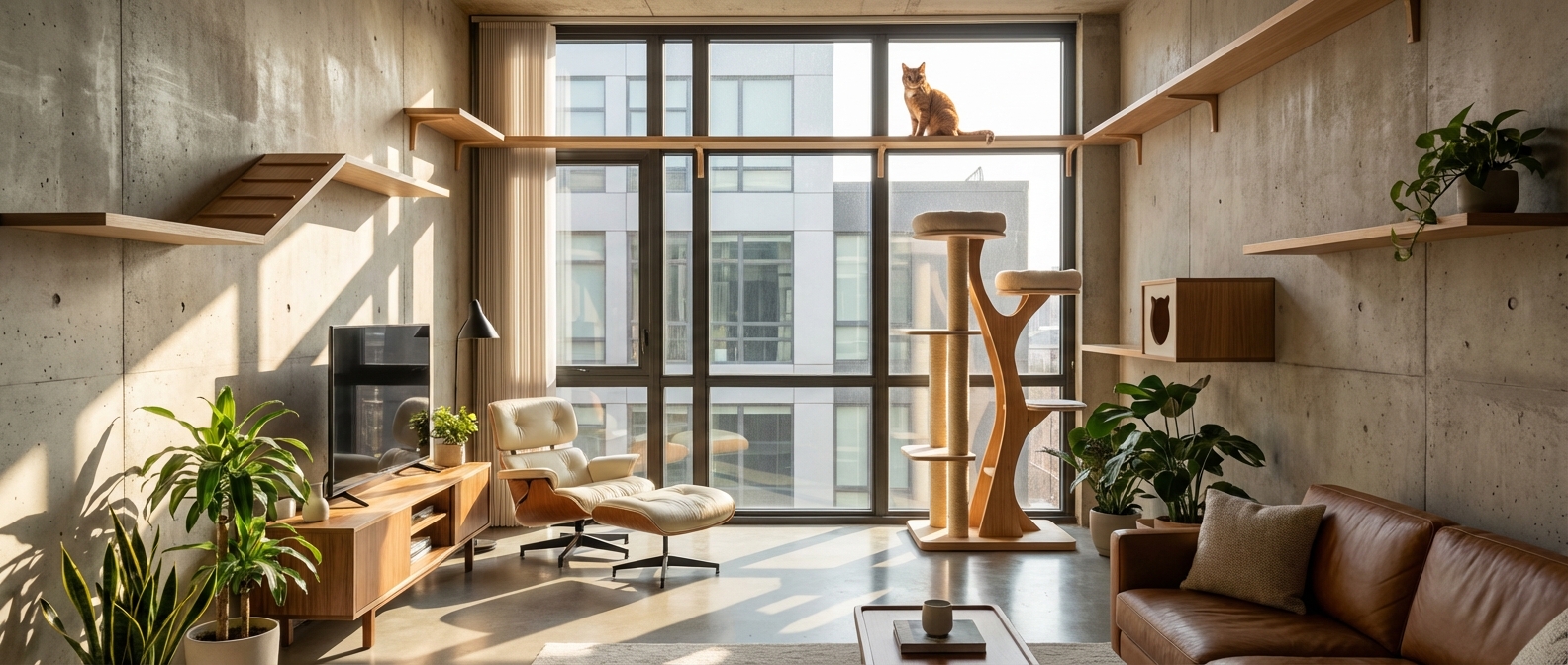
Cats are vertical animals by evolutionary design. In the wild, elevation equals safety (predators can’t reach you), information (you can see everything), and social status (the highest cat is often the most dominant). When you confine a cat to a space with no vertical dimension, you’re stripping away something deeply hardwired into its nervous system.
How to maximize vertical space in a small apartment:
- Choose tall over wide when buying cat trees. A cat tree with a 24″×24″ footprint but standing 6 feet tall delivers far more psychological value than a wide, low-profile model. Prioritize units with a spacious top platform or hammock — that’s where cats actually want to be.
- Install wall-mounted cat shelves. Wall-mounted cat steps and walkways are one of the highest-ROI investments for small apartments. A series of three to five shelves installed along one wall creates a full “cat highway” from floor to ceiling without consuming a single square foot of floor space. Many modular systems allow you to customize pathways, adding tunnels, resting pads, and scratching surfaces along the route.
- Reclaim high furniture surfaces. Refrigerator tops, bookshelves, and tall wardrobes are underutilized vertical real estate. Instead of discouraging your cat from climbing there, integrate these surfaces into your cat’s vertical ecosystem. Add a non-slip mat or an old towel, and you’ve created a premium observation post at zero cost.
A study in the Journal of Veterinary Behavior found that indoor cats with access to elevated resting spots showed measurably lower cortisol levels compared to cats limited to ground-level environments. Height isn’t a luxury — it’s a welfare necessity.
Pillar 2: Window Views — Your Cat’s Natural Television
For an indoor cat, a window is the only portal to the outside world, and its importance cannot be overstated. Animal behaviorists use the term “visual foraging” to describe what cats do when watching birds, pedestrians, blowing leaves, or passing cars through a window. These moving stimuli activate the same neural circuits involved in hunting, providing meaningful mental engagement without any physical prey.
How to maximize window enrichment:
- Install a window perch. Suction-cup or clamp-mounted window seats are inexpensive, require no tools, and give your cat a comfortable, dedicated viewing platform. Look for models rated for at least 25 lbs with a padded surface wide enough for your cat to lie down fully — standing-only perches defeat the purpose.
- Set up a bird feeder outside. If you have access to a balcony or a window that opens, a small bird feeder positioned in your cat’s sightline is one of the most powerful enrichment tools available. The dynamic movement, sounds, and unpredictable behavior of birds provide a level of stimulation no manufactured toy can replicate. Research shows this significantly increases time spent in focused, low-stress observation.
- Eliminate access barriers. Before buying any new equipment, audit your window situation. Is there furniture blocking the path? Rearranging your living room to give your cat clear, easy access to a window is often more impactful than any purchase.
- Use cat TV as a supplement. YouTube offers hours of bird, squirrel, and fish videos specifically produced for cats. These work well as a temporary substitute when you’re out. Choose ad-free, continuous-play versions and avoid videos with sudden loud noises that may cause startle responses.
Pillar 3: Simulated Hunting — The Daily Ritual Your Cat Can’t Skip
This is the most underrated category of indoor enrichment — and arguably the most critical.
A significant portion of indoor cat problems — midnight sprinting, redirected aggression, food obsession, chronic restlessness — share a common origin: an unmet hunting drive. Cats are obligate predators. Their nervous systems are built to complete a specific behavioral sequence every day: stalk → chase → catch → kill → eat → groom → sleep. When this cycle is chronically interrupted or absent, the accumulated energy and frustration manifest as behavior problems.
How to simulate the hunting cycle scientifically:
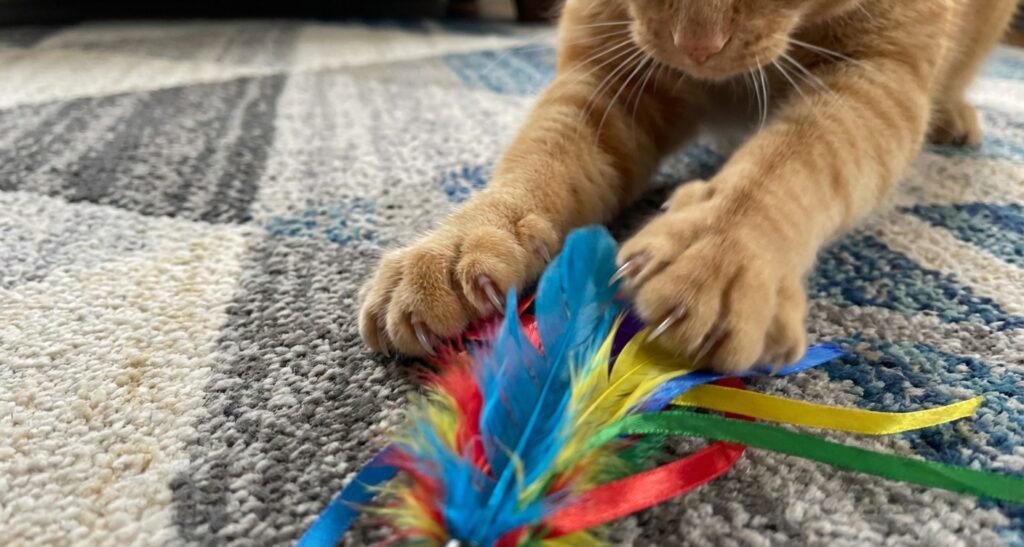
- Use interactive toys the right way. Wand toys and feather teasers are only effective if you operate them like real prey. Mimic natural prey movement — sudden stops, hiding under a blanket, slow creeping followed by a burst of speed. Critically, always let your cat make the kill. Ending a play session without a successful capture leaves the hunt loop open, creating frustration rather than satisfaction.
- Schedule two daily play sessions of 10–15 minutes each. Consistency matters more than duration. The most important session is before bedtime. Play vigorously, then immediately follow with a meal. This replicates the natural hunt-kill-eat sequence and sends a powerful neurological signal that the day is complete. Cats settled this way sleep soundly through the night — which also means you do.
- Introduce puzzle feeders. Transitioning part of your cat’s daily food ration from a bowl to a puzzle feeder is one of the most evidence-backed enrichment strategies available. Puzzle feeders transform eating from a passive activity into active foraging — the closest approximation of natural food-seeking behavior an indoor cat can experience. Even something as simple as scattering kibble across different surfaces in your apartment rather than filling one bowl produces measurable improvements in calmness and satisfaction.
- Rotate toys regularly. Cats habituate quickly. A toy that produces frantic excitement today may be completely ignored in two weeks. Keep a rotating inventory and reintroduce “old” toys after a few weeks away — novelty resets interest almost entirely.
- Understand the limits of automated toys. Electronic moving toys serve a useful role when you’re away, but they are supplements, not substitutes. Cats need the social dimension of play — the sense that another living being is engaged with them. Interactive play with you is irreplaceable.
Pillar 4: Scent Enrichment — A Sensory Dimension We Almost Always Ignore
A cat’s olfactory system contains roughly 200 million scent receptors — approximately 14 times more than a human’s. Cats navigate their world primarily through smell: they assess territorial safety, detect unfamiliar threats, and regulate emotional states through scent. Yet the average indoor apartment is a sensory desert when it comes to olfactory stimulation.
Small additions make a significant difference. Bringing in a branch, a handful of leaves, or a small amount of soil from outside introduces complex, layered scent profiles that engage your cat’s investigative behaviors for extended periods. Catnip (Nepeta cataria) and silver vine (Actinidia polygama) serve as powerful periodic olfactory stimulants — approximately 70% of cats respond strongly to one or both. Use them sparingly to preserve their novelty. Hiding small amounts in different locations turns scent exploration into an active foraging exercise.
Pillar 5: Safe Hiding Spaces — The Right to Disappear
Almost every first-time cat owner misses this one: cats need places to hide completely and remain undisturbed. This is not shyness. This is a primary stress-regulation mechanism. A cat that can choose to “disappear” maintains a sense of control over its environment — and perceived control is one of the most important predictors of low stress in domestic cats.
In an apartment, this can be a half-open cardboard box, a cat tent, a designated shelf with a curtain, or a corner of a closet with the door left ajar. The physical setup matters less than the social rule: when a cat retreats to its hiding space, no one disturbs it. This includes children, guests, and well-meaning owners who just want a quick cuddle. Respecting the hide is respecting the cat.
Pillar 6: Routine and Social Connection — You Are the Enrichment
No amount of physical enrichment will compensate for the absence of consistent, quality social interaction. You are, for your cat, the most important environmental feature in the apartment.
Cats are creatures of predictable routine. Fixed feeding times, predictable play sessions, and consistent daily rhythms significantly reduce background anxiety — even in cats who appear independent or aloof. Predictability itself is calming; it signals to the nervous system that the environment is safe and stable.
This doesn’t require hours of your time. Two focused, engaged 15-minute play sessions per day — truly present, putting your phone down, moving that wand toy like you mean it — outperforms three hours of passive coexistence. Presence over duration. Quality over quantity.
Pillar 7: Observe, Adapt, Iterate — Enrichment Is Not Interior Design
This is what commercial enrichment advice almost always leaves out: your cat is a unique individual.
Some cats are indifferent to window birds but will pursue a crinkled foil ball with Olympic focus. Some cats race to the highest point in the room; others prefer low, enclosed hiding spots. Some cats thrive on high-intensity daily play; others prefer shorter, quieter interactions. There is no universal formula.
Effective enrichment is an ongoing process of observation, hypothesis, and adjustment. Notice where your cat spends its time across different hours of the day. Track which toys generate genuine engagement versus a single bored sniff. When a behavior problem emerges, ask what unmet need it might be expressing — then experiment with addressing that need before reaching for behavioral correction.
A 600-square-foot apartment, designed with intention across all three physical dimensions and managed with consistent social and behavioral routines, is entirely capable of providing a rich, stimulating, psychologically healthy life for an indoor cat.
The square footage is a constraint. Your creativity and commitment are not.
Quick-Start Checklist: 7 Pillars at a Glance
| Pillar | Minimum Viable Action |
|---|---|
| Vertical Space | One tall cat tree (5ft+) or 3 wall shelves |
| Window Views | One window perch with clear sightline |
| Simulated Hunting | Two 10-min interactive play sessions daily |
| Scent Enrichment | Weekly introduction of outdoor scent items |
| Safe Hiding | One covered hiding spot cat can access freely |
| Routine & Social | Fixed feeding + play times, daily consistency |
| Observe & Adapt | Monthly “enrichment audit” — what’s working? |
References: Ellis, S.L.H. et al. (2013). AAFP and ISFM Feline Environmental Needs Guidelines. Journal of Feline Medicine and Surgery, 15(3), 219–230. | Herron, M.E. & Buffington, C.A.T. (2010). Environmental Enrichment for Indoor Cats. Compendium. | Amat, M. et al. (2009). Potential risk factors associated with feline behaviour problems. Applied Animal Behaviour Science, 121(2), 134–139.
IndoorCatExpert.com — Science-backed guidance for cats living their best indoor lives.