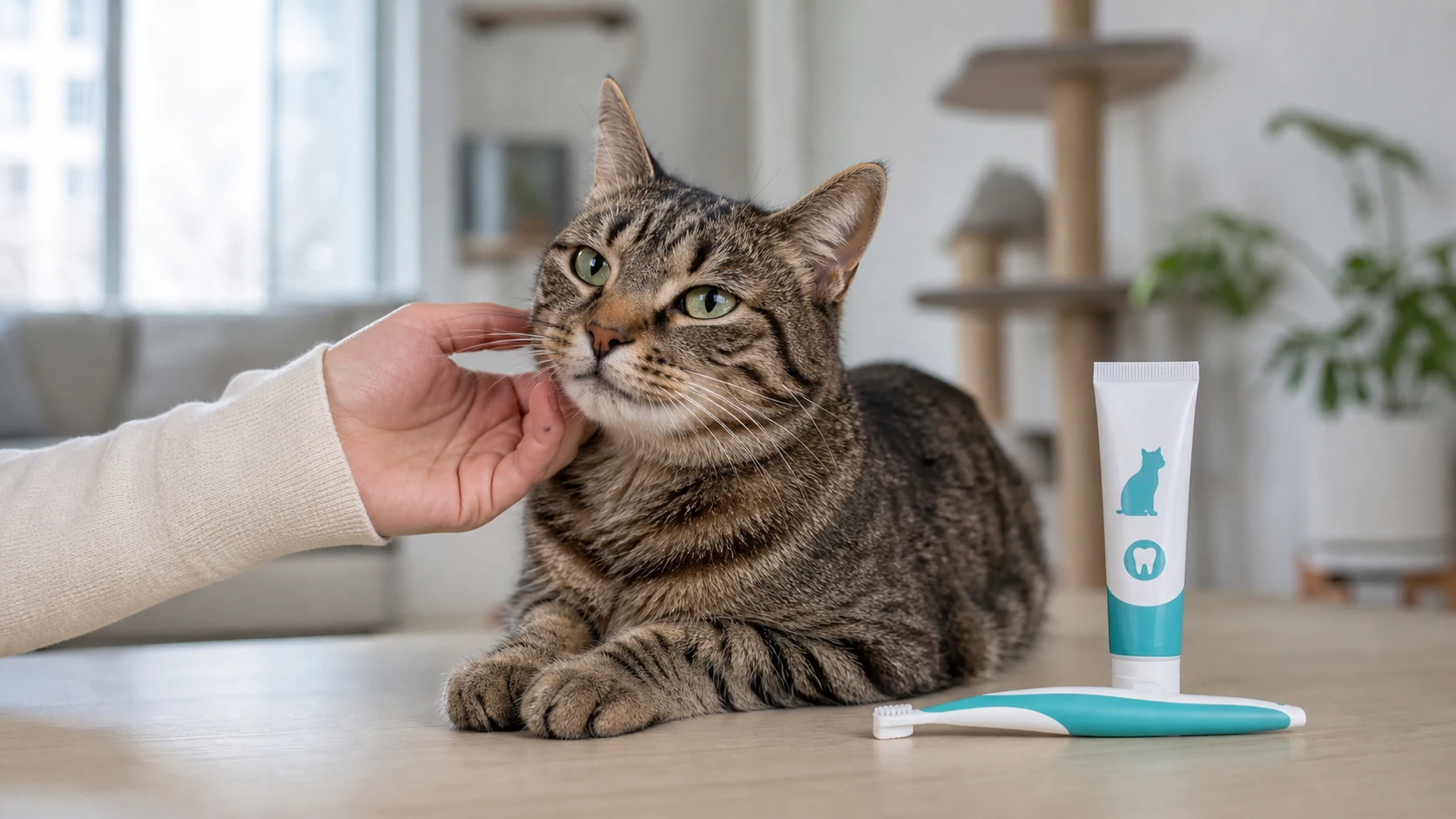
Cat dental care at home begins with a pain-free mouth, gradual toothbrushing with feline toothpaste, careful use of evidence-based dental products, and regular veterinary oral examinations. Home care can slow plaque accumulation, but it cannot remove disease below the gumline, repair a fractured tooth, or treat tooth resorption. If your cat has bad breath together with red or bleeding gums, drools, drops food, resists eating, or develops facial swelling, arrange a veterinary examination before trying to brush.
Indoor cats need dental care even when they never go outside. Plaque forms in the mouth, and cats often continue eating despite oral discomfort. A quiet change—chewing on one side, swallowing kibble without chewing, avoiding face touch, or choosing softer food—may be more informative than a dramatic cry of pain.
This guide separates safe prevention at home from diagnosis and treatment at a veterinary clinic. It also gives you a low-stress way to introduce brushing without forcing your cat.
Quick Answer
For safe cat dental care at home:
- Check for signs of oral pain before brushing. Do not brush inflamed gums, a visibly damaged tooth, or a mouth that seems painful.
- Introduce feline toothpaste and a cat toothbrush gradually. Brush the outer tooth surfaces near the gumline without forcing the mouth open.
- Use dental treats, diets, gels, powders, or water additives as supplements—not substitutes for an examination. Look for a current Veterinary Oral Health Council claim that matches your goal.
- Keep veterinary dental care in the plan. Disease below the gumline and tooth resorption may require an anesthetized examination, dental radiographs, cleaning, and treatment.
Daily brushing is the goal when a healthy cat accepts it, but a shorter calm session is more useful than a struggle. If brushing is not currently possible, ask your veterinarian to help build a realistic alternative plan.
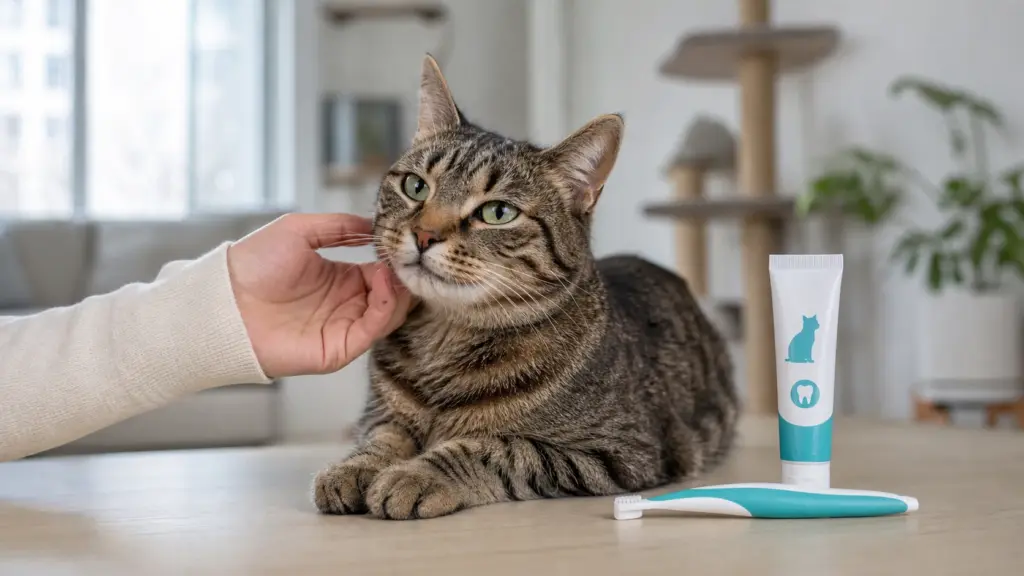
Table of Contents
Home Dental Care and Professional Dental Care Are Different
Home care is preventive. Its main purpose is to disrupt plaque before it matures and contributes to gum disease. Toothbrushing is the most direct home method because the bristles physically contact the outer tooth surfaces and gumline. Certain dental diets, treats, and other products can provide additional plaque or tartar control when used as directed.
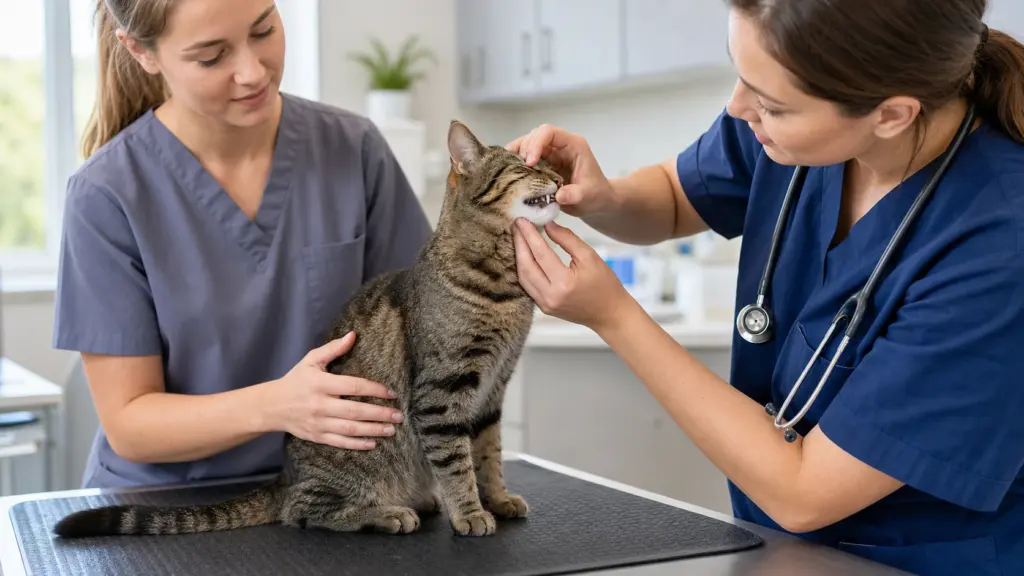
Professional veterinary dental care is diagnostic and therapeutic. A veterinarian can evaluate pain, gingivitis, periodontal disease, fractured teeth, tooth resorption, oral masses, and other conditions that home observation cannot confirm. A complete dental procedure may include examination under anesthesia, probing around each tooth, cleaning above and below the gumline, polishing, full-mouth dental radiographs, nerve blocks, and extraction or other treatment when needed.
AAHA’s dental guidelines state that general anesthesia with endotracheal intubation, monitoring, and physiologic support is necessary for dental cleaning and scaling. An awake cosmetic scraping cannot safely or thoroughly evaluate and clean beneath the gumline, and it can leave important disease undetected.
Think of home and professional care as complementary:
| Care type | What it can do | What it cannot do |
|---|---|---|
| Toothbrushing | Disrupt plaque on accessible tooth surfaces | Remove established calculus or diagnose disease below the gumline |
| VOHC-accepted home product | Help control the stated plaque or tartar claim when used as directed | Guarantee a healthy mouth or treat a painful tooth |
| Visual check at home | Help you notice changes in breath, gums, eating, and behavior | Rule out tooth resorption, periodontal pockets, or root disease |
| Veterinary oral examination | Identify visible abnormalities and determine next steps | Always reveal the full extent of disease in an awake cat |
| Anesthetized dental assessment with radiographs | Examine and treat disease above and below the gumline | Replace ongoing prevention after the mouth has healed |
This distinction protects cats from two common mistakes: expecting treats to cure existing disease and delaying needed treatment because the visible tooth crowns look acceptable.
Dental Warning Signs: Check Before You Brush
Do not begin a brushing program simply because you see tartar. First observe whether the mouth may already be painful.
Contact your veterinarian if you notice:
- persistent bad breath, especially with red or bleeding gums;
- drooling or blood-tinged saliva;
- dropping food or walking away after approaching the bowl;
- chewing on one side or turning the head while eating;
- swallowing dry food without normal chewing;
- a new preference for soft food;
- pawing or rubbing at the mouth;
- reluctance to have the face touched;
- chattering or a sudden reaction when eating;
- a loose, fractured, discolored, or missing tooth;
- swelling of the cheek, jaw, or area below an eye;
- weight loss, reduced appetite, hiding, or unexplained irritability.
A cat that stops eating or appears unable to eat needs prompt veterinary guidance. Mouth pain is one possible cause, but appetite loss can also accompany other illnesses. Do not wait for a routine brushing session to solve it.
If odor is the first change you notice, use our cat bad breath decision guide to separate a brief food smell from signs that need a veterinary examination.
Why a cat can keep eating with dental pain
Eating does not prove that a cat’s mouth is healthy. Cats may adapt by chewing on the less painful side, swallowing pieces whole, changing food preferences, or eating smaller amounts. Some show behavioral changes rather than obvious mouth signs.
Cornell’s Feline Health Center identifies gingivitis, periodontitis, and tooth resorption among the major feline dental diseases. Tooth resorption breaks down tooth structure and can be painful, yet much of the damage may be hidden. Dental radiographs are important because an awake look at the crown cannot show the roots and surrounding bone completely.
A home look is not a home diagnosis
If your cat is relaxed, you may briefly lift the lip to view the outer teeth and gums. Healthy-looking gums do not exclude hidden disease, and visible redness does not tell you its full cause or severity.
Do not pry the jaws apart, probe the gums, pull on a questionable tooth, or scrape tartar. Stop if your cat withdraws sharply, vocalizes, drools, growls, or shows other signs of pain or fear.
Step 1: Prepare a Low-Stress Cat Dental Care Setup
Before introducing a brush, choose the right place and supplies. A quiet corner with stable footing usually works better than a slippery counter or a noisy bathroom. Keep the session separate from nail trimming, medication, and other procedures your cat may dislike.
You will need:
- toothpaste labeled for cats;
- a small feline toothbrush, pet toothbrush, or other veterinarian-recommended applicator;
- a high-value reward compatible with your cat’s diet;
- good light for observing the outside of the mouth;
- patience to stop before the cat becomes distressed.
Use toothpaste made for cats
Cats swallow toothpaste rather than rinsing and spitting. Use only a veterinary oral-care product intended for cats and follow its label. Human toothpaste is not formulated for feline ingestion and may contain ingredients that should not be swallowed by pets.
Do not improvise with baking soda, hydrogen peroxide, alcohol mouthwash, essential oils, salt mixtures, or household disinfectants. “Natural” does not mean safe for oral use in cats.
Choose a brush your cat can tolerate
A long-handled small brush keeps your fingers away from the teeth and gives controlled contact. A finger brush may feel less unfamiliar to some cats, but it puts your finger inside the bite zone and can feel bulky. Gauze may help with initial handling practice if a veterinarian recommends it, but it does not automatically equal effective brushing.
The best tool is one that safely reaches the outer tooth surfaces without forcing the mouth. Replace worn or damaged brushes and keep each pet’s dental supplies separate.
Keep the cat in control
Do not pin your cat on its back, wrap it tightly for routine brushing, or chase it with the brush. A cat that can leave is less likely to panic. Many cats tolerate side-by-side handling better than being held face-to-face.
Choose a time when your cat is awake but calm. End after a small success: approaching the supplies, licking feline toothpaste, accepting a cheek touch, or allowing one brief brush stroke. Progress depends on body language, not a calendar.
Step 2: Introduce Toothbrushing in Four Flexible Stages
The stages below are not a fixed four-day or four-week promise. Some cats move forward quickly, while others need many repetitions at one level. Advance only when the current stage produces relaxed or neutral behavior.
Stage 1: Build a positive association
Place the closed toothpaste and toothbrush nearby during a calm interaction. Let your cat investigate without moving the brush toward the face. Reward voluntary interest.
Later, offer a tiny taste of feline toothpaste as directed by its label. If the flavor causes avoidance, ask your veterinarian about another feline product rather than forcing it.
Signs that your cat is comfortable enough to continue include approaching voluntarily, remaining in place, taking a reward normally, and showing a loose body posture. Flattened ears, tail lashing, skin twitching, crouching, repeated head withdrawal, growling, or attempts to escape mean the session has become too difficult.
Stage 2: Practice face and lip handling
Touch the cheek briefly, reward, and release. Gradually work toward lifting the lip for a moment so the outside of a canine or premolar becomes visible.
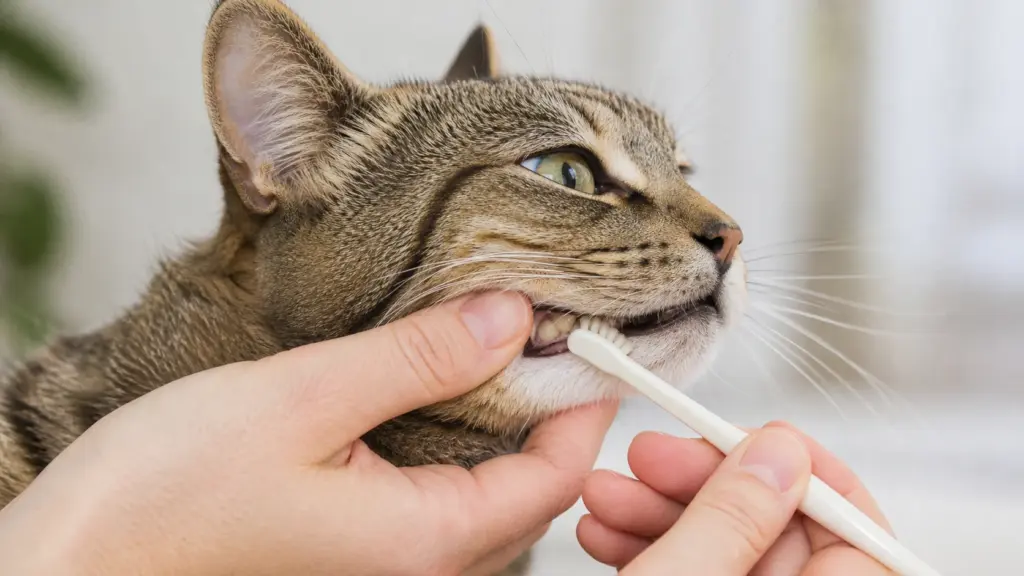
You do not need to open the jaws. The goal is access to the outside surfaces, where plaque control is most practical. Cornell notes that brushing the outside surfaces is sufficient because the tongue helps clean the inner surfaces.
If your cat previously accepted face handling but suddenly refuses it, consider pain rather than assuming stubbornness. Pause and ask your veterinarian if other dental signs are present.
Stage 3: Introduce brief brush contact
Put the recommended amount of feline toothpaste on the brush. Lift the lip gently and touch one accessible outer tooth for a moment. Reward and stop.
As acceptance improves, make a few gentle strokes along the tooth and gumline. Hold the brush at an angle that lets the bristles reach the narrow margin where tooth meets gum, but do not press hard enough to irritate tissue.
The first accepted contact may last only a second. That is still useful training. Repeatedly exceeding your cat’s tolerance can undo progress.
Stage 4: Build toward a repeatable routine
Gradually reach more of the upper and lower outer tooth surfaces, especially the cheek teeth where plaque accumulates. Keep movements gentle and controlled. You do not need to brush the chewing surfaces aggressively or force access to the inside surfaces.
Daily brushing provides the most consistent plaque disruption, but frequency should never override safety. If your cat’s mouth is healthy yet daily brushing is not currently achievable, discuss the most useful combination of accepted brushing and supplemental products with your veterinarian.
Stop brushing and seek advice if you see bleeding that is more than slight incidental irritation, worsening redness, swelling, a damaged tooth, or a pain response.
Step 3: Choose Supplemental Dental Products Carefully
Dental treats, diets, water additives, gels, sprays, toothpastes, and powders can be useful, but the package phrase “dental care” is not evidence by itself.
The Veterinary Oral Health Council reviews submitted product data against its standards and awards a seal for a specific plaque claim, tartar claim, or both. VOHC does not personally test every product, and a seal does not mean the product diagnoses or treats dental disease. Check the current cat list and match the exact product, size, and claim.
Dental treats
Dental treats may help when their size and texture encourage appropriate chewing. They still add calories and may not suit a cat with mouth pain, food allergy, obesity, diabetes, gastrointestinal sensitivity, or a prescription diet.
Watch your cat eat the treat. If it is swallowed whole, repeatedly vomited, or difficult to chew, stop and discuss alternatives. A treat cannot clean every tooth surface, and it should not be given to a cat that is struggling to eat.
For a focused comparison, see our guide to the best cat dental treats. Use that page for product selection; use this article for the complete home-care routine.
Dental diets
Some dental diets use kibble structure or other features intended to help control plaque or tartar. A dental diet is not simply any dry food. Ordinary kibble should not be assumed to brush a cat’s teeth.
Diet selection must account for the whole cat. A veterinary dental diet may conflict with another nutritional need, and changing food abruptly can cause refusal or digestive upset. Ask your veterinarian before replacing a prescribed or medically important diet.
Our indoor cat diet guide explains broader feeding considerations, but individual medical diets should be managed with your veterinarian.
Water additives
A water additive may reduce handling, but it is only useful if the cat continues to drink normally. Use a feline-appropriate product exactly as labeled. Maintain plain-water access if advised by your veterinarian and monitor drinking after any change.
Stop using an additive if your cat avoids the water, drinks noticeably less, vomits, or develops another concerning response. Hydration is more important than continuing a product the cat rejects.
Gels, sprays, toothpastes, and powders
These products have different active ingredients and evidence. Do not treat them as interchangeable. Check whether the exact product appears on the current VOHC cat list and whether its claim is for plaque, tartar, or both.
Introduce one new product at a time. This makes it easier to identify the cause if appetite, stool, vomiting, or water intake changes. Tell your veterinarian about all oral-care products, especially if your cat takes medication or follows a restricted diet.
A simple product decision checklist
Before buying, ask:
- Is the exact product intended for cats?
- What specific outcome does it claim—plaque, tartar, or only breath freshness?
- Is the exact product currently listed by VOHC?
- Can my cat use it without pain or distress?
- Does it change calories, water intake, or an important diet?
- Can I follow the label consistently?
- What will tell me to stop?
Choose the smallest routine you can perform reliably. A safe brush plus one suitable supplement is often more practical than several products used inconsistently.
Step 4: Include Veterinary Dental Care
At-home observation cannot establish that the mouth is disease-free. Your veterinarian can examine the visible mouth during routine care and recommend the timing of a more complete dental assessment based on age, findings, history, symptoms, and individual health—not a universal online schedule.
What an awake oral examination can show
An awake examination may reveal:
- gum redness or bleeding;
- visible plaque and calculus;
- a fractured or discolored crown;
- missing teeth;
- oral swelling or a visible mass;
- pain or resistance during gentle examination;
- an obvious bite or jaw abnormality.
It remains a preliminary assessment. A cooperative cat cannot explain which tooth hurts, and much of each tooth lies below the gumline.
Why anesthesia and dental radiographs matter
During a complete dental procedure, anesthesia allows the veterinary team to protect the airway, monitor the patient, examine all tooth surfaces, probe around the teeth, clean below the gumline, and obtain diagnostic images without causing fear or sudden movement.
Dental radiographs can reveal root and bone disease that is invisible from the crown. They are particularly important for feline tooth resorption and for evaluating missing, fractured, or questionable teeth.
Anesthesia has risks, so veterinary teams assess each cat individually and plan monitoring and support accordingly. Chronological age alone does not determine whether a medically indicated procedure should be rejected. Discuss your cat’s examination, laboratory evaluation, medications, health conditions, anesthetic plan, pain control, monitoring, and recovery with the clinic.
Why anesthesia-free scaling is not an equivalent alternative
Removing visible calculus from an awake cat may make the crowns look cleaner without addressing disease beneath the gumline. It also prevents a complete protected-airway procedure, thorough probing, and full-mouth radiography. AAHA describes anesthesia-free dentistry as unacceptable because it does not provide equivalent safety or diagnostic and treatment capability.
Do not scrape tartar at home with metal tools. Slips can injure gums or enamel, and a cosmetic result can create false reassurance while painful disease remains.
For broader preventive planning, see our annual vet visit for an indoor cat guide.
Common Feline Dental Problems Home Care Cannot Fix
Understanding the limits of home care helps you act sooner.
Gingivitis
Gingivitis is inflammation of the gums. The gumline may look red, swollen, or prone to bleeding. Plaque control is important for prevention, but brushing a severely inflamed mouth can hurt. A veterinarian should determine severity and possible causes before you intensify home care.
Periodontitis
Periodontitis affects the supporting tissues around teeth and can create pockets, attachment loss, infection, mobility, and pain. Diagnosis requires more than looking at the visible crown. Professional assessment, dental radiographs, and treatment may be necessary.
Tooth resorption
Tooth resorption is especially important in cats. Tooth structure breaks down, and visible changes may not show the full lesion. It can cause pain, drooling, eating changes, or a sudden reaction when a particular tooth is touched. Toothpaste, treats, and brushing cannot reverse it.
Fractured teeth
A broken crown can expose sensitive or infected tissue. Do not wait for the cat to stop eating, and do not cover the tooth with a home remedy. Veterinary examination and dental imaging determine the appropriate treatment.
Gingivostomatitis and oral masses
Severe widespread oral inflammation and oral tumors require veterinary diagnosis. Red tissue, ulcers, marked drooling, bleeding, difficulty eating, facial asymmetry, or an oral growth should not be managed as routine plaque at home.
What Not to Use on Cat Teeth
Avoid the following unless a veterinarian has given a specific feline instruction:
- human toothpaste;
- baking soda mixtures;
- hydrogen peroxide;
- essential oils;
- alcohol-based mouthwash;
- bleach, disinfectants, or household cleaners;
- sharp dental scalers or scraping tools;
- human electric dental devices;
- very hard objects offered as “natural toothbrushes”;
- unverified products that promise to dissolve disease or eliminate the need for veterinary care.
Do not use a fingernail test or a social-media claim as the sole safety standard for a chew. Cats differ in chewing behavior and dental condition. If you are uncertain about a chew, ask your veterinarian and check whether the exact dental product has evidence for cats.
What If Your Cat Refuses Toothbrushing?
Refusal is information, not disobedience. The mouth may hurt, the training step may be too difficult, the flavor may be unpleasant, or the restraint may feel threatening.
First, check for warning signs. If refusal is new or accompanies bad breath, drooling, appetite change, food dropping, or face sensitivity, arrange an examination rather than repeatedly attempting to brush.
If the mouth has been assessed and brushing is appropriate, return to the last comfortable stage:
- allow the cat to approach the supplies;
- reward a cheek touch;
- offer feline toothpaste without brushing;
- touch one outer tooth briefly;
- end before avoidance escalates.
Change only one variable at a time. You might try a smaller brush, another feline toothpaste flavor, a different position, or a quieter location. Do not turn each attempt into a long handling session.
Some cats will not accept meaningful brushing despite careful training. Ask your veterinarian to prioritize alternatives using the cat’s dental findings, diet, weight, medical conditions, and temperament. The backup plan may include an accepted amount of brushing, an appropriate VOHC-accepted product, regular monitoring, and professional care when indicated.
A Practical Indoor Cat Dental Routine
Apartment living can make dental training easier because supplies and rewards can stay in one predictable location. It can also make avoidance stronger if every encounter in a small home becomes a brushing attempt.
Use these principles:
- Keep supplies stored safely but bring them out during calm, predictable sessions.
- Use one location with stable footing and an easy exit.
- Keep training separate from medication and grooming when possible.
- Record meaningful changes in breath, chewing, appetite, drooling, or tolerance.
- Check product calories and account for rewards in daily food intake.
- Wash food and water bowls regularly, but do not mistake bowl cleaning for dental plaque control.
- Recheck the plan with your veterinarian when the cat’s health, diet, medication, or dental findings change.
Consistency means repeating a tolerable process, not forcing perfection. The routine should remain safe enough that you can notice a genuine change instead of attributing all resistance to personality.
Frequently Asked Questions
How often should I brush my cat’s teeth?
Daily brushing offers the most consistent plaque control when a healthy cat accepts it. Introduce it gradually and ask your veterinarian what is realistic for your cat. Do not brush through pain, significant inflammation, bleeding, or a suspected damaged tooth.
Can I clean my cat’s teeth at home without a veterinarian?
You can provide preventive plaque control at home, but you cannot perform a complete dental cleaning or diagnose disease below the gumline. Established calculus, periodontal disease, tooth resorption, fractures, and oral masses require veterinary assessment.
Can I use human toothpaste on my cat?
No. Cats swallow toothpaste, and human toothpaste is not intended for feline ingestion. Use a product specifically labeled for cats and follow the instructions.
Do I need to brush the inside surfaces of my cat’s teeth?
Cornell’s brushing guidance says it is necessary to brush only the outside surfaces because the tongue helps clean the inside surfaces. Focus gentle brushing along the accessible outer gumline without forcing the jaws open.
Are dental treats enough for cat dental care at home?
No. A suitable dental treat may supplement plaque or tartar control, but it cannot examine the mouth, clean every tooth surface, remove disease below the gumline, or treat a painful tooth. Match the exact product to its current VOHC claim and use it as part of a broader plan.
Does dry food clean a cat’s teeth?
Ordinary dry food should not be assumed to clean teeth. Certain formulated dental diets have evidence for specific plaque or tartar claims, but the exact product and feeding plan matter. A cat can develop dental disease while eating wet food, ordinary kibble, or both.
What does a VOHC seal mean?
It means VOHC reviewed submitted data and accepted the exact product for its stated plaque claim, tartar claim, or both when used as directed. It does not mean the product treats all dental disease or replaces veterinary examinations.
Why does my cat’s breath smell bad?
Persistent bad breath can accompany dental disease, but odor alone does not identify the cause. If it is new, strong, or associated with gum redness, drooling, eating changes, weight loss, or illness, arrange veterinary evaluation.
Is it too late to start brushing a senior cat’s teeth?
Age alone does not make brushing impossible, but a senior cat should be evaluated for existing pain and disease before a new routine begins. After treatment or examination, introduce handling gradually and use the plan your veterinarian recommends.
Is anesthesia-free dental cleaning safer?
AAHA does not consider anesthesia-free dentistry an acceptable substitute for a complete dental procedure. It cannot provide the same protected airway, examination below the gumline, dental radiographs, cleaning, or treatment. Anesthetic planning should be individualized for the cat.
When is a dental problem urgent?
Seek prompt veterinary guidance when a cat stops eating, appears unable to eat, has facial swelling, active oral bleeding, trauma, marked pain, or rapid decline. Also arrange an examination for persistent bad breath with inflamed gums, repeated drooling, food dropping, or other progressive changes.
Final Thoughts
Effective cat dental care at home has clear limits. Begin only when the mouth is comfortable enough for preventive care, introduce feline toothpaste and brushing gradually, and select supplemental products for a specific evidence-based purpose. Never use home scraping or cosmetic cleaning to replace diagnosis.
The most useful routine is one that helps you control plaque while remaining alert to pain. If eating, breath, gums, drooling, facial appearance, or brushing tolerance changes, pause the routine and contact your veterinarian. Early recognition and appropriate veterinary dentistry matter more than achieving a perfect-looking set of teeth at home.
References
- American Animal Hospital Association. 2019 AAHA Dental Care Guidelines for Dogs and Cats. https://www.aaha.org/resources/2019-aaha-dental-care-guidelines-for-dogs-and-cats/
- American Animal Hospital Association. Anesthesia, Sedation, and Analgesia Considerations. https://www.aaha.org/resources/2019-aaha-dental-care-guidelines-for-dogs-and-cats/key-points/
- American Animal Hospital Association. Essential Steps of Dental Cleaning and Therapy. https://www.aaha.org/resources/2019-aaha-dental-care-guidelines-for-dogs-and-cats/essential-steps/
- Cornell University College of Veterinary Medicine, Feline Health Center. Feline Dental Disease. https://www.vet.cornell.edu/departments-centers-and-institutes/cornell-feline-health-center/health-information/feline-health-topics/feline-dental-disease
- Cornell University College of Veterinary Medicine, Feline Health Center. Tooth Resorption. https://www.vet.cornell.edu/departments-centers-and-institutes/cornell-feline-health-center/health-information/feline-health-topics/tooth-resorption
- Veterinary Oral Health Council. Accepted Products for Cats. https://vohc.org/accepted-products/
- Veterinary Oral Health Council. What Does the VOHC Do? https://vohc.org/