.png)
Introduction: Choosing Reliable Care While You Are Away
Before a trip, compare the cat’s needs with the actual care each option can provide. A familiar home may reduce disruption, but a reliable visit and emergency plan are essential.
A boarding facility and a pet sitter can both sound reassuring on paper. Ask about staffing, visit frequency, medications, emergency response, and backup coverage before deciding.
The central question is which option fits this cat’s medical needs, home routine, stress responses, and access to reliable care.
That is the heart of the cat boarding vs pet sitter decision. Some cats do better at home with a sitter. Some cats are safer in a staffed boarding or veterinary facility. The right answer depends on your cat’s medical needs, stress level, medication schedule, social confidence, and the reliability of the person or facility caring for them.
Quick Answer: Which is Better, Cat Boarding or a Pet Sitter?
For most healthy indoor cats, a reliable pet sitter is usually the better choice because your cat can stay in familiar territory with the same litter box, food station, hiding spots, smells, and daily rhythm.
If your cat needs insulin, fluids, frequent medication, monitoring, or post-surgery care, ask the treating veterinarian what qualifications and supervision the caregiver must provide. Veterinary boarding, a trained sitter, or another arrangement may fit; confirm the actual staffing and emergency plan. Boarding may also make sense when no reliable in-home caregiver or backup is available.
The best cat boarding vs pet sitter decision is not just about price. It should come down to your cat’s medical needs, stress level, history with travel, sitter reliability, facility hygiene, emergency planning, and how long you will be gone.
Important Care Note
This guide is for planning vacation or travel care, not for diagnosing illness or replacing veterinary advice. If your cat has diabetes, kidney disease, urinary blockage history, heart disease, seizures, severe anxiety, recent surgery, appetite problems, or medication needs, ask your veterinarian whether boarding, a pet sitter, or veterinary boarding is safest. Any caregiver should know when to call a veterinarian, especially if your cat refuses food, does not urinate, hides unusually, vomits repeatedly, pants, collapses, or seems painful.
-1024x576.png)
Table of Contents
Why Staying Home Often Feels Safer to Indoor Cats
Your cat does not experience your vacation the way you do. You are thinking about flights, hotels, and packing. Your cat is thinking, in their own cat way, about routine, scent, food timing, litter box access, quiet hiding places, and whether the apartment still feels predictable.
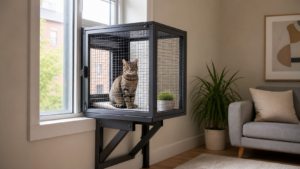
That is why many indoor cats do better at home with a sitter. Their familiar rooms still smell right. Their litter box is where it always is. Their bed, window perch, scratching post, and hiding spots are unchanged. For a cat who depends on routine, that stability matters.
Boarding changes more variables at once: carrier travel, unfamiliar smells, other animals, different sounds, new people, and a new room. Some cats handle that well. Others hide, vocalize, stop eating, or come home unsettled.
This does not mean boarding is bad. It means the cat boarding vs pet sitter decision should start with your cat’s stress level, medical needs, and ability to cope with change.
Compare these three factors first:
Reliability: Do you have a sitter or facility you genuinely trust to notice problems and act quickly?
Familiar territory: Does your cat feel safer in their own rooms, or have they boarded calmly before?
Care complexity: Does your cat need medication, injections, fluids, appetite monitoring, or special handling?
Cat Boarding: Pros and Cons
Boarding is not automatically wrong. A clean, quiet, cat-focused facility can be the safer choice for some cats, especially when medical monitoring matters or when home care would be unreliable.
The hard part is transport and adjustment. If your cat panics in the carrier, hides for days after vet visits, or refuses food in new places, boarding may be stressful even when the facility is good. For anxious cats, use a secure, easy-load carrier and review our guide to the best cat carriers for nervous cats before the drop-off.
When Boarding May Be Better
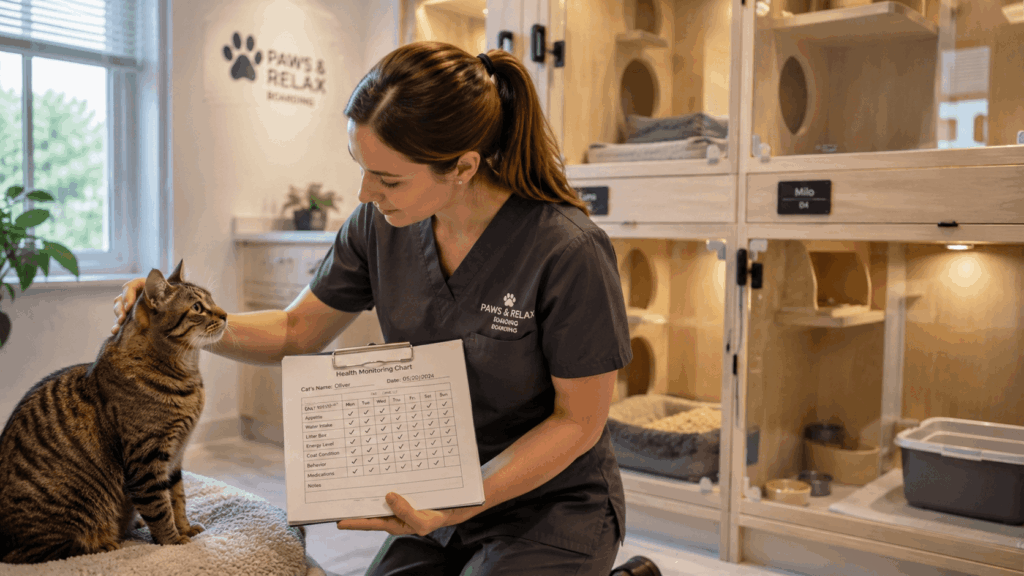
A veterinary boarding facility may offer closer medical monitoring if staff are actually present and qualified to provide the needed care. Ask whether staff remain onsite overnight, who administers medications, and how emergencies are handled. Do not assume an ordinary boarding facility provides continuous clinical supervision.
- Medically complex cats — ask the treating veterinarian which setting can reliably meet this cat’s medication and monitoring needs. Verify the caregiver’s skills, onsite hours, and emergency plan; veterinary boarding does not automatically mean continuous observation.
- Emergency response capacity — ask who checks the cat, how often, whether staff are onsite overnight, and how they contact a veterinarian if a problem is noticed.
- Multi-cat households with conflict — sometimes, separating bonded-but-conflicted cats during an owner’s absence is genuinely the safer option
- Security — no apartment access risk, no concerns about key management or stranger entry
When Boarding May Be Harder on Cats
Medical needs can change the decision:
Sharing a facility with other cats can create opportunities for respiratory infection. Ask about vaccination requirements, separation of sick cats, cleaning, ventilation, and what happens if your cat develops symptoms. Discuss your individual cat’s health risks with a veterinarian; do not assume that either boarding or home care is infection-free.
The additional clinical risks of boarding:
- Dermatophytosis (ringworm) transmission in facilities with inadequate surface decontamination protocols
- Feline Panleukopenia in facilities not verifying vaccination status rigorously
- Urinary signs in a susceptible cat — a change in environment may be stressful. If a cat strains to urinate or produces little or no urine, caregivers should seek urgent veterinary advice rather than assuming the cause is stress.
- Reduced appetite — ask the caregiver to record each meal and promptly contact you and a veterinarian if the cat eats little or nothing. Do not treat 24–72 hours without food as a normal adjustment period; Cornell Feline Health Center advises prompt veterinary consultation when a cat stops eating.
The Boarding Comparison Table
| What to verify | Ask the facility | Why it matters |
|---|---|---|
| Staffing | Who is onsite overnight, and how often is each cat checked? | Staff presence and check frequency vary. |
| Medical care | Who administers medication, and what is the veterinary emergency plan? | Boarding is not automatically medical supervision. |
| Infection control | How are sick cats separated and enclosures cleaned? | Practices vary by facility. |
| Appetite monitoring | Are meals recorded, and when will you contact me if my cat does not eat? | Loss of appetite needs prompt attention. |
| Cost | What is included in the written quote? | Rates and add-on fees vary. |
Pet Sitters: Pros and Cons
A pet sitter keeps your cat in the place that already feels like home. That is the biggest advantage. Your cat does not have to travel, adjust to a new room, hear unfamiliar animals, or rebuild their sense of safety from scratch.
But a sitter is only as good as the plan. One quick visit a day may not be enough for cats who need medication, careful appetite checks, fresh wet food, multiple litter boxes, or social interaction. The home setting is calmer, but it still needs structure.
When a Pet Sitter May Be Better
- Scent Map preservation — your cat remains in the environment their entire stress-management system is calibrated to
- Routine continuity — feeding times, play sessions, and environmental rhythms can be maintained with precision
- Less change in environment — staying home avoids travel and shared boarding spaces, but caregiver hygiene and an illness plan still matter
- Behavioral baseline visibility — a good sitter who knows your cat will notice deviations from normal behavior that indicate early illness
- Familiar surroundings — a familiar setting may help some cats keep their usual routines, although individual responses vary
When a Pet Sitter May Not Be Enough
- Visit frequency gaps — a sitter visiting once daily leaves 23 hours of unsupervised time. For a cat who develops acute urinary obstruction, respiratory distress, or toxic ingestion during that gap, the delay in detection is clinically serious.
- Security considerations — you are providing apartment access to another person, which introduces both practical and security variables
- Sitter reliability — a pet sitter who cancels, is delayed, or handles an emergency carelessly cannot be replaced mid-visit with the immediacy that a staffed facility allows
- Isolation risk — cats vary in how much interaction they need. Arrange adequate visits and enrichment for a cat that seeks social contact.
- Inadequate hydration management — a cat whose water bowl empties between once-daily visits faces a genuine dehydration risk. This is why, if you are using a once-daily visit schedule, a high-capacity fountain can add a useful backup layer. Compare size, cleaning, noise, and reliability in our guide to the best cat water fountains.
The Pet Sitter Comparison Table
| Question | More frequent visits | Less frequent visits |
|---|---|---|
| Food, water, and litter | More opportunities to check and replenish. | Longer gaps between checks; backup supplies do not replace monitoring. |
| Illness or injury | Changes may be noticed sooner. | Changes may go unnoticed longer. |
| Medication | Schedule must match the prescription. | May not suit the prescribed schedule. |
| Social needs | More opportunities for interaction. | Assess the individual cat. |
| Cost | Request a current written quote. | Request a current written quote. |
5 Practical Tips for Choosing the Right Option
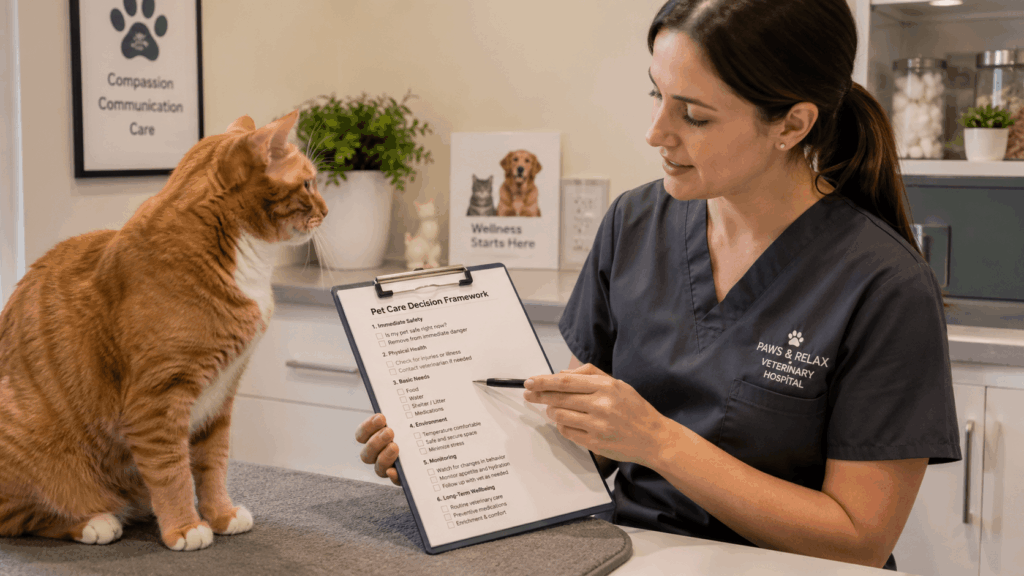
Tip 1: Assess Medical Complexity First
This is the non-negotiable first filter in the cat boarding vs pet sitter analysis, and it should resolve the question for a significant percentage of cats before any other factor is considered.
Ask your veterinarian to help choose a qualified care setting if your cat:
- Requires insulin injections on a fixed schedule
- Is on subcutaneous fluid therapy
- Is recovering from surgery and needs monitoring or medication
- Has a history of urinary obstruction (requires immediate intervention if recurrence occurs)
- Is managing hyperthyroidism, kidney disease, or diabetes with recent medication changes
- Has a seizure disorder and needs a medication and emergency plan
Home care may be suitable if a reliable sitter can meet your cat’s needs; confirm the plan with a veterinarian when illness or medication is involved:
- Is healthy with no active medical conditions
- Takes no medications or takes once-daily oral medications a sitter can administer
- Has a stable chronic condition only if the caregiver can follow the veterinary care plan and recognize when to seek help
For a medically complex cat, ask the treating veterinarian whether veterinary boarding, a trained sitter, or another supervised plan best meets medication and monitoring needs. General boarding is not the same as veterinary care, and no arrangement removes every emergency risk.
Tip 2: Evaluate Your Cat’s Individual Stress Threshold
Not all cats experience territorial displacement with the same intensity, and understanding your individual cat’s stress phenotype should directly inform the cat boarding vs pet sitter decision.
Signs your cat has a HIGH stress threshold (boarding may be tolerable):
- Readily explores novel environments without extended hiding behavior
- Resumes normal behavior and eating after prior visits, without a concerning loss of appetite
- Has previously boarded without significant behavioral or health sequelae
- Is socialized to strangers and does not hide during guest visits
- Has previously adjusted well to supervised changes in setting
Signs your cat has a LOW stress threshold (strongly favor pet sitter):
- Hides for extended periods after any environmental change
- Has a history of stress-induced cystitis or URI following stressors
- Refuses food during vet visits or after any novel experience
- Is a single-owner cat with limited socialization history
- Has age-related health or mobility needs that require an individualized care plan
- Has a diagnosed anxiety disorder or is on behavioral medication
A cat that becomes very distressed by changes in place may do better at home if reliable visits can meet its feeding, medication, and safety needs. Discuss individual medical needs with the cat’s veterinarian.
Tip 3: Make the Apartment Safe Before You Leave
If you choose a pet sitter, prepare the apartment as if your cat will have more unsupervised time than usual, because they will. The goal is to make the boring choice the safe choice: food reachable, water stable, litter clean, windows secure, and no easy way to slip out.
Once you choose in-home care, use this complete weekend care checklist to plan visit frequency, backup food and water, litter care, and emergency instructions.
Before you leave, check these things:
- Use a key lockbox (combination style, mounted near your door) rather than providing a physical key copy — allows code changes between sitters and eliminates lost key risk
- Confirm your building’s guest access policy — some buildings require advance registration of regular visitors
- Identify and secure all potential escape routes: check all window screens for tears or loose frames, confirm balcony door latches are functional
- Remove or secure all household toxins — cleaning products, medications, certain plants — that a cat might access during unsupervised periods between visits
- Audit all potential hiding spots that could become dangerous: open washing machines, dryers, refrigerator gaps, spaces behind large appliances
- Install a smart lock or camera (with appropriate disclosure to your sitter) to monitor entry and exit timing
Tip 4: Ask Specific Hygiene Questions
Hygiene matters for both boarding and pet sitting, but the questions are different. A good caregiver should be able to explain what they clean, when they clean it, and what they do if a cat looks sick.
For boarding facilities, ask about vaccination requirements, ventilation, cleaning between cats, isolation for sick cats, and emergency vet access.
For pet sitters, ask whether they visit other cats the same day, how they clean their hands or tools between homes, whether they can give medication, and what signs would make them contact you or a veterinarian.
If someone gives vague answers or seems annoyed by basic safety questions, that is useful information. You are not being difficult; you are choosing care for an animal who cannot explain when something is wrong.
Tip 5: Write the Emergency Plan Before You Travel
The emergency plan should be written before you leave, not invented from an airport gate while your sitter is texting you that something seems off.
Give your sitter or boarding facility your phone number, travel location, primary vet, nearest emergency vet, medication instructions, feeding routine, and permission rules for urgent care. If your building has alarms, power outages, elevator issues, or evacuation risks, also share your apartment cat emergency evacuation plan.
Arrange a local backup person who can enter the apartment if the sitter becomes ill, is delayed, or cannot complete a visit. Give both caregivers clear instructions and emergency contacts.
A pet camera can help you confirm that your cat is eating, moving, and using normal resting spots between visits. It should support sitter care, not replace it. If you want one, compare features in our guide to the best pet camera for cats.
- Confirm your cat is eating and moving normally between sitter visits
- Verify sitter arrival and departure times
- Identify early behavioral signs of distress (hiding, abnormal posture, lack of movement)
3 Questions to Ask Your Sitter or Boarding Facility
Reviews are helpful, but they do not tell you how someone will respond when your cat refuses food, hides, misses medication, or seems unwell. These three questions reveal more than a polished website.
Question 1: “What would you do if my cat stops eating?”
What a good answer looks like:
The caregiver records meals, contacts you promptly when the cat eats little or nothing, checks for other concerning signs, and follows the veterinary contact plan without waiting for a fixed 24-hour threshold. If a cat is not eating, Cornell Feline Health Center recommends prompt veterinary consultation.
A red flag answer:
“I’d try a different food” or “Cats sometimes just don’t eat when their owners are away.” These responses indicate a fundamental misunderstanding of feline anorexia risk that should disqualify the candidate.
Question 2: “Can you describe what a cat in respiratory distress looks like?”
What a good answer looks like:
Open-mouth breathing, flank heaving, blue-tinged gums, extended neck posture, labored or audible breathing at rest, or rapid shallow breath rate. They should identify this as an emergency requiring immediate veterinary contact, not observation.
A red flag answer:
Uncertainty, vagueness, or “I’d Google it.” A pet sitter working with cats should have basic feline emergency recognition competence before they are entrusted with unsupervised access to your animal.
Question 3: “What is your protocol if you cannot make a scheduled visit?”
What a good answer looks like:
A specific backup system — a colleague, a partner, a designated substitute sitter who already has your information and can cover immediately. They should never leave a cat unvisited beyond the agreed schedule without your explicit knowledge and consent, and their backup should be a named individual you can verify.
A red flag answer:
“That hasn’t happened” or “I’d let you know as soon as possible.” The absence of a specific, pre-arranged backup protocol is a significant operational vulnerability that the cat boarding vs pet sitter decision should account for.
Frequently Asked Questions
1. How often should a cat sitter visit?
For a healthy adult cat, arrange visits often enough to provide meals, fresh water, litter-box checks, interaction, and a prompt response to problems. Many owners choose at least two visits daily; ask a veterinarian about a cat with medical needs. Do not treat a fixed 10–12-hour gap as a medical guarantee.
Choose visit frequency around the cat’s feeding, medication, litter, social, and health needs—not a universal trip-length rule. Automatic feeders and fountains can be backups, but a person still needs to confirm that the cat is eating and behaving normally. Ask the veterinarian about any cat with medical needs, and arrange a reliable backup caregiver.
2. Is boarding too stressful for an indoor cat?
Some indoor cats find transport and a new setting stressful, especially if they have previously struggled with change. Others may settle well in a suitable facility. Observe the individual cat’s history rather than assuming one response for most cats.
Stress can affect some cats, but this article does not have evidence for a predictable cortisol difference between boarding and home care or for a guaranteed illness outcome. Ask the facility about quiet housing, routine, monitoring, and veterinary access; discuss a cat with a history of urinary or respiratory illness with its veterinarian.
However, “too stressful” is not universal — cats with high stress thresholds, previous positive boarding exposure, and robust baseline health may tolerate quality boarding facilities without significant sequelae. The cat boarding vs pet sitter decision should always be individualized based on your specific cat’s behavioral and medical profile rather than general assumptions.
3. Is a pet sitter safe if they only visit once a day?
A once-daily pet sitter may be enough for some healthy, low-stress adult cats on short trips, but twice-daily visits are safer for many indoor cats. More frequent visits make it easier to monitor appetite, water intake, litter box use, medication needs, and behavior changes. If your cat is senior, medically fragile, anxious, on medication, or prone to urinary issues, ask your veterinarian whether once-daily care is enough.
4. What should I leave for a cat sitter before traveling?
Leave written feeding instructions, medication details, your veterinarian’s contact information, an emergency contact with apartment access, your cat’s hiding places, litter box routine, microchip information, and permission instructions for urgent veterinary care. Also leave your carrier location, go-bag location, and apartment emergency plan so the sitter knows what to do during alarms, leaks, power outages, or building evacuation.
5. What is the average cost of a cat sitter vs boarding?
The cost comparison in the cat boarding vs pet sitter analysis varies significantly by market, visit frequency, facility type, and medical needs, but common ranges include:
Pet Sitter:
- Once-daily visit: $15–$30 per visit ($15–$30/day)
- Twice-daily visits: $25–$50 per day
- Overnight stay in your home: $60–$120 per night
- Premium/vet-tech certified sitters: $40–$80 per visit
Boarding:
- Standard cattery: $20–$45 per night
- Luxury cat hotel/suite: $35–$85 per night
- Veterinary clinic boarding: $30–$65 per night
- Add-ons (medication administration, playtime sessions): $5–$20 per service
For a 5-day trip, total costs typically range from $75–$250 for a once-daily pet sitter to $100–$425 for boarding, depending on market and facility quality. Potential follow-up costs, such as veterinary care after illness, appetite loss, urinary signs, or severe stress, should also be considered when comparing options.
Ask each provider for a current written quote and an emergency-care plan; do not assume that either option prevents veterinary costs.
Final Thoughts
When someone asks about cat boarding vs pet sitter care, the first answer should be: tell me about the cat.
A confident, medically stable cat with previous boarding experience may do well in a clean, quiet facility. A territorial indoor cat who depends on familiar rooms, litter box location, scent, and routine may do better with a reliable sitter at home. A diabetic cat, post-surgery cat, or medically fragile senior may need veterinary boarding or a caregiver with specific medical experience.
The best choice is the one that protects your cat’s health, keeps stress as low as realistically possible, and gives the caregiver a clear plan for food, water, litter, medication, emergency contacts, and vet decisions.
The guilt you feel before leaving is normal. Use it productively. Ask better questions, write clearer instructions, check the apartment, and choose the option that fits your actual cat, not the option that sounds best in theory.
References
1.Stella, J. L., Lord, L. K., & Buffington, C. A. T. (2011). Sickness behaviors in response to unusual external events in healthy cats and cats with feline interstitial cystitis. Journal of the American Veterinary Medical Association, 238(1), 67–73.
2.Rodan, I., Sundahl, E., Carney, H., Gagnon, A. C., Heath, S., Landsberg, G., Seksel, K., & Yin, S. (2011). AAFP and ISFM Feline-Friendly Handling Guidelines. Journal of Feline Medicine and Surgery, 13(5), 364–375.
3.American Association of Feline Practitioners and International Society of Feline Medicine. Feline-Friendly Handling Guidelines. https://doi.org/10.1016/j.jfms.2011.03.012
4.American Veterinary Medical Association. Selecting a pet sitter. https://www.avma.org/resources-tools/pet-owners/petcare/selecting-pet-sitter
5.International Cat Care. Stress in cats. https://icatcare.org/advice/stress-in-cats/