.png)
To feed multiple cats separately in a small apartment, give each cat a measured portion in a place another cat cannot easily interrupt. A closed interior door is often the simplest supervised option. Selective-access feeders can help some households, but they need training and observation; a timer alone does not identify which cat eats.
Start with what you can observe: who approaches first, who pauses or leaves, and whose food disappears. A shared feeding area does not prove a problem, but an empty bowl does not prove its intended cat ate. This guide compares five practical approaches without relying on a personal foster story or claiming clinical testing.
-1024x576.png)
Quick Answer: Separate Access, Then Measure Intake
- Label portions for each cat before serving.
- Set up the locations before bringing food out.
- Watch the first meals from a distance without making either cat feel trapped.
- Record leftovers and any attempts to reach the other bowl.
- Adjust the arrangement to the cats, rather than expecting one distance or device to work for every household.
Why Shared Meals Can Be Hard to Interpret
One cat may eat quickly, another may return for smaller amounts, and a third may hesitate near a doorway. Watch for blocking, staring, displacement, or leaving food when the other cat approaches. These observations are more useful than assuming a dominance hierarchy or estimating stress hormones from behavior.
The FelineVMA environmental-needs guidance recommends separated resources and comfortable access. For a broader layout, see multi-cat apartment living. Persistent appetite or weight changes need a veterinary assessment, not only a different bowl position.
Five Ways to Feed Cats Separately
1. Use separate rooms with closed doors
Put one feeding station in a quiet room and the other outside it, with both cats already comfortable in their spaces. Close the door for the meal, check both cats, and collect leftovers before reopening it. This gives a clear physical boundary and lets you see who ate each portion.
Do not use a bathroom if a noisy appliance, cleaning chemicals, or a frightening confinement experience makes the cat avoid food. For longer separation, provide necessary resources and monitor comfort. A cat refusing food behind the door needs a revised plan; do not wait for hunger to overcome distress.
2. Create separate zones and supervise
In a studio, furniture or a stable screen can break the direct view between bowls. Leave comfortable approach and exit routes. Stay nearby to prevent access to the other portion without chasing, startling, or physically crowding either cat.
A screen is not a secure barrier: a cat can walk around it. Use this for cats whose observed behavior allows supervised separation, not as reliable protection for incompatible diets. If blocking continues, review resource guarding and consider a more complete boundary.
3. Use different heights only when both cats can eat comfortably
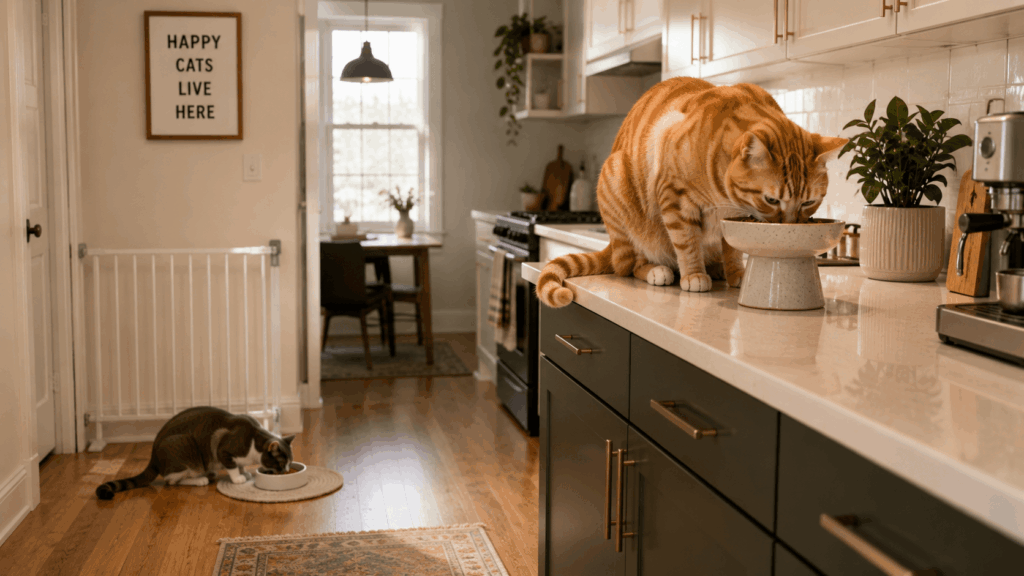
A stable, accessible platform can create another location, but height does not identify a cat or guarantee separation. Both cats may reach it. Avoid narrow counters, hot cooking areas, unstable furniture, and difficult jumps. Keep an easy floor-level option for a cat with mobility limitations.
Test access while you are present and stop if a cat slips, hesitates, or appears uncomfortable. Do not interpret the higher station as a necessary status privilege; choose locations for safe access and actual meal behavior.
4. Consider a microchip or collar-tag access feeder
Selective-access feeders recognize an enrolled identifier; timed feeders simply release food on a schedule. Our microchip feeder guide and automatic feeder guide cover different jobs and should not be treated as interchangeable.
Introduce the device gradually using its training instructions. Check whether the intended cat enters willingly, whether another cat crowds alongside, and whether the lid or placement causes hesitation. The SureFeed manufacturer manual explicitly does not guarantee exclusion of every other pet in every circumstance. Verify the exact model rather than assuming all smart feeders control access.
If a prescribed diet must be kept separate, ask the veterinarian how strict that separation needs to be and what to do after accidental sharing. See prescription-diet feeder considerations. A device does not remove the need to monitor intake and access.
5. Slow a fast eater without mistaking it for separation
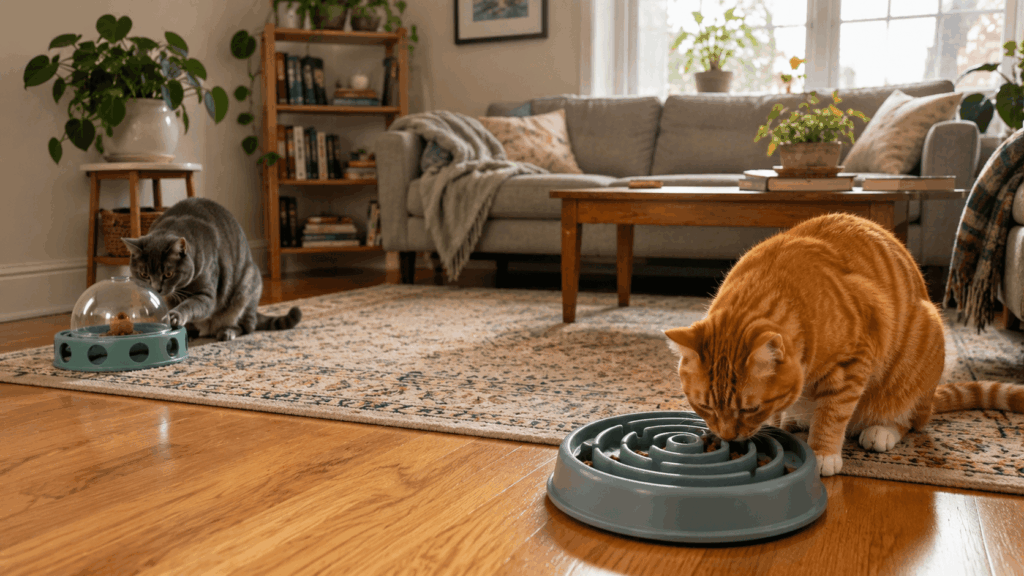
An appropriate puzzle or slow bowl may extend a meal, but it cannot stop that cat leaving to take another portion. Begin with an easy task, confirm the cat can obtain enough food, and keep the other feeding station protected.
Compare cat puzzle feeders or slow feeder bowls for suitable size and cleaning access. If food theft continues, use the troubleshooting steps for one cat stealing another cat’s food rather than making the puzzle harder and harder.
Choose the Method by the Problem
| Situation | Useful starting point | Limit to check |
|---|---|---|
| One cat finishes first and visits the other bowl | Separate rooms during meals | Both cats must eat comfortably |
| Studio with no spare room | Supervised screened zones | Screen is not a closed boundary |
| Cats need access at different times | Selective-access feeder trial | Training and tailgating |
| Fast eating within an assigned area | Easy slow bowl or puzzle | Does not prevent food theft |
| Different medical diets | Veterinarian-directed separation plan | Do not rely on an untested device |
Portions, Cleaning, and a Meal Record
Keep a simple record with cat name, food, amount offered, amount left, and any interrupted meal. Use portion planning and an indoor feeding schedule to organize the routine. Weight-control decisions should use the individual plan, not a single calorie allowance divided equally between cats.
Clean bowls according to their material and manufacturer instructions. The CDC pet-supply cleaning guidance recommends washing wet-food bowls after each use and dry-food and water bowls daily. Some feeder components require hand washing; do not assume every removable part is dishwasher-safe.
Frequently Asked Questions
How far apart should the bowls be?
There is no single distance that resolves every household’s access problem. Start with separate locations and assess whether each cat can approach, eat, and leave without being interrupted. Increase separation or use a door when observation shows the arrangement is not working.
Will this stop all fighting?
No. Meal arrangements address one resource, not every source of conflict. Also review routes to resting places, litter, water, and human interaction. A new arrival may need a separate cat introduction plan.
What if one cat eats much less?
Check which cat actually received the meal, but do not assume the cause is social stress. Contact your veterinarian promptly about reduced intake, refusal to eat, weight change, or other illness signs. Do not withhold food to force acceptance of a new device.