A renter friendly window catio can give an indoor cat fresh air, outdoor scents, and a protected viewing area without turning a rental apartment into a construction project. But “no drill” does not automatically mean safe. The enclosure still needs a reliable load path, a secure transition around the open window, written landlord approval when required, and a design that does not block an emergency exit.
The safest setup is the one you can measure, inspect, remove, and close quickly. It should never depend on a standard insect screen, a cat’s calm personality, or friction alone. If the window, frame, exterior wall, or lease rules are uncertain, choose an indoor perch or a freestanding enclosure instead of improvising an exterior window box.
Quick Answer
A renter friendly window catio is safest when it is made for the exact window type, supported by manufacturer-approved hardware or a stable freestanding structure, sealed around every access gap, and approved by the property manager when it changes the exterior of the building. A normal insect screen is not structural support or fall protection.
Before allowing access, confirm that the window still operates correctly, the enclosure cannot shift in any direction, the cat cannot squeeze beside or beneath the insert, and the installation does not interfere with drainage, maintenance, or emergency escape. Introduce the cat under direct supervision and inspect the full setup after storms, temperature changes, cleaning, or any movement.
If you are still comparing broad enclosure types, start with our guide to catio ideas for apartments. This article focuses specifically on evaluating and using a window-access catio in a rental.
Table of Contents
What Counts as a Renter Friendly Window Catio?
A window catio is an enclosed outdoor or partly outdoor compartment that a cat enters through a window opening. It is different from a window perch. A perch stays inside and gives the cat a place to sit, while a window catio must contain the cat beyond the normal interior boundary of the apartment.
Window catios generally fall into three groups:
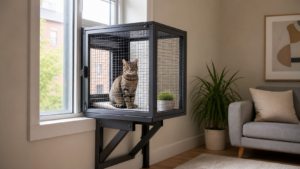
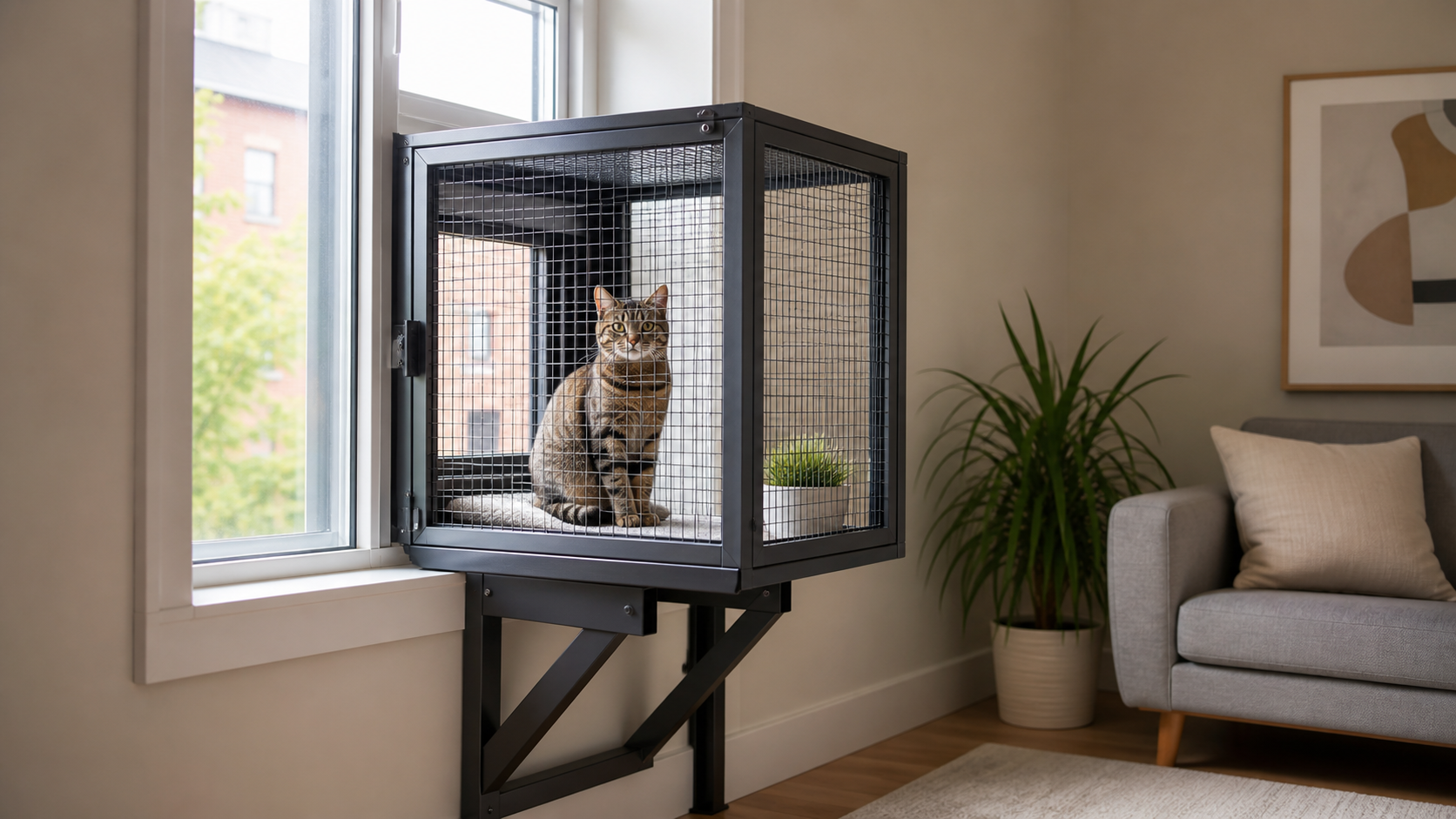
- Window-insert catios. A framed panel fills part of the open window, with an enclosed box extending outside.
- Freestanding catios aligned with a window. The enclosure stands on a balcony, patio, roofed deck, or other approved surface and connects to the window through a short contained passage.
- Custom exterior boxes. These attach to the building, sill, or wall and usually require written permission, appropriate anchors, and qualified installation.
A mesh tent placed beside an open window is not automatically a window catio. If the route between the room and the enclosure is open, loose, or reachable from outside the enclosure, the cat can still escape. Likewise, a reinforced screen may improve insect control, but it should not be treated as the main structure holding an exterior enclosure or resisting a cat’s jump.
Stop Before Installation If Any of These Apply
Do not continue with an exterior window catio until the following problems are resolved:
- The window is designated as an emergency escape or provides access to a fire escape.
- The lease or building rules prohibit exterior fixtures, visible structures, or window modifications.
- The frame, sill, glass, locks, restrictors, or surrounding wall are damaged or loose.
- The enclosure instructions do not identify compatible window types and attachment points.
- The design depends on an ordinary insect screen, adhesive strips, suction cups, or pressure alone to prevent a fall.
- There is no way to close the cat inside quickly during severe weather, maintenance, an alarm, or an equipment failure.
- The proposed installation blocks window drainage, prevents normal locking, or places weight on a component not designed to carry it.
- The cat can reach an uncontained exterior ledge before entering the enclosure.
When a setup fails one of these checks, the answer is not to add more improvised ties or stronger tape. Choose a different location or use an indoor alternative. A secure cat window perch can provide sunlight and visual enrichment without placing the cat outside the building envelope.
Rule 1: Never Use the Insect Screen as Structural Support
Standard window screens are designed primarily to keep insects out. They are not reliable fall barriers and are not intended to carry an enclosure, absorb a cat’s landing force, or resist repeated pushing and climbing. A screen can look secure while the mesh, spline, tabs, or lightweight frame is already weakening.
The catio needs its own support system. Depending on the product and building, that may be a manufacturer-designed insert frame, approved brackets anchored into suitable structure, or a freestanding base that carries the load independently of the window. The access opening should remain contained even if the insect screen is removed entirely.
Ask a simple question: If the screen disappeared, would the cat still be fully contained and would the catio remain supported? If the answer is no, the screen is doing a job it was not designed to do.
Do not place extra faith in labels such as “pet resistant” or “heavy duty.” Stronger mesh may resist claws better than ordinary fiberglass screen, but resistance to scratching is not the same as structural fall protection. Use the enclosure maker’s specified components and installation method, and replace damaged screening before the cat uses the area.
Rule 2: Match the Design to the Exact Window Type
Window openings are not interchangeable. A panel designed for a vertical double-hung window may not remain stable in a horizontal slider, and neither design necessarily works in a casement or awning window.
Double-Hung or Single-Hung Windows
These windows move vertically. Some removable inserts sit beneath the lowered sash, similar to a window air-conditioner panel. The insert must fit the full width, resist side movement, and prevent the sash from being raised from outside or pushed upward by the cat.
Do not assume the sash weight will hold the insert. The product should explain how the panel is retained and how the window is secured. Check whether the sill slopes, whether the exterior lip is deep enough for the specified support, and whether the frame material can tolerate the proposed contact points.
Horizontal Sliding Windows
These windows need a vertical insert that fills the opening from the track to the upper frame. The design must prevent the moving sash from sliding away from the insert. Pay special attention to the top and bottom tracks, because debris, worn rollers, or an uneven frame can create movement that was not obvious during measuring.
Casement and Awning Windows
Casement windows swing outward, while awning windows usually hinge at the top. Their handles, hinges, and opening paths make many standard window-insert catios incompatible. An improvised panel around a partly open casement window can leave irregular gaps and place force on hardware intended only to operate the glass sash.
For these windows, a professionally planned exterior enclosure or a freestanding catio aligned with another safe opening may be more appropriate. Do not remove a restrictor, hinge component, or safety device to make a catio fit.
Tilt-and-Turn Windows
Tilt-and-turn windows can create dangerous tapered gaps when left in tilt mode. A cat may push its head or body into the narrowing opening and become trapped. Do not treat the tilted sash as a catio entrance. Use only a compatible, fully contained solution that does not require the cat to pass through the tilt gap.
Windows with Fire-Escape or Emergency Functions
Do not install a catio where it obstructs a required exit, fire escape, rescue opening, or emergency access route. A removable structure is not automatically acceptable if it slows evacuation or prevents a window from opening as required. Ask building management which windows must remain clear and get the answer in writing.
Rule 3: Give the Catio a Clear, Rated Load Path
The load path is the route the cat’s weight and movement take from the enclosure to a stable supporting surface. In a safe design, you can identify which frame, bracket, base, or structural attachment carries the load. In an unsafe design, the catio appears to “hang there” because friction, suction, a thin screen frame, or an unverified trim piece is doing all the work.
Cats create more than a quiet downward load. They jump onto edges, turn rapidly, push against mesh, and may launch toward a bird or insect. Wind and rain can add force to an exterior structure. That is why the advertised static capacity is only one part of the decision.
Use the manufacturer’s current instructions to confirm:
- Compatible window dimensions and materials
- Required supports, fasteners, locks, or retaining hardware
- Maximum stated load and whether it includes more than one cat
- Indoor and outdoor use limitations
- Wind, rain, snow, and temperature restrictions
- Inspection and maintenance requirements
- Whether professional installation is required
Do not invent a hybrid installation by combining pieces from several products unless a qualified professional has designed and approved the result. Adding a stronger strap does not correct a weak sill, unsuitable fastener, or unknown attachment point.
For a freestanding enclosure, the floor or balcony carries the structure, but the transition still needs independent containment. Keep the unit level, prevent rolling or tipping as directed, and make sure the cat cannot enter the open balcony while moving between the window and catio. If your intended structure belongs on a balcony rather than directly in the window, compare the requirements in our apartment balcony catio guide.
Rule 4: Seal the Entire Transition, Not Just the Main Opening
The most obvious part of a window catio is the enclosure. The most easily missed part is the transition between the indoor room and that enclosure.
Inspect the perimeter from the cat’s perspective. Look above, below, and beside the insert. Check the corners where a rectangular panel meets an uneven frame. Press gently along every seam and observe whether a gap opens when the window, insert, or enclosure flexes.
The cat should not be able to:
- Put its head beside the insert
- Push a paw under a loose lower edge
- Reach an exterior sill outside the contained route
- Pull mesh away from a frame
- Work a zipper, latch, or sliding panel open
- Become trapped between the moving sash and insert
- Access cords, sharp fasteners, splintered wood, or exposed wire ends
Avoid relying on body-size guesses. Fur makes openings look smaller, and a determined cat may test a gap repeatedly. Follow the enclosure maker’s stated gap limits and inspect the fit with the same care you would use for an exterior door.
The indoor side also matters. Keep furniture from becoming a high-speed launch point into the opening. Provide a stable, non-slip step so the cat can enter and leave without leaping onto a narrow edge. For older cats or cats with mobility limitations, use a gradual approach and a wide resting platform.
Rule 5: Protect the Rental, the Window, and Emergency Access
“Renter friendly” should mean more than removable. The setup should avoid damage, comply with the lease, preserve the window’s normal function, and be easy to explain to a landlord or property manager.
Before purchasing, send management a short written request that includes:
- A product link or drawing
- Exact dimensions and exterior appearance
- The proposed window and apartment location
- Whether any drilling, screws, adhesive, pressure poles, or exterior supports are involved
- Installation instructions
- How the structure will be removed
- How the window will remain available for inspection, maintenance, and emergency use
Do not describe an exterior box as furniture if it attaches to the building or changes its appearance. Ask directly whether the installation is allowed. Written approval protects both sides from relying on an informal conversation that may later be remembered differently.
Protect the physical window as well. Pads can reduce rubbing only when the manufacturer allows them; adding an unapproved cushion can also make a fitted panel unstable. Do not drill into vinyl, aluminum, composite, or wood frames without confirming that the location is permitted and structurally suitable. Do not cover weep holes or drainage channels. Water trapped around an insert can damage the frame and wall even if the catio itself remains stable.
Confirm that the window can be closed and locked normally when the catio is not in use, or that the product provides an approved secure closure. If the structure must remain installed, make sure it does not compromise home security.
Rule 6: Test the Complete Setup Before the Cat Enters
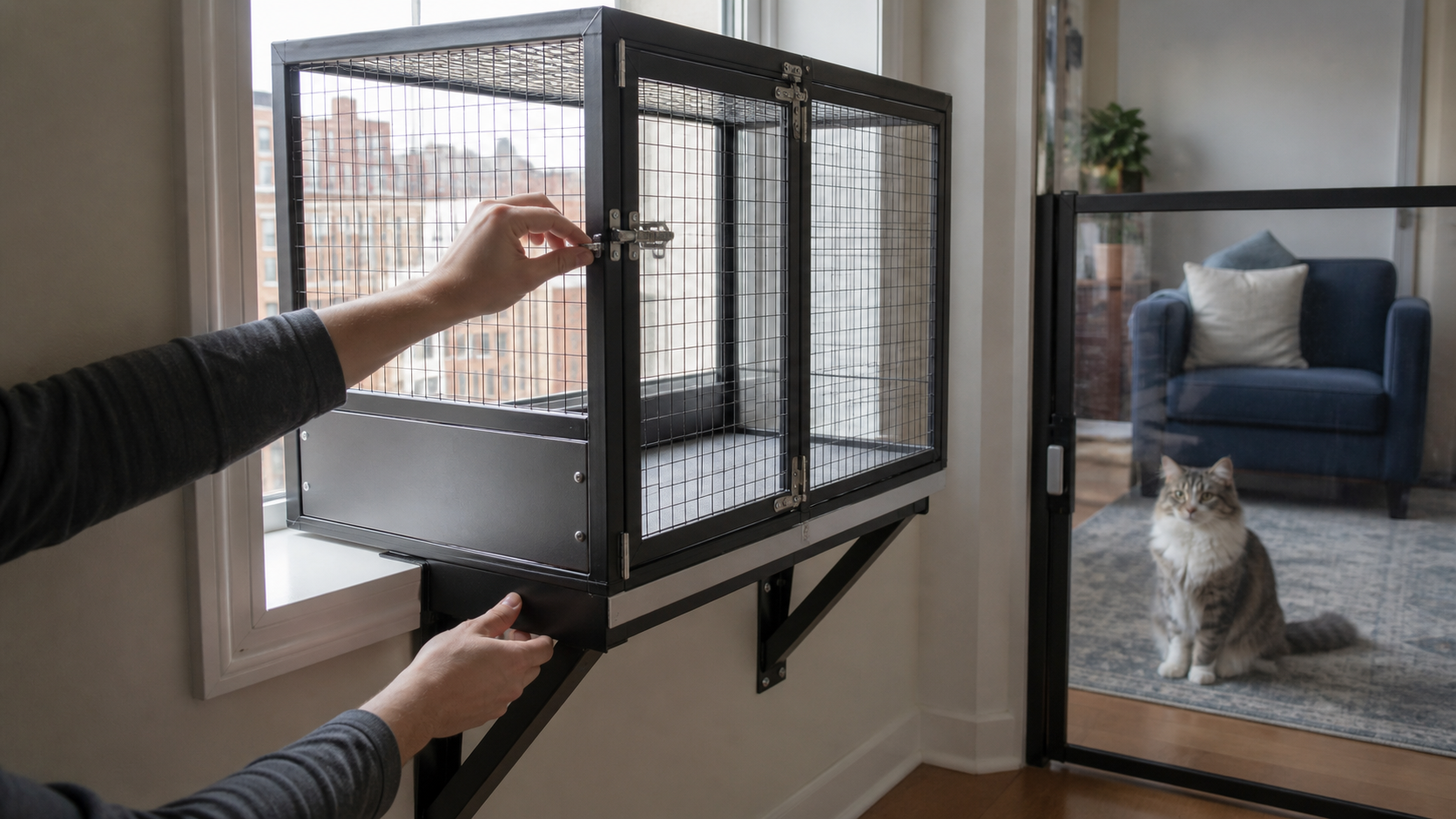
Testing should happen with the cat safely in another closed room. Complete the installation exactly as instructed, then examine the system from inside and, where legally and safely accessible, from the exterior side. Never lean out of a high window to inspect hardware.
Use this pre-access sequence:
- Visual check. Confirm that every specified fastener, lock, support, panel, and latch is present and correctly oriented.
- Perimeter check. Press along the insert and transition to identify movement or gaps.
- Directional stability check. Apply controlled hand pressure from several directions according to the manufacturer’s guidance. Stop if the frame shifts, tilts, separates, creaks, or damages the window.
- Door and latch check. Open and close each access door several times. Verify that a paw cannot operate the latch.
- Window function check. Confirm the sash or slider cannot move in a way that loosens the insert and that required exits remain usable.
- Landing check. Make sure the interior entry step is stable and the catio floor is non-slip.
- Recovery check. Practice closing the interior access and removing the cat from the catio without opening an uncontained exterior route.
Do not substitute a homemade load test for the manufacturer’s instructions. Hanging heavy objects from an unknown frame can damage the window or create a false sense of security. If the instructions are vague about support, compatible windows, or exterior use, choose a different product or ask a qualified installer to assess it.
Rule 7: Introduce the Cat Slowly and Keep Inspecting
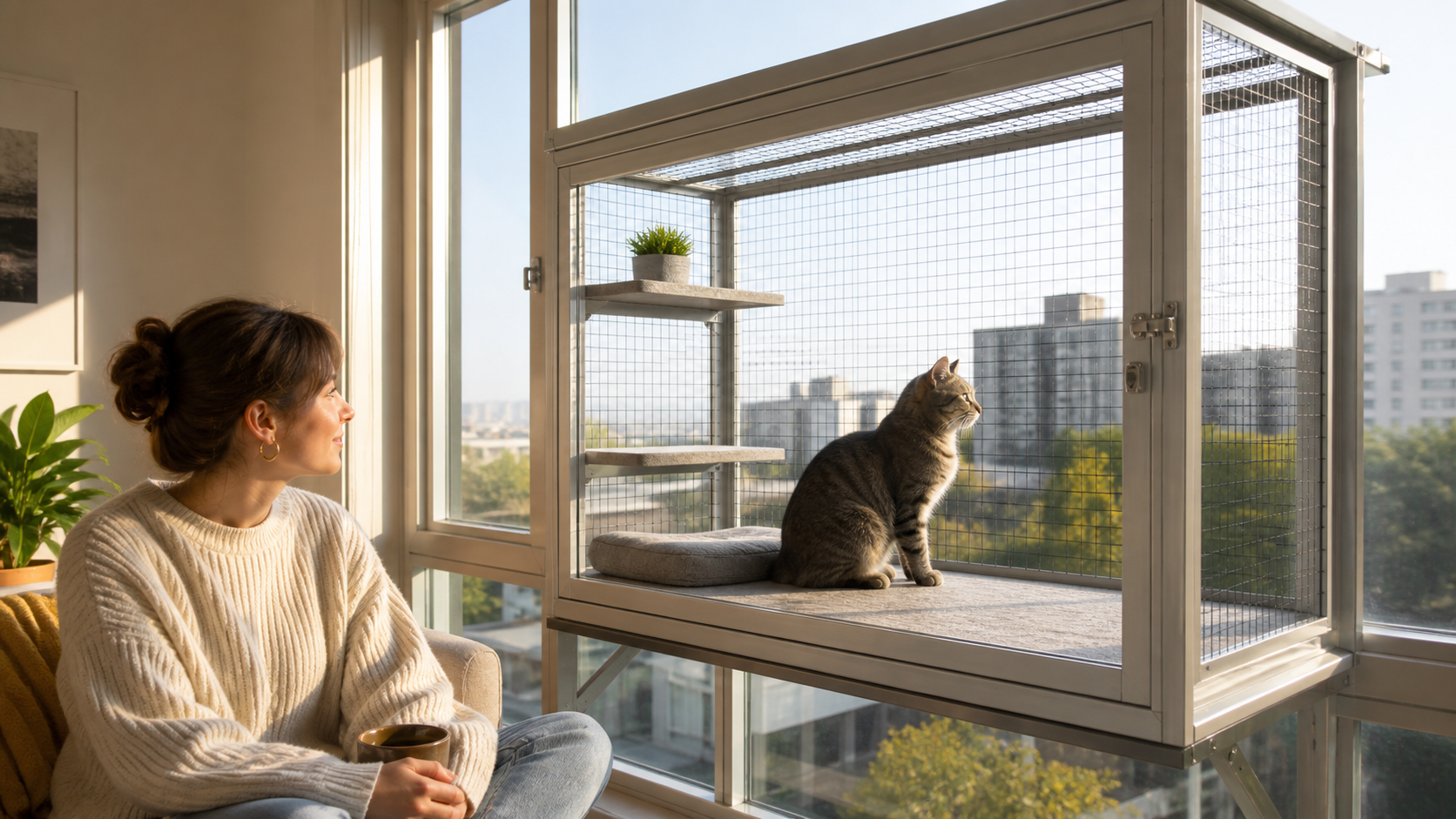
The first catio session is part of the safety test. Keep the exterior access closed while the cat explores the enclosure indoors if the product can be assembled inside. Let the cat smell the materials and investigate the floor, corners, and door without being exposed to height, wind, traffic, or unfamiliar outdoor noises.
For the first window session, stay close enough to close the interior access immediately. Watch what the cat actually does rather than what you expect. Some cats sit quietly. Others climb mesh, bite ties, paw at seams, rush back toward the room, or fixate on the weakest corner.
End the session if the cat:
- Pushes repeatedly against a panel or gap
- Climbs the enclosure in a way the product does not support
- Chews mesh, straps, weather seals, or fasteners
- Panics, freezes, pants, vocalizes intensely, or tries to escape
- Guards the entrance from another cat
- Hesitates because the entry or floor moves
Do not leave a cat unattended until the product explicitly supports that use, the building rules allow it, the weather is suitable, and you have observed repeated calm sessions without equipment movement. Even then, an exterior catio should be checked before use and closed during high wind, storms, extreme temperatures, fireworks, exterior maintenance, or construction.
Reinspect after cleaning, moving the structure, reopening a window that was closed, seasonal temperature changes, and any event that could loosen the installation. Replace worn parts with manufacturer-approved components. If anything shifts, close access until the cause has been corrected.
Window Catio Options Compared
| Setup | What Carries the Load? | Rental Considerations | Main Risk to Check | Best Fit |
|---|---|---|---|---|
| Window-insert catio | Designed insert frame and specified supports | May change exterior appearance; written approval may be required | Insert movement and perimeter gaps | Compatible hung or sliding window with clear instructions |
| Freestanding catio aligned to a window | Stable floor or approved balcony surface | Usually more removable, but exterior use may still require permission | Uncontained transition and tipping or rolling | Renters with suitable protected exterior floor space |
| Custom attached window box | Building structure and approved anchors | Usually needs explicit permission and qualified installation | Unsuitable anchors, water intrusion, blocked egress | Long-term installation approved by owner/building |
| Indoor window perch | Interior window, wall, or rated suction system | Often simplest rental option | Perch failure and unsafe open window | Homes where exterior structures are not allowed |
| Balcony enclosure | Balcony floor and approved anchoring system | Building appearance, wind, exits, and railing rules matter | Fall exposure outside enclosure | Apartments with an approved, physically suitable balcony |
This comparison is not a ranking. The correct choice depends on the actual opening, building rules, cat behavior, and whether the structure has a verifiable support method.
A Measurement Checklist Before You Order
Measure more than the visible glass. Record:
- Clear width and height of the opening
- Interior and exterior sill depth
- Track width and condition
- Frame material
- Direction and full path of sash movement
- Location of handles, locks, restrictors, hinges, and drainage holes
- Distance from the opening to the exterior support surface
- Space required for the enclosure door and for human access
- The lowest and highest points if the frame is not square
Measure at more than one point. Older frames may be slightly uneven. Compare every measurement with the product’s compatibility range and required clearances rather than choosing the nearest nominal window size.
Also measure the route from the building entrance to the installation area. A rigid enclosure that fits the window may not fit through the elevator, hallway, apartment door, or room. Confirm where assembly will happen and whether exterior work can be completed without leaning from the window.
Weather, Heat, and Air Quality
A small outdoor enclosure can become uncomfortable quickly in direct sun, especially when it has a solid roof or clear panels. Shade at one time of day does not guarantee shade later. Observe the location across the hours when the catio will be used.
Provide shade, airflow, a dry non-slip surface, and access back inside. Do not use the catio during extreme heat or cold, high wind, heavy rain, thunderstorms, wildfire smoke, pesticide application, exterior cleaning, or construction dust. Water should be available for longer supervised sessions, but the bowl must not create a slippery floor or tip hazard.
Metal, dark roofing, and clear acrylic can become hot in sun. Touch surfaces before allowing access and monitor the cat rather than relying only on the indoor thermostat. Bring the cat inside if it pants, drools, becomes restless, seems weak, or behaves unusually, and contact a veterinarian promptly if you suspect heat illness.
Secure or remove plants and decorations. Verify every plant with a reliable toxic-plant source, and do not allow dangling cords, fertilizer, standing water, sharp wire, or insect traps inside the enclosure.
Multi-Cat and Large-Cat Considerations
Never assume a catio rated for “multiple cats” suits your specific cats. Confirm the manufacturer’s total load limit and usable interior dimensions. Each cat needs enough room to turn, rest, and leave without being blocked.
Introduce cats separately before allowing shared access. In a narrow window box, one cat can guard the only doorway and trap another outside. Provide more than one resting level only when the enclosure is designed for it and each platform has a stated capacity. For cats that compete over windows, a larger freestanding enclosure or separate scheduled sessions may be safer than squeezing two cats into one box.
Large, athletic, or highly reactive cats may place more force on the front and sides of an enclosure. Match the system to the cat’s current weight and behavior, not an old estimate or the size of a previous cat. Kittens grow, and an opening that once seemed harmless can become an appealing climbing point.
What to Do If the Catio Shifts or a Cat Falls
If the insert, frame, floor, mesh, or latch moves, close the interior access immediately and keep the cat away. Do not make a quick repair while the cat remains in the enclosure. Bring the structure out of service until the cause is identified and the setup is restored according to the manufacturer’s instructions.
If a cat escapes onto an exterior ledge, do not lean or climb out of the window. Keep the area quiet, close interior doors, remove other pets, and contact building management or emergency services for safe assistance as appropriate. Sudden chasing or reaching can make a frightened cat move farther away.
After any fall from a window or height, seek veterinary care promptly even if the cat stands up or appears normal. Internal, chest, jaw, and limb injuries may not be immediately obvious. Transport the cat in a secure carrier and minimize unnecessary handling.
Frequently Asked Questions
Is a no-drill window catio safe for renters?
It can be, but “no drill” describes the installation method, not the safety result. A safe no-drill design still needs a clear support system, exact window compatibility, full containment around the transition, and permission when it changes the building exterior. If the product depends on a normal screen, weak friction, or unexplained pressure, choose another option.
Can a window screen hold a catio?
No ordinary insect screen should be treated as the catio’s structural support or as fall protection. The enclosure needs an independent support and containment system. Even reinforced mesh should be installed as part of a properly designed enclosure, not used as a substitute for the frame and supports.
Do I need landlord permission for a removable window catio?
Check the lease and ask management. A removable unit may still alter the exterior appearance, interfere with maintenance, affect a window warranty, or violate rules about fixtures and emergency access. Written approval is preferable whenever the catio extends outside the apartment or contacts the exterior of the building.
Can I use a window catio on a fire-escape window?
Do not obstruct a fire escape, emergency opening, or rescue route. Ask building management which windows must remain clear. If the proposed window has an emergency function, use a different location or an indoor enrichment option.
Can my cat stay in a window catio overnight?
Only consider unattended use if the manufacturer explicitly permits it, the installation and building rules support it, and the enclosure protects the cat from weather, escape, predators, and equipment failure. For most renter window setups, supervised daytime sessions with access closed afterward are the more cautious choice.
Is a harness enough protection in a window catio?
A harness is not a substitute for a secure enclosure. A tether can snag, tighten, or allow a cat to reach an unsafe edge, and a frightened cat may back out of a poorly fitted harness. Use physical containment as the primary protection and supervise any harness use.
Final Thoughts
A renter friendly window catio should expand a cat’s environment without transferring the risk to a weak screen, damaged frame, blocked exit, or uncertain lease rule. Start with the window and building, not the product photo. Confirm compatibility, identify the load path, seal the transition, obtain approval, and test the complete setup before the cat enters.
If those conditions cannot be met, choosing an indoor perch is not a lesser solution. It is the safer solution for that apartment. The best catio is the one that remains stable, contained, inspectable, weather-appropriate, and easy to close every time your cat uses it.
References
- ASPCA. “ASPCA Urges Pet Owners to Install Secure Window Screens to Prevent ‘High-Rise Syndrome.’” https://www.aspca.org/about-us/press-releases/aspca-urges-pet-owners-install-secure-window-screens-prevent-high-rise
- ASPCA. “High-Rise Syndrome: Lifesaving Tips for Cat Parents.” https://www.aspca.org/news/high-rise-syndrome-lifesaving-tips-cat-parents
- U.S. Consumer Product Safety Commission. “CPSC Urges Families to Protect Children During National Window Safety Week.” https://www.cpsc.gov/Newsroom/News-Releases/2026/CPSC-Urges-Families-to-Protect-Children-During-National-Window-Safety-Week
- U.S. Consumer Product Safety Commission. “Don’t Depend on Screens to Keep Children from Falling Out of Windows.” https://www.cpsc.gov/s3fs-public/windows.pdf
- Leeds City Council. “Window Safety.” https://www.leeds.gov.uk/housing/council-housing-information-for-tenants/your-tenancy/window-safety
- Wandsworth Council. “Tenancy Conditions for Fire Safety in Council Homes.” https://www.wandsworth.gov.uk/housing/council-tenants-and-leaseholders/safety-in-the-home/fire-safety-in-council-homes/tenancy-conditions-for-fire-safety-in-council-homes/