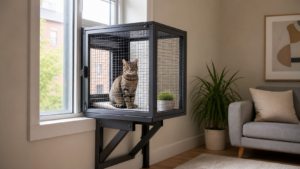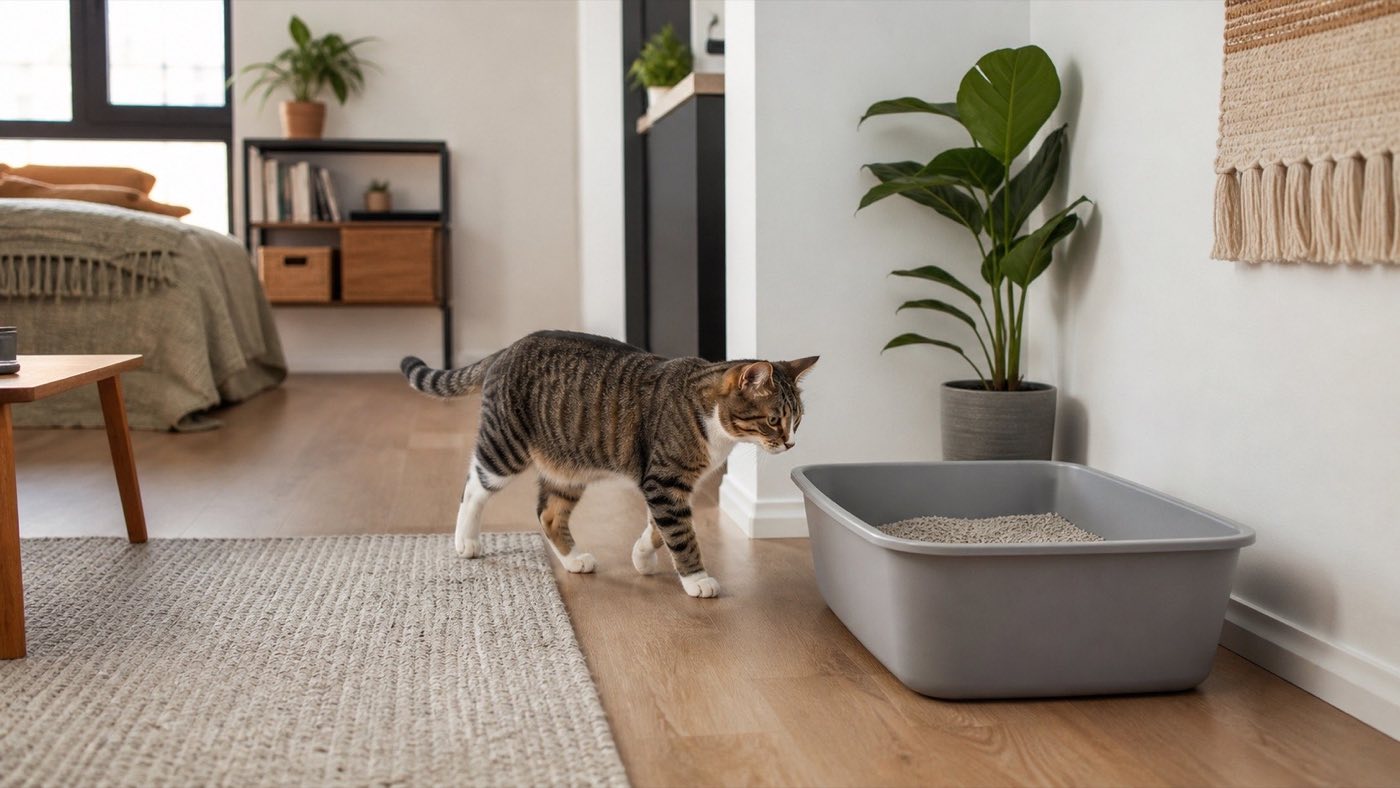
Wondering where to put a litter box in a studio apartment? Choose a quiet, continuously accessible spot that is separate from food and water and gives your cat a clear exit. In a studio, that usually means a low-traffic edge of the bathroom or living area—not beside a noisy appliance, inside a sealed cabinet, or at the end of a one-way escape route.
The perfect location is not the place where humans notice the box least. It is the place your cat can use comfortably every day while you can still scoop and clean it easily.
This guide gives you a practical way to choose that spot, even when one room has to function as a bedroom, living room, office, dining area, and cat space.
Quick answer
Start with a quiet, ventilated area that your cat already walks through comfortably. Keep the box away from food and water, loud machines, swinging doors, and locations where another pet can block the only exit. Make sure it remains available 24 hours a day and leaves enough room for your cat to enter, turn, dig, and leave without squeezing.
For one cat, two boxes in separate locations are ideal when the floor plan allows it. If a studio truly cannot fit two full-size boxes, do not place two trays side by side and assume they function as separate choices. Prioritize one generously sized, accessible box, then test a second compact but usable location if your cat needs another option.
Table of Contents
Important veterinary note
A placement change cannot diagnose or treat a medical problem. If your cat suddenly urinates or defecates outside the box, strains, cries, makes frequent trips, produces little or no urine, has blood in the urine, vomits, hides, or seems painful, contact a veterinarian promptly. Inability to pass urine can be an emergency, especially in male cats.
Do not punish a cat for house-soiling. Pain, fear, access problems, conflict, litter preferences, and environmental stress can all affect litter box use.
The seven placement rules
1. Choose quiet, not isolated
Cats generally prefer a private, low-traffic toileting area. That does not mean the box should be hidden in a remote place your cat cannot reach when a door is closed.
A good studio location sits outside the main walking path but remains part of the cat’s normal territory. A bathroom corner can work if the door always stays open and the room is not dominated by a loud washer, dryer, fan, or shower routine. A living-area corner can work if it is not beside the television, front door, or a chair that constantly moves.
Ask three questions:
- Can my cat reach this spot at night and when I am away?
- Will footsteps, doors, guests, or appliances startle the cat?
- Can I scoop the box without moving furniture every time?
If one answer is no, keep looking.
2. Keep food and water in a different zone
Do not place the litter box beside your cat’s food or water simply because all cat supplies fit neatly together. Cats generally prefer eating, drinking, and toileting resources to be separated.
In a studio, “separate” does not require another room. Use distance and layout. For example, food can sit along the kitchen-side wall while the box is placed at the bathroom-side edge of the apartment. A bookshelf, open room divider, or change in floor surface can help define zones, but it should not trap the cat or block airflow.
Avoid putting a water bowl on top of a litter box enclosure. It may look space-efficient to a person, but it combines resources the cat may prefer to use apart.
3. Give your cat a clear entrance and exit
A cat should not have to squeeze behind furniture or enter a dead-end tunnel to reach the box. This matters even more in a multi-pet home. Another cat or dog can wait outside a closet, narrow hallway, or covered enclosure and make the box feel unsafe.
Look at the area from cat height. Can your cat see what is approaching? Is there more than one direction to leave? Could a door swing shut or a storage bin slide in front of the entrance?
An open corner with visual cover on one side is often better than a deep closet with only one exit. If you use furniture to create privacy, keep the approach wide and predictable.
4. Avoid heat, moisture, and sudden noise
The empty gap beside a washing machine may seem perfect, but vibration, alarms, spinning cycles, and sudden water noise can make it unreliable. The same applies to a spot directly beside a furnace, portable heater, loud bathroom fan, speaker, or frequently slamming door.
A bathroom can still be a good option when it is dry, well ventilated, and calm. Keep litter away from the shower splash zone and do not let bath mats or stored items block access. If you close the bathroom during showers, your cat needs another box it can use.
Balconies and outdoor corridors are not substitutes for an indoor box. Weather, temperature, building access, insects, noise, and a closed door can remove access without warning.
5. Leave enough room for a full-size box
Do not choose the location first and then force the smallest possible box into it. Many cats need more turning and digging space than compact “apartment” boxes provide.
Feline veterinary guidance commonly recommends a box about one and a half times the cat’s length from nose to the base of the tail. A large storage container or mixing tray can sometimes fit the cat better than a decorative commercial box. Kittens, senior cats, and cats with mobility problems may need a low entry.
Measure both the box and the usable floor area. Your cat needs a stable, level approach and enough clearance to enter without rubbing against surrounding furniture. You also need enough room to lift, scoop, and wash the box.
6. Treat separate locations as separate choices
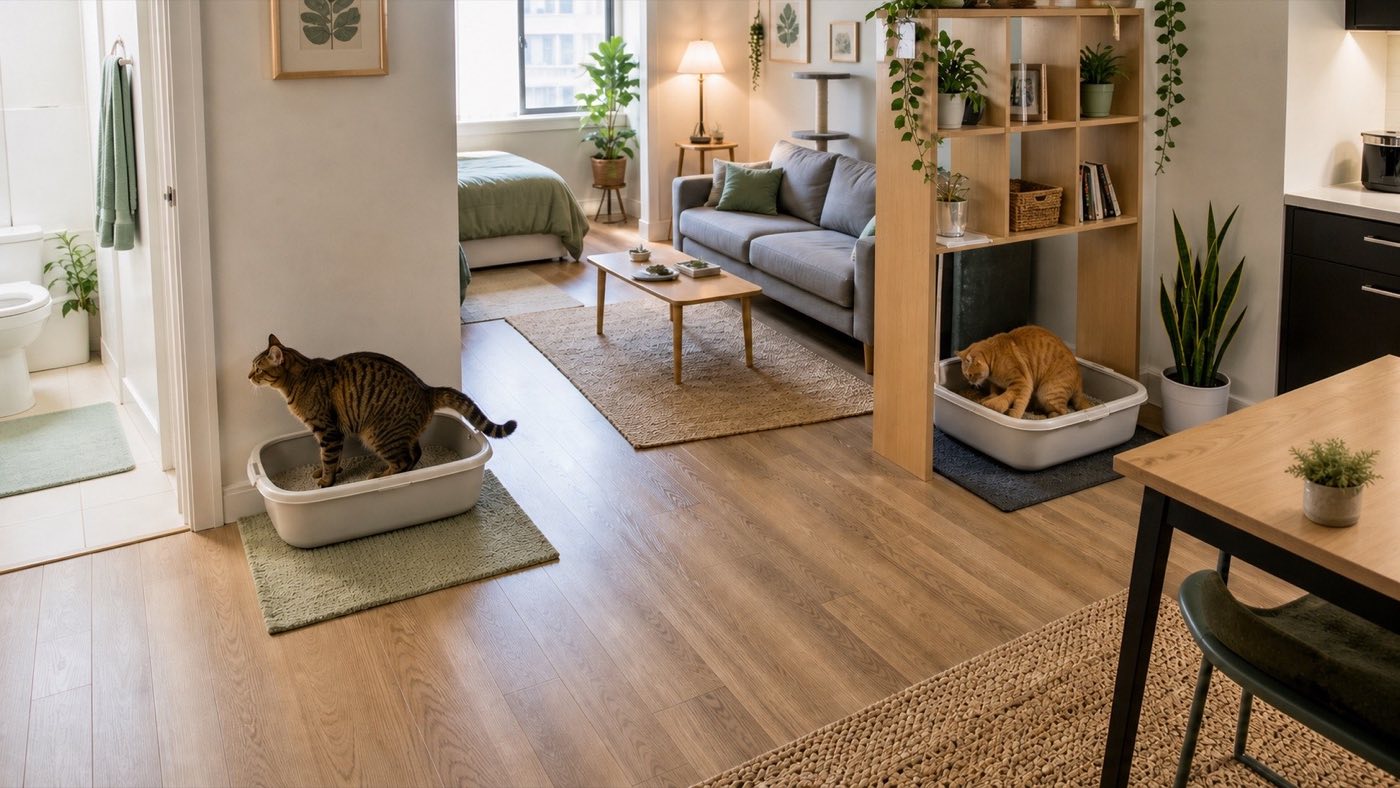
The usual starting point for litter box quantity is one box per cat plus one extra, distributed in different locations. In a studio, space may make that difficult, but two boxes pushed together behave more like one toileting station than two independent choices.
For one cat, possible paired locations might be:
- one box at the quiet edge of the bathroom and one behind an open divider in the living area;
- one standard box in the main living space and one low-entry box near a senior cat’s favorite resting zone;
- one permanent box and one temporary second box while testing a new location.
For two cats in a studio apartment, focus on preventing access blocking. Watch whether one cat follows, stares at, chases, or waits near the other cat’s route to the box. A small home can still create separation through opposite sides of the room and open escape paths.
If your layout cannot support the recommended number, discuss the constraint with your veterinarian or a qualified feline behavior professional rather than compensating with tiny or inaccessible boxes.
7. Pick a location you can keep clean
The best theoretical location fails if scooping it is unpleasant or physically awkward. Choose a place where you can remove waste at least daily, sweep scattered litter, and wash the box without dismantling the room.
Protect the floor with a washable, waterproof layer that extends beyond the box, but do not create a slippery or unstable entrance. A litter mat may help with tracking, provided your cat is comfortable walking on its texture.
Ventilation matters, but airflow should not mean pointing a strong fan directly at the box. Regular scooping and an adequately sized box matter more than perfumes or heavy fragrance. Many cats prefer unscented litter.
A studio apartment placement scorecard
Rate each possible location from 0 to 2 for every factor: 0 means poor, 1 means workable, and 2 means good.
| Factor | 0 points | 1 point | 2 points |
|---|---|---|---|
| Access | Door may close or route is blocked | Usually accessible | Accessible 24/7 |
| Noise | Sudden or frequent loud noise | Occasional disturbance | Consistently quiet |
| Escape | Dead end or easy to ambush | One clear route | Open view and easy exit |
| Food distance | Beside food or water | Same zone with separation | Clearly separate zone |
| Box size | Only a cramped box fits | Adequate box fits | Large box and clear approach fit |
| Cleaning | Difficult to scoop or wash | Manageable | Easy daily access |
| Moisture and heat | Wet, hot, or drafty | Sometimes affected | Dry and stable |
A location scoring 12–14 is a strong candidate. A low score does not mean your apartment is unsuitable for a cat; it shows which problem you need to solve before placing the box there.
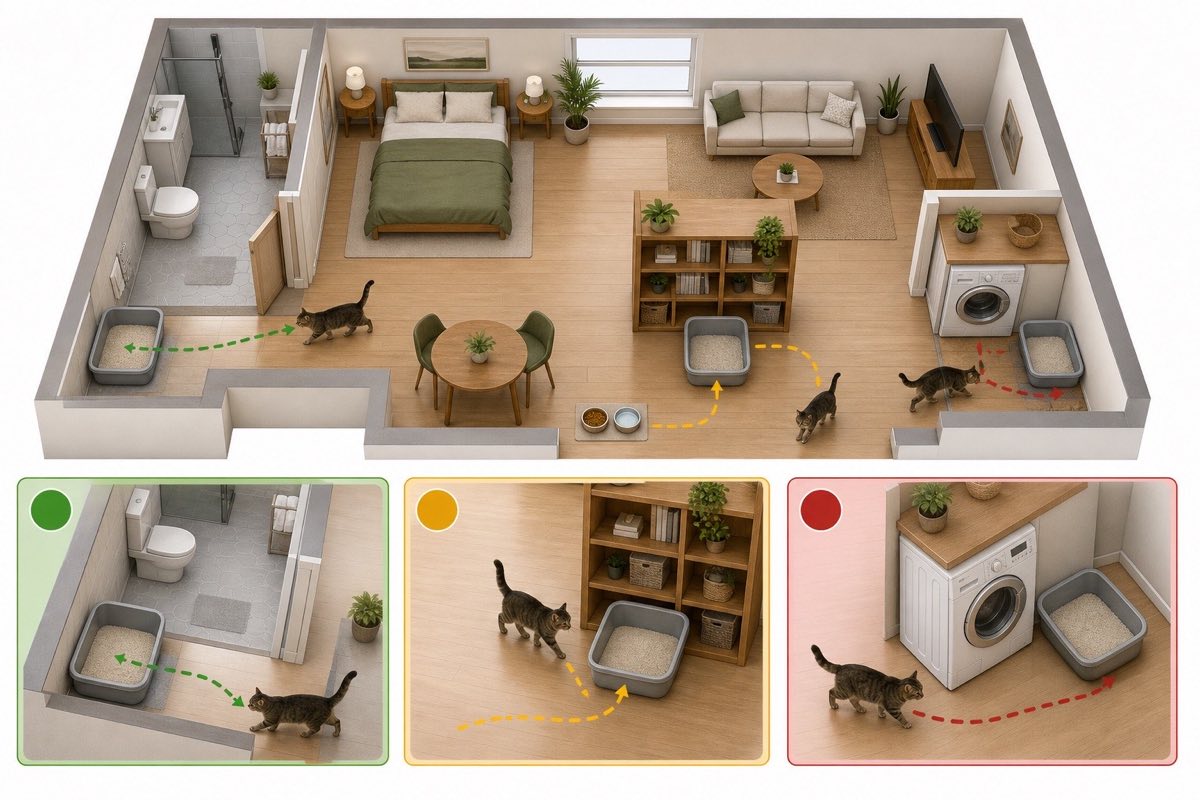
Where to Put a Litter Box in a Studio Apartment
Usually workable: a quiet bathroom edge
This can be practical because the floor is easy to clean and the box stays outside the main living area. It works only when the door remains open, the area stays dry, and nearby fans or machines do not frighten the cat.
Usually workable: behind an open room divider
An open shelf or divider can provide visual privacy without sealing the box inside a cabinet. Leave a wide approach and more than one exit direction. Do not stack unstable objects above the box.
Sometimes workable: an entryway corner
Use this only if the front door, shoes, deliveries, and foot traffic do not create frequent surprises. Keep the box away from drafty exterior doors and escape risk.
Sometimes workable: a ventilated closet
A closet is acceptable only when access is guaranteed, ventilation is adequate, the box fits properly, and the cat cannot be trapped. A closet with a closed door, strong stored-product smells, or a single guarded entrance is a poor choice.
Usually poor: next to food and water
Convenient storage does not outweigh resource separation. Move either the feeding station or the litter box.
Usually poor: beside a washer, dryer, furnace, or loud fan
Sudden vibration and noise can create a negative experience near the box. A cat may appear comfortable until a machine starts unexpectedly.
Usually poor: inside a tightly sealed litter cabinet
An enclosure may trap odor, restrict turning, and create one narrow exit. If you use furniture, prioritize internal space, ventilation, stability, and an open route over concealment.
How to move a litter box without creating a problem
Do not abruptly remove a box your cat uses reliably and place it across the apartment. Add the new box first. Keep the old box available while your cat investigates the new location.
Once the new box is used consistently, you can decide whether to retain both or gradually move the old box. If your cat stops using the new location, return to the last reliable setup and reassess access, noise, cleanliness, box size, litter, and social pressure.
When the cat repeatedly chooses a specific accident location, placing an additional box there temporarily may reveal a strong location preference. A veterinarian should first rule out medical causes when house-soiling begins suddenly.
One cat versus two cats in a studio
One cat
Start with the largest comfortable box you can place in a quiet, accessible zone. A second box is valuable because it gives the cat a choice and provides backup when one area becomes noisy or unavailable.
Two cats
Do not assume bonded cats always want to share. Separate boxes so one cat cannot control the entire toileting area from a single doorway or path. Food, water, resting places, and litter boxes should also be distributed to reduce competition.
If one cat urinates outside the box, do not treat the behavior as spite. Watch the route and interactions before, during, and after litter box use. Subtle staring or doorway blocking may matter even when there is no obvious fight.
Renters: protect the apartment without reducing access
Use a washable waterproof floor protector, a stable litter-catching mat, and regular sweeping. Avoid adhesive installations that damage flooring or create raised edges the cat must cross. Confirm that any enclosure is sturdy and cannot tip.
Do not solve odor by placing the box outdoors, spraying strong fragrance, or hiding it somewhere you rarely clean. Good placement makes daily care easier, which protects both the cat and the rental.
If visual concealment is your main problem, first choose a cat-friendly location and then use the separate guide to hiding a litter box safely in a small apartment.
Troubleshooting after placement
The cat uses the box but hesitates
Check for noise, a narrow entrance, a covered box, unstable flooring, or another pet watching the route. Offer an uncovered box in a more open location and compare the cat’s response.
The cat urinates beside the box
The location may be acceptable while the box, litter, cleanliness, or entry is not. It can also signal a medical problem. Arrange a veterinary check when the change is new, repeated, painful, or accompanied by urinary signs.
Odor spreads through the studio
Increase scooping frequency, check box size and litter depth, and improve gentle room ventilation. Do not rely on heavy fragrance. Placement helps, but cleanliness is the primary odor-control tool.
Litter reaches the bed or sofa
Keep a clear landing area outside the box, add a cat-tolerated litter mat, and sweep frequently. Do not make the entrance so complicated that the cat avoids it. For a fuller tracking plan, use the separate apartment litter-tracking guide.
FAQ
Can I put a litter box in a studio apartment bathroom?
Yes, if the bathroom stays accessible, quiet, dry, and well ventilated. Avoid placing the box beside a loud washer, dryer, fan, or shower splash zone. Keep the door open or provide another box when the room is unavailable.
Is it okay to put a litter box in the bedroom?
It can be acceptable in a studio when the location is quiet, accessible, and separate from food and water. Daily scooping and a washable floor barrier become especially important. Do not place it where bedding blocks the approach or where the cat can be trapped.
Can a litter box go in a closet?
Only if the closet remains open or has safe permanent access, fits a full-size box, has ventilation, contains no hazardous products, and does not create a dead-end route. A sealed or frequently closed closet is not reliable.
Should I hide the litter box in furniture?
Concealment is secondary to the cat’s comfort. Many enclosures are too small, trap odor, or provide only one exit. Use one only if it is spacious, stable, ventilated, easy to clean, and readily accepted by your cat.
How far should the litter box be from cat food?
There is no universal distance that fits every studio. Place food, water, and toileting resources in clearly separate functional zones rather than side by side. Use the maximum practical separation your layout allows.
Do two litter boxes side by side count as two locations?
They provide two trays but not two independent location choices. Cats can perceive adjacent boxes as one toileting station, and another pet can block both at once. Spread boxes apart when possible.
What if my apartment has no perfect location?
Choose the highest-scoring workable location, correct its weakest factor, and observe your cat. For example, widen the approach, move food, keep a door open, or add a screen for visual privacy. The best answer is usually a careful compromise, not an invisible box.
Final thoughts
The best place for a litter box in a studio apartment is quiet, continuously accessible, separate from food and water, large enough for a comfortable box, and easy to leave without being cornered. Start with your cat’s needs, then solve human concerns such as appearance, tracking, and odor around that safe location.
Use the scorecard to compare two or three real spots in your apartment. Once your cat uses a location reliably, keep the routine predictable and make changes gradually.
References
- American Association of Feline Practitioners and International Society of Feline Medicine. 2014 AAFP/ISFM Guidelines for Diagnosing and Solving House-Soiling Behavior in Cats. https://catvets.com/resource/aafp-isfm-house-soiling-guidelines/
- Feline Veterinary Medical Association. Setting Up the Environment for Success. https://catvets.com/resource/setting-up-for-success/
- Cornell Feline Health Center. Feline Behavior Problems: House Soiling. https://www.vet.cornell.edu/departments-centers-and-institutes/cornell-feline-health-center/health-information/feline-health-topics/feline-behavior-problems-house-soiling
- Cornell Feline Health Center. Choosing and Caring for Your New Cat. https://www.vet.cornell.edu/departments-centers-and-institutes/cornell-feline-health-center/health-information/feline-health-topics/choosing-and-caring-your-new-cat