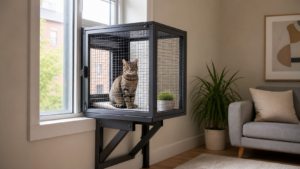
Two cats in studio apartment living can work, but the deciding factor is not a magic square-footage number. What matters is whether each cat can reach food, water, litter, rest, hiding, scratching, and elevated space without being watched, followed, or blocked by the other cat.
A studio is less forgiving than a larger home because most routes and resources share one room. The safest plan is to create several small zones, duplicate important resources, protect escape routes, and watch for quiet signs of tension instead of waiting for a fight.
This guide is for cats that have already been introduced appropriately or are being introduced gradually. If the cats are new to one another, follow a staged second-cat introduction plan before asking them to share the entire studio.
Safety note: sudden hiding, appetite loss, litter-box changes, overgrooming, pain, vomiting, lethargy, or urinary signs can have medical causes. Contact a veterinarian rather than assuming every change is behavioral. Straining to urinate, repeated unproductive litter-box visits, collapse, breathing difficulty, or severe distress requires urgent veterinary care.
Quick Answer: Can Two Cats Live in a Studio Apartment?
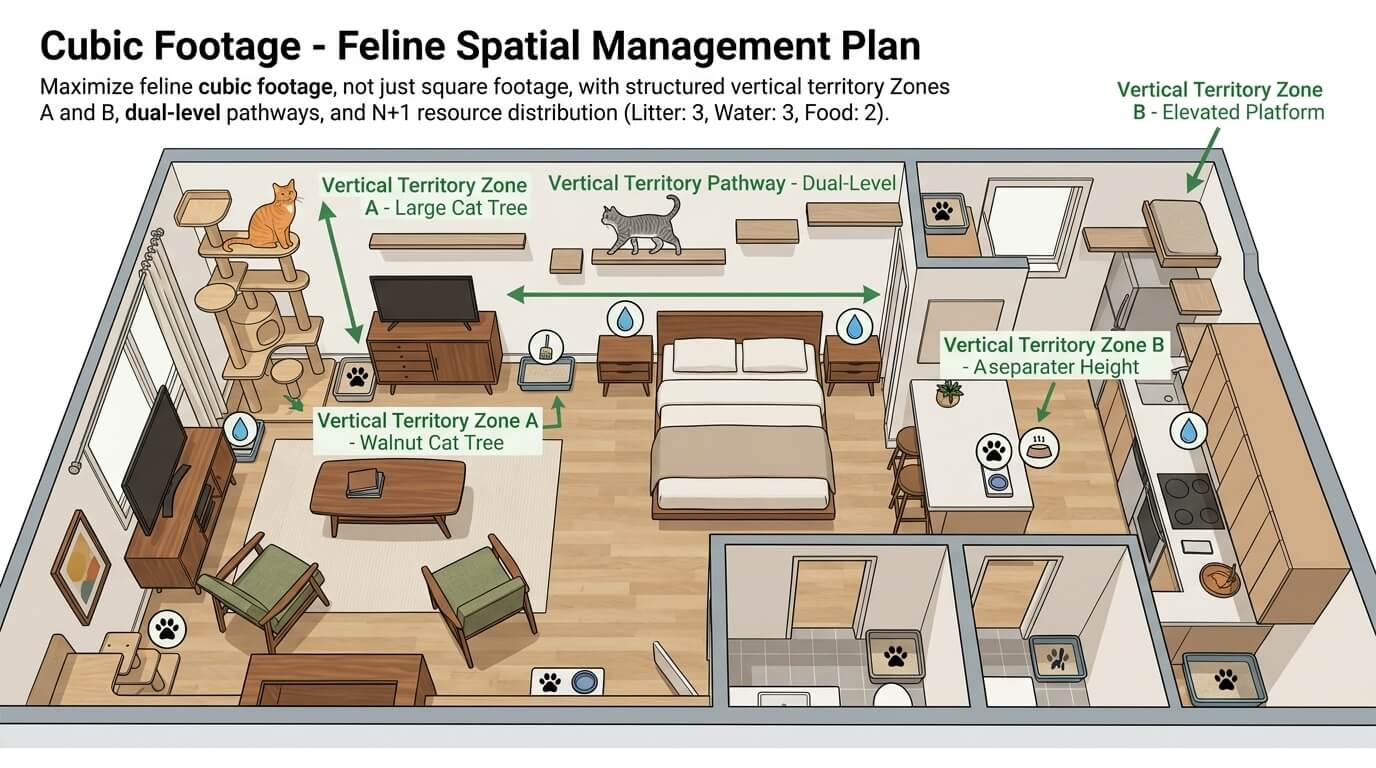
Yes, two compatible cats can live successfully in a studio apartment when each cat has genuine choices. At minimum, both cats need separate feeding access, more than one drinking location, multiple resting and hiding places, safe elevated options, scratching surfaces, and litter boxes placed so that one cat cannot guard every route.
The common “one litter box per cat, plus one extra” guideline means three boxes for two cats when space permits. In a studio, the number alone is not enough: three boxes lined up together still function like one toilet area if a cat can block the approach. Separation, accessibility, box size, cleanliness, and the cats’ preferences all matter.
A studio may be unsuitable for a particular pair if one cat persistently stalks or blocks the other, the home cannot provide separate resource locations, either cat lacks a safe retreat, or the cats require continuous separation that the floor plan cannot support.
Before You Rearrange the Room: Check Whether the Pair Is a Good Fit
Apartment design can reduce competition, but it cannot force two cats to become friends. Cats are socially flexible individuals. Some form close relationships; some coexist with distance; some remain uncomfortable together despite careful management.
Start by observing how the cats use the room when nothing dramatic is happening. A workable relationship does not require cuddling. Calm coexistence may look like both cats eating normally, resting in different places, moving through the room without hesitation, and passing one another without prolonged staring or pursuit.
| What you observe | What it may mean | Next step |
|---|---|---|
| Both cats use the whole studio at different times | They may be sharing space successfully | Keep resources separated and continue monitoring |
| One cat waits before approaching food, litter, or a doorway | Access may be socially blocked | Add another route or resource behind a visual barrier |
| Brief hiss, then both cats disengage | A boundary signal, not automatically a crisis | Increase distance and let both cats leave |
| Repeated staring, chasing, cornering, or ambushing | Possible intercat tension | Separate safely and use a structured reintroduction plan |
| Appetite, grooming, elimination, or activity changes | Stress, pain, or illness may be involved | Arrange veterinary assessment and review the environment |
Do not use breed, age, sex, or a single meeting to predict success. Temperament, health, prior social experience, resource access, and the quality of the introduction are more useful than a list of supposedly “studio-friendly” breeds.
7 Safe Setup Rules for Two Cats in a Studio Apartment
1. Separate Essential Resources Instead of Making One Shared Station
The most important improvement is not buying more furniture. It is preventing one location from controlling every essential activity. The 2013 AAFP and ISFM environmental-needs guidelines recommend multiple, separated locations for feeding, drinking, toileting, scratching, play, and rest in multi-cat homes.
For two cats, begin with:
- separate feeding positions where the cats do not have to face each other;
- more than one water location, away from litter boxes;
- multiple resting and hiding choices;
- more than one scratching surface and orientation;
- at least one safe place for each cat, preferably with more than one way out;
- one litter box per cat plus one extra when the apartment can accommodate it.
Do not interpret “separate” as a few inches apart. Two bowls on the same mat or three boxes in one bathroom can still be controlled from a single position. Use different corners, furniture screens, or opposite sides of a bookcase so a cat can approach without entering the other cat’s immediate space.
If one cat steals food, eats a prescription diet, or controls the feeding zone, physical separation is more reliable than hoping they take turns. Our guide to feeding multiple cats separately explains room rotation, barriers, and protected feeding options. A microchip feeder may help with food access, but it does not solve conflict around litter, water, paths, or resting places.
2. Give Every Valuable Place More Than One Route
Vertical space is useful when it increases choice. It becomes risky when a cat must pass the other cat on a narrow shelf or descend through a single landing point.
Look at each elevated place from the cat’s perspective. Can the cat climb up and leave without being cornered? Is the surface wide and stable enough for turning? Is there a second perch of similar value elsewhere? Can a less agile cat reach it safely?
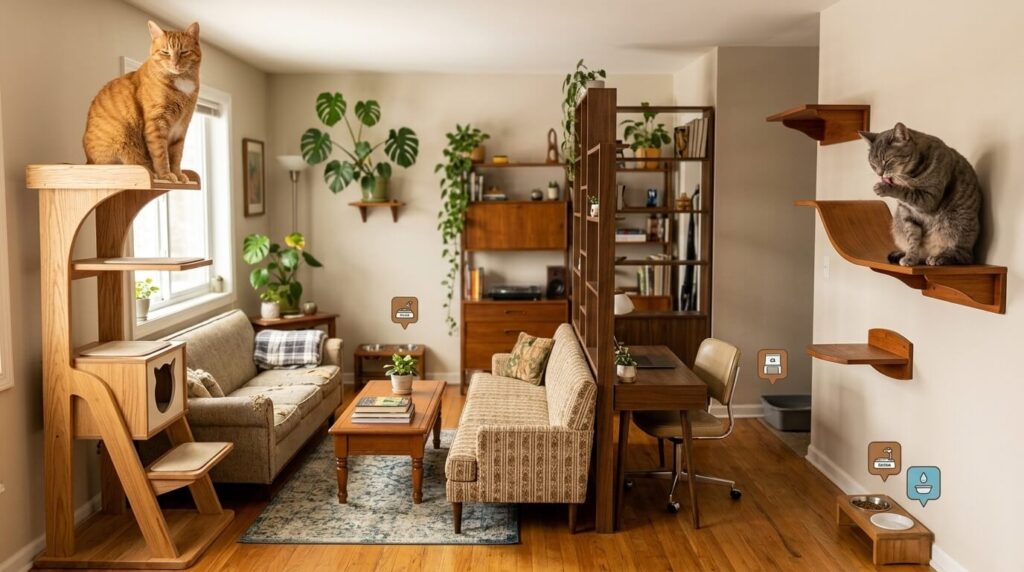
A practical studio setup might include one stable cat tree near a window and a separate shelf, cabinet-top bed, or lower climbing unit across the room. The goal is not to create the tallest possible structure. The goal is to stop one cat from owning the only desirable lookout.
Wall-mounted routes must be secured to an appropriate structure and installed according to their hardware requirements. Renters should confirm lease rules before drilling. Keep landing areas clear, add non-slip surfaces, and avoid a one-way “dead end” above a doorway or appliance. For more layout examples, see the cat superhighway guide and our comparison of cat furniture for small apartments.
3. Divide One Room into Several Visual Zones
A studio does not have interior doors between a living room and bedroom, but furniture can still interrupt direct sightlines. A bookcase placed perpendicular to a wall, the back of a sofa, a desk, a folding screen, or a covered bed can create a place where a cat rests without continuously watching the other cat.
Choose barriers that are stable and cannot topple when climbed. Avoid creating narrow funnels between a wall and large furniture. A route should be wide enough for a cat to turn around or should have two exits.
Try this simple mapping exercise:
- Mark the studio’s unavoidable bottlenecks: the entry door, bathroom door, kitchen passage, and path around the bed.
- Place essential resources outside those bottlenecks whenever possible.
- Create at least two resting zones that are not in direct view of each other.
- Check that each cat can reach water and a litter box without passing the other cat’s favorite bed.
- Sit at cat height and look for hidden traps, narrow gaps, and one-way routes.
Visual separation should create choice, not isolation. If a divider makes the room so narrow that cats must squeeze past each other, change its angle or use a smaller barrier.
4. Protect Litter-Box Access and Keep the Boxes Appealing
Litter boxes are especially vulnerable to blocking because a cat needs privacy, time, and a safe exit. A box under a desk may save space but fail if another cat can wait at its only opening. A covered box may also feel unsafe to a cat that cannot see the approach.
Use the largest boxes the studio can reasonably hold. Place them in quiet, accessible positions away from food and water. Avoid loud appliances and locations where a person or another animal can suddenly appear. Scoop at least daily and more often when needed; two cats can make a small box undesirable quickly.
Three full-size boxes may be difficult in a compact studio. Work through the options before reducing the number:
- use a bathroom location plus two genuinely separate room locations;
- replace bulky decorative enclosures with open boxes that provide more usable space;
- move nonessential storage instead of squeezing a box into a trap-like gap;
- use a furniture screen for privacy while keeping more than one approach;
- ask your veterinarian or a qualified feline behavior professional for an individualized plan if the ideal number is impossible.
Do not place litter boxes under a bed if access is cramped, the box cannot be cleaned easily, or a cat could be cornered there. Do not rotate boxes routinely just to spread odor; cats generally benefit from predictable, accessible locations. Our guide on how often to clean a litter box covers daily and multi-cat maintenance.
5. Feed Privately and Watch for Quiet Competition
Two cats eating from bowls beside each other may look peaceful while one is actually rushing, pausing, or leaving early. Feed each cat in a consistent place with enough visual separation that neither must monitor the other.
If the bathroom is used as a temporary feeding room, confirm that cleaning products, medications, cords, and toilet water are inaccessible. A folding screen or furniture barrier can work when closing a door is impossible. Stay nearby at first, then remove bowls after the meal so one cat does not inspect and guard the other cat’s station.
Track appetite by cat rather than estimating from one shared bowl. A simple daily note can reveal whether one cat is eating less, finishing unusually quickly, or approaching only after the other leaves. Sudden appetite change needs veterinary attention, especially when it is accompanied by vomiting, lethargy, weight change, or altered litter-box behavior.
6. Use Predictable Individual Play, Not a Rigid Timer
Play can provide an outlet and build positive associations, but there is no universal 15-minute schedule or fixed number of sessions that guarantees harmony. Age, mobility, health, motivation, and play style differ.
Offer each cat individual interactive play where the other cat cannot take over. One cat may prefer short wand-toy chases; another may prefer food puzzles, training, or slower stalking games. End before the cat becomes frustrated or physically exhausted, and store string-based toys after supervised use.
When both cats are comfortable, parallel play with two people or two separate toys can allow shared activity without forcing competition. Maintain enough distance that neither cat freezes, stares, or abandons the game. Do not use one toy to lure cats closer together when either cat is tense.
Predictability matters more than a rigid clock. Regular feeding, play, cleaning, and quiet periods help cats anticipate what happens next. If nighttime activity is a problem, address each cat’s routine rather than assuming conflict is the only cause.
7. Monitor Subtle Intercat Tension and Respond Early
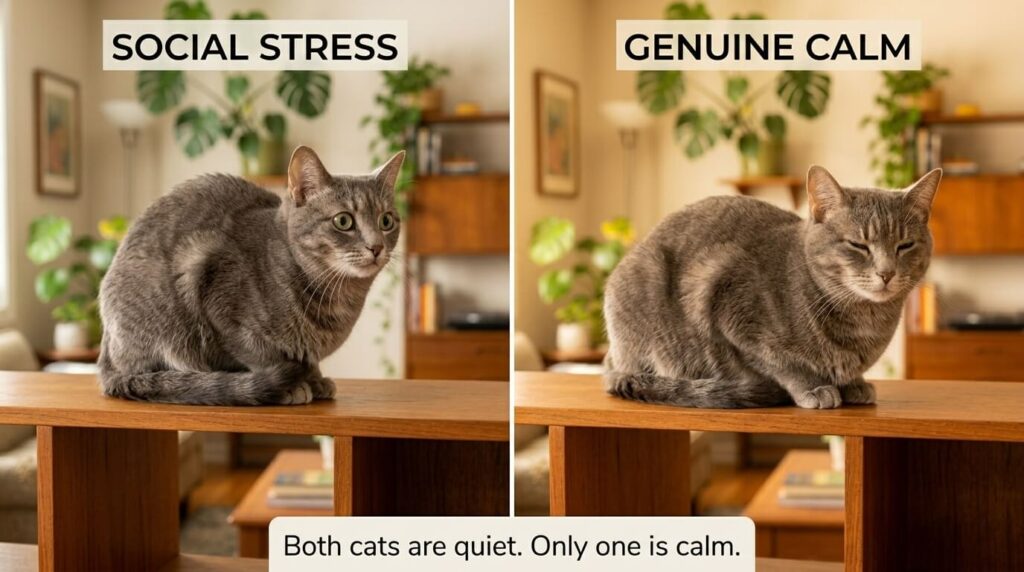
The 2024 AAFP Intercat Tension Guidelines emphasize that tension is often subtle and may be missed when caregivers look only for fighting. In a studio, pay attention to access, distance, and changes over time.
Possible signs include:
- prolonged staring or one cat tracking the other’s movement;
- blocking a doorway, litter route, feeding place, or elevated path;
- one cat consistently giving up a bed, perch, or room zone;
- ambushing, chasing, cornering, or guarding;
- hiding more, playing less, overgrooming, or becoming unusually watchful;
- eating only when the other cat leaves;
- urine marking or avoiding a litter box;
- a noticeable change in sleep, appetite, activity, or social behavior.
No single posture proves chronic stress, and quiet cats are not necessarily relaxed. Look for repeated patterns and changes from each cat’s normal behavior.
If tension is mild, increase distance and add separated resources before trying to make the cats interact. If one cat is controlling access, use the step-by-step resource guarding guide. Pheromone products may help some households as an adjunct, but they do not replace physical separation, resource distribution, medical evaluation, or a careful introduction. Our cat calming diffuser guide explains their limits and placement.
A Practical Studio Layout: Five Zones to Check
You do not need to assign half the apartment permanently to each cat. Instead, give both cats several usable options and make sure no essential activity depends on one contested route.
Zone 1: Entry and Doorway
Keep beds, food, and litter away from the main entry when possible. The door brings unpredictable sound and movement and can become a bottleneck. Provide an indoor waiting place away from the door so opening it does not force the cats together.
Zone 2: Feeding
Use opposite sides of furniture, a bathroom during meals, or two corners separated by a stable screen. Each cat should be able to eat without facing the other and leave without crossing the other bowl.
Zone 3: Toileting
Distribute boxes across genuinely different locations. Keep exits visible and avoid placing every box behind the same door. A box that looks private to a person may feel easy to ambush from a cat’s perspective.
Zone 4: Rest and Height
Offer at least two attractive elevated or protected resting choices. Match access to the cats’ mobility. A senior cat may need steps or lower platforms; a confident jumper may use a higher perch. Avoid forcing both cats onto one narrow route.
Zone 5: Neutral Shared Space
Leave part of the floor open enough for passing and play. Avoid filling every gap with cat furniture. Good design creates escape distance as well as enrichment.
How to Audit Your Current Studio Without Rebuilding Everything
You can learn more from the cats’ movement than from a perfect-looking floor plan. Before buying shelves or replacing furniture, observe the studio at several ordinary times: meals, litter-box visits, play, quiet rest, and when a person enters through the main door.
Draw a simple outline of the room and mark:
- where each cat eats, drinks, toilets, scratches, hides, and sleeps;
- the places where one cat pauses or turns back;
- doorways and furniture gaps that allow only one cat through;
- locations where staring, following, or chasing usually begins;
- high-value places that have no similar alternative;
- areas that one cat rarely uses even when the other cat is asleep.
Change one meaningful feature at a time when the situation is stable. For example, add a second water location behind a visual barrier, move a bed away from a litter route, or provide a lower exit from a cat tree. Then watch whether the previously hesitant cat uses the area more freely. Several simultaneous changes can make it difficult to identify what helped, and sudden furniture movement can unsettle some cats.
Resource use should be evaluated by access, not just by presence. A water bowl counts only if both cats can approach it. A shelf counts only if a cat can get on and off safely. A hiding box counts only if another cat cannot trap the occupant inside. A litter box counts only if it is clean, large enough, acceptable to the cat, and reachable without social pressure.
Low-Cost Changes to Try First
Many useful changes do not require permanent installation:
- move two feeding stations farther apart and block the sightline with stable furniture;
- turn a cardboard box on its side to create a temporary hiding place, then add a second opening;
- place a washable bed on a stable cabinet that the cat already reaches safely;
- use a non-slip mat on an existing broad surface rather than adding a narrow shelf;
- move a scratching pad beside a route where one cat currently hesitates;
- remove a chair that lets one cat supervise a litter box or doorway;
- spread toys across separate locations instead of storing every activity in one corner.
Do not sacrifice fire exits, ventilation, furniture stability, or human access to create cat zones. Avoid tension rods, adhesive shelves, or freestanding units that are not designed to withstand the expected load and movement. A renter-friendly solution still has to be physically secure.
Keep a Short Behavior and Access Log
A brief log can separate a repeated pattern from a one-time event. Record the date, location, resource involved, what happened immediately before the interaction, and how each cat recovered. Note appetite, litter use, grooming, sleep location, and any physical sign. Video can be helpful for a veterinarian or behavior professional when it can be recorded without provoking the cats.
The goal is not to score every hiss. Look for trends: one cat losing access, tension concentrating around one route, or a behavior change that persists. A log is especially valuable when different household members see different parts of the day.
What to Do When the Setup Is Not Working
Do not punish hissing, chasing, or avoidance. Punishment can add fear without fixing access or compatibility. Do not hold cats close together, force nose-to-nose meetings, or let them “fight it out.”
- Separate safely. Use a closed door when there is active chasing, cornering, or fighting. A studio may require a bathroom or another secure room temporarily, but each separated cat still needs food, water, litter, rest, and appropriate temperature.
- Check health. Pain and illness can change social behavior. Arrange veterinary assessment when aggression is sudden or when either cat has physical or behavioral changes.
- Map the trigger. Record where the problem starts, which resource or route is involved, and what each cat does before and after.
- Remove the bottleneck. Add another resource, open a second route, block a direct sightline, or move a valued bed away from a passage.
- Reintroduce gradually. When tension persists, return to separation, scent exchange, controlled visual access, and short positive sessions rather than immediately restoring full access.
A qualified feline behavior professional can help when tension continues despite environmental changes. Ask your veterinarian for medical assessment and referral options. Severe or repeated attacks, injuries, chronic fear, inability to access essential resources, or declining health may mean the current housing arrangement is not appropriate for that pair.
Frequently Asked Questions
Is a 500-square-foot studio large enough for two cats?
There is no universal square-footage cutoff that makes a pair safe or unsafe. Evaluate the cats, resource separation, routes, vertical options, health, and observed behavior. A well-arranged 500-square-foot studio may work for compatible cats, while a larger home can still create conflict when all resources are clustered.
Do two cats really need three litter boxes?
One box per cat plus one extra is a widely used starting guideline. For two cats, that means three boxes when possible. The boxes should be large, clean, accessible, and separated. If the studio cannot accommodate the ideal setup, discuss practical compromises with your veterinarian or a qualified behavior professional rather than relying on one small shared box.
Can bonded cats share food, beds, or litter boxes?
Bonded cats may voluntarily rest together or use the same resource, but voluntary sharing is different from having no alternative. Keep separate options available so a relationship change, illness, return from a veterinary visit, or temporary tension does not leave one cat without access.
Should I adopt a second cat to keep my studio cat company?
Not automatically. Some cats enjoy feline companionship, while others prefer to live without another cat. A second cat should be chosen because the household can support both individuals, not as a guaranteed cure for boredom, separation distress, or behavior problems.
Can a room divider stop cat conflict?
A stable divider can reduce staring and create separate resting zones, but it is only one part of the plan. The cats still need independent access to essential resources and safe routes. A divider that creates a narrow passage can make conflict worse.
Should I run two pheromone diffusers in a studio?
There is no universal number for every studio. Follow the product’s coverage and placement instructions, avoid hiding a diffuser behind furniture, and monitor response. Pheromones are optional support, not a substitute for separated resources or professional help.
How do I know whether the cats are friends or merely tolerating each other?
Friendly cats may seek contact, rub against each other, groom each other, rest touching, or approach with relaxed body language. Cats can also coexist successfully without those behaviors. The more important question is whether both cats can eat, eliminate, rest, play, and move around without fear or social blocking.
Final Thoughts
Living with two cats in a studio apartment is less about squeezing in more supplies and more about distributing choice. Separate food and litter access, provide multiple safe resting places, create two-way elevated routes, interrupt direct sightlines, and watch how each cat actually uses the room.
A peaceful pair does not have to cuddle. Success can mean calm coexistence: both cats eat normally, use the litter boxes, rest in preferred places, and move through the studio without being followed or blocked. When those basic freedoms are missing, change the layout and seek help early rather than waiting for open fighting.
References
- AAFP and ISFM Feline Environmental Needs Guidelines — guidance on safe places and multiple, separated resources.
- 2024 AAFP Intercat Tension Guidelines: Recognition, Prevention and Management — recognizing subtle tension and supporting multi-cat environments.
- Feline Veterinary Medical Association: 2024 Intercat Tension Guidelines — professional guideline overview and caregiver resources.
- Ohio State University Indoor Pet Initiative: Litter Boxes — litter-box number, placement, privacy, and accessibility.