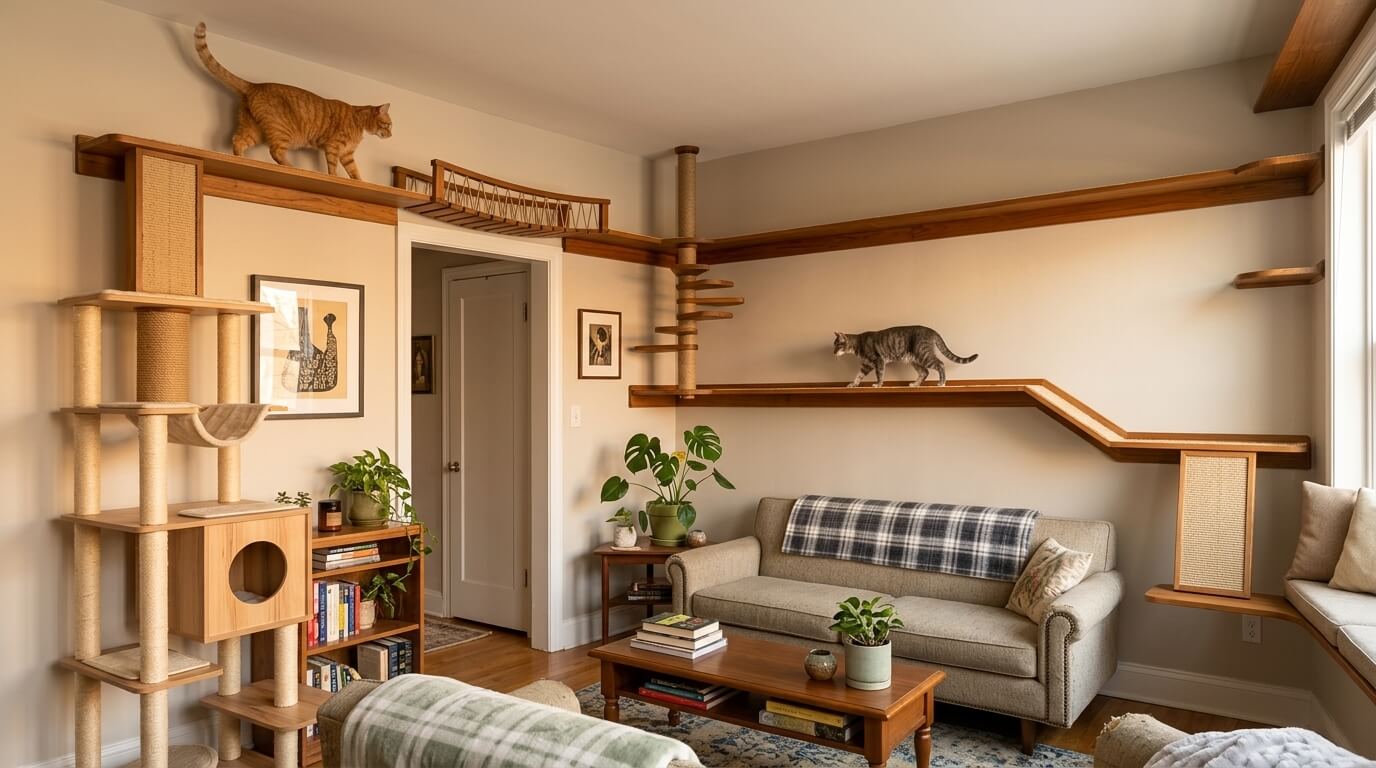
Cat superhighway ideas for apartments use connected cat trees, secured furniture tops, window perches, bridges, and properly installed shelves to create more usable vertical space without taking over the floor.
A safe route should provide stable footing, predictable landing areas, and more than one way on or off whenever another cat could block the path. Start with one simple connection at a comfortable height, observe how your cat uses it, and expand only after every element remains stable during climbing, landing, and turning.
Anchor tall furniture according to its manufacturer’s instructions, add a secure non-slip surface, and keep elevated routes away from hot appliances, open exterior doors, unprotected windows, ceiling fans, and other fall or burn hazards. Never use adhesive strips as the sole support for a weight-bearing cat shelf.
Older cats, kittens, large cats, and cats with pain or limited mobility may need lower platforms, shorter transitions, wider resting areas, and an easier route back to the floor. If your cat hesitates, slips, or repeatedly avoids part of the route, lower or simplify that section.
Quick Answer: What Is a Cat Superhighway?
A cat superhighway is a connected elevated route that allows a cat to climb, rest, observe, and move through a room without relying only on the floor. It may combine stable furniture, cat trees, window perches, ramps, bridges, and securely mounted shelves.
The best cat superhighway ideas create useful destinations rather than a decorative row of shelves. Each section should have secure traction, enough room for the cat using it, a clear next step, and an easy exit. In multi-cat homes, avoid narrow dead ends where one cat can block another.
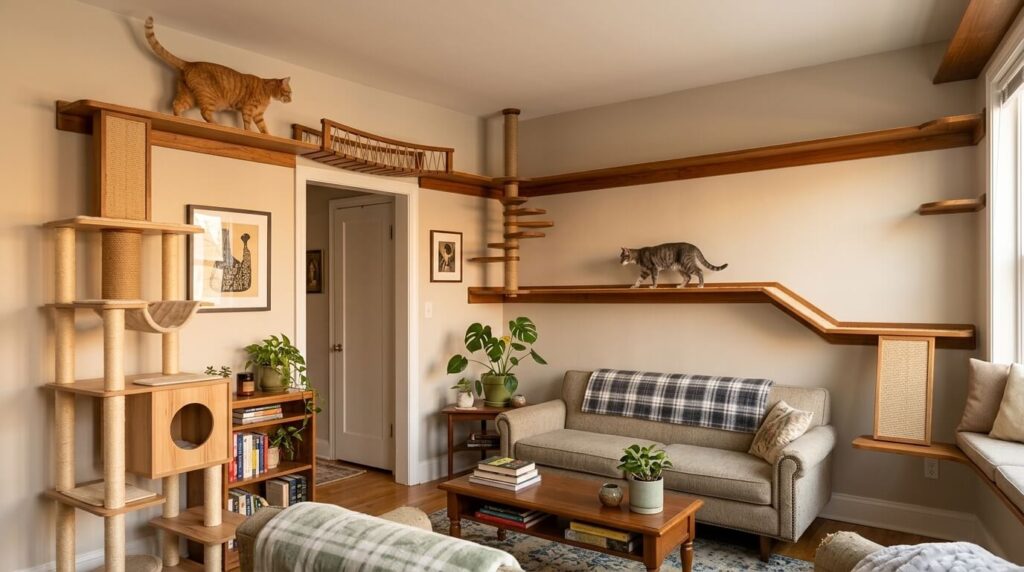
Table of Contents
Why Vertical Routes Can Help Indoor Cats
Vertical space gives an indoor cat more choices about where to rest, observe, hide, and move. Feline environmental guidelines recommend elevated safe places and separated resources because these options can increase a cat’s control over its surroundings.
In a single-cat apartment, a connected route can add climbing, observation, and resting opportunities without using much floor space. In a multi-cat home, additional vertical choices may also help cats avoid staring, blocking, or competing for one valuable perch.
A cat superhighway is not a treatment for aggression or a substitute for separated food, water, litter boxes, scratching areas, hiding places, and play. If cats are hissing, chasing, guarding resources, blocking doorways, or injuring one another, improve the overall resource layout and ask a veterinarian or qualified feline behavior professional for help.
For a broader room-by-room plan, use our guide to indoor cat enrichment in small apartments.
Safety Checks Before You Build a Route
Do not choose platform spacing from a universal chart. A comfortable transition for one young, athletic cat may be unsuitable for a kitten, senior cat, large cat, or cat with arthritis, vision loss, poor balance, or a previous injury.
Before adding any elevated element, check the following:
- The cat: Consider age, body size, mobility, confidence, vision, and current jumping behavior.
- The surface: Provide secure traction that will not slide, bunch, fray, or expose loose fibers.
- The support: Use hardware and attachment methods appropriate for the wall, furniture, platform, and expected movement. Follow the product instructions.
- The landing: Give the cat enough usable surface to land, turn, and choose the next step without slipping.
- The exit: Avoid a route that ends where another cat can block the only way down.
- The surroundings: Keep the route away from hot appliances, cooking areas, fragile objects, cords, open doors, unsafe windows, and moving fans.
- The furniture: Secure tall or narrow furniture according to its manufacturer’s anti-tip instructions before treating the top as cat space.
- The renter rules: Obtain written permission before drilling or making permanent changes.
If you cannot verify the wall material, fastener choice, furniture stability, or load rating, use a freestanding commercial system as directed or ask a qualified installer. A cat shelf is a dynamic surface: jumping and landing create different forces from an object resting still.
Plan the Route Before Installation
A useful cat superhighway begins with a floor plan, not a box of shelves. Draw the room or take a straight-on photograph of the wall, then mark the access point, resting destinations, return route, doors, windows, furniture, heat sources, and areas that must remain reachable for cleaning.
Treat the route as a sequence of decisions. Where will the cat first step up? Where can the cat pause without blocking the next platform? Can the cat turn around? Is there a clear way back to the floor? In a multi-cat home, what happens if another cat is sitting at the preferred destination?
Painter’s tape can help you visualize the position of proposed platforms on a wall, but it is only a planning marker. It must never be used to support a shelf, bridge, or cat. Compare the marked layout with the cat’s existing movement instead of assuming that a visually balanced arrangement creates comfortable transitions.
Next, check the human route through the room. An elevated pathway should not force people to duck, interfere with a door, create a head-level corner, or place a landing above a stove, desk equipment, fragile display, or frequently used seat. Make sure curtains, blind cords, electrical cables, and window openings will not become part of the cat’s route.
Plan for inspection as well as use. You should be able to see brackets and contact points, remove hair, clean the traction surface, and close access if something becomes loose. A platform that cannot be inspected easily may remain in service after damage begins.
Before buying several components, choose one access point and one useful destination. Confirm the wall material, furniture stability, installation requirements, and landlord rules. If any structural condition is uncertain, pause the project and ask a qualified installer rather than choosing fasteners from a generic online chart.
For multi-cat apartments, sketch a second route or lower alternative before adding height. The alternative does not need to mirror the main route. A stable cat tree, secured furniture top, or separate window seat may provide enough choice to prevent one cat from controlling the entire wall.
7 Safe Cat Superhighway Ideas for Apartments
1. A Secured Furniture-Top Route
Begin with furniture your cat already uses. A secured bookcase, low cabinet, or sturdy storage unit can become a resting station when its top is cleared, stable, and covered with a non-slip surface.
Do not place an unsecured board between pieces of furniture. A bridge can shift when a cat lands, and two units that look similar may move differently. If two furniture tops cannot be connected safely, treat them as separate destinations and provide an easier floor-level or cat-tree transition.
This approach works best when the furniture is already positioned near a useful destination, such as a protected window view or a quiet resting area.
2. A Stable Cat Tree Base Station
A cat tree can provide the first access point without requiring a cat to jump directly from the floor to a wall shelf. Choose a tree with a stable base, usable platform sizes, replaceable scratching surfaces, and a height your cat already approaches confidently.
Position the tree so its upper platform leads toward another safe destination, but do not create a gap merely because the platforms appear close in a photograph. Watch how your cat steps, turns, and descends before adding a connection.
If you need help choosing the base, compare the best cat trees for small apartments by stability, footprint, and platform design.
3. A Protected Window Destination
A window perch can give the route a purpose. Cats may use a pathway more readily when it leads to a comfortable observation or resting area.
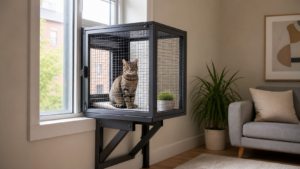
Use a perch designed for the window type and follow its current installation instructions. Check that the window screen or barrier is secure; a standard insect screen may not be designed to stop a cat from pushing through it. Keep blind cords and other entanglement hazards out of reach.
In a multi-cat home, avoid making the window the end of a narrow one-way path. Where practical, provide a second approach or an easy lower exit so one cat cannot control the only route.
For window-specific choices, see our cat window perch apartment guide.
4. A Low Corner Step Route
A corner can connect different heights without filling the center of the room. Use broad, stable steps or platforms that match your cat’s demonstrated mobility rather than copying fixed measurements from another home.
Test the lowest step first. If your cat stretches, scrambles, lands near an edge, or turns back, the transition is too demanding or unclear. Lower the next platform, add a ramp, improve traction, or use a larger resting surface.
Corner routes are useful for kittens, seniors, and less confident cats when they remain low and easy to reverse. They should not force a cat to climb toward the ceiling to find a way down.
5. A Doorway Bypass Route
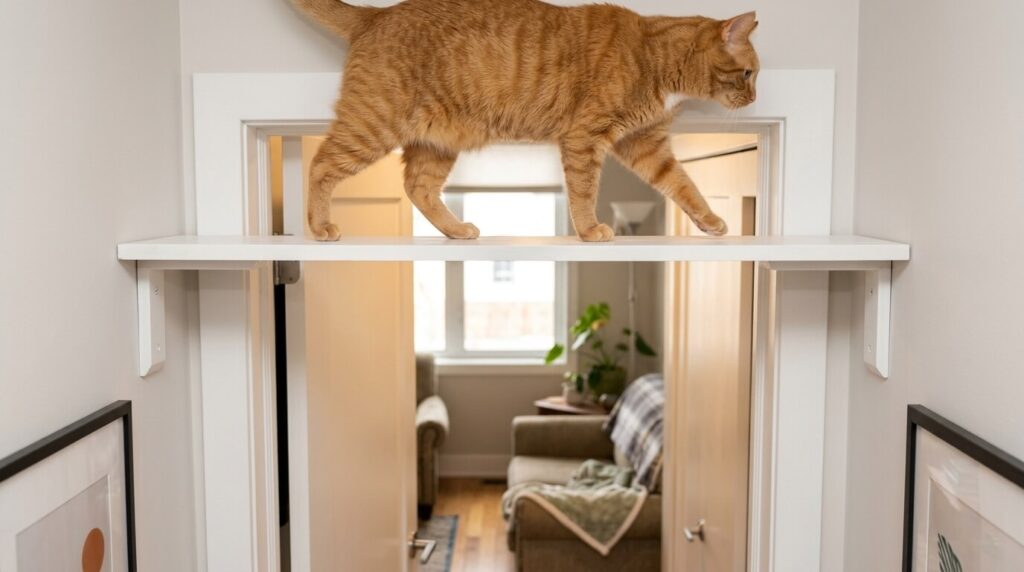
A properly designed route above or beside a doorway can provide another way through a narrow area. This idea is most relevant in multi-cat homes where one cat regularly stares at or blocks another near the doorway.
Door frames, surrounding walls, and trim are not interchangeable structural supports. Do not attach a platform to decorative trim or improvise a bridge with tension rods. A weight-bearing doorway route should be assessed for the actual wall and framing conditions and installed with suitable hardware.
The route also needs a safe approach and exit on both sides. A single shelf above a door is a perch, not a bypass, and may create another dead end.
6. Two Routes for a Multi-Cat Home
Instead of building one narrow “best” route, provide choices at different heights. One cat may prefer a higher observation area while another uses a lower cat tree, window seat, or furniture path.
Look for subtle blocking behavior: staring, waiting at the bottom of a cat tree, guarding the only window perch, or making another cat turn around. Add a visually separated resting option or a second exit instead of forcing both cats through the same junction.
Vertical space can support a multi-cat plan, but it should accompany separated resources in each cat’s preferred area. Do not place all valued resting spots, feeding stations, or play activities along one route.
7. A Modular Wall Route
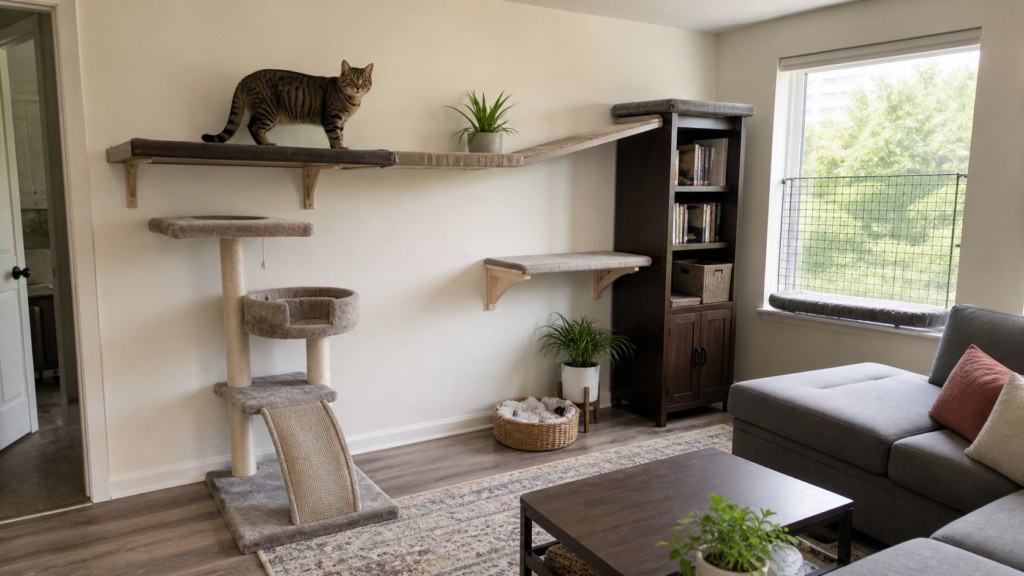
A modular system lets you begin with a few well-placed elements and expand only after observing real use. Start with an access point, one resting destination, and an easy way down. Add another platform only when it solves a specific problem in the route.
Choose wall shelves or a commercial system with clear installation instructions, usable surface depth, traction, and a stated load rating. Confirm that the installation method matches the wall material. Adhesive picture-hanging products are not a substitute for structural support.
For selection criteria rather than a universal construction formula, compare our guide to the best cat wall shelves for small apartments.
Connect the Route as a Complete Journey
A collection of elevated objects becomes a route only when the cat can understand how the parts connect. Think of each component as one of four types: an access point, a transition, a destination, or an exit.
The access point is the easiest place to begin. It may be the upper level of a cat tree, a low step, or a secured furniture surface the cat already uses. A transition moves the cat toward another location. A destination provides a reason to travel, such as a resting platform, protected window view, or quiet observation point. The exit returns the cat to the floor or to another familiar surface without requiring a difficult leap.
Some platforms can serve more than one function, but every route should still make the next choice obvious. If the cat reaches a surface and repeatedly looks down, stretches without stepping, backs away, or jumps past the planned landing, the connection is not working as intended. Improve the transition instead of adding another high platform.
Avoid placing the only comfortable resting platform in the middle of a narrow path. A sleeping cat can unintentionally close the route. In a multi-cat home, a valuable destination should not depend on passing a cat that is resting, staring, or waiting at a junction.
Also consider direction. A cat may climb confidently in one direction but hesitate when descending. Watch both movements before extending the route. A layout is not complete merely because the cat can reach the highest point; the cat also needs a controlled, understandable return.
The safest expansion is usually one connection at a time. Observe several voluntary trips in both directions, recheck stability and traction, and add the next component only when it creates a clear benefit.
Choose the Route for the Cat, Not the Room Photo
| Cat or home situation | Better starting route | Useful adjustment | Avoid |
|---|---|---|---|
| Confident adult cat | Stable cat tree plus one destination | Add traction and an easy return route | Expanding before observing use |
| Kitten | Low, closely connected platforms | Increase options gradually as coordination develops | High drops and unsupervised new routes |
| Senior or mobility-limited cat | Low steps, ramps, and broad resting areas | Shorten transitions and add easy ways down | Requiring repeated jumping |
| Large cat | Broad stable platforms and a strong base | Follow product load and installation instructions | Assuming a narrow perch is comfortable |
| Multi-cat home | Several routes or resting areas at different heights | Add visual separation and more than one exit | One contested dead-end perch |
| Rental apartment | Secured furniture and freestanding systems | Get written permission for permanent mounting | Adhesive-supported weight-bearing shelves |
Common Cat Superhighway Design Mistakes
The most common problems come from designing the wall as a photograph instead of designing a route for a particular cat. Review these mistakes before adding another component.
Building the Entire Route at Once
A completed wall may look efficient, but it removes the opportunity to learn from the cat’s behavior. If the first transition is uncomfortable, every later platform may remain unused. Begin with one access point and one destination, then expand after the cat uses both comfortably and the installation remains stable.
Copying Fixed Shelf Spacing
Online diagrams often present one set of distances as if it fits every cat. Comfortable movement varies with age, size, coordination, confidence, vision, joint health, surface traction, and whether the cat is climbing or descending. Use observed movement and the product’s installation limits rather than a universal spacing formula.
Prioritizing Narrow Decorative Shelves
A shelf can match the room and still be a poor resting or landing surface. The cat needs enough usable area to place the body, regain balance, turn, and prepare for the next movement. Decorative edges, objects, picture frames, or plants reduce usable space and may become falling hazards.
Using a Slippery or Loose Covering
Traction material should stay flat and secure during takeoff, landing, turning, and scratching. A rug remnant or cushion that slides may be more dangerous than the bare surface. Check for curling edges, loose fibers, exposed staples, worn adhesive, or material that bunches beneath the paws.
Creating a High Dead End
A single dramatic perch may leave the cat with only one difficult way down. This becomes more serious when another cat can sit below the exit. Add an easier return option or redesign the destination before increasing the height.
Routing Through Household Hazards
Do not place a pathway over a cooktop, near a moving ceiling fan, beside an unprotected window, across loose cords, or above fragile and valuable objects. Check how doors, curtains, blinds, lamps, and appliances move during normal daily use, not only when the room is quiet.
Renter-Friendly Cat Superhighway Ideas
The safest renter-friendly starting point is usually a system that transfers weight to the floor: a stable cat tree, secured furniture, or a freestanding unit used according to its instructions.
Adhesive strips may be appropriate for lightweight decorations when the manufacturer permits them, but they should not be the sole support for a platform that a cat will stand, jump, or land on. Dynamic movement can cause a mounting method to fail even when a static object seems secure.
If wall mounting would materially improve safety, ask the landlord or property manager for written permission. Describe the number and location of attachments, the proposed hardware, and how holes will be repaired at move-out. Do not promise that every landlord will approve the request.
Before buying a “no-drill” product, confirm that it is designed for cats, compatible with your ceiling or floor type, and installed within the manufacturer’s stated limits. Recheck any pressure-mounted system after moving it or changing the room conditions.
For broader lease and documentation considerations, see our renting with a cat tips guide.
How to Introduce a New Route
Let the cat investigate voluntarily. Do not place or hold a reluctant cat on an elevated platform.
Start with the lowest access point and reward calm investigation with a small treat, praise, or gentle play. Once the cat uses that section confidently, encourage movement toward the next easy platform. Progress according to the cat’s behavior rather than a fixed weekly schedule.
Keep food rewards within the cat’s normal daily intake. Do not place a full meal at a difficult high point, especially for a cat that is anxious, overweight, painful, or unsteady.
Stop the session if the cat freezes, crouches, repeatedly searches for a way down, slips, jumps past the intended landing, or becomes focused on another cat. Change the route instead of trying to force confidence.
How to Tell Whether the Route Works
Success is not measured by the highest platform or by whether the finished wall resembles the plan. A successful route is used voluntarily and allows the cat to move without scrambling, slipping, freezing, or making an uncontrolled jump.
Watch the complete trip rather than counting how often the cat appears on the final perch. Notice where the cat pauses, changes direction, bypasses a platform, lands near an edge, or chooses furniture instead of the intended access point. These details show which connection needs improvement.
Normal preferences also matter. One cat may use the route mainly for a morning window view, while another chooses a lower resting platform in the evening. Occasional use can still be meaningful when the route leads to a valued destination and does not create conflict or risk.
In a multi-cat home, observe what happens when both cats enter the room. A route that works when one cat is alone may fail when another cat watches the access point or occupies the only exit. Waiting, staring, turning away, or abandoning a preferred perch can indicate subtle blocking even without hissing or fighting.
Reassess the route after furniture changes, a move, weight or mobility changes, illness, injury, or the addition of another pet. A cat that suddenly stops climbing, begins missing familiar landings, hesitates on stairs, or avoids previously used surfaces may be experiencing pain, weakness, vision change, or another health problem. Close access to unsafe sections and contact your veterinarian rather than assuming that the cat has simply become bored.
Keep the parts that solve a real problem. Lower, move, or remove components that remain confusing or difficult. A shorter route that the cat uses confidently is more successful than a large installation that looks impressive but is regularly avoided.
Inspect and Maintain the Route
Check every element before first use and after installation, relocation, unusual impact, or visible movement. Continue routine checks based on the product instructions and the way the route is used.
Look for:
- loose fasteners, brackets, poles, or furniture connections;
- wobble, flexing, rotation, or a widening wall gap;
- worn traction, loose carpet, exposed staples, splinters, or sharp edges;
- surfaces that have become slippery from dust or wear;
- blocked exits caused by furniture changes;
- a cat that begins avoiding a platform it previously used.
Close access until a loose or damaged part is repaired. If the cat’s willingness or ability to climb changes suddenly, consider pain, injury, vision changes, or illness and contact your veterinarian.
Frequently Asked Questions
How high should a cat superhighway be?
There is no universal ideal height. Start at a level your cat already reaches comfortably and provide a simple way down. Kittens, seniors, large cats, and cats with mobility or vision limitations often need lower routes and easier transitions.
Can a heavy cat use wall shelves?
Yes, if the complete system is designed and installed for that cat and the actual wall conditions. Use broad resting surfaces, secure traction, suitable hardware, and the manufacturer’s stated limits. Do not choose spacing or load capacity from the cat’s weight alone.
Are cat superhighways useful for one cat?
They can be. A single indoor cat may use the route for climbing, observation, rest, and access to a window destination. Start with one useful connection instead of covering an entire wall.
Can I use Command Strips for a cat shelf?
Do not use adhesive picture-hanging strips as the sole support for a weight-bearing cat shelf. Choose a freestanding product or an installation method designed for the wall, platform, and expected movement.
What if my cat ignores the new route?
Give the cat time and keep the first step easy. Improve traction, lower the access point, or connect the route to a destination the cat already values. Do not place the cat on the platform or keep adding higher shelves to solve a poor starting point.
Final Thoughts
The safest cat superhighway ideas begin with the individual cat, not a fixed diagram. Build around stable surfaces, useful destinations, comfortable transitions, and easy exits.
Start with one secure access point and one resting destination. Observe how your cat moves before adding anything else. In a multi-cat home, prioritize choice and separated resources rather than one narrow route that every cat must share.
A successful apartment cat superhighway does not need to reach the ceiling or cover every wall. It only needs to give the cat safer, more useful ways to move through the space already available.
References
- American Association of Feline Practitioners and International Society of Feline Medicine. AAFP and ISFM Feline Environmental Needs Guidelines.
- American Association of Feline Practitioners. 2024 AAFP Intercat Tension Guidelines: Recognition, Prevention, and Management.
- American Association of Feline Practitioners. 2024 AAFP Indoor/Outdoor Lifestyle Position Statement.