.png)
If one cat keeps stealing another cat’s food, the fix is usually not discipline. The real solution is to change the feeding setup so each cat has protected access, enough time to eat, and less pressure around the bowl.
I fostered a cat named Noodle for six weeks last autumn — a two-year-old domestic shorthair with a personality that can only be described as enthusiastically chaotic and an appetite that operated completely independently of any concept of satiety or boundaries. Within forty-eight hours of Noodle’s arrival, Oliver — my measured, dignified Russian Blue — had begun retreating from his own food bowl the moment Noodle entered the kitchen. He would approach, assess the threat level, and withdraw.
Noodle, meanwhile, would complete his own meal in approximately ninety seconds and then position himself at Oliver’s bowl with the focused efficiency of someone who had been doing this professionally for years. The problem of one cat stealing other cats food is one I address regularly in clinical practice, and I want to be direct about the welfare stakes: it is not a minor inconvenience or a quirky multi-cat household dynamic.
Food theft creates obesity in the thief through chronic caloric excess, and malnutrition or significant stress in the victim through chronic caloric restriction and feeding-location anxiety — two simultaneous health crises that compound each other and are entirely preventable with the right management framework.
How to Stop One Cat Stealing Other Cats Food (Quick Answer)
To stop one cat stealing other cats food, implement ‘Station Feeding’ using separate rooms, utilize vertical space by feeding the agile cat on an elevated surface, and switch to scheduled meals instead of free-feeding. If the food thief is fast, start with a slow feeder cat bowl. If the victim cat needs protected access, compare feeder options in our best automatic cat feeders for indoor cats guide. When bowls still cannot be protected, a microchip feeder can open only for the assigned cat; compare the access controls and multi-cat limits in our best microchip cat feeder guide.
For the broader routine behind portions, schedules, feeders, and indoor weight control, see our apartment cat feeding and weight control guide.
Table of Contents
The Solitary Hunter Logic: Why ‘Sharing’ is a Human Concept
-1024x576.png)
To effectively address one cat stealing other cats food, you need to understand the evolutionary logic that makes food competition so deeply embedded in feline behavior — because managing it requires working with that biology rather than against it.
Domestic cats evolved as solitary hunters with exclusive territory and individual food resources. In the ancestral feline behavioral model, food sharing does not exist as a concept — prey is caught by one cat, consumed by one cat, and the caloric investment of the hunt belongs entirely to the individual who made it. There is no social structure that normalizes resource distribution, no pack hierarchy that allocates portions, no learned cooperation around food acquisition.
When multiple cats share a home, they are being asked to cohabit in a context that their evolutionary programming did not develop to navigate. The result is that food proximity creates automatic competitive pressure — not because your cats are misbehaving, but because their biology interprets a shared feeding space as a resource competition situation requiring active management. The cat who eats faster, eats more, and defends their position is following perfectly rational solitary-hunter logic. The cat who retreats is also following rational logic — avoiding a confrontation they calculate they cannot win.
Food theft is a proactive form of resource guarding in multi-cat homes. Like all resource guarding, it intensifies when resources feel scarce or unpredictable. Free-feeding can even increase food-theft motivation because constant food availability creates ambient competition rather than eliminating it. Free-feeding (leaving food out continuously) paradoxically increases food-theft motivation because the food’s omnipresence creates ambient competition rather than eliminating it.
The Risk of the ‘Vacuum’ Cat: Obesity and Malnutrition
The medical consequences of one cat stealing other cats food are not theoretical — they present in clinical practice with enough frequency that I consider them a differential diagnosis in any multi-cat household where one cat is overweight and another is underweight.
The thief’s medical risk profile:
A cat who consistently consumes their own meal plus partial or complete additional portions is in a state of chronic caloric excess. For a 10 lb cat with a daily requirement of 200 kcal, even 30 additional kcal per day — a small amount of stolen food — represents a 15% caloric surplus that produces approximately 0.5–1 lb of weight gain per month in a sedentary indoor cat.
Stolen portions are a major contributor to indoor cat weight gain. The difficult part is that owners often blame the thief’s regular portions instead of noticing the extra stolen calories, which can lead to unnecessary restriction without solving the real source of the weight gain.
The victim’s medical risk profile:
A cat who is chronically displaced from their food bowl by a food-aggressive housemate faces a different set of clinical consequences:
- Caloric restriction: Partial or complete meal avoidance leading to weight loss, muscle mass reduction, and hepatic lipidosis risk in severe cases
- Feeding anxiety: The development of a negative emotional association with the feeding location — a stress response that affects overall cortisol levels and can trigger stress-related illness including Feline Idiopathic Cystitis
- Prescription diet failure: For cats on medical diets, the inability to consume their allocated portion means the therapeutic intent of the diet is never achieved
- Behavioral suppression: Chronic retreat behavior around feeding can generalize to other resource-access situations, reducing the victim cat’s Resource Security and overall behavioral confidence in the shared home
Food stealing is usually part of a broader resource-access problem in small homes. For a complete setup covering feeding zones, litter access, resting spots, and conflict prevention, see our multi-cat apartment living guide.
Food stealing affects calories, weight, appetite tracking, and diet safety. For the full feeding framework, see our indoor cat feeding and weight control guide.
5 Proven Tactics: How to Stop One Cat Stealing Other Cats Food
Tactic 1: The ‘Door-Closed’ Strategy (Isolation)
The most clinically reliable method to stop one cat stealing other cats food requires no technology, no special equipment, and no training: physical separation of cats during all feeding events using a closed door between them.
This sounds obvious — and it is — but it is also systematically underimplemented because owners underestimate how quickly food theft occurs. A determined food thief can consume a housemate’s meal in under two minutes. The supervision requirement is not “watch them eat” but “maintain separation for the entire duration of the meal plus fifteen minutes post-meal” — the period during which a cat who has finished eating will attempt to access the remaining food of a slower eater.
The door-closed protocol:
- Designate permanent feeding locations for each cat — consistency is essential for establishing the routine that makes separation automatic rather than effortful
- Feed cats in separate rooms with the door fully closed — not ajar, not blocked with a baby gate, but fully closed with a physical barrier the food thief cannot bypass
- Maintain separation for a minimum of 20–30 minutes after placing the food — wet food meals typically require 10–15 minutes for completion; dry food meals may require 20+ minutes for slower eaters
- After the separation window, remove any uneaten food rather than leaving it accessible — this eliminates the post-meal theft opportunity
The studio apartment challenge: In open-plan spaces without separating doors, this tactic requires creative boundary creation — which I address in the FAQ section below. For more small-space layouts, see our guide on how to feed multiple cats separately.
Tactic 2: Vertical Feeding (Using Elevation)
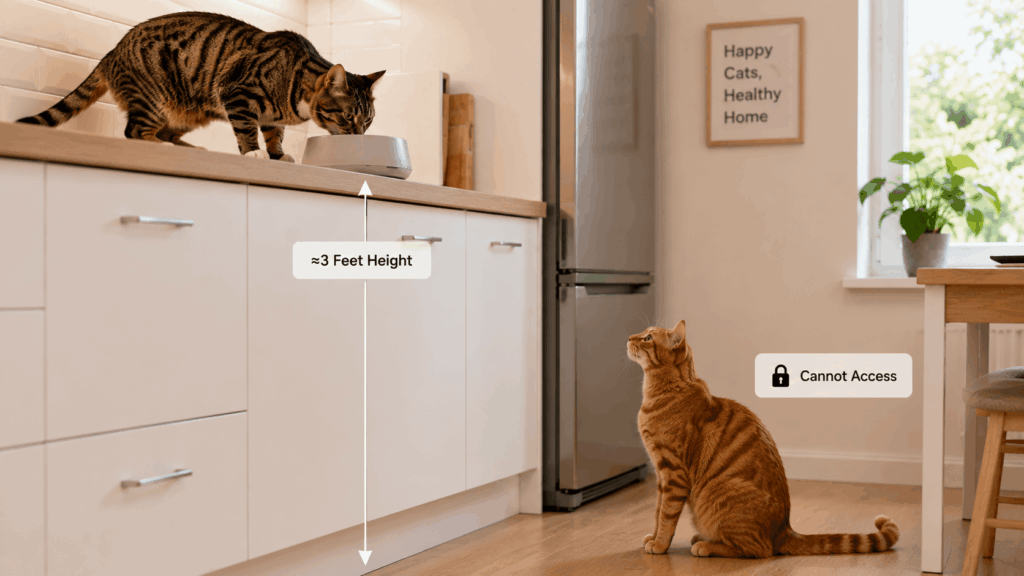
Vertical feeding is the most elegant solution to one cat stealing other cats food in small apartments where room separation is impractical — and it leverages a behavioral reality of the cat-food-thief dynamic: food thieves are almost always the more confident, ground-dominant cat, while victims are typically the more anxious, subordinate cat who has already self-selected lower positioning in the shared territory.
If the victim cat is physically capable of accessing an elevated surface (counter height, cat tree platform, or wall shelf) and the food thief is either less agile or simply less motivated to jump when ground-level food is available, feeding the victim at height provides effective separation without requiring a closed door.
Vertical feeding implementation:
- Identify the height the food thief will not access — most food thieves will jump to a surface if food is present there, so the target height must be high enough to create genuine access difficulty: minimum 36 inches for most cats, 48+ inches for athletic thieves
- Feed the victim cat at height consistently — they must develop a reliable association between “elevated surface” and “my meal location” before the thief’s learning curve can develop
- Remove the elevated food bowl after the meal window — leaving a food bowl at height with remaining food creates an elevated theft risk for athletic thieves
- For cats who are senior, arthritic, or mobility-limited: vertical feeding is not appropriate — use room separation instead
The counter ethics question: Many owners are reluctant to allow cats on kitchen counters for hygiene reasons. A practical compromise: use a wall-mounted cat shelf at 48-inch height positioned outside the primary food preparation area — this creates a permanent, designated feeding elevation that does not involve the food preparation surface.
Tactic 3: The ‘Nose-to-Tail’ Geometry
This tactic addresses a specific feeding dynamic I observe in multi-cat households: the problem of bowl proximity. Many owners place all cats’ food bowls in a cluster in the same corner of the kitchen — a configuration that makes it geometrically easy for one cat to eat from their bowl and then simply pivot to access the next bowl without meaningful displacement from their feeding position.
The Nose-to-Tail Geometry principle: position feeding bowls at distances that require complete physical displacement between meals — enough space that moving from one bowl to another requires leaving the feeding position entirely, which creates a behavioral barrier that slows theft and creates an intervention opportunity.
Geometric feeding placement rules:
- Minimum distance between bowls: 6 feet in the same room — this is the minimum distance that creates meaningful displacement, not a comfortable pivot
- Optimal placement: Different sides of the same room, or different rooms entirely
- Line-of-sight consideration: Cats who can see each other’s bowls experience higher competition anxiety than cats whose bowls are out of sightline — use furniture, room dividers, or corner positioning to break visual connection between feeding stations
- Approach angle management: Position bowls so that each cat’s feeding approach comes from a different direction — face-to-face feeding stations create direct competition pressure even when they are physically separated
Tactic 4: Slow-Feeders for the Thief
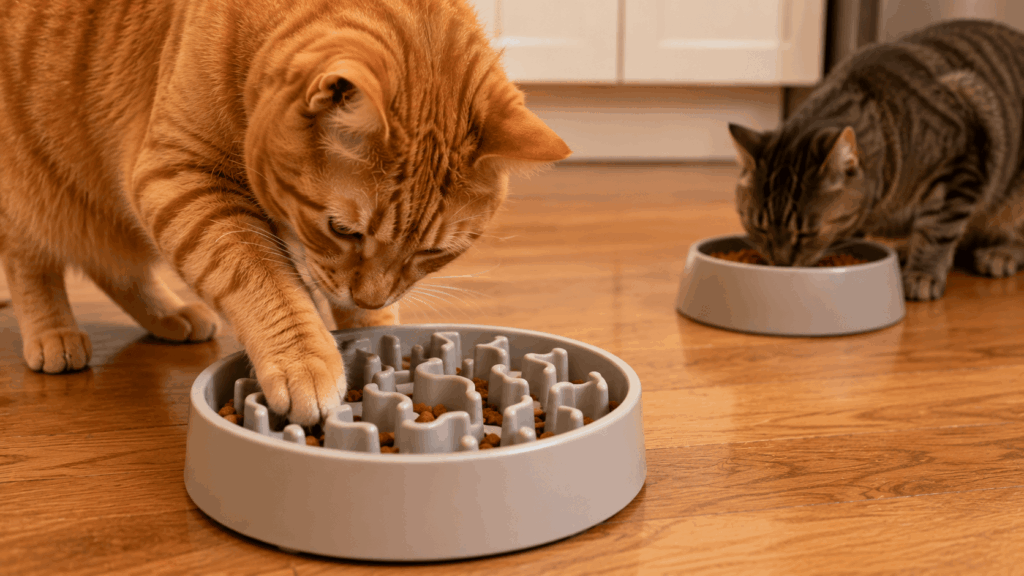
If physical separation is not fully achievable, slowing the food thief’s consumption rate to match the victim’s natural pace eliminates the behavioral opportunity for theft that speed differential creates. This is where a slow feeder cat bowl is most useful: it does not remove the thief’s motivation, but it can stretch a 90-second meal into several minutes so the other cat has time to finish. This tactic does not address the motivation for stealing — it addresses the temporal window during which theft is possible.
If your apartment layout makes separation difficult, start with our guide on how to feed multiple cats separately.
A food thief who normally consumes their meal in 90 seconds and then moves immediately to the victim’s bowl has a 90-second consumption window before their theft impulse activates. A food thief eating from a well-designed slow feeder who requires 8–12 minutes to complete the same caloric portion has a 8–12 minute consumption window — by which point the victim has likely completed their own meal and the theft opportunity has closed.
Slow feeder selection for the food thief:
- Maze-style feeders: Raised walls and channels require the cat to navigate food toward accessible positions — effective for kibble and wet food
- LickiMat (wet food): Spreading wet food across a textured silicone mat extends consumption to 8–12 minutes per portion — the most effective wet food slow-feeder mechanism
- Snuffle mats: Hide dry kibble in fabric tufts — extends consumption through foraging behavior
The difficulty calibration: Start at the lowest difficulty level and increase only when the cat navigates the current level in under 3 minutes. A slow feeder that is too difficult for the thief to access their full portion creates its own welfare problem — incomplete consumption and meal-associated frustration.
Slow feeders work best as one part of a structured feeding routine, not as a standalone fix. If your cats need separate zones, different meal timing, or a more predictable apartment feeding setup, start with our guide on how to feed multiple cats separately.
If the food thief eats too fast, a slow feeder can help stretch the meal while the other cat finishes. See our best slow feeder cat bowl guide for ceramic, stainless steel, silicone, wet food, and large-cat options.
Tactic 5: Microchip Security
A microchip feeder can reduce access by other cats, but it cannot guarantee complete dietary separation in every household. The SureFeed manufacturer manual explicitly notes this limitation. Supervise training, check for food stealing while the lid is open, and use separate feeding areas when the required separation cannot be verified.
If behavioral methods fail, a microchip feeder becomes the strongest mechanical barrier against food stealing. For protected feeding stations and portion-control options, compare the microchip and timed feeder choices in our best automatic cat feeders for indoor cats guide. The SureFeed Microchip Pet Feeder Connect’s sealed lid design opens only for the registered cat’s microchip signature, making it difficult for a non-registered cat to access the food through motivation, intelligence, or persistence.
If one cat needs medical food or a prescription diet, see our microchip cat feeder prescription diet setup guide.
The microchip feeder implementation protocol for food-theft households:
- Register the victim cat to the microchip feeder — their prescription or portion-controlled diet is protected by the sealed lid
- Feed the thief cat from a standard bowl in a separate location simultaneously — the thief does not need a microchip feeder unless their own diet also requires protection
- Position the units with maximum distance between the thief’s standard bowl and the victim’s microchip feeder — reducing the proximity motivation for theft attempts on the sealed unit
- Monitor for “sitting and waiting” behavior — some food thieves learn to wait at the microchip feeder for the victim to approach and trigger the opening, then attempt access during the brief lid-open window. The SureFeed’s sealed lid geometry prevents successful access during this behavior, but the waiting posture itself creates stress for the victim. If this behavior develops, move the units to separate rooms.
Vet Tech Tip: Using Body Condition Scores to Track the Victim
The victim cat in a food-theft dynamic loses weight in a pattern that is systematically underdetected by visual observation — because weight loss in cats occurs primarily as lean muscle mass reduction and coat quality degradation before visible prominence of skeletal landmarks, and because the gradual pace of chronic caloric restriction rarely produces the dramatic appearance change that triggers owner concern.
The Body Condition Score tracking protocol for multi-cat food-theft households:
- Assess BCS for both cats individually every 4 weeks — not visually, but by manual palpation of the ribcage
- For the victim cat: easy rib palpation without pressing (BCS 3), very prominent vertebral processes (BCS 2), or visible hip bones (BCS 2–3) are clinical indicators of significant caloric restriction requiring immediate intervention
- For the thief cat: ribs not palpable without firm pressure (BCS 6), absent waist definition from above (BCS 7), or prominent abdominal fat pad (BCS 7+) indicate caloric excess requiring portion reduction and food-theft management
Weekly weight monitoring: A digital kitchen scale used with the step-on-hold method (weigh yourself holding the cat, subtract your weight) provides BCS-independent weight tracking accurate to 0.1 lbs — a more sensitive early indicator than BCS changes alone.
When It’s Not Just Greed: Ruling Out Hyperthyroidism and Parasites
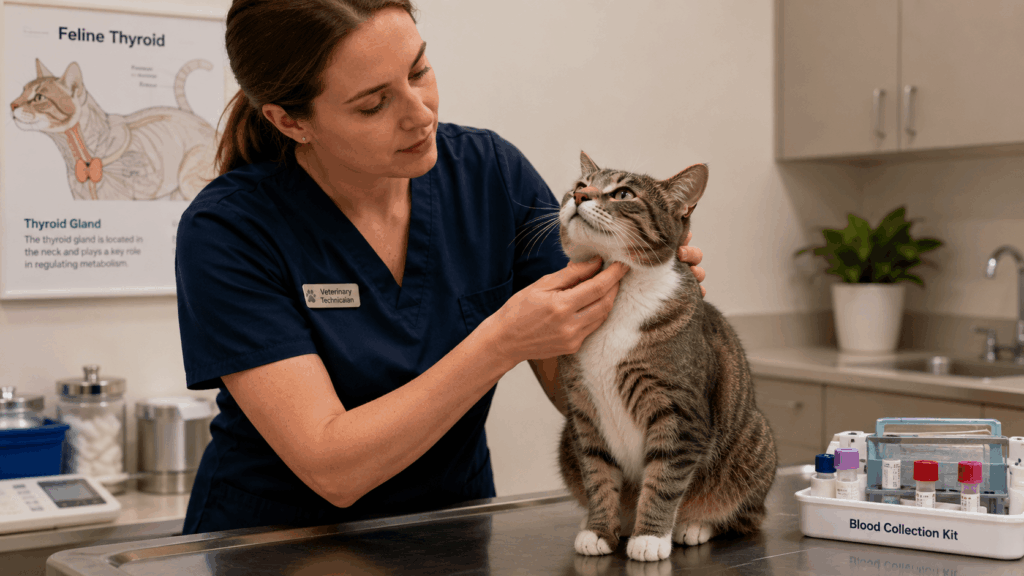
Before concluding that one cat stealing other cats food is a purely behavioral resource competition problem, clinical responsibility requires ruling out the medical conditions that produce pathologically increased appetite in cats — because a behavioral management program applied to a medically hungry cat is both ineffective and delays appropriate treatment.
Hyperthyroidism — the primary metabolic differential:
Hyperthyroidism — excessive thyroid hormone production — is the most common endocrine disease in cats over 10 years of age, and its most consistent behavioral manifestation is dramatically increased appetite. A previously well-mannered cat who suddenly becomes a food thief after years of stable cohabitation warrants immediate T4 testing to rule out hyperthyroidism before behavioral interventions are initiated.
Clinical indicators suggesting medical evaluation:
- Sudden onset of food-theft behavior in a previously well-managed cat — behavioral food guarding develops gradually; sudden onset suggests acute change in appetite drive
- Food theft accompanied by weight loss — hyperthyroid cats eat dramatically more while losing weight (increased metabolic rate exceeds caloric intake)
- Increased thirst and urination accompanying food-theft behavior — suggest diabetes mellitus or CKD as concurrent differentials
- Age over 8 years in the food-stealing cat — significantly elevated hyperthyroidism probability
Intestinal parasites:
Heavy intestinal parasite burden creates increased appetite through caloric malabsorption — a parasitized cat may be genuinely hungry despite consuming their normal portion. Fecal examination and routine deworming should be part of the diagnostic workup for any cat showing sudden onset of excessive food-seeking behavior.
The clinical rule: Any sudden change in food-stealing behavior — particularly in a cat over 8 years old — warrants veterinary blood panel and fecal examination before behavioral interventions are finalized. Managing a medical condition with behavioral tools is not clinical negligence — it is a missed opportunity for treatment.
FAQ: Your Top Questions Answered
Will my cats eventually learn to share their food if I let them work it out?
No — and this is one of the most clinically important misconceptions I address with multi-cat owners. Cats do not possess the social learning architecture to develop voluntary food sharing through repeated exposure to competition.
What happens when food-theft situations are allowed to “work themselves out” is not the development of tolerance — it is the establishment of a stable competitive hierarchy in which the dominant cat consistently eats first and most, the subordinate cat consistently receives less than their portion, and both outcomes become more entrenched over time rather than less. The subordinate cat does not become more assertive; the dominant cat does not become more generous.
The clinical consequences (obesity in the thief, caloric restriction in the victim) worsen progressively rather than resolving. The correct management approach is human-implemented structural change, not cat-self-regulation.
What if I live in a studio apartment with no doors to separate them?
This is the most common practical challenge in urban cat ownership, and it has genuine solutions that do not require architectural modification. Tactic 1 (Room Separation) can be partially implemented using a tall pet gate — not as a perfect barrier (a motivated food thief can jump most gates) but as a visual and mild physical barrier that slows the theft impulse long enough for the victim to complete eating.
For studios where even gates are impractical, Tactic 2 (Vertical Feeding) paired with Tactic 4 (Slow Feeders for the Thief) creates the most effective available barrier without physical room separation — the victim eats at counter height (inaccessible to or undesirable for the thief), and the thief’s extended slow-feeder consumption time closes the theft window. For a more detailed layout plan, use our guide on how to feed multiple cats separately in a small apartment.
Tactic 5 (Microchip Feeder) remains fully effective regardless of apartment layout — the sealed lid provides theft-proof access regardless of whether the cats are physically separated.
Is it okay to punish a cat for stealing food to stop one cat stealing other cats food?
No — and I want to be direct about this because punishment-based approaches to one cat stealing other cats food create multiple clinical problems beyond simply not working. Cats do not connect punishment delivered after the behavioral event with the behavior itself — the time window for behavioral association in cats is 2–3 seconds maximum.
Any punishment delivered after the theft event (which is how owners typically discover it) is perceived by the cat as random aversive stimulation, not as a consequence of the specific stealing behavior. The result: the punished cat develops anxiety and stress around the owner’s presence in the kitchen, not reduced motivation for food theft.
Additionally, punishment in a multi-cat environment escalates inter-cat tension — the associated stress can redirect onto the victim cat as redirected aggression, worsening the victim’s welfare further. Effective management is structural (the five tactics above), not punitive.
Final Thoughts
One cat stealing another cat’s food is not just a manners problem. In most multi-cat homes, it means the feeding setup is asking cats to share a resource in a way that does not feel secure to them.
The best fix is usually layered. Start with predictable meals and physical separation. Use the tool that matches the actual problem: a slow feeder for speed eating, a puzzle feeder for active eating, and an automatic or microchip feeder when one cat needs protected access to their own food. Add vertical feeding, slow feeders, or puzzle feeders when they match the cat’s behavior. Use microchip feeders when one cat needs protected food, weight control, or a prescription diet.
Do not wait until the victim cat loses weight or the food thief gains too much. A calm feeding routine protects both cats: one gets enough food without pressure, and the other stops practicing a habit that can lead to obesity, conflict, and stress.
If food stealing is happening alongside guarding, chasing, litter box blocking, or one cat avoiding shared spaces, treat it as a whole-home resource issue. Review the apartment setup, not just the bowls, with our multi-cat apartment living guide.
References
- Crowell-Davis, S. L., Curtis, T. M., & Knowles, R. J. (2004). Social organization in the cat: A modern understanding. Journal of Feline Medicine and Surgery, 6(1), 19–28. https://doi.org/10.1016/j.jfms.2003.09.013
- Bradshaw, J. W. S., Casey, R. A., & Brown, S. L. (2012). The Behaviour of the Domestic Cat (2nd ed.). CAB International. Referenced in context of feline feeding ecology, solitary hunting behavior, and inter-cat resource competition dynamics. https://doi.org/10.1079/9781845937041.0000