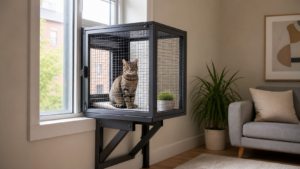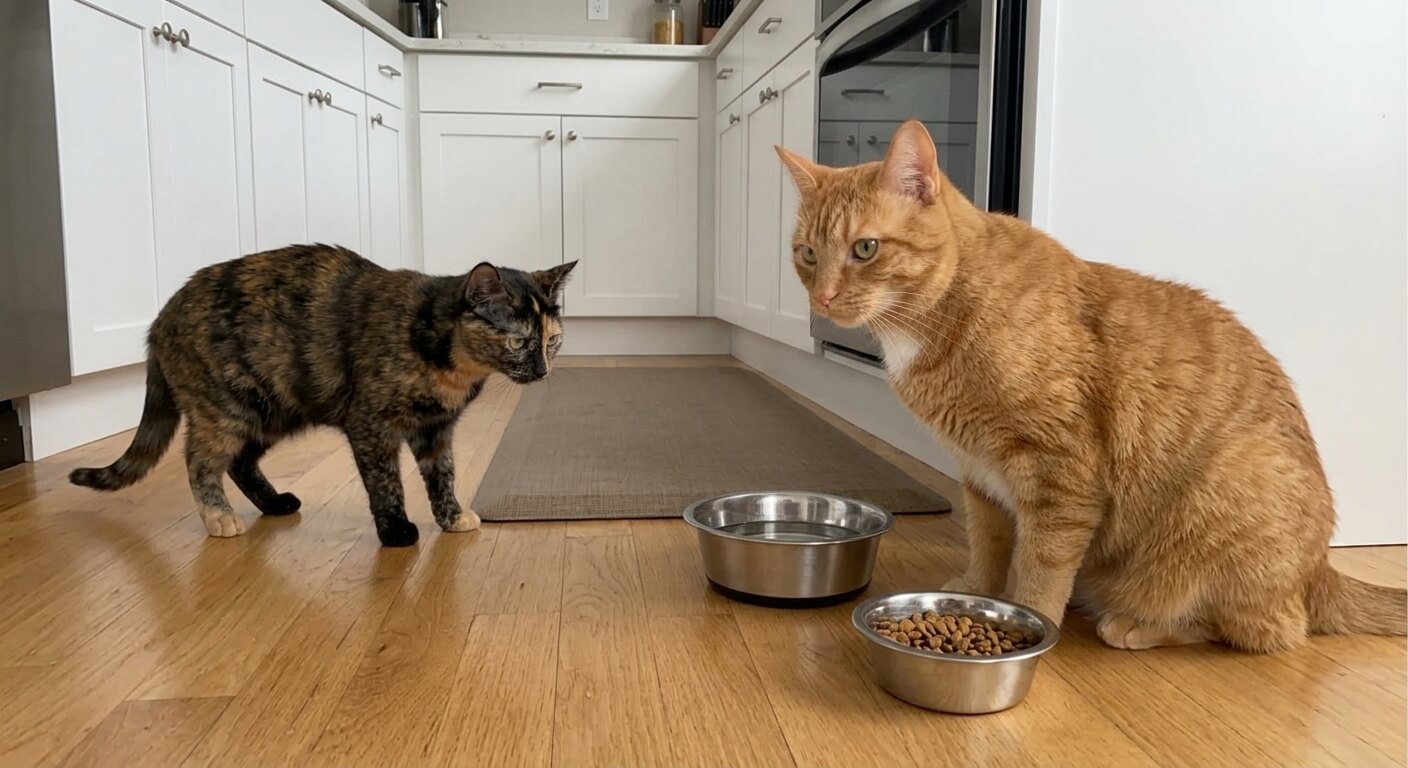
Cat resource guarding happens when one cat limits another cat’s access to something important, such as food, water, litter boxes, resting places, doorways, toys, elevated spaces, or a familiar person. It does not always look like a fight. A cat may control a resource simply by staring, waiting in a hallway, sitting beside a bowl, following the other cat, or occupying the only route to a litter box.
The first solution is not punishment and it is not forcing the cats to share. Reduce competition by giving each cat safe access to essential resources in separate locations. Feed them apart, create more than one route through important areas, add hiding and elevated spaces, and make sure one cat cannot control every useful station from a single position.
If the cats are fighting, if either cat is injured, or if one cat is no longer eating, drinking, eliminating normally, or moving comfortably around the home, separate them safely and contact a veterinarian. Sudden tension can be associated with pain, illness, a frightening event, a change in scent, or the arrival of a new animal.
Quick Answer: How Do You Stop Cat Resource Guarding?
To reduce cat resource guarding:
- Rule out pain and medical changes.
- Separate the cats if there is active fighting or fear.
- Identify exactly which resources and routes are being controlled.
- Give every cat separate food, water, litter, rest, hiding, and scratching options.
- Place those resources in different locations and out of one another’s sight.
- Prevent food theft and doorway blocking with doors, visual barriers, or selective-access equipment.
- Rebuild calm associations gradually instead of forcing close contact.
The goal is not to make the cats eat side by side, sleep together, or become close friends. Success means every cat can reach essential resources, rest, move around, and interact with the household without being threatened or displaced.
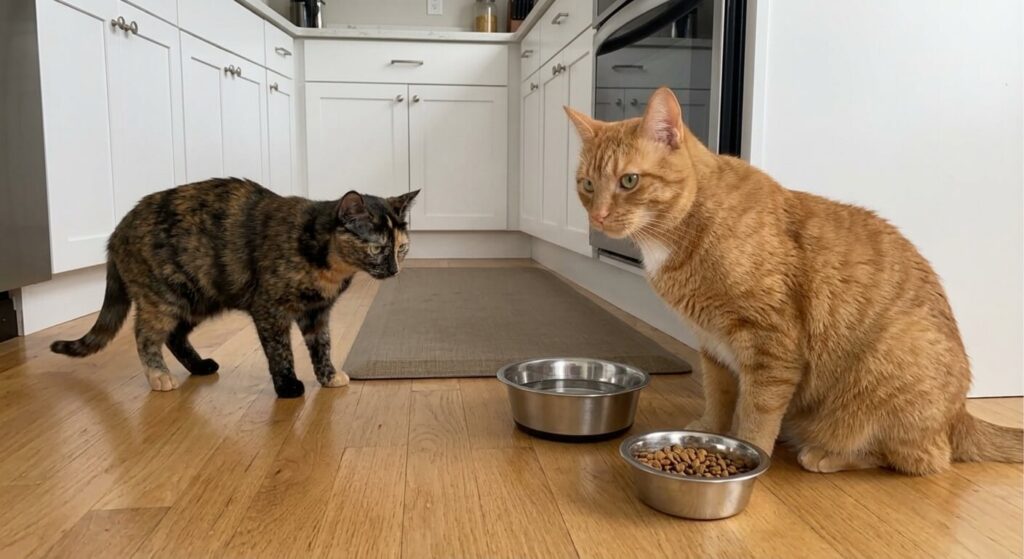
Table of Contents
What Cat Resource Guarding Looks Like
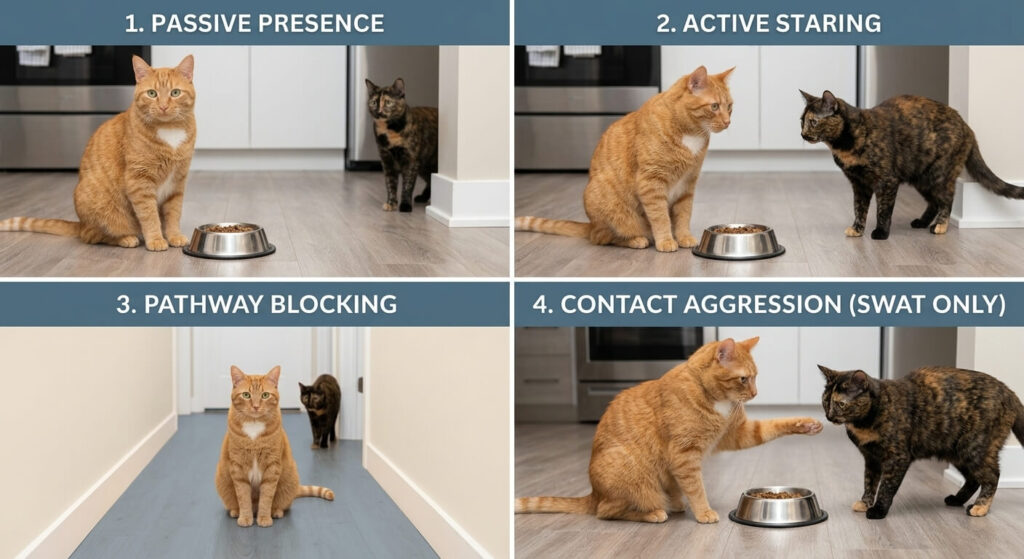
The term “resource guarding” is familiar to many dog owners, but conflict between household cats is often described more accurately as intercat tension or competition over resources. The 2024 AAFP Intercat Tension Guidelines emphasize that signs may be subtle, including staring and blocking, or overt, including stalking, chasing, hissing, swatting, and fighting.
Watch what happens before one cat leaves, not only what happens during a fight. The cat creating pressure may barely move. The affected cat may make the conflict invisible by yielding every time.
Subtle signs
- Sitting close to a food or water station without using it
- Staring at another cat until that cat turns away
- Lying across a hallway, stairway, or doorway
- Following another cat toward a litter box
- Approaching whenever the other cat receives attention
- Taking over a bed, perch, or window when the other cat arrives
- Waiting outside a covered litter box or narrow room
- Entering a room whenever the other cat begins to eat
- Occupying a central position from which several resources can be watched
More obvious signs
- Eating from the other cat’s bowl
- Chasing a cat away from food, water, litter, or a person
- Stalking or ambushing around corners
- Hissing, growling, yowling, or swatting
- Urine or fecal marking during household tension
- Repeated fights or injuries
Signs in the cat losing access
The most useful clues may appear in the cat that is being displaced:
- Waiting until the other cat sleeps before eating or using the litter box
- Eating very quickly when an opportunity appears
- Drinking from faucets, glasses, or unusual locations
- Spending most of the day in one room or on one piece of furniture
- Taking long detours around another cat
- Freezing, crouching, hiding, or scanning before moving
- Urinating or defecating outside the litter box
- Playing less or no longer approaching family members
- Losing weight or showing a change in appetite
- Leaving a preferred spot as soon as the other cat appears
These behaviors do not prove resource guarding by themselves. Pain, urinary disease, gastrointestinal illness, dental problems, mobility changes, vision loss, and other medical issues can also change eating, elimination, and social behavior. A veterinary assessment is especially important when the change is new.
Why Resource Guarding Develops in Multi-Cat Homes
Cat resource guarding is not evidence that one cat is “bad,” jealous, spiteful, or trying to become the household alpha. The AAFP guidelines caution against interpreting household conflict as cats trying to establish a simple dominance hierarchy. Tension is more often related to resource competition, incompatible social relationships, fear, frustration, pain, illness, or environmental changes.
Too few usable resources
Two bowls beside each other may look like two feeding stations to a person. To cats, they can function as one location that a single cat can control. The same is true of three litter boxes lined up in one laundry room.
A resource is not genuinely available if a cat must pass the other cat, enter a dead-end space, or expose itself to an ambush to reach it.
Resources concentrated in one area
Food, water, litter boxes, beds, and scratching posts often end up in the rooms that are convenient for people. When everything valuable is clustered together, a confident cat may monitor several resources from one doorway or central perch.
Incompatible social groups
Cats sharing a home are not necessarily one social group. Cats that sleep touching, groom one another, rub against each other, and approach with tails raised are more likely to be socially affiliated. Other cats may merely tolerate each other or organize their day so they rarely meet.
Unrelated cats can live successfully together, but they should not be required to share intimate spaces or essential resources just because they live at the same address.
A difficult introduction
Putting unfamiliar cats together too quickly can establish a pattern of chasing, hiding, and defensive behavior. If tension began after a new cat arrived, separating the cats and completing a gradual reintroduction may be more effective than continuing to expose them to conflict.
Our guide to introducing a second cat in a small apartment covers the initial introduction process in detail.
Pain, illness, or a change in scent
A previously peaceful relationship can change when one cat is painful, behaves differently, or returns from a veterinary visit smelling unfamiliar. An outdoor cat visible through a window can also trigger arousal that is redirected toward a housemate.
Do not assume a sudden conflict is purely behavioral. Both the cat applying pressure and the cat withdrawing may need a veterinary examination.
Restricted routes in a small home
Hallways, stairs, doorways, and narrow passages can become control points. A litter box at the end of a closet or a bed with only one exit may trap a less confident cat. Floor area alone does not determine whether a home works for multiple cats; routes, visibility, vertical space, and escape options matter.
Resource Guarding or Normal Cat Behavior?
Not every use of the same object is guarding. One cat sitting on a window perch is not a problem if the other cat has acceptable alternatives and can approach or leave without pressure. A cat finishing food first is not necessarily guarding if both cats receive and consume their own portions safely.
Ask three practical questions:
- Does one cat change course because the other cat is present?
- Can every cat reach an equivalent resource without passing or confronting the other?
- Is either cat showing fear, avoidance, reduced intake, house-soiling, or injury?
Repeated displacement, restricted access, or distress indicates a management problem even when there is no physical aggression.
Start With a Resource and Route Audit
Before moving objects at random, map the home from each cat’s perspective.
Create a list of:
- Food stations
- Water stations
- Litter boxes
- Resting and sleeping places
- Hiding places
- Scratching surfaces
- Window views
- Elevated perches
- Favorite toys
- Places where people provide attention
- Doorways, corridors, and stairs connecting these locations
For several days, note which cat uses each location, when it is used, and what happens when the other cat approaches. A stationary home camera can reveal blocking that occurs when no person is present.
Look for:
- Several resources visible from one guarding position
- Side-by-side bowls that do not provide privacy
- Litter boxes grouped in one room
- Dead ends with only one way in and out
- A timid cat whose entire routine is limited to one area
- A cat waiting for specific times when the other is absent
- Outdoor cats visible near windows or doors
Do not deliberately create a confrontation to test the cats. Observe normal movement and make access easier immediately if a pattern is already obvious.
7 Ways to Reduce Cat Resource Guarding
1. Arrange a Veterinary Check for New or Escalating Tension
Pain and illness can reduce tolerance, make handling uncomfortable, change scent, and alter a cat’s normal behavior. A cat that once moved easily may begin guarding a preferred location because climbing or walking is painful. Another cat may react to that behavioral change.
Contact a veterinarian when:
- Tension appears suddenly
- A cat becomes irritable when touched or approached
- Eating, drinking, grooming, mobility, sleep, or litter habits change
- A cat loses or gains weight unexpectedly
- Conflict begins after a veterinary visit, procedure, or illness
- A senior cat shows new social or spatial confusion
Record short videos when it is safe to do so, but do not stage an encounter. Note the timing, location, body language, and what happened immediately before and after the event.
If sudden aggression is the main concern, also review why an indoor cat may suddenly become aggressive.
2. Separate Cats Safely When Conflict Is Active
If cats are fighting or one cat cannot relax, short-term separation protects both cats and stops repeated conflict from becoming the daily routine.
Give each cat a secure area containing:
- Food
- Water
- A litter box
- A bed and hiding place
- A scratching surface
- Toys and calm human interaction
Do not reach between fighting cats or pick up a highly aroused cat. Redirected aggression can injure people. Use distance and a large visual barrier—such as a sturdy piece of cardboard, a cushion, or a blanket—to interrupt sight lines and guide the cats apart. Close solid doors once they are separated.
Separation is not punishment. It creates a period in which arousal can decrease and both cats can meet basic needs without confrontation.
Seek urgent veterinary care for puncture wounds, bleeding, limping, breathing difficulty, eye injury, severe pain, collapse, or any other concerning injury.
3. Provide Multiple, Separated Essential Resources
The most important environmental change is to provide choice. Each cat needs reliable access to food, water, toileting, resting, hiding, scratching, and play opportunities.
“Multiple” and “separated” are equally important. Stations should be distributed so one cat cannot supervise all of them at once. When possible:
- Put food stations in different rooms or behind visual barriers.
- Separate food from water.
- Place water in more than one quiet location.
- Put litter boxes in separate areas rather than in a row.
- Offer resting and hiding places in each cat’s preferred territory.
- Provide both horizontal and vertical scratching options.
- Duplicate highly valued resting or window locations.
The familiar “one litter box per cat plus one extra” rule is a useful starting point, but the number alone does not guarantee access. Three boxes together can still act like one toileting station. Socially unaffiliated cats may need separate litter locations within their own preferred areas.
Each station should have an unobstructed route. Avoid placing a necessary resource in a closet, tight corner, or room where another cat can wait at the only exit.
4. Feed Cats Separately and Prevent Food Theft
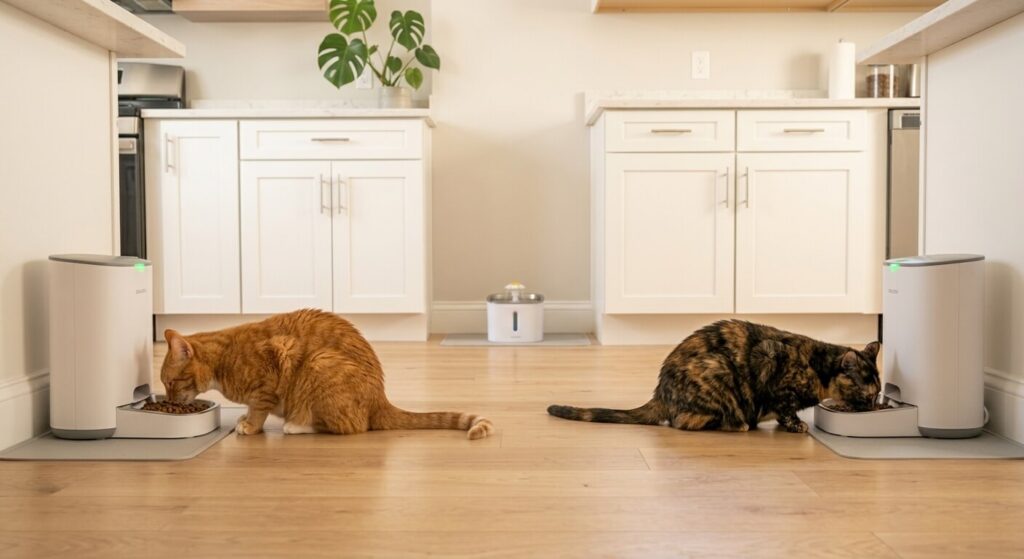
Feeding cats shoulder to shoulder is not a test of friendship. The 2024 AAFP Intercat Tension Guidelines recommend separating cats during feeding, including cats that appear affiliated, to reduce food competition.
Options include:
- Closed rooms during meals
- Feeding at opposite ends of a room with an opaque barrier
- Feeding on different levels only when both cats can access them comfortably
- Supervised scheduled meals
- Microchip-activated feeders for individual access
Place bowls so cats do not have to face or watch each other. Remove leftovers after a suitable meal period unless a veterinarian has prescribed another plan. Keep a record when monitoring appetite or medication.
A microchip feeder can protect one bowl, but it cannot resolve tension throughout the home. Another cat may still wait nearby, block the route, or guard water and litter. Use selective feeders as one part of a broader environmental plan.
For the exact meal setup, see how to feed multiple cats separately. If the primary problem is stealing rather than broader household blocking, use our guide to stopping one cat from stealing another cat’s food.
5. Add Safe Places, Vertical Space, and More Than One Exit
An effective safe place allows a cat to rest without being cornered. In multi-cat homes, hiding and resting options should ideally offer more than one approach or exit so another cat cannot trap the occupant.
Useful changes include:
- Open-sided shelves at different heights
- Stable cat trees with more than one route down
- Boxes with two openings
- Chairs or low furniture arranged as stepping points
- Window perches in separate rooms
- Visual screens beside resting spaces
- Ramps or steps for cats with limited mobility
Vertical space helps only when it is accessible and escapable. A single tall tower with one narrow route can become another guarded resource. Distribute perches instead of creating one premium location.
Watch landing points and bottlenecks. If every high route ends beside the same confident cat, the extra height has not created useful choice.
6. Change Traffic Flow and Block Triggering Views
Sometimes the resource is available but the route is not safe. Use furniture and visual barriers to prevent long stare-downs and create alternate paths.
Try:
- Moving a litter box away from a dead-end hallway
- Pulling furniture away from the wall to create a second route
- Using a screen so bowls are not visible to each other
- Adding a second doorway when a safe renovation is possible
- Keeping doors open with secure stops so they cannot trap a cat
- Applying privacy film to windows where outdoor cats appear
- Moving a perch away from a doorway used for ambushes
In severe cases, a microchip-activated cat flap can give a vulnerable cat access to a protected room. The protected space must still contain all essential resources and should not leave the other cat without adequate space or care.
Changing traffic flow is often more effective than repeatedly moving the cat that blocks. It removes the opportunity to control a route rather than relying on a person to intervene every time.
7. Rebuild Calm Associations Gradually
Environmental changes may be enough for mild tension. When cats react strongly at the sight of each other, a structured reintroduction may be necessary.
Begin with complete separation. Proceed only when both cats are eating, resting, playing, and using the litter box normally in their separate spaces.
A gradual sequence may include:
- Scent exposure without contact: Exchange bedding or use a clean cloth to transfer cheek scent only if neither cat reacts negatively.
- Positive activities on opposite sides of a closed door: Feed or play at whatever distance keeps both cats relaxed.
- Brief visual access through a secure barrier: Maintain enough distance and provide escape options.
- Short supervised proximity sessions: End before staring, stalking, crouching, tail lashing, or chasing begins.
- Longer shared time only after repeated calm sessions: Continue providing separate resources.
Progress is not measured by how close the cats can be. It is measured by relaxed body language and the ability to disengage.
Do not carry one cat toward the other, confine them together, or allow them to “fight it out.” If either cat stops eating, hides persistently, lunges at barriers, or cannot remain below threshold, return to an easier stage and seek professional guidance.
What Not to Do
Do not punish either cat
Yelling, spraying water, shaking objects, scruffing, or physically moving an aroused cat can increase fear and associate the other cat’s presence with unpleasant events. Punishment does not create additional resources or safe routes.
Do not label one cat as dominant or a bully
Labels can hide the actual cause. Identify the location, resource, trigger, and behavior instead: “Cat A sits in the hallway when Cat B approaches the litter room” is actionable. “Cat A is jealous” is not.
Do not force sharing
Cats do not need communal bowls, one favorite bed, or side-by-side affection sessions. Separate, predictable access reduces conflict.
Do not add new cats to solve the relationship
A kitten or third cat is unlikely to repair tension between two residents and may increase competition.
Do not rely on a diffuser alone
Synthetic feline pheromones may be a useful adjunct for some cats, but they cannot compensate for blocked litter boxes, shared food, pain, or repeated attacks. Environmental and behavioral changes remain necessary.
Do not withhold food to encourage cooperation
Every cat must consume an appropriate amount. A frightened cat should not have to approach another cat to eat. Contact a veterinarian promptly if a cat is eating substantially less or stops eating.
Resource-by-Resource Setup
Food
Give each cat an individual station with visual or physical separation. Monitor portions and confirm which cat ate. If one cat needs a prescription diet, a closed room or microchip feeder may help protect access.
Water
Provide bowls or fountains in several quiet locations. Do not put every water source beside food or in the same room. Clean them regularly and observe actual use rather than assuming all cats drink from the same fountain.
Litter boxes
Use large, accessible boxes in separate locations. Avoid dead ends, noisy appliances, and places where a cat can be ambushed. A house-soiling cat needs a veterinary evaluation; do not assume the behavior is revenge or solely social.
See our guide to cat urinating outside the litter box for the medical and litter-box factors that also require attention.
Resting and hiding places
Provide enough options that cats do not need to displace each other. Include quiet low spaces and elevated areas. Hiding places should not become traps.
Scratching surfaces
Place scratching posts or pads near each cat’s resting and activity areas. One post in a central room may not serve a cat that avoids that room.
Play and attention
Offer individual interactive play sessions if joint play creates stalking or competition. Store high-value toys between sessions when they trigger conflict.
Human attention can become a focus of tension, but the response should not be forced simultaneous petting. Give each cat predictable individual contact in a location where the other cannot interrupt. Reward relaxed behavior at a comfortable distance.
How to Tell Whether the Plan Is Working
Improvement may be quiet. Do not wait for the cats to cuddle.
Positive signs include:
- Both cats use resources throughout the day
- The affected cat takes shorter or fewer detours
- Less staring, following, blocking, or waiting
- Normal appetite and stable weight
- Relaxed resting in more than one area
- Normal litter-box use
- More play, grooming, exploration, and social contact with people
- Cats can notice each other and then disengage
Keep a weekly log of eating, body weight when appropriate, litter use, locations, and conflict events. Video can help a veterinarian or behavior professional distinguish playful chasing from tension.
Progress may be uneven. A visitor, home renovation, veterinary appointment, outdoor cat, or schedule change can temporarily increase tension. Return to the last setup in which both cats were comfortable.
When to Get Professional Help
Contact your veterinarian promptly if:
- A cat stops eating or eats much less
- There is weight loss or dehydration concern
- A cat strains to urinate, produces little or no urine, or repeatedly enters the litter box
- There are wounds, limping, eye injuries, or signs of pain
- House-soiling begins suddenly
- Aggression appears without a clear environmental change
- A cat remains hidden or confined to one area
- The cats cannot be together without stalking, chasing, or fighting
Urinary straining—especially in a male cat—can be an emergency and should not be treated as a behavior problem.
After medical issues are addressed, a board-certified veterinary behaviorist or another appropriately qualified feline behavior professional can develop a plan for environmental management, behavior modification, and reintroduction. Prescription medication is sometimes used for fear, anxiety, frustration, or pain, but only under veterinary direction and alongside environmental changes.
Permanent separation within the home may be the safest outcome for some pairs. In other situations, carefully planned rehoming may provide better welfare than repeated conflict. The standard for success is safety and quality of life, not keeping incompatible cats in unrestricted contact.
Frequently Asked Questions
Can cats guard resources without growling?
Yes. Cat resource guarding can consist of staring, blocking, following, or occupying a route. The other cat may quietly wait or leave, so no vocalization is necessary for the guarding behavior to succeed.
Why does one cat sit beside the food bowl but not eat?
The cat may be resting there, expecting food, or monitoring another cat. If the other cat will not approach, waits for the first cat to leave, or loses access to the meal, treat the location as a conflict point and create physically or visually separated feeding stations.
How many litter boxes do two cats need?
Three boxes in separate locations are a useful starting point, based on the traditional one-per-cat-plus-one guideline. It is not an absolute formula. Cats in separate social groups may need boxes within their respective territories, while placing all three boxes together does not provide three independent locations.
Will a microchip feeder stop cat resource guarding?
It may prevent one cat from eating another cat’s food, but it does not stop guarding of the route, feeder area, water, litter boxes, perches, or people. Combine it with separate feeding locations and a whole-home resource plan.
Can a cat guard its owner?
A cat may block or chase another cat when that cat approaches a familiar person. Give both cats predictable individual attention and provide multiple comfortable resting locations near people. Do not force the cats to receive affection side by side.
Are the cats playing or fighting over resources?
Play is usually reciprocal, with cats changing roles and taking pauses. Tension is more likely when one cat consistently pursues, the other always escapes, access to a location changes, or you see flattened ears, crouching, growling, hissing, prolonged staring, or avoidance afterward.
Does cat resource guarding resolve on its own?
Mild uncertainty after a change may settle, but repeated successful blocking can persist. Do not wait when a cat is losing access to food, water, litter, or safe space. Early environmental changes are easier and safer than responding after fights begin.
Should I let my cats fight it out?
No. Fighting can cause injury and make future encounters more threatening. Separate the cats safely without placing your hands between them, allow arousal to decrease, and use a gradual reintroduction plan.
Can pheromone diffusers help?
They may modestly support some cats, and responses can be subtle. Use a product containing a feline pheromone analog and treat it as an addition to—not a replacement for—medical assessment, separated resources, visual barriers, and behavior work.
What if my home is too small for duplicate resources?
Use vertical space, different rooms, visual barriers, furniture placement, and time-separated access. Even a turned cardboard screen can make feeding stations less visible to each other. If a cat still cannot reach essential resources safely, seek professional help to evaluate protected zones or longer-term separation.
Final Thoughts
Cat resource guarding is often a problem of access rather than aggression. One cat may never start a fight yet still control a hallway, bowl, litter box, resting place, or person through position and eye contact. That is why observing the cat that retreats is just as important as watching the cat that advances.
Start with medical assessment when the behavior is new. Then separate essential resources, improve routes and exits, feed cats privately, and give each social group a secure area. If tension is established, rebuild contact slowly and stop before either cat becomes distressed.
The cats do not need to share everything or become friends. They need enough choice, distance, and control to live without chronic obstruction or fear. A successful plan makes daily life uneventful: each cat can eat, drink, eliminate, rest, play, and move through the home safely.
References
- Rodan I, Dowgray N, Carney HC, et al. 2024 AAFP Intercat Tension Guidelines: Recognition, Prevention and Management. Journal of Feline Medicine and Surgery. 2024;26(7).
- Ellis SLH, Rodan I, Carney HC, et al. AAFP and ISFM Feline Environmental Needs Guidelines. Journal of Feline Medicine and Surgery. 2013;15(3):219–230.
- Carney HC, Sadek TP, Curtis TM, et al. AAFP and ISFM Guidelines for Diagnosing and Solving House-Soiling Behavior in Cats. Journal of Feline Medicine and Surgery. 2014;16(7):579–598.
- Crowell-Davis SL, Curtis TM, Knowles RJ. Social organization in the cat: A modern understanding. Journal of Feline Medicine and Surgery. 2004;6(1):19–28.