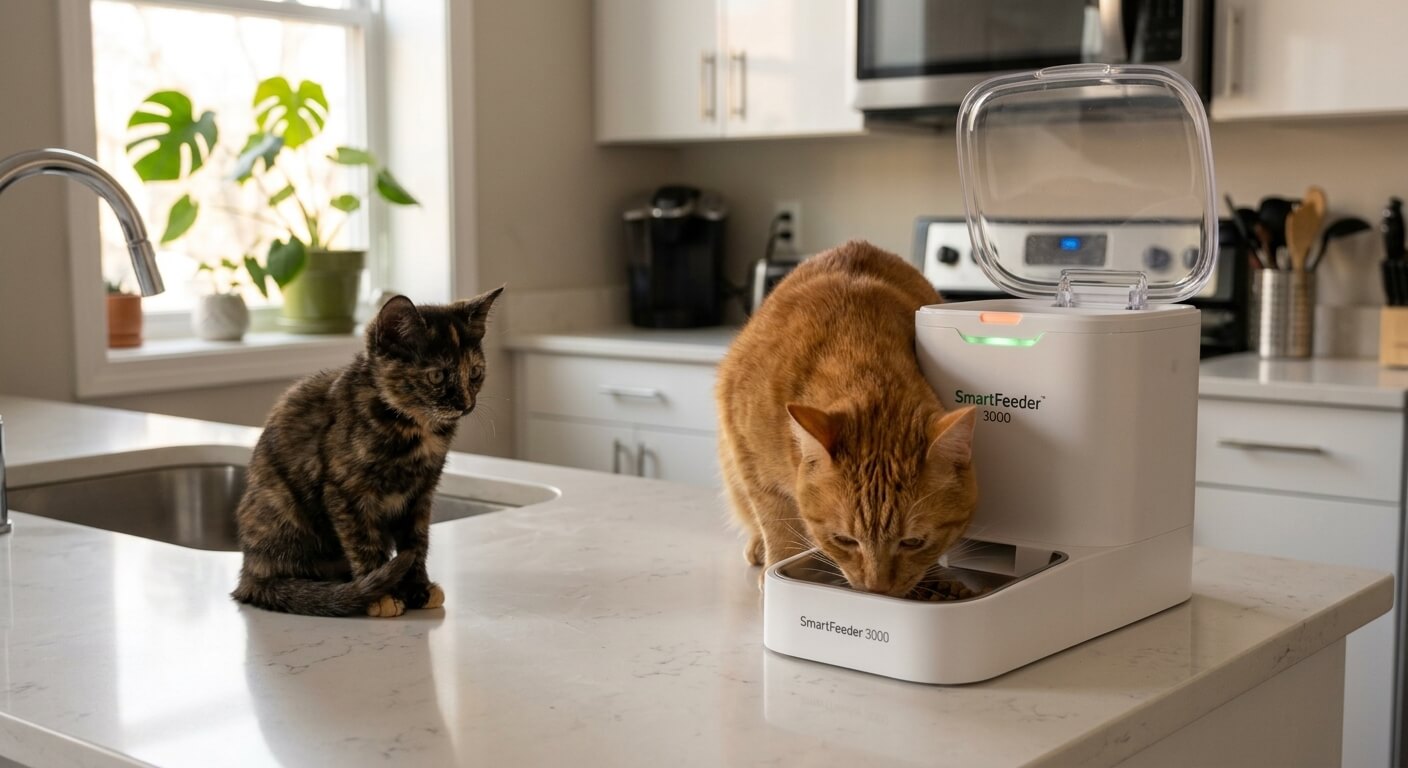
The best microchip cat feeder for most multi-cat homes is the SureFeed Microchip Pet Feeder. It opens only for a registered cat’s implanted identification microchip or compatible RFID collar tag, supports wet and dry food, and helps prevent other pets from accessing the protected bowl.
For owners who want portion guidance and feeding records, the SureFeed Microchip Pet Feeder Connect adds integrated scales and app-based monitoring. The Closer Pets MiBowl CP500 is a strong alternative for owners who prefer a more enclosed feeding area, while the MiBowl+ CP501 adds connected features to the MiBowl design.
Microchip feeders are particularly useful when one cat steals food, eats too quickly, needs a prescription diet, or quietly loses access to meals. However, a feeder cannot solve hovering, intimidation, or resource guarding by itself. It works best when paired with separate feeding locations, gradual training, and regular monitoring of each cat’s weight and appetite.
This guide compares four verified microchip cat feeders by food-access control, wet-food compatibility, connected features, cleaning, cat comfort, and multi-cat practicality.
Product information last checked: July 2026. Features, availability, accessories, and prices can change. Confirm current specifications on the manufacturer’s website before purchasing.
Quick Answer: What Is the Best Microchip Cat Feeder?
The SureFeed Microchip Pet Feeder is the best overall option for most multi-cat homes because it reads common implanted identification microchips or a compatible RFID collar tag, keeps the bowl closed to unauthorized pets, and supports both wet and dry food.
Choose the SureFeed Microchip Pet Feeder Connect if you want integrated scales, portion guidance, and app-based feeding records. Choose the Closer Pets MiBowl CP500 if you prefer an enclosed design that limits access from the sides and rear. The MiBowl+ CP501 is the connected MiBowl option for owners who want app monitoring within the Closer Pets system.
No feeder can guarantee complete separation in every household. A persistent food thief may hover behind an authorized cat, attempt to reach an open bowl, or pressure the cat away from the feeding area. In those homes, combine microchip access with separate feeding zones, visual barriers, and supervised training.
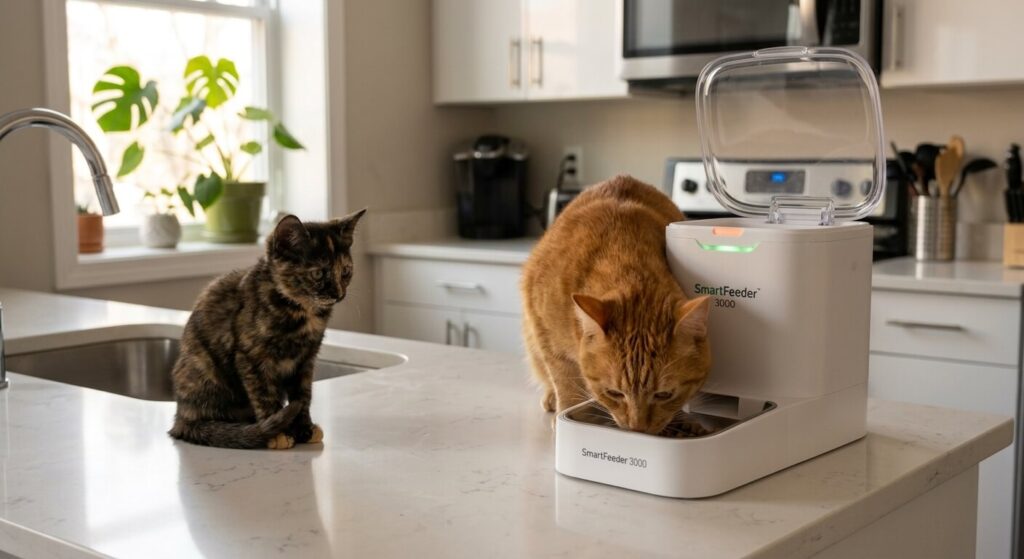
Table of Contents
Quick Comparison
| Feeder | Best for | Wet and dry food | Connected features | Registered pets | Main limitation |
|---|---|---|---|---|---|
| SureFeed Microchip Pet Feeder | Best overall | Yes | No | Up to 32 | Persistent cats may approach from behind |
| SureFeed Microchip Pet Feeder Connect | Portion and feeding monitoring | Yes | Yes; Hub required | Up to 32 | Higher cost and additional hardware |
| Closer Pets MiBowl CP500 | Enclosed food access | Yes | No | Up to 10 | No app-based feeding history |
| Closer Pets MiBowl+ CP501 | Connected MiBowl alternative | Yes | Yes; MiHub required | Confirm current specifications | Availability varies |
How We Chose These Microchip Cat Feeders
We limited this guide to feeders whose microchip-access features could be verified through current manufacturer information. We did not include standard timed feeders, automatic food dispensers, or nonexistent “microchip adapters” as substitutes for genuine selective-access feeders.
The main criteria were:
- compatibility with implanted identification microchips or RFID collar tags
- ability to prevent unauthorized pets from opening the bowl
- suitability for wet food, dry food, or both
- opening and closing design
- accessibility for cautious, small, or senior cats
- protection from side or rear approaches
- training features
- removable parts and cleaning practicality
- food capacity
- app monitoring and portion guidance, where available
- battery and connected-hardware requirements
- manufacturer support and replacement accessories
- suitability for multi-cat homes with different diets
We did not rank products by price alone because retail prices and discounts change frequently. A less expensive feeder is not a bargain if it does not reliably solve the household’s access problem.
We also avoided treating manufacturer health-monitoring features as diagnostic tools. Feeding records can help owners notice changes and communicate observations to a veterinarian, but an app cannot diagnose illness.
Microchip Cat Feeder Decision Table
| Situation | Recommended starting point | Why it fits | Main caution |
|---|---|---|---|
| One cat steals another cat’s food | SureFeed Microchip Pet Feeder | Simple selective access | Watch for rear or side approaches |
| Owner wants feeding records | SureFeed Connect | Tracks feeding patterns and portions | Hub and app required |
| Persistent side access | MiBowl CP500 | Enclosed feeding area | No connected history |
| Owner wants connected MiBowl | MiBowl+ CP501 | Combines enclosed access with app features | Confirm regional availability |
| Cat eats wet food | Any verified wet-food-compatible model | Protected bowl access | Wet food still requires safe handling |
| Cat is nervous about moving lids | Model with gradual training options | Allows slower introduction | Do not rush the cat |
| Cat needs prescription food | Dedicated registered feeder | Restricts access to the intended cat | Confirm the full feeding plan with a veterinarian |
| Cat is not microchipped | Compatible RFID collar-tag model | Provides selective access without an implanted chip | Use an appropriately fitted breakaway collar |
| Cats intimidate one another near food | Feeder plus separate feeding zones | Addresses access and social pressure | Feeder alone may not solve the conflict |
Feeding and Health Safety Note
A microchip feeder can help separate food access, but it does not replace veterinary guidance for prescription diets, diabetes, kidney disease, urinary disease, food allergies, unexplained weight loss, vomiting, or appetite changes.
Contact a veterinarian if a cat:
- loses weight despite apparently available food
- suddenly eats substantially more or less
- repeatedly misses meals
- vomits frequently
- struggles to chew
- appears painful while eating
- becomes unusually thirsty
- shows weakness or lethargy
- needs a medically prescribed diet
If one cat blocks, stares at, chases, or pressures another cat near the feeder, treat the situation as both a food-access problem and a multi-cat behavior problem. Move feeders farther apart, add visual separation, and ensure each cat has a calm route into and away from the feeding area.
For broader behavior management, see our cat resource guarding guide.
If each cat needs a different food or eating location, our guide to feeding multiple cats separately explains how to organize bowls, rooms, and meal routines around the feeder.
Why Standard Bowls Often Fail in Multi-Cat Homes
Standard bowls work when cats eat calmly, finish at similar speeds, and have no reason to compete. Problems begin when one cat eats quickly and moves to another bowl, when one cat grazes throughout the day, or when different cats need different foods.
A fast eater may finish first and take food from a slower cat. The slower cat may not fight back; some cats simply leave. Over time, one cat can gain weight while the other quietly loses access to calories.
Diet differences make the problem more complicated. One cat may need:
- a prescription renal or urinary diet
- weight-control food
- food for diabetes management
- an allergy or elimination diet
- a kitten or senior formula
- medication mixed into food
- a different portion size
Supervised meals and separate rooms can work, but they require the owner to be present and may not suit cats that prefer several small meals. A selective-access feeder allows the assigned cat to return to its protected food without leaving the bowl open to every pet in the home.
The feeder does not resolve every form of competition. An assertive cat may wait nearby, stare, block the approach, or rush toward the bowl when it opens. That is why feeder placement and household behavior matter as much as the access technology.
For a complete room-by-room setup, see our multi-cat apartment living guide. If the central problem is a fast eater taking another cat’s meals, use the practical steps in how to stop one cat from stealing another cat’s food.
How Microchip and RFID Cat Feeders Work
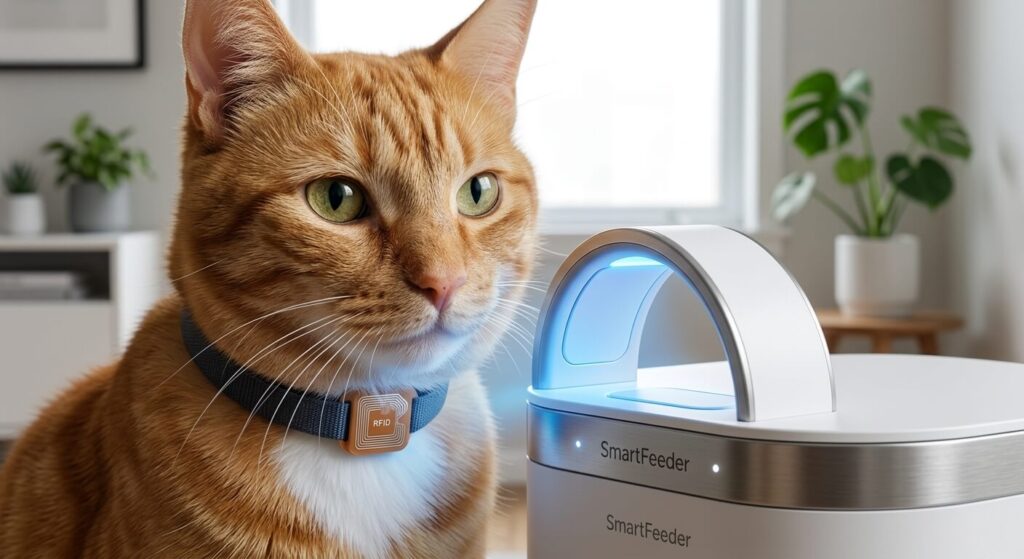
A microchip feeder reads the identification number stored in a compatible implanted microchip or RFID collar tag.
After an owner registers an authorized pet, the feeder opens when that pet approaches and remains closed for unregistered animals. Depending on the model, the lid may close when the authorized pet leaves.
The feeder does not alter the implanted microchip or dispense medication. It uses the chip’s identification number as a key that controls bowl access.
Compatibility varies by model. Before purchasing:
- Find your cat’s microchip number in the registration records.
- Use the manufacturer’s compatibility checker when available.
- Contact customer support if the chip type is unclear.
- Confirm whether the feeder includes a compatible RFID collar tag.
Cats without a compatible implanted chip may be able to use the manufacturer’s collar tag. If using a tag, attach it to an appropriately fitted breakaway collar and monitor the cat for comfort and safety.
1. SureFeed Microchip Pet Feeder
Best overall microchip cat feeder
The SureFeed Microchip Pet Feeder is the best starting point for most multi-cat homes. It reads common implanted identification microchips or the included Sure Petcare RFID collar tag and opens only for registered pets.
The feeder is suitable for wet and dry food. According to Sure Petcare, the bowl capacity is 400 ml, or approximately two pouches of wet food. The included full and split bowls give owners flexibility when serving one food or separating two types of food.
When the lid is closed, the bowl seal helps limit exposure to flies and reduces moisture loss. It is not a refrigerated feeder, so owners must still follow safe handling recommendations for the specific food.
SureFeed stores up to 32 pet identities, although households seeking individual portion control will normally register only the cat intended to use that bowl. Training mode introduces lid movement gradually, which is useful for cautious cats.
Best for
- one cat stealing another cat’s food
- cats on different diets
- prescription-food households
- slow eaters that need protected access
- wet- or dry-food feeding
- owners who do not need app monitoring
Advantages
- works with common implanted identification microchips
- compatible RFID collar tag included
- supports wet and dry food
- stores multiple pet identities
- training mode for cautious cats
- removable bowls for cleaning
- no Wi-Fi connection required
- replacement bowls and accessories available
Limitations
- requires four C-cell batteries
- does not record feeding history
- does not dispense meals on a schedule
- a persistent food thief may approach from behind
- some households may need a rear cover or additional physical separation
- each cat that needs protected portions may require a separate feeder
The SureFeed Microchip Pet Feeder is an access-control bowl, not a timed automatic food dispenser. It is best for cats that graze or return to a protected portion throughout the day.
If the protected cat eats veterinary-prescribed food, read our dedicated guide to using a microchip cat feeder for a prescription diet before deciding how the other cats will be fed.
2. SureFeed Microchip Pet Feeder Connect
Best for feeding records and portion monitoring
The SureFeed Microchip Pet Feeder Connect combines selective microchip access with integrated scales and app-based feeding records.
It can record when an authorized pet visits, how often the pet eats, and how much food is consumed. LED portion lights guide the owner while food is added, helping the owner serve a selected amount more consistently.
The Connect model supports wet and dry food and has a 400 ml bowl capacity. Owners can use two half bowls when serving two different foods.
Connected features require the Sure Petcare Hub, which links the feeder to the Sure Petcare app. The Hub is sold separately unless the feeder is purchased as part of a bundle.
Best for
- owners who want feeding records
- cats whose portions require closer monitoring
- multi-cat homes with different diets
- owners who want to notice changes in eating patterns
- households already using Sure Petcare connected products
- owners who want more precise portion guidance
Advantages
- microchip- or RFID-controlled bowl access
- integrated food scales
- app-based feeding history
- LED portion guidance
- supports wet and dry food
- records frequency, duration, and timing of feeding
- information can help owners describe changes to a veterinarian
Limitations
- costs more than the standard model
- requires the Sure Petcare Hub for connected functions
- still requires manual filling and cleaning
- does not dispense food at scheduled times
- feeding data cannot diagnose a health condition
- battery and connectivity maintenance add complexity
App data is useful for identifying a change in routine, but it should not be treated as a medical diagnosis. Contact a veterinarian if appetite changes significantly or if changes are accompanied by weight loss, vomiting, lethargy, increased thirst, or other symptoms.
To set an appropriate starting portion before using the scale data, see how much to feed an indoor cat. Individual needs still depend on body condition, food energy density, activity, and veterinary guidance.
3. Closer Pets MiBowl CP500
Best enclosed alternative
The Closer Pets MiBowl CP500 is a microchip-activated feeder designed to give an authorized pet access to wet or dry food while blocking other pets.
Its enclosed feeding area limits access from the sides and rear. This can be helpful when another cat has learned to approach an open feeder from an angle rather than directly from the front.
MiBowl recognizes an implanted microchip or a compatible Cat Mate electronic ID disc. It can register up to 10 pets, although registering only one protected cat is usually more useful when the goal is strict diet separation.
According to Closer Pets, the bowl holds up to approximately 340 g, or 12 oz, of wet food or the equivalent volume of dry food. The bowl is removable and suitable for top-rack dishwasher cleaning.
Best for
- owners wanting a more enclosed feeding area
- cats on separate diets
- households dealing with side or rear food-stealing attempts
- wet- or dry-food feeding
- cats that prefer a natural paws-on-the-floor eating position
- owners who do not need an app
Advantages
- enclosed access from the sides and rear
- reads compatible implanted microchips
- compatible electronic ID disc included
- supports wet and dry food
- can register multiple pets
- compact design
- quiet lid movement
- removable bowl
Limitations
- does not provide app-based feeding records
- does not dispense timed meals
- availability and pricing vary by region
- the bowl still requires regular refilling and cleaning
- some cats need gradual training
- connected monitoring requires the separate MiBowl+ model
MiBowl is not the same product as the Cat Mate C500. MiBowl provides selective microchip access to one bowl. The C500 provides five timed meal compartments but does not read an implanted microchip.
4. Closer Pets MiBowl+ CP501
Best connected MiBowl option
The Closer Pets MiBowl+ CP501 adds connected features to the enclosed MiBowl design. It is intended for owners who want selective microchip access together with monitoring through the Closer Pets system.
Like the standard MiBowl, it is designed to prevent unauthorized pets from reaching the food and may suit households where cats need separate diets or portions.
MiBowl+ requires a compatible MiHub for connected functions. According to Closer Pets support information, up to eight MiBowl+ feeders can connect to one MiHub. This may be useful in homes where several cats use separate connected feeders.
Because connected features, app availability, and regional product availability can change, confirm the current MiBowl+ specifications directly with Closer Pets before purchasing.
Best for
- owners who prefer the enclosed MiBowl design
- households wanting connected monitoring
- homes using multiple individual feeders
- wet- or dry-food feeding
- owners already using the Closer Pets connected system
Advantages
- selective microchip access
- enclosed feeding design
- connected monitoring
- wet- and dry-food compatibility
- multiple compatible feeders can use one MiHub
- designed for multi-pet diet separation
Limitations
- requires additional connected hardware
- availability may be more limited than standard models
- costs more than a non-connected feeder
- app information does not replace direct observation
- features should be confirmed for the owner’s region
Do not choose the connected model solely because it produces more data. The standard MiBowl may be a better value if the household only needs secure food access.
SureFeed vs. MiBowl: Which Design Is Better?
SureFeed and MiBowl solve the same basic problem using different physical designs.
SureFeed uses a front hoop and lid over an open bowl area. It offers a large registered-pet capacity, widely available accessories, and an established training mode. The Connect version adds integrated scales and detailed feeding records.
MiBowl uses a more enclosed feeding compartment. Its side and rear coverage may be helpful when another pet is skilled at approaching an authorized cat from an angle. The MiBowl+ offers connected functions within the Closer Pets system.
Choose SureFeed when:
- you want the most widely recognized product line
- you want readily available accessories
- you want integrated scales through the Connect model
- your cat is comfortable eating through the front hoop
Choose MiBowl when:
- side and rear access are major concerns
- your cat prefers a paws-on-the-floor eating position
- you prefer its enclosed compartment design
- you want the MiBowl connected ecosystem
The best design depends on the cats’ behavior. A confident food thief may exploit a different opening than a timid cat. Observe how the cats approach bowls before choosing.
How to Train a Cat to Use a Microchip Feeder
Some cats accept a moving lid immediately, while others need a slower introduction. Follow the manufacturer’s instructions and progress according to the cat’s behavior rather than a fixed schedule.
Stage 1: Use the feeder without lid movement
Place the feeder in the normal feeding location and serve the cat’s usual food with the lid fully open or in the earliest training position.
Allow the cat to investigate without being pushed toward the opening. Make sure another pet is not hovering nearby.
Stage 2: Build a positive association
Serve familiar meals in the open feeder. Keep the surrounding area quiet and predictable.
If the cat is reluctant, begin with the bowl near the feeder and move it gradually into position. Do not withhold food in an attempt to force rapid acceptance.
Stage 3: Introduce limited movement
Use the manufacturer’s training mode to introduce a small amount of lid movement. Stay nearby and watch the cat’s body posture.
The goal is calm eating, not merely getting the cat to approach once.
Stage 4: Increase movement gradually
Advance to the next training level only when the cat approaches, eats, and leaves without obvious fear.
Signs the cat is comfortable include:
- approaching without prolonged hesitation
- eating at a normal pace
- relaxed ears and body posture
- returning voluntarily for later meals
- remaining near the feeder after eating
Signs the cat needs more time include:
- crouching or flattened ears
- grabbing food and retreating
- eating unusually fast
- refusing meals
- repeatedly startling at the lid
- avoiding the feeding area
If the cat becomes worried, return to the previous training stage. Never force the cat’s head through the feeder opening.
Where to Place a Microchip Feeder
Placement can determine whether the authorized cat feels safe enough to use the feeder.
Choose a location that:
- is away from noisy appliances
- does not trap the cat in a corner
- provides a clear exit route
- is not beside a litter box
- is not in a narrow hallway controlled by another cat
- gives the owner enough room to clean and refill the unit
- allows observation during training
In a tense multi-cat household, place feeders in different rooms or around visual barriers. Feeding two competing cats side by side defeats much of the benefit of selective access.
Avoid positioning the authorized cat with its back completely exposed to a known food thief. A wall behind or beside the feeder may help, but the cat still needs a comfortable escape route.
Once the locations are established, use a predictable indoor cat feeding schedule so that access control, portions, and observation happen consistently.
Wet Food and Cleaning
All four feeders in this guide are designed to accommodate wet food, but a closing lid does not refrigerate the meal.
Follow the food manufacturer’s handling instructions and consider:
- room temperature
- how long the food has been exposed
- whether the cat grazes slowly
- whether ice-pack accessories are available
- how easily residue can be removed
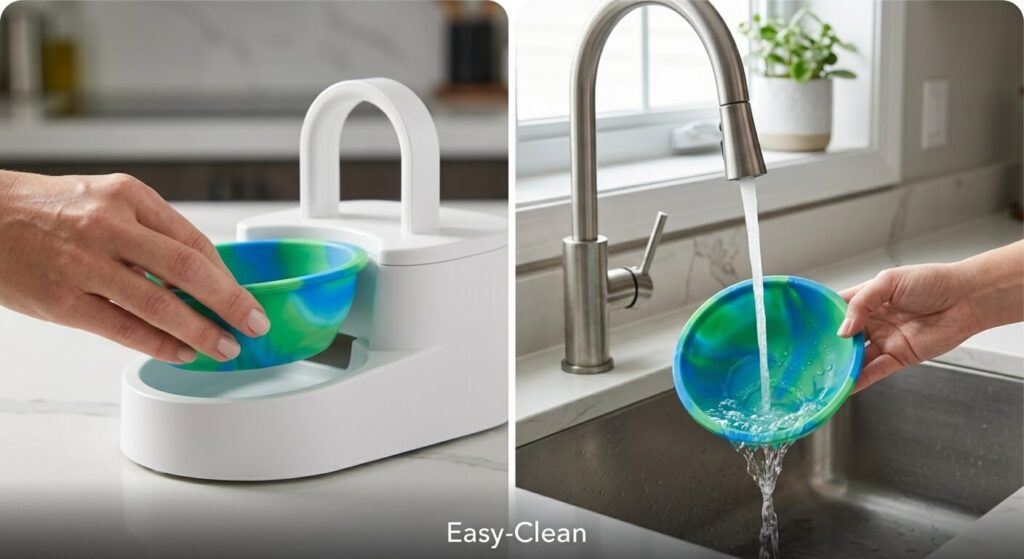
Wash removable bowls regularly and clean the feeder housing according to the manufacturer’s directions. Do not submerge electronic components.
Inspect:
- bowl edges
- seals
- lid tracks
- sensor areas
- corners where food collects
- mats beneath the feeder
Replace cracked or deeply scratched plastic parts when necessary. If using stainless-steel accessory bowls, confirm that they are designed for the exact feeder model.
How Many Microchip Feeders Do You Need?
One feeder may be enough when only one cat needs protection and the other cats eat elsewhere.
Multiple feeders may be necessary when:
- every cat needs a separate measured portion
- cats eat different prescription diets
- both cats steal from one another
- several cats graze throughout the day
- one shared authorized group would defeat portion control
Some models can register several authorized pets, but allowing several cats to access the same bowl does not separate portions between those cats.
Before buying multiple connected feeders, confirm how many devices the Hub supports and whether the app provides the level of individual tracking you need.
For households balancing portions, treats, body weight, and multiple diets, our cat feeding and weight-control guide provides the broader framework around the feeder.
Frequently Asked Questions
What is the best microchip cat feeder for multiple cats?
The SureFeed Microchip Pet Feeder is the best overall starting point for most multi-cat homes. It supports wet and dry food, reads common implanted identification microchips, includes an RFID collar tag, and offers a gradual training mode.
Owners who want feeding records and integrated scales should consider the SureFeed Connect. Owners who prefer a more enclosed design should compare the MiBowl CP500 and MiBowl+ CP501.
Will a microchip feeder work with my cat’s existing microchip?
Many models work with common identification microchips, but compatibility should be confirmed before purchasing.
Use the manufacturer’s online compatibility checker when available, enter the microchip number, or contact customer support. Cats without a compatible implanted chip may be able to use the RFID collar tag supplied with the feeder.
Do I need one microchip feeder per cat?
Not always. One feeder may be enough when only one cat needs protected food and the other cats eat from separate bowls.
If every cat needs an individual portion or different diet, one feeder per protected cat is usually the clearest setup.
Can two cats share one microchip feeder?
Some models can register multiple pets, but shared authorization does not prevent those cats from eating one another’s portions.
Shared access is more appropriate when the cats may safely eat the same food and individual portion control is not required.
Do microchip feeders work with wet food?
The four feeders in this guide support wet and dry food. However, a sealed lid does not refrigerate wet food. Follow the food label’s handling recommendations and clean the bowl regularly.
Is a microchip feeder the same as an automatic timed feeder?
No. A microchip feeder controls which pet can access a bowl. A timed feeder dispenses or reveals food at scheduled times.
Some products may offer connected monitoring, but the feeders in this guide should not be assumed to dispense new meals automatically.
How do I stop another cat from reaching the bowl while it is open?
Start by placing the feeder in a separate or visually protected feeding area. Consider manufacturer accessories designed to restrict rear access where available.
If the unauthorized cat continues hovering or pressuring the authorized cat, use separate rooms during meals and address the broader resource conflict.
Are microchip feeders worth the cost?
A microchip feeder may be worth the cost when food stealing prevents one cat from receiving the correct portion, when cats need different diets, or when supervised separate feeding is difficult to maintain.
The value is lower when a household only needs timed portions for one cat. In that situation, a standard automatic feeder may be more appropriate.
Will a microchip feeder stop food stealing completely?
It can prevent an unauthorized pet from opening the closed bowl, but it may not stop hovering, intimidation, or attempts to reach food while the authorized cat is eating.
Persistent cases require thoughtful placement, separate feeding zones, visual barriers, and behavior management in addition to the feeder.
Can feeding data tell me whether my cat is sick?
No. Connected feeders can help owners notice changes in eating patterns, but they cannot diagnose illness.
Contact a veterinarian if your cat eats substantially more or less, loses weight, vomits, becomes lethargic, or shows another concerning change.
Final Thoughts
The best microchip cat feeder is the one that reliably protects the intended cat’s food without making that cat afraid to eat.
The SureFeed Microchip Pet Feeder is the best overall option for most multi-cat homes. The SureFeed Connect is better for owners who want portion guidance and feeding records. The MiBowl CP500 offers a more enclosed alternative, while the MiBowl+ CP501 adds connected features for owners who prefer the Closer Pets system.
Whichever feeder you choose, confirm microchip compatibility, train the cat gradually, follow safe food-handling practices, and observe the social behavior around the feeding area. Selective access works best as part of a complete feeding plan—not as the only response to food stealing or resource pressure.