A cat health check at home is not a way to diagnose illness by yourself. It is a simple monitoring routine that helps you notice changes early, record useful details, and know when to call your veterinarian.
Count breathing when your cat is asleep and not purring. Keep simple notes on changes in breathing, appetite, litter-box use and behavior; do not use a normal reading to dismiss other symptoms.
This guide shows you five basic things you can monitor at home: resting respiratory rate, gum color and capillary refill time, hydration clues, heart rate or pulse, and monthly body weight. It also explains which signs should stop the home check and send you to a veterinarian or emergency clinic.
Quick Answer: How to Perform a Basic Cat Health Check at Home?
A basic cat health check at home includes watching your cat’s resting breathing rate, checking gum color and moisture, looking for hydration clues, feeling heart rate or pulse if your cat tolerates it, and recording body weight monthly. These checks work best when your cat is calm and when you compare the results to your cat’s normal baseline.
Home checks do not replace veterinary exams, bloodwork, urinalysis, imaging, dental checks, or emergency care. If your cat has open-mouth breathing, blue or pale gums, collapse, repeated vomiting, urinary straining, severe weakness, seizures, suspected toxin exposure, or a resting breathing rate that stays high, seek veterinary care promptly.
Important Veterinary Note
This guide is for general education only. Do not delay veterinary care because a home check seems “mostly normal.” Cats can hide serious illness, and some emergencies are not safe to monitor at home. If your cat is struggling to breathe, cannot urinate, collapses, has pale or blue gums, has repeated vomiting, is very weak, or may have eaten something toxic, contact an emergency veterinarian immediately.
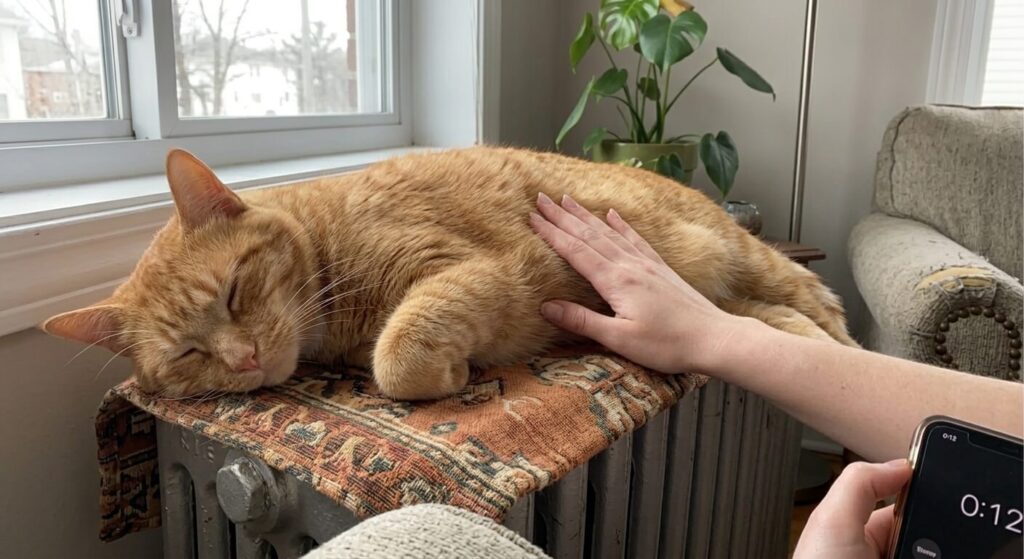
Table of Contents
The Baseline Concept: Preparing for a Cat Health Check at Home
A baseline can help show changes, but an individual baseline does not override warning signs or your veterinarian’s advice.
Heart rate varies with stress, handling and illness. An isolated home reading cannot determine whether a change is clinically important.
Use the ranges below only as general context, not as a home diagnostic test. Ask your veterinarian which measurements are useful for your cat.
How to establish your baseline:
- Perform each measurement at the same time of day (post-nap, pre-meal is ideal)
- Use the same environment and position each time
- Record every measurement in a dedicated health log — a notes app, a spreadsheet, or a physical journal
- Collect readings as your veterinarian recommends; do not wait to establish a baseline if your cat seems unwell.
- Share your baseline records with your veterinarian — this data is genuinely useful at wellness appointments
Home vitals are useful notes to bring to the clinic, but they are not a replacement for an annual exam. For what to review at yearly appointments, see our guide to the annual vet visit for an indoor cat.
To understand how prevention, body condition, dental care, and early detection influence the bigger picture, read our guide to indoor cat lifespan and healthspan.
The goal of a home health check is not to diagnose disease. The goal is to know your cat’s normal pattern well enough to notice meaningful change. A breathing rate, gum color, water intake, weight, or appetite shift is more useful when you can compare it with your cat’s usual baseline.
If the change involves sleeping longer, reduced responsiveness, or less interest in normal routines, our cat sleep and lethargy guide can help you record the difference before contacting your veterinarian.
Simple Monthly Cat Health Log
| What to Track | Normal Baseline | When to Call Your Vet |
|---|---|---|
| Resting breathing rate | Your cat’s relaxed/sleeping average | Repeatedly above baseline or above 30 breaths/min at rest |
| Gum color | Pink and moist | Pale, white, blue, yellow, very red, dry, or tacky |
| Hydration clues | Normal gum moisture and skin return | Dry gums, weakness, vomiting, poor appetite, slow skin return |
| Body weight | Stable month to month | Any unexplained loss or gain; do not wait for 10% |
| Appetite and water intake | Normal for your cat | Sudden decrease, major increase, or change with lethargy |
| Litter box output | Normal clump size and frequency | Straining, no urine, diarrhea, blood, or major clump changes |
A home check works best when it connects to vet care, dental health, weight tracking, vaccines, and age-related prevention. For the full framework, see our complete indoor cat health prevention routine.
Vital 1: Resting Respiratory Rate
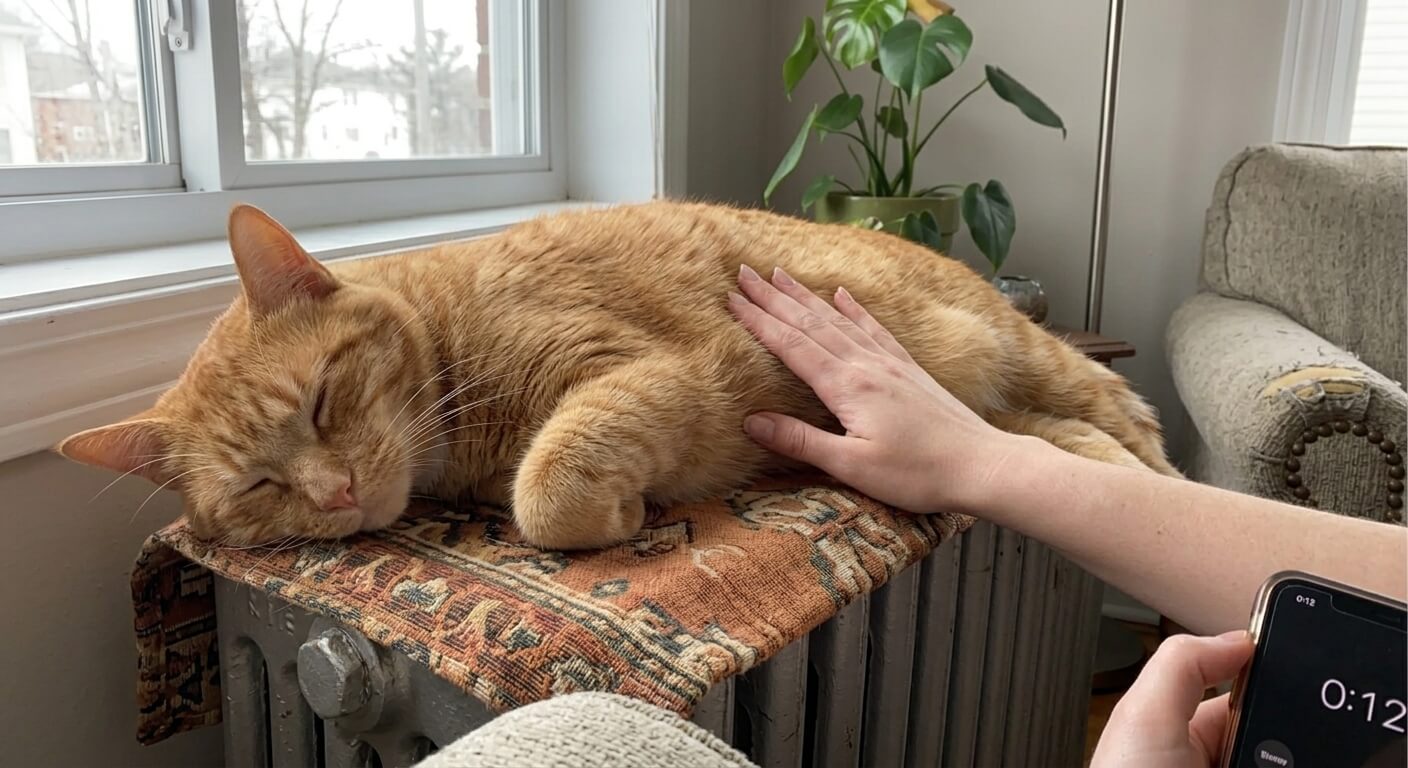
Resting breathing rate is a useful observation, particularly when your veterinarian has recommended cardiac monitoring. It does not detect or rule out all disease.
A single respiratory cycle = one inhalation followed by one exhalation. The chest rises and falls — that is one breath.
General sleeping/resting range: about 15–30 breaths per minute. Individual guidance and breathing effort matter as well as the number.
The measurement protocol:
- Wait until your cat is in a calm resting state — ideally asleep or in a deeply relaxed lateral position
- Set a timer for 60 seconds (or 30 seconds and multiply by 2)
- Watch the rise and fall of the chest or flank — count each complete cycle as one breath
- Record the result immediately
Why this vital sign matters so much:
A persistently increased rate can accompany heart or lung problems and other conditions. It is not a diagnosis; contact your veterinarian if readings remain above the advised range.
The home monitoring app option:
Several veterinary cardiology groups have developed smartphone apps specifically for RRR monitoring — they use the phone’s timer while the owner taps the screen with each breath, calculating the rate automatically.
Some veterinary cardiology teams recommend using a resting respiratory rate tracker or a simple timer to make counting easier. The important part is consistency: count when your cat is asleep or deeply relaxed, record the number, and contact your veterinarian if the resting rate is repeatedly above your cat’s normal baseline.
When the RRR is elevated — what it means:
- Repeated readings above 30 breaths per minute while asleep and not purring: contact your veterinarian promptly, or follow their individual monitoring plan.
- Fast breathing that persists at true rest: seek prompt veterinary guidance about urgency rather than waiting for a higher cutoff.
- Labored or open-mouth breathing, collapse or blue/gray gums: seek emergency care immediately, regardless of the measured rate. Do not delay to count again.
Vital 2: Capillary Refill Time (CRT) and Gum Health
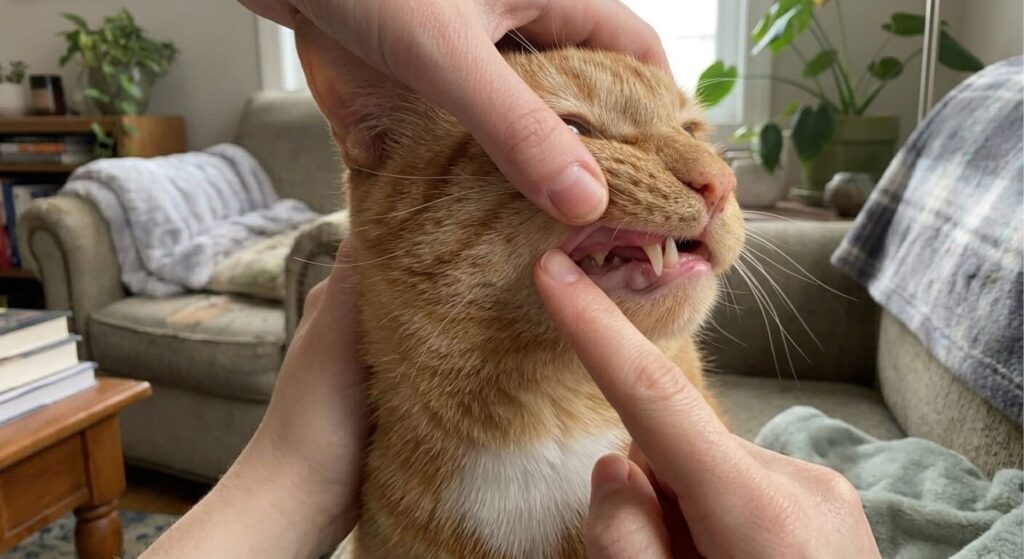
Gum color and moisture can provide clues, but lighting, pigmentation and technique can make home assessment unreliable. Check only if your cat is comfortable; do not force the mouth open.
Normal gum findings:
- Color: usually pink in an unpigmented area; normal pigmentation varies.
- Moisture: usually moist; dry or tacky gums are a reason to seek advice, not proof of a specific diagnosis.
- Capillary Refill Time (CRT): Under 2 seconds
How to assess Capillary Refill Time (CRT):
- Gently lift your cat’s upper lip to expose the gum tissue above the upper teeth
- If your veterinarian has demonstrated the technique, apply brief gentle pressure to an unpigmented area. Stop if your cat resists.
- Release and count the seconds until the pink color returns to the blanched area
- Normal: color returns in 1–2 seconds
While checking gum color during your cat health check at home, also look for tartar, gum redness, bad breath, drooling, dropped food, or obvious mouth pain. For a fuller routine, read our indoor cat dental health guide.
When breath odor is new or persistent, this cat bad breath guide explains which accompanying mouth signs make a veterinary dental check more urgent.
Abnormal gum findings and their significance:
| Finding | Possible Indication | Urgency |
|---|---|---|
| Pale pink or white gums | Anemia, severe shock, internal hemorrhage | Emergency |
| Blue or gray gums (cyanosis) | Oxygen deprivation, severe cardiac/respiratory failure | Emergency |
| Bright red gums | Carbon monoxide exposure, early sepsis | Emergency |
| Yellow-tinged gums (icterus) | Liver disease, hemolytic anemia | Urgent — same day vet |
| CRT > 2 seconds | Reduced cardiovascular perfusion, dehydration | Urgent |
| Unexpected CRT result | Needs professional interpretation; technique affects the result | Urgent |
| Dry, tacky gums | Dehydration | Contact your veterinarian promptly |
Vital 3: Hydration Clues
The scruff test can offer a rough clue, but it is not a reliable diagnosis of dehydration by itself, especially in older cats, thin cats, or cats with loose skin.
Suspected dehydration needs veterinary assessment. A home check cannot determine a fluid-deficit percentage or prescribe fluid treatment.
Skin return is only one clue and may be misleading, especially in older cats. Ask your veterinarian to demonstrate any handling technique.
How to perform the skin turgor test:
- Gently grasp a small fold of skin at the base of the neck (the scruff) or between the shoulder blades
- Lift the fold gently and release
- Observe how quickly the skin returns to its normal flat position
Interpretation:
- Prompt skin return does not rule out illness or dehydration.
- Slow skin return can raise concern, but cannot be converted into a reliable dehydration percentage at home.
- Skin remains tented or returns slowly: possible dehydration or reduced skin elasticity; contact your veterinarian, especially if your cat is also weak, vomiting, not eating, or has dry/tacky gums.
Important caveats for the scruff test:
- Skin turgor is affected by age — older cats and cats who have lost significant muscle mass have naturally reduced skin elasticity that can make the test appear abnormal even at normal hydration levels
- Body condition affects the test — very lean cats have less subcutaneous tissue and may appear more dehydrated than they are
- Previous observations can provide context, but even a familiar skin response does not establish hydration status.
Supporting hydration assessment:
Combine the scruff test with gum moisture assessment for a more complete hydration picture:
- Moist gums do not prove that hydration and circulation are normal.
- Dry, tacky or sticky gums can be a warning sign; contact your veterinarian promptly if dehydration is suspected.
When a cat hacks, retches, or brings up material, use this cat vomiting vs hairball comparison to record the event accurately before contacting your veterinarian.
Vital 4: Heart Rate and Pulse Quality
Home pulse checks are optional and can be difficult to interpret. Ask your veterinarian to demonstrate them if useful for your cat, and stop if handling causes stress.
Heart rate depends on the cat and the measurement conditions. Ask your veterinarian for an appropriate range; do not use a single number to diagnose or exclude a heart problem.
A rate measured during handling may not reflect a sleeping rate. Your veterinarian should interpret persistent changes.
Method 1: Chest auscultation with a stethoscope
If you own or can access a basic stethoscope:
- Place your cat in a calm sitting or sternal position
- Position the stethoscope bell on the left side of the chest, just behind the front elbow
- Count beats for 15 seconds and multiply by 4
- Note the rhythm — beats should be regular and consistent
Method 2: Femoral pulse assessment
Without a stethoscope:
- Place your cat in a relaxed position — lateral recumbency works best
- Place two fingers in the inner groin area where the hind leg meets the body
- Press gently against the femoral artery — you should feel a regular pulse
- Count beats for 15 seconds and multiply by 4
What pulse quality tells you:
- A pulse that feels regular does not rule out heart or circulatory disease.
- A weak or difficult-to-find pulse may reflect technique or a medical problem; assess symptoms and seek veterinary advice rather than repeatedly restraining the cat.
- An apparently irregular pulse needs veterinary interpretation; a home check cannot diagnose an arrhythmia.
- Comparing heart sounds with a pulse is a clinical skill, not a required home test.
Tachycardia considerations:
Stress and pain can increase heart rate. Report persistently unusual readings to your veterinarian; seek emergency care for collapse, breathing difficulty or severe weakness regardless of pulse rate.
Vital 5: The Monthly Weigh-In
Recording weight consistently can reveal a trend that is difficult to notice visually. Report unexplained changes rather than waiting for a fixed percentage loss.
How to weigh your cat at home:
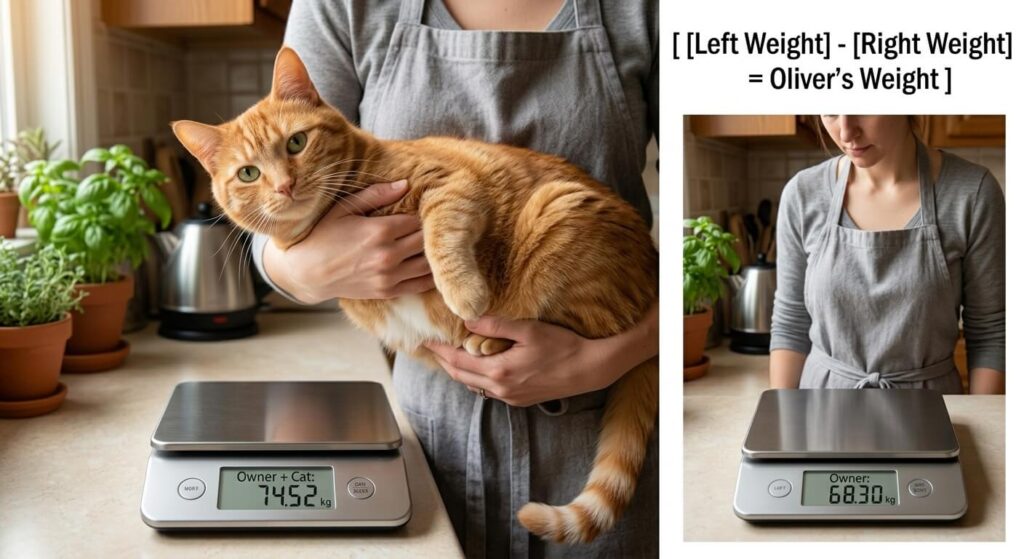
- Use a stable pet or baby scale with sufficient capacity, or the following bathroom-scale method. Do not stand on a kitchen scale.
- Weigh yourself holding your cat
- Weigh yourself alone
- Subtract to get your cat’s weight
- Record immediately with the date
Why monthly consistency matters:
Use the same scale and similar conditions each time. Small repeated losses add up, but scale error also matters; your veterinarian can confirm the trend.
The clinical significance of weight loss in cats:
Unexplained weight loss can have many causes and warrants assessment. A weight trend cannot identify the disease responsible.
Weight change thresholds requiring veterinary contact:
- Unexplained weight loss: contact your veterinarian; do not wait for a 10% loss.
- Any weight loss in a cat who appeared to be eating normally
- Unexplained weight gain or abdominal enlargement
- Visible change in body condition (rib feel, waist appearance) that precedes scale weight change
Unexplained weight loss can be one of the early clues in kidney disease, diabetes, dental pain, hyperthyroidism, or chronic digestive problems. If weight loss appears with increased thirst or larger urine clumps, read our guide to chronic kidney disease cats signs and schedule a veterinary exam.
A home check works best when it connects to vet care, dental health, weight tracking, and early warning signs. For the full prevention framework, see our indoor cat health prevention guide.
Emergency Red Flags: When to Stop Checking and Call a Vet
For emergency signs, stop home testing and contact an emergency clinic while arranging immediate transport. A call can help the team prepare; do not let it delay care.
Go immediately — do not wait:
- Open-mouth or visibly labored breathing: emergency assessment
- Blue, white, or gray gums — oxygen deprivation or severe circulatory failure
- Collapse or inability to stand — multiple possible causes, all serious
- Seizure activity — any convulsive episode in a cat with no prior seizure diagnosis
- Suspected toxin ingestion — any known or suspected contact with household toxins, medications, or toxic plants
- Repeated straining with little or no urine in any cat: possible life-threatening obstruction; immediate care
- Trauma — any fall from height, vehicle contact, or significant impact
- Persistent fast resting breathing, especially with increased effort, weakness or distress: urgent veterinary guidance; do not delay for repeated tests
- Abdominal distension with pain — multiple possible causes including obstruction, hemorrhage, and organ failure
Contact your veterinarian promptly for other new or persistent changes; ask them to determine urgency:
- Any single vital sign outside the normal range that persists on recheck
- Any unexplained weight loss
- New paleness of the gums, especially with weakness, requires urgent assessment
- CRT consistently at the upper limit of normal (approaching 2 seconds)
- Any behavior change that accompanies an abnormal vital sign measurement
FAQ
What is the normal breathing rate for a sleeping cat?
A commonly used sleeping/resting range is about 15–30 breaths per minute. Count when your cat is not purring. Repeatedly higher readings warrant veterinary advice; breathing difficulty is an emergency even below a numeric cutoff.
Cats in REM sleep may show brief irregular breathing patterns including slight breath-holding and faster shallow breathing that resolves spontaneously — this is normal sleep physiology and should not be confused with pathological respiratory distress, which tends to be consistent and effortful rather than episodic and relaxed.
How do I take my cat’s pulse at home?
Ask your veterinarian to show you a pulse check if they recommend it. Do not restrain a distressed cat to find a pulse. If you cannot locate it, stop; inability to feel it at home does not diagnose a heart problem. Breathing difficulty, collapse or severe weakness need urgent care.
You should feel a regular pulse against your fingertips. Count beats for 15 seconds and multiply by 4 for the per-minute rate. If you cannot locate the femoral pulse, purchasing a basic stethoscope (available for $15–$25) and learning chest auscultation is the most reliable alternative.
The stethoscope skill is worth developing for any cat owner performing a regular cat health check at home, as it also allows assessment of breath sounds alongside heart rate.
How often should I do a cat health check at home?
Notice appetite, behavior and litter-box changes every day. A monthly weight record may be useful, but monitoring frequency should reflect age and health and your veterinarian’s advice. Do not wait for the next scheduled check when symptoms appear.
What should I write down before calling the vet?
Write down what changed, when it started, your cat’s appetite, water intake, litter box output, breathing rate at rest, gum color, weight trend, medications, and any vomiting, diarrhea, coughing, hiding, weakness, or pain. Clear notes help your veterinarian decide how urgent the situation is.
Can I use a human thermometer on my cat?
Ask your veterinarian whether temperature measurement is needed and to demonstrate a safe method. Do not attempt rectal measurement on a struggling, painful or breathing-impaired cat, and do not delay care to obtain a temperature. Human forehead or ear devices may not give reliable readings in cats.
Lubricate the thermometer tip with a small amount of petroleum jelly, insert gently into the rectum to a depth of approximately 1 inch, and hold in place until the thermometer beeps. Two people make this significantly easier — one to hold the cat gently in a standing or lateral position, one to take the temperature.
Infrared ear thermometers marketed for humans are not reliable for feline temperature measurement because the feline ear canal geometry produces inconsistent readings with human-designed devices.
Final Thoughts
A cat health check at home is useful because it helps you notice patterns early. Breathing rate, gum color, hydration clues, pulse, weight, appetite, litter box habits, and behavior all mean more when you know what is normal for your own cat.
Use this routine as a monitoring habit, not as a diagnosis tool. If something changes suddenly, looks severe, or involves breathing trouble, urinary straining, pale gums, collapse, repeated vomiting, or major weakness, stop checking at home and contact a veterinarian.
The best home check is calm, brief, repeatable, and connected to real veterinary care. Bring your notes to wellness visits so your vet can compare home patterns with the physical exam.
References
- American Animal Hospital Association. (2023). 2023 AAHA Senior Care Guidelines for Dogs and Cats.
- American Animal Hospital Association. (2021). 2021 AAHA/AAFP Feline Life Stage Guidelines.
- Cornell Feline Health Center. Hydration. Skin elasticity limitations and when to seek veterinary care.
- VCA Animal Hospitals. Home Breathing Rate Evaluation and Emergencies in Cats. Home monitoring is not a substitute for diagnosis.