How to clean cat ears safely starts with deciding whether cleaning is needed at all. Most healthy cats do not need routine ear cleaning unless a veterinarian recommends it. Cleaning too often or using the wrong product can irritate the ear canal.
Before cleaning your cat’s ears, check for redness, swelling, a strong odor, pain, dark coffee-ground-like debris, pus, or persistent head shaking. If any of these signs are present, do not clean the ear at home. Contact a veterinarian because ear mites, infection, a foreign body, or another condition may require diagnosis and treatment.
If your veterinarian has advised cleaning and the ear appears comfortable, use only a cat-safe ear cleaner they recommend. Never insert cotton swabs into the ear canal. Do not use hydrogen peroxide, alcohol, vinegar, essential oils, or homemade cleaning solutions.
Quick Answer
To clean cat ears safely, apply the veterinarian-recommended cleaner as directed, gently massage the base of the ear, allow your cat to shake, and wipe only the visible outer ear with gauze or a cotton pad. Stop if your cat shows pain, bleeding, severe resistance, or worsening symptoms.
Important Veterinary Note
This article is for routine ear-care education only. It is not a diagnosis or treatment plan for ear mites, ear infection, ruptured eardrum, allergies, polyps, wounds, or chronic ear disease. If your cat has pain, strong odor, head tilt, loss of balance, blood, pus, swelling, repeated head shaking, heavy black debris, or one ear that looks very different from the other, contact your veterinarian before cleaning.
Table of Contents
Why Cotton Swabs Are Risky in Cat Ears
Understanding how to clean cat ears correctly starts with understanding why the cat ear canal is architecturally different from what most owners imagine when they think about ears.
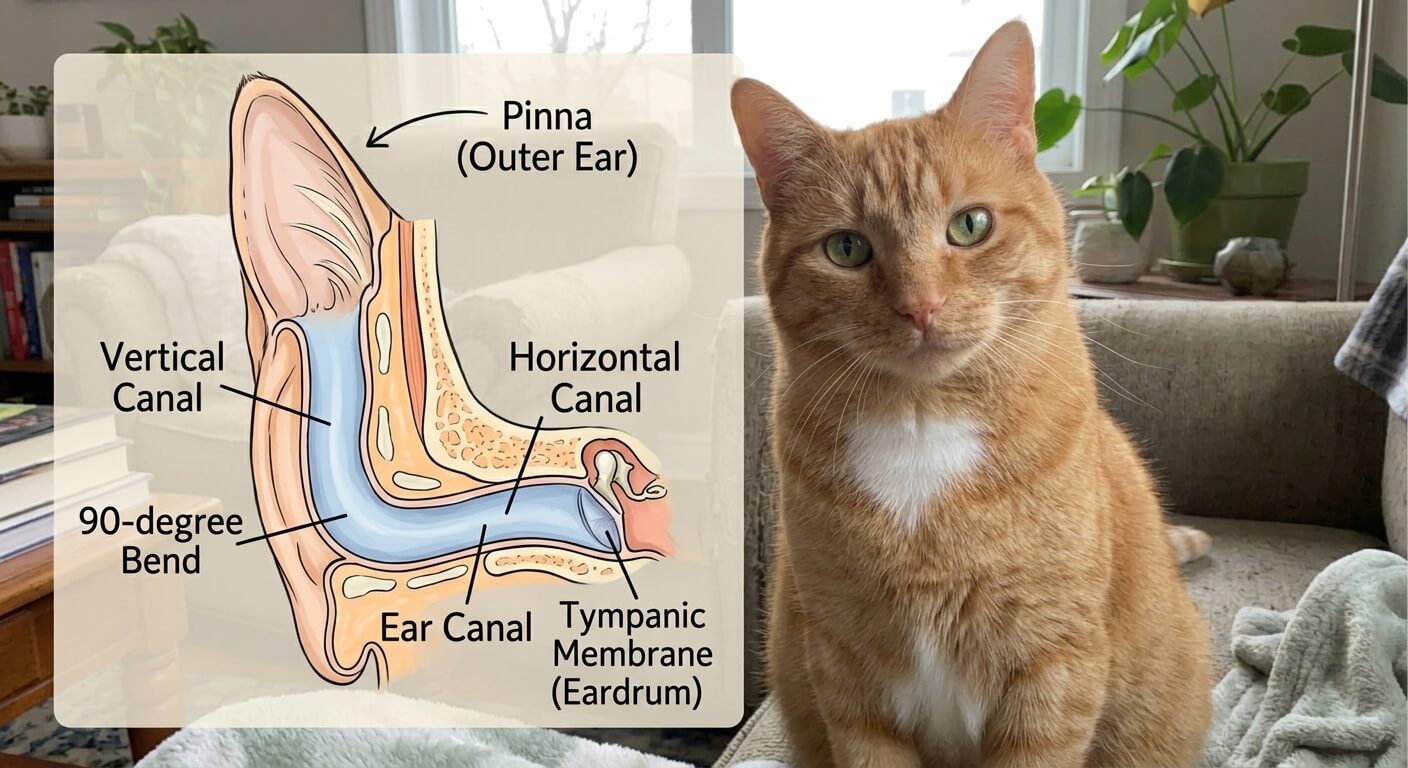
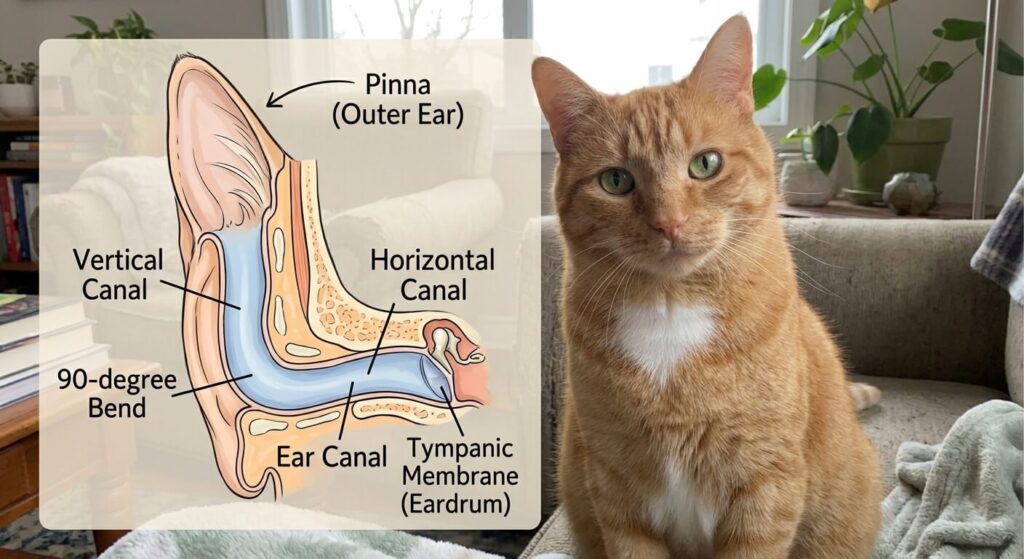
The human ear canal runs in a relatively straight line from the outer ear to the eardrum. The feline ear canal does not. It consists of a vertical canal that runs downward from the ear opening, then makes an approximately 90-degree turn into a horizontal canal that runs inward toward the Tympanic Membrane (Eardrum) — forming what is called an L-shaped Ear Canal.
This L-shaped geometry is the reason cotton swabs are dangerous in cat ears. When you insert a cotton swab into a cat’s ear and push downward, you reach the bend in the L — and anything on the swab tip at that point is pushed not out of the ear but around the corner and further toward the Tympanic Membrane (Eardrum). You are not cleaning the ear. You are compacting Cerumen (Ear Wax) and debris against the eardrum, where it cannot easily be removed without veterinary equipment.
What the L-shaped geometry means for safe cleaning:
- The horizontal canal cannot be reached by a cotton swab without risk of eardrum damage
- Liquid cleaning solutions, however, can flow around the bend by gravity and distribute throughout the canal
- The massage technique (which we cover in the protocol below) mechanically loosens debris throughout the full canal length — including the horizontal portion that no swab can safely reach
- The cat’s subsequent head shake is not an inconvenience — it is the functional ejection mechanism that brings loosened debris up the vertical canal and out of the ear
Ear Wax, Ear Mites, or Infection: When Not to Clean at Home
Before learning how to clean cat ears, decide whether home cleaning is appropriate at all. You can notice warning signs, but you cannot reliably diagnose ear mites, yeast, bacteria, a ruptured eardrum, or deeper ear disease at home. Veterinarians may need an otoscope exam and microscopic ear swab to identify mites, yeast, bacteria, inflammation, or eardrum problems.
Normal ear findings:
- Small to moderate amount of light tan to medium brown Cerumen (Ear Wax) in the vertical canal
- No odor beyond the mild natural scent of the ear
- No swelling, redness, or sensitivity to gentle palpation at the base of the ear
- Occasional mild scratching — not persistent or frequent
Possible ear mite signs:
Ear mites are one possible cause of ear irritation and inflammation in cats, particularly in kittens and cats exposed to other animals. Dark, coffee-ground-like debris may occur with ear mites, but appearance alone cannot confirm the diagnosis. Wax, infection, and other ear conditions can produce similar signs, so a veterinarian may need to examine the ear and inspect a sample under a microscope.
- Dark brown to black, dry, crumbly debris that looks like coffee grounds or finely ground black pepper
- The debris is present in large quantities relative to normal Cerumen (Ear Wax)
- Intense scratching — often breaking skin around the ear base and pin the area
- Head shaking that is frequent and forceful
- Possible scabbing or hair loss around the ear from self-trauma
Possible infection signs:
- Yellow, green, gray, bloody, or pus-like discharge — this can occur with infection, inflammation, injury, or other ear disease and needs veterinary assessment
- Strong or unusual odor — this is abnormal and can occur with infection or inflammation, but odor alone cannot identify the cause
- Significant redness and swelling of the ear canal visible at the entrance
- Pain response — the cat pulls away or vocalizes when the ear base is touched
- Discharge that is liquid or pasty rather than the dry, waxy consistency of normal Cerumen
A practical safety rule: If the debris is anything other than light to medium brown with a dry-to-waxy consistency, or if the ear has an unusual odor, pain, swelling, or significant redness, do not attempt home cleaning. A veterinarian should examine the ear before any cleaner or medication is used because infection, mites, inflammation, a foreign body, or eardrum damage cannot be reliably ruled out at home.
These signs do not confirm the cause. They mean the ear should be checked by a veterinarian before you put cleaner into the canal.
If you want a broader monthly monitoring routine, pair ear checks with our cat health check at home guide.
How to Clean Cat Ears Safely in 4 Steps
This is a gentle routine for mild wax maintenance when the ear looks comfortable and your veterinarian has approved home cleaning. The goal is not to deep-clean the canal. The goal is to loosen mild wax, let the head shake bring debris outward, and wipe only what you can see.
What you need before you start:
- Veterinarian-approved ear cleaning solution (more on product selection in the FAQ below)
- Cotton balls, cotton pads, or gauze for wiping only the visible outer ear
- A towel for your lap and for any initial cat-restraint comfort
- High-value treats for reward
- Good lighting — a headlamp or a bright room
The setup — position and restraint:
Sit on the floor or on a low surface with your cat in your lap, facing away from you. For cats who are comfortable with handling, no restraint beyond a gentle hand is necessary. For cats who are head-shy or handling-averse, you must use the same slow desensitization approach we recommend for grooming-resistant cats — building ear-handling tolerance gradually over days to weeks before attempting a full cleaning, rather than attempting to restrain an unwilling cat and creating a negative association with the process.
Step 1: Inspect the Ear Before You Touch It
Hold the ear flap gently between your thumb and forefinger and lift it to expose the entrance to the vertical canal. Look at the visible portion of the ear canal with your light source.
What you are assessing:
- Color of the canal skin — should be pale pink; redness indicates inflammation
- Amount and character of any visible debris — amount, color, and consistency as described in the previous section
- Any visible swelling that narrows the canal opening
- Any odor — bring your nose close to the ear and assess
If anything looks or smells abnormal, stop here and contact your veterinarian rather than proceeding with cleaning.
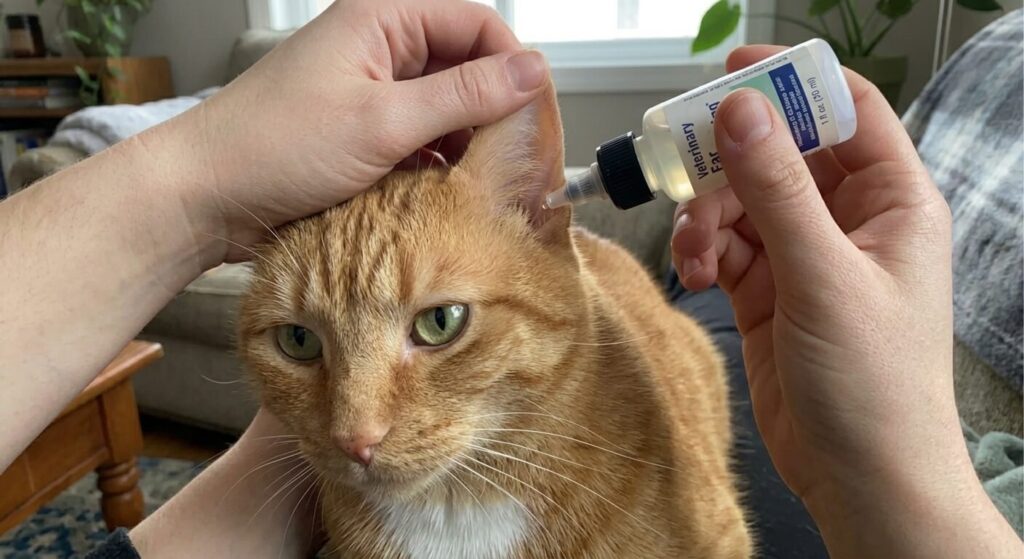
Step 2: Apply the Cleaning Solution
Hold the ear flap gently so the canal entrance remains visible. Position the bottle tip above the opening without inserting it into the ear canal or allowing it to touch the ear. Apply the cleaner exactly as directed on the product label or by your veterinarian. Avoid touching the bottle tip to the ear because this can contaminate the container.
How much solution to use:
Use only the amount stated on the product label or recommended by your veterinarian. Ear cleaners differ in formulation and application instructions, so do not estimate a universal volume or continue adding liquid simply to make the canal appear full.
Important: The solution will be cold if stored at room temperature in an air-conditioned apartment. Warming the bottle in your hands for two minutes before application prevents the startle response that a cold liquid entering the ear canal reliably produces.
Step 3: Massage the Ear Base
This is the step that does the actual mechanical cleaning work — and it is the step that owners most often skip or perform inadequately.
Immediately after applying the solution, fold the ear flap down over the ear opening and place your thumb and forefinger on either side of the vertical canal at the base of the ear — the firm cartilage structure you can feel at the junction between the ear and the head. Apply gentle but firm circular pressure and massage continuously for 30 full seconds.
Why 30 seconds matters:
The massage serves two functions simultaneously. The compression and release action breaks up Cerumen (Ear Wax) and debris throughout the full length of the canal — including the horizontal portion that nothing can physically reach. The solution, distributed by massage and gravity around the L-bend, softens and suspends the debris so it can be ejected. Many cats tolerate about 20–30 seconds of gentle massage. If your cat resists, vocalizes, or seems painful, stop rather than forcing the full time.
You will hear a characteristic squishing or sucking sound during effective massage — this is the solution and debris moving through the canal and is a sign that the technique is working correctly.
Step 4: Allow the Head Shake, Then Wipe
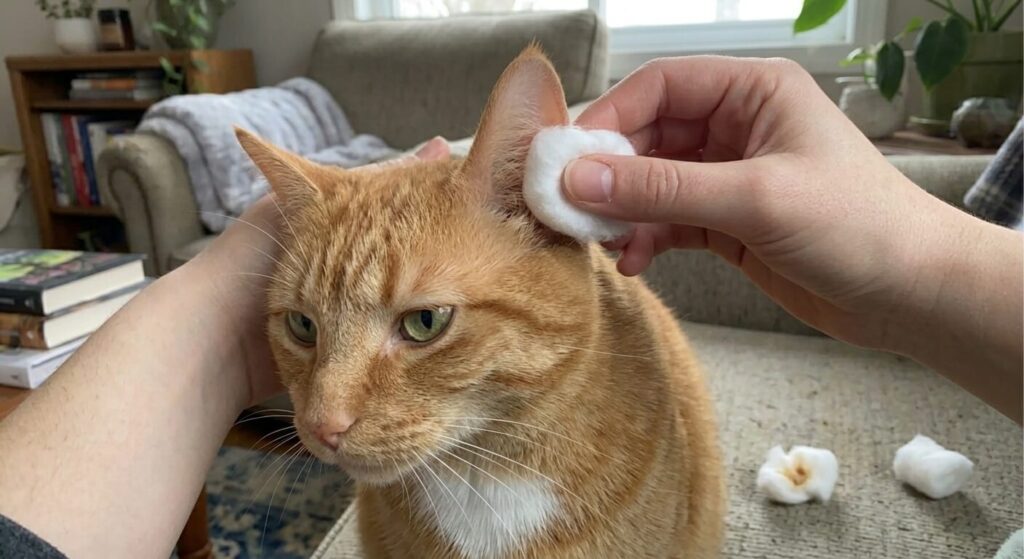
Release the ear after 30 seconds of massage and step back slightly — your cat will shake their head, and the debris-containing solution will be ejected outward. This is intended and desirable. It is how the loosened material exits the canal.
After the head shake, take a fresh cotton ball and wipe the visible outer ear flap — the pinna — and the entrance to the vertical canal, removing any debris that has been brought to the surface.
Critical technique: Wipe only what you can see. Do not insert the cotton ball into the canal. The canal cleaning has been accomplished by the solution and massage — the cotton ball’s role is to collect the debris that has been brought to the outer ear surface by the head shake and by capillary action.
Use a fresh cotton ball, cotton pad, or piece of gauze as needed to remove loosened debris from the visible outer ear. Do not keep rubbing in an attempt to make the ear completely spotless, and never push the material into the canal. Stop if the skin becomes red, irritated, painful, or starts bleeding.
Clean the other ear only if it also needs cleaning and your veterinarian or the product instructions recommend doing so. Always use fresh materials for each ear.
Red Flags: Stop Cleaning and Call Your Vet
Knowing how to clean cat ears at home also means knowing when home cleaning is not the appropriate action — and this knowledge is as important as the technique itself.
Stop cleaning immediately and contact your veterinarian if:
- The ear has a strong or unusual odor.
- Your cat shows pain, cries, pulls away sharply, or becomes unusually defensive.
- You see yellow, green, gray, bloody, or pus-like discharge.
- The ear canal appears swollen, very red, narrowed, or markedly different from the other ear.
- Dark or excessive debris returns soon after cleaning.
- Scratching or head shaking is frequent or forceful.
- Your cat develops a head tilt, loss of balance, unusual eye movements, or difficulty walking.
- Symptoms persist or worsen instead of improving.
One Warning Sign to Take Seriously: Ear Odor
A strong or unusual ear odor is a reason to stop home cleaning and contact your veterinarian. Odor may occur with infection or inflammation, but smell alone cannot identify the cause. If the odor is accompanied by discharge, redness, swelling, pain, scratching, or repeated head shaking, arrange a veterinary examination before putting anything into the ear.
FAQ
What is the best solution to clean cat ears?
The best ear cleaner is one recommended by your veterinarian for your individual cat. Product selection can depend on the condition of the ear canal, the suspected cause of the debris, previous ear problems, and whether the eardrum is intact. A cleaner appropriate for routine maintenance may not be appropriate for an inflamed, painful, or infected ear.
Do not choose a product solely because it contains a particular active ingredient. Avoid hydrogen peroxide, alcohol, vinegar, essential oils, olive oil, and homemade solutions unless your veterinarian has specifically instructed you to use a particular preparation. If the ear is painful, swollen, has an unusual odor or discharge, or the condition of the eardrum is unknown, arrange a veterinary examination before applying any cleaner.
Ear checks fit naturally into a broader grooming routine. For a full maintenance plan, read our indoor cat grooming guide.
Do not put household products, oils, essential oils, or an ear product not recommended for your cat into the canal. If the ear is painful, inflamed, has discharge or odor, or the eardrum has not been examined, ask your veterinarian which product—if any—is safe before cleaning.
Can I use olive oil to clean my cat’s ears?
Olive oil is sometimes recommended in home remedy contexts, but it is not an appropriate ear cleaning solution for several reasons. Oil does not have the surfactant properties needed to lift and suspend Cerumen (Ear Wax) and debris for ejection — it adds moisture to the canal environment rather than helping debris exit.
Residual oil in the ear canal creates a warm, moist environment that supports bacterial and yeast overgrowth rather than preventing it. Some sources recommend olive oil for the treatment of ear mites specifically, but this is neither the most effective nor the veterinary-recommended treatment for ear mite infestation.
If ear mites are suspected, a veterinarian can confirm the cause and recommend an appropriate antiparasitic treatment; cleaning alone does not eliminate an infestation.
Should I clean my cat’s ears if I see black debris?
Not automatically. Black or coffee-ground-like debris can be associated with ear mites, but it can also appear with wax, yeast, infection, or inflammation. If the debris is heavy, dark, smelly, painful, or paired with scratching and head shaking, schedule a veterinary exam before cleaning.
Can cleaning make a cat ear infection worse?
Yes. Cleaning an infected, painful, swollen, or damaged ear can make irritation worse, push debris deeper, or cause pain. If the eardrum is damaged, some products may be unsafe. That is why odor, pain, discharge, swelling, blood, head tilt, or heavy debris should be checked by a veterinarian first.
How often should I clean cat ears?
Most healthy cats do not need routine ear cleaning. Check the visible outer ear periodically during grooming, but clean it only when your veterinarian recommends it or when your cat has a documented maintenance plan for a diagnosed ear condition.
There is no universal weekly or monthly cleaning schedule. Cats with recurring wax buildup or ear disease may need an individualized product and cleaning frequency determined by their veterinarian. Cleaning a healthy ear unnecessarily can irritate the ear canal and disrupt its normal protective environment.
Final Thoughts
Learning how to clean cat ears is mostly about restraint in the good sense: inspect first, clean only mild routine wax, avoid cotton swabs in the canal, and stop when the ear looks painful, smelly, swollen, or abnormal.
Mild wax in an otherwise comfortable ear is very different from intense scratching, heavy dark debris, discharge, odor, swelling, or pain. Home cleaning is appropriate only when the ear looks comfortable and your veterinarian has approved the product and routine. When the ear looks abnormal, arrange a veterinary examination before putting anything into the canal.
References
- Merck Veterinary Manual. Otitis Externa (External Ear Infection) in Cats.
https://www.merckvetmanual.com/cat-owners/ear-disorders-of-cats/otitis-externa-external-ear-infection-in-cats - Cornell Feline Health Center. Ear Mites: Tiny Critters That Can Pose a Major Threat.
https://www.vet.cornell.edu/departments-centers-and-institutes/cornell-feline-health-center/health-information/feline-health-topics/ear-mites-tiny-critters-can-pose-major-threat - VCA Animal Hospitals. Instructions for Ear Cleaning in Cats.
https://vcahospitals.com/know-your-pet/instructions-for-ear-cleaning-in-cats - VCA Animal Hospitals. Ear Infections in Cats (Otitis Externa).
https://vcahospitals.com/know-your-pet/ear-infections-in-cats-otitis-externa