How much to feed indoor cat meals depends on body weight, body condition, age, activity level, food calories, health status, and whether the cat eats wet food, dry food, or both. Indoor cats often need careful portions because they usually burn fewer calories than highly active outdoor cats.
The safest answer is not one universal cup amount. The safest answer is a measured starting point, followed by body condition tracking and gradual adjustment. A healthy 10 lb indoor cat may need a very different amount from an overweight 10 lb cat, a senior cat losing muscle, or a young active cat who plays constantly.
This guide explains how to estimate portions, read calories, split wet and dry food, adjust for body condition, and know when your veterinarian should guide the plan.
Quick Answer
Most healthy adult indoor cats need a measured daily portion based on calories, not just cups or cans. As a broad reference, the WSAVA chart for healthy adult cats in ideal body condition spans about 180–190 kcal/day at 5.5 lb and 260–310 kcal/day at 12.1 lb. Individual needs may be higher or lower, so use the chart only as a starting point and adjust with body weight, body condition, muscle condition, activity, age, neuter status, health, and the food’s calorie density.
Start with the feeding guide on the food label, measure the portion, track weight and body shape for two to three weeks, then adjust gradually. If your cat is overweight, underweight, senior, diabetic, has kidney disease, has urinary issues, or is losing weight, ask your veterinarian before making major feeding changes.
Portion size is only one part of the routine. For meal timing, wet food, hydration, treats, weight control, and feeder choices, use our apartment cat feeding and weight control guide.
Important Safety Note
Do not crash diet a cat. Sudden or severe calorie restriction can be dangerous. If your cat stops eating, loses weight quickly, vomits repeatedly, drinks much more water, strains in the litter box, or suddenly changes appetite, contact your veterinarian. Feeding amount is a health question when weight, appetite, or medical signs change.
Table of Contents
If you are building a complete feeding routine, use our apartment cat feeding and weight control guide to connect portions, meal timing, feeders, treats, and weight management.
How Much to Feed Indoor Cat: The Safe Starting Point
How much to feed indoor cat meals should start with calories, not cup size. Cups are easy to use, but they can be misleading because different foods have very different calorie densities. One dry food may contain far more calories per cup than another. Wet foods also vary by can size, texture, and calories per ounce.
The safest starting point is:
- Find the calories on the food label.
- Estimate your cat’s daily calorie need.
- Measure the total daily amount.
- Feed that amount consistently.
- Track body condition for two to three weeks.
- Adjust gradually based on weight and shape.
Published calorie charts are starting estimates for healthy adults in ideal body condition, not prescriptions for every indoor cat. The WSAVA reference ranges rise from about 180–190 kcal/day at 5.5 lb to 260–310 kcal/day at 12.1 lb, while noting that individual cats may need more or less to maintain a trim body condition. An overweight cat may need a veterinarian-guided reduction, and a senior cat losing weight needs medical assessment before calories are increased.
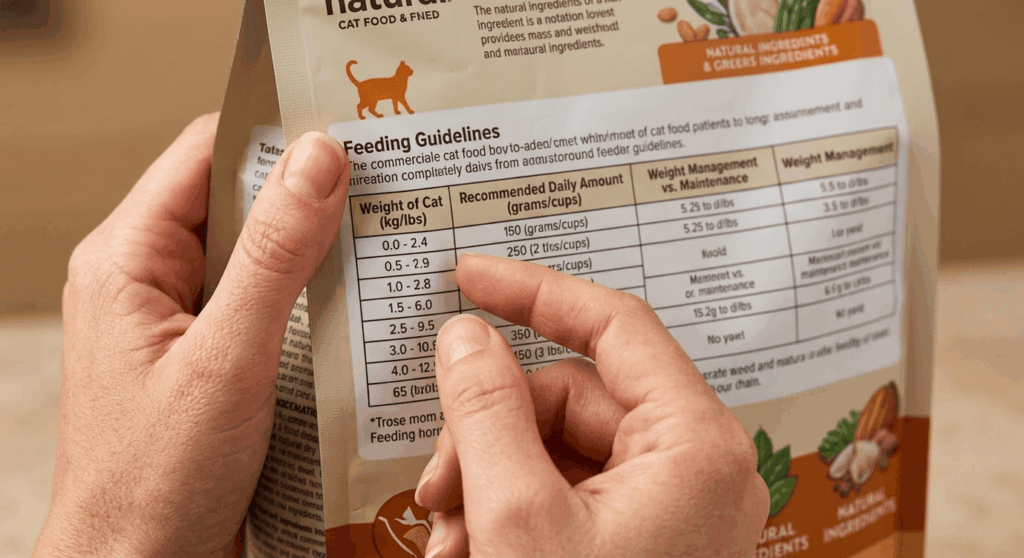
The package feeding guide is a starting point, not a final answer. Many indoor cats need less than the label suggests because they are neutered, less active, or prone to weight gain.
Indoor Cat Portion Planning Table
| Cat Situation | Portion Goal | What to Watch | Best Next Step |
|---|---|---|---|
| Healthy adult indoor cat | Maintain stable weight | Waist, ribs, energy, stool | Measure meals and reassess every few weeks |
| Overweight indoor cat | Gradual safe weight loss | Begging, treat calories, fast eating | Ask vet for a safe target and calorie plan |
| Underweight cat | Restore weight safely | Weight loss, appetite, vomiting | Schedule a vet check before adding calories |
| Senior indoor cat | Maintain muscle and appetite | Weight loss, dental pain, thirst | Track weight and ask about senior screening |
| Fast eater | Slow meal pace | Vomiting, food obsession | Use smaller meals or puzzle feeders |
| Multi-cat home | Prevent stealing and uneven intake | One cat gaining, one losing | Feed separately or use controlled feeders |
How to Calculate Daily Calories
To estimate feeding amount, you need two things: your cat’s calorie target and the food’s calorie density.
Food labels usually list calories as:
- kcal per cup
- kcal per can
- kcal per ounce
- kcal per pouch
Once you know the daily calorie target, divide it across the foods you use.
Example:
If your cat’s target is 220 calories per day and the food is 110 calories per can, two cans per day would provide 220 calories.
If your cat’s target is 220 calories per day and the dry food is 400 calories per cup, then half a cup would provide 200 calories. A little more would reach 220. This is why dry food portions can look small but still contain many calories.
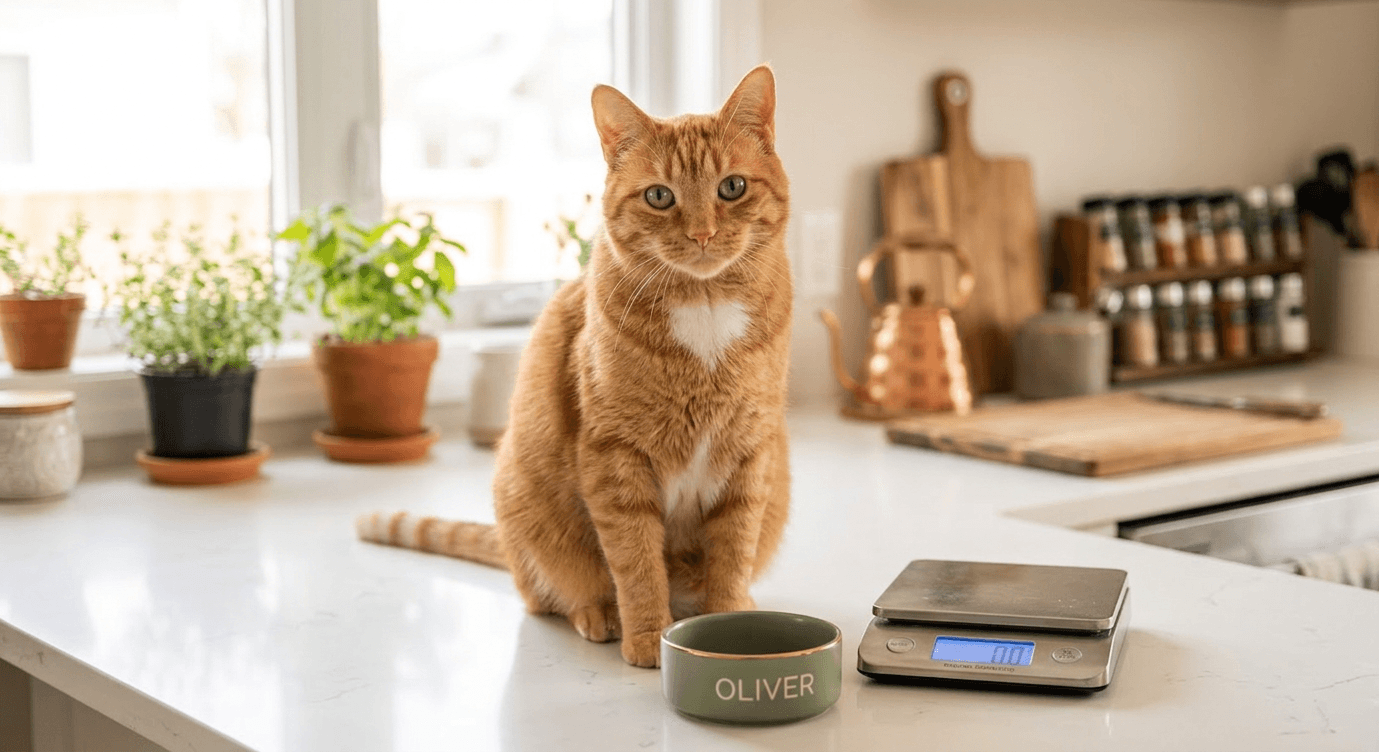
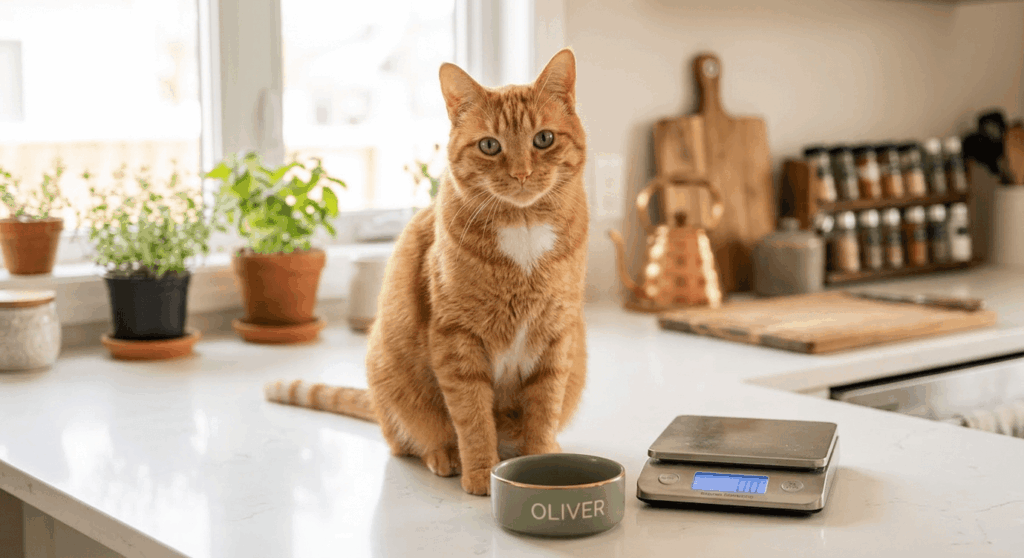
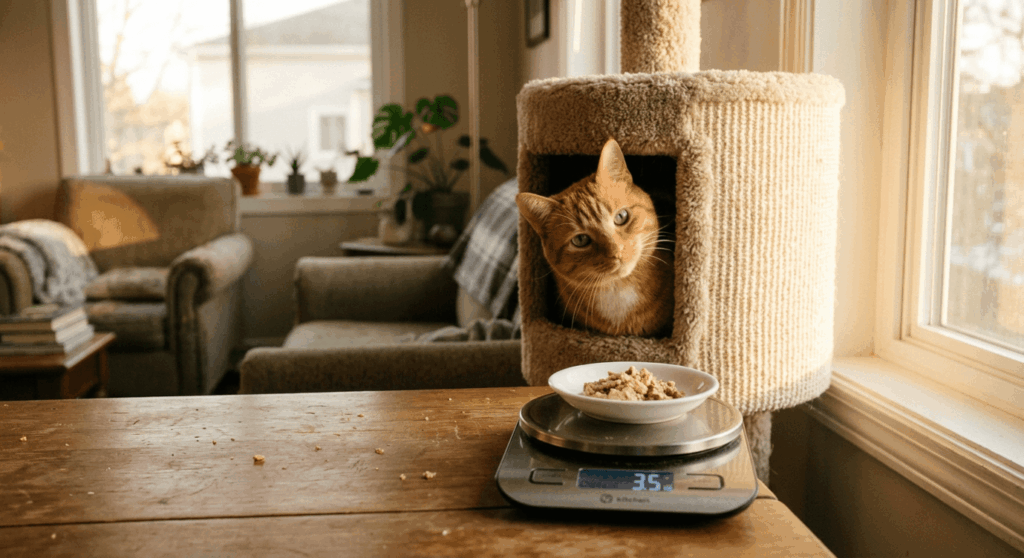
Do not guess dry food by bowl fullness. A casual scoop can easily add extra calories. Use a measuring cup or kitchen scale.
The calculation is only the starting point. Your cat’s body condition tells you whether the amount is working. If your cat gains weight, the intake may be too high. If your cat loses weight unexpectedly, the issue may be too little food, food stealing, dental pain, illness, or another medical problem.
How to Read Cat Food Calories Correctly
The most important number on a cat food label is not the front-of-bag claim. It is the calorie statement. Look for phrases such as “kcal per cup,” “kcal per can,” “kcal per ounce,” or “kcal per pouch.”
When comparing wet-food labels, use our low calorie cat wet food guide to place kcal per container, kcal per kilogram, package weight, and nutritional adequacy into the same worksheet.
This number tells you how much energy the food provides. Without it, portion planning becomes guesswork.
For an overweight adult eating wet food, our best wet cat food for weight loss comparison shows how to match the exact kcal-per-can label to a veterinarian-provided daily target.
Dry food is usually calorie-dense. A small scoop may contain more calories than expected. Wet food usually contains more water, so the serving looks larger even when calories are moderate. This is why switching between wet food and dry food without checking calories can accidentally increase or decrease your cat’s intake.
For example:
| Food Type | Example Calories | What It Means |
|---|---|---|
| Dry food | 400 kcal per cup | 1/4 cup = about 100 kcal |
| Wet food | 90 kcal per 3 oz can | 2 cans = about 180 kcal |
| Lickable treat | 8-15 kcal each | Several per day can add up |
| Dental treat | Varies widely | Count it as food, not “extra” |
If your cat eats multiple foods, add everything together. A common mistake is calculating the main meals but forgetting treats, toppers, pill pockets, dental chews, or food used in puzzle toys.
For indoor cats, small extras matter. A few extra calories every day can slowly become weight gain over months.
How to Adjust for Wet Food and Dry Food
Many indoor cats eat a mix of wet and dry food. Mixed feeding can work well, but it requires math. The common mistake is feeding a full wet portion plus a full dry portion, which doubles calories.
A better method:
- Decide the total daily calorie target.
- Choose how many calories will come from wet food.
- Choose how many calories will come from dry food.
- Measure both.
- Count treats inside the same daily total.
Example:
If your cat’s daily target is 220 calories and one can of wet food is 90 calories, you might feed two cans for 180 calories and add 40 calories of dry food or treats. If the dry food has 400 calories per cup, 40 calories is only one-tenth of a cup.
This is why mixed feeding can accidentally become too much food. Dry food calories are concentrated.
Wet food may help some cats feel fuller because it contains more moisture and volume. Dry food may be useful for timed feeders, puzzle feeders, or cats who prefer crunch. Neither option is automatically perfect. The portion matters.
Food format affects more than portion size. Compare moisture, calorie density, storage, dental claims, and mixed feeding in our wet food vs dry food for indoor cats guide.
If you need a broader diet foundation, use our indoor cat diet guide.
If you are considering uncooked food, review our raw food diet indoor cat safety guide before changing feeding formats.
Feeding by Body Condition
Body condition matters more than body weight alone. Two cats can both weigh 10 lb and need different amounts. One may be lean and muscular. The other may be overweight. A third may be losing muscle but still have belly fat.
A healthy body condition usually means:
- ribs can be felt with light pressure
- waist is visible from above
- belly is not heavily sagging with fat
- cat moves comfortably
- grooming is normal
- weight stays stable over time
An overweight cat may have:
- no clear waist
- ribs difficult to feel
- fat over the hips or belly
- reduced jumping
- less grooming
- more sleep
- begging from habit
- trouble fitting into favorite spots
An underweight cat may have:
- sharp ribs or spine
- visible hip bones
- muscle loss
- reduced appetite
- poor coat
- vomiting or diarrhea
- dental discomfort
- increased thirst
- weakness
If your cat is overweight, reduce calories gradually and safely. Do not crash diet. Count treats, measure food, increase gentle activity, and ask your veterinarian for a target weight if significant weight loss is needed.
If your cat is underweight or losing weight, do not simply add food without asking why. Weight loss can signal dental disease, kidney disease, hyperthyroidism, diabetes, gastrointestinal disease, cancer, pain, or food access problems.
For weight checks, use our guide to telling whether an indoor cat is overweight.
For food options during a safe weight plan, see our guide to best wet cat food for weight loss.
Portion control is also part of long-term health prevention. For the full routine connecting weight, diet, vet visits, and early warning signs, see our indoor cat health prevention guide.
Portion Examples by Cat Weight
These examples follow the WSAVA guidance chart for average healthy adult cats in ideal body condition and are only starting points, not medical prescriptions. The chart itself notes that individual cats may have higher or lower requirements. Do not use current weight alone to set calories for an overweight, underweight, growing, pregnant, nursing, senior, or medically affected cat.
| Cat Weight | Common Daily Calorie Starting Range | Notes |
|---|---|---|
| 6 lb indoor cat | about 190–210 kcal/day | Small cats can be overfed easily |
| 8 lb indoor cat | about 215–250 kcal/day | Watch body condition, not just weight |
| 10 lb indoor cat | about 240–270 kcal/day | Many adult indoor cats fall near this range |
| 12 lb indoor cat | about 260–310 kcal/day | May be healthy if large-framed, too much if overweight |
| 14 lb indoor cat | varies widely | Ask whether this is healthy size or excess weight |
| 16 lb+ indoor cat | vet-guided plan recommended | Do not crash diet |
The mistake is assuming every 12 lb cat should eat more than every 10 lb cat. A lean, muscular 12 lb cat and an overweight 12 lb cat need different plans. An overweight cat should usually be fed toward a safe target weight, not simply maintained at the current weight.
If your cat’s body shape is unclear, ask your veterinarian for a body condition score and target weight. That makes portion planning much safer.
Feeding by Age and Life Stage
Kittens
Kittens need more calories per pound than adult cats because they are growing. They usually need kitten-formulated food and more frequent meals. Do not restrict a kitten’s calories for weight control unless your veterinarian gives specific guidance.
Young Adult Cats
Young adult indoor cats may look active, but this is also when weight gain often begins. After neutering and after kitten growth slows, calorie needs may drop. This is a good stage to build measured feeding habits.
Adult Indoor Cats
Adult indoor cats need consistency. Feed measured portions, track body condition, and adjust if weight changes. Many adult indoor cats gain weight because food stays the same while activity decreases.
Senior Cats
Senior cats need close monitoring. Some seniors gain weight because they move less. Others lose weight because of dental disease, kidney disease, thyroid disease, arthritis, nausea, or other medical issues. Do not assume senior weight loss is normal.
For senior cats, weigh regularly and ask your veterinarian whether screening tests, dental checks, or diet adjustments are needed.
How to Split Meals During the Day
Meal timing affects hunger, begging, vomiting, early wake-ups, and weight control. Many adult indoor cats do well with two or three measured meals per day. Some cats do better with smaller, more frequent meals.
Common schedules include:
- two meals per day: morning and evening
- three meals per day: morning, late afternoon, evening
- wet food meals plus a measured dry puzzle feeder portion
- timed feeder meals for early morning or workday gaps
- separate meals for multi-cat homes
If your cat wakes you early, avoid feeding immediately after meowing. That teaches the cat that waking you works. Instead, use a timed feeder, shift a measured portion later in the evening, or add play before bed.
If your cat eats too fast, divide the daily amount into smaller portions. Puzzle feeders can help some cats slow down and work for food. For fast eaters or bored indoor cats, a cat puzzle feeder can make a measured portion last longer.
For owners who need more scheduling help, an automatic cat feeder for indoor cats can help with portion timing, but it still needs measured calories.
Sample Feeding Plans for Indoor Cats
These examples show how portions can be divided during the day. Adjust calories and food amounts based on your own cat’s food label.
Example 1: Two Wet Meals Per Day
This works well for cats who prefer wet food, need hydration support, or feel more satisfied with larger meal volume.
Example structure:
- Breakfast: half of daily calories
- Dinner: half of daily calories
- Treats: counted inside the total, not added on top
This is simple, but some cats may become hungry between meals. If your cat begs heavily, consider three smaller meals instead of two larger ones.
Example 2: Wet Food Plus Measured Dry Food
This is a practical mixed-feeding plan.
Example structure:
- Morning: wet food meal
- Afternoon: small measured dry portion in a puzzle feeder
- Evening: wet food meal
This can help cats who enjoy crunch while still supporting moisture. The dry portion must be measured carefully because dry food calories add up quickly.
Example 3: Timed Feeder for Early Morning Hunger
If your cat wakes you before breakfast, do not feed immediately after meowing. Use a timed feeder to separate food from the act of waking you.
Example structure:
- Evening: measured wet or dry meal
- Early morning: small timed feeder portion
- Morning: regular meal after you wake up
This helps the cat learn that the feeder, not loud behavior, controls early food access.
Example 4: Fast Eater Plan
Fast eaters may vomit after meals or act hungry immediately after eating. Smaller meals and feeding tools can help.
Example structure:
- Three or four smaller meals
- Puzzle feeder for dry food
- Slow feeder surface if appropriate
- Short play before meals
Do not solve fast eating by adding more food. Slow the pace first.
Example 5: Multi-Cat Portion Plan
Multi-cat homes need more structure because one cat may steal food while another eats too little.
Example structure:
- Feed cats in separate rooms
- Pick up bowls after meals
- Track each cat’s body condition separately
- Use microchip or timed feeders if needed
- Do not assume shared bowls are fair
If one cat is gaining weight and another is losing weight, the feeding system is not working.
Common Portion Mistakes
Mistake 1: Feeding by Bowl Size
A full bowl is not a portion. Bowl size varies, and dry food calories are concentrated. Measure the food, not the visual fullness.
Mistake 2: Ignoring Treat Calories
Treats count. Dental treats, lickable treats, training rewards, and small table scraps can add meaningful calories.
Mistake 3: Using the Label as a Final Answer
Package guidelines are useful starting points, but your cat’s body condition decides whether the amount is right.
Mistake 4: Reducing Food Too Quickly
Crash dieting can be dangerous for cats. Weight loss should be gradual and safe.
Mistake 5: Feeding All Cats Together
In multi-cat homes, one cat may eat more while another eats less. If weight changes are uneven, feed separately.
Mistake 6: Not Rechecking After Life Changes
Calorie needs may change after neutering, aging, moving, illness, medication changes, or reduced activity.
How to Know the Portion Is Working
A feeding amount is working when your cat’s body condition, energy, stool, appetite, and behavior stay stable over time.
Signs the portion may be right:
- weight stays stable
- ribs can be felt with light pressure
- waist is visible from above
- cat has normal energy
- stool is consistent
- coat and grooming are normal
- cat is interested in food but not frantic all day
Signs the portion may be too high:
- gradual weight gain
- rounder belly
- ribs harder to feel
- less jumping
- less grooming
- more sleeping
- leftover food plus weight gain
- treats increasing without adjustment
Signs the portion may be too low or medically concerning:
- weight loss
- begging with weight loss
- poor coat
- weakness
- vomiting
- diarrhea
- eating less
- drinking more
- stealing food desperately
- muscle loss along the back or hips
If the signs are mixed, do not guess aggressively. A cat who begs constantly may be bored, underfed, stressed, or medically unwell. A cat who loses weight while eating well may need a veterinary exam. A cat who gains weight on a small portion may need diet review, activity changes, or medical assessment.
When to Ask Your Veterinarian
Ask your veterinarian before changing portions if your cat is:
- overweight
- underweight
- losing weight
- senior
- diabetic
- diagnosed with kidney disease
- diagnosed with urinary issues
- vomiting often
- having diarrhea
- eating much more than usual
- eating much less than usual
- drinking much more water
- on a prescription diet
- recovering from illness or surgery
Call promptly if your cat stops eating, loses weight quickly, strains in the litter box, vomits repeatedly, becomes weak, or seems painful.
Feeding amount is not just a math problem when health signs are present. It becomes a medical question.
Frequently Asked Questions
1. How much should I feed an indoor cat per day?
There is no single calorie range that fits every healthy adult indoor cat. The WSAVA chart gives weight-based starting ranges for cats in ideal body condition, but the correct amount still depends on body condition, muscle condition, activity, age, neuter status, health, and the food’s calorie density.
Use the food label as a starting point, measure the portion, and adjust based on weight and body condition.
2. Should I feed my cat based on current weight or ideal weight?
If your cat is at a healthy weight, current weight can help guide portions. If your cat is overweight, feeding based only on current weight may maintain excess weight. If your cat is underweight, the issue may require veterinary evaluation.
Ask your veterinarian for an ideal weight if your cat needs to lose or gain weight safely.
3. How do I split calories between wet and dry food?
Start with the daily calorie target. Subtract the calories from wet food, then use the remaining calories for dry food or treats.
For example, if the target is 220 calories and wet food provides 160 calories, only 60 calories remain for dry food and treats.
4. Can I free-feed an indoor cat?
Some cats can free-feed without gaining weight, but many indoor cats cannot. Free-feeding makes it harder to control calories, track appetite changes, and prevent food stealing in multi-cat homes.
If your cat is overweight, begging often, or eating too quickly, measured meals are usually better.
5. Do spayed or neutered cats need less food?
Many cats need fewer calories after spaying or neutering because metabolism and activity may change. This does not mean every cat needs a diet food, but portions should be monitored carefully after surgery and growth changes.
6. How much should I feed a senior indoor cat?
Senior cats vary widely. Some need fewer calories because they move less. Others need veterinary evaluation because they are losing weight or muscle. Track weight, appetite, dental comfort, water intake, and litter box habits.
Do not assume senior weight loss is normal.
7. What if my indoor cat is always hungry?
A cat may seem hungry because of true calorie needs, habit, boredom, fast eating, stress, food stealing, or medical problems. If hunger is sudden or paired with weight loss, vomiting, diarrhea, increased thirst, or behavior change, call your veterinarian.
If your cat is healthy, try measured meals, smaller frequent portions, play before meals, and puzzle feeders.
8. How often should I adjust my cat’s food amount?
Recheck every two to three weeks when making a routine change. For stable cats, reassess body condition monthly and at veterinary visits. Adjust gradually if weight changes.
9. Is a measuring cup enough?
A measuring cup is better than guessing, but a kitchen scale is more accurate. Dry food pieces vary in size and density, so grams can be more precise than cups.
10. Can I use the feeding chart on the bag?
Yes, but use it as a starting point only. Feeding charts are broad estimates. They do not know your cat’s exact body condition, activity level, age, metabolism, or treat intake.
Start with the label, measure carefully, then adjust based on your cat’s body shape and weight trend.
11. Why does my cat beg even after eating enough?
Begging does not always mean hunger. It can come from habit, boredom, fast eating, attention-seeking, stress, or meal timing. If your cat is healthy and body condition is stable, try play before meals, smaller meals, puzzle feeders, and predictable routines.
If begging is sudden or paired with weight loss, increased thirst, vomiting, or diarrhea, contact your veterinarian.
12. Should treats be included in my cat’s daily calories?
Yes. Treats should be counted as part of the daily food intake. For indoor cats, treats can quietly add too many calories, especially lickable treats, dental treats, and multiple small rewards throughout the day.
A simple rule is to keep treats limited and reduce meal calories slightly if treats are given daily.
13. When should I call a veterinarian about feeding amount?
Call your veterinarian if your cat stops eating, loses weight, gains weight rapidly, drinks much more, vomits often, has diarrhea, strains in the litter box, or has a medical condition. Also ask for help if your cat needs significant weight loss.
Final Thoughts
How much to feed indoor cat meals is not a fixed cup amount. It is a measured routine based on calories, body condition, age, activity, food type, and health.
Start with the label, measure carefully, count treats, and watch your cat’s body shape over time. Adjust gradually. If your cat is overweight, underweight, senior, or medically complex, involve your veterinarian before making major changes.
The best feeding plan is not dramatic. It is consistent: measured meals, realistic portions, clean water, safe treats, and regular weight checks.
References
AAFCO: Reading Pet Food Labels