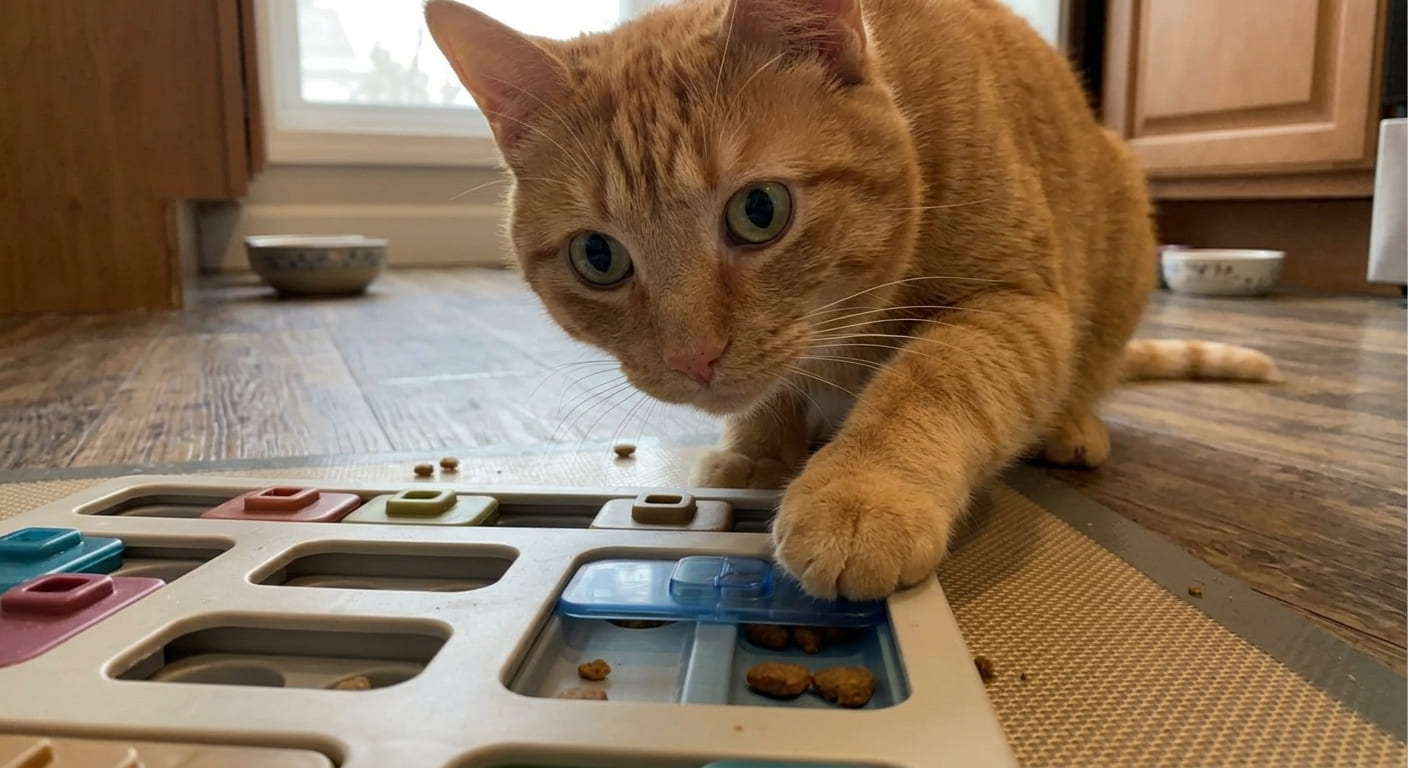
The best cat puzzle feeders are easy enough for your cat to solve without frustration, compatible with the food you actually serve, and simple to clean after every meal. For most cats, the Catstages Buggin’ Out Puzzle & Play is the best place to start because its adjustable pegs and swiveling leaves that reveal hidden food compartments create a visible, adjustable challenge without requiring a cat to push its face between tall obstacles.
Not every cat needs the same puzzle. A cat that eats dry food too quickly may do well with rounded spikes or narrow cups. A wet-food eater needs a shallow, washable surface rather than a rolling dispenser. A confident, food-motivated cat may enjoy several doors, tunnels, and compartments, while a cautious senior may need an open tray with most of the food initially uncovered.
This guide compares seven useful designs by food compatibility, difficulty, stability, cleaning, and the way a cat must retrieve the food. It also explains how to introduce a puzzle gradually, how much food to place in it, and when a conventional bowl is the safer choice.
Quick answer: Choose Catstages Buggin’ Out for a first sliding-cover puzzle, Northmate CATCH for slowing dry-food meals, LickiMat Casper for wet food, Catit Senses Digger for cats that like to scoop with a paw, Doc & Phoebe’s Indoor Hunting Feeder for room-to-room foraging, and the TRIXIE Cat Activity Fun Board for experienced puzzle solvers.
Best Cat Puzzle Feeders at a Glance
| Puzzle feeder | Best for | Food type | Relative difficulty | Main limitation |
|---|---|---|---|---|
| Catstages Buggin’ Out Puzzle & Play | Best overall and first sliding puzzle | Dry food or treats | Easy to moderate | Food can scatter outside the tray |
| Northmate CATCH | Fast dry-food eaters | Dry food; manufacturer also permits wet food | Easy to moderate | Large footprint; deep spaces may frustrate some cats |
| LickiMat Casper | Wet food and pâté | Wet, soft, liquid, and some dry food | Easy | Not a paw-operated puzzle |
| Catit Senses Digger | Cats that naturally scoop food | Dry food or treats | Moderate | Narrow cups will not suit every paw or mobility level |
| Doc & Phoebe’s Indoor Hunting Feeder | Foraging around the home | Dry food or treats | Moderate | Requires setup and finding all feeders |
| TRIXIE Cat Activity Fun Board | Variety in one stationary board | Dry food or treats | Moderate to advanced | More pieces and recesses to clean |
| DIY muffin-tin puzzle | Low-cost introduction | Dry food or treats | Adjustable | Requires supervision and has no fitted puzzle parts |
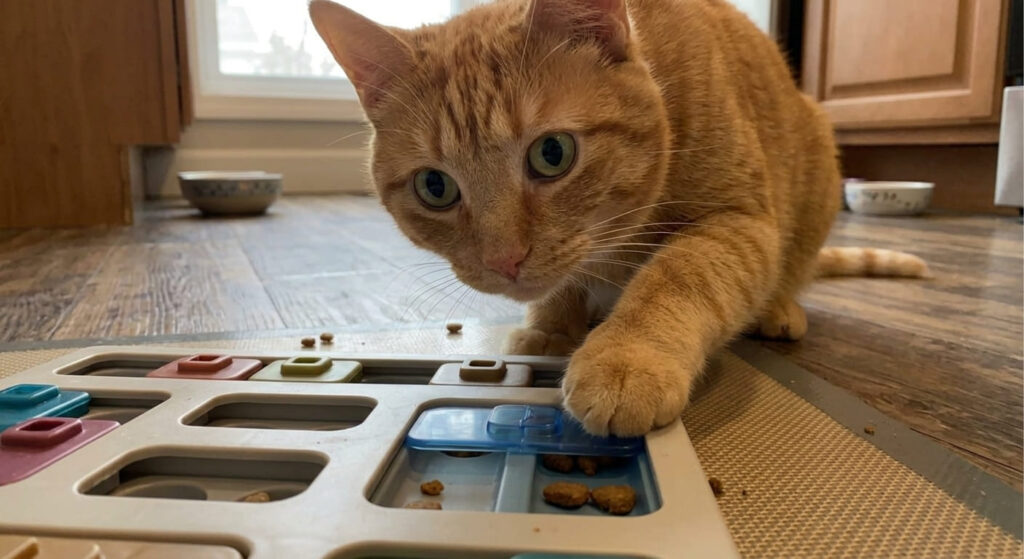
Table of Contents
How We Chose These Cat Puzzle Feeders
This comparison is based on manufacturer specifications, the physical action required to release food, food compatibility, cleanability, stability, and suitability for different experience levels. It is not a claim that every product was laboratory tested in our home or that one design will work for every cat.
The most useful selection criteria are practical:
- The challenge is adjustable. A beginner should be able to reach some food immediately. Difficulty can increase only after the cat understands the task.
- The feeder matches the food. Dry kibble can go into cups, tubes, or rolling feeders. Wet food needs an open, washable surface that does not trap residue.
- The eating surface is accessible. A cat should not have to force its whiskers or face into a space that is too narrow.
- The base stays in place. Excessive sliding can turn a manageable puzzle into an irritating one.
- Every food-contact area can be cleaned. Complicated grooves are only useful if you can reach and wash them.
- The puzzle permits portion control. A feeder should distribute the cat’s measured meal, not add uncounted treats on top of the daily ration.
- There are no loose or damaged parts. A puzzle should be inspected regularly and removed if chewing, cracking, or detachment creates a swallowing hazard.
Puzzle feeders are tools, not necessities. A cat that ignores one design may enthusiastically use another because licking, sliding, digging, batting, and searching are different behaviors. The goal is to find the easiest version your cat willingly uses, then add variety if the cat continues to enjoy it.
1. Catstages Buggin’ Out Puzzle & Play — Best Overall
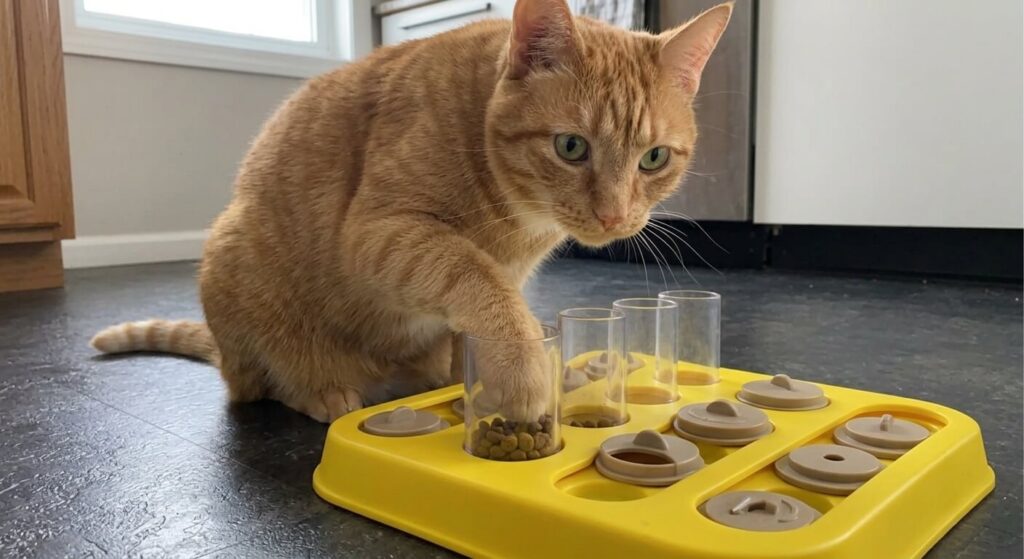
Catstages Buggin’ Out is the strongest all-around choice for a cat’s first conventional food puzzle. The manufacturer describes Buggin’ Out as an adjustable puzzle with 16 hidden treat compartments. Cats move the pegs and swivel the leaves to uncover dry food or treats.
That mechanism matters for beginners. The food is not hidden inside a sealed object, and the cat does not need to learn that rolling a ball makes kibble fall out. You can leave several cups fully exposed during the first session, partly cover them later, and eventually use all the moving pieces.
Why it stands out
- The 16 hidden compartments provide several places to distribute a measured portion.
- Sliding and swiveling covers create more than one route to a reward.
- The broad, low profile is easier to approach than a tall feeder.
- Difficulty can be reduced without modifying the product.
Best use
Use dry food or small treats that can be removed cleanly from the cups. Begin with food in the open cups and a few pieces on top of the covers. Once the cat retrieves those pieces comfortably, move one cover partway over a cup. Increase difficulty one change at a time.
Follow the manufacturer’s supervision instructions: stay with your cat throughout use, prevent chewing, and put the puzzle away when it is empty.
Possible drawbacks
A determined cat may scoop food beyond the edge, so placing the puzzle on a washable feeding mat helps. Cats with limited paw mobility may need the covers kept mostly open. As with any feeder, verify the current packaging instructions before putting components in a dishwasher; product-care directions can change.
Best for: beginners, curious paw-users, and people who want an adjustable stationary puzzle.
2. Northmate CATCH — Best for Fast Dry-Food Eaters
Northmate CATCH is a one-piece feeder with 37 smoothly rounded spikes of different heights. Food is scattered between the spikes, and the cat uses a paw or muzzle to retrieve small amounts at a time. Unlike a board with doors, there is no single trick to learn. The shape itself slows access.
The manufacturer describes the feeder as hard, phthalate-free plastic with four nonslip feet. It measures approximately 27 × 23 × 8 centimeters and is listed as dishwasher-safe. The raised outer edge can contain food that moves toward the perimeter.
Why it stands out
- One molded piece means there are no sliding caps to lose.
- Varied spike heights distribute food across easy and harder spaces.
- Rounded obstacles encourage smaller bites instead of access to a full pile.
- The nonslip feet help keep the feeder stable.
- Manufacturer cleaning instructions are straightforward.
Although the manufacturer says its outer edge can accommodate wet food, CATCH is most practical with dry food because kibble can be scattered between the spikes and removed without leaving residue throughout the structure. For regular wet-food meals, a shallow lick mat is easier to spread, inspect, and wash.
Possible drawbacks
The 27 × 23-centimeter footprint is not especially compact. Some cats will readily paw between the spikes; others may dislike putting their face near them. Start with most of the meal around the outer, easier spaces rather than filling only the deepest center.
If speed is the main problem but your cat dislikes puzzle mechanisms, also compare the options in our slow feeder cat bowl guide. A shallow slow-feed bowl may be a better first step than a demanding activity board.
Best for: dry-food eaters that gulp meals and cats that enjoy scooping with a paw.
3. LickiMat Casper — Best for Wet Food
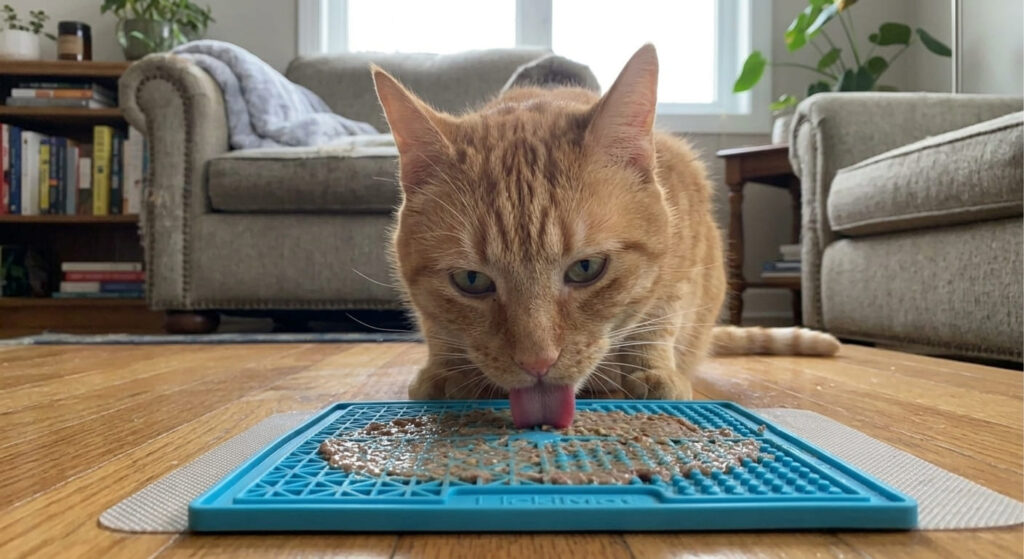
LickiMat Casper is a shallow, fish-shaped feeding mat with a textured surface and deeper pockets designed for cats. Instead of lifting doors or reaching into cups, the cat licks soft food from the pattern. That makes it the most appropriate option here for pâté, mousse, purée, gravy-rich food, or a thin layer of another cat-safe soft food.
According to the manufacturer, the Classic Casper is made from food-grade thermoplastic rubber and measures about 22 × 15 centimeters. It is freezer-safe and microwave-friendly. Care instructions vary between regional listings—one official page says hand washable while another lists dishwasher-safe—so follow the directions printed on the exact version you purchase.
Why it stands out
- The shallow surface suits wet-food feeding better than enclosed cups.
- Food can be spread thinly so a meal takes more licking actions to finish.
- It can be frozen if the current product instructions allow it and your cat tolerates cold food.
- The pattern is visually simple, making it suitable for puzzle beginners.
- It occupies less floor space than many multi-module boards.
How to use it
Spread the cat’s normal measured wet-food portion across several sections. Do not fill every groove deeply; a thin, even layer is easier to finish and clean. On the first use, leave a small mound in the center so the cat immediately recognizes the surface as a feeding area.
Freezing can make food much harder to retrieve. It is optional, not the default. Begin with food at the temperature your cat normally accepts. If you later try a chilled or frozen portion, use only part of the meal and confirm that the cat can consume it comfortably.
Possible drawbacks
Casper is a slow-feeding surface rather than a multi-step puzzle, so an experienced cat may not find it mentally challenging. Rubber-like mats also require supervision when first introduced, especially for cats that chew nonfood materials. Replace the mat if it becomes torn, deeply scratched, sticky, or impossible to clean.
Best for: wet-food eaters, puzzle beginners, and cats that prefer licking to pawing.
4. Catit Senses Digger — Best for Cats That Like to Scoop
The Catit Senses Digger uses five removable cups—three short narrow cups and two longer, wider cups—set into a broad base. Dry food or treats go into the cups, and the cat reaches down to hook pieces out with a paw.
The two cup sizes naturally vary the challenge. Wide or shallow access is easier; narrow or deep access demands more precise paw movement. The official product page lists rounded cup edges, a stable sloped base, and BPA-free materials. Because the cups detach, they are more accessible for cleaning than fixed deep wells.
Why it stands out
- Five removable cups allow several difficulty combinations.
- The wide base resists tipping.
- A front basin catches some pieces that fall out of the cups.
- Smooth, rounded parts simplify inspection and washing.
- It suits cats that already pull toys or food toward themselves with a paw.
Best use
For the first meal, put several pieces in the front basin, fill only the widest cup, and allow a few pieces to sit near its rim. Add the narrower or deeper cups after the cat succeeds. This progression teaches the action without forcing the cat to solve the hardest configuration immediately.
Possible drawbacks
This is a dry-food feeder. Wet food would collect in the tubes and be inconvenient to remove completely. The official global product page lists the assembled size as approximately 37 × 37 × 11 centimeters, so measure the feeding area before buying. Cats with arthritis, weak paw control, or very large paws may struggle with the narrow cups.
Best for: cats that retrieve objects with their paws and dry-food eaters ready for a moderate challenge.
5. Doc & Phoebe’s Indoor Hunting Feeder — Best for Foraging
Doc & Phoebe’s Indoor Hunting Feeder changes the task from solving one board to finding several mouse-shaped feeders around the home. The current kit includes three fabric-covered feeder mice, a trainer, and a scoop. The plastic insert dispenses dry food as the cat bats or moves the mouse.
This is the most spatially engaging option in the list. A cat must locate the feeder, interact with it, and collect the pieces it releases. Hiding the mice in different safe, accessible places can prevent the same routine from becoming completely predictable.
Why it stands out
- Multiple feeders divide a measured ration into smaller portions.
- Hiding locations add searching and movement to mealtime.
- The trainer lets the cat learn the dispensing action before the feeders are hidden.
- The hard plastic parts are described as top-rack dishwasher-safe.
- The fabric skins are listed as machine washable.
How to introduce it
Do not hide all the food on day one. Start with the trainer or an uncovered feeder in the usual eating area. Let the cat see you place food inside, and keep an easy bowl portion available until the dispensing action is understood. Next, place one feeder in plain sight a short distance away. Only then move feeders to simple hiding locations.
Choose locations the cat can enter and exit freely. Avoid appliances, recliners, cords, cleaning products, balconies, and areas where a dog or another cat can guard the food. Count the feeders before and after each session so food is not forgotten under furniture.
Possible drawbacks
The system is intended for dry food or treats, not wet food. It also requires more daily setup than a stationary board. In a multi-cat home, one fast or confident cat may find every mouse. Separate feeding zones may be necessary; see our guide to feeding multiple cats separately if one cat consistently takes another cat’s portion.
Best for: active dry-food eaters, confident explorers, and homes with several safe hiding locations.
6. TRIXIE Cat Activity Fun Board — Best Multi-Module Challenge
The TRIXIE Cat Activity Fun Board combines five different activity modules on one 30 × 40-centimeter board. Depending on the section, the cat must reach around obstacles, move food through a channel, retrieve it from recesses, or manipulate a covered area. This variety is useful for a cat that solves a simple sliding puzzle quickly.
TRIXIE says the board was developed with cat expert Helena Dbalý, has rubber nonslip feet, and can be used for dry-food feeding. The manufacturer lists it for cats at least three months old and includes training instructions.
Why it stands out
- Five mechanisms prevent the entire session from depending on one skill.
- Food can be placed only in the easiest module at first.
- The fixed board is more predictable than a rolling dispenser.
- Nonslip feet help maintain a consistent working surface.
- Different modules reveal whether a cat prefers scooping, sliding, or reaching.
Best use
Treat each module as a separate puzzle. Let the cat master one before loading all five. If one section repeatedly causes frustration, leave it empty and continue using the successful areas. A puzzle feeder does not have to be filled completely to be useful.
Possible drawbacks
More modules mean more seams and recesses to inspect. Dry crumbs should be removed after use, and every food-contact section should be washed according to the current instructions. This board can also be too difficult as a first-ever puzzle if every compartment is closed or filled at once.
Best for: experienced, food-motivated cats and owners who want several puzzle actions in one stationary product.
7. DIY Muffin-Tin Puzzle — Best Budget Introduction
A clean muffin tin can show you whether your cat enjoys pawing around obstacles before you buy a specialized product. Put part of the measured dry-food meal in several cups. Leave some cups open and loosely cover others with cat-safe balls that are too large to swallow.
The cat can eat from the exposed cups, nose a ball aside, or use a paw to retrieve pieces. Removing or adding covers changes the difficulty immediately.
How to set it up safely
- Use a clean, undamaged metal or rigid food-grade tin.
- Place it on a nonslip mat on the floor.
- Use only large, intact covers that cannot fit in the cat’s mouth.
- Begin with most cups uncovered.
- Supervise every session.
- Remove the setup when the meal ends.
Do not use loose foil, rubber bands, string, bottle caps, brittle plastic, or anything the cat could chew or swallow. Stop if the cat bites the covers, flips the tin forcefully, or appears anxious.
Possible drawbacks
A muffin tin was not designed as a pet toy, so it lacks fitted pieces and product-specific safety testing. It is an introductory supervised activity, not something to leave out unattended. Wet food is possible in an open tin, but a purpose-built shallow feeder is usually easier for a cat to access comfortably.
Best for: supervised trials and learning which puzzle actions interest your cat.
If your cat enjoys this trial, explore more safe DIY cat enrichment projects for apartments, including paper-tube feeders, cardboard hideouts, and supervised paper games.
How to Choose the Best Cat Puzzle Feeders for Your Cat
Match the feeder to the food
Food compatibility is the first decision:
- Dry kibble: sliding trays, cups, spikes, activity boards, and dispensing mice can work.
- Wet food: choose a shallow lick mat or open slow-feeding surface.
- Mixed feeding: use separate feeders suited to each texture rather than forcing wet food into a dry-food tube.
- Large or unusual kibble: compare the piece size with the product openings before buying.
Residue matters as much as retrieval. If you cannot see, reach, and clean the places that touch wet food, do not put wet food there.
Match the action to your cat
Watch how your cat already interacts with objects:
- A cat that reaches under furniture may enjoy cups or channels.
- A cat that pushes objects may understand sliding covers quickly.
- A cat that licks gravy first may prefer a textured wet-food mat.
- A cat that patrols the home may enjoy hidden dispensing mice.
- A cat that avoids unstable objects may prefer a wide stationary tray.
These are starting clues, not rules. Cats have individual preferences, and a failed puzzle does not mean the cat lacks intelligence.
Start below the cat’s maximum ability
The best first session looks almost too easy. The cat should find food before frustration begins. A common mistake is presenting a fully loaded, fully closed advanced board and waiting for the cat to “figure it out.”
Instead, expose the food, demonstrate one movable part, and reward any calm investigation. Once the cat completes the easy version on several occasions, make one small change.
Consider age, mobility, and health
A senior cat or a cat with arthritis may find deep cups, tall spikes, or a feeder that slides across the floor uncomfortable. Cats with dental pain, nausea, reduced appetite, vision changes, or neurologic problems may also avoid a puzzle for reasons unrelated to motivation.
Do not use a difficult feeder to force a sick or underweight cat to work for necessary calories. If appetite, weight, swallowing, regurgitation, or vomiting has changed, speak with a veterinarian before treating the issue as boredom or fast eating.
Consider the household
In a multi-cat home, a puzzle can increase competition if one cat controls the board. Provide separated feeding stations with visual distance and more than one route of escape. Microchip feeders may help protect individual portions, while puzzle feeders provide activity; the two products solve different problems.
If food theft is already occurring, use the steps in one cat stealing another cat’s food before adding a shared puzzle.
How to Introduce a Cat Puzzle Feeder
Step 1: Use familiar food
Put a small part of the cat’s normal ration in the puzzle. Introducing a new feeder and an unfamiliar food at the same time makes refusal harder to interpret.
Step 2: Make the reward obvious
Place several pieces beside the puzzle, several on top, and several in the easiest open section. For wet food, leave an accessible mound in the center of the lick mat.
Step 3: Let the cat investigate
Stay nearby, but do not repeatedly move the cat’s paw or push its face toward the feeder. You can slide one cover or tap one piece of kibble to demonstrate the mechanism, then allow the cat to choose.
Step 4: Keep the first session short
End while the cat is still calm. Return any uneaten portion in the cat’s normal dish if needed. The objective is a positive introduction, not completion at any cost.
Step 5: Increase only one variable
Cover one additional cup, use one deeper tube, move one feeder farther away, or spread wet food a little more thinly. Do not increase every challenge at once.
Step 6: Rotate without constantly starting over
Once the cat uses one puzzle comfortably, alternate between two familiar designs. Too much novelty can create hesitation; too little variation can reduce interest. A simple rotation also makes cleaning easier because one feeder can dry fully while another is used.
How Much Food Should Go in a Puzzle Feeder?
Use the puzzle for part or all of the cat’s measured daily food allowance, depending on the cat’s experience and nutritional needs. Do not automatically add puzzle treats on top of regular meals.
A practical beginner approach is:
- Measure the day’s normal ration.
- Put a small portion in the easy puzzle.
- Serve the remainder in the usual way.
- Increase the puzzle portion only when the cat retrieves it reliably.
Calorie density varies substantially among foods, so a generic cup measurement cannot determine the correct amount for every cat. Use the feeding plan recommended for your cat’s body condition and health. For weight-management questions, consult a veterinarian rather than relying on the feeder to compensate for excess calories.
What Research Actually Says About Puzzle Feeding
The evidence supports offering feeding methods that allow normal searching and small-meal behavior, but it does not prove that every cat prefers working for food.
The American Association of Feline Practitioners’ consensus recommendations describe puzzle feeders, forage feeding, multiple feeding stations, and frequent small meals as possible ways to address feline feeding behavior. The emphasis is on an individualized program and gradual introduction.
A review by Dantas and colleagues described food puzzles as a form of environmental enrichment and presented clinical cases and practical guidance. However, it did not establish that all cats will choose a puzzle over freely available food.
In a controlled home study of 17 indoor cats, Delgado, Han, and Bain offered both a food puzzle and a tray with freely available food. As a group, the cats ate more from the tray and approached it first more often. Some individuals did use the puzzle substantially, but the overall result was a preference for the easier food source.
That finding provides a useful lesson: refusal is information. Make the puzzle easier, try another action, or serve the meal conventionally. Hunger should never be used as pressure to make a cat solve a task.
Cleaning and Safety
Wash food-contact surfaces after use according to the manufacturer’s instructions for the exact model. “Dishwasher-safe” should never be assumed across a brand: even regional instructions for similar-looking versions can differ.
Use these routine checks:
- Remove wet-food residue promptly.
- Empty dry crumbs from seams and tubes.
- Inspect sliding covers, feet, fabric skins, and rubber surfaces.
- Stop using any product with cracks, sharp edges, detached parts, or deep chew damage.
- Let washed pieces dry completely before reassembly.
- Keep the feeding area away from cords, toxic plants, cleaners, and unstable furniture.
- Supervise initial sessions and any feeder containing movable pieces.
If a cat persistently chews the feeder rather than retrieving food, remove it and choose a simpler, more durable design.
Common Cat Puzzle Feeder Mistakes
Starting too difficult
A puzzle that is challenging for an experienced cat may be discouraging for a beginner. Open most compartments and provide visible food first.
Using the wrong food texture
Wet food inside narrow tubes is difficult to retrieve and clean. Rolling dispensers and hunting mice are generally for dry food; lick mats and shallow trays are better for wet meals.
Adding unmeasured treats
Puzzle calories still count. Fill the product from the cat’s planned ration or account for treats in the daily total.
Assuming one puzzle suits every cat
Licking, digging, sliding, batting, and searching are different actions. Change the mechanism before concluding that your cat dislikes all food puzzles.
Making cats compete
A single shared board can become a guarded resource. Give each cat a separated station and monitor who actually consumes each portion.
Ignoring cleaning complexity
A clever design that retains food in unreachable seams is not practical for daily use. Inspect the product before buying and follow its care instructions.
Frequently Asked Questions
What are the best cat puzzle feeders for beginners?
Catstages Buggin’ Out can be introduced gradually by leaving food easy to reach before increasing the challenge with its movable parts. A DIY muffin tin with most cups uncovered is another supervised way to test interest.
What is the best puzzle feeder for wet cat food?
LickiMat Casper is the best wet-food option in this guide because it has a shallow, textured surface designed for soft and liquid foods. Avoid putting wet food in enclosed dispensers unless the manufacturer expressly permits it and every food-contact area can be washed.
Can a cat eat every meal from a puzzle feeder?
Some cats can use an appropriate feeder for a large part of their daily ration, but there is no need to force every meal through a puzzle. Introduce it with a small portion and make sure the cat consistently consumes enough food. Cats with medical or nutritional concerns need an individualized veterinary plan.
Do puzzle feeders stop vomiting?
They may slow a cat that regurgitates after eating very quickly, but vomiting and regurgitation have many possible causes. Repeated episodes, weight loss, appetite changes, lethargy, diarrhea, blood, or difficulty swallowing require veterinary attention. A feeder is not a diagnosis or treatment.
Why does my cat ignore the puzzle feeder?
The task may be too hard, the food may be insufficiently motivating, the feeder may move or make an unpleasant noise, or the required action may not suit the cat. Offer familiar food in an almost fully open configuration. If the cat still walks away, try a different mechanism or return to a normal dish.
Are cat puzzle feeders good for senior cats?
They can be, provided the feeder is stable, shallow, and easy to solve. Senior cats with arthritis or sensory changes may prefer open sliding trays or lick mats over deep cups and rolling toys. Keep food accessible and discuss new appetite or mobility changes with a veterinarian.
Can two cats share one puzzle feeder?
Sharing is only appropriate when both cats remain relaxed and each receives the intended portion. If one cat blocks, rushes, or steals, use separate rooms or widely separated stations. For many multi-cat households, individual feeding is safer and easier to monitor.
How often should I change the puzzle?
There is no required schedule. Keep using a design while the cat engages calmly and eats the intended portion. You can rotate two familiar feeders or change which compartments hold food. Novelty is useful only when it does not create frustration.
Final Verdict
Catstages Buggin’ Out is an adjustable option for cats learning to move pegs and swivel covers to find food. Northmate CATCH is a strong option for slowing dry food without movable parts, while LickiMat Casper is the practical choice for wet food. Catit Senses Digger, Doc & Phoebe’s hunting mice, and the TRIXIE Fun Board suit cats that already enjoy pawing, searching, or solving more varied tasks.
Whichever design you choose, begin with an easy configuration, use familiar measured food, supervise the introduction, and let the cat’s behavior guide the difficulty. A useful puzzle should add choice and activity to feeding—not turn access to food into a test the cat must pass.
For additional indoor activity that does not involve extra calories, see our indoor cat enrichment ideas for small apartments and best cat toys for a small apartment.
References
- American Association of Feline Practitioners. How to Feed a Cat: Addressing Behavioral Needs.
- Delgado MM, Han BSG, Bain MJ. Domestic cats (Felis catus) prefer freely available food over food that requires effort. Animal Cognition. 2022;25:95–102.
- Dantas LMS, Delgado MM, Johnson I, Buffington CAT. Food puzzles for cats: Feeding for physical and emotional wellbeing. Journal of Feline Medicine and Surgery. 2016;18(9):723–732.
- Northmate. CATCH interactive cat feeder: product details and care.
- Catit. Senses Digger: product features and specifications.
- TRIXIE. Cat Activity Fun Board: product information.
- LickiMat. Classic Casper: product details and care.