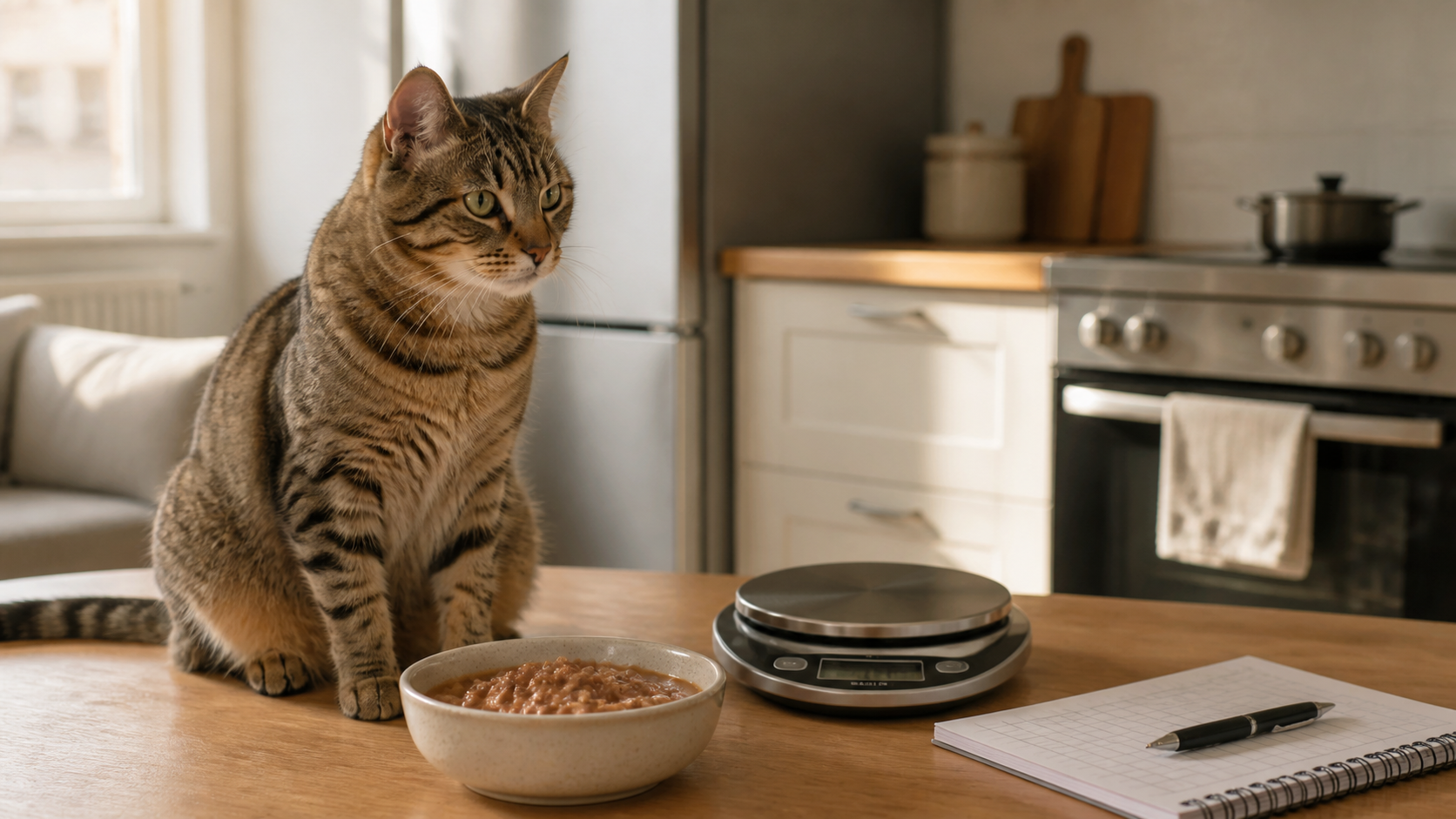
Low calorie cat wet food is easiest to compare by reading the calorie statement, container size, nutritional adequacy statement, life stage, and feeding directions together. A lower number on the front of a package does not automatically make a food suitable for your cat, and a food that works for weight maintenance may not supply enough nutrients when heavily restricted for weight loss.
This guide explains seven label checks you can use before buying or changing food. It does not rank specific brands. Product formulas, container sizes, calorie values, and availability can change, so verify the current package or manufacturer information every time you compare foods.
Health note: Ask your veterinarian to assess body condition and set a calorie plan before trying to make an overweight or obese cat lose weight. Do not sharply reduce food, allow prolonged poor intake, or keep using a new diet that the cat refuses. Cats with diabetes, kidney disease, liver disease, urinary disease, gastrointestinal problems, pregnancy, growth needs, or unexplained weight change require individualized veterinary nutrition advice.
Table of Contents
Quick Answer
To compare low calorie cat wet food, check these seven items:
- Calories per container or familiar unit.
- Calories per kilogram as fed.
- The exact container weight and serving size.
- A complete-and-balanced nutritional adequacy statement.
- The intended life stage and use.
- Moisture, protein, and fat in the right comparison context.
- Feeding directions plus the cat’s actual measured response.
For a healthy adult cat that only needs help avoiding gradual weight gain, a lower-calorie complete-and-balanced maintenance food may allow a useful meal volume within the daily calorie allowance. A cat needing significant calorie restriction may instead need a veterinary therapeutic weight-loss diet because those diets are formulated to provide appropriate nutrients while calories are restricted.
What “Low Calorie” Means on a Cat Food Label
The words on the front of a package do not all mean the same thing. Under AAFCO model labeling rules, terms such as “light,” “lite,” or “low-calorie” are tied to calorie limits and feeding directions. “Less calorie” or “reduced calorie” describes a comparison with another product and should identify the comparison and reduction.
Other phrases—such as “indoor,” “premium,” “natural,” “grain-free,” or “high protein”—do not tell you the number of calories in the portion. A grain-free food can still be calorie-dense. A high-moisture food can still deliver more calories per container if the container is large. An “indoor” formula can still be inappropriate for a particular cat’s health or life stage.
The useful number is in the Calorie Content statement. In the United States, this commonly shows metabolizable energy as kilocalories per kilogram of food as fed and per familiar unit, such as kcal per can, pouch, tray, or cup. A kilocalorie on a pet-food label is what consumers usually call a food calorie.
Marketing helps you find a category. The calorie statement and adequacy statement help you decide whether a product belongs in the comparison.
1. Find Calories per Container or Familiar Unit
Begin with the number you will use at feeding time: kcal per can, pouch, tray, or cup. This is the fastest way to see what a whole container contributes to the daily total.
Do not compare the numbers without checking the unit. A small tray can show fewer calories than a large can simply because it contains less food. That does not prove the recipe has lower caloric density. Likewise, two cans that look similar may hold different weights.
Record the complete statement rather than remembering a front-label claim. A useful note looks like this:
- Product name and exact recipe
- Container size in ounces and grams
- kcal per container
- kcal/kg as fed
- Nutritional adequacy and life stage
- Date checked
Recipe names matter. Chicken pâté, chicken in gravy, and chicken-and-fish varieties from the same product line may have different calorie values. Do not transfer the calories from one flavor or texture to another.
If the label lists calories per cup but the product is wet food sold in a can, contact the manufacturer for the current calorie value per container and the product’s gram weight. Do not estimate based only on another website’s listing.
2. Compare Calories per Kilogram as Fed
Calories per container answer “How many calories are in this package?” Calories per kilogram answer “How calorie-dense is this food by weight?” You need both numbers.
For example, Food A may have fewer calories per container than Food B because Food A is sold in a 3-ounce can and Food B is sold in a 5.5-ounce can. When both are compared per kilogram, Food A could actually be more calorie-dense.
Use kcal/kg to compare wet foods with each other when you want to understand caloric density. Use kcal per container or gram to calculate the actual amount fed. Do not compare wet and dry food by kcal/kg without remembering that moisture strongly affects the as-fed weight and volume.
A simple calculation converts kcal/kg to kcal per gram:
kcal per gram = kcal per kilogram ÷ 1,000
If a food contains 900 kcal/kg as fed, it contains 0.9 kcal per gram. If the current label says a container holds 85 grams, the estimated container total is 76.5 kcal. The package’s own kcal-per-container declaration should still be your primary value; use the calculation as a reasonableness check, not as a replacement for verified manufacturer data.
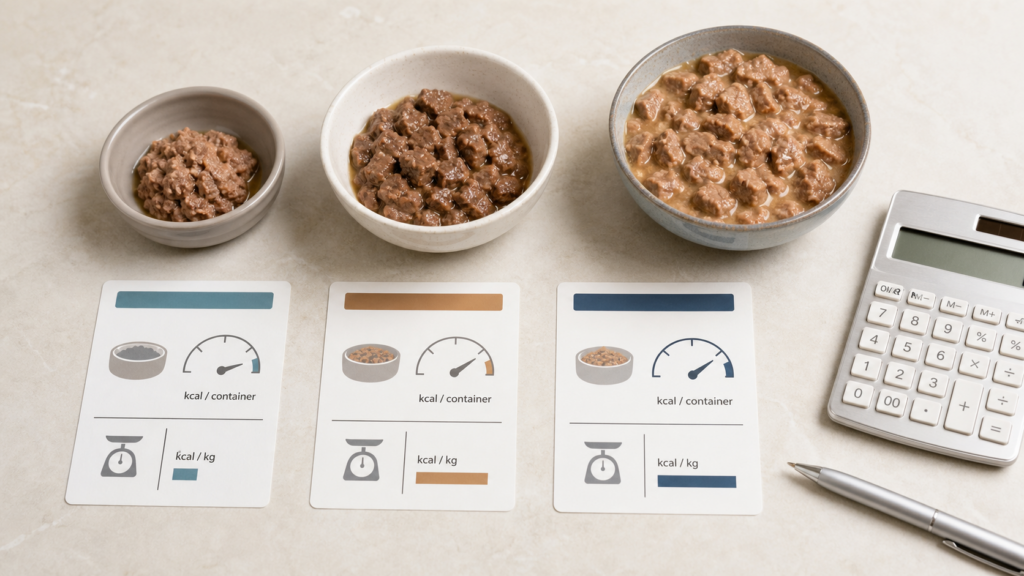
3. Check Container Weight Before Comparing Portions
“One can” is not a standard portion. Wet cat food is sold in multiple can, pouch, cup, and tray sizes. Even two packages described with the same rounded ounce value can vary slightly in grams.
Write down the net weight printed on the exact product. Then calculate calories per gram if you need to feed part of the container:
kcal per gram = kcal per container ÷ grams per container
portion grams = calories assigned to this food ÷ kcal per gram
The second calculation should use a daily calorie target provided or confirmed by your veterinarian, especially for weight loss. It should also account for all other food, treats, toppers, supplements that contain calories, and food obtained from other pets.
Use a digital kitchen scale that reads in grams. Place the empty bowl on the scale, press tare, and add the food. Measuring by spoonful or estimating “half a can” creates avoidable variation, particularly when two people feed the same cat.
Refrigerate opened food according to the manufacturer’s directions, use clean utensils, and discard food that has been left out longer than the product or veterinary guidance permits. Portion accuracy should not come at the expense of food safety or acceptance.
4. Confirm “Complete and Balanced” and the Intended Life Stage
Calories are only one requirement. Find the nutritional adequacy statement, usually in small print on the side or back of the package.
For a food intended as the main diet, look for language indicating that it is complete and balanced for the appropriate life stage, based on an AAFCO Cat Food Nutrient Profile, an AAFCO feeding trial, or an equivalent applicable standard in your country.
Check whether the statement applies to:
- Adult maintenance
- Growth, including kittens
- Gestation and lactation
- All life stages
- Intermittent or supplemental feeding only
A food labeled for intermittent or supplemental feeding is not intended to be the sole long-term diet unless a veterinarian is directing its use. Some broths, toppers, complementary foods, and attractive shredded products fall into this category even though they look like ordinary wet food.
Life stage matters. A healthy adult maintenance food is not automatically suitable for a growing kitten or pregnant or nursing cat. Conversely, an all-life-stages food may be more calorie-dense than a sedentary adult needs, although the actual label numbers must be checked.
For cats undergoing meaningful calorie restriction, simply feeding much less of a standard maintenance food can reduce the intake of essential nutrients along with calories. AAHA guidance notes that therapeutic weight-loss diets are designed to remain appropriately fortified during restriction. This is an important boundary between ordinary weight maintenance and veterinary obesity treatment.
5. Use Moisture and Guaranteed Analysis Correctly
Wet food usually contains much more water than dry food, which affects as-fed calorie density and meal volume. Moisture can support total water intake and may help some cats consume a larger food volume for a given calorie allowance. It is not proof that the food is low calorie.
The guaranteed analysis lists minimum crude protein and fat, maximum crude fiber and moisture, and sometimes other nutrients. These are guarantees, not necessarily the exact typical analysis of every batch.
When comparing two wet foods with similar moisture percentages, their as-fed guaranteed values can provide a rough comparison. When comparing foods with very different moisture levels, convert nutrients to a dry-matter basis:
dry matter percentage = 100 − moisture percentage
nutrient on dry-matter basis = as-fed nutrient percentage ÷ dry matter percentage × 100
This helps compare nutrient concentration, but it does not turn the guaranteed analysis into a complete nutritional profile. Minimum protein is not the same as typical protein, maximum fiber is not an exact fiber result, and the ingredient list alone cannot show whether the finished food delivers every nutrient in the correct amount.
Avoid rigid internet rules such as “protein must always exceed X%” or “carbohydrate must always be below Y%” without considering life stage, health, total calories, nutrient adequacy, and the manufacturer’s full analysis. Cats with kidney, urinary, gastrointestinal, endocrine, or other medical conditions may require priorities that differ from a general weight-control comparison.
6. Evaluate the Manufacturer, Not Just the Ingredient List
The ingredient list is required information, but it does not reveal ingredient quality, finished-product nutrient consistency, digestibility, or the manufacturer’s quality-control system by itself.
WSAVA’s pet-food selection guidance suggests asking questions such as:
- Does the company employ an appropriately qualified nutritionist?
- Who formulates the diet and what are that person’s qualifications?
- Who manufactures the food?
- What quality-control procedures cover ingredients and finished products?
- Is a typical nutrient analysis available beyond the guaranteed minimums and maximums?
- Can the company provide current calorie and nutrient information for the exact recipe?
- Has relevant product or nutrition research been conducted and published?
Use the manufacturer contact information printed on the label when data are unclear. Ask for the exact product name, package size, lot information if relevant, current kcal/kg, kcal/container, typical analysis, and whether the formula or calorie content recently changed.
Do not assume that by-products, grains, peas, potatoes, or another single ingredient automatically determines whether a food is nutritious or low calorie. Ingredients contribute nutrients within a complete formulation. The finished diet, its calorie density, adequacy, quality control, and suitability for the individual cat matter more than a simplistic “good ingredient/bad ingredient” list.
7. Compare the Label With the Cat’s Measured Response
A label comparison gives you a starting point. The cat’s intake, appetite, body condition, muscle condition, health, and weight trend determine whether the plan is working.
Use one consistent record:
| Date | Body weight and unit | Food and exact recipe | Grams fed per day | Treat/extra calories | Appetite or health notes |
|---|---|---|---|---|---|
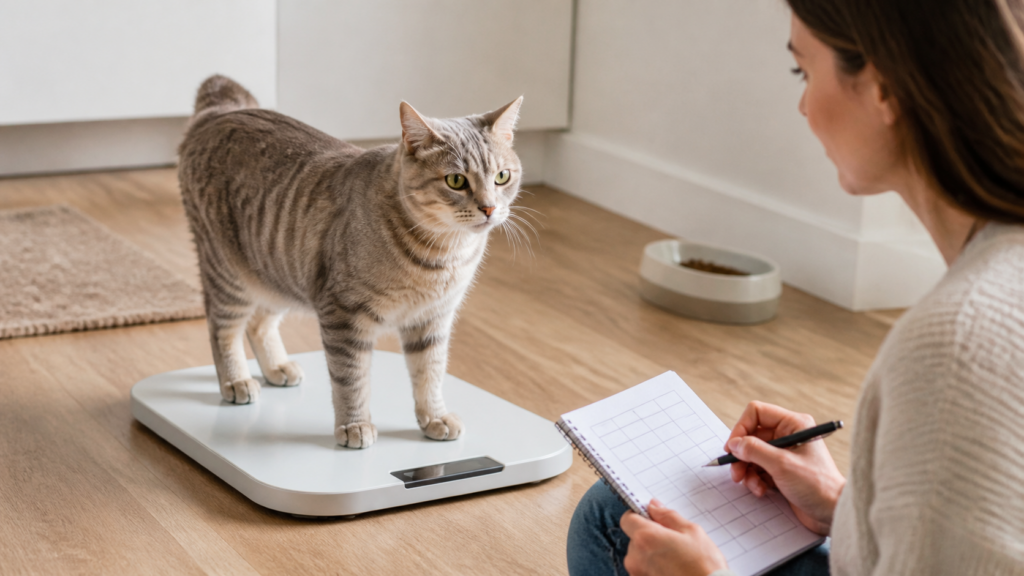
Weigh under similar conditions using the same reliable scale when possible. Your veterinarian should set the recheck interval and interpret the trend. Body weight alone does not show whether the cat is preserving muscle or whether a medical problem is affecting intake.
Contact your veterinarian promptly if the cat refuses the new food, eats substantially less, vomits repeatedly, becomes lethargic, appears jaundiced, loses weight unexpectedly, or develops another health change. Overweight cats that stop eating are at risk of serious illness, including hepatic lipidosis. Do not try to force faster loss by further reducing food.
Worked Example: Put Three Labels Into Equal Units
Suppose you are comparing three hypothetical adult-maintenance wet foods. These numbers are examples only; they are not current data for any real product.
| Example food | Package weight | Calories per package | Calories per kilogram | Calculated calories per gram |
|---|---|---|---|---|
| Food A | 85 g | 80 kcal | 941 kcal/kg | 0.94 kcal/g |
| Food B | 156 g | 135 kcal | 865 kcal/kg | 0.87 kcal/g |
| Food C | 85 g | 72 kcal | 847 kcal/kg | 0.85 kcal/g |
Food C has both the lowest package total and the lowest caloric density in this example. Food A and Food B show why package totals alone can mislead: Food A contains fewer total calories because its package is smaller, but it is more calorie-dense per gram than Food B.
Now suppose a veterinarian assigns 120 kcal of the day’s total allowance to this wet food. The approximate amounts would be:
- Food A: 120 ÷ 0.94 = about 128 grams
- Food B: 120 ÷ 0.87 = about 138 grams
- Food C: 120 ÷ 0.85 = about 141 grams
The lower-density example produces a somewhat larger food weight for the same assigned calories. That may be useful for some cats, but it does not prove Food C is the best diet. You still need to check whether each food is complete and balanced for the correct life stage, whether the cat will eat it reliably, whether its nutrient profile fits the cat’s health, and whether the manufacturer can support its label information.
Do not copy the 120-kcal example as your cat’s target. Daily energy needs and the portion assigned to one food vary by ideal weight, body condition, activity, age, health, treats, mixed feeding, and the veterinary plan. The point of the example is the method: verify the label, convert to equal units, and only then calculate a measured portion from an individualized allowance.
A Four-Step Buying Check
When you are standing in a store or comparing manufacturer pages, use this order:
- Eligibility: Is the food intended for cats, complete and balanced, and appropriate for the cat’s life stage and veterinary needs?
- Comparable calories: Can you verify both kcal/kg and kcal per exact package or familiar unit?
- Practical feeding: Will the texture, package size, storage method, and cost work for accurate daily portions?
- Accountability: Is the manufacturer identifiable and able to answer current nutrition and quality-control questions?
This sequence prevents a common mistake: spending time comparing small calorie differences between products that should already have been excluded because they are supplemental, meant for another life stage, unacceptable to the cat, or unsuitable for a medical condition.
A Practical Label Comparison Worksheet
Use the same fields for every product rather than collecting whatever marketing point is most prominent on each package.
| Check | Food A | Food B | Food C |
|---|---|---|---|
| Exact recipe/flavor | |||
| Package weight (g) | |||
| kcal per package | |||
| kcal/kg as fed | |||
| Calculated kcal/g | |||
| Complete and balanced? | |||
| Life stage | |||
| Intermittent/supplemental only? | |||
| Moisture maximum | |||
| Protein minimum | |||
| Fat minimum | |||
| Manufacturer contact checked | |||
| Date information verified |
Eliminate products that do not fit the cat’s life stage or intended use before comparing minor nutrient differences. Next, compare verified calories using equal units. Finally, discuss the shortlist with your veterinarian when weight loss or disease management is involved.
Low-Calorie Maintenance Food vs Therapeutic Weight-Loss Diet
These categories have different jobs.
Lower-Calorie Adult Maintenance Food
This may be appropriate for a healthy adult cat whose veterinarian agrees that modest calorie control, portion measurement, and activity changes are enough to prevent or reverse mild weight gain. The product should be complete and balanced for adult maintenance and acceptable to the cat.
Therapeutic Weight-Loss Diet
This is designed for supervised calorie restriction and may contain adjusted protein, fiber, vitamins, minerals, and other nutrients so the cat receives appropriate nutrition in a smaller calorie allowance. It may be recommended when a cat is obese, needs substantial restriction, has lost muscle, has another medical condition, or has not responded safely to a basic maintenance plan.
Do not substitute a maintenance food for a prescribed diet based only on the kcal number. Likewise, do not choose a therapeutic food for another household cat simply because it is available. Each cat’s diet should match its health and veterinary plan.
For readers who have already received a veterinary weight-loss target and now need a product-oriented comparison, our best wet cat food for weight loss guide covers that separate decision.
How to Change Wet Food Without Creating Food Refusal
Some cats accept a new texture or flavor immediately; others need a gradual transition. Ask your veterinarian about timing if the current diet treats a medical condition or if the cat has a history of appetite problems.
For a healthy cat, introduce a small amount of the new food beside or mixed with the familiar food only if the cat remains willing to eat. Increase gradually according to veterinary and manufacturer guidance. Do not disguise spoilage, mix medications into the entire meal without guidance, or keep escalating a rejected food until the cat stops eating.
Texture can matter as much as flavor. Pâté, minced food, chunks in gravy, shreds, mousse, and stew may be accepted differently. Temperature and bowl cleanliness also affect intake. A lower-calorie food has no practical value if the cat consistently refuses it.
If several cats share the home, feed separately when necessary so you know who ate each portion. Remove leftovers before cats exchange bowls. A microchip feeder or separate rooms may help, but the feeding method still needs observation and accurate measurement.
Treats, Toppers, and Mixed Feeding
The calorie plan includes everything the cat consumes, not only the main wet food. Record treats, dry food, dental products, lickable snacks, toppers, supplements that contain calories, table food, and food stolen from another animal.
Mixing wet and dry food is possible, but calculate each component from its own current label. Dry food can contribute a meaningful number of calories in a visually small portion, so weigh it rather than estimating by handful.
Toppers labeled for intermittent or supplemental feeding can improve acceptance, but they do not replace a complete-and-balanced main diet. Check sodium, phosphorus, fat, or other nutrients with your veterinarian when a cat has a medical condition.
Our apartment cat feeding and weight control guide explains how to combine portions, treats, meal structure, activity, and monitoring into one routine.
Common Label-Reading Mistakes
Comparing Calories per Can Without Comparing Can Size
This confuses package size with caloric density. Record grams, kcal/container, and kcal/kg.
Choosing by “Grain-Free” or the First Ingredient Alone
Neither phrase establishes total calories, nutrient adequacy, manufacturing quality, or suitability for the cat.
Treating Feeding Directions as a Prescription
Package directions are a starting guideline for a broad population. Individual needs vary. Use the cat’s measured condition and veterinary plan.
Feeding a Supplemental Product as the Entire Diet
Broths and complementary foods may look like ordinary meals but may not provide complete nutrition. Read the adequacy statement.
Restricting a Maintenance Diet Too Far
Reducing the portion reduces every nutrient along with calories. Significant restriction may require a fortified therapeutic weight-loss diet.
Using Old Online Product Data
Formulas and package sizes change. Verify the current physical label or official manufacturer information and record the date.
Ignoring Appetite Loss
A cat that stops eating needs veterinary attention, not a more aggressive calorie cut.
Frequently Asked Questions
What calorie level makes wet cat food “low calorie”?
Do not use one universal internet cutoff. Regulatory claims depend on applicable labeling rules, and clinical suitability depends on the cat, the complete diet, package size, caloric density, and degree of restriction. Compare the current kcal/kg and kcal/container values and ask your veterinarian what fits the individual plan.
Is wet food automatically lower in calories than dry food?
Wet food commonly contains more water and therefore often has fewer calories per gram as fed, but products vary. Compare verified calorie statements and actual portions. A large wet-food container can still contain more total calories than a small dry-food serving.
Is grain-free wet food better for weight control?
Not automatically. Grain-free describes excluded ingredients, not total calories or complete nutritional quality. Read the calorie and adequacy statements instead.
Can I feed less of regular wet food to make my cat lose weight?
Small portion adjustments may be appropriate for some healthy cats under veterinary guidance. Significant restriction of a maintenance food can reduce essential nutrient intake, so a therapeutic weight-loss diet may be safer for an obesity-treatment plan.
How often should I weigh my cat?
Use the schedule recommended by your veterinarian. The interval depends on the cat’s health and goal. Keep the scale and conditions consistent and record appetite, exact intake, body condition, and health changes alongside weight.
What if the calorie statement is missing or unclear?
Contact the manufacturer using the package information. Request current kcal/kg and kcal per container for the exact recipe and size. If the company cannot clarify key nutritional information, discuss an alternative with your veterinarian.
Should I calculate dry-matter protein for every wet food?
Dry-matter conversion is useful when moisture levels differ, but calories, adequacy, life stage, typical nutrient analysis, and the cat’s medical needs remain essential. Do not select a diet from one calculated nutrient percentage alone.
Final Checklist
Before buying a low calorie cat wet food, confirm:
- The exact recipe and current package size match the data you recorded.
- You found both kcal per familiar unit and kcal/kg as fed.
- The food is complete and balanced for the correct life stage, unless a veterinarian directs otherwise.
- It is not labeled only for intermittent or supplemental feeding when you need a main diet.
- You compared equal units rather than package fronts.
- You understand that guaranteed minimums and maximums are not a full typical analysis.
- The manufacturer can answer nutrition and quality-control questions.
- The cat’s total daily intake includes treats, toppers, dry food, and stolen food.
- The veterinary plan explains portions, monitoring, and when to recheck.
- You will stop and contact the veterinarian if appetite or health changes.
The best label comparison is not the one with the smallest calorie number. It is the one that identifies a complete, appropriate, acceptable food that can be measured accurately within a safe plan for the individual cat.
References
Merck Veterinary Manual. Feline Hepatic Lipidosis. https://www.merckvetmanual.com/digestive-system/hepatic-diseases-of-small-animals/feline-hepatic-lipidosis
U.S. Food and Drug Administration. “Complete and Balanced” Pet Food. https://www.fda.gov/animal-veterinary/animal-health-literacy/complete-and-balanced-pet-food
Association of American Feed Control Officials. Reading Labels. https://www.aafco.org/consumers/understanding-pet-food/reading-labels/
Association of American Feed Control Officials. Calories. https://www.aafco.org/consumers/understanding-pet-food/calories/
World Small Animal Veterinary Association. Guidelines on Selecting Pet Foods. https://wsava.org/wp-content/uploads/2021/04/Selecting-a-pet-food-for-your-pet-updated-2021_WSAVA-Global-Nutrition-Toolkit.pdf
American Animal Hospital Association. Nutrition and Weight: Young Adult Cats. https://www.aaha.org/resources/2021-aaha-aafp-feline-life-stage-guidelines/nutrition-and-weight-young-adult-cats/
American Animal Hospital Association. Use of Therapeutic Diets Designed to Promote Weight Loss. https://www.aaha.org/resources/2021-aaha-nutrition-and-weight-management-guidelines/use-of-therapeutic-diets-designed-to-promote-weight-loss/