The best wet cat food for weight loss is not simply the can with the fewest calories. It should be complete and balanced for your cat’s life stage, clearly labeled with calories per can or pouch, acceptable enough that your cat will eat it consistently, and appropriate for any medical conditions. The correct portion must then fit a veterinarian-guided daily calorie target.
This guide compares five current wet-food options: three non-prescription foods for otherwise healthy adult cats and two veterinary diets for cats who need a more structured weight-loss plan. The products are compared by intended use, calorie information, nutritional adequacy, texture, and the situations in which veterinary input matters.
Food formulas, package sizes, calorie values, and availability can change. Check the exact package in your hand before feeding, and never assume that two flavors or textures in the same product line have identical calories.
Medical note: A cat should not be placed on an aggressive calorie restriction without veterinary guidance. Cats that stop eating or lose weight too quickly can become seriously ill. Contact your veterinarian before changing the diet of a kitten, pregnant or nursing cat, senior cat with muscle loss, or any cat with diabetes, kidney disease, urinary disease, gastrointestinal disease, pancreatitis, food allergy, or unexplained weight change.
Quick Answer
For an otherwise healthy adult cat who is only mildly overweight, Hill’s Science Diet Adult Perfect Weight wet food, Purina Pro Plan Adult Weight Management Chicken & Rice Entrée in Gravy, and Royal Canin Weight Care wet food are the three non-prescription options in this comparison. Each is marketed for weight management and carries a complete-and-balanced statement for adult maintenance.
For a cat with obesity, repeated diet failure, intense hunger, mobility limitations, or another medical concern, Royal Canin Veterinary Satiety Support Weight Management and Hill’s Prescription Diet Metabolic are more appropriate products to discuss with a veterinarian. They are therapeutic diets, not general substitutes for ordinary adult food.
There is no universal “best” can for every cat. Choose the category first—non-prescription or veterinary—then compare the exact calorie label, texture, can size, feeding practicality, and your cat’s health needs. If you are unsure whether weight loss is necessary, start with our guide to checking whether your cat is overweight rather than reducing food based on appearance alone.
Table of Contents
Before choosing a weight-loss food, it helps to review the full apartment cat feeding and weight control guide so you can match food choice with portions, meal timing, and activity level.
Wet Cat Food Comparison
| Food / US formula | Category | Can size | kcal/can | kcal/100 g, as fed | Main selection limit |
|---|---|---|---|---|---|
| Hill’s Science Diet Adult Perfect Weight Roasted Vegetables & Chicken Medley | Non-prescription | 2.9 oz (82 g) | 62 | 75.8 | Adult maintenance; these values are for chicken, not the other flavors in the variety pack. |
| Purina Pro Plan Adult Weight Management Chicken & Rice Entrée in Gravy | Non-prescription | 3 oz (about 85 g) | 73 | 85.9 | Adult maintenance; do not transfer values from the tuna recipe or dry food. |
| Royal Canin Weight Care Loaf in Sauce | Non-prescription | 3 oz (about 85 g) | 56 | 66.1 | Adult maintenance; intended for mild weight concerns, not a substitute for an obesity assessment. |
| Royal Canin Veterinary Satiety Support Weight Management Loaf in Sauce | Veterinary diet | 5.1 oz (about 145 g) | 82 | 56.7 | Use with a veterinary feeding plan; a larger can is not necessarily more energy-dense. |
| Hill’s Prescription Diet Metabolic Vegetables & Chicken Stew | Veterinary diet | 2.9 oz (82 g) | 64 | 78.4 | Use the veterinarian’s daily calorie target; do not substitute another Metabolic recipe. |
How to Choose the Best Wet Cat Food for Weight Loss
This is not a ranking based on ingredient-list aesthetics, popularity, or the lowest number printed on a can. Choosing the best wet cat food for weight loss requires five practical checks.
1. Does the food provide complete and balanced nutrition?
The nutritional adequacy statement is one of the most important parts of a pet-food label. For a food used as the main diet, look for a statement that it is complete and balanced for the appropriate life stage. “Intermittent or supplemental feeding only” is not suitable as the sole daily diet unless a veterinarian is deliberately using it for a specific reason.
AAFCO does not approve, certify, or endorse individual pet foods. Marketing phrases such as “premium,” “natural,” or “grain free” do not replace the adequacy statement.
2. Is the calorie information clear?
For weight control, the useful number is the calorie content for the exact package—usually expressed as kcal per can, pouch, or tray. Kcal per kilogram helps compare energy density, but owners still need the per-container value to portion meals accurately.
Do not compare cans by size alone. A 3 oz can can contain more or fewer calories than another 3 oz can, and a 5.1 oz veterinary can cannot be compared to a 2.9 oz retail can by counting “one can” of each. Compare total daily calories, not the number of containers.
3. Is the product actually intended for weight management?
Many ordinary wet foods happen to be relatively low in calories. That does not automatically make them weight-loss diets. The three non-prescription foods below are included because their manufacturers position them for adult weight management. The two veterinary foods are designed for therapeutic weight programs and should be selected with veterinary oversight.
4. Is the texture realistic for the cat?
A nutritionally appropriate food cannot help if the cat refuses it. Some cats accept stew or chunks in gravy but reject loaf; others lick gravy and leave the solid pieces. Texture also affects how accurately you can judge intake. A cat that leaves half the chunks may consume far fewer nutrients and calories than the amount served.
5. Can the household measure and monitor it consistently?
The best plan is one the household can repeat. Every person who feeds the cat should know the daily allowance, treat limit, meal schedule, and method for recording leftovers. In multi-cat homes, separate feeding or a microchip feeder may be necessary so the planned calories reach the correct cat.
1. Hill’s Science Diet Adult Perfect Weight Wet Food — Best OTC Stew Option
Hill’s Science Diet Adult Perfect Weight is a non-prescription adult food formulated for cats prone to weight gain. The Roasted Vegetables & Chicken Medley contains 62 kcal per 2.9 oz can on the current U.S. product page. Other flavors in the variety pack list different values, including 64 or 66 kcal per can, so the flavor-specific label matters.
Why it stands out
- It is a weight-specific retail formula rather than a general adult wet food.
- The manufacturer provides calories for each flavor and a weight-control feeding table.
- It is available in a stew texture, which may suit cats that reject pâté.
- Animal feeding tests substantiate complete-and-balanced nutrition for adult maintenance.
What to consider
The 2.9 oz can is small. Feeding several small cans per day may be less convenient or more expensive than using a larger can, even when the daily calories are appropriate. Do not reduce the number of cans merely because the label’s daily amount looks high; a veterinarian-guided calorie target and the food’s per-can calories should determine the total.
Best for
An otherwise healthy adult cat with mild excess weight whose owner wants a clearly labeled, non-prescription weight-management food and whose cat prefers stew.
2. Purina Pro Plan Adult Weight Management Chicken & Rice Entrée in Gravy — Best OTC Gravy Option
Purina Pro Plan Adult Weight Management Chicken & Rice Entrée in Gravy contains 73 kcal per current can and is formulated to meet AAFCO nutrient profiles for adult maintenance. The manufacturer’s label instructs owners to divide the daily amount into at least two meals and adjust to maintain ideal body condition.
Why it stands out
- It is explicitly formulated for adult weight management.
- The current label provides both kcal per kilogram and kcal per can.
- The pieces-in-gravy texture gives a useful alternative to stew and loaf.
- It is complete and balanced for adult maintenance.
What to consider
Purina sells several weight-management wet recipes with different proteins and textures. Use the calorie value from the exact Chicken & Rice Entrée in Gravy can only for that product. Do not assume the tuna, salmon, turkey, ocean whitefish, or ground entrée has the same calorie content.
Best for
An otherwise healthy adult cat that needs a non-prescription weight-management option and reliably eats chunks in gravy.
3. Royal Canin Weight Care Loaf in Sauce — Best OTC Loaf Option
Royal Canin Weight Care Loaf in Sauce contains 56 kcal per 3 oz can on the current U.S. page. It is complete and balanced for adult maintenance and is positioned for adult cats with a tendency to gain weight or mild excess weight. Royal Canin also sells a chunks-in-gravy pouch with a different per-package calorie value, so identify the texture before calculating portions.
Why it stands out
- It offers a smooth loaf texture for cats that reject pieces or stew.
- The current product page gives a clear per-can calorie value.
- The formula is designed for adult weight care rather than being selected only because it is wet.
- It provides an OTC option before moving to a veterinary therapeutic diet, when the cat’s condition is mild and the veterinarian agrees.
What to consider
The manufacturer describes this product for cats with mild weight concerns. A cat with a body condition score clearly above the ideal range, repeated weight-loss failure, major mobility problems, or a concurrent disease should receive a veterinary assessment instead of relying on retail “weight care” labeling.
Best for
A mildly overweight adult cat that prefers loaf and can use a non-prescription food as part of a measured plan.
4. Royal Canin Veterinary Satiety Support Weight Management — Best Veterinary Satiety Option
Royal Canin Veterinary Satiety Support Weight Management Loaf in Sauce is a therapeutic adult diet. The current 5.1 oz can lists 82 kcal. The manufacturer describes a higher-protein, fiber-containing formulation intended to support lean mass and satiety during weight management.
Why it stands out
- It is designed for veterinary weight-loss programs rather than general retail maintenance.
- Its larger 5.1 oz can offers a different volume-to-calorie format from the smaller OTC cans.
- Fiber and protein are deliberately incorporated into the product’s satiety and lean-mass strategy.
- The label supplies a clear per-can calorie value.
What to consider
This is not the default choice for every cat that has gained a little weight. A veterinarian should determine whether a therapeutic diet is indicated and how much to feed. The diet may be unsuitable when another condition requires different nutrient control.
Best for
A veterinarian-supervised adult cat whose obesity plan needs a therapeutic food and whose hunger or begging makes adherence difficult.
5. Hill’s Prescription Diet Metabolic Vegetables & Chicken Stew — Best Veterinary Metabolic Option
Hill’s Prescription Diet Metabolic Vegetables & Chicken Stew is a therapeutic weight-management food in a 2.9 oz can. The current manufacturer page describes it as complete and balanced for adult maintenance and provides separate feeding guidance for weight loss and adult maintenance.
Why it stands out
- It is designed specifically for veterinary weight loss and maintenance.
- It provides a stew texture for cats that do not accept loaf.
- The manufacturer emphasizes a fiber blend and long-term weight maintenance.
- Its feeding table distinguishes a weight-loss amount from an adult-maintenance amount.
What to consider
Use the calorie value and feeding direction on the current can or information supplied by the veterinary clinic. Product pages and packages can change, and the veterinarian may prescribe an amount different from the general table.
Claims reported by the manufacturer about the percentage of pets losing weight reflect the manufacturer’s study population and feeding conditions; they do not guarantee the same outcome for an individual cat. Success still depends on the correct portion, control of all extra calories, household adherence, and follow-up measurements.
Best for
An adult cat in a veterinarian-managed therapeutic weight-loss program, especially when a stew texture improves acceptance.
How to Read a Wet Cat Food Label for Weight Loss
Start with the nutritional adequacy statement
Confirm that the main food is complete and balanced for your cat’s life stage. Adult-maintenance diets are not automatically suitable for growth, pregnancy, or lactation. A food labeled for supplemental or intermittent feeding should not quietly replace the complete diet.
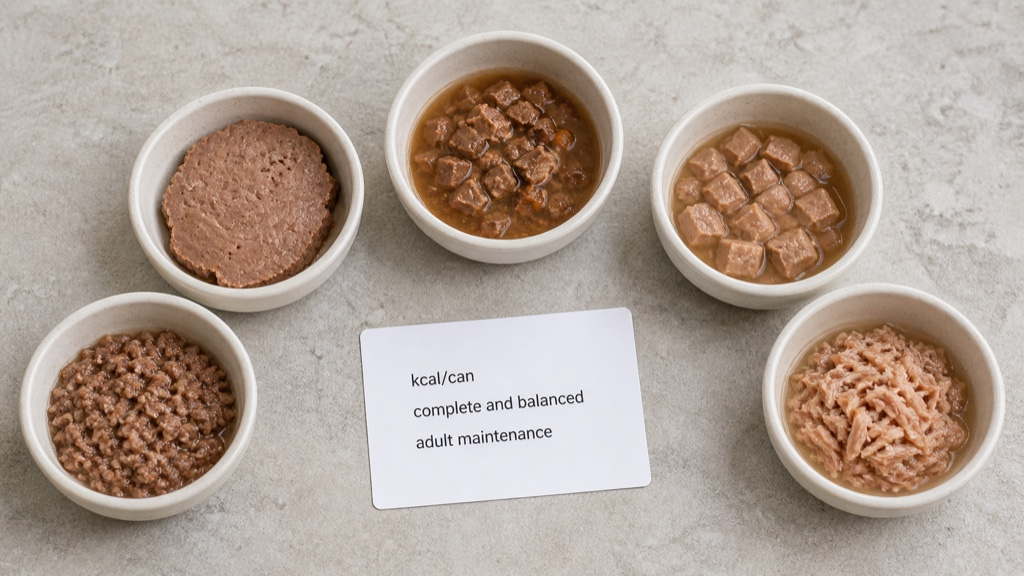
Find kcal per can, pouch, or tray
This is the easiest number for calculating how much of the exact product fits into a daily plan. Kcal/kg is useful for comparing energy density, but it does not tell you the serving unless you also know the food’s weight.
Treat the guaranteed analysis as minimums and maximums
Guaranteed-analysis protein and fat are usually minimums; fiber and moisture are usually maximums. They are not a complete nutrient profile, and the numbers are presented “as fed.” Comparing a wet food directly with a dry food from these percentages can be misleading because their moisture contents are very different.
Dry-matter calculations can help compare foods with different moisture levels, but they do not turn label estimates into a prescription. They also do not replace the calorie statement or a veterinary assessment. For this buyer guide, clear calories, adequacy, intended use, and medical fit matter more than chasing one universal protein, fat, or carbohydrate percentage.
Do not judge weight-loss food by carbohydrate estimates alone
Most conventional U.S. cat-food labels do not list carbohydrate as a measured guaranteed-analysis value. Online calculators often estimate it by subtracting other listed components, sometimes without a listed ash value. That estimate can be imprecise.
Cats with diabetes may receive individualized carbohydrate recommendations, but diabetes, obesity, kidney disease, and urinary disease do not all call for the same diet. A food should not be called “best” solely because an estimated carbohydrate number is low.
Ignore ingredient-list myths
An ingredient appearing early or late on the list does not reveal the finished food’s calorie density, digestibility, or suitability for a particular disease. “Grain free” does not mean low calorie. “Natural” does not mean complete and balanced. By-products are not automatically nutritionally inferior, and a recognizable ingredient list does not guarantee that portions can be fed freely.
How to Turn a Veterinary Calorie Target Into a Daily Wet-Food Amount
The veterinarian should establish the target weight and starting daily calories, especially when a cat is obese or medically complex. Once that target is known, the package calorie statement allows a simple conversion:
Veterinarian-provided daily kcal target ÷ kcal per can = cans per day
Example only: if a veterinarian gives a target of 180 kcal per day and the exact food contains 60 kcal per can, the mathematical result is 3 cans per day. This example does not mean that 180 kcal is right for your cat.
If the result is a fraction, weigh the food in grams rather than estimating by eye. Suppose the daily result is 2.5 cans and each full can contains 82 g of food. The daily amount is approximately 205 g. Divide that total into the planned number of meals.
For mixed feeding, subtract every counted calorie from the same daily allowance. If wet food, dry food, treats, toppers, supplements, and medication foods together exceed the target, measuring the wet food accurately will not prevent overfeeding.
Our guide on how much to feed an indoor cat explains why package feeding directions are starting points and how to keep a simple intake record. For the full behavior, activity, treat, and monitoring plan, use seven safe steps to help an indoor cat lose weight.
Safe Transition and Monitoring Plan
Get a baseline before changing food
Record the cat’s current weight, body condition score, muscle condition, current foods, exact portions, treats, table food, and food stolen from other pets. Note appetite, stool, vomiting, drinking, urination, mobility, and grooming. A scale number without these details can hide muscle loss or illness.
Transition gradually unless the veterinarian says otherwise
Many manufacturers suggest changing food over about seven days by increasing the new food while decreasing the old food. Some cats need a slower transition. A veterinarian may recommend a different process when a medical condition or urgent diet change is involved.
Do not try to force acceptance by allowing a cat to go without food. If your cat refuses the new diet, contact the veterinary team and discuss another texture, flavor, transition pace, or product.
Weigh consistently
Use the same scale and similar conditions each time when possible. AAHA’s nutrition and weight-management guidance describes a typical target rate of about 0.5% to 2% of body weight per week for cats, but the appropriate rate and check-in schedule are individual. Faster is not automatically better.
The percentage should be interpreted with a veterinarian, especially for small cats, seniors, cats losing muscle, and cats with disease. A brief fluctuation may reflect hydration, food in the digestive tract, or scale variation rather than true fat change.
Monitor more than body weight
A good plan protects muscle, mobility, grooming, comfort, and willingness to eat. Record:
- body weight and unit;
- body condition and muscle condition;
- the exact daily food amount;
- treats and unplanned extras;
- appetite and leftovers;
- vomiting, diarrhea, or constipation;
- drinking and urination changes;
- activity, jumping, mobility, and grooming.
If progress stalls, do not immediately make a large calorie cut. First check measuring accuracy, treats, food stealing, feeder calibration, and whether every household member follows the same plan. Then ask the veterinarian whether the calorie target or medical evaluation needs to change.
Know the warning signs
Contact a veterinarian promptly if the cat stops eating, eats markedly less than usual, vomits repeatedly, becomes weak or lethargic, hides, appears painful, develops diarrhea, drinks or urinates much more, or loses weight unexpectedly or rapidly. These signs are not proof that the chosen food is “working.” They may signal illness or an unsafe plan.
Common Mistakes That Stop Wet-Food Weight Loss
Choosing the lowest-calorie can without checking adequacy
A topper or supplemental food can look attractive because it has few calories. If it is not complete and balanced, using it as the entire diet can create nutrient deficiencies.
Feeding by “cans per day” without checking can size
Container counts are meaningless unless the formula, package size, and kcal per container are specified. Measure total calories first.
Keeping the old dry-food portion
Adding a full wet-food ration on top of the former dry-food ration increases calories. Mixed feeding can work, but both portions must be recalculated together.
Forgetting treats and household extras
Dental treats, lickable treats, pill pockets, human food, and small “just this once” additions can erase a modest calorie reduction. Record them rather than guessing.
Cutting food harder when the scale stalls
A plateau can reflect measurement errors, inconsistent feeding, low activity, or a calorie target that requires professional adjustment. It can also justify screening for a medical issue. Recheck the process before making a sharp reduction.
Frequently Asked Questions
Is wet food always better than dry food for cat weight loss?
No. Wet food’s moisture can provide more food volume for a given calorie amount and may make portioning easier, but successful weight loss depends on the complete daily calorie intake, nutritional adequacy, acceptance, and monitoring. A measured dry, wet, or mixed plan can work when it is appropriate for the cat.
What calorie level makes a wet food “low calorie”?
There is no single per-can cutoff because can sizes differ. Compare kcal per package, package weight, kcal/kg, the cat’s daily target, and whether the food remains complete and balanced at the amount fed. A small can with a low calorie number is not automatically less energy-dense than a larger can.
Is high-protein wet food always best for weight loss?
Adequate protein matters when protecting lean mass, but one fixed “high protein” threshold is not right for every cat. Kidney disease, other medical conditions, total calories, food digestibility, and the complete nutrient profile can change the recommendation. Use the veterinarian’s plan rather than a universal internet percentage.
Can I use a regular low-calorie wet food instead of a weight-management formula?
Sometimes an otherwise healthy adult cat can lose weight on a measured general adult food, but the diet must be complete and balanced and the portion must fit the plan. A weight-specific formula may make calorie control or satiety easier. Cats with obesity or disease should be evaluated before substituting a retail food for a therapeutic diet.
Do prescription weight-loss foods require veterinary supervision?
Yes. Therapeutic diets are designed for specific nutritional purposes. The veterinarian should confirm that the diet fits the cat’s health status, set the amount, and monitor response. Do not borrow another pet’s prescription food or choose one only because its calorie number is low.
How quickly should a cat lose weight?
AAHA guidance describes approximately 0.5% to 2% of body weight per week as a typical feline target range, but the veterinarian should choose the individual goal and monitoring schedule. Rapid loss, food refusal, or illness signs require prompt attention.
What if my cat refuses the weight-loss food?
Do not wait for hunger to force the change. Offer the former complete diet while contacting the veterinary team for advice. A different texture, flavor, transition schedule, warming method, or product may be safer than allowing prolonged poor intake.
Final Verdict
For mild excess weight in an otherwise healthy adult, begin the product discussion with the three non-prescription categories in this guide: Hill’s Science Diet Adult Perfect Weight for a stew texture, Purina Pro Plan Adult Weight Management for pieces in gravy, or Royal Canin Weight Care for a loaf. Select by the exact calorie label, adequacy statement, texture acceptance, and household ability to measure the daily amount.
For obesity, repeated diet failure, strong hunger, mobility concerns, or concurrent disease, ask the veterinarian whether Royal Canin Satiety Support or Hill’s Prescription Diet Metabolic is appropriate. These diets should be used as part of a monitored therapeutic plan.
The best wet cat food for weight loss is ultimately the complete diet your cat can safely eat, your household can accurately measure, and your veterinary team can monitor. The product is one component; the daily calorie total, treats, food access, activity, and follow-up measurements determine whether the plan is both effective and safe.
References
Hill’s Prescription Diet — Metabolic Vegetables & Chicken Stew
AAFCO — Reading Pet Food Labels
AAHA — 2021 Nutrition and Weight Management Guidelines for Dogs and Cats
WSAVA — Body Condition Score for Cats
Hill’s Science Diet — Adult Perfect Weight Wet Food
Purina Pro Plan — Adult Weight Management Chicken & Rice Entrée in Gravy