How to calm a cat during fireworks starts before the first boom. The safest plan is to prepare a quiet hiding room, reduce sound and light, keep every escape route secured, and avoid forcing your cat out of hiding.
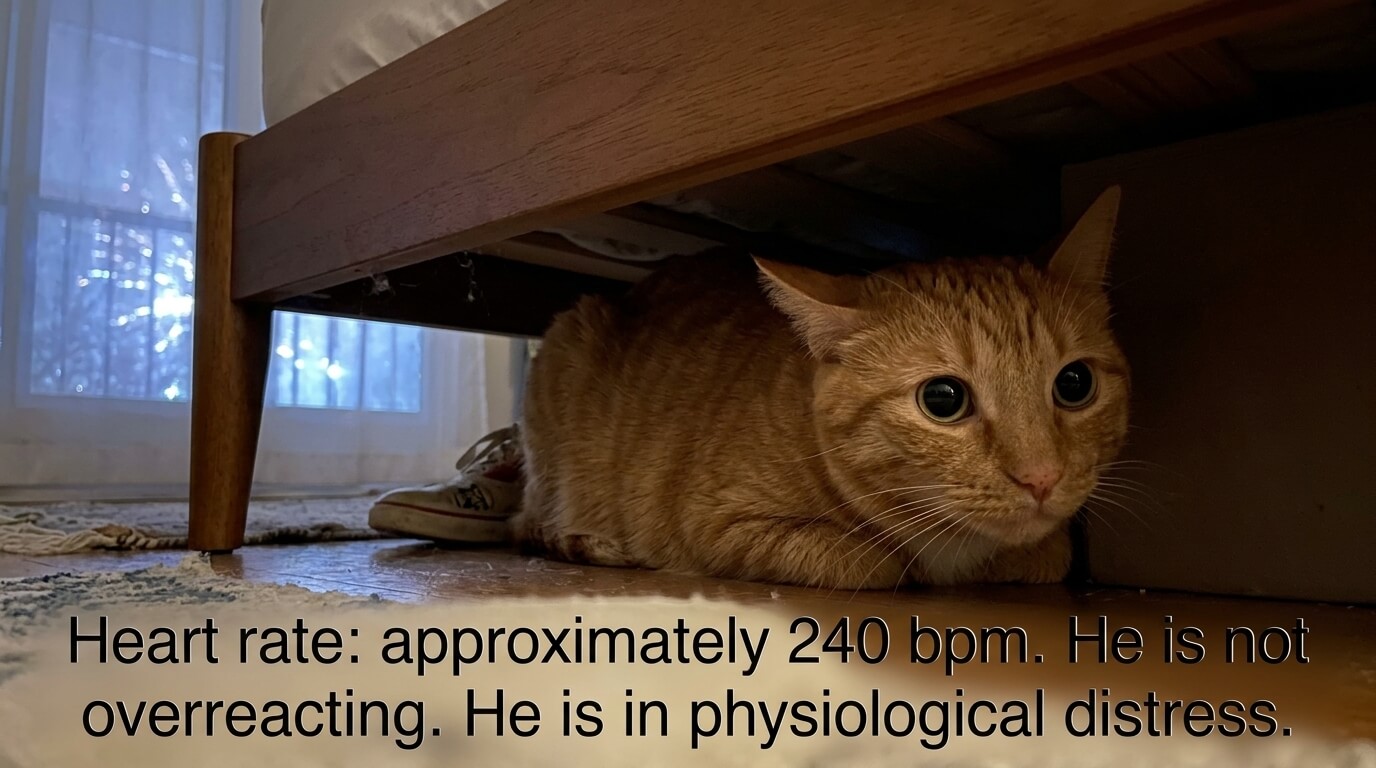
I learned this with Oliver on a fireworks night when he disappeared under the bed, body low, pupils wide, and too frightened to come out. The problem was not “bad behavior.” It was a normal fear response to loud, unpredictable noise.
This guide explains seven safe steps for fireworks and thunder, when to ask your veterinarian about medication, what not to give, and how to reduce escape risk during noise events.
Senior cats, especially those with cognitive changes, may become more disoriented during sudden loud noise. If your older cat also shows night vocalizing, confusion, pacing, or changed sleep patterns, compare the pattern with our senior cat dementia signs guide.
How to Calm a Cat During Fireworks (Quick Answer)
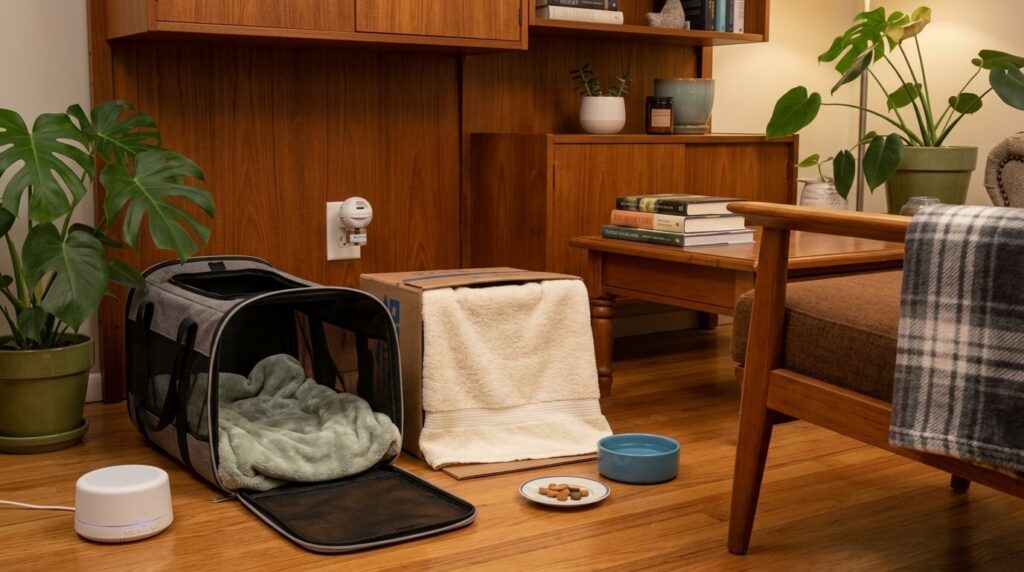
To calm a cat during fireworks, prepare an interior safe room before the noise starts. Add familiar bedding, a hiding box or open carrier, water, litter box access, closed curtains, and steady background sound such as white noise or calm music. Let your cat hide if they choose to.
Do not give human sedatives, essential oils, CBD, or leftover pet medication. If your cat panics severely, refuses food or water, urinates from fear, injures themselves, or stays distressed after the event, contact your veterinarian before the next fireworks season.
Important Safety Note
Fireworks and thunder can trigger panic, hiding, escape attempts, and injury. Keep your cat indoors, close windows and balcony access, secure doors before visitors or deliveries arrive, and do not pull a hiding cat out by force. If your cat has severe noise fear, heart disease, kidney disease, senior cognitive changes, or a history of panic, ask your veterinarian for an individualized plan before the event.
Table of Contents
The Feline Acoustic Burden: Why Booms Hurt
Most owners intuitively understand that cats don’t like loud noises. What they significantly underestimate is the neurophysiological reality of why — and understanding this transforms the question of how to calm a cat during fireworks from a behavioral puzzle into a medical one.
The Frequency Problem
The Feline Auditory Range extends from approximately 48 Hz on the low end to 64,000 Hz on the high end. For context: humans hear from roughly 20 Hz to 20,000 Hz. This extraordinary range evolved to make cats supreme hunters of small prey animals — a mouse’s ultrasonic communication, a vole moving through grass, the specific wing frequency of a bird — but it comes with a cost when the acoustic environment becomes pathologically loud.
Fireworks produce a sound profile that attacks this system from multiple directions simultaneously:
- The concussive boom: A low-frequency pressure wave that cats feel as much as hear — transmitted through the floor, the walls, the furniture
- The high-frequency whistle and crack: The ascending sound of fireworks in flight and the sharp crack of the explosion, which fall directly in the feline high-sensitivity range
- The unpredictability factor: Cats cannot habituate to fireworks the way they might habituate to traffic noise — because the intervals are irregular, the intensity varies, and there is no learned “safe pattern” to find
The Physiological Cascade
When Oliver’s brain registered that first boom, his amygdala triggered a full sympathetic nervous system activation:
- Heart rate spiked from resting 120–140 bpm to 220–240 bpm
- Cortisol and adrenaline flooded his bloodstream
- Blood pressure elevated
- Digestion halted (which is why some cats vomit during noise events)
- All non-essential metabolic functions suspended in favor of survival mode
This is not anxiety in a casual sense. This is acute stress response — the same system that would activate if a predator entered the apartment. Knowing this frames how to calm a cat during fireworks correctly: we are not managing a preference, we are managing a physiological state that the cat cannot voluntarily exit on their own.
If your cat shows similar fear signs during ordinary household changes, compare the pattern with our guide to signs your indoor cat is stressed.
7 Safe Steps for How to Calm a Cat During Fireworks
Step 1: Create a Safe Haven
The most important physical intervention in how to calm a cat during fireworks is environmental — and it must be prepared before the event begins, not during it.
A Safe Haven is a designated interior room that functions as a sensory buffer zone between your cat and the noise event. “Interior” is the operative word: a room with no exterior-facing windows or walls is dramatically quieter during fireworks than a room adjacent to an outside wall.
Building the optimal Safe Haven:
- Location: Bathroom, interior hallway closet, or interior bedroom — the more walls between your cat and the outside, the better
- Bedding: Your cat’s existing, unwashed sleeping bed or a worn item of your clothing — familiar scent is the fastest-acting anxiety buffer available
- Hiding options within the haven: A cardboard box on its side, an open carrier with a blanket inside, a covered cat bed — multiple enclosed options allow your cat to choose their preferred concealment.If your cat is afraid of the carrier, build comfort before the event with our cat carrier training guide.
- Food and water: Fresh water and a small food bowl — stress can cause cats to avoid leaving their haven to eat or drink
- Litter box: Place a clean box inside the haven for the duration of the event
- Pre-event access: Open the haven 48–72 hours before the anticipated event so your cat discovers and begins using it voluntarily before they need it for stress regulation
The critical rule: Once your cat is in the Safe Haven, leave the door open so they can exit freely. A cat who chooses to stay in the haven is self-regulating. A cat who is locked in has lost the control that makes hiding effective as a coping mechanism.
Step 2: Use White Noise or Calm Music
Sound cannot be completely blocked in an apartment environment. But it can be meaningfully competed with — and this is the acoustic strategy for how to calm a cat during fireworks.
White noise and brown noise:
White noise works by raising the ambient acoustic floor of the environment, which reduces the signal-to-noise ratio of the fireworks booms. The sudden, startling quality of each boom is significantly reduced when the ambient sound level is already elevated.
- White noise machine placed inside or directly outside the Safe Haven — the LectroFan or Marpac Dohm are clinical favorites for consistent, non-looping sound
- Brown noise (lower frequency than white noise) is often more effective for the specific low-frequency boom profile of fireworks — many white noise machines and apps offer this option
- Volume: Set at approximately the level of a running shower — loud enough to mask, not loud enough to be its own stressor
Classical music for cats:
Research has specifically examined cat-appropriate music. A study by Snowdon et al. (2015) developed “species-appropriate music” composed at tempos and frequencies that match feline vocal ranges — and demonstrated measurable behavioral calm in cats exposed to it.
Practical playlist options:
- “Music for Cats” by David Teie (Spotify/Apple Music) — specifically composed using feline-appropriate frequencies and tempos
- Through a Cat’s Ear album series — classical music processed for calming effect
- Avoid human pop or rock music during noise events — the unpredictable rhythm and bass can compound rather than reduce arousal
Step 3: Start Pheromone Support Before the Event
Synthetic feline facial pheromones are the most evidence-based non-pharmaceutical intervention available for feline Situational Anxiety — and the most consistently underused, typically because owners deploy them reactively (during the event) rather than proactively (before it).
Pheromone diffusers can be one part of the plan, especially when started before the event. For product comparisons and cautions, read our guide to the best cat calming diffusers.
How pheromones work:
Feliway Classic contains synthetic analogs of the feline facial pheromone — the chemical signature cats deposit when they rub their cheeks against objects. This pheromone communicates “this environment is safe and familiar.” When ambient levels of this pheromone are elevated, the cat’s baseline threat-detection sensitivity is genuinely reduced.
The loading protocol:
- Plug in the Feliway Classic diffuser in or directly adjacent to the planned Safe Haven 24–48 hours before the event — not 30 minutes before, not during
- Use Feliway Spray on the bedding inside the haven 30 minutes before the event (allow to dry — wet pheromone spray is not effective)
- If you know about the event more than a week in advance (planned fireworks displays, July 4th, New Year’s Eve), begin diffuser use 7 days prior for maximum environmental saturation
Realistic expectations: Pheromones do not sedate. They do not eliminate the noise. They reduce the baseline anxiety level — which means your cat enters the event with more neurological buffer before they cross into full acute stress response. Think of it as lowering the starting line rather than changing the finish line.
Step 4: Try Pressure Wraps Only If Your Cat Accepts Them
The anxiety wrap — sold as Thundershirt, Comfort Zone Wrap, or similar — uses the principle of maintained gentle pressure to activate the parasympathetic nervous system. This is the same principle as swaddling in infants, and it has documented anxiolytic effects in cats when applied correctly.
Application for cats:
- Sizing must be accurate — too loose provides no pressure benefit; too tight causes physical distress
- Apply the wrap 15–20 minutes before the anticipated start of the noise event — the pressure effect takes time to activate
- The first 2–3 applications in a non-stressful context (practice sessions with treats) significantly improve acceptance during the actual event
- Limit continuous wear to 2–3 hours maximum
The evidence: A controlled study (King et al., 2014) found that pressure wraps reduced physiological and behavioral stress indicators in cats during veterinary examination — suggesting the mechanism is genuine rather than purely placebo.
Cat-specific consideration: Cats are more variable in their response to wraps than dogs. Some cats become immediately calmer with the pressure applied. Others find the novel sensation of the wrap to be an additional stressor, particularly if it’s introduced for the first time during an already-frightening event. Practice application well before July 4th.
Step 5: Manage Windows, Curtains, and Light
Fireworks produce both acoustic and visual triggers — the flashing light through windows is a secondary stressor that most owners don’t address because they’re focused on sound. For cats in high-rise apartments, large windows that face the direction of a fireworks display can be a significant amplification factor.
Window management protocol:
- Close all windows — this provides 3–5 dB of acoustic reduction and eliminates the drafts that carry smoke and chemical smells
- Draw all curtains or blinds — eliminates the visual flash trigger entirely; blackout curtains provide the most complete solution
- Seal gaps under doors — interior doors with gaps beneath them allow significant sound transmission; a rolled towel at the base of the Safe Haven door reduces this meaningfully
- Move the cat’s primary resting spot away from exterior-facing windows for the duration of the fireworks season — repositioning a cat tree from a window perch to an interior wall during July reduces overall noise exposure
Step 6: Use Treats Only Below the Panic Threshold
Counter-conditioning is the behavioral process of replacing a negative emotional response to a stimulus with a positive one — and it is the long-term solution to noise phobia rather than just a management tool.
How to apply it during fireworks:
At the moment of a boom, before your cat escalates into full panic: offer the highest-value treat in your repertoire. Freeze-dried salmon. A lick of tuna juice. The specific treat that your cat would normally do anything for.
The timing chain: boom occurs → treat appears immediately → cat’s attention orients to the treat → brief positive experience during the scary stimulus.
Repeated across multiple exposures, this begins building a new neural association: boom → something good happens → reduced threat assessment of the boom.
This only works if:
- Your cat is below their panic threshold when you attempt it — a cat in full acute stress response will not eat, no matter the treat
- The treat is genuinely high-value — kibble will not compete with fear
- You remain calm during the delivery (see Secret #7)
What Counter-conditioning is not: It is not distraction. It is not “tricking” your cat. It is genuine neurological rewiring through associative learning — the same mechanism that created the fear association can be used to modify it.
Step 7: Stay Calm and Predictable
The final secret in how to calm a cat during fireworks is the most overlooked and the most powerful: your emotional state directly regulates your cat’s.
Cats are extraordinarily sensitive to human physiological and behavioral cues. Research has demonstrated that cats in stressful situations orient to their owners’ faces and behavioral signals to assess threat level — a process called social referencing. If you rush to your hiding cat with panicked energy, speak in an anxious, soothing voice, or follow them around trying to comfort them, you are providing social information that confirms the threat is real and serious.
What genuine calm looks like:
- Move at your normal speed around the apartment — don’t rush, don’t freeze, don’t tiptoe
- Use your normal conversational voice if you speak to your cat — not the “it’s okay baby” anxious cooing that actually communicates panic
- Sit near (not over, not directly engaging) your cat’s safe space and do something ordinary: read, watch television at moderate volume, eat dinner
- Your body language — relaxed posture, normal breathing, unhurried movement — transmits directly to your cat’s nervous system through the cortisol gradient of your shared environment
What to avoid:
- Picking up a hiding cat to “comfort” them — this removes their concealment choice and adds physical restraint to an already overwhelming experience
- Repeatedly checking under the bed or in hiding spots — each approach reactivates the threat-assessment response
- Playing loud, upbeat music to “drown it out” — unpredictable music at high volume can compound acoustic stress
When to Ask Your Veterinarian About Medication
For some cats, environmental management and behavioral interventions are not sufficient. If your cat’s response to fireworks includes sustained hiding for more than 24 hours, complete food and water refusal, urination or defecation outside the litter box from fear, or signs of physical distress — Situational Anxiety at this level warrants pharmaceutical support.
Gabapentin
Medication Options Your Veterinarian May Discuss
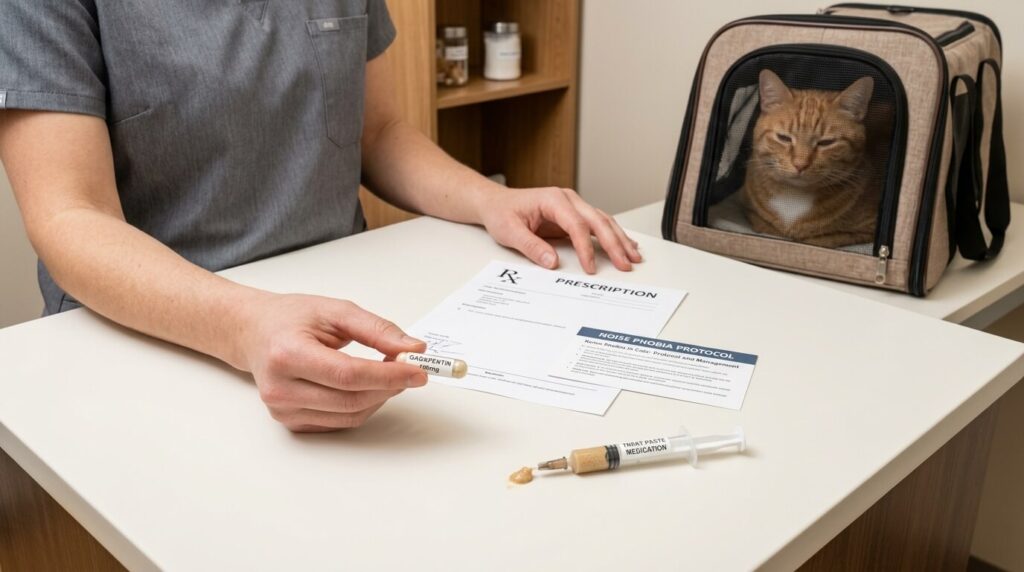
For some cats, environmental changes are not enough. If your cat has severe panic, refuses food or water, injures themselves, urinates or defecates from fear, or stays hidden long after fireworks end, ask your veterinarian about a pre-event medication plan.
Your veterinarian may discuss medications such as gabapentin, trazodone, or another cat-appropriate option depending on your cat’s age, weight, kidney function, medical history, and other medications. Do not use human prescriptions, leftover pet medication, or online dosing charts. The safest plan is prescribed for your individual cat and tested before the actual fireworks event when possible.
What I Do Not Recommend
Human sedatives or sleep aids: Do not give human sedatives, benzodiazepines, sleep aids, pain relievers, or combination cold medications unless your veterinarian specifically prescribes them for your cat. Some human medications are dangerous or fatal to cats.
Essential oils or scented calming products: Avoid diffusing lavender, eucalyptus, tea tree, citrus, peppermint, or other essential oils around cats. Cats can be sensitive to airborne compounds, and respiratory irritation is not worth the risk.
CBD products: Evidence, dosing, and product quality are still inconsistent for cats. Some products may contain ingredients that are not safe for cats.
Forcing exposure: Do not pull your cat out to “show them it is safe.” Hiding is a coping strategy, and forced exposure can make the fear worse.
Safety Warning: The Danger of Outdoor Access During Noise Events
This section is brief and serious.If your cat tends to rush doors during stress, use this plan alongside our guide on how to stop a cat from running out the door.
Do not allow your cat outdoor access during fireworks events — under any circumstances.
The statistics on lost cats during July 4th, New Year’s Eve, and Guy Fawkes Night are genuinely alarming. Animal shelters report intake increases of 30–60% in the days following major fireworks events — the majority of these animals are indoor-outdoor cats who bolted in a panic response and became geographically disoriented.
The acute stress response of a fireworks fright eliminates a cat’s usual spatial orientation and homing behavior. A cat who bolts from fear is not running home — they are running away from the threat, and they may run until exhaustion before stopping. The territory that was perfectly familiar in calm conditions becomes unrecognizable when the cat is in full panic-flight mode.
Specific urban apartment risks:
- Ensure all windows are secured — a cat in acute panic will attempt to exit through any available opening, including windows that are “only open a crack”
- Check balcony access — balcony falls during fireworks panic are documented in urban high-rise settings
- Ensure the front door protocol is airtight for the evening — delivery workers, visitors, and momentary door openings during a fireworks event can result in a cat bolting into the building corridor or stairwell
For apartment-wide safety planning, prepare an apartment cat emergency evacuation plan before fireworks season.
If your cat does escape during a noise event:
- Do not chase — running after a panicked cat drives them further from home
- Return to the last known location and sit quietly — panicked cats often circle back to familiar scent zones
- Leave a worn item of your clothing near the building entrance — familiar scent is a homing anchor
- File with local shelters immediately and post to Nextdoor, local Facebook groups, and PawBoost within the first hour
Hiding is a normal coping response during frightening events. If your cat hides often outside fireworks or thunder, read our guide to why your cat is hiding.
Frequently Asked Questions
1. Can I give my cat human sedatives for fireworks?
Absolutely not — and this cannot be stated strongly enough. Human sedatives and anxiolytics — including benzodiazepines (Valium, Xanax), sleep aids (Ambien, Benadryl), and herbal sedatives (Valerian in high doses) — have completely different dose profiles in cats than in humans, and several are outright toxic.
Cats metabolize many human medications through pathways that humans don’t share — or lack the enzymes required to process certain compounds entirely. Benzodiazepines, for example, can produce paradoxical excitation rather than sedation in cats, and acetaminophen (present in many combination human sleep/pain products) is acutely fatal to cats at any dose.
If your cat requires pharmaceutical support for fireworks anxiety, that conversation happens with your veterinarian — who will prescribe a cat-appropriate medication at a cat-appropriate dose. The appointment is worth scheduling in advance of the fireworks season. Many veterinary practices offer telehealth consultations for behavioral medication discussions if an in-person visit isn’t logistically possible.
2. Should I close my cat in a room during fireworks?
You can prepare a safe room, but avoid trapping your cat if that makes them panic. The best safe haven is open, familiar, and available before the noise begins. Add bedding, water, litter box access, hiding spots, and steady background sound. If you must close the door for safety, make sure your cat has everything they need and check calmly without pulling them out of hiding.
3. Are essential oils safe for calming cats during fireworks?
No. Essential oils are not a safe first-line calming tool for cats during fireworks. Avoid diffusing lavender, tea tree, eucalyptus, peppermint, citrus, or other oils around cats. Some cats develop coughing, drooling, watery eyes, vomiting, lethargy, or breathing irritation from airborne products. Use safer options such as hiding access, white noise, pheromone products, and veterinary guidance instead.
4. Why is my cat suddenly scared of thunder when they weren’t before?
New-onset thunder or fireworks phobia in a cat who previously showed no reaction has several possible explanations, and age is often the primary factor.
Aging auditory sensitivity: As cats age, their processing of sudden loud sounds can become more reactive rather than less — possibly related to changes in the auditory cortex and the amygdala’s threat-processing efficiency. A cat who was habituated to thunder at age 3 may develop genuine phobia at age 8 or 9.
Cumulative sensitization: Repeated exposure to frightening stimuli without effective coping support can produce sensitization rather than habituation — each exposure makes the next one more frightening, not less. A cat who has experienced several distressing fireworks nights without support may show progressively worse responses.
Medical contributors: Hyperthyroidism, hypertension, and early cognitive dysfunction all increase baseline neurological arousal — making previously tolerated stimuli intolerable. New-onset phobia in a cat over 8 years of age warrants a veterinary examination including thyroid function testing before concluding the problem is purely behavioral.
Pain: Acoustic trauma can cause tinnitus (ringing in the ears) that makes ongoing sound processing uncomfortable — another reason that new-onset noise sensitivity deserves medical evaluation.
5. Is it better to leave my cat alone during fireworks?
“Leave them alone” requires significant nuance — because it is correct in some ways and incorrect in others.
What leaving them alone correctly means:
- Do not force interaction or handling
- Do not follow them into their hiding spot and attempt physical comfort
- Do not repeatedly call their name or attempt to lure them out during the event
- Allow them complete autonomy over their concealment choices
What leaving them alone does NOT mean:
- Leaving the apartment during a fireworks event — your presence, even at a distance, provides genuine co-regulatory benefit
- Providing no environmental support — the Safe Haven, white noise, pheromones, and window management are all interventions that happen without requiring your cat’s direct participation
- Ignoring signs of physical distress — a cat who is actively vomiting, hyperventilating, or in apparent pain during a fireworks event needs veterinary attention
The ideal approach: prepare the environment proactively, remain present in the apartment, occupy yourself calmly in a room adjacent to the Safe Haven, and allow your cat complete autonomy to manage their own experience within the supportive environment you’ve built. Your presence provides co-regulatory benefit without any interaction requirement.
Final Thoughts
How to calm a cat during fireworks is mostly about preparation. A frightened cat does not need to be pulled out, comforted on demand, or exposed to the noise until they “get used to it.” They need control, hiding access, reduced sound, familiar scent, secured exits, and a calm routine.
Oliver does best when his safe room is ready before the first boom: familiar bedding, an open hiding spot, steady background sound, closed curtains, and no pressure to come out before he chooses to.
If your cat’s fear is severe, plan ahead with your veterinarian. Medication, if needed, should be prescribed for your cat, tested safely, and used alongside environmental support rather than as the only strategy.
Scientific References
- Landsberg, G. M., Mougeot, I., Kelly, S., & Ballantyne, K. C. (2015). Assessment of noise-induced fear and anxiety in dogs: An overview of noise phobia. Journal of the American Veterinary Medical Association, 247(12), 1329–1337.
- Vitale Shreve, K. R., & Udell, M. A. R. (2015). What’s inside your cat’s head? A review of cat (Felis silvestris catus) cognition research past, present and future. Animal Cognition, 18(6), 1195–1206.
- International Cat Care. Keeping cats safe during fireworks. https://icatcare.org/keeping-cats-safe-during-fireworks/
- VCA Animal Hospitals. Fears, Phobias, and Anxiety in Cats and Dogs. https://vcahospitals.com/know-your-pet/fears-phobias-and-anxiety
- ASPCA Animal Poison Control Center. Essential Oils and Cats. https://www.aspca.org/news/essentials-essential-oils-around-pets