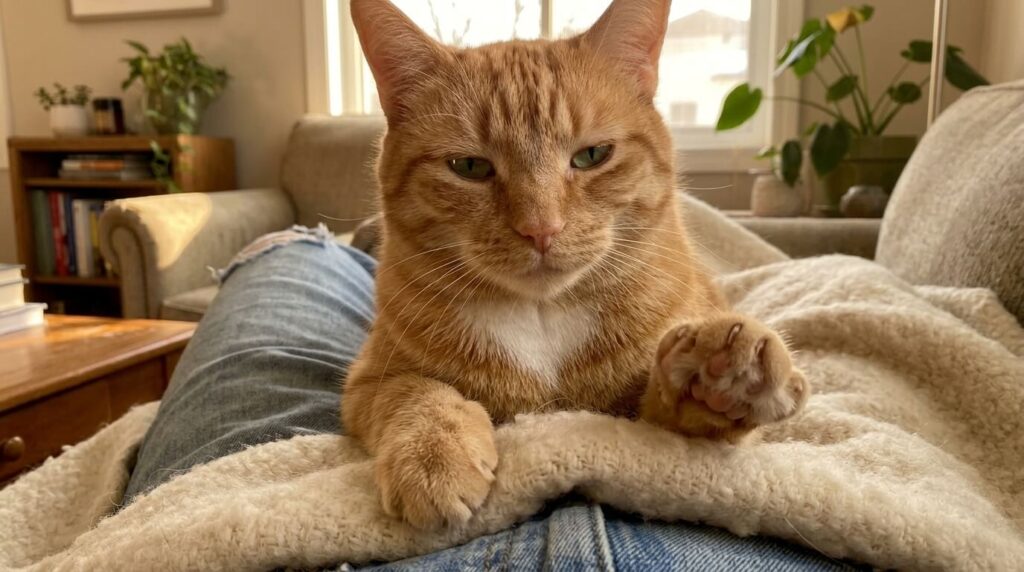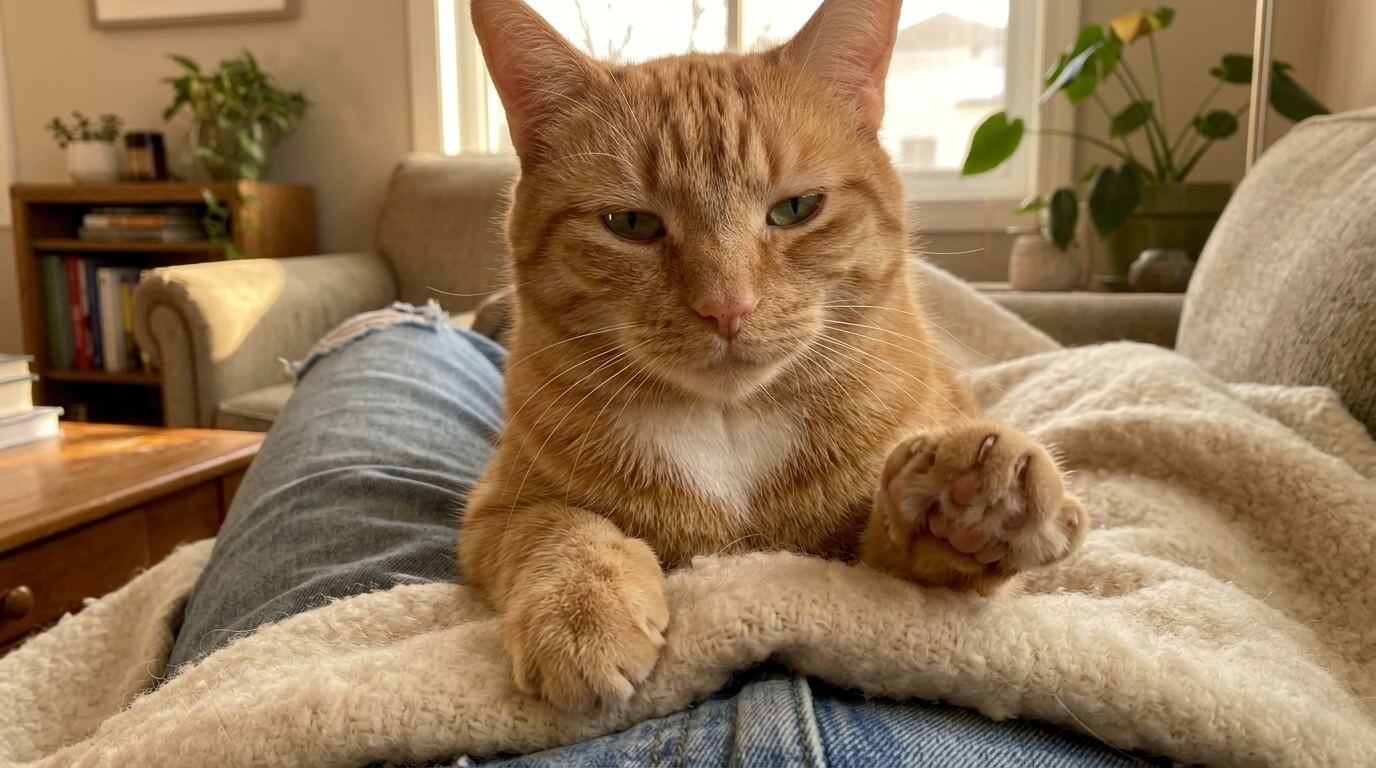
Oliver is on my lap right now. He has been there for approximately twenty-two minutes, purring at a frequency that I can feel in my sternum, and methodically working my favorite charcoal wool blanket with both front paws in the slow, rhythmic alternation that cat owners everywhere call “making biscuits.”
As a veterinary technician, I cannot look at this behavior without simultaneously feeling the warmth of it and reading it clinically — because what I’m observing is not just endearing.
It is a state of profound Parasympathetic Activation: Oliver’s nervous system has fully downshifted from alert to rest, his cortisol is measurably lower than it was an hour ago, and his body is engaged in a behavior so neurologically ancient it predates his ability to remember performing it.
Why do cats knead is one of those questions that has a genuinely fascinating multi-layered answer — evolutionary, neurological, territorial, and deeply emotional all at once. Let me give you all of it.
Quick Answer: Why Do Cats Knead (Making Biscuits)?
Cats knead due to a combination of infantile instinct (stimulating milk flow from their mother), scent marking (deploying pheromones from their paw glands), preparing a nesting site from wild ancestry, and stress regulation. This rhythmic behavior releases Oxytocin and endorphins, signaling that the cat feels genuinely safe, secure, and deeply bonded with their environment or owner.
The Evolutionary Roots: From the Nest to the Sofa
To fully understand why do cats knead, we need to go back approximately 10,000 years — and then back even further, to before domestication existed at all.
The Wild Ancestor Connection
The African wildcat (Felis lybica), the ancestor of every domestic cat alive today, was a solitary hunter who nested in grass, leaf litter, and soft vegetation. Before lying down to rest or give birth, wildcats would circle and press their paws into the nest material — testing its stability, compressing it into a body-conforming shape, and checking for hidden hazards underneath.
This nest-preparation behavior is the oldest layer of the kneading behavior stack. It is so deeply embedded in feline neurology that domestic cats perform it on memory foam beds, wool blankets, and human laps — surfaces that require no structural preparation whatsoever — because the behavioral program runs regardless of environmental necessity.
The Domestication Paradox
Here is what makes domestic cat kneading genuinely fascinating from an evolutionary perspective: domestic cats knead far more frequently and throughout their entire lives in ways that their wild relatives do not.
Wild felids knead as neonates and occasionally as adults during nest preparation. Domestic cats knead as kittens, adolescents, adults, and seniors — on their owners, on blankets, on other cats, on thin air — because the domestication process essentially extended kittenhood behavioral patterns into the full adult lifespan.
This phenomenon is called neoteny — the retention of juvenile characteristics into adulthood — and it is one of the defining features of domestic cat behavior compared to their wild counterparts. Understanding this gives you the first piece of the answer to why do cats knead: domestication preserved a kitten behavior by making adult cats permanently emotionally connected to the safety and warmth of their earliest experiences.
5 Scientific Reasons: Why Do Cats Knead?
Reason 1: The ‘Kitten Brain’ and Milk Stimulation
This is the foundational layer — the oldest and most deeply embedded reason why do cats knead, and the one that explains the trance-like, almost dissociated quality of the expression Oliver gets when he’s deep in a kneading session.
The neonatal mechanism:
In the first weeks of life, kittens knead rhythmically against their mother’s mammary glands to stimulate milk letdown — the physiological release of milk from the glands into the nipple. The kneading applies pressure that triggers oxytocin release in the mother, which causes muscle contractions that move milk forward. Without kneading, milk production and delivery would be significantly less efficient.
What makes this neurologically remarkable is the feedback loop: the kitten kneads → milk flows → the kitten experiences warmth, satiation, physical contact, and safety → the kneading behavior becomes one of the most powerfully positively reinforced behaviors in the cat’s entire behavioral repertoire.
This is called Fetal Regression — the adult cat performing a behavior that belongs neurologically to their earliest developmental stage. When Oliver kneads my blanket, some part of his brain is accessing the neurological template of the most safe, warm, and satisfied he has ever felt. The trance-like expression is not accidental. He is, in a neurological sense, briefly somewhere else.
Why blankets and soft surfaces? Because the texture and give of soft material mimics the feeling of the mother’s abdomen — which is why why do cats knead specifically on soft things rather than hard surfaces. The tactile match to the original stimulus is important.
Reason 2: Territorial ‘Scent-Soaking’ (Digital Scent Glands)
This is the reason that surprises most cat owners — and the one that adds a territorial dimension to what appears to be purely an affectionate behavior.
The anatomy of the kneading paw:
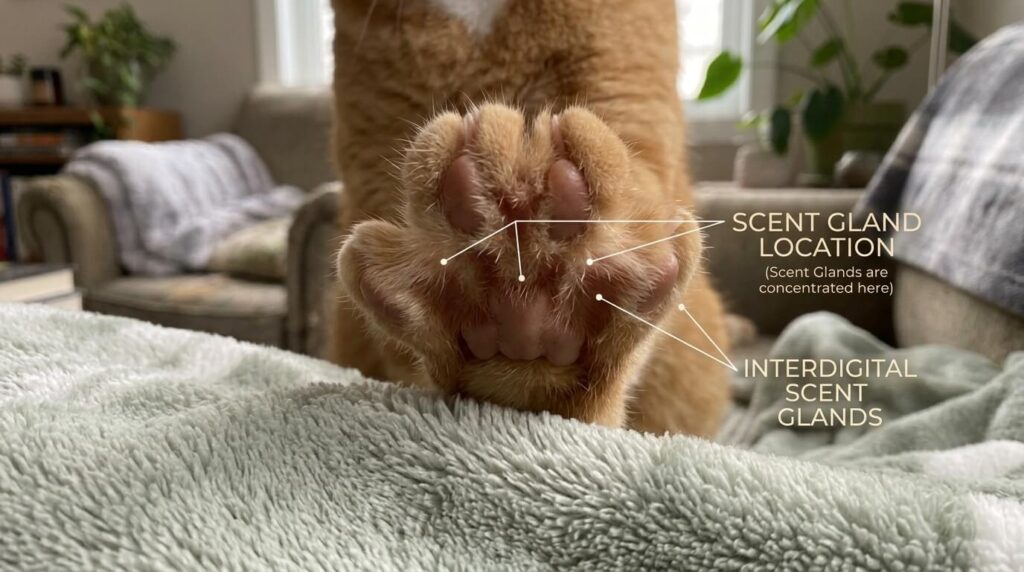
Cats have scent glands in multiple locations: cheeks, chin, forehead, tail base — and critically, between their toes. These are called Interdigital Scent Glands, and they produce a complex chemical signature containing pheromones that communicate territorial ownership, social identity, and emotional state.
When a cat kneads a surface, they are not just pressing — they are marking. The rhythmic pressure and the spreading of the toes during kneading maximizes contact between the Interdigital Scent Glands and the surface being kneaded, depositing a pheromone signature that persists long after the cat has moved on.
What this means in practice:
- When Oliver kneads my lap, he is depositing his scent on me — I am becoming part of his claimed territory in the most literal chemical sense
- When a cat kneads a specific blanket repeatedly, that blanket becomes saturated with their scent signature — which is why they return to it preferentially
- The preferred kneading surfaces in a household are the objects most heavily scent-marked by the cat — which is why they’re typically the items the owner uses most
Why do cats knead their owners specifically? Because their owners are the most important social objects in their environment, and scent-marking them is a form of social bonding that says, in chemical language: “You are mine. I am yours. This is documented.”
Reason 3: Wild Ancestry and Bed Preparation
The third scientific reason why do cats knead connects directly to the wildcat nest-preparation behavior we discussed in the evolutionary section — but there are additional layers worth understanding.
The safety assessment function:
Beyond simply compressing nest material into a comfortable shape, the pressing motion of kneading allows a cat’s paw pads to assess the substrate beneath the surface. Is the ground stable? Is there anything hidden in the grass that might be a hazard? The rhythmic pressing, repeated across the surface, creates a tactile map of the sleeping site.
The temperature regulation function:
Pressing and compressing soft material generates micro-warmth through friction and compression — and compacted nesting material retains heat more effectively than loosely arranged material. Wild cats preparing a nest in cool conditions were creating a warmer sleeping site through the mechanical action of kneading.
The circling and kneading sequence:
If you observe a cat carefully before they settle, you will often see them circle the area 2–3 times before kneading begins — and then knead before finally lying down. This is the ancestral nest-preparation behavioral sequence intact: survey → circle for hazard assessment → compress the substrate → lie down.
The fact that Oliver performs this on my entirely hazard-free, pre-warmed apartment blanket is a beautiful illustration of how deeply behavioral programs persist beyond the environmental context that created them.
Reason 4: Endorphin Release and Stress Regulation
This reason is perhaps the most clinically significant for understanding why do cats knead in terms of its function in adult feline emotional health.
The neurochemistry of rhythmic behavior:
Rhythmic, repetitive behaviors trigger endorphin release in mammals — this is a well-documented phenomenon that includes behaviors as diverse as rocking in infants, chewing in equines, and yes, kneading in cats. The rhythmic compression activates proprioceptive receptors in the paws and lower limbs that feed into feedback loops producing Oxytocin and beta-endorphin release.
The subjective experience of this neurochemical state is: warmth, calm, mild euphoria, and reduced sensitivity to stressors. This is the biological explanation for the trance-like expression and the reduced environmental responsiveness that accompanies deep kneading.
Kneading as self-regulation:
Adult cats who knead are engaging in what behavioral scientists call self-regulatory behavior — they are using an innate behavioral mechanism to manage their own emotional and physiological state. This is a healthy, functional coping behavior.
This is also why stressed cats may knead more intensely or more frequently than usual — they are activating the neurochemical relief that kneading provides as a response to elevated cortisol. If you notice increased kneading frequency in your cat, it can be a useful signal that their stress load has increased, warranting an environmental audit.
It’s equally worth noting: a sudden cessation of kneading in a senior cat — a cat who previously kneaded regularly and has stopped — can be a subtle but diagnostically meaningful observation. Joint pain in the paws, wrists, or elbows can make the mechanical action of kneading uncomfortable enough that the cat stops. This is one of the subtle diagnostic clues for feline arthritis that we’ve detailed in our joint pain checklist. [Why Does My Cat Sleep So Much? Indoor Cat Sleep Explained]
Reason 5: The Ultimate Sign of Trust and Bonding
The fifth scientific reason why do cats knead is the one that I find most emotionally meaningful — because it places the behavior in the context of the human-cat relationship in a way that is neurologically genuine rather than sentimentally projected.
The vulnerability equation:
Kneading requires a specific emotional precondition: the cat must feel completely safe. The trance-like state of deep kneading — the half-closed eyes, the reduced environmental scanning, the dissociation from normal alertness — represents a genuine reduction in the cat’s threat-monitoring. A cat who does not trust their environment cannot achieve this state.
When Oliver kneads on my lap, he is not just comfortable. He has made an unconscious neurological assessment that this is one of the safest places he has ever been. His threat-detection system has stood down enough to allow the ancient, infantile kneading behavior to emerge — and that system stands down only in the presence of deep, established trust.
The oxytocin reciprocity:
Research has demonstrated that Oxytocin — the bonding hormone associated with attachment in both humans and animals — is released during positive human-cat interactions including mutual touch. When your cat kneads you, both you and your cat are likely experiencing elevated oxytocin levels — which is the neurochemical substrate of what we experience as affection, warmth, and connection.
Why do cats knead specifically on the people and objects they are most bonded with? Because kneading requires the safety that only deep attachment creates, and it deposits the scent signature that makes the bond chemically legible in a language evolution gave them millions of years before humans arrived.

The ‘Claw Conflict’: How to Manage Kneading Pain Safely
Understanding why do cats knead explains why this behavior is valuable and should be preserved — not discouraged. But for owners who are on the receiving end of enthusiastic kneading on bare legs or delicate fabric, the claw component can be genuinely uncomfortable.
Here’s how to manage the physical reality without disrupting the behavior:
For the Owner
Barrier methods that work:
- Thick blanket layer: Keep a dedicated, machine-washable blanket on your lap as a kneading buffer — Oliver has a specific wool blanket that is “his” kneading blanket, which also means it’s heavily scent-marked and therefore particularly appealing to him
- Strategic clothing: Denim and thicker fabrics provide meaningful claw protection during lap kneading sessions
- Paw sandwich: Gently place your hand over the kneading paws with light pressure — this provides warmth and contact while reducing the claw-to-skin interface
What not to do:
- Do not push the cat off your lap during kneading — this pairs the behavior with rejection at a neurologically sensitive moment
- Do not physically restrain the paws — this creates a conflicting sensory input that can interrupt Parasympathetic Activation and stress the cat
- Do not verbally scold — negative communication during kneading creates an association between a safety behavior and threat
For the Fabric
Oliver’s wool blanket is both his favorite kneading surface and its primary victim. Management strategies:
- Regular nail trims every 2–3 weeks reduce the fabric-catching capacity of the claws significantly
- Nail caps (Soft Paws) — if kneading on delicate fabric is genuinely problematic, vinyl nail caps prevent claw penetration without preventing the behavior
- Redirect to a designated kneading surface — a specific blanket with your scent on it, placed in Oliver’s favorite locations, draws the kneading behavior to a managed surface over time
When to Worry: When Kneading Becomes Obsessive (Compulsive Behaviors)
The vast majority of why do cats knead questions have a happy, normal answer. But in a small subset of cats, kneading behavior escalates into compulsive territory that warrants clinical attention.
Normal Kneading vs. Compulsive Behavior
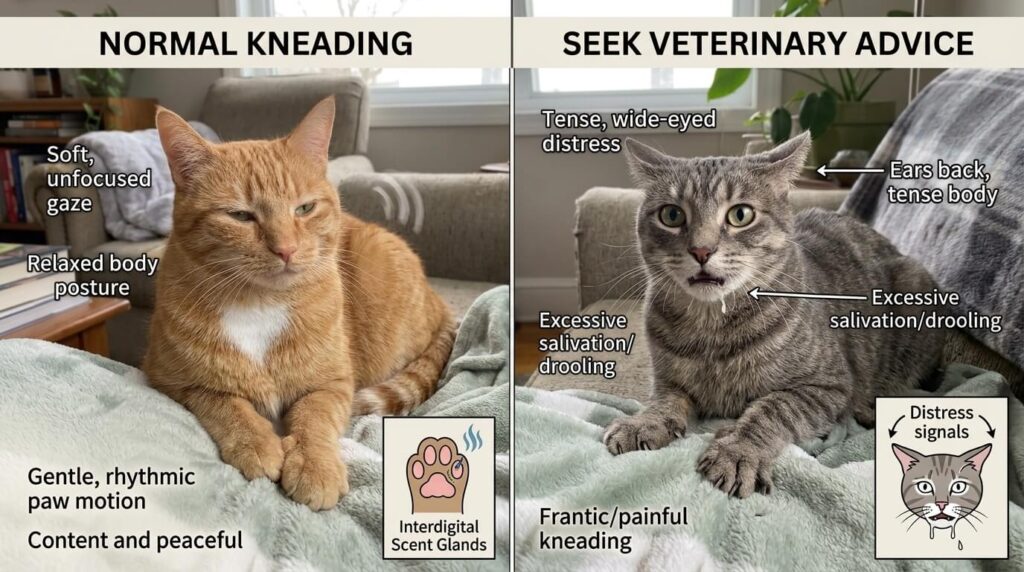
Normal kneading:
- Occurs in specific contexts (settling down, reuniting with owner, pre-sleep)
- The cat can be interrupted and responds normally
- Duration is self-limiting — Oliver typically kneads for 5–15 minutes before settling into sleep
- The cat appears content, relaxed, and in a positive emotional state throughout
Potentially compulsive kneading:
- Occurs at very high frequency throughout the day without clear contextual trigger
- The cat appears unable to interrupt the behavior or becomes distressed when it is interrupted
- Accompanied by excessive suckling on fabric (Wool Sucking — a related compulsive behavior particularly common in Siamese and Burmese breeds)
- The cat appears anxious rather than calm during the behavior
- Physical consequences — raw or irritated paw pads from excessive kneading frequency
Associated Compulsive Behaviors
Wool Sucking and Fabric Chewing:
Wool sucking — suckling on fabric, clothing, or blankets — frequently co-occurs with kneading and shares the same infantile neurological roots. Occasional wool sucking in the context of normal kneading is generally benign. Escalating wool sucking that progresses to fabric ingestion (Pica) requires immediate veterinary attention — ingested fabric can cause gastrointestinal obstruction.
When to consult your veterinarian:
- Kneading sessions lasting more than 30–45 minutes repeatedly
- Any fabric ingestion during or after kneading
- Kneading accompanied by visible distress, vocalization, or aggression when interrupted
- New onset of compulsive kneading in an adult cat with no previous history — which can indicate thyroid dysfunction, neurological changes, or chronic pain

Frequently Asked Questions
❓ Why does my cat knead and bite a blanket?
The kneading-and-biting combination is the most complete expression of the infantile nursing behavioral sequence — and it’s significantly more common in cats who were weaned early (before 8 weeks of age). The suckling component (the biting and rhythmic mouthing of fabric) represents the oral part of the nursing behavior, while the kneading represents the tactile paw component. Together, they are the full nursing behavioral template running as a unit.
In most cats, this is entirely normal and self-limiting — the cat soothes itself through the full sequence and settles. The behavior warrants monitoring when it escalates to actual fabric ingestion (which can cause GI obstruction) or becomes so compulsive that the cat cannot engage in normal daily activities.
❓ Why do cats knead only on soft things?
The tactile specificity of why do cats knead only on soft surfaces is rooted in the original stimulus — the mother’s abdomen. Mammary gland tissue has a specific yield under pressure: it compresses and returns in a way that perfectly matches the kneading motion, provides feedback to the kneading paws, and allows the milk-stimulation pressure to be applied efficiently.
Hard surfaces don’t compress under paw pressure, provide no proprioceptive feedback, and don’t match the tactile template established in the first weeks of life. The cat’s nervous system is looking for a specific sensory input — a surface that gives, yields, and provides warmth — and only soft, compliant materials meet that template.
This is also why cats develop specific preferences for particular soft surfaces — a blanket that has been kneaded hundreds of times has the “right” feel, the right scent, and the right yield profile for that individual cat’s preferences.
❓ Is it bad to stop a cat from kneading?
For most cats, interrupting or preventing kneading is not acutely harmful — the cat will simply stop and move on. However, routinely discouraging or punishing kneading is behaviorally counterproductive for several reasons:
Kneading is a self-regulatory behavior that serves genuine neurological and emotional functions. A cat who is not permitted to knead loses access to one of their primary stress-management tools. Over time, this can contribute to elevated baseline anxiety and the behavioral consequences of chronic stress.
Additionally, the contexts in which cats most want to knead — settling on a trusted person, pre-sleep preparation, reunion after separation — are exactly the contexts where disruption is most emotionally dissonant. Pushing a cat off your lap the moment they begin kneading repeatedly teaches the cat that their trust-behaviors lead to rejection — a lesson that erodes the bond rather than managing the claw problem.
The appropriate response to uncomfortable kneading is management (barrier layers, nail trims, redirection to a designated surface) — not suppression of the behavior itself.
Scientific References
- Beaver, B. V. (2003). Feline Behavior: A Guide for Veterinarians (2nd ed.). Saunders/Elsevier.
https://doi.org/10.1016/B978-0-7216-9498-6.X5001-8 - Nagasawa, M., Mitsui, S., En, S., Ohtani, N., Ohta, M., Sakuma, Y., Onaka, T., Mogi, K., & Kikusui, T. (2015). Oxytocin-gaze positive loop and the coevolution of human-dog bonds. Science, 348(6232), 333–336.
https://doi.org/10.1126/science.1261022
The Bottom Line: Why Cats Knead
Oliver has fallen asleep in the time it took me to write most of this guide. His paws are still now, tucked loosely beneath his chest in the classic meatloaf position, his purring reduced to the almost-inaudible rumble of deep sleep.
Understanding why do cats knead transformed how I experience this behavior — from “cute habit” to “neurological window.” Every time Oliver makes biscuits on my lap, I am watching 10,000 years of domestication expressing itself, infantile neurological templates activating in an adult brain, chemical ownership being documented on my wool blanket, and a stress-regulation system working exactly as designed.
I am also watching an animal who trusts me completely enough to stand his nervous system down in my presence.
That, more than anything else in this guide, is why do cats knead on the people they love.
It is the oldest, most neurologically honest thing they know how to say.
Questions about your cat’s kneading behavior or variations you’ve observed? Drop them in the comments — I read every one. And if your cat is currently making biscuits on you while you read this, well. Lucky you.
Tags: why do cats knead | cat behavior | making biscuits cats | feline behavior | cat enrichment | indoor cat care | cat science