The listing said “No Pets” in bold — and it was the most perfect mid-century modern studio I had seen in four months of apartment hunting in New York. Original parquet floors, south-facing windows, a galley kitchen that actually had counter space. I walked through it in twelve minutes and knew it was Oliver’s apartment before I knew it was mine.
The agent smiled sympathetically when I asked about the pet policy. “The owner is firm on that,” she said. Twenty-four hours later, I had a lease and a signed pet addendum. What changed the landlord’s mind wasn’t luck or negotiation tactics — it was a document package I had developed specifically for this scenario, built around the same philosophy I apply to everything involving Oliver’s care:
if you present a risk, present the management plan alongside it. The most practical renting with a cat tips don’t start with the lease — they start weeks before you ever view a property, with a portfolio that transforms your cat from a landlord’s liability into a documented, managed, low-risk resident. Here is the complete system.
Quick Answer: How Do You Get a Landlord to Accept Your Cat?
To convince a landlord, move beyond the standard application. Provide a Pet Resume including vet records, proof of neutering, behavior references, and a scratching management plan. Offer a slightly higher pet deposit or “pet rent” proactively, and demonstrate a professional cleaning protocol. You are not asking for an exception — you are eliminating the landlord’s risk.
The Landlord’s Nightmare: Understanding Their Fear
The most important of all renting with a cat tips is this: before you make your case, understand precisely what case you are responding to. Landlords who say “No Pets” are not being arbitrary. They are managing a specific set of documented, financially significant risks — and if you can demonstrate that those risks don’t apply to you and Oliver, the “No Pets” policy becomes negotiable.
The Three Primary Landlord Fears
Fear #1: Odor Damage
Cat urine — particularly from an unsterilized male cat spraying territorial markings — can penetrate subfloor materials beneath hardwood and tile, requiring complete flooring replacement at costs of $3,000–$15,000+. Even in non-spraying cats, inadequate litter management in a closed apartment can create ammonia levels that damage drywall finishes and require repainting.
This is the fear that most renting with a cat tips fail to address directly — because most owners don’t understand how specific and financially grounded it is.
Fear #2: Structural Damage
Claws on hardwood floors. Scratching on door frames, baseboards, and carpet edges. Chewing on blinds and window treatments. The landlord who has re-tenanted an apartment after a cat has been in residence knows exactly what the damage assessment can look like — and it frequently exceeds the standard security deposit.
Fear #3: Noise and Neighbor Complaints
A cat in heat yowling at 3 AM. A cat with separation anxiety vocalizing for hours during the owner’s workday. A startled cat knocking items off surfaces at midnight. In a dense apartment building where noise complaints affect other tenants’ satisfaction and lease renewals, a noise-generating pet is a management problem that extends beyond the individual apartment.
What This Means for Your Strategy
Every strong renting with a cat tips strategy addresses each of these three fears explicitly — not by dismissing them, but by providing documented evidence that your specific cat and your specific management practices eliminate them. You are not arguing that cats in general don’t cause damage. You are proving that Oliver specifically won’t.
7 Professional Renting with a Cat Tips to Win the Lease
Tip 1: The ‘Pet Resume’ — Your Most Powerful Document
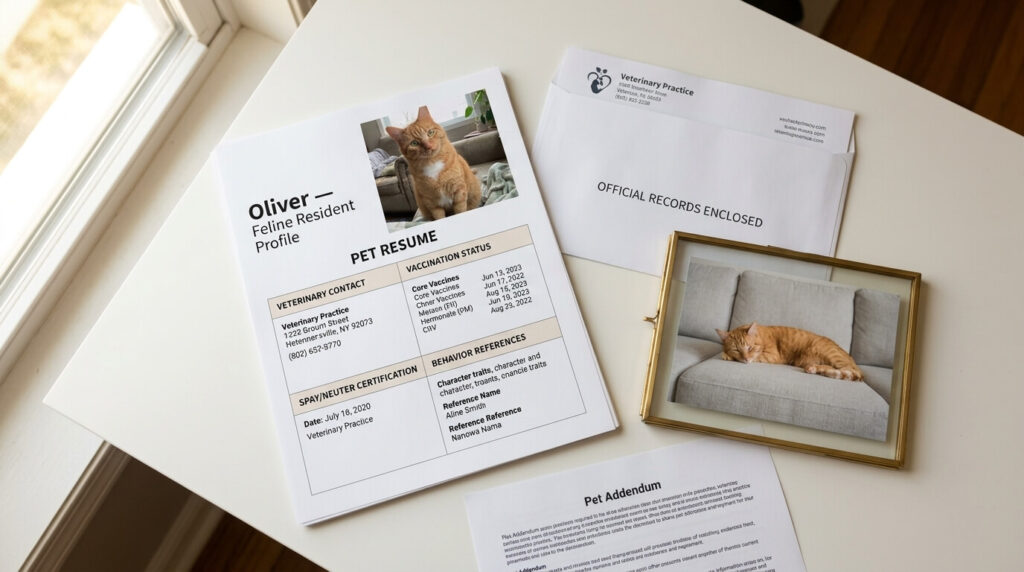
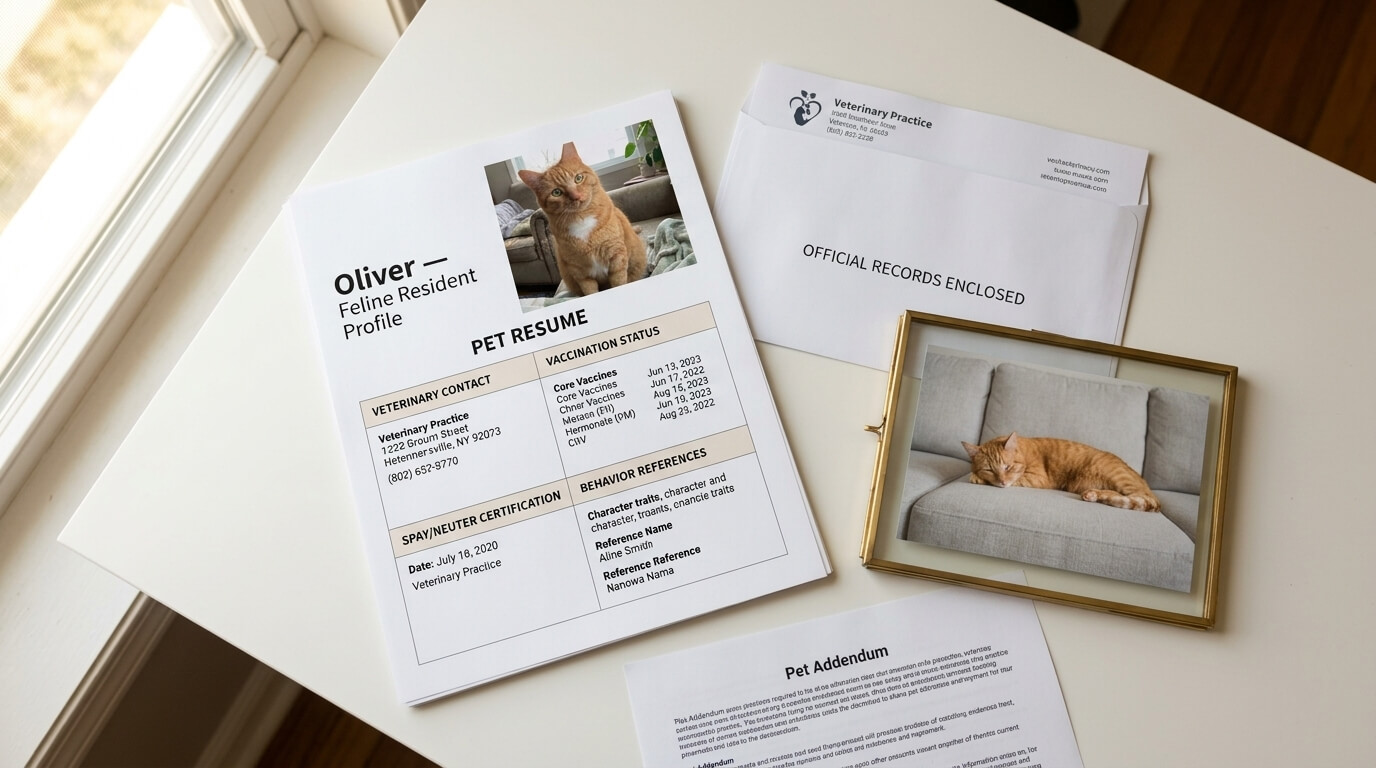
The Pet Resume is the centerpiece of every successful renting with a cat tips package, and it is the single document most likely to differentiate you from every other applicant with a cat.
A Pet Resume is a one-to-two-page professional document — formatted with the same care as your own CV — that presents your cat as a documented, managed, low-risk resident. The fact that it exists at all communicates more than its contents do: this owner takes their pet’s management seriously enough to document it.
Pet Resume structure:
Header:
- Professional photo of your cat (calm, clean, well-groomed — not mid-zoomie)
- Cat’s name, age, breed
- Your name and contact information
Section 1: Health Status
- Veterinarian name, practice, and contact number
- Date of most recent wellness examination
- Current vaccination status (FVRCP, Rabies — include copies)
- Heartworm/flea prevention status and product
Section 2: Sterilization Status
- Spayed/neutered: Yes/No
- Date of procedure
- Veterinarian who performed the procedure
Section 3: Behavior Profile
- Indoor-only status (yes — this matters enormously to landlords)
- Litter box trained: Yes, since what age
- Known behavioral issues: None / Managed with [specific protocol]
- History of property damage in previous residences: None / Managed with [specific protocol]
Section 4: References
- Previous landlord name and contact (if applicable)
- Veterinarian contact (if not listed above)
- Pet sitter or boarding facility contact
Section 5: Management Protocols
- Scratching management: [Specific furniture listed, scratching post setup described]
- Odor management: Enzymatic cleaning protocol, litter management schedule
- Noise management: Indoor-only, neutered, no separation anxiety history
Formatting guidance: This document should be printed on quality paper, not photocopied. It should use a clean, professional font. It should look like something you prepared with genuine care — because you did. Present it in a folder or binder alongside the supporting documents from the tips below.
Tip 2: The Vet Reference Letter — Third-Party Credibility
A Reference Letter from your veterinarian is the single most credible document in your renting with a cat tips package — because it transforms your self-reported pet information into verified, professional third-party testimony.
What the vet letter should include:
- Practice letterhead (this matters — it signals institutional credibility)
- Patient name and species
- Confirmation of regular wellness care and current vaccination status
- Statement of overall health status
- Statement of temperament as observed in the clinical setting
- Confirmation of sterilization status
- The veterinarian’s professional contact information and signature
How to request it:
Call your veterinary practice and explain that you are applying for a rental property and need a brief letter confirming your cat’s health and behavior status for a landlord. Most practices will prepare this letter for a nominal fee ($15–$35) or include it as a courtesy for established patients. Allow 3–5 business days for the letter to be prepared.
Sample language to request:
“I am renting a new apartment and the landlord requires documentation of my cat’s health and behavior. Would the practice be able to prepare a brief letter on your letterhead confirming Oliver’s vaccination status, that he is neutered, and that he is in good health? I would appreciate any behavioral observations from his clinical visits as well.”
A letter from a licensed veterinarian carries authority that no amount of owner self-reporting can replicate — and in the context of renting with a cat tips, it is the document that moves a skeptical landlord from “probably responsible owner” to “documented, verified responsible owner.”
Tip 3: Proof of Sterilization and Vaccination — The Paper Trail
Sterilization Proof is arguably the single most important piece of documentation in your renting with a cat tips package — because it directly eliminates the landlord’s primary odor fear.
An intact male cat who sprays territorial urine creates the type of flooring damage described in the introduction. A neutered male cat does not spray for territorial reasons, does not yowl for mating, and does not exhibit the roaming and escape-seeking behaviors that create structural damage through window and door attempts.
Documents to include:
- Surgical discharge paperwork from the spay/neuter procedure
- Veterinary medical record excerpt confirming sterilization
- If you don’t have the original paperwork: your current vet can confirm sterilization status on their letterhead (a brief physical examination confirms the procedure)
Vaccination documentation:
- Current FVRCP vaccine certificate
- Current Rabies vaccine certificate (in many jurisdictions, Rabies vaccination is legally required for cats — having it documented shows compliance)
- Flea and heartworm prevention records
Microchip registration:
Include your cat’s microchip number and registration details. A microchipped cat demonstrates responsible ownership and — practically — means that if your cat is ever lost in the building (an escape through an open door, a maintenance visit mishap), they can be identified and returned without incident.
Tip 4: Scratching Management Certification — Addressing the Damage Fear
This is the renting with a cat tips element that most owners never think to include — and it directly addresses the second major landlord fear: structural damage to floors, walls, and door frames.
The scratching management documentation should include:
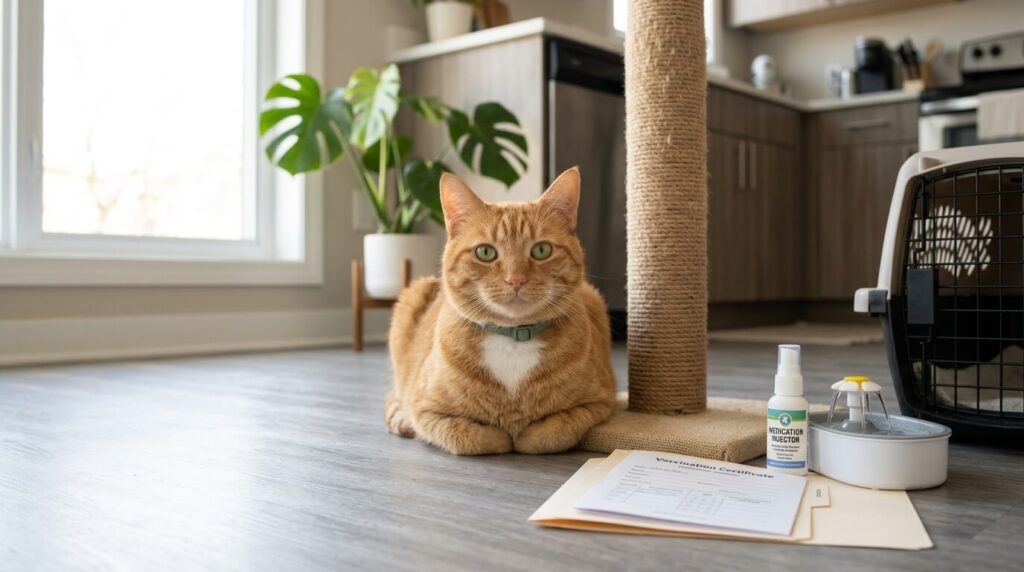
Your scratching post setup (with photos):
- Number of scratching posts/pads provided
- Material types (sisal, cardboard, carpet — ideally including horizontal options)
- Placement (near furniture corners, near doors, near primary resting spots — the strategic locations that redirect scratching from surfaces to appropriate alternatives)
Showing your landlord photos of your scratching post setup is a key strategy from our guide on protecting apartment furniture from feline damage [How to Stop Cat From Scratching Couch: A Proven 4-Step Guide] — because it transforms an abstract promise (“my cat won’t scratch your floors”) into a documented, specific management system.
Nail trimming documentation:
- Nail trim schedule (every 2–3 weeks for indoor cats)
- If you use a groomer: their contact information and your appointment history
- If you trim at home: brief note confirming regular maintenance
Nail cap use (if applicable):
- Soft Paws or similar vinyl nail caps physically prevent scratch damage even if the cat contacts the surface
- Mention in the resume if you use them — it’s a compelling specific detail
The furniture protection letter:
Include a brief written commitment that you will:
- Maintain a minimum of [X] scratching posts throughout the apartment
- Trim Oliver’s nails every [X] weeks
- Replace any minor scratching damage to baseboards or door frames at your own cost upon tenancy end
- Report any accidental damage immediately rather than attempting to conceal it
This last point — proactive damage reporting — is one of the most trust-building commitments an owner can make, because concealed damage is the landlord’s actual nightmare.
Tip 5: Meeting in Person — The Temperament Test
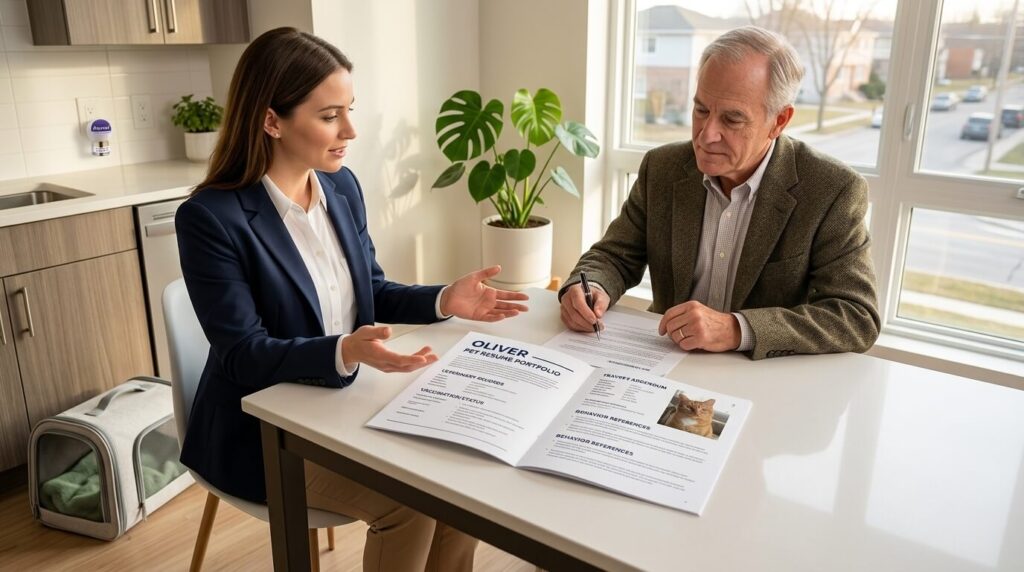
For landlords who are genuinely on the fence, an in-person meeting with your cat is one of the most persuasive renting with a cat tips available. A calm, well-groomed, socially appropriate cat makes its own argument in a way that documents cannot.
How to arrange and execute the meeting:
- Propose the meeting in writing: “I would love for you to meet Oliver before making your final decision — I find that meeting him addresses most concerns more effectively than any paperwork.”
- Bring Oliver in a clean, well-maintained carrier with a fresh blanket — the carrier itself is a signal of your organizational standards
- Groom Oliver the day before — a clean, well-groomed cat communicates attentive ownership
- Allow Oliver to emerge from the carrier at his own pace — forcing the interaction communicates stress, not calm
- Have a few treats available to demonstrate a trained recall or sit command — a cat who responds to their name and follows a simple cue demonstrates behavioral management
What you are demonstrating:
- Oliver is accustomed to travel and new environments (low separation anxiety)
- Oliver is clean, healthy, and well-cared-for
- You are organized, calm, and take your pet’s care seriously
- The landlord can visually assess that Oliver is an adult cat (not a kitten, whose developmental behaviors are less predictable), neutered, and calm in temperament
Tip 6: The ‘Pet Addendum’ — Legal Clarity for Both Parties
A Pet Addendum is a formal legal document that supplements the main lease agreement, specifically addressing the terms under which the pet is permitted in the rental property. Proposing a pet addendum proactively — rather than waiting for the landlord to require one — is one of the most sophisticated renting with a cat tips because it communicates legal literacy and good faith simultaneously.
What a pet addendum should include:
- Pet description (name, species, breed, age, weight, color, microchip number)
- Owner’s responsibilities (damage repair, waste management, noise management)
- Pet deposit terms (amount, refund conditions)
- Pet rent terms if applicable (monthly amount, start date)
- Behavioral standards (the pet will not create sustained noise disturbance)
- Right to revoke (under what conditions the landlord may require pet removal)
- Right to inspect (advance notice required for any pet-related inspection)
Where to find templates:
- Your state’s landlord-tenant legal association typically provides standard pet addendum templates
- LegalZoom and Rocket Lawyer offer customizable pet addendum documents
- Review with a tenant’s rights organization in your city if you have concerns about specific clauses
The proactive offer framing:
“I’ve taken the liberty of drafting a pet addendum that clearly outlines my responsibilities and your protections. I’m happy to modify any terms that don’t meet your standard requirements.”
This framing repositions you from “tenant requesting a favor” to “informed professional proposing a mutual solution.”
Tip 7: Proactive Financial Incentives — Pet Deposits and Pet Rent
The final and most direct of the renting with a cat tips addresses the landlord’s concern at its most fundamental level: financial risk. If the landlord’s concern is that your cat might cause damage that exceeds the security deposit, the solution is additional financial protection.
Pet deposit strategy:
- Offer a pet deposit that is higher than the landlord would have requested — proactively
- Standard pet deposits range from $200–$500 for cats; offering $400–$600 before being asked signals both financial stability and genuine risk acknowledgment
- Specify in writing that the pet deposit is refundable under the same conditions as the security deposit (many jurisdictions require this, but specifying it in your offer builds trust)
Pet rent strategy:
- Pet rent ($25–$75 per month for cats in most markets) is a non-refundable monthly amount that compensates for the general wear associated with pet occupancy
- Proactively offering pet rent — even a nominal amount — addresses the landlord’s concern that pets create incremental depreciation that isn’t covered by security deposits
The framing that works:
“I want to be completely transparent about the additional considerations that come with having Oliver as a resident. I’d like to offer an additional $400 pet deposit, fully refundable upon move-out under the same conditions as the standard security deposit, and I’m happy to include $50 per month in pet rent to account for any general additional wear. I’d also like to be explicitly responsible for any specific damage attributable to Oliver beyond normal wear.”
The professional cleaning commitment:
Emphasizing your use of professional-grade enzymatic cleaners — as detailed in our feline hygiene protocol [How to Cat-Proof a Rental Apartment (Without Losing Your Deposit)] — can provide specific, documented reassurance to landlords about the long-term integrity of their flooring, particularly hardwood and tile that is most vulnerable to urine damage.
Include a written commitment to:
- Professional carpet cleaning or floor refinishing at tenancy end (with enzymatic pre-treatment)
- The specific enzymatic cleaner you use for any litter box accidents
- Your litter management schedule

Legal Rights: ESAs vs. Pet Policies — A Brief Note
While the seven renting with a cat tips above are designed for the majority of standard rental situations, there is an important legal dimension that some cat owners qualify for: the Emotional Support Animal (ESA) designation.
What an ESA Designation Provides
Under the Fair Housing Act (FHA), individuals with a documented disability may qualify for a reasonable accommodation that requires landlords to permit an Emotional Support Animal — even in “No Pets” buildings — without charging a pet deposit or pet rent for the ESA animal.
An ESA designation requires:
- A letter from a licensed mental health professional (therapist, psychologist, psychiatrist) documenting that you have a disability and that the animal provides therapeutic support related to that disability
- The disability must be recognized under the Fair Housing Act definition — a physical or mental impairment that substantially limits one or more major life activities
Important Boundaries
- An ESA letter does not exempt you from being responsible for damage caused by the animal
- An ESA designation applies to housing — it does not provide airline travel rights (this changed in 2020–2021 under DOT regulations)
- Fraudulent ESA letters obtained from online “certification mills” without a genuine therapeutic relationship are legally problematic and ethically questionable
- Not every cat owner qualifies for or should pursue ESA designation — it is a specific legal accommodation for genuine therapeutic need, not a workaround for pet policies
If you believe you may genuinely qualify for an ESA accommodation, consult with a licensed mental health professional and a tenant’s rights organization in your jurisdiction before pursuing this route.

Frequently Asked Questions
❓ What should be on a cat resume?
The complete Pet Resume should include: a professional photograph of your cat; basic information (name, age, breed, weight, indoor-only status); veterinarian contact information and confirmation of regular care; current vaccination status with dates; sterilization confirmation with date of procedure; microchip number and registry;
behavioral profile (litter trained since age X, no history of property damage, temperament as assessed by veterinarian); reference contacts (previous landlord if applicable, veterinarian, pet sitter or boarding facility); and a brief management protocols section describing your scratching post setup, nail trimming schedule, litter box management system, and cleaning protocol.
The resume should be one to two pages maximum, formatted professionally, printed on quality paper, and presented alongside supporting documentation (the vet reference letter, vaccination certificates, and sterilization proof). The goal is a document that could be presented in a professional context without embarrassment — because that level of preparation is itself the message.
❓ Can a landlord legally say no to cats?
In most jurisdictions in the United States, yes — a landlord can legally refuse to rent to pet owners, including cat owners, unless a specific legal protection applies. The key exceptions are:
Fair Housing Act ESA provisions: As noted above, landlords must provide reasonable accommodations for documented Emotional Support Animals for qualified individuals with disabilities. Standard “No Pets” policies do not apply.
State and local law: Some states and municipalities have enacted pet-friendly rental legislation that limits a landlord’s ability to refuse all pets or charge excessive pet deposits. Oregon’s statewide pet policy law (2021) is the most comprehensive current example — requiring landlords to accept “pet agreements” in most circumstances and capping pet deposits. Several other states are considering similar legislation. Check your specific state’s tenant rights resources for current local law.
Cooperative buildings: In some cooperative (co-op) apartment structures, pet policies are set by the co-op board rather than individual unit owners, and the process for requesting an exception involves the board rather than a single landlord.
In standard private rental markets without specific legal protection, a “No Pets” policy is legally enforceable — which is exactly why the renting with a cat tips in this guide focus on persuasion and risk elimination rather than legal challenge.
❓ How much is a typical pet deposit for an apartment?
Pet deposit ranges vary significantly by market, property type, and landlord policy:
National average ranges (United States, 2024–2025):
- Cat-specific pet deposit: $150–$500 (refundable)
- Pet rent (monthly, non-refundable): $25–$75 per month for cats
- Combined first-month pet deposit + pet rent: $200–$600 upfront for cats in most markets
Market-specific variations:
- New York City: Pet deposits are heavily regulated — New York City law limits security deposits to one month’s rent total (including pet deposits), making large separate pet deposits uncommon. Pet rent of $25–$75 per month is more standard.
- San Francisco: Similar security deposit limitations
- Mid-market cities (Chicago, Dallas, Denver): Pet deposits of $200–$400 are standard; pet rent of $25–$50 per month common
- Premium markets: Some luxury buildings charge $500+ in non-refundable pet fees plus ongoing pet rent
Strategic context for renting with a cat tips:
When proactively offering a pet deposit as part of your persuasion strategy, research the local market standard and offer 20–30% above it. In a market where $300 is standard, offering $400 proactively signals both good faith and financial stability — two qualities that make a landlord’s risk calculation significantly more favorable.
Industry References
- American Pet Products Association (APPA). (2023–2024). National Pet Owners Survey. American Pet Products Association.
https://www.americanpetproducts.org/press_industrytrends.asp
(Referenced for pet ownership prevalence statistics in rental housing context) - Zillow Research. (2023). Pet-Friendly Rental Housing Report: The Growing Demand for Pet-Accommodating Properties. Zillow Group.
https://www.zillow.com/research/pet-friendly-rentals
(Referenced for landlord pet policy trends and pet deposit market data)
Oliver has lived in this apartment for three years. The parquet floors are unmarked. The baseboards are intact. The neighbors have never filed a noise complaint. The landlord — who initially said “No Pets” — renewed our lease without renegotiation and told me at the last inspection that Oliver is “the least troublesome resident in the building.”
The Pet Resume did that. The vet letter did that. The scratching posts and the enzymatic cleaner and the nail trimming schedule did that.
The best renting with a cat tips don’t argue that your cat won’t cause problems. They prove it — document by document, protocol by protocol — before the landlord ever has to take your word for it.
Questions about your specific rental situation or how to adapt these materials for your market? Leave them in the comments. I read every one.
Tags: renting with a cat tips | cat-friendly apartments | pet resume | landlord cat negotiation | apartment cat living | pet deposit | ESA housing rights