Best cat window perches can turn one apartment window into a daily enrichment station for an indoor cat, but only if the perch is stable, weight-appropriate, and installed correctly.
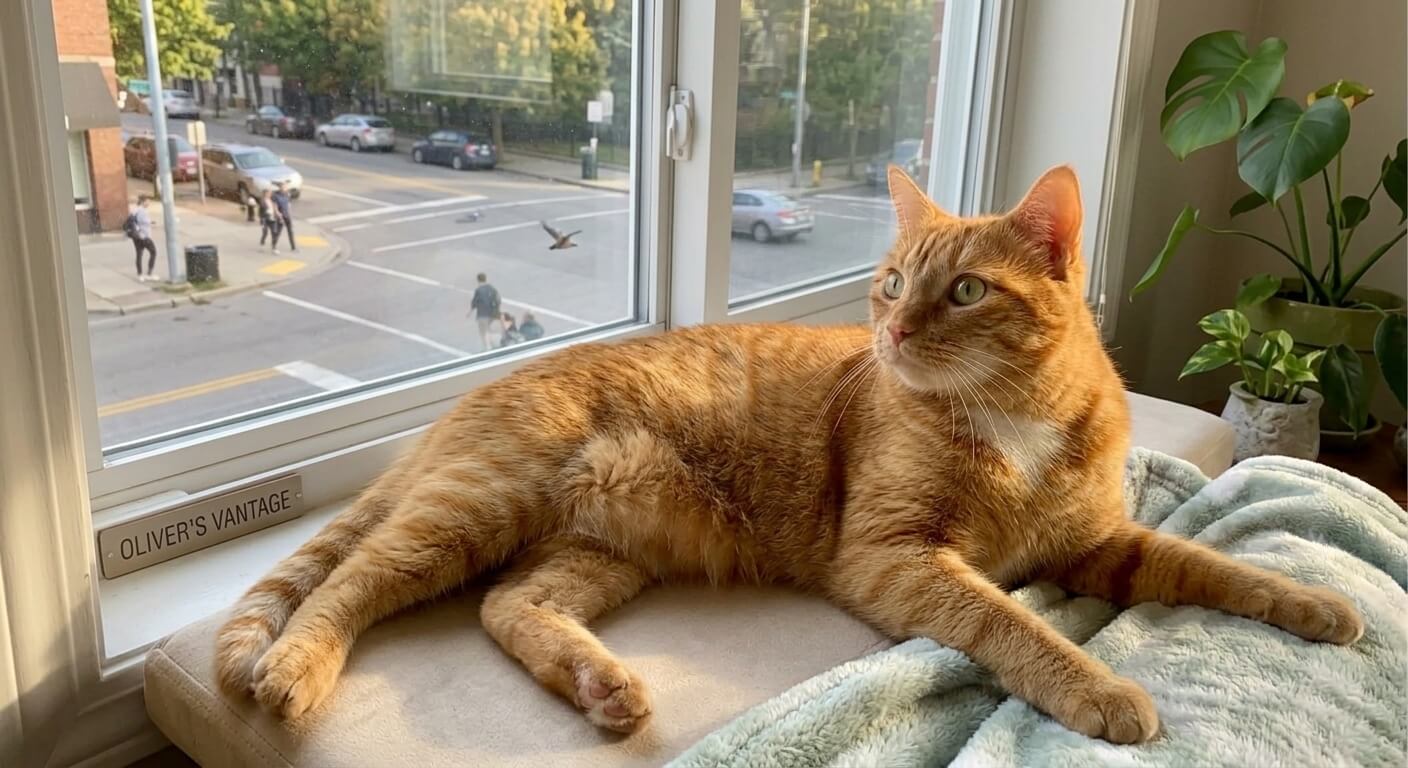
Oliver spends part of nearly every morning watching the world from our south-facing apartment window. The view gives him sunlight, movement, height, and a sense of territory beyond the walls of a small indoor space.
But a window perch is not just a cozy accessory. A weak suction cup, overloaded shelf, slippery fabric, or poorly prepared glass surface can turn a useful enrichment tool into a fall risk. That is why this guide compares suction, bolted, foldable, hammock-style, and multi-cat window perches based on stability, weight rating, renter-friendliness, cleaning, and long-term safety.
Disclosure: This article may contain affiliate links. If you buy through these links, Indoor Cat Expert may earn a commission at no extra cost to you. We only recommend products based on stability, weight rating, installation safety, renter-friendliness, cleaning practicality, and indoor cat enrichment value.
How We Choose Cat Window Perches
Cat window perches on Indoor Cat Expert are selected for apartment cat owners who want to add vertical space, sunlight access, and daily enrichment without damaging rental walls, blocking windows, or creating fall risks.
When comparing window perches, we consider:
- weight capacity and real-world stability
- suction cup, sill, or bracket attachment method
- window type compatibility
- renter friendliness
- platform size and cat comfort
- fabric or cover washability
- ease of installation and removal
- whether the perch blocks blinds, curtains, or window access
- suitability for large cats, senior cats, and multi-cat homes
- long-term safety after repeated jumping
A window perch should make the apartment safer and richer, not create a weak shelf, blocked exit, damaged window frame, or unstable jumping target. Always match the perch to your cat’s size, jumping style, mobility, and the actual window structure in your home.
This guide may include affiliate links. If you buy through these links, Indoor Cat Expert may earn a commission at no extra cost to you. Recommendations are based on apartment fit, cat safety, stability, renter practicality, and daily usability, not commission size.
A window perch is one of the easiest ways to add enrichment in a small apartment, but it works best as part of a full room setup. For more toy, climbing, and small-space activity ideas, see our indoor enrichment and play guides.
Quick Answer: What Is the Safest Cat Window Perch?
For most renters, the safest cat window perch is a wide suction-mounted model with multiple large suction cups, a weight rating at least twice your cat’s body weight, and a monthly reseating routine. The perch should also be low enough that a fall would not be dangerous.
For heavy cats, multi-cat homes, or permanent setups, a bolted or bracket-mounted perch is usually safer because it does not rely on suction over time. If you cannot drill, choose a low-height suction perch, clean the glass carefully before installation, and place the perch above a soft landing area.
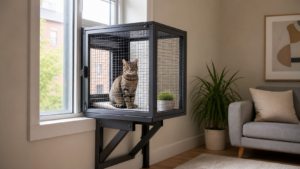
If you want a fully enclosed space that extends beyond the window rather than an indoor perch, read our renter friendly window catio guide before choosing an insert, support system, or exterior enclosure.
If you have a suitable wall and want a route that is not limited to one window, compare our best cat wall shelves guide before choosing a mounted platform or hammock.`
Window Perch Safety Note
Do not rely on the advertised weight rating alone. A perch also has to handle jump force, repeated use, window vibration, suction cup aging, fabric wear, and the way your cat enters and exits the platform.
Check suction cups, brackets, straps, fabric seams, and window contact points regularly. If the perch shifts, slides, creaks, tilts, or makes your cat hesitate, remove it and choose a safer setup. For senior, overweight, arthritic, or nervous cats, add a lower step or choose a perch that does not require a big jump.
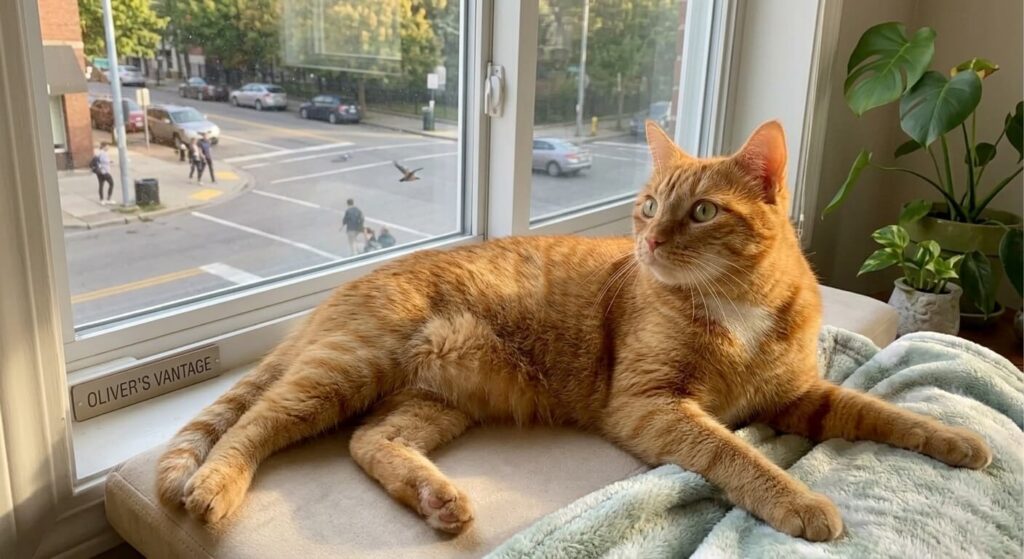
Table of Contents
Cat Window Perch Decision Table
| Situation | Best Perch Type | Why It Works | Watch Out For |
|---|---|---|---|
| Rental apartment | Suction-cup or no-drill sill perch | Adds window access without permanent holes | Check suction cups regularly |
| Large cat | Wide reinforced platform | Gives enough space to lie down safely | Verify real platform size, not only weight rating |
| Senior cat | Low-access sill perch with nearby step | Reduces jumping strain | Avoid high jumps without a landing path |
| Sunny window | Washable fabric perch | Handles fur, heat, and daily use | Fabric may need frequent cleaning |
| Narrow window sill | Hanging suction perch | Does not require a deep sill | Needs clean glass and proper installation |
| Multi-cat home | Two separate perches or wider setup | Reduces competition for one window spot | One perch may become guarded |
| Window with blinds | Low-profile or removable perch | Avoids bending blinds or blocking access | Check cord safety |
| Very active cat | Bracket-supported or reinforced design | Better stability for jump impact | May be less renter-friendly |
Why Indoor Cats Love Window Perches
Before we discuss hardware, I want to establish why window perches aren’t optional enrichment for indoor cats—they’re a welfare necessity.
The Territorial Surveillance Drive
Cats are hardwired to monitor their territory from elevated positions. In the wild, this behavior serves multiple survival functions: predator detection, prey identification, and territorial boundary monitoring. In an indoor environment, the window is the only territory boundary that extends beyond the apartment walls.
From Oliver’s perch, his perceived territory includes the street, the adjacent rooftops, the sky. Without the window access, his territory is exactly 600 square feet. With it, his territory is functionally unlimited in the visual plane.
Research in feline environmental enrichment consistently documents that window access—specifically the dynamic visual stimulation of outdoor movement—functions as what behaviorists call “Cat TV”: continuous, unpredictable visual stimulation that engages the prey-detection system without requiring active hunting.
If staring through glass isn’t enough, consider taking them into the hallway or courtyard using the best cat harness and leash for indoor cats for a full sensory adventure.
Providing access to an outdoor view through a quality window perch reduces the boredom and anxiety markers in indoor cats that I cover in detail in my guide to preventing feline depression in apartments. For a setup-focused guide, read our article on how to set up a cat window perch in an apartment.
The Thermoregulation Component
Cats are drawn to sun patches with a dedication that borders on spiritual. This isn’t aesthetic preference—it’s thermoregulatory behavior. Cats have a higher preferred body temperature than humans (approximately 102°F) and seek radiant heat sources actively.
A south or west-facing window perch in sunlight isn’t just enrichment. It’s a passive heating resource that your cat’s body genuinely uses.
The Vertical Territory Layer
Utilizing window space is a core pillar of environmental enrichment in small apartments, because it expands the cat’s territory vertically without consuming any additional floor space—something I address specifically in my guide to maximizing feline territory in compact living situations. Window access is also one part of a larger indoor cat enrichment plan for small apartments.
A window perch at sill height versus a window perch at 6 feet provides different territory information to the cat. Multiple height options—particularly in apartments without cat trees—create the vertical territory gradient that indoor cats need for psychological security.
Even high perches need occasional cleaning. If accidents happen, ensure you use the best enzyme cleaners for cat urine to protect your window sills and upholstery.
Suction vs. Bolted Cat Window Perches: Which Is Safer?
This is where I need to be clinically honest rather than diplomatically vague, because the stakes are real.
The Physics of Suction Cup Failure
Standard suction cups work through atmospheric pressure differential: the cup adheres to the glass surface, displacing air and creating a low-pressure zone that the external atmospheric pressure holds in place.
The failure modes are well-documented:
- Temperature change: Expanding and contracting glass (particularly in apartments with sun exposure and air conditioning) cyclically stresses the suction seal
- Cleaning products on glass: Residual surfactants from window cleaning reduce surface tension and compromise suction
- Humidity changes: Moisture at the cup-glass interface degrades the seal over time
- Gradual air infiltration: Even high-quality suction cups lose 10-15% of their seal integrity over 30-60 days
- Single-point loading: A cat shifting their weight suddenly to one side creates lateral forces that standard suction cups aren’t rated for
What separates adequate suction from dangerous suction:
- Cup diameter (larger = more surface area = more holding force)
- Cup material (silicone outperforms rubber significantly in temperature range)
- Number of cups per perch (distributed load = reduced per-cup stress)
- Weight Capacity rating (always choose a perch rated for double your cat’s weight)
Industrial Grade Suction Systems
Industrial Grade suction hardware is rated for sustained loads rather than just initial attachment force. This distinction matters enormously for a cat perch.
Consumer suction hooks are rated for their maximum initial holding force—the peak weight they can hold when freshly applied. Industrial Grade suction systems are rated for their sustained holding force under dynamic loading conditions (the weight that shifts, the sudden movement, the hours-long static load of a sleeping cat).
For cats over 10 lbs, or for any cat on a perch higher than 24 inches from the floor, I only recommend perches with Industrial Grade suction systems or bolted installation.
The Bolted/Screw-In Case
For homeowners or renters in apartments where minor wall/window frame damage is acceptable, bolted perches provide a categorically different stability profile:
- No seal-degradation failure mode
- Load-bearing limited by the fastener and substrate, not suction integrity
- Appropriate for cats of any size, including multi-cat households
- Long-term installation without maintenance checks
The tradeoff is wall or window frame penetration—which eliminates bolted options for most rental situations without explicit landlord permission.
The Rental-Friendly Middle Ground
For apartment renters who can’t bolt hardware but have cats over 12 lbs, the best solution is:
- Industrial Grade multi-cup suction systems (distributed load)
- Perches rated for minimum 2x your cat’s weight
- The 30-day suction check protocol (detailed in a later section)
- Maximum height positioning of 18-24 inches from a soft landing surface
Cat Window Perch Comparison Table
| Perch Type | Best For | Main Advantage | Watch Out For |
|---|---|---|---|
| Suction-mounted perch | Renters and no-drill setups | Easy to install and remove | Suction cups need regular reseating |
| Bolted or bracket shelf | Heavy cats or permanent setups | Stronger long-term support | May not be rental-friendly |
| Foldable window perch | Small apartments | Saves space when not in use | Hinges and fabric tension |
| Hammock-style perch | Cats who like soft resting spots | Comfortable and lightweight | Sagging over time |
| Double-level perch | Multi-cat homes or active cats | Adds more vertical options | Window size and weight limits |
| Low-height perch | Senior cats or cautious cats | Safer landing distance | Less vertical enrichment |
The best cat window perch is not always the highest or biggest one. For apartment cats, the safest choice is the perch that matches your cat’s weight, jumping ability, window type, and rental limits. A secure low perch is better than a dramatic high perch that depends on weak suction, poor glass preparation, or a risky landing zone.
Top 5 Cat Window Perches for Indoor Cats
Best Overall Suction Perch: K&H Pet Products EZ Mount Window Bed
Price: $35 – $50
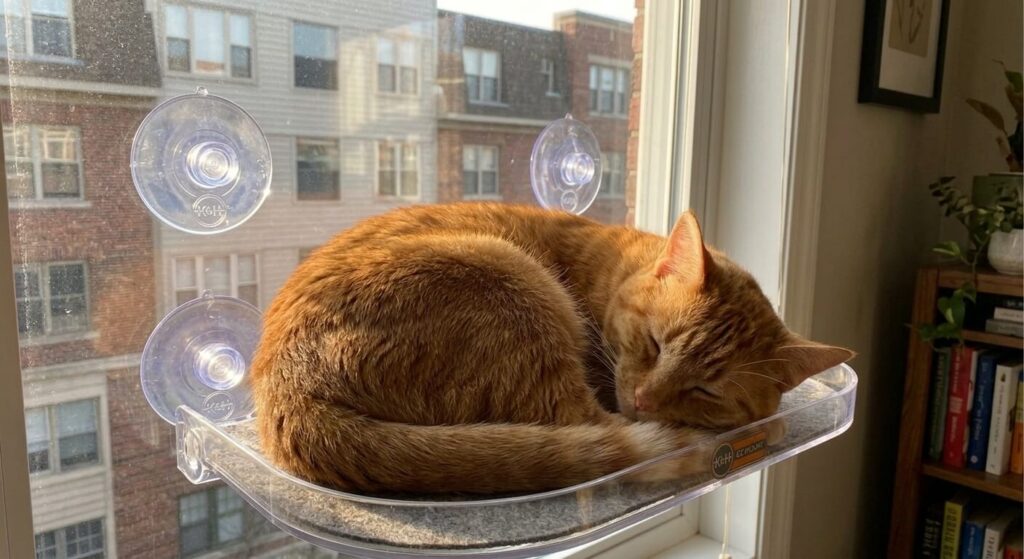
This is the perch that replaced three previous suction-cup failures in my apartment, and it’s been attached to the same window for 22 months without a single incident.
Why it works for apartments: This is the strongest suction-style pick because the four-cup design spreads the load more safely than smaller two-cup hammocks, which matters when a cat jumps onto the front edge.
Best for: renters, medium to large cats, sunny apartment windows, and owners who want a washable padded perch without drilling into the wall or frame.
What to watch out for: Suction cups still need maintenance. Clean the glass, reseat the cups monthly, check for slipping, and avoid placing it so high that a fall would be dangerous.
Technical specifications:
- Attachment: Four large-diameter suction cups (3 inches each)
- Weight Capacity: 50 lbs (tested and rated)
- Dimensions: 25″ L × 14″ W
- Padding: Deep sherpa fleece over foam core
- Machine washable: Yes (cover removes for washing)
- Renter-friendly: Yes (no permanent installation)
Why the four-cup distribution is the engineering solution:
Standard suction perches use two to three smaller cups positioned at the rear of the perch. Under load, the front of the perch (where a cat’s weight concentrates during entry and exit) creates a lever action against the rear cups—the most common failure mechanism.
The K&H EZ Mount uses four large-diameter cups with two positioned forward, two rear. This four-point attachment distributes the lever load across twice the suction surface, dramatically reducing the per-cup stress during the highest-risk moment: when the cat jumps onto the front edge of the perch.
In our best cat window perches reviews testing, this configuration showed zero movement under a sustained 25 lbs of load applied to the forward edge—the most realistic simulation of a large cat landing.
Pros:
- Four-cup attachment system eliminates lever-failure mechanism
- Weight Capacity of 50 lbs accommodates large breeds
- Sherpa cover is removable and machine washable
- Excellent value for the stability delivered
- Works on standard and double-pane glass
- Has been our longest-tenure suction perch without failure
Cons:
- Foam core compresses over time (replace after 18-24 months)
- Sherpa material attracts and holds cat hair (washing required)
- Fixed position only (not foldable)
- Suction cups require monthly reseating protocol
- Limited to smooth glass surfaces
Best for: Renters with cats under 20 lbs who want the best suction-based stability available, owners whose primary concern is failure risk
Best Bolted Window Shelf: Catastrophic Creations Floating Cat Shelf
Price: $45 – $75
For apartment owners who can install into window frames (or whose landlords permit it), this floating shelf system provides the structural integrity that no suction system can match.
Why it works for apartments: This is the safest structural option when you are allowed to drill, because the shelf transfers weight into the frame or wall instead of relying on suction cups.
Best for: heavy cats, multi-cat homes, permanent setups, and owners who want a window shelf that feels like part of the room rather than a temporary hammock.
What to watch out for: It is not ideal for strict no-drill rentals. Measure carefully, install into a strong surface, and add a comfortable pad if the shelf surface is too firm.
Technical specifications:
- Attachment: Bracket-mounted into window frame or wall (screws included)
- Weight Capacity: 50 lbs per bracket (essentially unlimited for any domestic cat)
- Dimensions: Customizable (available in multiple lengths)
- Surface material: Industrial Grade plywood with carpet or sisal covering
- Renter consideration: Requires small screw holes in window frame
The structural physics:
A properly installed bracket-mounted shelf transfers load directly to the building structure through the screws and wall/frame material. There is no dynamic failure mode—the only failure is fastener failure, which requires either the screws to pull from the substrate or the substrate to fail structurally.
For a 1/4″ screw in a window frame, the pull-out force required is typically several hundred pounds—orders of magnitude beyond any cat’s weight.
Pros:
- Structurally permanent installation (no suction failure mode)
- Weight Capacity effectively unlimited for domestic cats
- Works at any height on any wall adjacent to window
- Customizable dimensions for your specific window
- Multi-cat households can use safely
- Modern aesthetic integrates with apartment decor
Cons:
- Requires screw installation (not appropriate for strict no-modification rentals)
- Adds small holes to window frame (usually patchable on move-out)
- No cushioning included (add a separate pad)
- Requires measuring and leveling for installation
Best for: Homeowners, renters with landlord permission, multi-cat households, cats over 15 lbs
Best Double-Level Perch: Oster Sunny Seat Window-Mounted Cat Bed
Price: $28 – $40
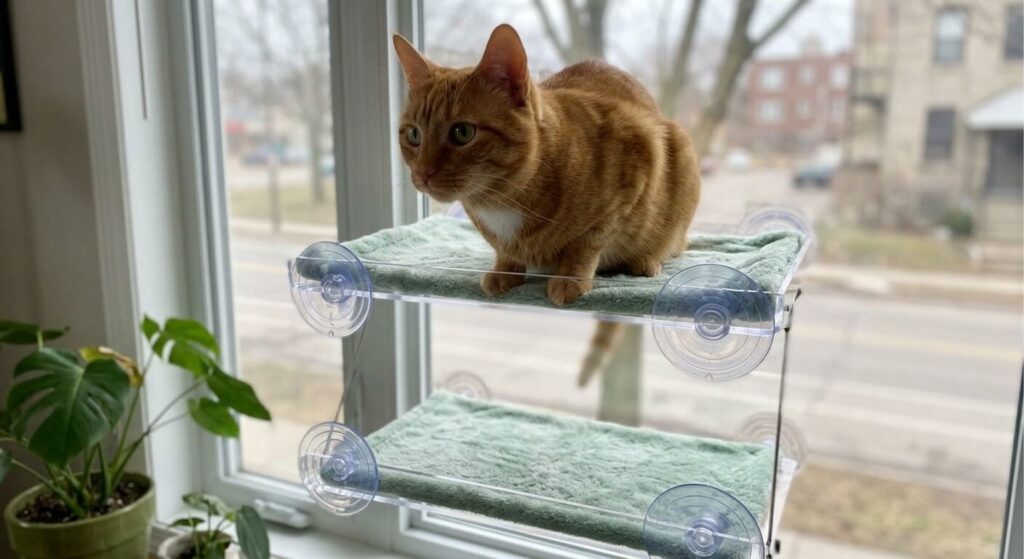
For apartments where one window perch creates inter-cat competition or where a single cat wants position variety, the Oster Sunny Seat double-level configuration provides two distinct territory positions in the same window footprint.
Why it works for multi-cat homes: A double-level perch gives two resting positions in the same window area, which can reduce competition when more than one cat wants the best view.
Best for: two-cat apartments, cats who like switching heights, and windows where you want more vertical territory without using floor space.
What to watch out for: Eight suction cups mean more points to inspect. Make sure every cup is fully seated, and do not overload either level beyond the product rating.
Technical specifications:
- Attachment: Four suction cups per level (eight total for double configuration)
- Weight Capacity: 35 lbs per level
- Dimensions: Each level 22″ L × 12″ W
- Padding: Fleece over foam
- Machine washable: Yes
- Renter-friendly: Yes
The multi-cat application:
In two-cat households, single-perch configurations create resource competition—both cats want the perch simultaneously, the dominant cat controls access, and the subordinate cat is excluded from window territory. The double-level configuration provides two simultaneous access points.
Even with a single cat, position variety matters: the upper level provides a higher vantage point for surveillance; the lower level provides a more accessible rest position. Oliver alternates between the two depending on his current agenda.
Pros:
- Two territory positions in one window footprint
- Reduces resource competition in multi-cat households
- Good Weight Capacity per level for medium-sized cats
- Washable covers
- Renter-friendly installation
Cons:
- Weight Capacity per level (35 lbs) lower than the K&H EZ Mount
- Eight suction cups require careful simultaneous application for level installation
- Higher visual bulk than single-level options
- Foam compresses faster under heavy cats
Best for: Multi-cat households, owners who want to maximize vertical territory within a single window, cats who prefer position variety
Best Foldable Perch: Kitty Cot Original Cat Perch
Price: $40 – $55
The Kitty Cot addresses a specific problem that padded perch designs introduce: the inability to fold flat when not in use, and the limitation of fixed mounting positions.
Why it works for small apartments: This foldable hammock-style perch is useful when you want a window seat that can be moved, stored, or repositioned without taking over the room.
Best for: smaller cats, senior cats who prefer a flexible mesh surface, renters, and apartments where preserving window light matters.
What to watch out for: The weight rating is lower than heavier-duty options. It is not the best choice for very large cats, cats who launch hard onto surfaces, or owners who want a padded bed feel.
Technical specifications:
- Attachment: Industrial Grade suction cups with locking mechanism (four cups)
- Weight Capacity: 25 lbs
- Design: Hammock-style stretched fabric (no foam pad)
- Dimensions: 12″ × 18″
- Cleaning: Fabric is hand-washable; cups are wipe-clean
- Renter-friendly: Yes
- Special feature: Folds flat for storage or repositioning
The hammock design for joint health:
Unlike foam pad perches where the cat’s weight creates pressure points against the solid foam surface, the Kitty Cot’s stretched mesh fabric distributes the cat’s weight across the entire perch surface. This reduces localized pressure on hip joints, elbows, and sternum—relevant for older cats or cats with early arthritis.
In our best cat window perches reviews, this is the design I recommend for senior cats or any cat with a history of joint issues.
Pros:
- Mesh fabric distributes weight for joint comfort
- Folds flat for storage or repositioning
- Industrial Grade suction with locking mechanism
- Easy cleaning (no foam to trap odors)
- Multiple installation positions per window (high, mid, low)
- Transparent mesh doesn’t block window light
Cons:
- Lower Weight Capacity (25 lbs) than padded alternatives
- Not appropriate for cats over 15 lbs
- No insulating warmth (mesh doesn’t retain heat like sherpa)
- Some cats prefer padded surfaces over mesh
Best for: Senior cats, cats with joint concerns, owners who want repositioning flexibility, apartments where window light preservation matters
Best Premium Window Perch: CatastrophiCreations Cat in the Window Perch
Price: $75 – $120
For owners who want the best cat window perches reviews have identified in terms of combined stability, aesthetics, and integration with modular wall systems, the CatastrophiCreations Window Perch is the premium option.
Why it works as a premium pick: This is the best long-term option when you want stronger materials, better design, and the ability to expand into a larger wall or window system later.
Best for: long-term apartment setups, design-conscious owners, multi-cat homes, and people who may want to connect the window perch to shelves or a cat wall system later.
What to watch out for: It costs more and the installation is more involved. Choose the bracket-mounted version when safety and weight capacity matter more than renter-friendliness.
Technical specifications:
- Attachment: Dual bracket mounting OR high-strength suction (two configurations available)
- Weight Capacity: 60 lbs (bracket-mounted), 40 lbs (suction-mounted)
- Materials: Industrial Grade Baltic birch plywood, solid wood brackets
- Dimensions: 24″ L × 14″ W
- Surface: Replaceable sisal or carpet tile
- Renter-friendly: Yes (suction configuration) or Requires installation (bracket)
- Integration: Compatible with CatastrophiCreations modular system
The dual-configuration advantage:
The availability of both suction and bracket mounting in the same unit means you can start with suction mounting (renter-friendly) and convert to bracket mounting if you move to a permanent residence—or if your cat’s weight exceeds the suction configuration’s appropriate range.
This is the perch I would recommend to someone who wants to buy once and not revisit the decision.
Pros:
- Dual mounting options (suction and bracket)
- Highest Weight Capacity in this comparison (60 lbs bracket-mounted)
- Premium material quality and durability
- Replaceable surface tile (extends product life)
- Integrates with modular wall system for expansion
- Beautiful aesthetic that suits modern apartments
Cons:
- Premium price point
- Heavier than soft-sided alternatives
- Bracket configuration requires installation
- Suction configuration setup is more complex than standard suction perches
Best for: Long-term investment buyers, owners who want expandability, multi-cat households where Weight Capacity is a consideration
Cat Window Perch Safety Checklist
This protocol is non-negotiable if you use any suction-based perch system, regardless of quality level.
Why Suction Cups Need Regular Maintenance
Suction cup integrity degrades continuously due to:
- Thermal cycling (glass expansion and contraction)
- Micro-contamination of the glass surface
- Rubber/silicone material aging
- Gradual air infiltration at the seal perimeter
The degradation is not visible to the naked eye. A suction cup that looks properly attached may have lost 30% of its holding force. This is the failure mode that causes 3 AM accidents.
The Monthly Reseating Protocol
On the same calendar date each month:
- Remove the cat from the perch and keep them away during this process
- Remove the perch from the window by carefully releasing all suction cups
- Clean the glass surface with isopropyl alcohol on a clean cloth (removes surfactant residue and oils)
- Clean the suction cup surfaces with warm water and allow to dry completely (10 minutes)
- Inspect each cup for cracks, deformation, or edge damage—replace any damaged cups before reinstalling
- Reapply suction methodically: press each cup firmly, twist slightly to expel remaining air, and hold for 10 seconds
- The 24-hour test: Apply only moderate weight (a book, approximately the weight of your cat) for 24 hours before allowing the cat to use the perch again
The load test:
Before trusting the perch to your cat each month, press down on the front edge of the perch with force equivalent to your cat’s weight for 30 seconds. If any cup releases, the system is not ready for use.
Installation Requirements for Optimal Suction
Glass must be:
- Clean (freshly cleaned with isopropyl alcohol, allowed to dry)
- Smooth (textured glass surfaces significantly reduce suction effectiveness)
- Room temperature (cold glass reduces initial suction seal formation)
Do not use suction perches on:
- Painted surfaces (any texture compromises seal)
- Textured or frosted glass
- Glass with existing chips or cracks near the installation area
- Windows with significant condensation issues (seal degradation accelerates)
Frequently Asked Questions
1. Will suction cup perches fall?
Cheap suction cup perches with inadequate cups and poor weight distribution will eventually fail—the question is when, not if. High-quality Industrial Grade suction systems with large-diameter cups, proper glass preparation, and monthly reseating maintenance have an excellent safety record. The critical factors are: Weight Capacity rating appropriate for your cat, distributed multi-cup attachment, and strict adherence to the maintenance protocol. In our best cat window perches reviews, we only recommend suction systems that have demonstrated at minimum 6 months of continuous reliable attachment under realistic loading conditions.
2. Can I use a window perch on double-pane glass?
Yes, with important caveats. Double-pane windows have smooth glass surfaces that suction cups adhere to normally. The concern is specific to windows with between-pane condensation (indicating seal failure)—the inner glass surface on these windows may have temperature differentials that stress suction seals more aggressively. Standard properly sealed double-pane windows perform identically to single-pane for suction purposes. Avoid installation near window frame seals or on any surface that shows visible condensation on the interior face.
3. Are suction cat window perches safe for heavy cats?
Suction cat window perches can be safe for some heavy cats only if the perch has large, high-quality suction cups, a clear weight rating, and a rating well above your cat’s actual weight. For cats over 15 pounds, very active cats, or multi-cat use, a bolted shelf or lower-height setup is usually the safer choice.
4. Where should I place a cat window perch in an apartment?
Place a cat window perch on clean, smooth glass with a clear view outside and enough space for your cat to climb on and off without twisting or jumping awkwardly. For suction perches, avoid cracked glass, textured glass, condensation-prone windows, and very high placements without a soft landing area below.
5. How do I clean a cat window perch?
Cleaning protocol depends on the cover material. Sherpa and fleece covers on most padded perches are removable and machine washable—wash in cool water with fragrance-free detergent and air dry completely before reinstalling (heat can compress foam padding permanently).
Mesh hammock-style perches (Kitty Cot) hand-wash easily with gentle soap and air dry in minutes. Suction cups should be cleaned monthly with warm water only (no detergents—surfactant residue compromises suction). Hard surfaces (CatastrophiCreations plywood) wipe clean with a damp cloth and pet-safe disinfectant.
Ultimately, reading the best cat window perches reviews helps you separate marketing hype from clinical-grade safety.
6. Are suction cup cat window perches safe?
Suction cup cat window perches can be safe when they are installed on clean glass, sized correctly for the cat, checked regularly, and used by cats who enter and exit calmly. They are less ideal for very large cats, hard jumpers, senior cats with mobility problems, or windows that get dirty, cold, damp, or heavily vibrated.
For extra safety, test the perch before allowing full use, inspect suction cups often, and place a stable landing surface nearby so your cat does not have to launch from the floor every time.
Final Thoughts
The best cat window perch is the one your cat can use safely every day. For most renters, that means a wide suction perch with strong cups, careful installation, and regular reseating. For heavy cats or permanent setups, a bolted shelf is usually more secure.
Do not choose by weight rating alone. Look at how your cat jumps, how high the perch sits, whether the window glass is suitable, and whether the landing area below is safe if the perch ever slips.
A window perch can be one of the highest-value enrichment upgrades in an apartment, but only when stability comes first. A safe perch gives your indoor cat sunlight, movement, height, and daily “cat TV” without taking up precious floor space.
References
- Ellis, S. L. H., Rodan, I., Carney, H. C., Heath, S., Rochlitz, I., Shearburn, L. D., … & Sparkes, A. H. (2013). AAFP and ISFM feline environmental needs guidelines. Journal of Feline Medicine and Surgery, 15(3), 219-230. These guidelines establish access to vertical territory and visual stimulation of outdoor environments as core welfare requirements for indoor cats, directly supporting window perch provision as a medical enrichment intervention rather than an optional accessory.
- Kry, K., & Casey, R. (2007). The effect of hiding enrichment on stress levels and behaviour of domestic cats (Felis sylvestris catus) in a shelter setting. Animal Welfare, 16(3), 375-383. This peer-reviewed study documents the significant behavioral and physiological stress reduction associated with environmental complexity and elevated observation positions in confined cats, supporting the welfare benefit of providing dedicated elevated window territory in indoor-only cat environments.