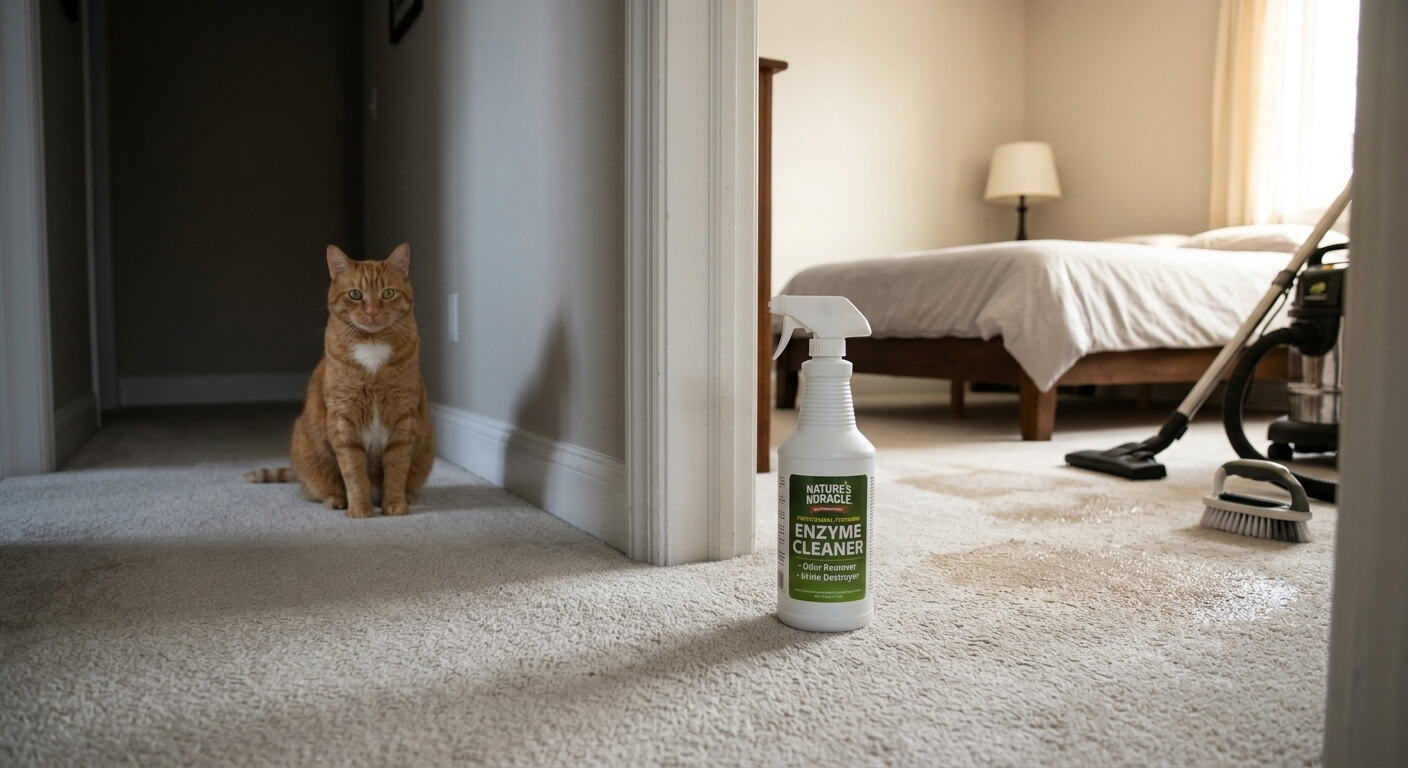
The best enzyme cleaner for cat urine is one that reaches the full depth of the accident, is approved for the affected surface, and is given the exact contact time listed on its label. For most carpet, rug, and upholstery accidents, Rocco & Roxie Professional Strength Stain & Odor Eliminator is our best overall pick. For a cat-specific formula and stubborn urine residue, choose Nature’s Miracle Urine Destroyer Plus for Cats. Different surfaces and fragrance preferences may make one of the other products below a better fit.
Enzyme cleaner can remove organic residue and odor, but cleaning does not explain why a cat urinated outside the litter box. A new accident can be associated with urinary pain, bladder inflammation, arthritis, stress, conflict, an unsuitable litter box, or a box the cat cannot reach comfortably. Contact your veterinarian when the behavior begins suddenly, repeats, or occurs with changes in appetite, thirst, activity, or urination.
A male cat that repeatedly strains to urinate, produces little or no urine, cries in the litter box, vomits, or becomes weak may have a urinary blockage. That is an emergency and should not be treated as a cleaning or behavior problem.
Best Enzyme Cleaners for Cat Urine at a Glance
| Product | Best for | Officially listed surfaces | Main limitation |
|---|---|---|---|
| Rocco & Roxie Professional Strength Stain & Odor Eliminator | Best overall for carpet, rugs, and upholstery | Carpet, rugs, upholstery, clothing, pet areas, and other listed surfaces | Fragranced; deep treatment uses substantial liquid |
| Nature’s Miracle Urine Destroyer Plus for Cats | Cat-specific urine stains and stubborn odor | Carpet, hard floors, furniture, fabrics, and more | Not for untreated hardwood, leather, suede, silk, or wool specialty fabrics |
| Simple Solution Cat Urine Destroyer | Carpet backing, upholstery, bedding, and other washable fabrics | Carpet, upholstery, clothing, bedding, and other fabrics | Requires saturation and may take 24–48 hours to dry |
| Nature’s Miracle Hard Floor Cleaner | Sealed hard flooring | Sealed wood, tile, linoleum, vinyl, and other listed hard surfaces | Not a universal choice for unsealed or damaged wood |
| Biokleen Bac-Out Pet Stain + Odor Remover | Fabric and carpet users who prefer a biodegradable formula | Carpets, couches, pillows, mattresses, kennels, and other listed uses | Contains fragrance and lavender/citrus-derived ingredients |
No cleaner is automatically safe for every surface. Product formulas and labels can change, so read the container you receive, spot-test in a hidden area, and follow that label if it differs from a general online guide.
Table of Contents
How We Chose the Best Enzyme Cleaner for Cat Urine
These selections are based on current manufacturer descriptions, ingredient disclosures where available, directions, surface exclusions, refill or package availability, and whether the product is genuinely described as enzymatic or bacteria-based. The rankings are not presented as personal laboratory tests, clinical recommendations, or proof that one formula outperforms every competitor.
We prioritized cleaners that:
- are currently listed by their manufacturer;
- specifically mention urine or organic pet messes;
- provide usable directions rather than vague “spray and wipe” claims;
- name appropriate surfaces and important exclusions;
- address residue rather than relying only on perfume;
- are sold in a format practical for a household accident; and
- fill a distinct role in the comparison.
We did not rank a product as an enzyme cleaner merely because it says “odor destroyer.” Some current products use surfactants, oxidizers, or molecular deodorizers instead of enzymes. Those technologies may still be useful, but they do not match the search intent of this guide.
1. Rocco & Roxie Professional Strength Stain & Odor Eliminator — Best Overall
Rocco & Roxie is our strongest all-purpose recommendation for cat urine on colorfast carpet, rugs, and upholstery. Its manufacturer identifies it as a bio-enzymatic formula for urine, feces, vomit, and other organic messes. It is also certified by the Carpet and Rug Institute for use on carpet.
The official directions are more realistic than the instant-action language common in this category. For a new stain, the company instructs users to apply a liberal amount, allow it to stand for 30–60 minutes, blot, and air-dry. For deep odor, the liquid must penetrate the carpet and the pad beneath it, then remain for at least an hour. Older contamination may require another application.
Why It Ranks First
Cat urine often travels below the visible carpet fibers. A product can appear to work while the surface is damp, only for odor to return because the backing or pad was never reached. Rocco & Roxie’s instructions explicitly acknowledge this depth problem and explain how to treat it.
The formula is chlorine-free and color-safe according to the manufacturer, but “color-safe” does not remove the need for a hidden-area test. Carpet dyes, upholstery treatments, adhesives, natural fibers, and previous cleaners can all change the result.
Best Uses
- fresh urine on colorfast carpet;
- old spots that reached carpet backing or padding;
- washable rugs after checking the care label;
- colorfast upholstery;
- pet bedding and washable fabric;
- repeat accidents in the same carpeted location.
Limitations
This is not an unscented formula. Fragrance-sensitive households and cats with respiratory disease may prefer another product after discussing cleaning choices with a veterinarian.
Deep treatment also requires moisture. Saturating a removable rug over a hard floor can transfer liquid into the floor underneath. Overwetting upholstery or a mattress can prolong drying and create other material problems. Move removable items to a protected cleaning area when possible, use only the amount required to reach the contamination, and provide strong ventilation and drying.
How to Use It
Remove as much fresh urine as possible with white absorbent towels. Do not scrub, because scrubbing can spread the wet area and damage fibers. Test the cleaner in a hidden spot. Apply enough product to reach every layer touched by urine, follow the current label’s contact time, blot or extract as directed, and keep your cat away until the surface is fully dry.
2. Nature’s Miracle Urine Destroyer Plus for Cats — Best Cat-Specific Formula
Nature’s Miracle Urine Destroyer Plus for Cats is designed specifically for the sticky yellow residue and strong odor associated with cat urine. The manufacturer describes it as a bacteria-based enzymatic formula that produces enzymes when it contacts an organic food source.
Its official directions say to use it at full strength. For a standard stain, soak the affected area, allow the product to work for 15 minutes, and blot with a clean cloth. For difficult odor, the company advises thoroughly soaking the area again and allowing it to air-dry.
Why Choose It
This product is a logical first choice when the buyer wants a formula explicitly labeled for cat urine instead of a general pet stain remover. Its manufacturer provides both a defined 15-minute stain protocol and a separate air-dry approach for stubborn odor.
It can be used on carpet, certain hard floors, furniture, fabrics, and other approved surfaces when used as directed. The exclusions are equally important: the official page says not to use it on untreated hardwood, leather, suede, silk, or wool specialty fabrics.
Best Uses
- cat-specific urine residue;
- recurring odor on approved carpet and fabric;
- washable upholstery after a spot test;
- sealed, product-compatible hard surfaces;
- households that want a ready-to-use product rather than a concentrate.
Limitations
The formula is scented, so it may not suit every household. The phrase “safe for pets and home when used as directed” does not mean a cat should walk through, lick, or lie on wet cleaner. Keep pets away during treatment and drying.
Do not assume all products carrying the Nature’s Miracle name have the same ingredients or directions. Urine Destroyer Plus, Cat Urine Remover, Stain & Odor Remover, and Hard Floor Cleaner are separate products. Follow the label on the exact bottle.
3. Simple Solution Cat Urine Destroyer — Best for Carpet Backing and Washable Fabrics
Simple Solution Cat Urine Destroyer is formulated for cat urine on carpet, upholstery, clothing, bedding, and other fabrics. The manufacturer describes it as a pro-bacteria and enzyme formula that breaks down organic proteins.
Its directions emphasize coverage. For carpet, users are told to treat an area twice the size of the visible mess and saturate the carpet backing and padding. After a 10-minute contact period, excess liquid should be blotted with a color-safe cloth. The area may then need 24–48 hours to dry naturally.
Why It Earns a Place
The continuous-spray format can make it easier to cover a larger fabric area evenly. More importantly, the instructions warn that the apparent stain may be smaller than the material affected underneath. That is a practical advantage for soft furnishings and carpet.
Best Uses
- carpet where the accident may have reached the backing;
- colorfast upholstery;
- washable clothing;
- pet bedding;
- other compatible fabric surfaces.
Limitations
Saturating a surface is not appropriate everywhere. A mattress, sofa cushion, rug over hardwood, or glued flooring can retain moisture or transfer it to another layer. Check the manufacturer’s surface directions and the item’s care label before treatment.
The drying period also requires planning. Block the area so the cat cannot contact wet cleaner or return to the spot. Run ventilation and fans when safe for the material, but do not apply heat unless both the cleaning label and the surface-care instructions allow it.
4. Nature’s Miracle Hard Floor Cleaner — Best for Sealed Hard Floors
Nature’s Miracle Hard Floor Cleaner is the most appropriate pick in this group when the accident is on sealed wood, tile, linoleum, or vinyl. The manufacturer identifies it as a bio-enzymatic hard-surface product intended to remove pet stains and odor while protecting the natural floor finish.
For routine cleaning after the urine residue has been fully treated, see our guide to choosing a cat-safe floor cleaner for everyday use.
Why Hard Floors Need Their Own Pick
“Hard floor” does not mean waterproof. Urine and cleaner can enter:
- gaps between wood boards;
- worn or cracked finish;
- grout lines;
- seams in laminate or vinyl;
- edges beside baseboards; and
- joints around cabinets or built-ins.
A carpet protocol that calls for deep saturation can swell wood, damage the finish, loosen adhesive, or trap moisture beneath a floating floor. A product specifically labeled for compatible hard surfaces is a safer starting point.
Best Uses
- intact sealed hardwood;
- glazed tile;
- compatible grout after a hidden-area test;
- linoleum;
- vinyl;
- other hard surfaces listed on the current label.
Limitations
Do not use “safe for sealed wood” as permission to treat unfinished, waxed, oiled, damaged, antique, or moisture-sensitive flooring. If urine has entered seams or reached the subfloor, a surface cleaner may reduce odor without resolving the deeper source. Persistent odor beneath wood or laminate may require a flooring professional.
On natural stone, check with the stone manufacturer. Cleaners that are fine for ceramic tile can discolor, etch, or penetrate porous stone and its sealer.
5. Biokleen Bac-Out Pet Stain + Odor Remover — Best Biodegradable Option
Biokleen Bac-Out Pet Stain + Odor Remover uses viable bacterial culture and plant-derived cleaning ingredients. The company recommends it for pet urine, vomit, feces, blood, and related organic messes on surfaces such as carpet, couches, pillows, kennels, and mattresses.
The manufacturer states that the formula contains no phosphates, chlorine, ammonia, brighteners, or artificial colors. It also identifies the product as biodegradable.
Why It Is Not Ranked Higher
Bac-Out is sometimes described online as a fragrance-free or minimal-fragrance choice, but the current official ingredient list includes fragrance, citrus species leaf oil, linalool, and lavandula hybrida oil. The company describes the scent as Lavender Lime. That does not make the product automatically unsafe when used as directed, but it means this is not our preferred recommendation for a fragrance-sensitive household or a cat with asthma.
Best Uses
- colorfast carpet and fabric;
- removable pet bedding;
- washable pillows or covers;
- couches after a hidden-area test;
- users who prioritize a biodegradable formula and accept fragrance.
Limitations
Do not apply the product to your cat. Keep your cat away while the cleaner is wet, ventilate the area, and allow treated fabric to dry completely. If your cat has asthma, chronic coughing, or a history of reacting to fragranced products, ask your veterinarian before introducing a new scented cleaner.
What an Enzyme Cleaner Can and Cannot Do
Enzymatic and bacteria-based cleaners are designed to break down components of organic messes. That differs from simply covering odor with perfume. However, a product’s real performance depends on whether it contacts all contaminated material for the required time.
An enzyme cleaner cannot:
- diagnose urinary disease;
- stop territorial conflict;
- make an unsuitable litter box acceptable;
- reach urine trapped beneath flooring without physical access;
- repair permanently stained or damaged material;
- guarantee that fluorescence under a UV light will disappear; or
- prevent another accident if the underlying cause remains.
Claims about individual enzymes should be treated carefully. Consumer product labels often say “enzymatic blend” or “bacteria-based formula” without identifying each enzyme or its concentration. It is not responsible to invent a protease, lipase, amylase, or urease profile that the manufacturer does not publish.
Likewise, terms such as “professional strength,” “bio-enzymatic,” and “natural” are marketing descriptions, not a universal scale that allows direct concentration comparisons. Choose by the current label, surface compatibility, application method, fragrance, and the depth of the accident.
How to Find the Full Cat Urine Area
Start With Your Nose and the Cat’s Behavior
Note where odor is strongest and where the cat pauses, sniffs, scratches, or returns. Check edges, baseboards, furniture legs, curtains, bedding, laundry, and nearby vertical surfaces. Spraying usually leaves a smaller amount on a vertical surface, while ordinary urination more often produces a puddle on a horizontal surface, but the pattern is not always obvious.
Our guide to cat spraying versus peeing explains how the posture, location, and amount can point toward different causes.
Use a UV Light as a Screening Tool
A UV flashlight can help locate some dried urine in a dark room, but it is not a urine detector with perfect specificity. Cleaning products, food, body fluids, fibers, adhesives, and other residues can fluoresce. Some urine spots may not glow clearly.
Mark suspicious borders with removable tape and confirm them using location, odor, and context. Do not keep applying cleaner simply because an old mark still fluoresces; fluorescence can remain after odor-causing material has been reduced.
Inspect Beyond the Visible Spot
Liquid spreads outward and downward. On carpet, check the backing and pad when accessible. Under a removable rug, inspect the floor. On a mattress or cushion, consider whether urine reached an inner layer. On hard floors, examine joints and baseboards.
How to Clean Fresh Cat Urine
Step 1: Keep the Cat Away
Move the cat calmly to another comfortable area with water, a litter box, and a resting place. Do not punish or carry the cat to the stain. Punishment can increase fear and does not teach the desired litter-box behavior.
Step 2: Blot First
Use white paper towels or washable white cloths to absorb as much liquid as possible. Press rather than rub. Replace the towel until it absorbs little additional moisture.
White material makes it easier to monitor liquid and avoids transferring dye. Wear gloves and wash your hands after cleanup.
Step 3: Read Both Labels
Check the cleaner label and the surface-care label. A product may be approved for carpet generally but excluded by the warranty or care instructions for a particular wool rug, performance fabric, or treated floor.
Step 4: Spot-Test
Apply a small amount in an inconspicuous area. Allow it to remain and dry for the full period that would be used on the stain. Check for color change, texture change, ring formation, finish softening, or adhesive damage.
Step 5: Apply Enough Product
The cleaner must reach the same depth as the urine. On carpet, that may include backing and padding. On upholstery, avoid blindly flooding internal foam; follow the care code and manufacturer’s directions. On hard flooring, control moisture and prevent pooling.
Step 6: Respect Contact Time
Use the contact time printed on the exact product. In this guide, current official directions range from approximately 10 minutes to 30–60 minutes for a fresh stain, depending on the product. These times are not interchangeable.
Step 7: Blot or Extract as Directed
Some products instruct blotting after a defined period; others use air-drying for odor treatment. Follow the label. Do not mix methods from competing brands.
Step 8: Dry Completely
Ventilate and block access until the surface is fully dry. Drying may take many hours, particularly after carpet padding or upholstery has been treated. A cat returning while the surface is damp can contact cleaner and may add another accident to the same area.
How to Treat Old or Repeated Cat Urine
Old odor usually means one or more contaminated layers were missed, insufficient product reached the source, the product was removed too quickly, or new urine was added after cleaning.
First, identify all affected material. Treat according to the label and allow complete drying before judging the result. Odor can temporarily become more noticeable while an old area is wet.
Repeat only when the product allows another treatment. More liquid is not always better. If repeated label-directed treatment fails, inspect for:
- contaminated carpet padding;
- urine on the back of a rug;
- subfloor penetration;
- baseboard or drywall exposure;
- liquid inside a mattress or cushion;
- unfinished wood;
- grout or porous stone; and
- a continuing accident in the same area.
Replacing a small section of pad, sealing an appropriately cleaned subfloor, or consulting a flooring or upholstery professional can be more effective than endlessly soaking a surface from above.
Surface-by-Surface Instructions
Carpet
Blot fresh urine, test for colorfastness, and apply enough approved cleaner to reach the backing and pad. Follow the product’s contact and extraction instructions. Put a waterproof barrier under a removable rug so treatment does not damage the floor below.
Avoid combining products. Residue from detergents, disinfectants, deodorizers, or carpet shampoo can interfere with another formula or create discoloration. If another cleaner was already used, contact the enzyme-cleaner manufacturer for guidance.
Upholstery
Find the fabric care code and check whether the cushion cover can be removed. A “W” code generally indicates water-based cleaning may be allowed, while other codes can require solvent or professional care. The furniture manufacturer’s instruction takes priority.
Treating only the cover will not resolve urine in the cushion. Conversely, saturating foam without a way to extract and dry it can create a prolonged moisture problem. For valuable, delicate, or deeply contaminated furniture, use a professional upholstery cleaner.
Mattress
Blot quickly and remove washable bedding. Check the mattress warranty and care instructions before adding liquid. Apply only a compatible product and provide airflow from multiple sides when possible.
Do not cover a wet mattress with bedding or sleep on it before it is fully dry. Deep contamination may be difficult to remove without overwetting the foam. A waterproof, washable mattress protector is valuable after the mattress is clean and dry.
Sealed Hardwood
Blot immediately. Use a cleaner specifically approved for sealed wood, apply sparingly, and prevent pooling. Dry the area promptly according to the label.
Darkening, raised edges, cupping, or odor from board gaps can indicate that liquid passed below the finish. Stop repeated wet treatment and ask a flooring professional about the damaged area.
Laminate and Vinyl
These surfaces may resist liquid on top while remaining vulnerable at seams and edges. Use an approved hard-floor cleaner and avoid flooding. Inspect transitions and baseboards where urine can travel beneath the surface.
Tile and Grout
Glazed tile is usually less absorbent than grout. Test the cleaner on both surfaces. Persistent odor may sit in grout, beneath loose tile, or around unsealed joints. Natural stone needs product-specific approval.
Laundry and Washable Bedding
Rinse or pre-treat according to the enzyme product and fabric labels. Do not put an item in a hot dryer until the odor is gone; heat and drying can make later correction more difficult. Some products are designed as pre-treatments rather than washing-machine additives.
Never pour a household surface cleaner into the washer unless its label explicitly permits that use.
What Not to Mix With an Enzyme Cleaner
Do not combine an enzyme cleaner with bleach, ammonia, peroxide, vinegar, disinfectant, carpet shampoo, or another stain remover unless the product manufacturer explicitly instructs you to do so.
Mixing household chemicals can create irritating or toxic gases, damage surfaces, and change how the cleaner works. Bleach mixed with ammonia is particularly dangerous. Because urine and dirty cleaning materials may contain ammonia-related compounds, bleach is a poor improvisational choice for a urine accident.
Use one product at a time. If a previous cleaner was applied, remove residue and allow the area to dry as directed before deciding what to do next. When uncertain, call the manufacturer rather than experimenting.
Steam should also be approached cautiously. Heat is not necessary for enzyme activity and may be incompatible with the cleaner, carpet adhesive, upholstery, wood finish, or mattress foam. Follow the cleaner and surface instructions.
Are Enzyme Cleaners Safe Around Cats?
The products in this guide are marketed for household pet messes and are described by their manufacturers as suitable around pets when used and stored as directed. That is not the same as edible, lick-safe, paw-safe while wet, fragrance-free, or appropriate for direct application to an animal.
For safer use:
- remove the cat from the treatment area;
- ventilate the room;
- wear gloves when the label recommends them;
- prevent licking, paw contact, and chewing of bottles;
- keep the cat away until the surface is completely dry;
- store the closed product out of reach;
- follow eye, skin, ingestion, and first-aid directions on the label; and
- contact a veterinarian or poison service if exposure causes symptoms.
Fragrance matters in a small apartment. Cats have a highly developed sense of smell, and a scent that seems light to a person can be unpleasant to an individual cat. A cat with asthma, chronic bronchitis, coughing, or fragrance sensitivity may need a different product and a veterinarian-guided cleaning plan.
“Natural,” “plant-based,” and “contains essential oils” are not automatic safety guarantees. Evaluate the entire ingredient list and directions rather than relying on a front-label claim.
Why the Cat May Return to the Same Spot
Residual odor is only one possibility. A cat may return because:
- urination is painful;
- the litter box is dirty, too small, covered, noisy, or difficult to enter;
- litter texture or fragrance is disliked;
- another cat blocks the route;
- outdoor cats trigger territorial marking;
- the cat prefers a soft surface;
- the location feels safer than the box;
- routine or household composition changed; or
- the learned location has become familiar.
Start with our guide to a cat peeing outside the litter box. If tension between cats affects litter-box access, the cat resource guarding guide explains how to distribute resources and prevent blocking.
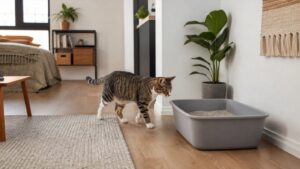
Clean every box at least daily, use an adequate number of boxes in separate locations, and make sure the cat can enter and exit without being cornered. Older or arthritic cats may need a lower entrance.
If stress contributes to marking, environmental changes matter more than perfume. Blocking the view of outdoor cats, adding predictable play, separating resources, and using an appropriate cat calming diffuser may support a larger plan.
Frequently Asked Questions
What is the best enzyme cleaner for cat urine?
Rocco & Roxie Professional Strength Stain & Odor Eliminator is our best overall choice for compatible carpet, rugs, and upholstery. Nature’s Miracle Urine Destroyer Plus for Cats is the best cat-specific alternative. Choose Nature’s Miracle Hard Floor Cleaner for compatible sealed flooring rather than saturating wood with a carpet treatment.
Do enzyme cleaners really remove cat urine odor?
They can reduce or remove organic urine residue when the product reaches all contaminated layers and remains for its required contact time. They cannot remove material they never touch. Urine beneath carpet padding, flooring, baseboards, or upholstery may require physical access or professional treatment.
How long should enzyme cleaner sit on cat urine?
Follow the exact product label. Current directions among the products in this guide vary. Simple Solution lists a 10-minute treatment before blotting; Nature’s Miracle Urine Destroyer Plus lists 15 minutes for stains; Rocco & Roxie lists 30–60 minutes for new stains and longer for deep odor. Do not use a time copied from another brand.
Is vinegar an enzyme cleaner?
No. Vinegar is dilute acetic acid and contains no enzymes. It may change odor temporarily, but it is not a substitute for a product formulated to treat organic pet messes. Do not mix vinegar with an enzyme cleaner unless the manufacturer explicitly directs it.
Can I use bleach on cat urine?
Bleach is not an enzyme cleaner and should never be mixed with ammonia or other household cleaners. It can damage surfaces and create dangerous fumes when improperly combined. Use a product approved for the surface and urine cleanup.
Can I use enzyme cleaner on hardwood?
Only if the product and floor manufacturer approve it. Use a hard-floor formula on intact sealed wood and avoid pooling. Untreated, waxed, oiled, damaged, or urine-saturated wood may need professional assessment.
Can enzyme cleaner be used on a mattress?
Some products list mattresses or fabrics, but mattress construction varies. Check the care instructions, spot-test, avoid uncontrolled saturation, and dry completely. Deep foam contamination may require professional cleaning or replacement.
Should I use a black light after cleaning?
A UV light can help locate suspicious spots, but fluorescence is not specific to urine and may persist after treatment. Judge success using odor after complete drying, recurrence, and the condition of the material—not fluorescence alone.
Why does cat urine smell worse after applying cleaner?
Wetting an old spot can temporarily release odor from material below the surface. The cleaner itself may also be fragranced. Let the product complete its label-directed treatment and dry fully before judging. Persistent odor after drying suggests missed depth, another spot, or repeated urination.
Can I put enzyme cleaner in a carpet-cleaning machine?
Only if both the cleaner and machine manufacturers permit it. Many spot-treatment products are not formulated for a machine reservoir. Foaming, residue, or incompatible dilution can damage equipment or reduce cleaning performance.
Is an enzyme cleaner enough to stop repeat accidents?
No. It removes a possible odor cue but does not treat urinary pain, fear, conflict, litter-box aversion, or marking triggers. Combine cleaning with veterinary assessment and a cause-specific litter-box and environmental plan.
Final Thought
The best enzyme cleaner for cat urine depends on the surface more than the size of the marketing claim. Rocco & Roxie is the best overall option for compatible carpet and upholstery; Nature’s Miracle Urine Destroyer Plus for Cats is the strongest cat-specific choice; Simple Solution is practical for fabric and carpet backing; Nature’s Miracle Hard Floor Cleaner suits approved sealed floors; and Biokleen Bac-Out offers a biodegradable but fragranced alternative.
Successful cleanup comes down to four things: find the complete area, select a product approved for the material, follow that product’s contact time, and dry the surface fully. Then address why the cat urinated there. Cleaning the stain without resolving pain, litter-box access, stress, or conflict leaves the most important part of the problem untreated.
References
- Rocco & Roxie Supply Co. “Professional Strength Stain and Odor Eliminator.” Accessed July 2026. https://roccoandroxie.com/products/stain-and-odor
- Nature’s Miracle. “Urine Destroyer Plus for Cats.” Accessed July 2026. https://www.naturesmiracle.com/products/stain-and-odor/urine-destroyer-plus-for-cats
- Nature’s Miracle. “Hard Floor Cleaner.” Accessed July 2026. https://www.naturesmiracle.com/products/other-messes/hard-floor-cleaner
- Simple Solution. “Cat Urine Destroyer Stain and Odor Remover.” Accessed July 2026. https://simplesolution.com/collections/urine-stains-odors/products/cat-urine-destroyer-stain-and-odor-remover
- Biokleen. “Bac-Out Pet Stain + Odor Remover.” Accessed July 2026. https://biokleenhome.com/bac-out-pet-stain-odor-remover-128-oz
- American Association of Feline Practitioners and International Society of Feline Medicine. “AAFP and ISFM Guidelines for Diagnosing and Solving House-Soiling Behavior in Cats.” Journal of Feline Medicine and Surgery, 2014. https://journals.sagepub.com/doi/10.1177/1098612X14539092
- American Association of Feline Practitioners. “2024 AAFP Intercat Tension Guidelines: Recognition, Prevention and Management.” Journal of Feline Medicine and Surgery, 2024. https://pmc.ncbi.nlm.nih.gov/articles/PMC11292941/