Cats walk across freshly cleaned floors, groom their paws, nap close to the ground, and investigate spills before we notice them. That makes floor-cleaner selection more than a question of scent or shine.
The best cat safe floor cleaner is not simply the product with the biggest “pet-friendly” label. A better choice has clear directions, works on your specific flooring, leaves as little unnecessary residue as possible, and can be used while your cat stays out of the room until the floor is completely dry.
For most cat homes, these are five practical options:
- Branch Basics Concentrate for a fragrance-free concentrated cleaner
- Bona Commercial System Hard-Surface Floor Cleaner for a ready-to-use, no-fragrance-added option
- A Bissell PowerFresh steam mop used with water only for compatible sealed floors
- Plain water and a microfiber mop for routine dust and light soil
- Diluted white vinegar for compatible surfaces when a simple DIY cleaner is appropriate
No cleaner can be guaranteed safe for every cat, every concentration, or every type of exposure. Even a relatively mild product can cause irritation if a cat walks through it while wet, drinks it, or licks concentrated residue from its paws. Correct dilution, ventilation, storage, and drying matter as much as the product itself.
Quick Answer: What Floor Cleaner Is Safe for Cats?
For routine cleaning, start with the least complicated method that will do the job:
- Use plain water and microfiber for dust, footprints, and light dirt.
- Choose a fragrance-free or no-fragrance-added cleaner when water is not enough.
- Follow the product’s exact dilution and surface instructions.
- Keep your cat in another room while you clean.
- Do not allow your cat back until the floor is fully dry and the room is ventilated.
- Store concentrates, mop water, pods, and used cloths where your cat cannot reach them.
The ASPCA notes that most household cleaning products can be used around cats when owners follow label directions. Problems are more likely when animals contact wet floors, lick spills, drink mop water, or encounter undiluted products.
This is why “safe when used as directed” is more meaningful than a broad pet-safe marketing claim.
Table of Contents
Our Five Picks at a Glance
| Option | Best for | Fragrance status | Main limitation |
|---|---|---|---|
| Branch Basics Concentrate | People who want one fragrance-free concentrate | Fragrance-free | Must be diluted exactly for the floor and surface |
| Bona Commercial System Hard-Surface Floor Cleaner | Quick cleaning of compatible hard floors | No fragrance added | Check the exact product and flooring compatibility |
| Bissell PowerFresh steam mop, water only | Reducing cleaner residue on compatible sealed floors | No cleaner required when used with water only | Heat and moisture are unsuitable for some floors |
| Plain water and microfiber | Everyday dust, hair, and light footprints | None | Will not remove every greasy or sticky mess |
| Diluted white vinegar | Occasional cleaning on vinegar-compatible floors | No added fragrance | Not suitable for natural stone, waxed, or some unsealed floors |
For cat urine spots, use a dedicated enzymatic urine cleaner rather than relying on a routine floor cleaner. Compare products for sealed flooring, carpet, upholstery, and other surfaces in our guide to the best enzyme cleaner for cat urine.
How We Chose These Options
We did not rank products based only on words such as “natural,” “green,” or “pet-friendly.” Those terms do not tell you how a cat will respond to a concentrated spill, a wet floor, or repeated paw contact.
Instead, we prioritized:
- A short or clearly disclosed ingredient list
- Fragrance-free or no-fragrance-added choices
- Clear dilution and surface directions
- Methods that can reduce unnecessary residue
- Practical availability for apartment and multi-cat homes
- The ability to keep cats separated until the floor dries
We also distinguished between a product claim and an independent guarantee. For example, a manufacturer may describe its cleaner as pet-safe or obtain a third-party product certification. That information can be useful, but it does not replace correct use or veterinary advice for an individual cat.
What “Cat Safe” Really Means
A floor cleaner does not need to be edible to be usable in a cat household. It does need to be used in a way that prevents meaningful exposure.
For most routine cleaning products, the biggest practical differences are:
Concentrated versus diluted
A concentrate in the bottle is not the same as the correctly diluted solution on the floor. Never estimate the amount by eye when the label provides a measurement. More cleaner does not mean a cleaner floor; it can mean more residue.
Wet versus fully dry
A cat that crosses a wet floor can get cleaner on its paw pads and fur. Grooming may then turn skin contact into oral exposure. Keep cats away until the surface is completely dry, not merely until it looks almost dry.
Occasional contact versus ingestion
Briefly stepping on a dry, properly cleaned floor is different from licking a spill, drinking mop-bucket water, chewing a cleaning wipe, or contacting an undiluted formula.
The formula versus the scent
“Unscented,” “fragrance-free,” and “no fragrance added” do not always mean exactly the same thing. Read the ingredient disclosure and label rather than relying on the front of the package.
Fragrance is not proof that a product is toxic, but strongly scented cleaners can be unpleasant for a cat and may be a poor fit for animals or people with respiratory sensitivities. Choosing a fragrance-free version also removes an ingredient that is unnecessary for cleaning performance.
The cleaner versus the floor
A mild solution can still damage an incompatible floor. Natural stone, unsealed wood, waxed surfaces, laminate, and luxury vinyl may have different restrictions. Always follow both the cleaner label and the flooring manufacturer’s instructions.
1. Branch Basics Concentrate
Best for: Cat owners who want a fragrance-free concentrate for several household cleaning jobs
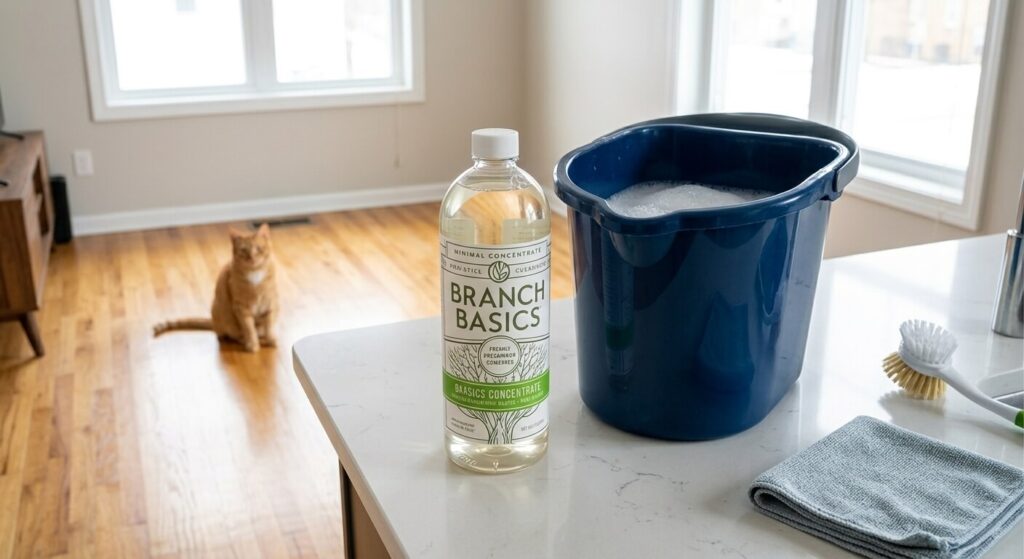
Branch Basics Concentrate is a fragrance-free, plant- and mineral-based concentrate. The company provides separate dilution instructions for different cleaning tasks and describes the product as suitable for pet households.
The main advantage is control: you can mix only the strength directed for the floor-cleaning job instead of using a heavily scented general-purpose solution. The concentrate also carries the MADE SAFE certification listed by the manufacturer.
However, a certification or manufacturer statement is not permission to leave concentrate where a cat can reach it. Store the bottle securely and use the floor-specific dilution on the current label.
How to use it more safely
- Confirm that the product is compatible with your flooring.
- Measure the concentrate and water according to the current floor-cleaning directions.
- Move your cat, food bowls, water bowls, toys, and bedding away from the area.
- Use a damp mop rather than flooding the floor.
- Keep your cat out until the floor is completely dry.
What to know before buying
- It is a concentrate, so inaccurate dilution is its biggest practical drawback.
- The upfront price is higher than a single ready-to-use bottle.
- The exact directions may change, so use the label on your bottle rather than an old recipe found online.
- “Fragrance-free” does not mean the concentrate is safe to drink or lick.
Bottom line: A useful choice for people who value a fragrance-free concentrate and are willing to measure it correctly.
2. Bona Commercial System Hard-Surface Floor Cleaner
Best for: People who prefer a ready-to-use cleaner with no fragrance added
Bona Commercial System Hard-Surface Floor Cleaner is sold as a ready-to-use formula for specified hard-surface flooring. Its technical information lists no added fragrance and a near-neutral pH range.
Ready-to-use packaging removes one common source of error: over-concentrating a product. It can therefore be convenient for quick apartment cleaning, especially when there is no suitable place to store a mop bucket.
This recommendation applies to the specific no-fragrance-added hard-surface formula—not automatically to every Bona product. Product lines include different cleaners for different surfaces, and packaging can look similar.
How to use it more safely
- Verify the exact product name and check your flooring type.
- Vacuum or sweep up cat litter and grit first.
- Apply only the amount directed on the label.
- Prevent your cat from walking through the wet area.
- Let the floor dry fully before restoring food bowls, beds, or toys.
What to know before buying
- “No fragrance added” is not the same as “contains only water.”
- Some floors require a product made specifically for their finish.
- Never transfer cleaner into an unmarked bottle.
- If your cat has a known respiratory or skin condition, ask your veterinarian whether additional precautions are appropriate.
Bottom line: A convenient lower-fragrance option when the exact formula is compatible with your floor.
3. Bissell PowerFresh Steam Mop Used With Water Only
Best for: Compatible sealed floors when you want to minimize cleaning-product residue
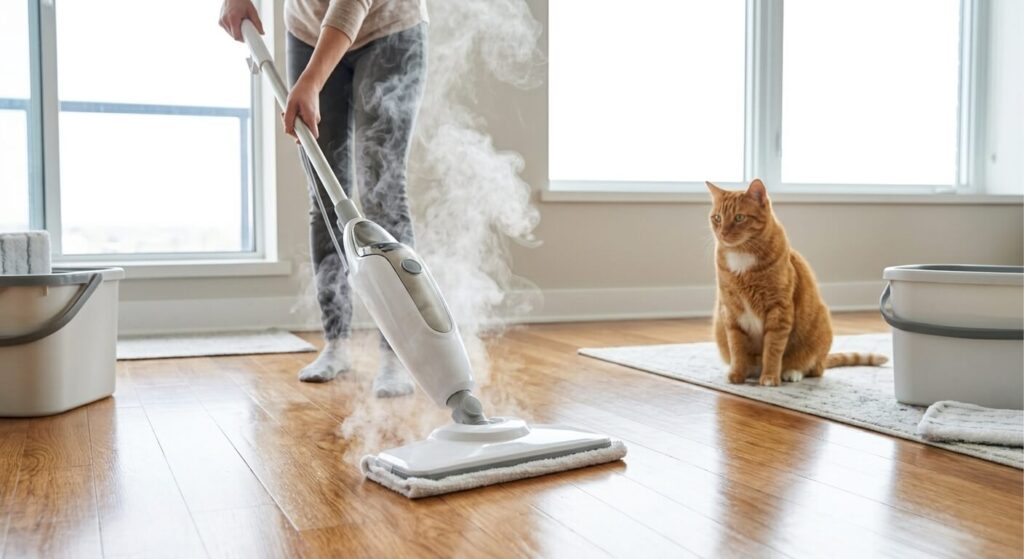
A steam mop uses heated water and a washable pad instead of relying on a conventional floor-cleaning solution. For cat households, its main benefit is straightforward: when the machine is used with water only, there is no floor-cleaner formula for a cat to track through.
The Bissell PowerFresh line is designed for specified sealed hard floors. Some models or packages include fragrance discs. If your goal is to minimize added scent and residue, leave those discs out.
Steam is not suitable for every floor. Heat and moisture may damage unsealed wood, waxed surfaces, some laminates, or flooring with compromised seams. Your floor manufacturer’s guidance takes priority over a general appliance description.
How to use it more safely
- Check that both the steam-mop manual and flooring manufacturer permit steam.
- Use water only unless the manufacturer explicitly authorizes another substance.
- Do not add vinegar, essential oils, disinfectant, or floor cleaner to the water tank.
- Keep cats away from the hot appliance, cord, steam path, and damp floor.
- Allow the mop and pad to cool before storing or washing them.
What to know before buying
- Steam can burn skin and paws.
- A steam mop is equipment, not a universally safe treatment for every surface.
- It may be unnecessary for light daily dust.
- Wash dirty pads promptly, especially after cleaning near a litter box.
Bottom line: A strong residue-minimizing option for floors that are specifically approved for steam cleaning.
4. Plain Water and a Microfiber Mop
Best for: Daily cat hair, litter dust, paw prints, and light soil
The simplest option is often overlooked. A well-wrung microfiber mop with plain water can remove a surprising amount of dust and light surface dirt.
Microfiber works by physically picking up fine particles rather than merely moving them around. In a small apartment, frequent light cleaning with water may reduce the need for stronger cleaning products.
This method is particularly useful after vacuuming tracked litter. For a more complete prevention plan, read our guide on how to stop cat litter tracking in an apartment.
How to use it effectively
- Vacuum or sweep first so grit does not scratch the floor.
- Dampen the pad and wring it thoroughly.
- Work in small sections.
- Replace or rinse the pad when it becomes visibly dirty.
- Dry any pooled water immediately.
What to know before using it
- Water alone is not a disinfectant.
- It may not remove cooking grease, sticky spills, or dried urine.
- Excess water can damage wood and laminate.
- Use separate washable pads for kitchen, litter-box, and general living areas.
Bottom line: The lowest-complexity choice for routine maintenance, provided your floor tolerates damp mopping.
5. Diluted White Vinegar for Compatible Floors
Best for: Occasional simple cleaning on surfaces whose manufacturers permit diluted vinegar
The ASPCA notes that vinegar diluted in cleaning solutions and followed by rinsing and drying generally does not pose the same concern as a pet drinking concentrated vinegar. That does not make vinegar appropriate for every floor.
Its acidity can etch or dull natural stone and may damage certain finishes. Do not use it on marble, limestone, travertine, waxed floors, unsealed surfaces, or any floor whose care guide prohibits acidic cleaners.
There is no universal DIY ratio that is ideal for every flooring material. Use the floor manufacturer’s recommended dilution if it permits vinegar. If the manufacturer does not recommend it, select another method.
How to use it more safely
- Confirm that diluted vinegar is approved for your exact floor.
- Mix only the amount and concentration recommended by the floor manufacturer.
- Never combine vinegar with bleach or other cleaning products.
- Keep your cat away during cleaning.
- Rinse if the surface instructions require it and let the floor dry fully.
What to know before using it
- It has a noticeable odor even without added fragrance.
- It is not appropriate for many natural-stone and finished surfaces.
- Stronger is not better.
- It should not be used as a substitute for a veterinary or public-health disinfection protocol.
Bottom line: A simple occasional option only when your flooring manufacturer explicitly allows it.
How to Evaluate Any Cat-Friendly Floor Cleaner
Product formulas and labels change. Instead of depending forever on one recommendation, use this checklist whenever you buy a new cleaner.
1. Read the back label
Look for:
- Exact dilution directions
- Required rinsing
- Surface restrictions
- Ventilation instructions
- First-aid information
- Storage warnings
The front label is marketing. The back label explains how the product must be used.
2. Prefer clear ingredient disclosure
A complete ingredient disclosure makes comparison easier. Avoid assuming that “natural” means harmless or that a chemical-sounding ingredient is automatically dangerous.
Risk depends on the substance, concentration, route of exposure, and amount. A correctly diluted product used on a floor is a different exposure from swallowing the concentrate.
3. Look for fragrance-free choices
When two products perform the same job, the fragrance-free option is often the simpler choice for a cat household. Check the exact version because scented and unscented bottles can belong to the same product line.
4. Consider EPA Safer Choice
The U.S. Environmental Protection Agency’s Safer Choice program evaluates every intentionally added ingredient in a certified product against its criteria. The program also has a separate fragrance-free label.
This can be a useful shopping filter, but it is not a cat-specific safety guarantee. You still need to follow the label and prevent contact with wet cleaner.
5. Match the product to the mess
Do not use a heavy-duty cleaner simply because it is available.
- Hair and dust: Vacuum, then damp microfiber
- Tracked litter: Vacuum before mopping
- Food spill: Remove the material, then use a compatible general cleaner
- Urine: Blot first, then use an appropriate enzyme cleaner
- A true disinfection need: Follow a product label or professional protocol for the target organism
If litter-box odor is spreading through the room, cleaning the entire floor repeatedly may not fix the source. Our apartment litter-box odor guide covers box placement, scooping, litter depth, and ventilation.
6. Avoid homemade mixtures
Never mix cleaning products unless a manufacturer explicitly directs it. In particular, never mix bleach with ammonia or acids such as vinegar. Dangerous gases can form.
Cat urine can contain ammonia-related compounds, so clean up organic material before using any disinfectant and follow its label precisely.
A Safer Floor-Cleaning Routine for Cat Owners
The process matters as much as the bottle.
Step 1: Put the cat in a separate room
Move your cat before opening or mixing the cleaner. Give them water, a resting place, and access to a litter box if the cleaning will take more than a few minutes.
This also prevents paw prints from forcing you to re-clean the same area.
Step 2: Remove cat items
Pick up:
- Food and water bowls
- Toys
- Beds and blankets
- Scratchers that touch the wet area
- Litter mats
Do not spray cleaner near food, water, or uncovered litter.
Step 3: Vacuum or sweep
Remove hair, grit, and litter before wet cleaning. Mopping loose debris can create a muddy film and increase the amount of cleaner you think you need.
For airborne hair and fine dust, floor cleaning works best alongside regular vacuuming and appropriate filtration. See our comparison of air purifiers for cat hair and odor.
Step 4: Use the minimum directed amount
Follow the label. Do not add an extra splash for a stronger smell. A strongly scented room is not evidence of a cleaner floor.
Use a damp—not dripping—mop on moisture-sensitive flooring.
Step 5: Prevent access while wet
Close a door or use a secure barrier. Do not rely on watching the cat from across the room; a curious cat can cross a wet area in seconds.
Step 6: Rinse when directed
Some products are no-rinse, while others require a clean-water pass. Follow the exact instructions for that formula and surface.
If you accidentally used too much cleaner and the floor feels sticky after drying, follow the manufacturer’s advice. A clean, damp microfiber pass may help on compatible floors, but do not improvise on delicate finishes.
Step 7: Allow complete drying and ventilation
There is no universal 15-minute or 30-minute drying rule. Humidity, temperature, airflow, product quantity, and flooring all affect drying time.
Wait until the entire floor is dry, including edges and low spots. If the label requires ventilation, continue it for the stated period.
Step 8: Wash equipment and store products
Empty mop water promptly. Rinse or wash reusable pads and let them dry where the cat cannot chew them. Secure bottles in a closed cabinet rather than leaving them beside the toilet or under an accessible sink.
Floor-by-Floor Compatibility Guide
| Flooring | Usually practical approach | Important caution |
|---|---|---|
| Sealed tile | Compatible ready-to-use cleaner, damp microfiber, or approved steam | Grout and sealants may have separate care rules |
| Vinyl or luxury vinyl | Damp microfiber or manufacturer-approved cleaner | Avoid excess water at seams; check steam restrictions |
| Laminate | Very lightly damp microfiber or approved laminate cleaner | Standing water and steam may damage the core or seams |
| Sealed hardwood | Wood-floor product approved by the finish manufacturer | Minimize moisture; do not assume vinegar or steam is allowed |
| Unsealed wood | Follow the installer or manufacturer’s specialist guidance | Water and general cleaners may stain or warp it |
| Natural stone | Stone-specific pH-compatible cleaner | Avoid vinegar and other acids |
| Waxed floor | Product approved for waxed finishes | Steam, acids, or general cleaners may strip or dull the finish |
When in doubt, test the product in an inconspicuous area—but remember that a successful spot test only checks visible floor damage. It does not replace label precautions for your cat.
What About Essential Oils?
Do not add essential oils to mop water or a steam mop simply to make the room smell fresh.
Cats can be exposed to essential oils through ingestion, skin contact, or inhalation. Concentration and the specific oil matter, and some essential oils present a recognized poisoning risk for cats.
This is different from saying that every trace fragrance creates the same risk. The practical rule is simpler: avoid DIY essential-oil additions, use products exactly as formulated, and choose fragrance-free versions when they meet your cleaning needs.
If you want the apartment to smell fresher, address the odor source instead. Improve litter-box maintenance, wash textiles, remove urine with an appropriate enzyme cleaner, and ventilate the space.
What About Bleach and Disinfectants?
Bleach should not be treated as a routine everyday floor cleaner, but it is also inaccurate to say that it can never be used in a cat household.
The ASPCA explains that diluted bleach can be used safely when it is properly diluted, rinsed as necessary, and allowed to dissipate before pets return. Undiluted bleach can cause significant irritation or injury.
If a veterinarian, public-health authority, or product label calls for disinfection:
- Use the exact dilution and contact time.
- Remove cats, bowls, toys, bedding, and litter items.
- Ventilate the room.
- Rinse if directed.
- Keep pets out until the surface is dry and fumes have dissipated.
- Never mix bleach with ammonia, vinegar, or another cleaner.
For ordinary paw prints and dust, a disinfectant is usually unnecessary.
Is Fabuloso Safe for Cats?
It is not responsible to give every Fabuloso formula a permanent yes-or-no label. Formulas, fragrances, concentrations, and regional products can differ.
If you use one:
- Read the current bottle rather than relying on an old online recipe.
- Dilute it only as directed.
- Keep your cat away from the solution, mop bucket, and wet floor.
- Provide ventilation.
- Do not let the cat return until the floor is fully dry.
If your cat licked the concentrate, drank cleaning water, or developed symptoms after exposure, contact a veterinarian or animal poison-control service promptly. Have the bottle or ingredient list available.
For owners who want to minimize scent and simplify the decision, one of the fragrance-free or no-fragrance-added options above may be a better fit.
Is Pine-Sol Safe for Cats?
As with other branded product families, check the exact current formula and label. Do not assume that every product sold under one brand has identical ingredients or directions.
Never allow a cat to contact concentrated product or a wet treated surface. Use only the directed dilution, ventilate the room, and wait for complete drying.
If you need only routine cleaning, plain water and microfiber or a compatible fragrance-free cleaner may accomplish the job with fewer unnecessary ingredients.
Are Robot Mop Solutions Safe for Cats?
Do not assume that a solution is cat-safe merely because it is sold for a robot mop or includes the word “pet” in its name.
Check:
- Whether the machine manufacturer permits the formula
- Whether the formula contains fragrance
- Whether the bottle provides complete directions
- Whether the robot leaves wet areas accessible to the cat
- Whether the machine can reach food bowls or litter areas
Run the robot while your cat is separated from the cleaning zone, then inspect the floor for puddles before allowing the cat back.
Do not put vinegar, essential oils, or an unapproved cleaner into a robot’s tank. It may damage the machine and create an uncontrolled dilution.
What Should I Use for Cat Urine on the Floor?
First blot fresh urine with absorbent material. Avoid scrubbing it across a larger area.
Then use a product appropriate for both the flooring and the urine contamination. Enzyme cleaners are designed for organic stains and odors, but they still require label-following and drying precautions.
Before treating wood, laminate, stone, or grout, check whether the product may discolor or damage the material.
If your cat is repeatedly urinating outside the box, cleaning is only part of the solution. Sudden or repeated house-soiling can have medical, litter-box, environmental, or stress-related causes. Read our guide to why cats pee outside the litter box and contact your veterinarian when the behavior is new or persistent.
Regular box care also reduces floor contamination. Our guide explains how often to clean a litter box without relying on fragrance to cover odors.
What to Do If Your Cat Walks on a Wet Floor
Act calmly and prevent grooming.
- Move the cat away from the wet area.
- Check the product label for first-aid directions.
- If it can be done safely, wipe the paws and contaminated fur with a clean cloth dampened with water.
- Do not apply another household chemical to “neutralize” the first one.
- Contact your veterinarian or an animal poison-control service if the exposure involved concentrate, ingestion, persistent residue, symptoms, or a product of uncertain composition.
Do not induce vomiting unless a veterinary professional specifically instructs you to do so.
Possible signs after a concerning cleaning-product exposure can include:
- Drooling
- Pawing at the mouth
- Vomiting
- Coughing or breathing difficulty
- Red or irritated skin
- Squinting or eye irritation
- Weakness, tremors, or unusual behavior
Breathing difficulty, collapse, seizures, severe eye exposure, or significant ingestion requires urgent veterinary help.
Keep the product packaging. The exact name, ingredients, concentration, and estimated exposure are more useful than the general phrase “floor cleaner.”
Frequently Asked Questions
What is the best cat safe floor cleaner for everyday use?
For light dirt, plain water and a well-wrung microfiber mop may be enough. When you need more cleaning power, choose a compatible fragrance-free or no-fragrance-added product with clear directions, and keep your cat away until the floor is fully dry.
Does “pet-friendly” mean a cat can walk on the wet floor?
No. A pet-related marketing statement does not mean the wet product is intended for paw contact or ingestion. Follow the label and keep cats away during use and drying.
Is fragrance-free floor cleaner always safe for cats?
No. Fragrance-free removes one unnecessary product feature, but the cleaner can still irritate a cat if swallowed, spilled in concentrated form, or used incorrectly.
Can I use dish soap to mop the floor?
Only if your flooring manufacturer permits it and you can use an appropriate amount. Too much soap leaves slippery residue that attracts dirt and may transfer to paws. A floor-specific product is easier to use correctly.
Can I use castile soap on floors around cats?
Some people use a small amount of unscented castile soap on compatible surfaces, but dilution and floor-finish requirements vary. Do not add essential oils, do not assume all castile soaps are fragrance-free, and follow both the soap maker’s and floor maker’s instructions.
Is vinegar safe for cats?
Diluted vinegar used appropriately, followed by any required rinsing and complete drying, is different from a cat drinking concentrated vinegar. The larger practical limitation is floor compatibility: vinegar can damage natural stone and certain finishes.
Can I add essential oils to a floor cleaner?
No. Do not add essential oils to mop water, steam mops, or commercial cleaners. The mixture is not safety-tested, and essential oils can pose a poisoning risk to cats.
How long should I keep my cat away after mopping?
Until the floor is completely dry and any label-required ventilation period is complete. Do not rely on one fixed number of minutes.
Do I need to rinse a no-rinse floor cleaner?
Follow the current label. If you used too much or the floor remains sticky, contact the manufacturer or follow its cleanup guidance rather than adding another chemical.
Is a steam mop safer than floor cleaner?
Using water only avoids conventional cleaner residue, but steam introduces heat and moisture risks. It is only a good option when the machine and floor manufacturers both approve it.
Should I disinfect my floors every day?
Usually not. Routine removal of hair, dust, litter, and ordinary spills is different from disinfection. Use a disinfectant when there is a specific need and follow its label precisely.
What if my cat has asthma or allergies?
Choose low-scent or fragrance-free products, ventilate the area, and discuss cleaning routines with your veterinarian. For the wider home environment, our guide to living with cat allergies in a small apartment may also help.
Final Thoughts
The best cat safe floor cleaner is the least complicated option that can handle the actual mess without damaging your floor.
For everyday hair, dust, and paw prints, start with plain water and microfiber. If you need a product, Branch Basics offers a fragrance-free concentrate, while the specified Bona hard-surface formula provides a convenient no-fragrance-added ready-to-use option. On compatible sealed floors, a Bissell PowerFresh steam mop used with water only can reduce reliance on cleaning solutions. Diluted vinegar is an occasional alternative only for surfaces whose manufacturers allow it.
Whichever method you choose:
- Follow the current label.
- Use the correct amount.
- Never mix cleaning products.
- Keep cats away from concentrates, mop water, and wet floors.
- Let the surface dry completely.
- Store supplies securely.
Those habits do more to reduce exposure than any “pet-friendly” phrase printed on the front of a bottle.
References
- ASPCA, “Poisonous Household Products”: https://www.aspca.org/pet-care/aspca-poison-control/poisonous-household-products
- ASPCA, “Pet Poisons: Household Products and Cleaning Agents”: https://www.aspca.org/news/pet-poisons-be-mindful-these-household-products-and-cleaning-agents
- Pet Poison Helpline, “Essential Oils and Cats”: https://www.petpoisonhelpline.com/uncategorized/essential-oils-cats/
- U.S. EPA, “Safer Choice Products”: https://www.epa.gov/saferchoice/products
- U.S. EPA, “Frequently Asked Questions on Safer Choice”: https://www.epa.gov/saferchoice/frequently-asked-questions-safer-choice
- Branch Basics, “Pet-Safe Floor Cleaner”: https://branchbasics.com/blogs/cleaning/pet-safe-floor-cleaner
- Bona Commercial System Hard-Surface Floor Cleaner technical information: https://www.bona.com/globalassets/catalogassets/bona-cs-hard-surface-floor-cleaner.pdf
- Bissell PowerFresh product information: https://www.bissell.com/en-us/product/powerfresh-deluxe-scrubbing–sanitizing-steam-mop-1806.html