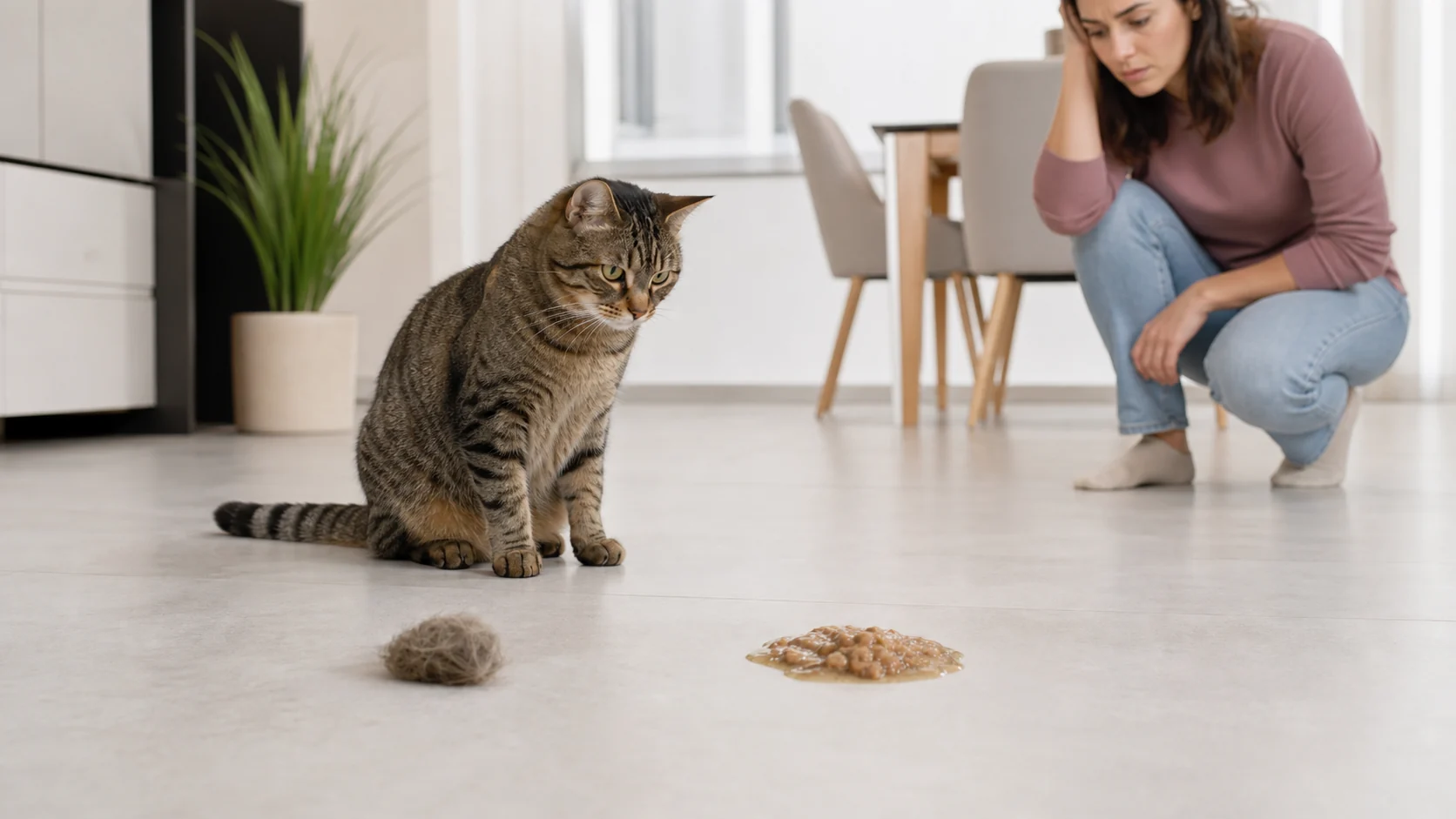
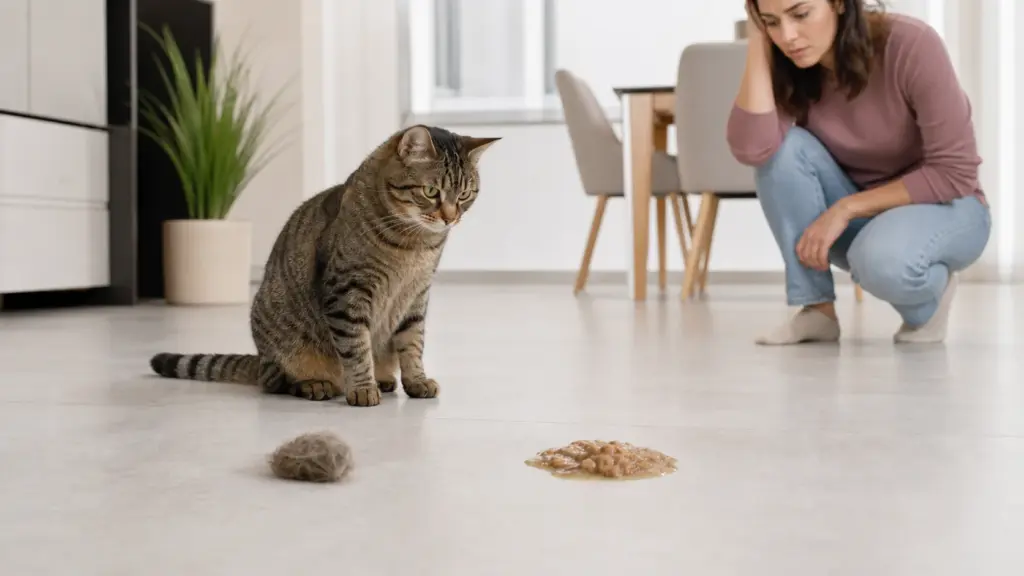
Cat vomiting vs hairball episodes can look similar, but the material produced and the cat’s movements provide useful clues. A hairball usually contains a dense, damp cylinder of fur. Vomiting commonly produces food, liquid, foam, bile, or blood and involves nausea and abdominal contractions. Regurgitation is more passive and often brings up undigested food. Coughing produces little or nothing and may indicate an airway problem rather than a stomach problem.
You do not need to diagnose the cause at home. Your job is to recognize what happened, check how your cat is breathing and behaving, save useful details for the veterinarian, and respond quickly when warning signs are present.
Seek emergency veterinary care now if your cat has difficulty breathing, open-mouth breathing, blue or gray gums, collapse, severe weakness, suspected poisoning, a swallowed string or foreign object, a swollen or painful abdomen, or repeated unsuccessful retching with distress. Contact a veterinarian promptly for repeated vomiting, blood in the material, appetite loss, lethargy, weight loss, diarrhea, changes in thirst or urination, or any pattern that is becoming more frequent.
Quick Answer: Cat Vomiting vs Hairball
Use these four patterns as a starting point:
| Event | What happens before or during it | What may appear afterward |
|---|---|---|
| Hairball | Active gagging or retching with abdominal effort | A damp, compact mass made mainly of fur, often cylindrical |
| Vomiting | Nausea may include lip licking, drooling, swallowing, restlessness, and abdominal contractions | Digested or partly digested food, liquid, foam, bile, blood, foreign material, or sometimes hair |
| Regurgitation | Often sudden and passive, with little warning and no obvious abdominal heaving | Undigested food or water, sometimes shaped like the esophagus |
| Coughing | Cat may crouch low, extend the neck, and make repeated hacking sounds | Usually nothing from the stomach; breathing signs may also be present |
These descriptions overlap. A video of the episode is often more informative than the mess alone, especially when coughing is being mistaken for an attempt to bring up a hairball.
The 30-Second Event Check
Before cleaning the area, answer these five questions. They create a more useful record than simply reporting that your cat “threw up.”
- Was breathing normal? Open-mouth breathing, blue or gray gums, marked effort, or collapse is an emergency.
- Was the event active or passive? Abdominal heaving suggests vomiting; a sudden return of undigested food without heaving suggests regurgitation.
- What was produced? Note compact fur, food, clear fluid, foam, bile, blood, string, plants, or another object.
- How did your cat act afterward? Returning quickly to normal is different from hiding, pain, weakness, repeated swallowing, or refusing food.
- Has it happened again? Record the time, connection to meals, frequency, and any recent diet, medication, grooming, or household change.
If it is safe to do so, take a photo of the material and a short video of a repeated episode. Do not delay emergency care to make a recording.
First Check: Is Your Cat Having Trouble Breathing?
Before inspecting the floor, look at the cat. Breathing takes priority over deciding whether the episode involved fur.
Go to an emergency veterinary service immediately if your cat is:
- breathing with an open mouth
- struggling to draw breath or using obvious abdominal effort to breathe
- showing blue, gray, or very pale gums
- unable to settle after a coughing or retching episode
- collapsing, becoming unresponsive, or showing profound weakness
Keep the cat calm, minimize handling, and call the emergency clinic while preparing to leave. Do not put food, water, oil, paste, or medication into the cat’s mouth during respiratory distress.
A cat with asthma or another airway disorder may crouch, extend the neck, and hack repeatedly. Owners often describe this as “trying to cough up a hairball,” even when no hairball appears. Repeated coughing, wheezing, faster breathing, or increased breathing effort needs veterinary assessment. A suspected hairball should never be allowed to explain away breathing difficulty.
Seven Differences Between Cat Vomiting and a Hairball
No single clue is perfect. Consider the whole event: what happened beforehand, the cat’s posture and effort, what came out, and how the cat behaved afterward.
1. The main material produced
A true hairball is composed primarily of densely packed hair. It is usually damp and may be coated with mucus, food particles, or digestive fluid. Its elongated form comes from passing through the esophagus; despite the name, a expelled hairball is not necessarily round.
Vomit may contain recognizable food, partially digested food, clear fluid, white foam, yellow or greenish fluid, mucus, blood, plant material, parasites, or a foreign object. Finding a few loose hairs in liquid does not automatically make the event a hairball. Cats swallow hair during grooming, so some hair can be present in ordinary vomit.
2. Nausea before the event
Vomiting may be preceded by signs of nausea such as lip licking, repeated swallowing, drooling, vocalizing, restlessness, hiding, or approaching and leaving food. The cat may look uncomfortable before abdominal contractions begin.
A hairball is expelled through vomiting, so nausea and retching can also occur. The presence of nausea therefore does not prove that the cause is unrelated to hair. The deciding evidence is the complete event and the material produced, not one movement or sound.
3. Active effort versus a passive return of food
Vomiting is an active process. The cat may lower the head, extend the neck, contract the abdomen, and heave. The material comes from the stomach or upper small intestine.
Regurgitation is different. It is often sudden and passive, without repeated abdominal contractions. Undigested food or water may simply come back up soon after swallowing. Because the esophagus can shape the material, regurgitated food may also look tubular. A tubular shape alone therefore does not prove that you found a hairball.
Repeated regurgitation deserves veterinary evaluation. Possible causes range from eating behavior to disorders of the mouth, throat, or esophagus, and the correct treatment depends on identifying the cause.
4. What happens during coughing
Coughing arises from the respiratory tract, not the stomach. A coughing cat may crouch close to the floor, extend the head and neck, and make repeated dry hacking movements. The episode may end without producing food, liquid, or fur.
It can be difficult to distinguish coughing from retching by description alone. Record a short video if doing so does not delay care. Show it to the veterinarian rather than repeatedly waiting for a hairball to appear.
Wheezing, rapid breathing, open-mouth breathing, blue or gray gums, or visible respiratory effort makes the situation urgent. Even mild recurring coughs should be discussed with a veterinarian because cats do not normally cough as a routine way to clear hair.
5. Timing in relation to eating
Food that returns almost immediately after a meal and looks largely unchanged may be regurgitated, especially when the event is passive. However, timing alone cannot distinguish regurgitation from vomiting. A cat can vomit soon after eating, and a disorder can cause either pattern.
Record how long after eating the event occurred, whether the cat ate unusually fast, and whether the same food has come back more than once. Do not assume that every post-meal episode only requires a slow feeder. Repetition, weight loss, swallowing difficulty, pain, or other illness signs require examination.
6. Behavior after the episode
A cat that produces one obvious hairball and immediately returns to normal breathing, movement, appetite, and social behavior is less concerning than a cat that remains hunched, hides, seems painful, refuses food, or vomits again.
Normal behavior afterward is reassuring, but it is not a guarantee that nothing is wrong. Some chronic gastrointestinal, kidney, thyroid, and other diseases produce intermittent vomiting while a cat appears normal between episodes. Track recurring events instead of judging each one in isolation.
7. The pattern over time
An isolated event and a repeating pattern are not equivalent. Record each episode so that “occasionally” becomes a specific history. Patterns that are increasing, occurring regularly, or accompanied by weight loss, appetite change, thirst or urination changes, diarrhea, constipation, or reduced activity should be evaluated.
There is no universal household number that safely separates normal from abnormal for every cat. Age, medical history, current medication, possible toxin or foreign-body exposure, hydration, and associated signs all change the level of concern. If you are uncertain, call your veterinarian and describe the complete situation.
Read the Episode as a Timeline
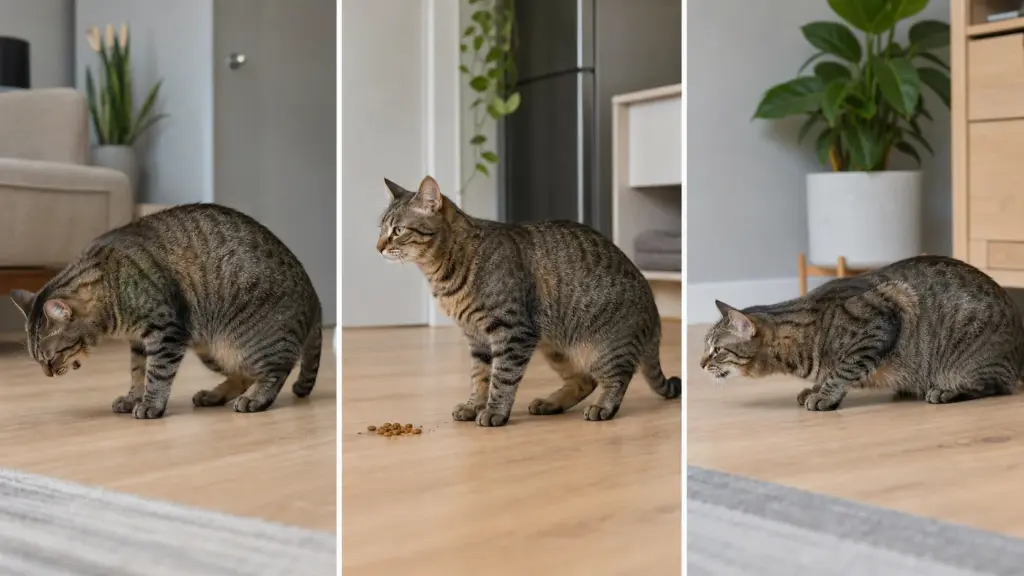
The material on the floor is only the final part of the event. When vomiting, regurgitation, coughing, and hairballs look similar, the sequence before, during, and after the episode often provides the clearest practical distinction.
| Stage | What to notice | Why it helps |
|---|---|---|
| Before | Meal timing, lip licking, drooling, repeated swallowing, pacing, coughing, grooming, or access to plants, string, food, medication, or cleaners | Shows whether nausea, an airway event, a meal-related pattern, or a possible exposure came first |
| During | Abdominal contractions, a passive return of food, neck extension, hacking sounds, breathing effort, duration, and whether anything was produced | Helps separate active vomiting from regurgitation and respiratory signs |
| After | Food, fluid, foam, bile, blood, compact fur, foreign material, appetite, breathing, comfort, hiding, weakness, or another episode | Shows both the likely event type and how urgently the cat may need care |
For example, undigested food appearing soon after a meal with little warning may fit regurgitation better than vomiting, but a recurring pattern still needs veterinary evaluation. A compact cylinder of fur supports a hairball, yet fur can also appear in vomit and does not make repeated illness harmless. Likewise, a low crouch and hacking sound may be mistaken for retching even when the problem is respiratory.
Write the timeline in ordinary language rather than trying to name the disease: “ate dinner, licked lips, heaved three times, produced yellow fluid, then hid” is more useful than “had a bad hairball.” If the episode happens again and the cat is not in distress, a short video can preserve movements and sounds that disappear before the veterinary visit.
Context That Changes the Next Step
The same-looking material can carry different significance depending on the cat and the surrounding circumstances. Use context to decide what information to give the veterinarian, not to diagnose the cause yourself.
- Life stage and medical history: kittens, senior cats, and cats with known kidney, thyroid, gastrointestinal, respiratory, or other chronic conditions may need a lower threshold for professional advice when a new episode appears.
- Changes in eating: note whether the event followed a large meal, rapid eating, a new food, a diet transition, reduced appetite, or an unusual treat. Do not assume food timing proves the cause.
- Foreign-object access: missing string, ribbon, tinsel, elastic bands, toy pieces, dental floss, or plant material changes the risk. Never pull visible string from the mouth or rectum; contact a veterinarian.
- Medication or chemical exposure: record prescriptions, supplements, flea products, cleaners, plants, and human medications that may have been accessible. Keep the package or label available when calling.
- Coat and grooming: heavy shedding, long hair, overgrooming, or difficulty grooming may increase swallowed fur, but frequent hairballs can still justify a veterinary discussion.
- Multi-cat households: identify which cat had the episode when possible. Separate feeding records, appetite checks, litter observations, or a camera may prevent symptoms from being assigned to the wrong cat.
Avoid home experiments while the event is unclear. Do not induce vomiting, give a human medication, start a laxative or hairball remedy, or force food or water unless a veterinarian provides instructions for your cat. Product labels and internet advice cannot account for obstruction, poisoning, dehydration, respiratory disease, or an individual cat’s medical history.
When you call the clinic, report the number and timing of episodes, whether food and water stay down, current appetite and energy, stool and urination changes, breathing signs, the appearance of the material, and any possible exposure. Mention recent diet changes, medications, procedures, travel, stress, or household changes. The veterinary team can then decide whether the cat needs emergency care, a prompt appointment, monitoring instructions, or specific samples and records brought to the visit.
When Cat Vomiting Requires Emergency Care
Go to an emergency veterinary service now—or call one for immediate triage—if vomiting or retching occurs with any of the following:
- trouble breathing, open-mouth breathing, or blue or gray gums
- collapse, unresponsiveness, seizures, or severe weakness
- repeated unsuccessful retching with distress
- a swollen, tense, or markedly painful abdomen
- known or suspected ingestion of string, medication, lilies, chemicals, or another toxin
- a swallowed object or visible string from the mouth or anus
- substantial or repeated blood, pale gums, or signs of shock
- inability to keep water down with continued vomiting or rapid deterioration
- vomiting in a very young kitten or medically fragile cat accompanied by weakness or dehydration
If poisoning is possible, take the product container, plant sample, label, or photograph with you when it is safe to do so. Do not induce vomiting or give a home antidote unless a veterinarian or animal poison service gives case-specific instructions.
When to Contact Your Regular Veterinarian Promptly
Not every episode requires an emergency hospital, but these patterns should not be dismissed as “just hairballs”:
- vomiting that repeats during the day
- vomiting that recurs over days or weeks
- confirmed hairballs that are becoming frequent
- appetite loss or a meaningful reduction in food intake
- weight loss or loss of muscle
- lethargy, hiding, pain, or reduced activity
- diarrhea, constipation, or a change in stool output
- increased thirst or urination
- recurring regurgitation or swallowing difficulty
- recurring coughing, wheezing, or hacking without a hairball
- a new vomiting pattern in a senior cat or a cat with an existing disease
Call sooner when the cat has diabetes, kidney disease, hyperthyroidism, gastrointestinal disease, is receiving medication, or has recently had surgery. A veterinary professional who knows the patient can give more appropriate triage advice than a generic online frequency rule.
What to Do After One Isolated Episode
If your cat has produced one clear hairball or vomited once, is breathing normally, is alert and comfortable, and has none of the warning signs above, take these practical steps:
- Photograph the material before cleaning it.
- Write down the time and its relationship to the last meal.
- Note whether you saw active vomiting, passive regurgitation, or coughing.
- Check for access to plants, string, spoiled food, medication, cleaners, or small objects.
- Observe appetite, drinking, litter box use, energy, posture, and breathing.
- Contact your veterinarian if another episode occurs or anything else changes.
Do not give human medicines, oils, butter, petroleum products, laxatives, herbal preparations, or hairball remedies without veterinary approval. Do not force-feed or syringe water into a nauseated cat. Do not create a prolonged fasting plan from internet advice; cats have individual nutritional and medical risks, and a veterinarian should advise you about feeding after vomiting.
If your cat wants to eat and drink, call the clinic for guidance appropriate to the cat’s age, condition, and history. The safest next meal and timing may differ for a healthy adult, a kitten, a diabetic cat, or a cat with kidney or gastrointestinal disease.
How to Make a Useful Vomiting Record
A short record can help a veterinarian distinguish a one-time event from a meaningful trend. For each episode, note:
- date and time
- food and treats eaten beforehand
- time since the last meal
- active abdominal heaving, passive return, or coughing
- photograph of the material
- video of the movement when safely possible
- hair, food, liquid, foam, blood, plant material, or foreign material seen
- appetite, water intake, stool, and urination afterward
- energy, hiding, pain, and breathing changes
- recent food changes, medication, grooming, or possible exposures
Do not delay urgent care to complete the record. Its purpose is to improve communication, not to prove a diagnosis at home.
Hairball Prevention Without Missing a Vomiting Problem
Regular brushing can reduce the loose fur a cat swallows, particularly for long-haired cats and cats that shed heavily. But repeated vomiting, repeated unproductive retching, appetite loss, lethargy, constipation, or weight loss should not be managed as a routine grooming issue. Those patterns need veterinary assessment.
If the episode produced a true cylinder of compacted fur and your veterinarian has ruled out other concerns, use our cat hairball prevention guide for grooming and home-care options. This page remains focused on identifying the event and deciding how quickly to seek help.
How Veterinarians Investigate Repeated Vomiting
The investigation begins with the history and physical examination. The distinction between active vomiting, regurgitation, coughing, and confirmed hairball production can change the diagnostic plan, which is why photographs and videos matter.
Depending on the cat’s age, signs, and examination, the veterinarian may recommend blood tests, urinalysis, fecal testing, imaging, or other procedures. These can help evaluate hydration, parasites, metabolic disease, inflammation, obstruction, organ disease, and other possible causes.
There is no single universal test for every vomiting cat. A young cat with possible string ingestion, a senior cat losing weight, and a coughing cat require different priorities. Treatment may include fluids, anti-nausea medication, dietary management, parasite treatment, removal of a foreign object, or therapy for an identified underlying disease.
Avoid giving leftover medication before the appointment. Some human and veterinary products are unsafe for cats, and suppressing a symptom without knowing the cause can complicate care.
Frequently Asked Questions
Can a hairball contain food or liquid?
Yes. A hairball can be coated with mucus, digestive fluid, or small amounts of food. The main mass should still be visibly composed of compacted fur. Liquid vomit with scattered hairs is not automatically a hairball.
Why is my cat vomiting but acting normal?
A cat may appear normal after a minor isolated episode, but appearance afterward does not identify the cause. Eating too fast, a hairball, dietary irritation, parasites, chronic gastrointestinal disease, kidney disease, hyperthyroidism, and other problems can produce intermittent signs. Record the episode and contact your veterinarian if it repeats or if any additional change develops.
Is white foam a hairball?
White foam is not a hairball. It may contain saliva, mucus, and stomach fluid and can appear for several reasons. If a compact fur mass follows, the complete event may have involved a hairball. Repeated foam, illness signs, unproductive retching, or breathing changes should be assessed rather than treated as proof that fur is coming.
Is undigested food vomiting or regurgitation?
Either is possible. Regurgitation is generally passive and occurs without obvious abdominal contractions, while vomiting is active and may be preceded by nausea. A video of the event is more reliable than judging the food alone.
Can coughing look like a hairball?
Yes. A coughing cat may crouch and extend the neck, leading owners to expect a hairball. Coughing usually produces no stomach contents and may be associated with wheezing or breathing changes. Recurring cough needs veterinary evaluation; breathing difficulty is an emergency.
Should I withhold food after my cat vomits?
Do not apply a prolonged fasting rule without veterinary guidance. The appropriate feeding plan depends on the cat’s age, health, medication, and the severity and cause of vomiting. Kittens and cats with conditions such as diabetes may have particular risks. Call your veterinarian for individualized advice, especially if appetite is reduced or vomiting repeats.
Are frequent hairballs normal in a long-haired cat?
Long hair can increase the amount of fur swallowed, but frequent hairballs should not automatically be considered normal. Increased grooming, skin disease, gastrointestinal problems, or impaired movement of material through the digestive tract may contribute. Discuss a recurring or increasing pattern with a veterinarian.
When should I take a photo or video?
Photograph the material before cleaning it and record the movement if it is safe and does not delay care. Do not continue filming a cat with respiratory distress, collapse, severe pain, suspected poisoning, or repeated unproductive retching; seek help immediately.
The Bottom Line
The most useful cat vomiting vs hairball distinction is not simply “liquid versus tube-shaped.” A hairball is a compact mass made mainly of fur. Vomiting is an active process that may bring up food, fluid, foam, bile, blood, or hair. Regurgitation is typically passive, and coughing comes from the respiratory tract and may produce nothing.
Check breathing first, then consider the movements, contents, timing, behavior afterward, and pattern over time. One clear hairball in a comfortable cat is different from repeated vomiting, unsuccessful retching, recurring cough, appetite loss, blood, pain, lethargy, or weight loss.
When the pattern is unclear, save a photo or video and call your veterinarian. Prompt professional triage is safer than assuming that every hacking or retching episode is “just a hairball.”
References
- Cornell Feline Health Center. Vomiting. https://www.vet.cornell.edu/departments-centers-and-institutes/cornell-feline-health-center/health-information/feline-health-topics/vomiting
- Cornell Feline Health Center. The Danger of Hairballs. https://www.vet.cornell.edu/departments-centers-and-institutes/cornell-feline-health-center/health-information/feline-health-topics/danger-hairballs
- Cornell Feline Health Center. Feline Asthma: What You Need to Know. https://www.vet.cornell.edu/departments-centers-and-institutes/cornell-feline-health-center/health-information/feline-health-topics/feline-asthma-what-you-need-know
- Merck Veterinary Manual. Vomiting in Cats. https://www.merckvetmanual.com/cat-owners/digestive-disorders-of-cats/vomiting-in-cats
- Merck Veterinary Manual. Introduction to Digestive Disorders of Cats. https://www.merckvetmanual.com/cat-owners/digestive-disorders-of-cats/introduction-to-digestive-disorders-of-cats
- American Animal Hospital Association. Help! Is This a Pet Emergency? https://www.aaha.org/resources/help-is-this-a-pet-emergency/