Best Automatic Cat Feeders for Indoor Cats: 5 Reliable Picks for Portion Control

Every morning at exactly 4:27 AM, Oliver used to find me. He would climb onto my chest, stare at me with absolute conviction, and act as if breakfast were a medical emergency.

An automatic feeder did not just save my sleep. It made his meals predictable, helped me measure portions more consistently, and made it easier to follow the indoor cat feeding schedule I had been trying to maintain by hand.

This guide compares the best automatic cat feeders for indoor cats based on portion control, lid security, jam resistance, ease of cleaning, app reliability, and whether the feeder fits single-cat, multi-cat, weight-control, or travel situations.

Disclosure: This article may contain affiliate links. If you buy through these links, Indoor Cat Expert may earn a commission at no extra cost to you. We only recommend products based on relevance, safety, and practical use for indoor cats.


Quick Answer


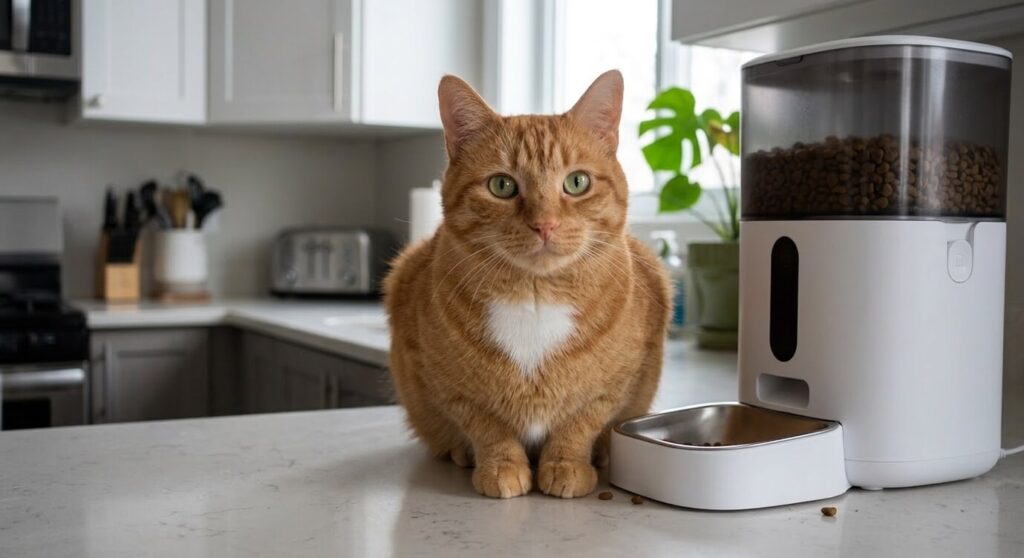
The best automatic cat feeders for indoor cats are portion-controlled, difficult for cats to break into, easy to clean, and reliable enough to dispense meals on schedule every day. For most single-cat homes, a Wi-Fi timed feeder with a secure hopper and battery backup is the most practical choice.

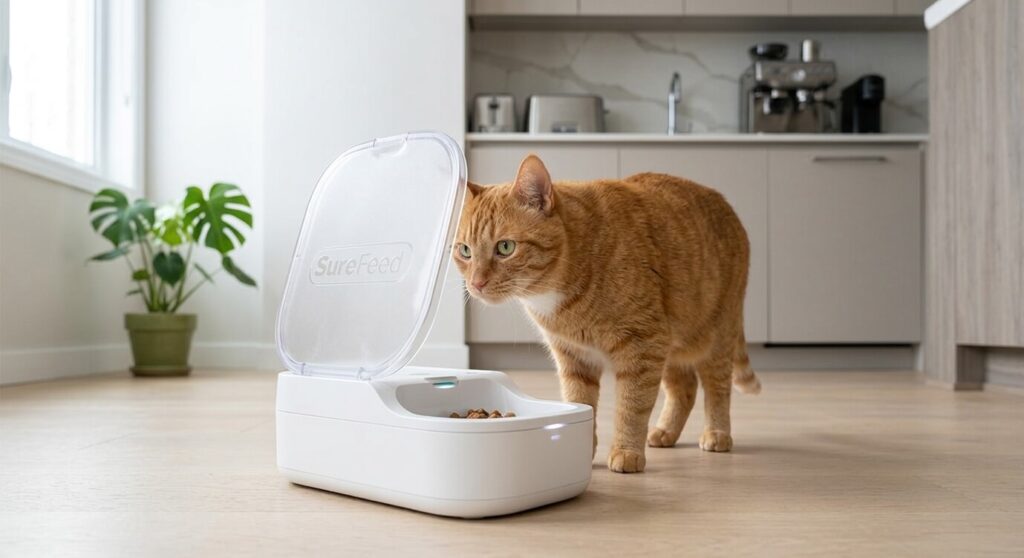
For multi-cat homes, prescription diets, or food stealing, a microchip feeder is usually a better fit than a standard hopper feeder. For cats who eat too fast, choose a feeder that can split meals into smaller portions or pair the feeder with a puzzle feeder or slow feeder bowl.

Before choosing a feeder, build the meal timing first with our indoor cat feeding schedule, then use the feeder to make that schedule easier to follow.


Why the Best Automatic Cat Feeders for Indoor Cats Prevent Obesity

Let me give you the professional case first, then the personal one.

Indoor cats have a obesity problem that the pet industry doesn’t talk about loudly enough. Without hunting activity, territorial roaming, or the caloric demands of outdoor life, indoor cats burn significantly fewer calories than their outdoor counterparts—but most owners feed them the same portions they’d find on a generic bag label.

Those bag labels are not individualized medical advice. They’re marketing averages.

The Obesity Epidemic in Indoor Cats

According to the Association for Pet Obesity Prevention, https://petobesityprevention.org/ an estimated 61% of cats in the United States are classified as overweight or obese by their veterinarians. The health consequences are serious and well-documented:

  • Type 2 diabetes
  • Hepatic lipidosis (fatty liver disease)
  • Osteoarthritis and joint deterioration
  • Urinary tract disease
  • Shortened lifespan

Automatic feeders with precise portion dispensing are the single most effective tool I recommend for managing indoor cat weight through accurate calorie control—and if you want to understand the full picture of why indoor cats gain weight so easily, and how to fight it, this connects directly to what I cover in my guide on managing indoor cat obesity. [Best Indoor Cat Feeding Schedule (Vet-Backed Routines)]

The Consistency Factor

Cats are creatures of routine in a way that is genuinely physiological, not just behavioral.

Irregular feeding times elevate cortisol levels in cats and create anxiety-driven behaviors: excessive vocalization, food guarding, destructive behavior, and the 4 AM chest assault I described above.

Consistent mealtimes reduce stress. An automatic feeder dispenses food at the same minute every day, regardless of whether you slept through your alarm, got stuck in a meeting, or forgot entirely. Maintaining that consistent feeding schedule is especially important when your workday runs long—something I cover in depth for busy cat owners who worry about their cats waiting. [How Much Should You Feed an Indoor Cat? Portion Guide by Weight]

Beyond portion control, timing is everything. See how to use scheduling to [5 Proven Secrets to Stop Cat Waking Me Up at Night ] stop cat waking me up at night once and for all.

The Veterinary Perspective on Portion Accuracy

Here’s what I see in practice that frustrates me: owners who “eyeball” portions.

A single extra tablespoon of dry kibble per meal—barely noticeable to a human—can add 20-30 calories per day to a cat’s intake. Over a year, that’s a meaningful weight gain in an animal that should consume roughly 200 calories total per day.

Automation is key, but the food itself matters most. Combine your schedule with the best wet cat food for weight loss to achieve optimal results for chunky cats.

Automatic feeders with calibrated dispensing wheels or rotors provide accuracy that human measurement simply cannot match consistently over time.


Key Features of the Best Automatic Cat Feeders for Indoor Cats

Not all automatic feeders are created equal. After testing multiple models and evaluating them through a vet tech’s lens, these are the features that actually matter.

1. Portion Accuracy and Dispensing Mechanism

This is non-negotiable for me. The best feeders use:

  • Rotating drum or disc systems: Most accurate; dispense a calibrated volume of kibble
  • Conveyor belt systems: Good for larger kibble sizes
  • Auger systems: Common in budget models; less precise, more prone to jamming

Avoid: Simple gravity-based feeders. They are not portion-controlled feeders—they are food dispensers that will make your cat fat.

2. Jam-Proof Design

Kibble jams happen when:

  • Kibble pieces are irregular in size
  • Humidity causes clumping
  • The motor is underpowered for the kibble density

Look for feeders that explicitly advertise jam-proof or anti-clog rotor designs. A feeder that jams silently while you’re at work means your cat missed a meal with no notification.

Pro tip: Make sure the hopper has space for a desiccant bag (silica gel packet) to keep kibble dry and free-flowing. Not all hoppers have this, and in humid climates, it makes a significant difference.

3. Cat-Proof Lid Security

This deserves its own section because indoor cats are extraordinarily clever food thieves.

Oliver dismantled his first feeder’s lid in approximately four days. He had worked out that pressing the rear hinge while lifting the front rim would pop the hopper open. He then ate approximately three days’ worth of food in one sitting.

Why lid security matters specifically for indoor cats:

Indoor cats have nothing to do all day but think about food and solve problems. They have no hunting, no territorial patrolling, no environmental demands on their attention. The feeder hopper is their intellectual challenge and their snack simultaneously.

A lid that requires simultaneous manipulation in two directions—or a locking mechanism that requires tools to open—is the minimum standard for an indoor cat with time on their paws.

4. Power Backup Options

A feeder that loses programming every time the power flickers is useless.

  • Battery backup: Essential; should maintain schedule for at least 24 hours
  • Dual power (AC + battery): Ideal configuration
  • Memory retention: Settings should survive a full power outage

5. Wi-Fi Connectivity and App Control

Wi-Fi connectivity has moved from “nice to have” to “genuinely useful” as the app ecosystems have matured.

The best apps now offer:

  • Remote schedule adjustments
  • Feeding history logs
  • Portion size changes without touching the device
  • Low food alerts
  • Camera integration on premium models

6. Hopper Capacity

Calculate your cat’s daily portions and multiply by the number of days between refills you want.

  • Small hoppers (1-2 lbs): Suitable for a single cat; refill every few days
  • Medium hoppers (4-6 lbs): Good for 1-2 cats; weekly refills possible
  • Large hoppers (8+ lbs): Multi-cat households or travel periods

7. Ease of Cleaning

Bacteria and mold grow in kibble residue. Any feeder you consider should be:

  • Dishwasher safe (at minimum the bowl and hopper)
  • Free of hard-to-reach corners where food debris accumulates
  • Designed so the rotor mechanism can be fully disassembled

I clean Oliver’s feeder components weekly. If I couldn’t disassemble and reassemble a feeder in under five minutes, it didn’t make my final list.


Automatic Cat Feeder Comparison

FeederBest ForFood TypeKey StrengthWatch Out For
SureFeed MicrochipMulti-cat homes and prescription dietsWet or dry portionsPrevents food stealing by catExpensive and not a bulk hopper
PETLIBRO Granary Wi-FiSingle-cat portion controlDry foodReliable app control and secure lid2.4GHz Wi-Fi only
Cat Mate C500Wet food and simple timed mealsWet or dry portionsSealed compartments and ice pack optionNo app or feeding history
WOPET Automatic FeederBudget scheduled feedingDry foodAffordable and simpleLess precise for medical diets
Arf Pets Camera FeederRemote monitoringDry foodCamera and two-way audioHigher price and app dependence

The feeders below are organized by use case, not by a single universal “best” pick. A multi-cat home, a wet-food routine, and a weight-control plan often need different feeder designs.

Top 5 Automatic Cat Feeders for Indoor Cats

These are the feeders I recommend based on hands-on testing, veterinary criteria, and real-world use with Oliver.


Best Overall for Multi-Cat Homes: SureFeed Microchip Feeder

Price range: $180 – $220

This feeder does something no rotating-drum feeder can: it reads your cat’s microchip and opens only for them. For multi-cat households where one cat is on a prescription diet or calorie restriction, this is genuinely transformative.

The SureFeed Connect integrates with the Sure Petcare app and provides:

  • Precise feeding history and portion tracking
  • Individual cat identification via microchip or RFID collar tag
  • Weight monitoring when paired with the SureFeed Scale
  • Real-time alerts when your cat hasn’t eaten

Why it’s Best Overall: The combination of behavioral data, portion accountability, and cat-specific access makes this the most medically useful feeder I’ve tested. For cats with diagnosed health conditions—diabetes, kidney disease, obesity—this level of monitoring is invaluable.

Pros:

  • Microchip/RFID access prevents food theft between cats
  • Feeding graphs show intake patterns over time
  • Works as a behavioral health monitoring tool
  • No kibble spillage (sealed bowl design)
  • Excellent app ecosystem

Cons:

  • Premium price point
  • Primarily designed for wet food or mixed feeding; less suited to large dry kibble hoppers
  • Requires consistent app engagement to extract full value
  • Lid can be slow to open/close for impatient cats

Best for: Multi-cat households, cats on prescription diets, owners who want veterinary-grade intake monitoring


Best Wi-Fi Feeder for One Cat: PETLIBRO Granary Wi-Fi

Price range: $80 – $110

This is the feeder Oliver currently uses, and it’s earned that position.

The PETLIBRO Granary features a twist-lock hopper lid that defeated Oliver’s attempts to gain unauthorized access. The rotating drum dispenser is accurate to within 2-3 kibble pieces per portion—which is genuinely impressive and consistent across my testing.

Key specifications:

  • 5-liter hopper capacity (approximately 12-14 days for a single adult cat)
  • Up to 15 meals per day programmable
  • Dual power (AC adapter + 3D batteries)
  • Infrared sensor to prevent overflow
  • Recorded voice message playback at mealtimes

The voice message feature is more useful than it sounds. Playing a recording of your voice calling your cat for dinner maintains behavioral association and can reduce the anxiety some cats show toward mechanical feeding.

Pros:

  • Excellent value for feature set
  • Twist-lock lid is genuinely cat-proof
  • Infrared blockage detection prevents overfeeding
  • App is intuitive and stable
  • Strong battery backup system

Cons:

  • Hopper is not fully transparent (requires opening to check level)
  • Not suitable for kibble smaller than 3mm (falls through gaps)
  • Wi-Fi requires 2.4GHz network only
  • Minimal feeding data analytics compared to premium options

Best for: Single-cat households, owners wanting reliable Wi-Fi control without premium pricing


Best for Wet Food Portions: Cat Mate C500

Price range: $55 – $75

I know what you’re thinking: this isn’t a Wi-Fi feeder. You’re right. And for multi-cat households where the priority is separate, simultaneous meal delivery rather than tech features, this reliability-focused option outperforms its connected competitors.

The C500 has five individual covered compartments that rotate on a timer. Each compartment is sealed until the scheduled mealtime, which means:

  • No food drying out in an open bowl
  • No other cats accessing another’s meal (when feeders are physically separated)
  • Accurate portion control through pre-measured compartments

Pros:

  • Individual sealed compartments maintain food freshness
  • Exceptionally reliable; minimal mechanical complexity
  • Works with wet food, dry food, and raw food
  • Battery operated; no power outlet required
  • Very easy to clean

Cons:

  • No app control or Wi-Fi connectivity
  • Five meals maximum (not suitable for owners wanting 6+ daily feedings)
  • Limited hopper capacity; frequent refilling needed
  • No feeding history or monitoring features

Best for: Budget-conscious multi-cat owners, wet food feeders, travel use, owners who prioritize reliability over technology


Best Budget Pick: WOPET Automatic Cat Feeder

Price range: $35 – $50

For owners who want reliable scheduled feeding without connectivity features, the WOPET delivers respectable performance at an entry-level price.

The portion accuracy isn’t class-leading, but it’s consistent—which matters more than precision at this price point. In my testing, portions varied by approximately 5-8% from the target, which is acceptable for a healthy adult cat without medical dietary requirements.

Pros:

  • Genuinely affordable entry point
  • Simple programming interface (no app required)
  • Reasonable portion consistency for the price
  • Dual power supply
  • Voice recording feature included

Cons:

  • Lid is not cat-proof against determined, intelligent cats
  • Hopper develops static cling issues with certain kibble types
  • Customer support is inconsistent
  • Not suitable for cats with medical dietary precision requirements

Best for: First-time automatic feeder users, cats without weight management needs, owners on a strict budget

Important caveat: If Oliver were on a calorie-restricted diet, I would not use this feeder. The portion variance is acceptable for maintenance feeding in healthy cats; it is not acceptable for therapeutic weight management.


Best Feeder With Camera: Arf Pets Automatic Feeder

Price range: $130 – $160

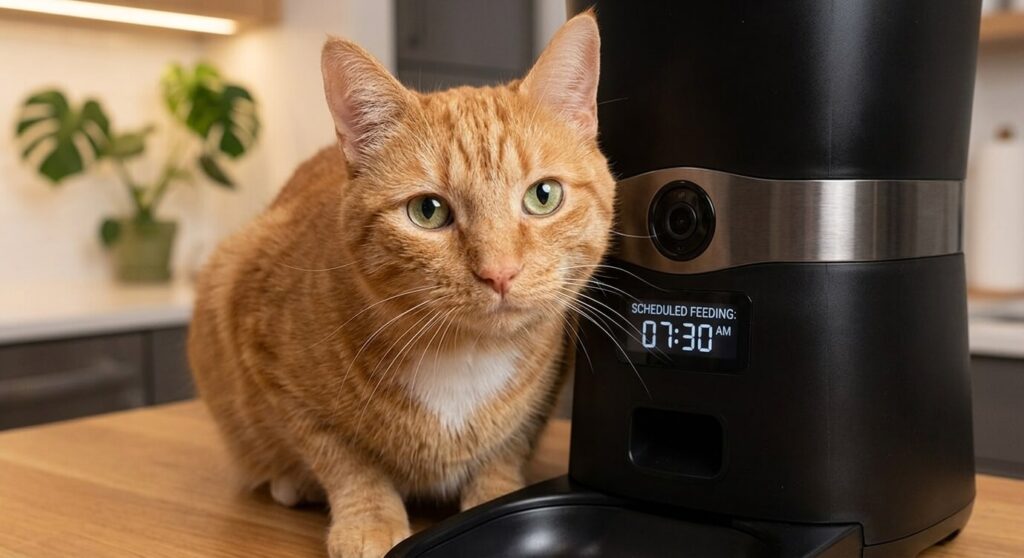
For owners who want to watch their cat eat from three states away (no judgment—Oliver is very watchable), the Arf Pets feeder integrates a 1080p camera with two-way audio directly into the feeder unit.

Beyond the camera, this feeder performs well on core metrics: the rotor is jam-resistant up to standard kibble sizes, the hopper is cat-proof with a dual-latch system, and the app provides meal history logging.

Pros:

  • Integrated 1080p camera with night vision
  • Two-way audio (call your cat’s name from your phone)
  • Reliable portion accuracy
  • Strong app experience with feeding history
  • Dual latch hopper security

Cons:

  • Premium price for a feeder that doesn’t offer RFID cat identification
  • Camera requires stable Wi-Fi; video quality degrades on slower connections
  • Hopper capacity (5 liters) is adequate but not exceptional
  • Some users report app connectivity drops requiring router restarts

Best for: Owners who travel frequently and want visual confirmation their cat is eating, those who want camera monitoring without a separate pet camera investment


Common Pitfalls to Avoid

I’ve watched these mistakes play out in practice. Skip the learning curve.

Buying A Feeder Before Testing Your Kibble

Not all feeders work with all kibble sizes. Before purchasing, check the manufacturer’s recommended kibble size range and measure your current food.

  • Kibble under 3mm often falls through disc gaps or creates dust buildup
  • Kibble over 12mm can jam rotating mechanisms
  • Irregularly shaped kibble (star, fish shapes) causes jams in drum systems

Ignoring the Humidity Factor

Humid apartments—especially in summer—cause kibble to soften and clump inside hoppers. Clumped kibble jams mechanisms and grows bacteria.

Solutions:

  • Add a food-safe desiccant packet to the hopper
  • Refill hoppers more frequently in summer months
  • Choose a feeder with a fully sealed hopper design

Setting and Forgetting

Automatic feeders reduce daily effort; they don’t eliminate oversight.

Check weekly that:

  • The rotor or mechanism is dispensing correctly
  • Kibble isn’t clumping or bridging in the hopper
  • The bowl is clean and free of residue
  • Battery backup charge is maintained

Transitioning Too Abruptly

If your cat currently free-feeds or eats on demand, moving immediately to four measured meals a day is stressful. Transition gradually over 10-14 days, introducing the feeder alongside your existing routine before fully relying on it.

Overlooking Wet Food Compatibility

Most automatic feeders are designed exclusively for dry kibble. If your cat eats wet food—or a combination—you need a feeder specifically designed for fresh food rotation, with ice pack compartments or a refrigerated unit.

If you plan to use wet food while you are away, read our guide on how to leave a cat alone for the weekend before relying on an automatic feeder alone.


Cleaning and Maintenance Schedule

TaskFrequency
Wash food bowlEvery 1-2 days
Wipe hopper interiorWeekly
Full disassembly and washBi-weekly
Check and replace desiccantMonthly
Full mechanism inspectionMonthly
Battery backup testMonthly

FAQ

How do I choose the best automatic cat feeders for indoor cats with weight issues?

Choosing the best automatic cat feeders for indoor cats managing weight requires prioritizing portion accuracy above all other features. Look for feeders with calibrated rotating drum or disc mechanisms—not gravity feeders, which cannot control portions.

Target a feeder that dispenses in increments of 1-5 grams and has an infrared overflow sensor. The SureFeed Microchip Connect is the gold standard for this use case because it also tracks intake over time, giving you data to share with your veterinarian. Always consult your vet for the specific daily calorie target before programming.

Can automatic feeders help with cats who eat too fast?

Absolutely, and this is one of the most underappreciated benefits. By programming 4-6 small meals per day instead of 1-2 large ones, you reduce the volume consumed in a single sitting, which directly reduces the vomiting associated with rapid eating.

Some feeders also have a “slow feed” bowl attachment or dispense kibble in small batches with brief delays between pieces. Fast eating in cats is often a scarcity response—when food appears reliably multiple times per day, many cats naturally slow down within 2-3 weeks.

Are automatic cat feeders safe to leave running during a vacation?

Yes, with appropriate precautions. Use a feeder with dual power (AC + battery backup) so a power interruption doesn’t disrupt the schedule.

Choose a hopper capacity sufficient for the full trip duration. If your trip exceeds 3-4 days, I’d strongly recommend having someone check in, refill water, and ensure the feeder is dispensing correctly—not because the technology isn’t reliable, but because cats need social contact and health monitoring beyond just food delivery.

For trips longer than 48 hours, a pet sitter who can verify the feeder is functioning correctly is always worth the investment.

Final Thoughts: Investing in the best automatic cat feeders for indoor cats is about more than just convenience—it’s about long-term health, weight stability, and a better relationship with your feline friend.

Can I use an automatic feeder with wet cat food?

Yes, but only if the feeder is designed for wet food. Most hopper-style automatic feeders are made for dry kibble and should not be used with wet food because they cannot keep it safely chilled or sealed for long periods. If you feed wet food, choose a compartment-style feeder with an ice pack, such as a timed tray feeder, and follow the food label’s storage and discard instructions.

For overnight or weekend absences, do not rely on wet food alone unless the feeder can keep it fresh and your cat has already tested the routine successfully. If you are planning to leave your cat for longer than a normal workday, read our guide on how to leave a cat alone for the weekend before depending on any automatic feeder.

Are automatic feeders good for cats on a diet?

Automatic feeders can help cats on a diet because they make portions more consistent and reduce emotional “extra scoops.” A good feeder can split the daily calorie target into smaller scheduled meals, which may reduce begging and help prevent overeating.

However, an automatic feeder does not replace a weight-loss plan. If your cat is overweight, ask your veterinarian for a target weight and daily calorie goal first. Then use the feeder to dispense that measured amount. For cats who eat too quickly, pair the feeder with a slow feeder bowl or puzzle feeder so the food lasts longer and feels more satisfying.


Final Thoughts

The best automatic cat feeder is not the fanciest one. It is the one that fits your cat’s food type, prevents unauthorized snacking, dispenses consistent portions, and is easy enough to clean that you will actually maintain it.

For most indoor cats, start with a clear feeding schedule, choose a feeder that supports that routine, and check the feeder weekly to make sure portions are still dispensing correctly.

If your cat is overweight, diabetic, on a prescription diet, or living in a multi-cat home, ask your veterinarian before relying on any automatic feeder as your primary feeding system.


References

Share this post

Subscribe to our newsletter

Keep up with the latest blog posts by staying updated. No spamming: we promise.
By clicking Sign Up you’re confirming that you agree with our Terms and Conditions.

Related posts