Leaving a cat at home for the weekend should not mean leaving the cat completely unattended. The safer plan is to keep a healthy adult cat in the familiar home while a reliable sitter, friend, or neighbor visits at least twice a day.
If you are working out how to leave a cat alone for the weekend, plan the human care first. Automatic feeders, water fountains, pet cameras, and extra litter boxes can reduce some failure points, but they cannot examine a sick cat, clean up vomit, restore a failed water supply, or respond to an emergency.
Give the caregiver clear feeding and litter instructions, your veterinarian’s contact details, the nearest emergency clinic, the carrier location, apartment access instructions, and written permission guidelines for urgent care. At every visit, they should see the cat when possible and confirm that food, water, litter access, movement, and behavior appear normal.
Quick Answer
For a weekend trip, do not rely on equipment alone. Arrange at least two in-person visits each day from a trusted caregiver. Then use a tested feeder, separate water sources, clean litter boxes, a hazard-checked home, and a pet camera as backup layers.
Very young or older cats, cats taking medication, and cats with recent illness, urinary problems, diabetes, kidney disease, seizures, poor appetite, repeated vomiting, or significant anxiety may need more frequent visits, an overnight sitter, boarding, or an individualized plan from a veterinarian.
Important Safety Note
A camera can show that something may be wrong, but it cannot provide care. Your caregiver should contact you promptly and follow your written veterinary instructions if the cat is not seen, does not eat, vomits repeatedly, has difficulty breathing, appears weak or painful, strains to urinate, or if food, water, power, temperature control, or home access fails.
Table of Contents
How Long Can a Cat Be Left During a Weekend?
There is no universal 48- or 72-hour rule that is safe for every cat. Age, health, medication needs, feeding routine, temperament, home temperature, and access to reliable care all affect how much supervision a cat needs.
For a weekend trip, plan around human visits rather than the maximum number of hours your cat might tolerate alone. Cats Protection and Blue Cross recommend arranging for a responsible caregiver to visit at least twice a day while you are away. Some cats need more frequent care or an overnight sitter.
During every visit, the caregiver should:
- See the cat when possible and check that they are alert and moving normally.
- Refresh food and water and confirm that any feeder or fountain is working.
- Scoop the litter boxes and look for significant changes in urine or stool output.
- Check for vomiting, diarrhea, injury, escape risks, unusual hiding, or damage in the home.
- Spend time interacting with the cat if the cat is comfortable with them.
- Contact you promptly if anything appears abnormal.
Kittens, older cats, cats taking medication, and cats with diabetes, kidney disease, urinary problems, seizures, recent surgery, appetite changes, repeated vomiting, or significant anxiety may need more frequent visits, professional care, boarding, or a plan agreed with a veterinarian.
Automatic feeders, water fountains, cameras, and extra litter boxes are useful backup layers, but they do not replace a person who can enter the home and respond when something fails.
If you are planning a normal workday rather than a weekend trip, see our guide to how to entertain an indoor cat while at work.
Step 1: Food Planning — Keep the Normal Diet and Add Human Checks
Keep your cat’s usual food, portion sizes, and meal schedule while you are away. A weekend trip is not the right time to introduce a new diet, switch feeding methods, or depend on unfamiliar equipment.
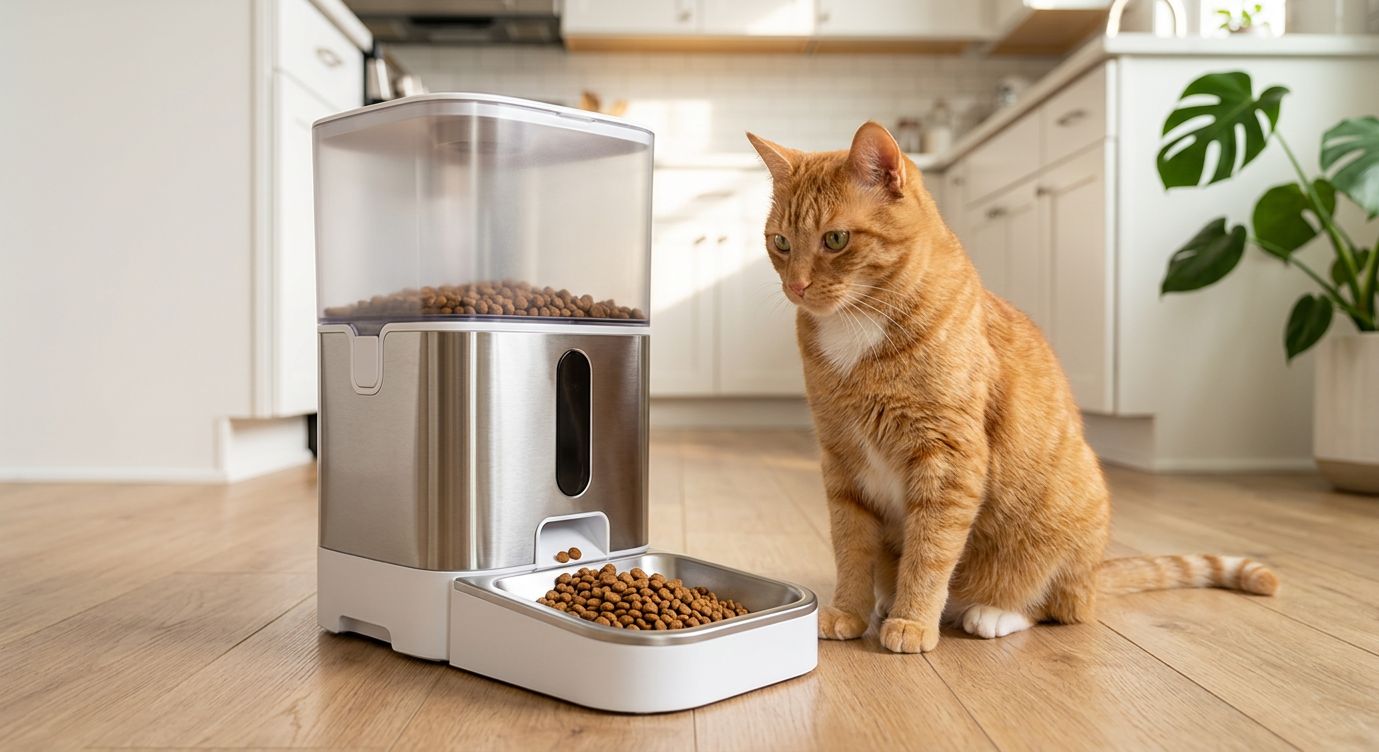
An automatic feeder can help maintain the normal schedule, but it should support the caregiver rather than replace them. The person visiting your cat should confirm that food was dispensed, the cat has eaten, and no vomiting or other concerning change is visible.
Preparing the Feeding Setup
- Test the feeder through a complete weekend-length cycle while you are still at home.
- Make sure your cat is already comfortable eating from it.
- Use the portions your cat normally receives rather than adding an arbitrary percentage of extra food.
- Check the batteries, power connection, clock, dispensing mechanism, and bowl before departure.
- Leave clearly labeled food portions and written instructions for the caregiver.
- Store additional food where the caregiver can reach it if the feeder fails or your return is delayed.
- If your cat eats wet food, use a feeding method that keeps it appropriately chilled or have the caregiver serve fresh meals.
- In a multi-cat home, confirm that one cat cannot block another cat’s access or consume both portions.
For feeder capacity, battery backup, portion control, and wet-food compatibility, see our guide to the best automatic cat feeders for indoor cats.
If Your Cat Does Not Eat
Loss of appetite in cats can be an early sign of illness and can become medically serious, particularly in cats that are overweight or have an existing health condition. Do not assume that an untouched meal is simply a reaction to your absence.
Ask the caregiver to contact you promptly if food remains untouched, the cat refuses a normally accepted meal, or there is vomiting, marked lethargy, hiding, drooling, weakness, or another significant behavior change. Follow your veterinarian’s instructions or contact an emergency clinic rather than waiting until the end of the weekend.
The safest feeding backup is a person who can enter the home, examine the situation, provide fresh food, and obtain veterinary help when necessary.

Step 2: Water Security — Provide Multiple Fresh Sources
Cats should have continuous access to fresh water. During a weekend trip, multiple water sources reduce the risk created by a spilled bowl, contaminated water, a power outage, or a fountain malfunction.
For one cat, provide at least two familiar water sources in separate, easily accessible locations. A fountain can be one source if the cat already uses it reliably, but a stable bowl should remain available as a backup.
Setting Up the Water Sources
- Clean and refill every bowl and fountain shortly before departure.
- Use containers your cat already accepts rather than introducing a new fountain immediately before the trip.
- Place the water sources in separate, quiet locations away from litter boxes and household hazards.
- Choose stable bowls that are difficult to tip and easy for the caregiver to clean.
- If using a fountain, check the pump, filter, cord, reservoir, and power connection.
- Keep a non-electric bowl available in case the fountain or household power fails.
- Maintain your cat’s normal diet rather than making a sudden switch solely to increase water intake.
- Ask the caregiver to refresh the water and confirm that the bowls and fountain are accessible at every visit.
- Have the caregiver check for spills, contamination, unexpectedly low water levels, vomiting, and significant changes in litter-box output.
A pet camera may help show whether a cat approaches the water area, but it cannot confirm adequate hydration or replace an in-person check.
For information about bowl materials, fountain cleaning, and individual drinking preferences, see our guide to the best cat water fountains.
Watch for Urinary Emergencies
Straining to urinate, repeatedly entering the litter box, crying while attempting to urinate, passing blood, or producing little or no urine requires urgent veterinary attention. A complete urethral obstruction is a medical emergency and is more common in male cats.
Make sure the caregiver knows these warning signs, has the emergency clinic details, and understands that they should not wait for you to return before seeking veterinary help.
Step 3: Litter Box Planning — Add Capacity and Schedule Scooping
A clean, accessible litter box is an essential resource, but there is no fixed number of hours after which every cat will refuse a box. Cats differ in their litter preferences, elimination frequency, health, and tolerance for a soiled tray.
A useful starting point is one litter box per cat plus one extra. For a single cat staying home during a weekend trip, providing a second box in a separate location adds capacity and gives the cat another option if one box becomes dirty or difficult to access. It does not replace regular scooping by the caregiver.
Preparing the Litter Boxes
- Keep the litter type, box style, and normal litter depth familiar. Do not introduce scented litter or make a major setup change immediately before the trip.
- Scoop every litter box shortly before departure.
- Place the boxes in separate, quiet, easily accessible locations rather than side by side.
- Keep boxes away from food and water, and make sure doors or appliances cannot block access.
- Use boxes that are stable and large enough for the cat to use comfortably.
- Leave extra litter, waste bags, and written cleaning instructions where the caregiver can find them.
- Ask the caregiver to scoop the boxes at every visit and confirm that urine and stool are present.
- Clean accidents appropriately, and never punish the cat for eliminating outside the box.
Changes That Need Attention
Repeated trips to the litter box, straining, crying, blood in the urine, vomiting, diarrhea, a sudden lack of urine or stool, or new elimination outside the box may indicate a medical or environmental problem.
Straining with little or no urine is an emergency, especially in a male cat, and requires immediate veterinary care.
If your cat has a history of urinary disease, constipation, diarrhea, mobility problems, or litter-box avoidance, ask your veterinarian whether more frequent caregiver visits or a different care plan is needed.
Step 4: Apartment Hazard Proofing — The Pre-Departure Walkthrough
Before leaving, inspect the apartment from your cat’s point of view. Remove hazards rather than assuming the cat will ignore them, and make sure the caregiver can reach every essential resource during each visit.
Physical and Escape Hazards
- Close and securely latch exterior windows, balcony doors, and screens. Do not rely on an ordinary insect screen to prevent a fall or escape.
- Tie up or remove blind and curtain cords that could form a loop around the cat.
- Put away string, yarn, ribbon, dental floss, rubber bands, hair ties, twist ties, needles, and other small objects that could be swallowed. Do not leave wand toys or string toys available without supervision.
- Secure electrical cords that the cat is known to chew, and unplug nonessential heating appliances such as heating pads and electric blankets.
- Keep plastic bags, food wrappers, and other materials that could be swallowed or become trapped around the cat’s head out of reach.
- Close toilet lids and empty buckets, tubs, or sinks containing water or cleaning solution.
- Check washers, dryers, recliners, folding furniture, closets, and cabinets before closing or operating them.
- Use doorstops where needed so an interior door cannot swing shut and trap the cat away from food, water, or litter boxes.
Toxic Substances
- Store human and veterinary medications in securely closed cabinets, not on counters or open shelves.
- Lock away cleaning products, pesticides, rodenticides, essential oils, nicotine products, cannabis products, and other potentially toxic substances.
- Remove toxic plants and flowers from every area the cat can access. Do not leave lilies in the home because even a small exposure can cause life-threatening kidney injury in cats.
- Remove unsafe human food, dirty dishes, food scraps, and unsecured trash.
Temperature, Lighting, and Access
- Keep the heating or cooling system operating at a temperature already comfortable for your cat. Check the weather forecast and make sure the caregiver knows how to respond if the apartment becomes unusually hot or cold.
- Preserve a normal day-and-night pattern. Use securely arranged natural light or a lamp on a timer rather than leaving the apartment brightly lit or completely dark throughout the trip.
- Confirm that the caregiver has a working key, building-access instructions, your contact information, the veterinarian’s number, and the location of the carrier.
- Before leaving, perform one final head count and confirm that the cat has access to every food station, water source, litter box, resting area, and hiding place.
If you suspect that your cat has swallowed a toxic substance or foreign object, contact a veterinarian or animal poison control service immediately. Do not induce vomiting unless a veterinary professional specifically instructs you to do so.
Step 5: Use a Pet Camera as Backup Monitoring
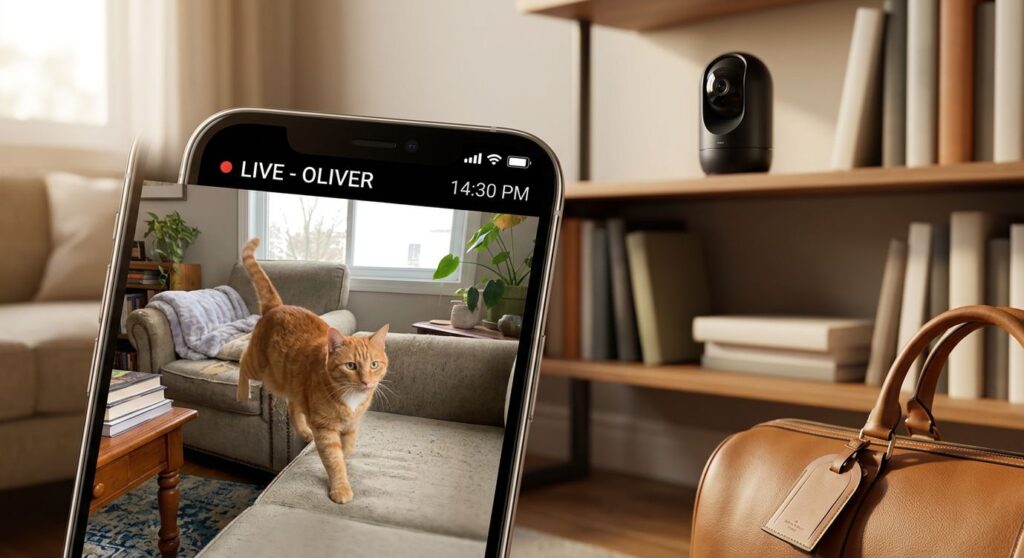
A pet camera can help you notice obvious changes while you are away, but it should supplement scheduled caregiver visits rather than replace them. A camera has a limited field of view and cannot reliably confirm how much your cat has eaten or drunk, whether urine and stool are normal, or what is happening elsewhere in the apartment.
For feature comparisons, see our guide to the best pet camera for cats.
Set Up and Test the Camera
- Position the camera where it can show the feeding area and a frequently used route or resting space.
- Mount it securely and protect its power cable from chewing or entanglement.
- Test the live view, notifications, night vision, power supply, and internet connection before the trip.
- Use a unique password, install available security updates, and enable two-factor authentication if the camera account supports it.
- Test two-way audio while you are home. If your cat appears startled or distressed by a voice coming from the device, leave that feature turned off.
- Do not treat a lack of motion alerts as proof that the cat is ill. The cat may be sleeping or outside the camera’s view, but the caregiver should investigate if the cat is not seen during its usual routine.
When the Camera Shows a Possible Problem
Ask the caregiver to enter the apartment promptly if:
- the camera or feeder goes offline and the cause cannot be confirmed;
- the cat is repeatedly visiting the feeder, water station, or litter box;
- vomiting, limping, unusual hiding, weakness, or abnormal movement is visible;
- the cat appears trapped, injured, or unable to reach an essential resource;
- food, water, or litter conditions appear abnormal.
Difficulty breathing, open-mouth breathing, collapse, unresponsiveness, seizure activity, serious trauma, repeated or severe vomiting, or straining with little or no urine requires urgent veterinary attention. A camera image can identify a warning sign, but it cannot diagnose the cause or determine whether it is safe to wait.
Prepare the Human Response Plan
Before leaving, give the caregiver:
- a working key and complete building-access instructions;
- your regular veterinarian’s number and the nearest emergency clinic’s information;
- the location of the carrier and emergency supplies;
- permission and payment instructions for urgent veterinary care;
- a written checklist covering food, water, litter, medication, behavior, and visible signs of illness.
The caregiver should still complete every scheduled visit even when the camera appears normal. If your cat needs closer observation than home visits can provide, compare a pet sitter with boarding before the trip and use a written apartment cat emergency evacuation plan.
Enrichment for the Weekend: Keep It Familiar and Safe
Weekend enrichment should give your cat safe choices while preserving its normal routine. It does not replace the exercise, observation, and social interaction provided during the caregiver’s visits.
Use only toys and activities that your cat has already used safely while you were home. A new toy should be tested under supervision before it is left in the apartment.
Safe Pre-Departure Enrichment
- Leave several familiar, sturdy toys that are too large to swallow and have no loose strings, ribbons, feathers, elastic loops, bells, or detachable pieces.
- Put away wand toys, yarn, hair ties, and other linear objects whenever nobody is supervising the cat.
- Provide a stable scratching post or scratching pad in a location the cat already uses.
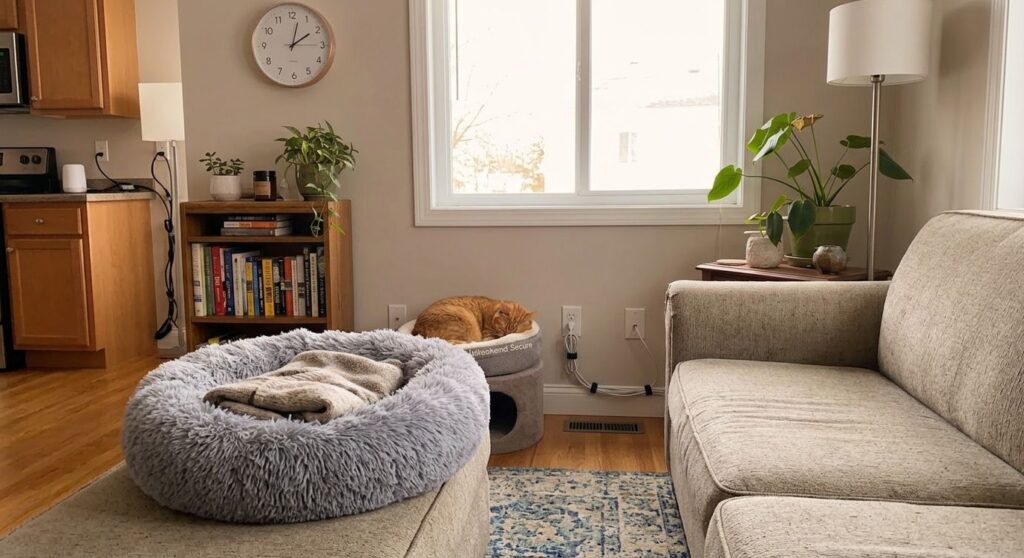
- Keep familiar hiding places and securely anchored elevated resting areas available.
- An open cardboard box can provide a simple hiding and exploration space. Remove staples, loose tape, plastic, and handles, and make sure the box cannot collapse or trap the cat.
- Use a food puzzle only if the cat already understands it and has used it safely. Fill it with part of the cat’s normal daily food allowance rather than adding extra calories.
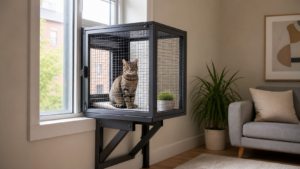
- If the cat normally enjoys watching activity through a window, leave access to a secure window perch only after confirming that the window and screen are safely latched.
- Ask the caregiver to offer a short play or interaction session during each visit, following the cat’s preferences without forcing contact.
Avoid Unsupervised Equipment Risks
Do not leave string toys, feather wands, laser devices, or unfamiliar battery-powered toys operating while the cat is alone. Automatic toys may stop, break, trap a paw, expose a battery, or create loose parts.
A television or video is optional, not essential enrichment. Use it only if your cat already responds calmly to it and the screen, stand, power cable, and timer can all be secured. Do not leave an unsecured tablet or laptop running in the apartment.
If your cat follows a veterinary diet, weight-control plan, or feeding restriction, count every treat and food puzzle portion within the prescribed daily allowance.
The Return Home: Check Your Cat Before Resuming the Routine
Cats respond differently when their caregiver returns. Some approach immediately, while others remain asleep, watch from a distance, or stay in a hiding place. Do not interpret a quiet or distant response as punishment, and do not expect every cat to return to its usual behavior within a fixed number of hours.
Enter calmly, close the exterior door securely, and locate your cat without pulling it out of a hiding place. Allow the cat to choose whether to approach.
Complete a Post-Trip Check
- Observe the cat’s breathing, alertness, posture, balance, and ability to walk normally.
- Ask the caregiver about appetite, drinking, urination, stool, vomiting, medication, hiding, and behavior during the final visit.
- Check the feeder history and remaining food rather than assuming an empty or full bowl tells the whole story.
- Inspect every water source for spills, contamination, or equipment failure.
- Check the litter boxes for urine and stool, and look for diarrhea, blood, or unusually small urine clumps.
- Inspect the apartment for vomit, damaged objects, chewed cords, spilled products, or evidence that the cat swallowed something.
- Refresh the water, scoop the litter boxes, and offer the cat its normal scheduled meal. Do not compensate for your absence with an unusually large meal.
- Resume the usual feeding, play, and rest schedule. Offer calm interaction, but stop if the cat shows avoidance, flattened ears, agitation, or other signs that it needs space.
When to Contact a Veterinarian
Difficulty breathing or open-mouth breathing, collapse, unresponsiveness, seizure activity, serious injury, or straining with little or no urine requires immediate veterinary care.
Contact your veterinarian promptly if the cat has missed meals, has a clear reduction in appetite, vomits repeatedly, develops diarrhea, shows unusual thirst or urination, appears weak or painful, walks abnormally, or continues behaving differently from its normal pattern.
After the cat’s immediate needs are addressed, record any feeder, fountain, camera, access, or caregiver problems. Use those notes to improve the care plan or arrange more frequent visits for the next trip.
FAQ
Will My Cat Think I Abandoned Them?
We cannot know whether a cat interprets an owner’s absence as “abandonment” in the human sense. What can be observed is that cats notice changes in routine, environment, and social interaction, and individual responses vary.
Some cats greet their owner immediately, while others hide, vocalize, eat differently, or appear more reserved. None of these behaviors alone proves that the bond has been damaged.
For a weekend trip, focus on the cat’s observable needs: maintain its familiar feeding and household routine, arrange scheduled caregiver visits, provide safe resting and hiding places, and make sure changes in appetite, elimination, movement, or behavior are noticed promptly.
When you return, resume the normal routine and allow the cat to choose when to interact. If a change in eating, drinking, litter-box use, activity, or hiding persists—or occurs with vomiting, pain, weakness, or another sign of illness—contact your veterinarian.
If your cat already shows separation-related distress, discuss the travel plan with your veterinarian before leaving rather than assuming that additional equipment will solve the problem.
Is 3 Days Too Long to Leave a Cat Alone?
Yes—three days is too long for a cat to remain completely without in-person care. An automatic feeder, water fountain, camera, and extra litter box can reduce individual equipment failures, but they cannot examine an ill cat, clean vomit, correct a blocked water source, or obtain veterinary care.
A healthy adult cat may remain in its familiar home during a three-day trip only when a reliable sitter, friend, or neighbor provides scheduled visits. Arrange at least two visits each day to:
- visually check the cat’s condition and movement;
- provide fresh food and water;
- confirm that feeding and water equipment is working;
- scoop the litter boxes and check for urine and stool;
- look for vomiting, diarrhea, injury, escape, or unusual behavior;
- provide appropriate interaction; and
- respond immediately if veterinary care is needed.
Kittens, senior cats, cats taking medication, and cats with urinary disease, diabetes, kidney disease, appetite problems, recent illness or surgery, mobility limitations, or significant anxiety may need more frequent care, an overnight sitter, or veterinary boarding. Ask your veterinarian which arrangement is appropriate.
Also prepare for a delayed return. The caregiver should remain available until you have physically returned home and confirmed that the cat is well.
Should I Hire a Sitter if I Leave My Cat Alone for the Weekend?
Yes. If you will be away overnight or for an entire weekend, arrange a reliable sitter, friend, neighbor, or family member to provide in-person care. For a healthy adult cat, schedule at least two visits each day. Automatic feeders, fountains, extra litter boxes, and cameras should serve as backups between visits, not as replacements for a caregiver.
The caregiver does not have to be a paid professional if a trusted person can reliably:
- follow the cat’s normal feeding and care schedule;
- confirm that the cat is seen and moving normally;
- refresh water and verify that equipment is working;
- scoop the litter boxes and monitor urine and stool;
- recognize vomiting, appetite changes, urinary problems, injury, or unusual behavior;
- enter the apartment promptly if an alarm or camera shows a problem; and
- contact a veterinarian and transport the cat if urgent care is needed.
Arrange a professional sitter, overnight care, or boarding if the cat needs medication, frequent meals, close medical observation, help with mobility, or more supervision than short visits can provide. Kittens, senior cats, cats recovering from illness or surgery, and cats with urinary disease, diabetes, kidney disease, appetite problems, or significant anxiety may need an individualized plan from a veterinarian.
Meet the caregiver before the trip, test the key and building access, provide written instructions and emergency authorization, and identify a second person who can take over if the primary caregiver becomes unavailable.
If you are deciding between care at home and a boarding facility, use our cat boarding vs pet sitter comparison to evaluate which option better fits your cat’s health, temperament, and care needs.
What Should the Caregiver Check During Each Visit?
The caregiver should follow the same written checklist at every scheduled visit and report the results to you. Equipment status alone is not enough—the visit should include an observation of the cat and the apartment.
At each visit, ask the caregiver to:
- confirm that the cat is safely inside the apartment;
- visually locate the cat without pulling it from a hiding place or forcing contact;
- observe breathing, alertness, posture, balance, and walking;
- serve the normal meal and record whether the previous food appears to have been eaten;
- provide fresh water and inspect every bowl, fountain, and feeder for spills, contamination, jams, or power failure;
- scoop every litter box and confirm that urine and stool are present;
- look for unusually small urine clumps, diarrhea, blood, vomit, damaged objects, or possible toxin exposure;
- give medication exactly as instructed, if applicable;
- offer calm interaction or supervised play according to the cat’s preference; and
- send a brief update after the visit, including any change in food intake, litter-box output, behavior, or equipment.
If the cat cannot be located, the caregiver should check hiding places, doors, windows, closets, appliances, and possible escape routes. They should not simply assume that the cat is sleeping.
Difficulty breathing or open-mouth breathing, collapse, unresponsiveness, seizure activity, serious injury, suspected poisoning, or repeated straining with little or no urine requires immediate veterinary attention. Appetite loss, repeated vomiting, diarrhea, weakness, unusual hiding, abnormal walking, or a significant change in drinking or urination should be reported promptly and discussed with a veterinarian.
Before the trip, provide the caregiver with veterinary and emergency-clinic details, the carrier location, treatment authorization, payment instructions, your travel contact information, and a second person to call if you cannot be reached.
What If My Automatic Feeder Malfunctions While I’m Gone?
Contact the caregiver immediately and ask them to enter the apartment. They should inspect the feeder, provide the cat’s normal premeasured meal manually, confirm that the cat is able and willing to eat, and repair or replace the device only if they can do so safely. Do not wait until the next scheduled visit if an alert or camera suggests that a meal was not dispensed.
Before the trip:
- operate the feeder through multiple normal meal cycles while you are home;
- confirm the clock, schedule, portion setting, food level, lid, and dispensing mechanism;
- clean and dry the food-contact parts according to the device instructions;
- connect the power supply securely and install fresh backup batteries if the model supports them;
- leave individually measured backup meals with written feeding instructions;
- show the caregiver how to open, reset, or manually dispense from the feeder; and
- include the feeder check in every scheduled visit.
Do not rely on a large unrestricted bowl of emergency food unless free-feeding is already appropriate for your cat. Some cats may eat too much at once, while cats on a veterinary diet, weight-control plan, or prescribed meal schedule may require strict portions.
A camera or feeder notification can alert you to a possible problem, but it cannot confirm how much food the cat consumed. The caregiver must check the cat and the food directly.
If the cat has missed a meal and then refuses the replacement food, appears weak, vomits, or behaves abnormally, the caregiver should contact your veterinarian promptly. Cats with diabetes, medication tied to meals, appetite disorders, or another medical condition need a veterinarian-approved feeding and emergency plan before the trip; the caregiver should never improvise medication changes.
Final Thoughts
Learning how to leave a cat alone for the weekend safely is not about finding the maximum number of hours a cat can tolerate without help. It is about creating a care plan that continues to meet the cat’s needs while you are away.
For many healthy adult cats, remaining in their familiar home can be appropriate when a reliable caregiver visits at least twice each day. The caregiver should provide fresh food and water, clean the litter boxes, observe the cat’s health and behavior, and respond if something goes wrong.
Before leaving, confirm that:
- the feeding plan follows the cat’s normal diet and schedule;
- multiple fresh water sources are available;
- clean litter boxes are placed in accessible locations;
- windows, cords, toxic substances, and other apartment hazards are secured;
- enrichment items are familiar and safe for unsupervised use;
- the caregiver has tested access, written instructions, veterinary contacts, and emergency authorization; and
- someone can continue providing care if your return is delayed.
Automatic feeders, fountains, extra litter boxes, and pet cameras can add useful backup layers, but none can replace scheduled in-person care.
Kittens, senior cats, cats taking medication, and cats with medical or significant behavioral needs may require more frequent visits, overnight care, boarding, or an individualized plan from a veterinarian. If reliable visits and emergency response cannot be guaranteed, do not leave the cat at home without appropriate care.
References
American Animal Hospital Association. “General Litter Box Considerations.”
https://www.aaha.org/resources/2021-aaha-aafp-feline-life-stage-guidelines/general-litter-box-considerations/
Cats Protection. “Going on Holiday Without Your Cat.”
https://www.cats.org.uk/help-and-advice/home-and-environment/going-on-holiday
Cornell Feline Health Center. “Anorexia.”
https://www.vet.cornell.edu/departments-centers-and-institutes/cornell-feline-health-center/health-information/feline-health-topics/anorexia
Cornell Feline Health Center. “Feline Lower Urinary Tract Disease.”
https://www.vet.cornell.edu/departments-centers-and-institutes/cornell-feline-health-center/health-information/feline-health-topics/feline-lower-urinary-tract-disease
Cornell Feline Health Center. “Common Cat Hazards.”
https://www.vet.cornell.edu/departments-centers-and-institutes/cornell-feline-health-center/health-information/feline-health-topics/common-cat-hazards-0
Cornell Feline Health Center. “Safe Toys and Gifts.”
https://www.vet.cornell.edu/departments-centers-and-institutes/cornell-feline-health-center/health-information/feline-health-topics/safe-toys-and-gifts