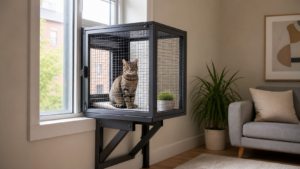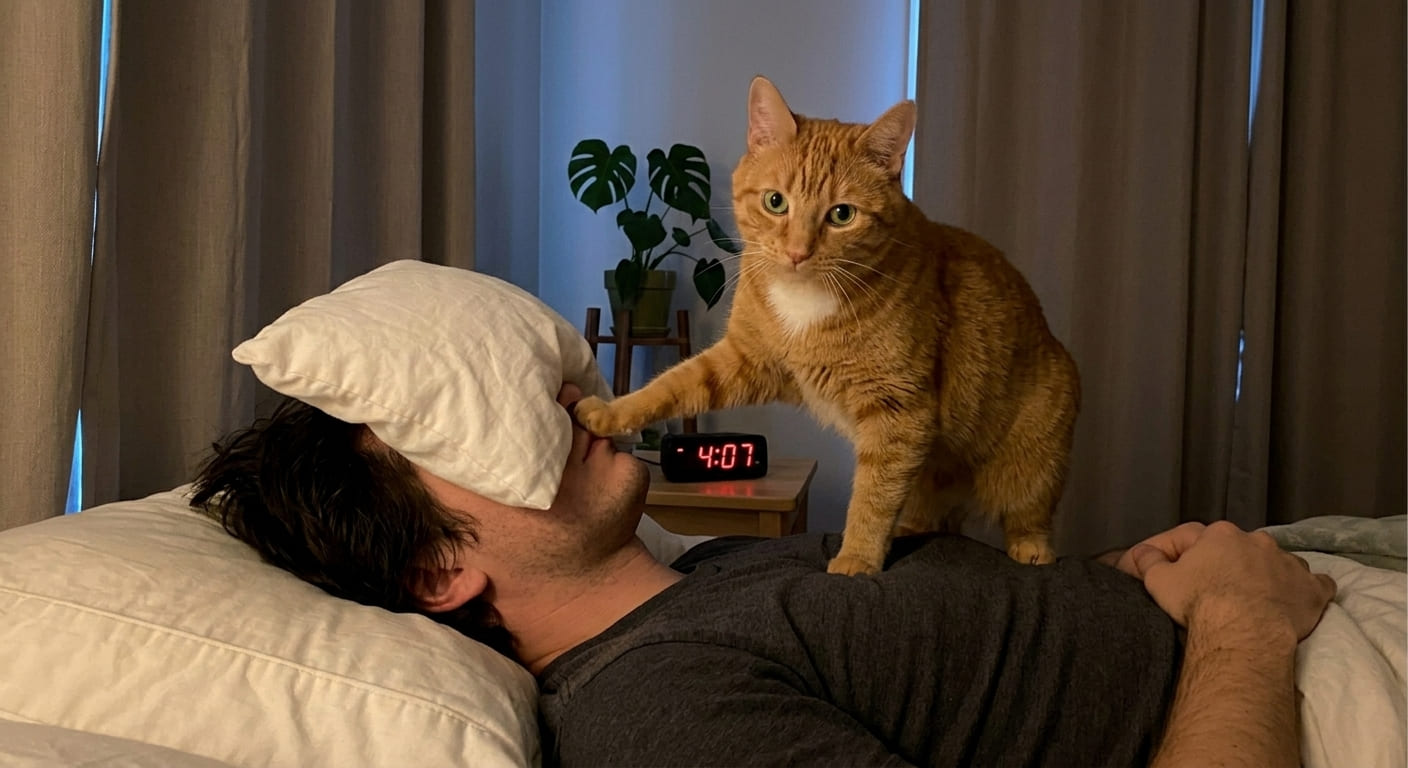
Being woken by a cat before dawn is exhausting, but the solution starts with identifying what the cat is seeking: food, play, access, attention, or relief from discomfort.
If you are trying to stop cat waking me up at night, the first thing to understand is that your cat is not doing it to annoy you. Night waking usually comes from a mix of dawn activity patterns, hunger expectations, boredom, learned attention-seeking, or, in older cats, possible medical changes.
This guide combines predictable feeding, appropriate evening play, environmental adjustments, and veterinary warning signs. Withholding attention is relevant only to a safe, established attention-seeking pattern after the cat’s needs and health have been assessed.
Quick Answer: How Can I Stop My Cat Waking Me Up at Night?
To stop cat waking me up at night, do three things consistently: do not reward nighttime meowing with attention, move the early food reward to an automatic feeder, and add a structured play-and-meal routine before bed. The goal is to make nighttime boring and predictable while giving your cat a better outlet for hunger and dawn energy.
If the waking is sudden, intense, or happening in a senior cat, rule out medical causes first. Hyperthyroidism, chronic kidney disease, hypertension, pain, and cognitive changes can all cause nighttime restlessness or vocalizing.
Important Veterinary Note: If your cat is over 7 years old, suddenly starts waking you, cries at night, loses weight, drinks more, seems confused, vomits, limps, or changes appetite, schedule a veterinary exam before treating the problem as training. Night waking can be behavioral, but it can also be a sign of pain, thyroid disease, kidney disease, high blood pressure, or cognitive decline.
Table of Contents
The Crepuscular Clock: Why 4 AM Is Primetime for Cats
Before choosing a solution, separate normal dawn activity and learned routines from a sudden behavior change that may need veterinary attention.
What ‘Crepuscular’ Actually Means
Cats are Crepuscular animals — a term from the Latin crepusculum meaning twilight. Their evolutionary biology has optimized them for peak activity, alertness, and hunting drive during the low-light periods of dawn and dusk. This is not arbitrary. It reflects the activity patterns of their primary prey species — small rodents and birds — which are themselves most active in these transitional light conditions.
The Crepuscular drive is encoded in the cat’s circadian rhythm through:
- Suprachiasmatic nucleus (SCN) programming: The brain’s internal clock is calibrated by light exposure, with activity hormones (particularly orexin/hypocretin) peaking in the crepuscular windows
- Retinal light sensitivity: Cats have a tapetum lucidum that amplifies light in low-light conditions — their vision is genuinely optimized for dawn/dusk hunting conditions
- Melatonin suppression patterns: Melatonin (the sleep hormone) drops sharply as first light approaches, triggering the pre-dawn activation phase
What this means for your 4 AM problem:
Cats are often active around dawn and dusk. In an apartment with limited overnight outlets, that activity may be redirected toward the caregiver, bedroom door, food area, or objects that reliably produce a response.
The Indoor Amplification Problem
Outdoor Crepuscular cats discharge their pre-dawn activation in the environment — actual hunting, territory patrol, social interaction with other cats. The activity finds its natural outlet.
Indoor cats may have few appropriate outlets for early-morning activity. Common behaviors include:
- Your face (the most prominent moving object in the room)
- Your feet under the duvet
- Sudden sprinting circuits of the apartment (zoomies)
- Loud vocalizations
- Knocking objects off surfaces (the 4 AM physics experiments)
- Demand-meowing at the bedroom door
Treat this as a routine to redirect rather than a battle to win. The plan should meet the cat’s needs while making the unwanted wake-up behavior less rewarding.
The Hunger Amplifier
Layered on top of the Crepuscular activation is a very practical problem: Metabolic Demand.
Meal timing can contribute to early waking, especially when breakfast consistently follows meowing or contact with the sleeping caregiver. Do not assume hunger is the only cause; first review the cat’s total diet, health, evening activity, and established feeding routine.
Dawn activity, food expectation, and learned attention can overlap. Address the triggers you can identify instead of relying on one universal fix.
The ‘Ignoring’ Paradox: Why Your Anger Is a Reward
This is the behavioral concept that changes everything once it clicks — and the reason that many owners who try to “ignore” their cats’ nighttime behavior fail to see results.
Every Response Is a Reward
Attention can reinforce attention-seeking behavior even when the response is negative. Common accidental rewards include:
- Saying the cat’s name or telling them “no”
- Pushed him off gently — that was physical interaction
- Groaned audibly — that was a vocal response
- Turned over and pulled the duvet up — that was movement (which triggers Crepuscular prey drive)
If these responses repeatedly follow the same behavior, the cat may learn that waking the person produces interaction. The learning history matters more than whether the human response felt positive or negative.
The result is classic operant conditioning: behavior → reward → behavior increases in frequency and intensity.
Night waking is often a learned behavior pattern, not just a sleep problem. For related indoor behavior guides, see our cat behavior guide hub.
The Extinction Burst: It Gets Worse Before It Gets Better
Here is the piece of information that saves people from giving up on the ignoring protocol just as it starts working:
When a familiar reward stops, the behavior may briefly become more frequent or intense, but this does not happen on a fixed schedule and is not the only possible response. Reassess if the cat appears distressed, stops eating, or shows a sudden change in behavior.
A cat that previously received attention for nighttime behavior may try the same behavior again or use a different attention-seeking behavior when the routine changes.
- Try face-sitting again (the usual behavior)
- Try face-sitting more insistently (escalation)
- Try face-sitting plus meowing (adding behaviors that previously worked)
- Try face-sitting plus meowing plus knocking things off the nightstand (Extinction Burst peak)
- Review whether the cat remains comfortable and whether the identified attention-seeking pattern changes; do not assume that persistence always leads to improvement.
A previously rewarded demand may temporarily increase when a routine changes, but this is not inevitable and has no universal duration. Worsening behavior can also signal distress or illness.
Plan for reassessment rather than assuming that louder or more persistent behavior means the method is working.
True Ignoring: The Technical Definition
“Ignoring” in the behavioral sense is more demanding than most people realize:
- No speaking. Do not say your cat’s name, whisper, scold, or negotiate.
- No touching. Do not pet, push away, pick up, or move your cat.
- No feeding. Food is the strongest possible reward at night.
- No eye contact. Keep your eyes closed or look away.
- No dramatic movement. Even frustrated movement can become part of the reward.
Consistency can be difficult when you are tired. Decide in advance which behaviors can safely be ignored and which signs require attention. Never ignore signs of pain, breathing difficulty, vomiting, injury, disorientation, or other illness.
Strategy 1: Move the Early Food Reward to a Feeder
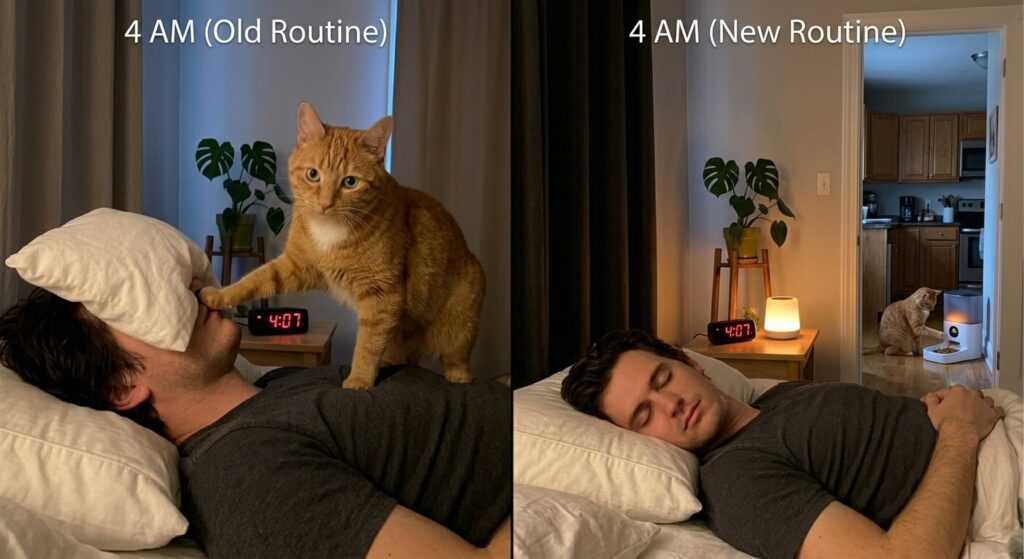
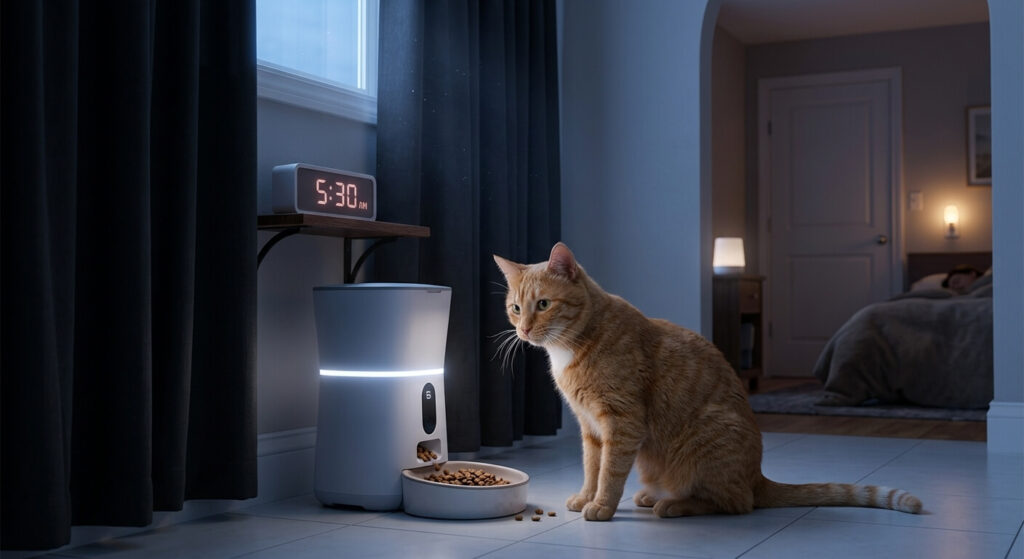
A timed feeder may help when food expectation is a clear part of the pattern, because it separates the food delivery from the sleeping person’s response.
The Automatic Feeder Solution
The core intervention is elegantly simple: remove yourself from the food equation at the critical pre-dawn activation window.This works best when the rest of the day also has predictable meals, so pair the feeder plan with a consistent indoor cat feeding schedule.
If breakfast always follows waking the caregiver, the behavior can become part of the feeding sequence. A timed feeder can move a small scheduled meal away from the bedroom and make food delivery independent of meowing at a person.
A timed feeder can help separate food from your response. For reliable portion timing, see our guide to the best automatic cat feeders for indoor cats.— An automatic feeder is the single most effective tool for breaking the deeply conditioned association between “meowing at the human” and “breakfast arrives.” Our comprehensive guide to the best automatic cat feeders covers the specific features that matter for nighttime feeding protocols — portion precision, quiet operation, and scheduling flexibility — with recommendations across every price point.
The protocol for implementing the pre-dawn automatic feed:
Step 1 — Establish the feeder’s schedule:
Use part of the cat’s measured daily food allowance and schedule it shortly before the usual waking period. Ask your veterinarian how to divide meals if your cat has diabetes, kidney disease, obesity, a prescription diet, or another condition affected by meal timing.
Step 2 — Gradually shift the time:
Once your cat is consistently going to the feeder at 4:15 AM instead of your face, shift the dispensing time forward by 15 minutes every 3–4 days:
- Week 1: 4:15 AM
- Week 2: 4:30 AM
- Week 3: 4:45 AM
- Week 4: 5:00 AM
- Continue until the feeding time aligns with your desired wake time
Step 3 — Reduce the pre-feeder meal accordingly:
Adjust the evening meal portion to account for the automatic feeder dispensing — the total daily caloric intake should remain consistent.
Why This Works Behaviorally
The automatic feeder does something behaviorally profound: it transfers the cat’s “food source” association from a human to a machine. The cat’s Crepuscular hunger-driven motivation remains, but it is now satisfied by an object that doesn’t respond to face-sitting, meowing, or physics experiments on the nightstand.
Watch what happens over several nights. If the cat waits near the feeder instead of waking you, shift the time gradually toward the schedule you want. If the behavior does not change, hunger may not be the main trigger.
Additional automatic feeder protocol tips:
- Location matters: Place the feeder in the room where you want the cat to be at 4 AM — ideally outside the bedroom. The cat will begin gravitating to the feeder location in anticipation.
- Use dry food or freeze-dried toppers in the automatic feeder — wet food cannot be safely left in a dispensing mechanism for extended periods
- If the feeder malfunctions, check it and ensure the cat receives the appropriate meal. Access to food, prescribed meal timing, and health take priority over avoiding attention reinforcement.
- Introduce the feeder during the day first so the cat understands the mechanism before relying on it at 4 AM
Strategy 2: Use a Play-Eat-Groom-Sleep Routine
If the automatic feeder addresses the Metabolic Demand trigger, Strategy 2 addresses the Crepuscular activation trigger — by proactively discharging the predatory and physical energy that would otherwise express itself at 4 AM.
The Hunt-Eat-Groom-Sleep Sequence
In their natural environment, cats follow a remarkably consistent daily behavioral sequence:
Hunt → Catch/Kill → Eat → Groom → Sleep
Play, eating, grooming, and resting can occur together in a daily routine, but they are not a mandatory neurological sequence. Cats can sleep without completing a simulated hunt.
A bowl-fed cat does not have an incomplete nervous-system cycle. The practical goal is to provide suitable activity and a predictable routine, not to force every cat through fixed stages.
Recreating the sequence deliberately:
You can use a flexible play-meal-wind-down sequence before bedtime:
Stage 1 — The Hunt (Structured Play Session):
If your cat needs a stronger evening routine, use this plan with our guide on how to tire out an indoor cat before bed. — A 10- to 15-minute interactive play session before bed can help many indoor cats discharge energy before the overnight rest period. Our comprehensive indoor cat exercise guide provides specific wand toy techniques, movement patterns, and intensity benchmarks that ensure the play session is aerobically meaningful rather than just superficially engaging.
The play session must be:
- Comfortable and voluntary: do not exercise a cat to panting or exhaustion. Stop if breathing becomes abnormal. Breathing difficulty warrants prompt veterinary attention, not a harder workout.
- Predatorily complete: End the session with a “kill” — allow the cat to catch, bite, and bunny-kick the toy into stillness, then release it and let them “finish” it
- Timed: 30–45 minutes before your intended bedtime (not immediately before — you need time for the remaining sequence)
Stage 2 — The Eat (Post-Play Meal):
Offer the planned evening meal as part of the normal feeding schedule, using the appropriate daily portion. Timing should fit the individual cat and any veterinary dietary instructions rather than a fixed post-play interval.
Stage 3 — The Groom (Natural Self-Grooming):
Allow the cat to wind down without forced handling. Some cats groom after eating; others rest or choose another quiet activity. No fixed grooming duration is needed.
Stage 4 — The Sleep:
A predictable evening routine may help some cats settle, but it does not guarantee deep sleep, an uninterrupted night, or a specific waking time.
The Timing Matrix
| Time | Activity | Purpose |
|---|---|---|
| 2–3 hours before bed | Light daytime enrichment winds down | Begin reducing stimulation |
| 60 min before bed | Begin active play session | Crepuscular energy discharge |
| 45 min before bed | Peak aerobic play intensity | Maximum predatory drive discharge |
| 30 min before bed | “Kill” completion; play ends | Predatory sequence closure |
| 25 min before bed | Evening meal served | Hunt → eat sequence completion |
| 25–10 min before bed | Cat self-grooms | Neurological cool-down |
| 10 min before bed | Cat settles | Sleep priming |
| Your bedtime | You sleep; cat sleeps | Successful stop cat waking me up at night |
| 4:00–5:00 AM | Automatic feeder dispenses | Metabolic Demand met without human involvement |
High-Energy Breed Considerations
Evaluate changes in waking frequency, duration, and distress over time. The response depends on the cause, health, learning history, and household routine; no breed or schedule guarantees results.
Cats vary widely in activity level. If nighttime waking includes sprinting or repeated play-seeking, add appropriate daytime and evening enrichment and review our guide to cat zoomies at night. Avoid assuming that breed alone determines how much activity an individual cat needs.
For high-energy breeds, add:
- Two additional play sessions during the day (morning and midday)
- Puzzle feeding for at least two meals daily
- Clicker training sessions (5–10 minutes, twice daily) — cognitive work is as tiring as physical work
- Consider a cat companion (with careful introduction) to provide social play throughout the day
Strategy 3: Reduce Dawn Light and Apartment Noise
This strategy addresses the environmental triggers that activate the Crepuscular clock — and in an urban apartment environment, those triggers can be significant.
Why Your Apartment Is Working Against You
Crepuscular activation is light-triggered. As the sky begins to lighten at dawn — even to a degree imperceptible to human eyes — your cat’s retinal photoreceptors detect the shift and begin triggering the wake-up hormonal cascade.
In a typical urban apartment, this light-triggered activation can begin earlier than true dawn for several reasons:
- Street lighting through curtains: Orange or white street light creates a persistent low-level illumination that can interact with the cat’s light-sensitive retinal system
- Pre-dawn urban activity: Delivery trucks, early commuters, garbage collection — all beginning before sunrise in most cities
- Neighbor activity: Building sounds, hallway lights, elevator operation
- Seasonal variation: In summer, civil twilight begins surprisingly early — 4:00–4:30 AM in many locations — which can shift your cat’s activation window earlier across the year
The Blackout Protocol
Blackout curtains may reduce an obvious dawn-light cue when a room brightens early. They will not change every cat’s schedule, so treat them as an optional environmental adjustment rather than a guaranteed delay.
Implementation:
- Use blackout curtain liners behind existing curtains, or purpose-made blackout curtains
- Ensure the curtains extend at least 4 inches beyond the window frame on each side and floor length — light ingress at edges is as activating as direct light
- Also address the bedroom door gap — if light enters from a hallway, fit a door draft excluder
- Cover LED standby lights on electronics — small blue or green LEDs are visible to cats and can contribute to nighttime disturbance
Reducing an obvious light trigger may help some cats, but it may not change waking time. Keep safe navigation and access to essential resources available, especially for older cats.
White Noise for Feline Sleep Management
Cats can notice sounds that sleeping people overlook. If hallway traffic, delivery vehicles, neighbors, or outdoor animals reliably precede the waking behavior, a steady fan or low-volume sound machine may help mask the changing noise. Keep the volume comfortable and give the cat access to a quiet alternative resting place.
White noise implementation:
- A white noise machine (or app) placed between the cat’s sleeping area and the primary sound sources (windows, hallway door) creates a consistent acoustic environment that masks variable environmental triggers
- Use pink noise (white noise with reduced high-frequency content) or brown noise — cats habituate to consistent sound profiles, and these spectral profiles are less likely to create their own alerting response
- Volume: sufficient to mask environmental sounds without being aversive — roughly the volume of a running shower at the far end of a bathroom
- A fan achieves a similar acoustic masking effect while also addressing temperature regulation
The Bedroom Door Question
Whether to allow bedroom access is addressed fully in the FAQ section, but within the environmental strategy context:
Do not use white noise to make it easier to overlook a distressed cat. Bedroom separation should be introduced gradually, with essential resources available and a plan to respond to abnormal behavior.
When It’s Not Behavior: Rule Out Pain and Hyperthyroidism
Behavioral advice is appropriate only after considering health. Sudden or increasing night waking, especially with vocalization or other changes, deserves veterinary attention.
Sudden or increasing nighttime vocalization in a cat over age 7 must have medical causes ruled out before behavioral management is attempted.
Hyperthyroidism: The Most Common Medical Culprit
Hyperthyroidism is a common endocrine disorder in older cats and can cause weight loss despite increased appetite, restlessness, increased thirst, vomiting, and vocalization. These signs overlap with other illnesses, so diagnosis requires a veterinary evaluation.
How hyperthyroidism causes nighttime waking:
- Increased metabolic activity: Some hyperthyroid cats become hungrier, more active, restless, or vocal
- Neurological hyperirritability: Excess thyroid hormone produces a state of neurological excitation that manifests as restlessness, hyperactivity, and increased vocalization
- Disrupted sleep: The hypermetabolic state prevents the normal depth of sleep cycles
- Increased cardiac output: Elevated heart rate and blood pressure contribute to restlessness
Signs that suggest hyperthyroidism rather than behavioral causes:
- Nighttime vocalization in a cat who previously slept well — new behavior
- Concurrent weight loss despite increased or ravenous appetite
- Increased water consumption
- Unkempt coat
- Palpable thyroid nodule (detectable by your veterinarian)
- Hyperactivity or restlessness during the day as well as at night
- Vomiting or diarrhea
A veterinarian may use physical examination and blood testing, including thyroid hormone testing, alongside the cat’s history and other results. No single home observation can diagnose the cause. Treatment choices and the expected response depend on the individual cat.
Chronic Kidney Disease (CKD)
Chronic kidney disease may be accompanied by changes in thirst, urination, appetite, weight, nausea, or comfort. Nighttime waking alone cannot establish the diagnosis; a veterinarian must assess the overall pattern.
Associated signs: Excessive drinking and urination, weight loss, vomiting, bad breath (uremic odor).
Hypertension
High blood pressure — often secondary to CKD or hyperthyroidism — can cause neurological symptoms including disorientation, head pressing, and sudden vocalization. Any sudden onset of loud nighttime howling in a senior cat warrants same-day veterinary assessment.
Pain
Pain may affect rest, movement, grooming, and social behavior at any time. A cat appearing active during the day can still need assessment for arthritis, dental disease, or another painful condition.
Feline Cognitive Dysfunction (FCD)
As discussed in our senior cat dementia guide, Crepuscular nighttime vocalization in older cats with FCD has a characteristic hollow, disoriented quality that distinguishes it from behavioral nighttime waking. Medical management of FCD-related nighttime howling is distinct from the behavioral strategies in this guide.
The safety rule: Arrange a veterinary assessment when nighttime waking is new, worsening, accompanied by other symptoms, or occurring in an older cat. Treating an underlying medical cause takes priority over trying to extinguish the behavior.
The 30-Day Plan to Stop Cat Waking Me Up at Night
Bringing all five strategies together into a single, actionable framework:
The 30-Day Implementation Timeline
Days 1–3: Assessment and Setup
- Schedule veterinary exam if cat is over 7 or nighttime waking is new
- Purchase and position automatic feeder; introduce during the day
- Install blackout curtains and white noise machine
- Identify and acquire appropriate wand toys
- Communicate the protocol to all household members — consistency is non-negotiable
Days 4–7: Protocol Initiation
- Begin the play-eat-groom-sleep sequence every evening
- Set automatic feeder to current wake-up time
- Only avoid reinforcing familiar, mild attention-seeking after health and essential needs have been addressed; respond to distress or illness.
- Review the cat’s response without assuming that an increase in behavior must occur.
Days 7–14: The Extinction Burst Phase
- If behavior intensifies, check for unmet needs, fear, illness, or an unsuitable plan before continuing.
- Keep responses as consistent as practical, but do not withhold necessary care. One response does not automatically reset all learning.
- Begin shifting automatic feeder time forward by 15 minutes every 3–4 days
- Keep a simple log of nighttime waking frequency to track progress objectively
Days 14–21: Consolidation
- Compare waking frequency and duration with the baseline; improvement is possible but is not required on a fixed date.
- Continue automatic feeder time shifts toward target wake time
- Continue the evening routine when it remains comfortable and appropriate; adapt it to health, appetite, and interest.
- Assess whether daytime enrichment needs supplementation (especially high-energy breeds)
Days 21–30: Target Achievement
- Track whether waking becomes less frequent, shorter, or shifts toward the feeder; progress varies by cat and cause
- Review whether the feeder schedule suits the cat and household; do not force a target time at the expense of health or needed food access.
- Keep helpful routines and change those that do not work. Long-term management should remain flexible and welfare-focused.
Frequently Asked Questions
1. Should I Lock My Cat Out of the Bedroom?
Bedroom access is a household choice, not a universal yes-or-no rule. Closing the door can reduce direct reinforcement for some cats, but only if the cat has safe access to water, litter boxes, resting places, and an appropriate overnight environment.
The bedroom door protocol is one of the most effective interventions to stop cat waking me up at night — but it requires specific implementation to avoid creating new problems:
Why it works:
- Removes the target (you and your moving body parts) from the environment
- Prevents the reinforcement cycle — the cat cannot access the reward (your attention) regardless of behavior
- Creates a physical separation that, combined with white noise and a well-furnished nighttime environment, allows both of you to sleep independently
Why people resist it:
- Guilt about excluding the cat
- The cat meows or scratches at the door
- Concern about the cat’s wellbeing overnight
Addressing the door-scratching problem:
Door scratching or meowing may reflect attention-seeking, fear, frustration, or unmet needs. Do not assume it is an extinction burst. Provide gradual practice and reassess bedroom exclusion if the cat becomes distressed.
Furnishing the “other side”:
For the bedroom door protocol to work without creating distress:
- Place the automatic feeder outside the bedroom (not inside — this trains the cat that the bedroom is where food happens)
- Provide a comfortable sleeping option in the main living area — ideally near a window with pre-dawn visual access
- Place a worn item of your clothing in the cat’s sleeping area — your scent is genuinely calming
- Run white noise on the bedroom side; consider a pheromone diffuser on the cat’s side
The transition period:
Some cats adjust quickly to bedroom exclusion; others become more distressed or persistent. Introduce the change gradually when possible, provide essential resources outside the room, and reconsider the plan if welfare or household safety deteriorates.
2. Why Is My Old Cat Suddenly Howling at Night?
Sudden nighttime howling in an older cat should not be assumed to be an attention problem. Medical causes need to be considered before relying on behavioral management.
Possible causes include the following; they are not ranked by likelihood for an individual cat:
1. Hyperthyroidism: one possible cause in older cats, particularly with weight loss, increased appetite, thirst, or restlessness. Diagnosis requires veterinary examination and appropriate testing.
2. Feline Cognitive Dysfunction (FCD):
The disoriented, hollow nighttime howling of FCD has a distinctive quality — the cat seems genuinely lost or confused. It typically occurs in association with other cognitive signs (disorientation, litter box changes, altered social interaction). Management is medical and environmental, not behavioral.
3. Hypertension:
Sudden severe nighttime vocalization with apparent distress or neurological signs (dilated pupils, stumbling) warrants emergency veterinary assessment — this can represent a hypertensive crisis.
4. Pain:
Arthritis, dental abscess, or internal discomfort. The vocalization may be position-specific (worsens when lying still).
5. Hearing loss:
Cats who lose hearing begin vocalizing at higher volumes because they cannot modulate their own voice — they literally cannot hear themselves. Associated with confusion about environmental sounds.
The safety rule: Book a veterinary appointment for sudden or increasing nighttime howling, particularly when it occurs with confusion, appetite or weight change, increased thirst, reduced mobility, or altered litter-box habits. Behavioral and environmental management can follow once medical findings are addressed.
For a comprehensive guide to the signs, diagnosis, and management of FCD-related nighttime vocalization, please refer to our Senior Cat Dementia Signs guide, which covers this presentation in clinical detail.
3. Should I feed my cat when they wake me up at night?
For an established food-demand pattern, provide meals on a planned schedule rather than repeatedly adding extra food in response to meowing. Do not withhold a needed meal or ignore illness. Check portions and timing with the veterinarian when a medical condition or prescribed diet is involved.
4. How Long Does It Take to Train a Cat to Sleep Through the Night?
Use the timeline as a review framework, not a promise: the response depends on the cause, how long the routine has been learned, household consistency, enrichment, and the cat’s health.
| Review point | What to assess |
|---|---|
| First few nights | Confirm that essential resources are available and note the time and type of waking behavior |
| End of week 1 | Check whether play, meal timing, and caregiver responses have been consistent |
| Week 2 | Look for a useful trend: fewer episodes, shorter episodes, or attention shifting toward the feeder |
| Weeks 3–4 | Keep what is helping; change one variable at a time if there is no progress |
| Any time symptoms appear | Pause the behavior-only plan and contact a veterinarian |
Factors that extend the timeline:
- Inconsistency can make a learned pattern harder to change, but one response does not erase all progress. Necessary caregiving takes priority.
- Multiple household members: Use the same planned response across the household. Mixed responses can make the pattern harder to change.
- Activity needs vary between individuals. Provide suitable daytime enrichment without assigning a breed-specific recovery deadline.
- Long-established habits may need gradual, sustained work. Review progress and welfare rather than assigning a fixed number of weeks.
- Concurrent medical issues: Unmanaged hyperthyroidism or pain will prevent behavioral protocols from succeeding regardless of consistency.
The most important variable: Your consistency. The protocol can work well when the cause is behavioral and every household member follows it consistently. The variable is whether you maintain it through the Extinction Burst and resist the 4 AM temptation to just let the cat in “this once.”
Consistency helps learning, but care is not a test of perfect ignoring. If the cat seems unwell, frightened, hungry because of a feeding failure, or unable to reach essential resources, respond appropriately.
Final Thoughts
The most useful plan is the one matched to the cause. Start by recording when the waking happens, what the cat does, what happens immediately afterward, and whether food, play, light, sound, access, or discomfort appears to be involved.
Then make one or two safe changes consistently: separate breakfast from human attention, add an appropriate evening play routine, reduce an identifiable environmental cue, or change bedroom access while preserving the cat’s resources.
Improvement is not always linear. Review the pattern rather than chasing a fixed deadline, and seek veterinary help when the behavior is sudden, worsening, or accompanied by health changes.
The strategies in this guide to stop cat waking me up at night work because they work with your cat’s biology rather than against it. You are not suppressing the Crepuscular drive — you are redirecting it. You are not punishing your cat — you are building a new routine that serves both of you.
With a clear cause, consistent routine, and attention to health, many behavior-driven cases can improve without punishment.
Aim for a routine that protects both the cat’s welfare and the household’s sleep.
References
- Piccione, G., Giannetto, C., Fazio, F., & Caola, G. (2013). Influence of feeding time on the daily rhythm of physical activity in the cat. Journal of Veterinary Behavior, 8(5), 397–399. https://doi.org/10.1016/j.jveb.2013.06.002
- Plantinga, E. A., Bosch, G., & Hendriks, W. H. (2011). Estimation of the dietary nutrient profile of free-roaming feral cats: possible implications for nutrition of domestic cats. British Journal of Nutrition, 106(S1), S35–S48. https://doi.org/10.1017/S0007114511002285
- Cornell Feline Health Center. Cognitive Dysfunction. Nighttime vocalization can be associated with cognitive change, hyperthyroidism, hypertension, pain, and other conditions. Cornell overview
- Feline Veterinary Medical Association. Training Techniques for Addressing Undesirable Behaviors. Caregiver guidance
- Ohio State University Indoor Pet Initiative. Increasing the Activity. Scheduled play may improve behavior and help cats rest longer at night. Indoor Pet Initiative guidance