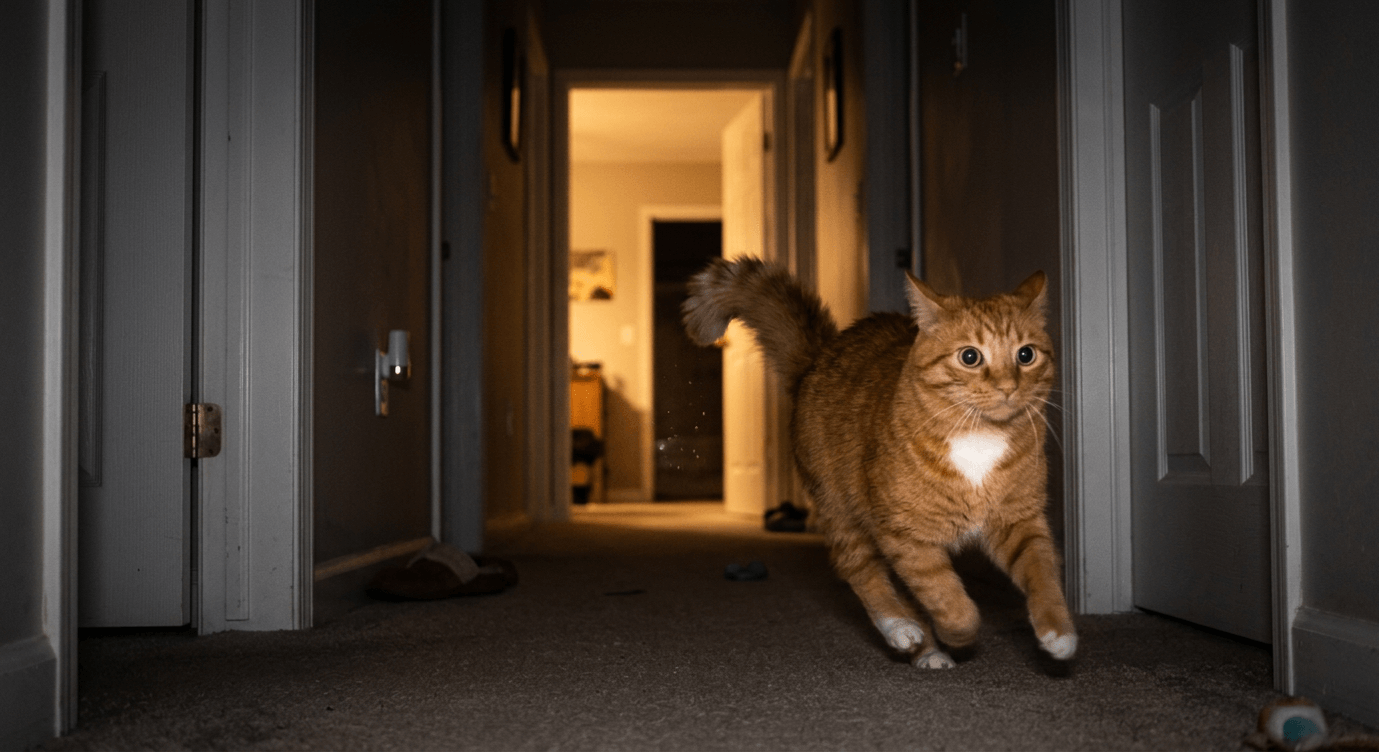
Nighttime running and jumping are often normal, especially in active cats. The pattern may reflect activity timing, play opportunities, or an individual cat’s routine; it is not possible to diagnose the cause from one sprint. For ways to distribute activity across the day, see our indoor cat exercise routine guide.
A practical first step is to record when the activity happens and try a predictable evening routine that includes interactive play and a planned meal. The aim is a safer, more manageable routine—not a guarantee that zoomies will stop.
This guide explains possible contributors to nighttime zoomies, safe ways to adjust the home routine, and signs that warrant veterinary advice.
Quick Answer
Cat zoomies at night may be a normal burst of activity. Some cats benefit from more daytime enrichment and an interactive play session followed by part of their usual food allowance, but the response varies. Sudden, distressed, or painful-looking activity needs a different assessment.
Contact your veterinarian if this behavior is new or is accompanied by crying, appetite or weight changes, pain, confusion, or a change in an older cat. Do not assume every nighttime activity problem is behavioral.
For older cats with pacing, confusion, or a changed sleep cycle, see our senior cat dementia signs guide and arrange a veterinary assessment rather than diagnosing dementia at home.
If meal timing is part of the problem, pair this routine with a consistent indoor cat feeding schedule.
Important Veterinary Note
Occasional nighttime activity can be normal. Ask a veterinarian about a new or worsening pattern, especially with pain, hiding, appetite or weight changes, excessive thirst, vomiting, or confusion. If a cat strains in the litter box but passes little or no urine, seek emergency veterinary care immediately.
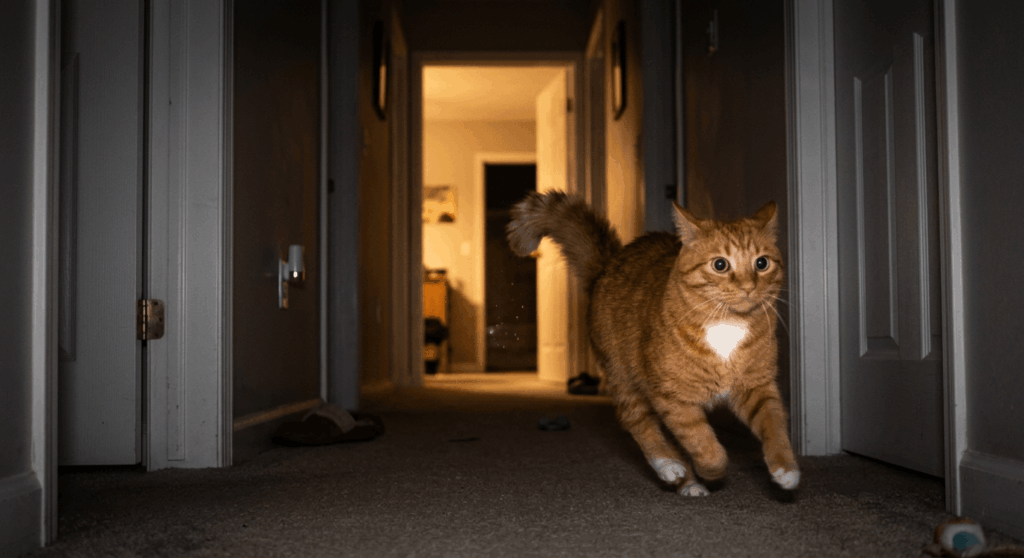
Table of Contents
What Are Cat Zoomies (FRAPs), Exactly?
Brief bursts of running or jumping are often called “zoomies” or FRAPs (frenetic random activity periods). A cat may sprint, turn sharply, climb, or chase a toy, then settle again.
FRAPs are not automatically a behavior problem. In many healthy cats, they are a normal way to discharge energy. The issue is timing. A five-minute sprint at 6 PM is usually harmless. A five-minute sprint across your pillow at 2 AM feels like a household emergency.
Cats are commonly described as nocturnal, but that is not quite accurate. Most cats are crepuscular, meaning their natural activity peaks tend to happen around dawn and dusk. Those windows match the hunting rhythm of many small prey animals. Indoor life does not remove that rhythm. It just moves it into a living room, hallway, kitchen, or bedroom.
The aim is not necessarily to eliminate all vigorous play. Offer safe opportunities to run, climb, and chase when your cat is receptive, while considering health or stress if the behavior changes suddenly.
Look at the timing and context before changing the routine. Interactive play, food puzzles, safe climbing spaces, and predictable meals are options to try; none is a universal cure.
The 4 Main Causes of Midnight Crazies
Several factors can influence nighttime activity. Observe your cat’s pattern before deciding which adjustment is relevant.
- Their Body Clock Peaks at Dawn and Dusk
The first cause is biology. Cats are built for bursts of activity rather than long endurance exercise. A cat may sleep for much of the day, wake sharply in the evening, sprint hard for a few minutes, and then settle again.
This is especially obvious in apartments because the space is smaller and every sound is amplified. A hallway becomes a racetrack. A sofa becomes a launch platform. A rug becomes a skid zone. The behavior may be normal, but the apartment makes it feel much bigger.
What helps:
- Schedule one active play session around dusk.
- Use a wand toy or prey-style toy rather than only leaving toys on the floor.
- Let your cat catch the toy several times so the session has a clear ending.
- Follow the session with dinner or a planned small meal.
A burst around dusk may fit a cat’s activity pattern; it is not evidence that the cat is being deliberately difficult.
- They Have Too Much Unused Daytime Energy
An indoor cat may spend much of the day resting. If there are few opportunities to investigate, climb, or play, offering safe enrichment is reasonable, although inactivity alone does not establish the cause of nighttime running.
Consider whether your cat has suitable daytime play, a safe viewing spot, and opportunities to explore. Adding enrichment may help some cats redirect activity, but it cannot be assumed to prevent zoomies.
Enrichment does not require a large home. Offer choices suited to the cat and available space, and introduce new toys or feeding puzzles gradually.
Useful daytime enrichment options:
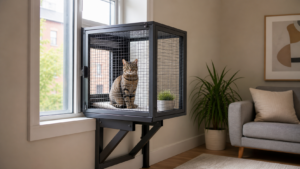
- A secure window perch with something interesting to watch outside. If your apartment lacks safe observation spots, use our cat window perch apartment guide to choose a renter-friendly setup.
- A food puzzle for one measured meal or snack.
- A rotating toy basket with only a few toys available at once.
- A safe climbing route, such as a cat tree, shelf, or cleared furniture path.
- Short owner-led play breaks before work, after work, or before dinner.
If the zoomies come with destructive behavior, attention-seeking, or over-sleeping during the day, compare the pattern with our signs indoor cat is bored guide.
- Their Feeding Rhythm Does Not Match Their Hunting Rhythm
Food-seeking can contribute to some nighttime disruptions, but meal timing does not explain every zoomie. Cats differ in how they respond to play and feeding schedules.
If food-seeking is part of the problem, a consistent feeding plan may make routines more predictable. Keep total daily calories appropriate for your cat and ask a veterinarian about any medical diet or feeding concern.
What helps:
- Use a feeding plan appropriate for your cat rather than abruptly changing a diet or portion size.
- Consider offering part of the usual food allowance after evening play if it suits your cat’s health and schedule; the last meal need not be the largest.
- Avoid giving random snacks every time your cat asks at night.
- Use an automatic feeder if your cat wakes you early for breakfast. If early-morning food demands are part of the problem, compare portion-control options in our best automatic cat feeders for indoor cats guide.
If meal timing seems relevant, use a consistent indoor cat feeding schedule tailored to your cat.
- Age, Stress, and Health Can Change the Pattern
Kittens and some young cats may show frequent vigorous play, but age alone does not determine whether a new nighttime pattern is harmless.
Senior cats are different. New or increasing nighttime activity in an older cat should not be dismissed as cute or random. Some older cats become restless at night because of pain, hyperthyroidism, blood pressure changes, sensory decline, or cognitive changes. Other cats vocalize because they feel disoriented in the dark or cannot settle comfortably.
Ask your veterinarian about new or escalating nighttime activity, especially with vocalizing, appetite or weight changes, pain, or confusion. An age cutoff alone cannot diagnose a problem. For a related overview, see our senior cat dementia signs guide.
Apartment-Specific Triggers That Make Night Zoomies Worse
Small apartments do not cause zoomies by themselves, but they can make the behavior more intense, louder, and harder to ignore. A cat in a larger home may sprint through several rooms and disappear. In a studio or one-bedroom apartment, that same sprint happens beside your bed.
In an apartment, check the immediate environment and note what happens just before a sprint:
Too much open floor at night
If your cat has a straight hallway or open living-room path, it may become a runway. That does not mean you need to block movement completely, but you can redirect it. Put a rug runner, cat tunnel, cardboard scratcher, or low climbing object in the path so the sprint becomes more controlled and less slippery.
No legal climbing outlet
Cats who cannot climb safely may create their own route across counters, shelves, curtains, or furniture. A small cat tree, wall shelf, or stable window perch gives the body a place to spend energy without turning your apartment into a crash zone. For compact climbing options, compare the best cat trees for small apartments before using unstable furniture as a launch path.
Evening noise or light changes
Some cats become more active when the apartment changes from daytime noise to nighttime silence. Others react to hallway sounds, neighbors, elevators, pipes, or outdoor lights. If your cat sprints after a specific sound, the problem may be arousal rather than simple energy.
Owner attention at the wrong time
If you talk, laugh, chase, feed, or get up every time your cat sprints at night, the behavior may become more rewarding. That does not mean ignoring medical signs. It means avoiding accidental training when the cat is simply trying to start a game.
If nighttime activity is paired with repeated meowing, pawing, or waking the household, our guide to cat attention seeking explains how to separate a learned request from boredom, stress, or a possible health change.
The Infamous Post-Poop Zoomies: A Special Category
We need to talk about this because it deserves its own section.
You’ve seen it. Your cat uses the litter box, then immediately launches into a victory lap around the entire apartment like they’ve just won the Super Bowl. There are a few theories on why this happens:
- Cause uncertain: a brief sprint after using the litter box does not establish why the cat ran.
- Context may matter: observe whether the cat runs after a normal litter-box visit or shows signs of straining or discomfort. The cause of a brief sprint is often unknown.
- Do not assume celebration: a behavior that looks playful does not rule out discomfort.
If your cat suddenly starts running after litter-box visits, cries, strains, or produces very little urine, contact a veterinarian promptly; inability to pass urine is an emergency. Keep the box accessible and clean, but do not use cleaning as a substitute for medical assessment.
How to Stop Cat Zoomies at Night (Without Locking Them in Another Room)
Occasional FRAPs may be normal. If nighttime activity is disruptive, try safe changes to enrichment and routine while remaining alert to medical warning signs. Results vary between cats.
Build a Consistent Pre-Bedtime Play Routine
Interactive play is a reasonable first option for many cats. For more ideas, see our guide on how to tire out an indoor cat before bed.
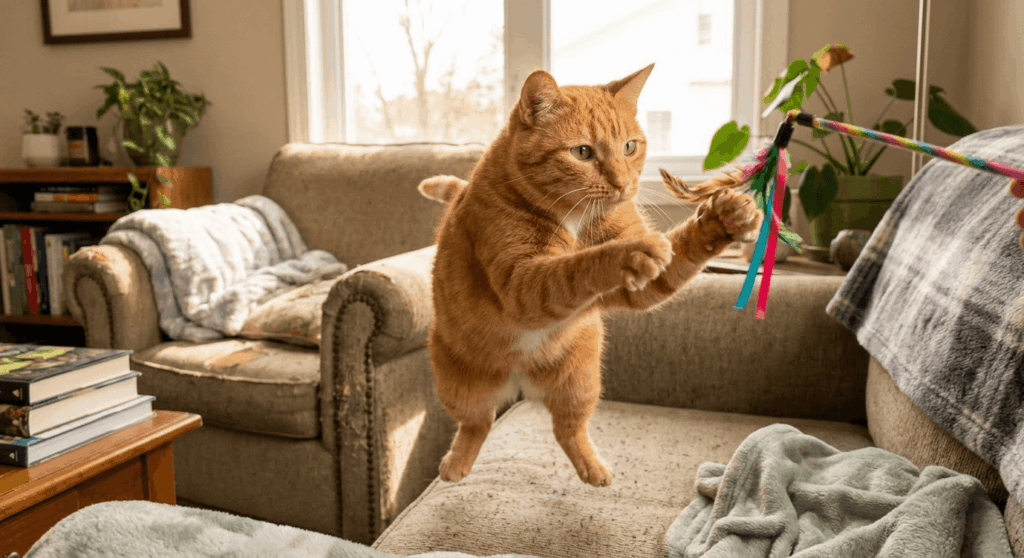
Use a wand or other suitable toy with movement your cat wants to chase. Let the cat catch the toy at times and finish the session calmly; a laser should not be the only form of play, and never shine it into eyes. Some cats settle after play and a planned meal, but this is not a guaranteed biological sequence.
The timing matters:
- Interactive play: try a short, supervised session at a time that suits your cat, adjusting duration to age, health, and interest.
- Feeding: if appropriate, offer a planned portion of the usual daily food after play without adding extra calories.
- Quiet time: provide a comfortable place to rest; do not expect every cat to sleep within a set number of minutes.
For a step-by-step example of a flexible evening routine, see how to tire out an indoor cat before bed. No individual-cat outcome is promised.
Add Daytime Environmental Enrichment
Daytime enrichment can offer choices for activity and investigation. Consider one or two options that are safe and appealing to your cat:
- Secure window perch: provide a stable view, and ensure windows and screens cannot be pushed open.
- Food puzzle: use part of the cat’s measured daily ration and introduce the puzzle at an easy level.
- Toy rotation: offer a few safe toys and change them when interest fades; no exact toy count is required.
- Supervised visual enrichment: some cats watch moving images, but interest varies and screens are not a substitute for interactive play.
- Vertical space: a stable cat tree or shelf can offer an additional place to explore; check stability and fall risks.
If the zoomies come with destructive behavior, attention-seeking, or over-sleeping during the day, compare the pattern with our signs indoor cat is bored guide.
If your cat enjoys a food puzzle, it can make a measured meal more engaging. Introduce it gradually and do not add extra food on top of the usual allowance.
Adjust Meal Timing Strategically
If nighttime waking is food-related, review the feeding plan rather than making a blanket change to all cats’ meals.
Keep the cat’s total daily nutrition appropriate. Some cats do well with scheduled meals; others need a different plan because of age, health, diet, or household needs. Ask your veterinarian before a major change to a prescribed diet.
- Use a suitable meal pattern and measured daily intake for this individual cat; no fixed number of meals works for all cats.
- Offer a planned portion after evening play if useful, without assuming the last meal must be the largest or timed to a universal bedtime interval.
- Observe the response: some cats settle after eating, but grooming or sleep should not be promised.
Consider a Second Cat (Carefully)
A second cat should not be adopted solely to address nighttime activity. Compatibility is uncertain, introductions take time, and some cats prefer separate resources or do not welcome a companion.
If you’re considering this route:
- Match energy levels and ages when possible
- Introduce cats gradually at a pace guided by their behavior; a fixed number of days or weeks cannot guarantee acceptance.
- Don’t assume your cat wants a companion — some genuinely don’t
Use Calming Aids as a Supplement (Not a Fix)
Calming products do not treat the cause of a new behavior change. Seek veterinary guidance before using supplements or botanical products, especially if your cat has a medical condition or takes medication.
- Synthetic feline pheromone products: evidence and individual response vary; they are not proven to stop normal zoomies.
- Supplements: discuss any ingredient and dose with your veterinarian rather than assuming a calming treat is safe or effective for your cat.
- Avoid unverified botanical toys or remedies: garden/Roman chamomile is listed as toxic to cats by the ASPCA; do not recommend chamomile as a routine calming toy.
If a cat shows fear, pain, or a sudden behavior change, address the underlying issue. Neither a diffuser nor a supplement should replace appropriate veterinary care.
When Cat Zoomies at Night Are Not Just Zoomies
Most nighttime sprints are normal, but some patterns deserve a closer look. The safest rule is this: if the behavior is sudden, extreme, painful-looking, or paired with other changes, do not treat it as a training issue first.
Call your veterinarian if you notice:
- New nighttime activity in a senior cat.
- Loud crying, yowling, or seeming lost.
- Increased thirst or larger urine clumps.
- Weight loss despite normal or increased appetite.
- Limping, stiffness, or reluctance to jump.
- Hiding, irritability, or sudden aggression.
- Vomiting, diarrhea, or appetite changes.
- Restlessness that seems anxious rather than playful.
These signs do not establish a diagnosis at home, but they justify veterinary assessment. Conditions including pain, hyperthyroidism, urinary disease, and age-related cognitive change can alter activity or vocalization. A cat straining and passing little or no urine needs emergency care.
If the night activity is sudden, intense, or paired with appetite, weight, litter box, mobility, confusion, or behavior changes, step back and review the bigger health picture. Our indoor cat health prevention guide can help you connect home observations with vet care, dental health, weight tracking, and early warning signs.
If night zoomies come with hiding, aggression, attention seeking, or litter box changes, compare the pattern with our indoor cat behavior guide.
What NOT to Do
Avoid these common responses to nighttime activity:
- Do not start an unplanned midnight play-and-food routine if the cat is healthy and simply soliciting attention; provide opportunities at a planned time instead. Never ignore signs of illness.
- Do not punish normal activity with yelling or water sprays; use appropriate enrichment and positive reinforcement instead.
- Do not use confinement as a blanket first response. Assess safety, resources, and the individual cat before changing access to a room.
- Do not dismiss a new pattern at any age. A sudden change, especially with pain, vocalizing, or other symptoms, warrants veterinary advice.
A 7-Day Reset Plan for Cat Zoomies at Night
Use this seven-day checklist as a way to observe and adjust routines, not as a promised one-week treatment. Stop and seek veterinary advice if new symptoms appear.
Day 1: Track the pattern
Write down when the zoomies happen, how long they last, whether your cat vocalizes, whether they used the litter box first, and what happened in the two hours before bedtime. Do not change everything yet. Just observe.
Day 2: Add one daytime enrichment point
Choose one simple daytime job: a window perch, a food puzzle, a toy rotation, or a treat hunt. Keep it easy enough that your cat succeeds.
Day 3: Start the evening play window
Try a short supervised play session at a time your cat is interested. The length and timing can be adjusted; neither a 10–15 minute session nor a 60–90 minute interval is a proven universal rule.
Day 4: Add the post-play meal
If appropriate for your cat, offer a planned portion of the usual daily ration after play. Keep the total daily intake unchanged unless your veterinarian recommends otherwise.
Day 5: Reduce accidental rewards
If the cat is healthy and safe, avoid turning a nighttime request into an unplanned play or feeding session. If the behavior is new, intense, or accompanied by warning signs, do not ignore it—contact a veterinarian.
Day 6: Adjust the apartment path
If the sprint route is slippery or dangerous, add traction, close risky doors, move fragile objects, and provide a legal climbing or scratching option.
Day 7: Review what changed
Review the notes for any pattern and keep adjustments that seem to suit your cat. A change in timing or frequency does not prove the cause. If the behavior worsens or new health signs appear, consult your veterinarian.
The Honest Truth About Timelines
There is no evidence-based timetable that guarantees nighttime zoomies will improve after a set number of days or weeks. Track your own cat’s response and reassess if the plan is not helping.
Individual cats can respond differently to changes in play, enrichment, and feeding. Do not treat the following as a measured clinical timeline:
- Early observation: note when the activity occurs and whether it is playful or accompanied by distress.
- Routine adjustment: keep changes manageable and monitor sleep, appetite, play interest, and litter-box behavior.
- Reassessment: if the activity remains disruptive or becomes unusual, discuss the pattern with your veterinarian rather than waiting for a promised improvement.
Consistency may make a routine easier to evaluate, but it cannot guarantee a particular outcome or time to improvement.
Frequently Asked Questions
1. Should I punish my cat for midnight zoomies?
No. Avoid yelling or spraying water. Punishment does not explain the desired behavior to the cat and can undermine welfare. Offer appropriate play, enrichment, and a predictable routine; seek veterinary advice if the behavior changes suddenly.
2. Why do cat zoomies at night seem so much worse in winter?
A seasonal change in activity cannot be assumed to be caused by winter light. One study found seasonal activity differences in a subgroup of cats with outdoor access, which does not establish a cause or treatment for indoor nighttime zoomies. Track the individual cat’s routine and environment instead of using light therapy without veterinary advice.
3. Is it normal for my cat to have zoomies every single night?
Brief regular play bursts can be normal, but frequency alone cannot establish whether a cat is healthy. Watch for a sudden change, distress, pain, weight or appetite changes, and altered litter-box behavior. No “2–4 week” improvement is guaranteed.
4. When should cat zoomies at night worry me?
Yes, short bursts of nighttime running can be normal, especially in young cats and cats who sleep most of the day. The concern is not one playful sprint. The concern is a sudden change, frantic behavior, vocalizing, pain signs, weight loss, appetite changes, or senior disorientation.
5. What time should I play with my cat to reduce night zoomies?
Try interactive play when your cat is interested and you can supervise, then offer a planned meal portion if appropriate. There is no proven universal “best” number of minutes before bedtime.
6. Why does my cat get zoomies after using the litter box?
The reason for a brief sprint after a normal litter-box visit is often unknown. Contact your veterinarian for straining, crying, diarrhea, constipation, or a sudden change. If a cat repeatedly strains and passes little or no urine, seek emergency veterinary care immediately.
7. Can an automatic feeder help with cat zoomies at night?
An automatic feeder may help some cats when a predictable early meal is the issue. It is not a treatment for zoomies, and it should dispense part of the planned daily ration rather than extra calories.
Final Thoughts
Nighttime zoomies are often ordinary activity, but one cannot infer the cause from a sprint alone. Consider the timing, environment, and any accompanying signs.
Try safe enrichment, supervised play, and a suitable feeding plan. If the pattern is new, painful-looking, or paired with health changes, consult your veterinarian rather than assuming it is just behavior.
References
1. VCA Animal Hospitals. Cat Zoomies Explained. Describes FRAPs and when a change in activity warrants veterinary attention.
2. Ellis, S. L. H., Rodan, I., Carney, H. C., et al. (2013). AAFP and ISFM Feline Environmental Needs Guidelines. Journal of Feline Medicine and Surgery, 15(3), 219–230.
3. Feline Veterinary Medical Association. How to Feed a Cat: Consensus Statement. Feeding schedules and enrichment should be tailored to the individual cat.
4. Cornell Feline Health Center. Feline Lower Urinary Tract Disease. Urinary obstruction requires urgent veterinary care.
5. ASPCA. Garden Chamomile: Toxic and Non-Toxic Plants. Botanical safety reference.