An indoor cat exercise routine works best when it is short, repeatable, and matched to your cat’s age, weight, energy level, and health. Most cats do not need one exhausting workout. They need several small chances to stalk, chase, climb, pounce, and use their brain each day.
Oliver did not become more active because I bought more toys. He became more active when I stopped waiting for random play moods and built movement into predictable times: a morning chase, a food puzzle, a vertical climb, and a pre-bed wand session. For safe difficulty levels and apartment-friendly options, compare the best cat puzzle feeders for indoor cats.
This guide gives you a simple daily routine you can use in an apartment without turning your living room into an obstacle course. He went from decorative floor object to an actual, functioning, leaping cat within two weeks.
Quick Answer
A good indoor cat exercise routine includes two or three short interactive play sessions, daily climbing or jumping opportunities, food puzzles or treat hunts, and a calm pre-bed play-and-feed cycle. Start with 5 to 10 minutes at a time and adjust based on your cat’s age, weight, stamina, and interest.If your main problem is late-night sprinting, pair this routine with our cat zoomies at night guide.
If your cat is overweight, senior, painful, breathing harder than normal, limping, or suddenly less active, ask your veterinarian before increasing exercise. For weight-related activity planning, start with our is my cat overweight guide before changing calories or play intensity.
Important Safety Note
Do not force intense exercise if your cat is overweight, senior, limping, breathing abnormally, hiding, refusing food, or suddenly less active. Reduced movement can come from pain, arthritis, dental disease, illness, stress, or weight gain. If your cat’s activity level changes suddenly, ask your veterinarian before treating it as laziness.
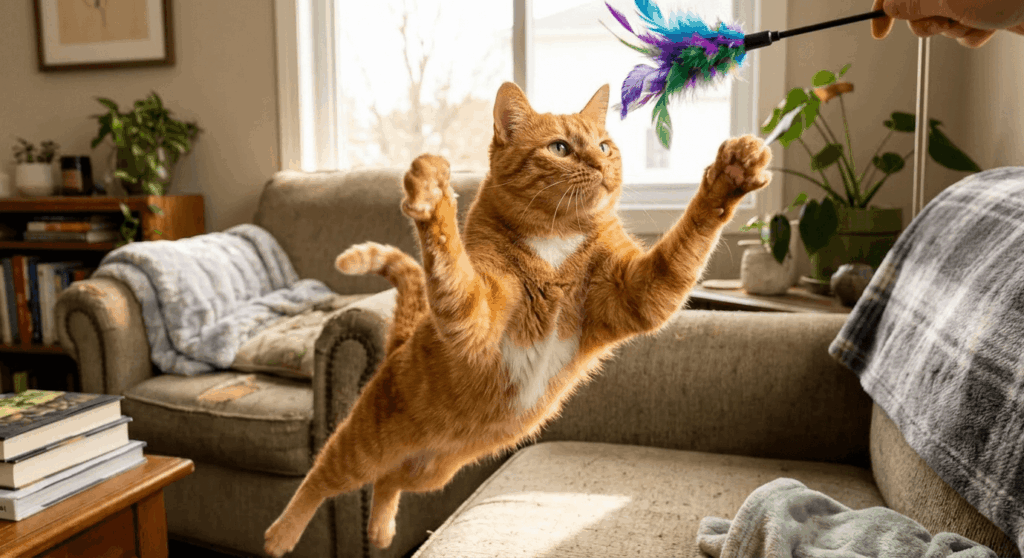
Table of Contents
Why Indoor Cats Need an Exercise Routine
Indoor cats need an exercise routine because indoor life removes many natural movement triggers. An outdoor cat may climb, patrol, chase, stalk, jump, explore, and react to changing sounds and smells. An indoor cat depends on the home environment and the owner’s routine to create those opportunities safely.
Without regular movement, an indoor cat may become less active over time. That can contribute to weight gain, boredom, weaker muscles, reduced confidence, night zoomies, attention-seeking, and less interest in play. Some cats become disruptive when they have unused energy. Others become quieter and sleep more, which can make the problem harder to notice.
A good indoor cat exercise routine does not need to be intense. Most cats do better with short daily sessions that match their hunting style. Watching, stalking, crouching, chasing, pouncing, catching, climbing, and pawing all count as movement.
Exercise also helps owners notice changes. If a cat suddenly stops jumping, refuses play, tires quickly, or avoids normal movement, that may be a sign of pain, arthritis, weight gain, stress, or illness. A routine gives you a baseline, so changes stand out sooner.
The goal is not to force your cat to “work out.” The goal is to build small, repeatable movement into daily life in a way your cat enjoys.
Exercise Is Not Just About Weight
Many owners think exercise only matters when a cat is overweight, but indoor movement affects much more than body fat. A good exercise routine can support muscle tone, confidence, digestion, sleep rhythm, stress control, and daily behavior.
An under-exercised cat may not look “unhealthy” at first. They may simply sleep more, beg more, chase feet, wake you at night, or lose interest in toys. Over time, less movement can make the cat weaker, less confident, and more likely to gain weight.
Exercise also gives the owner useful information. A cat who normally jumps to a window but suddenly stops may be painful. A cat who used to chase but now only watches may be tired, overweight, stressed, or aging. A cat who pants after mild play may need medical attention.
Movement is a daily check-in. It tells you how your cat feels.
5 Essential Steps for an Indoor Cat Exercise Routine
Step 1: Start With Short Play Sessions
Most indoor cats do better with short, repeatable sessions than one long exhausting play period. Start with 5 minutes once or twice a day. If your cat engages well, slowly increase the time.
A good starting goal is:
- 5 minutes in the morning
- 5 minutes in the evening
- 2-5 minutes before bed if your cat gets night energy
Do not judge success by whether your cat sprints nonstop. Watching, stalking, crouching, pawing, and short bursts all count as engagement.
How Long Each Play Session Should Be
Most indoor cats do not need one long workout. Short sessions are usually better.
A useful starting point:
| Cat Type | Starting Session Length | Notes |
|---|---|---|
| Young active cat | 10-15 minutes | May need harder chase and climbing |
| Average adult cat | 5-10 minutes | Two sessions daily often works well |
| Overweight cat | 2-5 minutes | Keep it low-impact |
| Senior cat | 2-5 minutes | Watch stiffness and fatigue |
| Shy or low-motivation cat | 1-3 minutes | Start with curiosity, not speed |
The session is long enough if your cat engages and finishes calmly. It is too long if your cat pants, hides, limps, becomes frustrated, or refuses future play.
Some cats play in short bursts. That is normal. A one-minute chase followed by a pause can still be successful if the cat is mentally engaged.
Step 2: Use Hunting-Style Play
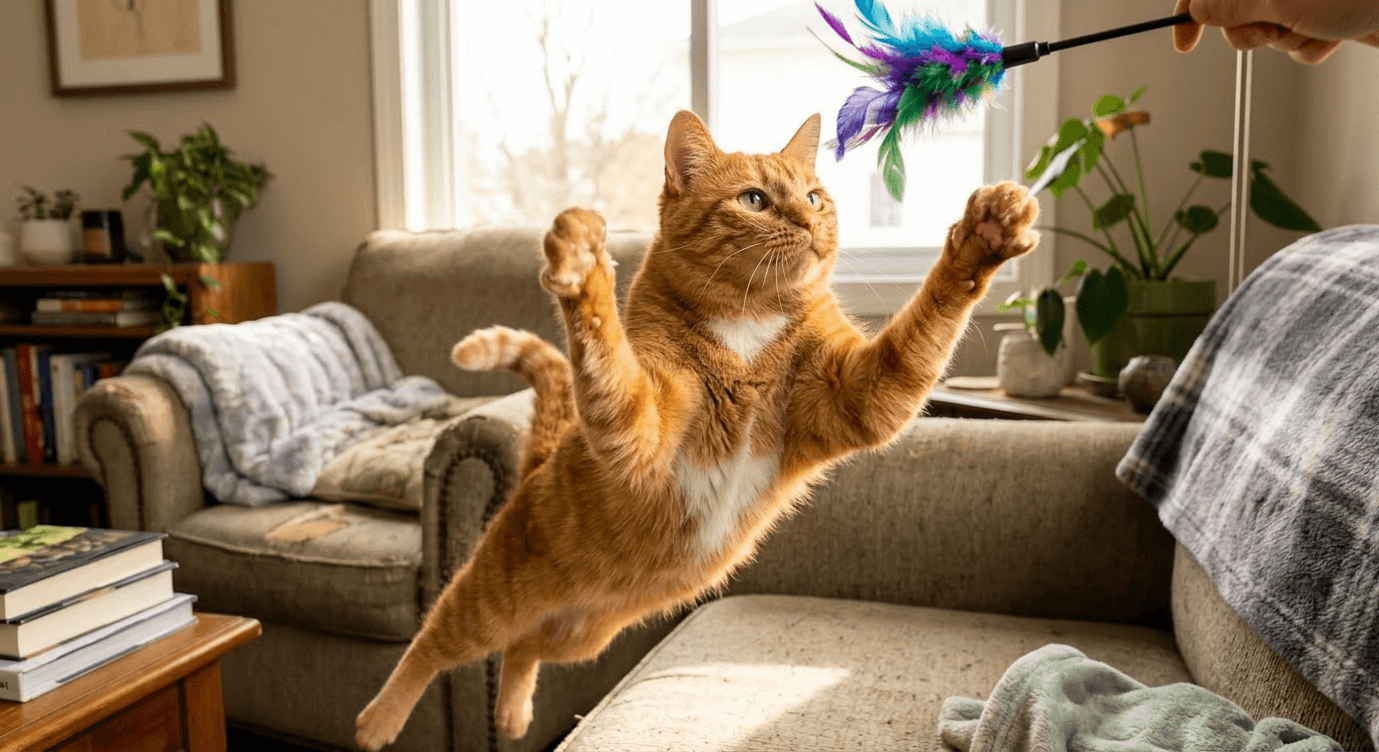
Cats are more motivated when play feels like hunting. Move the toy like prey: hide it, pause it, let it dart, let your cat stalk, then allow a catch.
A good sequence is:
- Watch
- Stalk
- Chase
- Pounce
- Catch
- Eat or rest
Do not wave the toy randomly in your cat’s face. Many cats prefer prey that moves away, hides behind furniture, or pauses before escaping.
How to Move the Toy Like Prey
The way you move the toy matters more than the toy itself. Many cats ignore toys because the movement does not feel like prey.
Try these patterns:
- hide the toy behind a chair leg
- drag it slowly along the floor
- pause it under a towel edge
- make it dart away from the cat
- let it disappear behind a box
- slow down when your cat crouches
- allow a catch after several attempts
Avoid:
- shaking the toy in the cat’s face
- moving too fast from the start
- never letting the cat catch it
- forcing play when the cat walks away
- using hands as prey
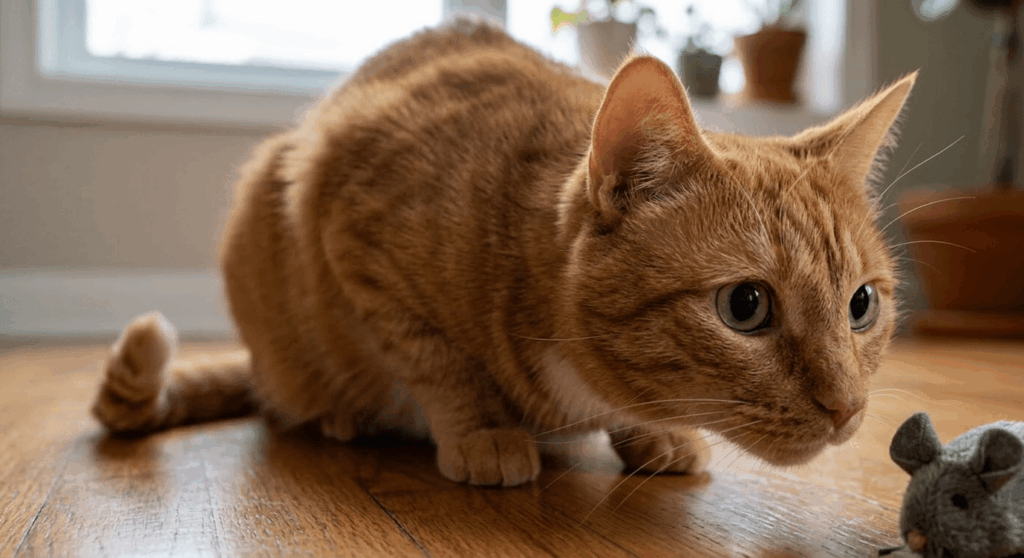
Cats often enjoy the stalk as much as the chase. If your cat watches silently with wide eyes and a still body, they may be engaged even if they are not running yet.
Step 3: Add Climbing and Vertical Movement
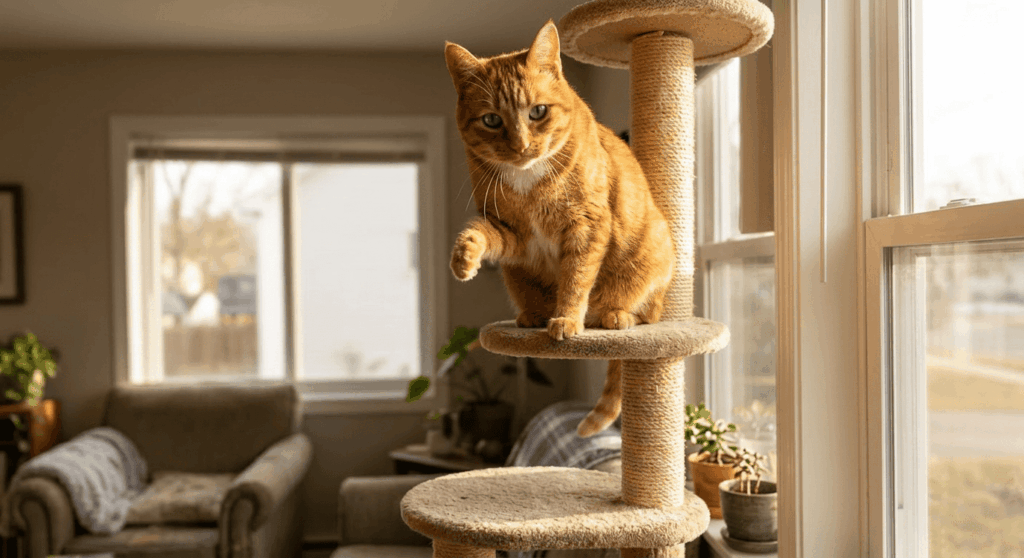
Indoor exercise is not only running. Climbing, stepping, balancing, and jumping all help build movement into the room.
Use:
- cat trees
- stable furniture routes
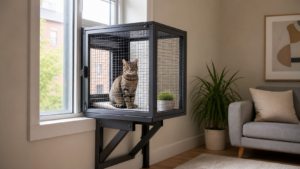
- window perches
- low platforms for seniors
- stairs if available
- safe shelf routes if renter-friendly
For overweight or senior cats, keep routes low and stable. The goal is safe movement, not dramatic jumping.
Apartment-Friendly Movement Without Extra Floor Space
Small apartments can still support exercise if you use vertical and route-based movement. You do not need a huge playroom.
Use existing areas:
- a stable sofa-to-window route
- a cat tree near a window
- a low shelf cleared for safe landing
- a hallway chase path
- a bed-to-stool-to-perch route
- stairs if available
- a foldable tunnel used only during play
For renters, avoid permanent wall damage unless allowed. Furniture-based routes often work better. The key is stability. A wobbly shelf or slippery landing can make a cat avoid movement.
For senior or overweight cats, lower the route. A small step up can still count as useful movement.
Step 4: Use Food Puzzles and Treat Hunts
Food puzzles turn part of a meal into light activity. They are especially useful for cats who are food-motivated but not interested in toys.
Use part of the normal daily food, not extra calories. Hide a few pieces around the room, use a puzzle feeder, or place small portions in different safe locations.
If your cat needs more workday enrichment, connect this with your how to entertain a cat while at work guide.
How to Use Food for Exercise Without Overfeeding
Food-based exercise works best when it uses part of the normal daily food. Do not add puzzle food on top of regular meals unless your veterinarian has told you your cat needs more calories.
Easy food-based movement ideas:
- hide a few kibble pieces in different rooms
- place food on a low perch
- use a puzzle feeder
- toss one piece at a time down a hallway
- make a short scent trail with dry food
- divide a meal into several small dishes
- use a snuffle mat for part of breakfast
This turns eating into movement and problem solving. It is especially helpful for cats who are not excited by toys but are motivated by food.
If your cat is overweight, count every piece. Food games should replace bowl calories, not add extra calories.
Step 5: Track Energy, Weight, and Mobility
An indoor cat exercise routine should improve daily life, not create stress. Track whether your cat becomes more engaged, sleeps better, moves more comfortably, and maintains a healthier body condition.
Watch for:
- better play interest
- fewer night zoomies
- less boredom behavior
- improved jumping confidence
- steadier weight
- better grooming
- calmer evenings
If your cat is gaining weight, pair exercise with feeding control. Exercise helps, but portions still matter.
Indoor Cat Exercise Routine Table
| Goal | Best Activity | Time Needed | Watch Out For |
|---|---|---|---|
| Reduce boredom | Wand toy play | 5-10 minutes | Do not overstimulate |
| Support weight control | Food puzzles + measured meals | Daily | Count calories |
| Build confidence | Climbing routes | Ongoing | Keep surfaces stable |
| Reduce night energy | Evening play before dinner/bed | 10 minutes | Avoid rewarding 3 AM activity |
| Help senior cats move | Low-impact floor play | 2-5 minutes | Watch pain or fatigue |
| Entertain while working | Puzzle feeder or window perch | Work block | Avoid unsafe toys |
Sample Daily Exercise Routines
Simple 10-Minute Routine
This works for busy owners.
- Morning: 5 minutes wand play
- Evening: 5 minutes chase or puzzle feeding
This is enough to start for many adult cats.
15-Minute Weight Support Routine
This works for cats who need more movement but should not be pushed too hard.
- Morning: 5 minutes low-impact wand play
- Afternoon or workday: puzzle feeder using measured food
- Evening: 5 minutes gentle chase or treat hunt
High-Energy Evening Routine
This works for cats who get restless at night.
- Early evening: 10 minutes active play
- Later evening: food puzzle or climbing route
- Before bed: 3-5 minutes calm play, then a measured meal
Senior-Friendly Routine
This works for older cats.
- Morning: 2 minutes slow wand movement
- Midday: easy food puzzle
- Evening: 2-5 minutes gentle pawing or low-step movement
The best routine is the one you can repeat. Consistency beats intensity.
Exercise Ideas by Cat Type
Different cats need different exercise styles. A high-energy young cat, an overweight adult cat, and a senior cat with stiff joints should not be pushed into the same routine.
For Lazy or Low-Motivation Cats
Some cats do not leap into play immediately. Start with curiosity instead of speed.
Try:
- slow wand toy movement near the paws
- hiding the toy behind a blanket edge
- crinkle sounds
- scent-based toys
- short treat hunts
- rolling a soft ball slowly
- placing a toy near a favorite resting spot
Do not wave the toy directly in your cat’s face. Many cats prefer prey that moves away, pauses, hides, and reappears.
For Overweight Cats
Overweight cats often need low-impact movement. They may want to play but tire quickly or avoid jumping because movement feels harder.
Good options include:
- floor-based wand play
- short hallway walks for a meal
- food puzzles using measured food
- low platform steps
- gentle treat hunts
- slow chase games
- batting toys while lying down
Keep sessions short. Two to five minutes can be enough at first. Build confidence before increasing intensity.
For Senior Cats
Senior cats may still enjoy play, but they often need softer, slower routines. Avoid high jumps or slippery surfaces.
Try:
- slow wand play
- low steps to favorite places
- soft mats for traction
- short play sessions
- gentle pawing games
- warm resting spots after activity
- food puzzles with easy access
If your senior cat stops jumping, limps, hesitates, or seems stiff, ask your veterinarian about arthritis or pain.
For High-Energy Cats
High-energy cats need structure. If they do not get a planned outlet, they may create one through night zoomies, chasing feet, climbing curtains, or knocking things over.
Use:
- wand toy chase
- climbing routes
- puzzle feeders
- tunnels
- evening play
- toy rotation
- pre-bed hunting sessions
For these cats, timing matters. Put the biggest play session before the time when problem behavior usually starts.
For Cats Who Get Night Zoomies
Move the main play session to evening. Use a hunting-style routine: stalk, chase, catch, then a measured meal. This helps some cats settle better overnight.
If night racing is the main issue, see our cat zoomies at night guide.
How to Exercise an Overweight Indoor Cat
An overweight indoor cat should exercise gently and gradually. The goal is not to make your cat sprint until exhausted. The goal is to increase daily movement without causing pain, fear, or frustration.
Start with low-impact movement:
- 2-5 minutes of play at a time
- toys that move across the floor
- short treat hunts using measured food
- stable low steps
- slow wand toy sessions
- puzzle feeders
- short walks between rooms for meals
Avoid high jumps at first. Extra weight can put more stress on joints, and a cat who lands heavily may become less willing to play.
Watch your cat’s breathing and body language. Stop if your cat pants, hides, limps, becomes frustrated, or refuses to continue. A successful session should end with your cat still confident.
Exercise helps, but it should be paired with measured feeding. If your cat is overweight, connect this routine with your help indoor cat lose weight plan and your how much to feed an indoor cat guide.
For the broader feeding and weight system, use our apartment cat feeding and weight control guide.
Signs Your Cat Is Getting Fitter
Progress is not only a number on the scale. Your cat may show fitness improvements before obvious weight loss.
Positive signs include:
- plays a little longer
- jumps more confidently
- lands more softly
- grooms more easily
- sleeps more calmly at night
- has more interest in toys
- moves between rooms more often
- uses climbing spots again
- seems less food-focused
- has steadier energy
Track small changes. An overweight cat who starts playing for five minutes instead of one minute is improving. A senior cat who uses a low perch again is improving.
If progress stops, do not force harder exercise immediately. Review food, pain, sleep, stress, and motivation.
Common Exercise Mistakes
Mistake 1: Expecting Long Play Sessions
Cats often play in short bursts. A cat who plays hard for two minutes and then stops is not necessarily lazy. They may be following a normal hunt-rest pattern.
Short, repeatable sessions are usually better than one long session.
Mistake 2: Moving the Toy Like a Human, Not Prey
Random waving can be boring or overwhelming. Move the toy like prey: hide, pause, dart, slow down, and let your cat catch it.
Mistake 3: Never Letting the Cat Catch the Toy
If your cat never catches the toy, play can become frustrating. Let them grab, bite, or pin the toy sometimes so the session feels complete.
Mistake 4: Using Hands or Feet as Toys
Hands and feet should not become prey. Use wand toys, kickers, or soft toys instead. This reduces biting and ambush behavior.
Mistake 5: Forcing Overweight or Senior Cats Too Hard
Overweight and senior cats may need low-impact exercise. High jumps, slippery floors, and intense chase sessions can be too much.
Mistake 6: Ignoring Sudden Activity Changes
If your cat suddenly stops playing, avoids jumping, hides, or seems stiff, do not assume they are lazy. Pain, illness, stress, or arthritis may be involved.
Mistake 7: Relying on Toys Alone
A toy lying on the floor is not always enrichment. Many cats need movement, timing, and interaction. Rotate toys and play actively.
How to Build the Habit as an Owner
The hardest part of an indoor cat exercise routine is often not the cat. It is the owner’s consistency.
Make the routine easy:
- keep the wand toy visible but stored safely
- attach play to an existing habit
- play before breakfast or dinner
- use the same hallway or room
- keep sessions short
- track only one behavior at first
- rotate toys once a week
- stop while the cat still enjoys it
Do not wait for the perfect 30-minute window. Two minutes is better than nothing. A routine that happens daily is more useful than a perfect routine that happens once a week.
If you miss a day, just restart. Cats respond to patterns over time.
When Exercise Does Not Work
Sometimes exercise does not improve the problem because exercise is not the main issue.
If your cat refuses play, consider:
- the toy movement is wrong
- the toy is always available and boring
- the session is too long
- the cat is playing at the wrong time of day
- the floor is slippery
- the cat is overweight and movement is hard
- the cat is painful
- the cat is stressed
- the cat is senior and needs gentler movement
Change one variable at a time. Try a different time, slower toy movement, a lower-impact game, or food-based activity.
If your cat used to play and suddenly stops, that is different. Sudden loss of interest can be a health signal.
When to Ask Your Veterinarian
Ask your veterinarian before increasing exercise if your cat is obese, senior, limping, breathing abnormally, recovering from illness, or suddenly less active.
Call your veterinarian if you notice:
- sudden reduced activity
- limping
- stiffness
- hiding
- appetite changes
- weight loss
- rapid weight gain
- breathing changes
- panting after mild activity
- reluctance to jump
- crying when touched
- litter box changes
- weakness
- collapse
Exercise should make your cat healthier and more comfortable. If movement seems painful or unusually difficult, get medical guidance first.
For long-term health monitoring, see our indoor cat health prevention guide.
Frequently Asked Questions
1. How much exercise does an indoor cat need?
Many indoor cats benefit from 10-20 minutes of structured play per day, split into short sessions. Some cats need more, while seniors or overweight cats may need shorter, gentler sessions.
2. Is 15 minutes of play enough for an indoor cat?
For many cats, yes, especially if the play is focused and prey-like. A few short sessions may work better than one long session.
3. Why does my cat stop playing after one minute?
That can be normal. Cats often hunt in short bursts. Try slower toy movement, hiding the toy, and letting your cat catch it. If your cat suddenly loses interest in all activity, consider a veterinary check.
4. Can exercise help my indoor cat lose weight?
Yes, but exercise works best with measured feeding. Play supports muscle, confidence, and calorie use, but weight loss usually requires portion control too.
5. What is the best exercise for a lazy indoor cat?
Start with low-effort play: slow wand movement, scent toys, treat hunts, food puzzles, and toys placed near favorite resting spots. Build gradually.
6. How do I exercise a senior cat?
Use gentle, low-impact movement. Try slow wand play, low steps, soft surfaces, and short sessions. Avoid high jumps and slippery floors.
7. What if my cat only wants to play at night?
Shift activity earlier with evening play, food puzzles, and a predictable bedtime routine. Avoid rewarding middle-of-the-night demands with food or exciting attention.
8. Do food puzzles count as exercise?
They count as light activity and mental enrichment. They are useful, especially for food-motivated cats, but they should use measured food from the daily portion.
Final Thoughts
An indoor cat exercise routine does not need to be intense or complicated. It needs to be repeatable, safe, and matched to your cat’s age, weight, energy level, and personality.
Start with short play sessions. Use hunting-style movement. Add climbing, scratching, food puzzles, and gentle daily routines. Watch how your cat responds and adjust slowly.
If your cat is overweight, senior, painful, or suddenly less active, involve your veterinarian. The best routine is one that helps your cat move more comfortably and enjoy daily life.