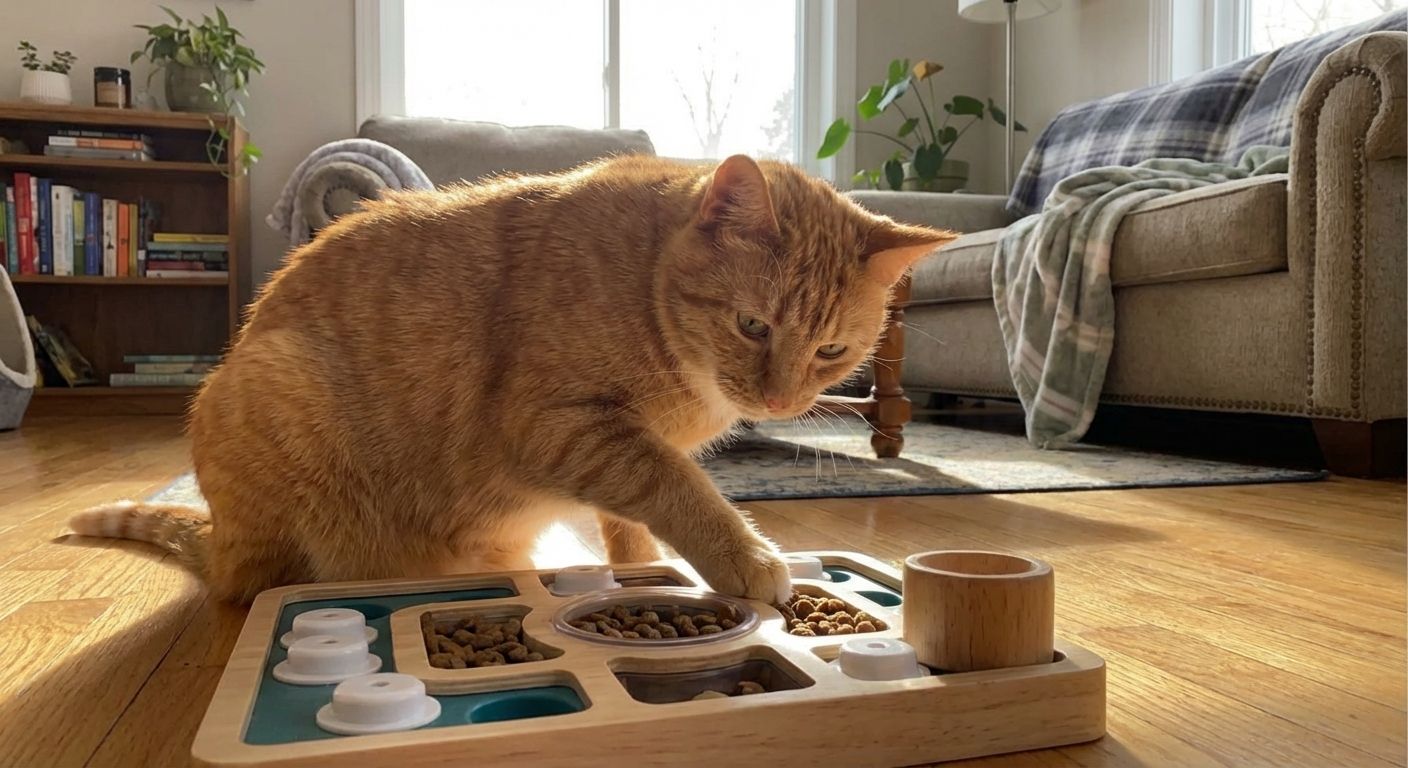
Learning how to entertain a cat while at work is not about keeping your cat busy every minute. Most healthy adult cats sleep for large parts of the day. The goal is to give your indoor cat safe choices: places to watch, scratch, explore, solve small food puzzles, rest, and use energy before or after your work hours.
A good workday setup should be safe unsupervised. That means no loose strings, risky batteries, fragile objects, toxic plants, unstable shelves, or toys your cat can chew apart. The best routine usually combines a little pre-work play, one or two safe solo activities, a comfortable window or resting spot, and a predictable after-work interaction.
This guide shows practical ways to entertain an indoor cat while you work without filling your apartment with clutter or creating unsafe distractions.
Quick Answer
To entertain a cat while at work, set up safe solo enrichment before you start your day: a window perch, food puzzle, toy rotation, scratching surface, climbing route, scent item, or timed feeder. Then add short interactive play before or after work so your cat gets real hunting-style movement with you.
Do not leave out toys with loose strings, feathers that detach easily, small parts, open batteries, sharp edges, or anything your cat might swallow. If your cat becomes destructive, overgrooms, stops eating, hides, has litter box changes, or seems unusually distressed when alone, the issue may be stress or health-related rather than simple boredom.
Important Safety Note
Unsupervised enrichment must be safer than supervised play. Wand toys, string toys, elastic cords, ribbons, yarn, and small detachable pieces should be put away when you are not watching. If your cat chews fabric, plastic, cords, or toy parts, choose sturdier options and talk to your veterinarian if chewing becomes repetitive or compulsive.
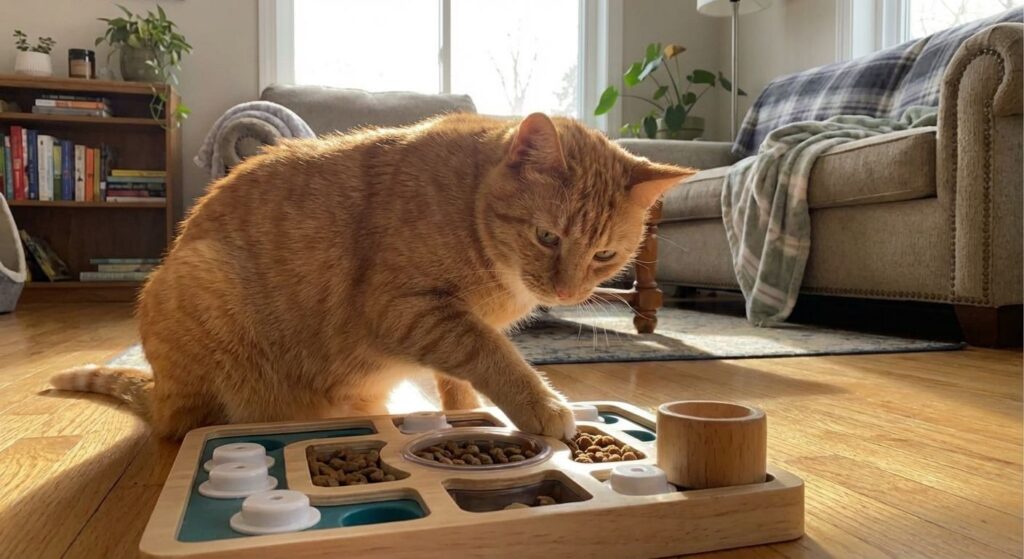
Table of Contents
What Cats Actually Need While You Work
Cats do not need constant entertainment while you work. They need a daily rhythm that includes rest, observation, movement, food-seeking, scratching, and secure territory.
A bored cat may interrupt you, meow, knock things over, chase feet, wake you at night, or become food-focused. But a cat who rests peacefully for hours is not automatically bored. The goal is balance.
A good workday plan gives your cat:
- a comfortable resting place
- safe window access
- a scratching option
- a small problem to solve
- a predictable food routine
- a few rotating objects
- interactive play outside work hours
- no unsafe unsupervised toys
If you are not sure whether your cat is truly bored, compare behavior with our guide to signs indoor cat is bored.
Workday Enrichment Is About Timing, Not Constant Stimulation
A common mistake is thinking a cat needs entertainment every hour while the owner works. Most adult cats do not. Many cats naturally sleep during large parts of the day. The real problem is not quiet rest. The problem is an empty routine with no predictable outlets before, during, or after the workday.
A good workday plan uses timing:
- a short activity before you start work
- one or two safe solo options during the day
- a calm resting place
- a predictable after-work interaction
- a bedtime routine if evening energy builds up
This matters because many “workday behavior problems” are actually timing problems. A cat who sleeps all day may explode with energy at night. A cat who gets no attention before work may interrupt the first meeting. A cat who has no food puzzle may turn the kitchen or desk into their entertainment source.
You do not need to entertain your cat constantly. You need to create a daily rhythm that gives them something appropriate to do before they invent their own activity.
9 Safe Ways to Entertain a Cat While at Work
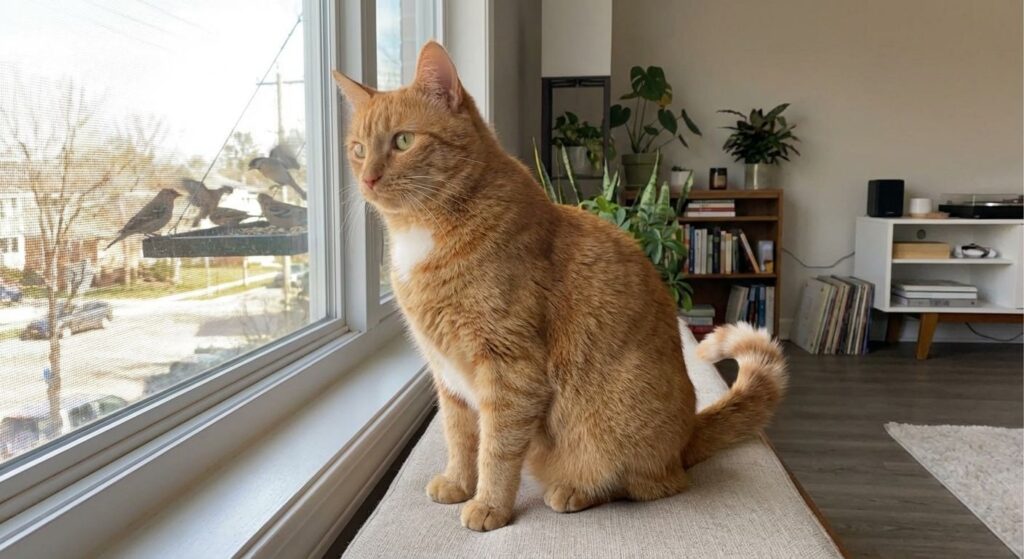
Idea 1: Window Watching Station
A window can be one of the best low-clutter enrichment tools for an indoor cat. Birds, light, weather, people, and movement outside can provide quiet visual stimulation.
A safe window station may include:
- a stable perch
- a soft blanket
- closed or secured screens
- no dangling blind cords
- no fragile objects nearby
- no access to unsafe balcony gaps
Watch your cat’s reaction. Some cats relax at windows. Others become frustrated by outdoor cats or wildlife. If your cat growls, tail-thrashes, sprays, or becomes aggressive after window watching, limit access during trigger times.
If your cat loves watching outdoor movement, a stable window setup can be one of the highest-value passive enrichment tools. See our best cat window perch guide.
Idea 2: Food Puzzle or Treat Hunt
Food puzzles are useful because they turn part of a normal meal into activity. Instead of adding extra treats, use a portion of your cat’s regular food.
Options include:
- puzzle feeder
- treat ball
- snuffle mat
- hidden kibble trail
- small dishes placed around the room
- cardboard egg carton puzzle, supervised first
Start easy. If the puzzle is too hard, your cat may ignore it or become frustrated. The goal is gentle problem-solving, not a test.
For safe options that turn meals into work, see our best cat puzzle feeders guide.
How to Use Food Puzzles Without Overfeeding
Food puzzles are useful only when they use part of the normal daily food. If you add puzzle food on top of regular meals, enrichment can quietly become overfeeding.
A simple method:
- Measure your cat’s daily dry food or treat allowance.
- Remove a small portion from the bowl.
- Use that portion in a puzzle feeder or treat hunt.
- Keep the total daily calories the same.
Start easy. Put food where your cat can find it quickly. Once your cat understands the game, make it slightly harder. A puzzle that is too difficult may cause frustration, not enrichment.
Good beginner options include:
- a few kibbles hidden in a towel fold
- a shallow puzzle tray
- a treat ball with a wide opening
- several small dishes placed around one room
- cardboard tubes with large openings
- a snuffle mat used with supervision first
Watch your cat’s style. Some cats enjoy pawing. Some prefer sniffing. Some give up quickly if the puzzle does not pay out fast enough. Match the puzzle to the cat, not the other way around.
Idea 3: Toy Rotation Basket
Leaving every toy out all the time can make toys boring. A toy rotation basket keeps novelty alive without buying new items constantly. If floor space is the main problem, compare our guide to the best space saving cat toy options for renters before buying more bulky toys.
Use three groups:
- active toys for supervised play
- solo-safe toys for work hours
- stored toys for later rotation
Only leave out toys that are safe without supervision. Put away wand toys, string toys, ribbons, and toys with loose parts.
Rotate every few days. An old toy that has been hidden for a week often feels more interesting than a toy that has been on the floor for months.
The 3-Bin Toy Rotation System
Toy rotation works better when it is simple. Use three groups.
Bin 1: Workday-Safe Toys
These are toys that can stay out while you work:
- soft balls
- sturdy mice
- crinkle toys without loose parts
- kicker toys with strong seams
- safe puzzle feeders
- cardboard boxes without handles or staples
Bin 2: Supervised Toys
These are toys you use only when watching:
- wand toys
- string toys
- feather toys
- elastic toys
- toys with small parts
- high-energy chase toys
Bin 3: Resting Toys
These are toys stored away for novelty. Bring them back later so they feel fresh.
This system prevents clutter and keeps toys more interesting. Instead of buying more toys every time your cat seems bored, rotate what you already have. If you need safer workday options to rotate, our guide to the best interactive cat toys for solo play compares motion toys, puzzle feeders, and durable automatic toys for indoor cats.
Idea 4: Scratching and Stretching Zone
Scratching is not optional for cats. It supports claw care, stretching, scent marking, and stress relief. If your cat has no good scratching outlet while you work, furniture may become the target.
A good scratching zone should be:
- stable
- tall or long enough for full stretch
- placed near where your cat already spends time
- matched to your cat’s preferred texture
- easy to access
Some cats prefer vertical posts. Others prefer horizontal cardboard. If your cat scratches furniture, place the legal scratcher near that area first, then gradually move it if needed.
Idea 5: Safe Climbing Route
Vertical space helps indoor cats use the room more fully. In a small apartment, a safe climbing route can be more useful than another floor toy.
Options include:
- cat tree
- window perch
- cleared shelf
- stable furniture path
- low step route for senior cats
- wall shelves only if securely installed and renter-safe
For renters, avoid permanent wall damage unless you have permission. Use furniture-based vertical space when possible.
Idea 6: Scent and Texture Enrichment
Cats explore with smell and touch. Simple scent and texture changes can make the day more interesting.
Safe ideas include:
- a paper bag with handles removed
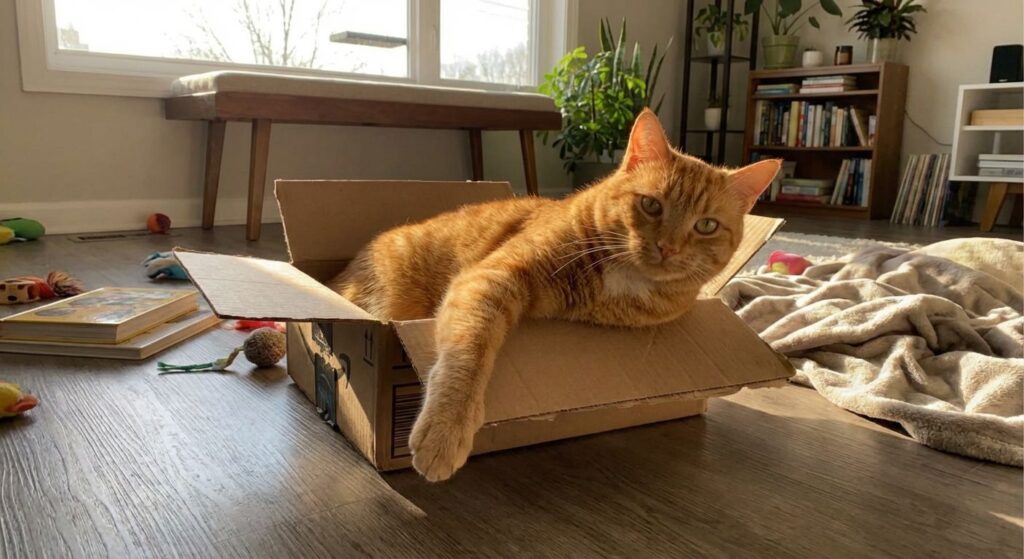
- cardboard box
- clean towel from a familiar room
- cat-safe silvervine or catnip toy
- crinkle mat
- fleece blanket
- rotating bed location
Do not use essential oils around cats. Many scented products are not appropriate for feline environments.
Idea 7: Timed Feeder Routine
A timed feeder can help cats who become restless during long work hours or who wake owners early for food. It can separate food access from begging and create predictable structure.
Use measured portions. A timed feeder should not become an extra feeding source. It should distribute part of the daily food.
Timed feeders are especially useful when:
- your cat begs during meetings
- your cat wakes you early
- meals are inconsistent
- work calls make feeding times unpredictable
- your cat eats too fast from one large meal
If your cat is overweight or on a diet, count every feeder portion.
Idea 8: Background Sound or Visual Calm
Some cats rest better with predictable background sound. Others prefer quiet. Test gently.
Options include:
- low-volume calm music
- white noise
- quiet nature sounds
- a bird video only if it does not frustrate the cat
- leaving normal household sounds consistent
Do not use loud or overstimulating videos all day. If your cat paws aggressively at the screen, vocalizes, or becomes frustrated, use calmer options.
Idea 9: Pre-Work and Post-Work Play
Solo enrichment helps, but it does not replace interactive play. Many cats need a real play session with their person.
A good pre-work routine can be short:
- 5 minutes wand toy
- a catch
- breakfast or puzzle feeder
- calm transition to work
A good post-work routine can help prevent evening restlessness:
- greeting
- short play
- meal
- quiet attention
If your cat gets intense late-night energy, connect this with your guide on how to tire out a cat before bed.
Workday Enrichment Safety Table
| Enrichment Idea | Safe While Unsupervised? | Watch Out For |
|---|---|---|
| Window perch | Yes, if stable and secure | Screens, cords, outdoor cat stress |
| Puzzle feeder | Usually | Frustration, chewing, extra calories |
| Wand toy | No | Strings and choking risk |
| Cardboard box | Usually | Chewing, staples, handles |
| Scratching post | Yes | Wobbling or tipping |
| Treat hunt | Yes, if food-safe | Hidden food attracting pests |
| Robotic toy | Maybe | Batteries, wheels, chewing |
| Cat TV | Maybe | Frustration or screen pawing |
| Scent toy | Usually | Overexcitement or chewing |
Apartment-Friendly Enrichment Zones
A small home can still provide variety if each area has a purpose.
Window Zone
Use this for passive observation. Keep cords secured and make sure the perch is stable.
Scratch Zone
Place a scratcher near the area your cat already uses. If your cat scratches the sofa, the legal scratcher should start near the sofa, not across the room.
Food Puzzle Zone
Use an easy-to-clean area. Avoid hiding food where it may be forgotten or attract pests.
Rest Zone
Your cat needs a quiet place away from traffic. This is especially important if you work from home and make calls all day.
Desk Zone
If your cat wants to be near you, give them a legal nearby spot. A cat bed beside the desk often works better than constantly removing the cat from the keyboard.
Climbing Zone
Use stable furniture, a cat tree, or a renter-safe vertical route. Do not rely on unstable shelves or furniture that can tip.
Sample Workday Routine
Before Work
Start with a short play session. It does not need to be long. Five to ten minutes of focused play can help your cat settle.
Then offer breakfast or a puzzle feeder. This creates a hunt-play-eat-rest rhythm.
During Work
Leave out only safe options:
- window perch
- scratcher
- puzzle feeder
- safe solo toys
- resting spot near you or away from noise
If you work from home, give your cat a legal place near your desk. A side chair, small bed, or nearby perch can reduce keyboard interruptions.
Lunch or Midday Break
If possible, offer a short reset: toss a few pieces of kibble from the daily portion, open a new box, rotate one toy, or give two minutes of attention.
After Work
Give your cat a predictable interaction when work ends. This helps cats who wait all day for owner attention. Play first, then feed or settle.
Routine Examples by Owner Schedule
Different workdays need different enrichment plans.
If You Work From Home
Your cat may interrupt because you are visible but unavailable. Set up a nearby legal space before work begins: a cat bed, chair, window perch, or blanket beside the desk.
Use a pre-work play session and a puzzle feeder during your first focused work block. If your cat jumps on the keyboard, calmly move them to the nearby spot rather than creating a big reaction.
If You Leave for the Office
Your cat needs safe options that do not require supervision. Prioritize window access, scratchers, food puzzles, safe solo toys, and a comfortable resting place.
Use interactive play before you leave or after you return. Do not leave string toys, wand toys, or fragile objects out.
If You Work Long Shifts
Long workdays need more predictability. A timed feeder, water check, clean litter box, and safe resting zones matter. Consider whether a trusted person should check in if your shift is unusually long.
Avoid leaving new toys unsupervised for the first time on a long workday. Test them while home first.
If You Work Irregular Hours
Cats like routine, but the routine does not have to happen at the same clock time every day. Use sequence instead: play, meal, work block, rest. The order can be consistent even if the hour changes.
If You Have Multiple Cats
Make sure enrichment does not create competition. Use more than one resting spot, more than one window view if possible, separate food puzzles, and enough distance so one cat cannot guard everything.
What Not to Leave Out Unsupervised
Avoid leaving out:
- string
- yarn
- ribbon
- wand toys
- elastic cords
- small bells or beads
- broken toys
- toys with exposed batteries
- fragile glass
- toxic plants
- plastic bags
- hair ties
- rubber bands
- human food
- medication
- sharp objects
If your cat chews or swallows non-food objects, be extra cautious. Safe enrichment should not create an emergency risk.
Common Mistakes
Mistake 1: Leaving Out Too Many Toys
Too many toys become background clutter. Rotate a few at a time.
Mistake 2: Using Food Without Counting Calories
Food puzzles should use part of the daily portion, not extra calories added on top.
Mistake 3: Leaving String Toys Out
String toys are for supervised play only.
Mistake 4: Ignoring the Cat’s Actual Preferences
Some cats love puzzles. Others prefer windows, boxes, or chasing. Watch what your cat actually uses.
Mistake 5: Expecting Solo Toys to Replace Human Play
Your cat still needs interactive play and social contact. Solo enrichment fills gaps; it does not replace you.
How to Know Your Workday Plan Is Working
A good workday enrichment plan should make your cat calmer, not more frantic.
Signs it is working:
- fewer work interruptions
- less meowing during meetings
- calmer evenings
- fewer night zoomies
- more use of scratchers
- more independent resting
- less food-focused behavior
- more interest in rotating toys
- fewer objects knocked over
- better sleep after play
Do not expect every behavior to disappear. The goal is improvement. If your cat still interrupts but settles faster, that is progress. If night activity drops from every night to twice a week, that is progress.
Track one problem behavior for a week before and after changes. Count how often it happens and when. This gives you better information than guessing.
When to Upgrade the Setup
Start small, then upgrade only if needed.
Upgrade the setup if:
- your cat ignores all current toys
- night zoomies continue every night
- your cat interrupts work constantly
- your cat is gaining weight from boredom eating
- your cat has no vertical space
- your cat has no window access
- multiple cats compete for the same resources
- your cat destroys unsafe objects
The best first upgrades are usually:
- better wand play routine
- puzzle feeder
- stable window perch
- scratching post
- toy rotation
- safe climbing route
Do not buy a large expensive item before knowing what kind of enrichment your cat actually uses. Some cats prefer a box and wand toy over a complicated electronic toy.
When Boredom May Be Stress or Illness
If your cat’s behavior changes suddenly, do not assume workday boredom.
Call your veterinarian if you notice:
- appetite changes
- weight loss
- increased thirst
- vomiting
- diarrhea
- hiding
- overgrooming
- aggression
- litter box changes
- reduced jumping
- lethargy
- confusion
- pain signs
If the issue looks more like anxiety or stress than boredom, compare it with your signs your indoor cat is stressed guide.
For a broader enrichment setup, use our indoor cat enrichment in small apartments guide.
Frequently Asked Questions
1. How do I entertain my cat while I am at work?
Use safe solo enrichment: window access, puzzle feeders, scratchers, toy rotation, scent items, climbing spots, and a predictable play routine before or after work. Avoid unsafe string toys or fragile objects.
2. Is it okay to leave my cat alone while I work?
Most healthy adult cats can rest while owners work, as long as they have food, water, litter access, safe resting spots, and enrichment. Kittens, senior cats, anxious cats, or cats with medical needs may require more planning.
3. What toys are safe to leave out while I am gone?
Sturdy solo toys, puzzle feeders, scratchers, cardboard boxes, and safe soft toys are usually better than string toys, wand toys, ribbons, or toys with small detachable parts.
4. Should I leave the TV on for my cat?
Some cats enjoy calm video or background sound, while others become frustrated. Test it. If your cat paws at the screen, vocalizes, or becomes tense, choose a calmer option.
5. How can I stop my cat interrupting work calls?
Give your cat attention before calls, set up a nearby bed or perch, use a puzzle feeder, and keep tempting desk items away. Reward calm presence instead of only reacting when your cat interrupts.
6. Can food puzzles make my cat gain weight?
Yes, if they add extra food. Use part of your cat’s normal daily portion in the puzzle feeder.
7. What if my cat sleeps all day while I work?
That may be normal. Cats sleep a lot. Worry more if your cat seems lethargic, stops playing entirely, loses weight, changes appetite, or has litter box changes.
8. What can I leave out for my cat while I am at work?
Safe options include sturdy solo toys, puzzle feeders, scratchers, cardboard boxes without handles, window perches, and soft toys without loose parts. Avoid strings, ribbons, exposed batteries, small detachable pieces, and anything your cat might swallow.
9. Should I get an automatic toy for my cat while I work?
Maybe, but test it while you are home first. Some automatic toys are useful, but others scare cats, break easily, or have parts that should not be left unsupervised. Choose simple and safe over flashy.
10. How do I keep my cat entertained without making my apartment messy?
Use rotation. Keep only a few items out: one scratcher, one puzzle feeder, one resting spot, and a few safe toys. Store the rest and rotate them every few days.
11. What if my cat still bothers me while I work?
Give your cat attention before work starts, create a nearby legal resting spot, and use a safe puzzle or window setup during your first work block. If the behavior is sudden, intense, or paired with health changes, rule out stress or illness.
Final Thoughts
Learning how to entertain a cat while at work is about building a safe, repeatable routine. Your cat does not need constant entertainment, but they do need choices: a window, a scratcher, a place to climb, a small problem to solve, and real play with you when you are available.
Start simple. Add one safe solo activity, one play session, and one better resting or viewing spot. Watch what your cat actually uses, then rotate and refine.
The best workday enrichment plan is safe, low-clutter, and easy enough to repeat every week.
-300x169.png)
-300x169.png)
-300x169.png)