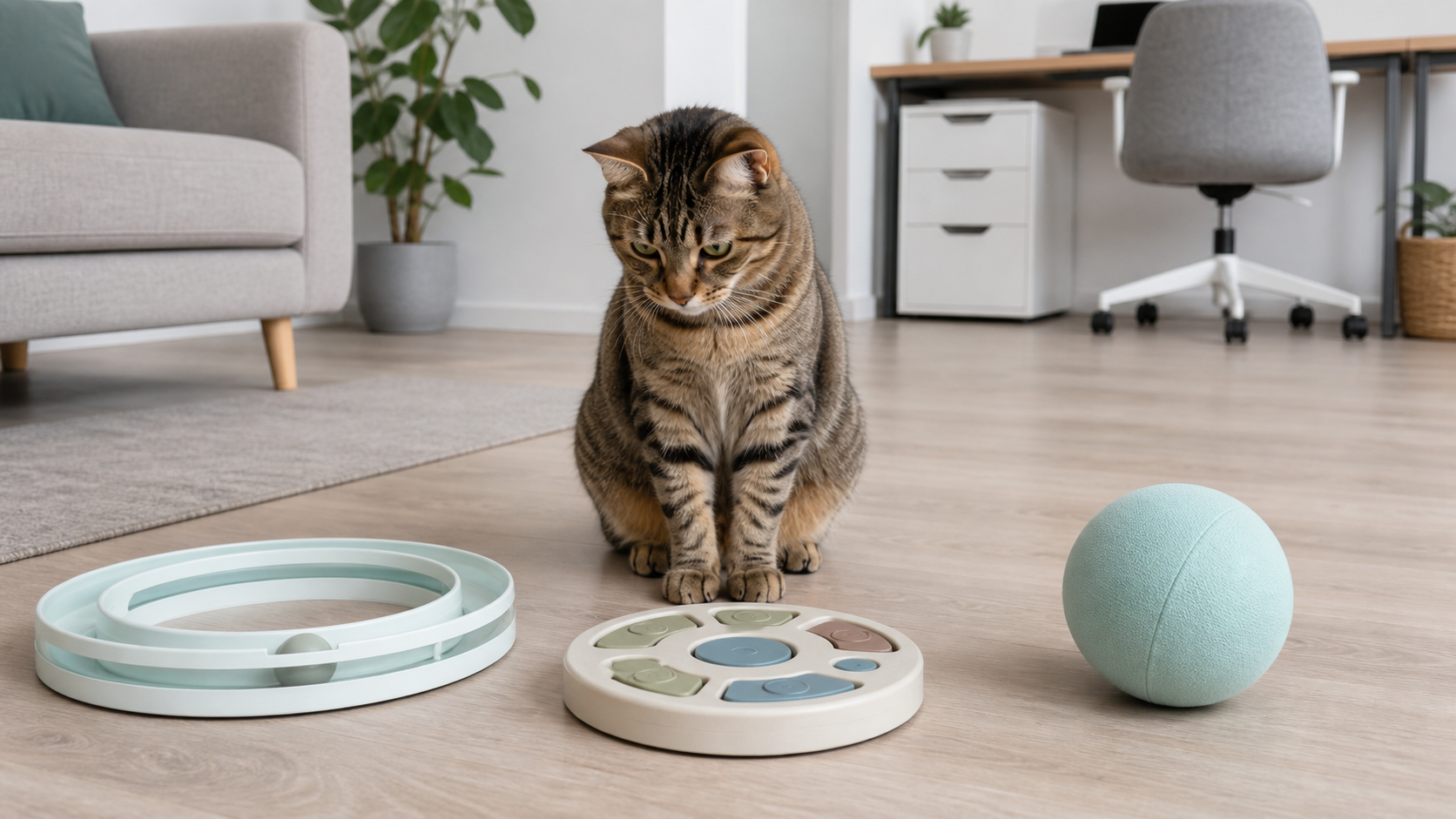
The best interactive cat toys for solo play give an indoor cat something safe and rewarding to chase, paw, investigate, or solve without requiring you to control every movement. The most useful options are usually enclosed ball tracks, stable food puzzles, covered motion toys, or sturdy one-piece rolling toys. They should not have loose string, ribbon, elastic, exposed batteries, sharp edges, or small parts that your cat can detach and swallow.
“Solo play” does not automatically mean “safe to leave out while nobody is home.” A toy may work independently but still require supervision under its manufacturer’s instructions. Introduce every new toy while you are present, watch how your cat bites, claws, lifts, or dismantles it, and remove it if any part loosens or becomes damaged.
This guide compares five practical choices by design, apartment fit, activity type, maintenance, and supervision needs. It is a feature-based comparison, not a claim that every cat will prefer the same toy.
Disclosure: This article may contain affiliate links. Indoor Cat Expert may earn a commission at no extra cost to you. Product availability, materials, accessories, and instructions can change, so confirm the current label and manufacturer guidance before use.
Table of Contents
Quick Answer
For many indoor cats, a strong solo-play rotation starts with an enclosed ball track for batting, a food puzzle that uses part of the normal daily meal, and one reactive or rolling toy used only after a supervised trial. The five options compared here are:
- Catit Senses Play Circuit — best simple enclosed ball track
- Catit Senses Treat Puzzle — best all-in-one food puzzle
- TRIXIE Cat Activity Fun Board — best progressive puzzle challenge
- Catit Senses Ball Dome — best covered motion-activated option
- Cheerble Wicked Ball M3 — best compact rechargeable rolling toy
No toy should replace daily interactive play with a person. Use solo toys to fill quiet periods, then keep wand toys, string toys, loose feathers, and laser play for sessions you actively supervise.
Solo-Play Toy Decision Table
| Your priority | Best starting type | Why it may fit | Main check before use |
|---|---|---|---|
| Quiet workday activity | Enclosed ball track | No motor and the ball stays inside the track | Confirm all track joints lock firmly |
| Food-motivated cat | Treat or meal puzzle | Adds searching and paw work to part of a meal | Count puzzle food in the daily allowance |
| Cat new to puzzles | Easy food puzzle | Difficulty can begin low and increase gradually | Make the first attempt easy enough to succeed |
| Cat that likes moving objects | Covered motion toy | Moving part is separated from direct access | Test noise, stability, and reaction while present |
| High-energy cat | Sturdy rolling toy | Encourages batting and following across clear floor | Check seams, charging port, size, and floor obstacles |
| Cat that chews toy parts | Simple non-electronic toy | Fewer components can mean fewer failure points | Remove immediately if the cat gnaws or lifts parts |
| Multi-cat household | Separate activity stations | Reduces crowding around one high-value toy | Watch for guarding, blocking, or conflict |
What “Solo Play” Should Mean
A solo-play toy can respond to a cat’s paw, movement, or food-seeking behavior without a person continuously operating it. That can be useful while you cook, work at a desk, or complete another task nearby. It does not transfer responsibility for safety from the caregiver to the toy.
The safest interpretation is:
- you have inspected the toy before the session;
- you introduced it while watching;
- the cat has not tried to chew, swallow, lift, or dismantle it;
- the floor area is free of cords, fragile objects, and tight gaps;
- the toy is removed when worn, damaged, or no longer appropriate;
- manufacturer instructions are followed even when they are more cautious than a product description.
If you are preparing enrichment for a full workday, combine a safe resting place, scratching surface, window access, and food-based activity with the toy. Our guide on how to entertain a cat while at work explains how these pieces fit into a realistic routine.
Safety Checks Before Comparing Toys
1. Loose strings, ribbons, and elastic
The American Veterinary Medical Association warns that string or ribbon can cause life-threatening intestinal problems if swallowed. Wand toys can be excellent for shared play because you control the movement and put them away afterward. They are not appropriate to leave accessible for independent, unobserved play.
Reject a solo-play setup that includes:
- exposed string, yarn, ribbon, fishing line, or elastic;
- a feather or fabric tail that detaches with light pulling;
- bells, eyes, caps, clips, or decorations small enough to swallow;
- frayed fabric or cracked plastic;
- openings that can trap a paw, claw, collar, or jaw.
If you see string emerging from your cat’s mouth or anus, do not pull it. Contact a veterinarian promptly.
2. Batteries and charging components
An electronic toy needs more inspection than a passive toy. Check whether the battery area or charging port can be opened, chewed, or exposed during play. Never use a toy with a cracked housing, loose cover, damaged cable, swelling battery, or unusual heat or odor.
Rechargeable does not automatically mean risk-free. Charge the toy away from the cat, disconnect the cable before play, and follow the manufacturer’s charging instructions. Button-cell products deserve particular caution because the batteries are small and hazardous if accessed or swallowed.
3. Size, seams, and construction
The complete toy and every removable component should be too large for your cat to swallow. Press and pull the seams, covers, track joints, and closures before use. A cat that plays by biting and carrying objects may need a different design from a cat that only bats with a paw.
4. Stability and the play area
Place tracks and puzzles on a level, non-slip surface. Clear the route for rolling toys so they cannot disappear behind an appliance, strike a fragile object, or lure the cat toward cables. In a multi-cat home, provide more than one activity location so a confident cat cannot guard the only toy.
5. The cat’s individual response
Some cats stalk moving toys quietly. Others become overstimulated, chew components, or repeatedly flip the entire unit. A product that remains intact for one cat can be unsuitable for another. Stop the session if your cat pants, becomes frantic, redirects aggression, or tries to ingest the toy.
How We Chose These Five Options
This comparison prioritizes designs whose core features can be checked on current manufacturer pages. We looked for:
- an enclosed, stable, or largely one-piece play mechanism;
- a clear activity purpose such as batting, foraging, or following movement;
- usefulness in a small indoor space;
- a practical way to clean, inspect, or reset the toy;
- enough variety to build a rotation instead of buying five versions of the same motion toy;
- published product information that allows the reader to verify dimensions, materials, operating modes, or included parts.
We did not rank a toy as “safe when nobody is home.” Manufacturers commonly instruct caregivers to supervise pet play, and an individual cat’s chewing style matters more than a broad marketing label.
The 5 Best Interactive Cat Toys for Solo Play
1. Catit Senses Play Circuit — Best Simple Ball Track
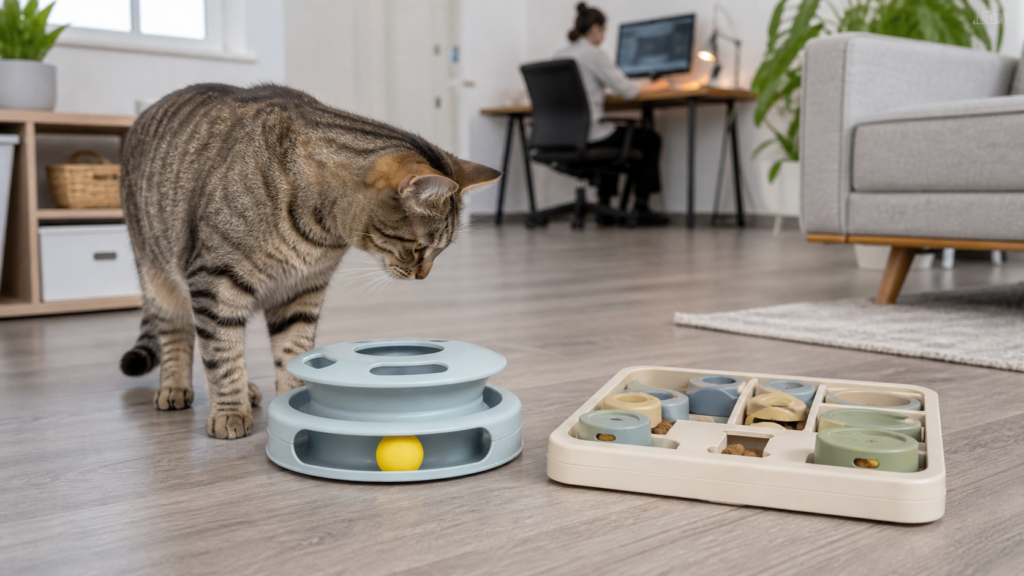
The Catit Senses Play Circuit uses a ball inside a covered track. Openings allow the cat to reach in with a paw while the track keeps the ball contained. The brand says the circuit can be disassembled and rebuilt in different layouts, and its sections use an easy-click connection system.
Why it stands out: The activity is simple to understand, quiet, and not dependent on a motor. A cat can bat the enclosed ball, follow it through the translucent cover, pause, and return later. Rearranging the track can add variation without buying a completely new toy.
Best for:
- cats that like batting and following rolling objects;
- apartments where motor noise would be disruptive;
- owners who want a low-maintenance first interactive toy;
- cats that become frustrated by difficult food puzzles.
Check before use: Lock every track section fully and confirm the ball enclosure is secure. The included ball can be opened, so inspect it regularly and do not add anything that could escape through the track or be swallowed. Remove the circuit if a cat persistently chews joints or pries up the cover.
Apartment note: Place it on a mat if the plastic slides or the ball sound travels through hard flooring. Keep it away from doorways and walking routes.
Bottom line: This is the easiest non-food starting point in the list. It offers repeated paw-and-ball interaction without asking the cat to understand a complicated mechanism.
2. Catit Senses Treat Puzzle — Best All-in-One Food Puzzle
The Catit Senses Treat Puzzle combines six activity areas on one broad tray. Food can be placed in different wells, tunnels, tubs, and covered sections so the difficulty varies within the same unit. The manufacturer describes it as an interactive slow feeder made from BPA-free plastics that can be disassembled for cleaning.
Why it stands out: Food provides a clear reward, so a puzzle can engage cats that ignore motion toys. Multiple sections also let you begin with visible, easy-to-reach pieces and introduce harder compartments only after the cat understands the task.
Best for:
- food-motivated cats;
- cats that eat dry food or suitable treats;
- beginners who need several difficulty levels;
- owners who want one stable puzzle instead of several small dispensers.
Check before use: Use part of the cat’s measured daily food rather than adding unlimited treats. Confirm all covers and inserts are seated correctly. Watch the first sessions to see whether the cat solves the puzzle with a paw or tries to bite and remove components.
Apartment note: The tray occupies more floor space than a small rolling toy, but its wide base can be easier to contain in one feeding zone. Clean out crumbs so the puzzle does not attract pests.
Bottom line: Choose this when food is the most reliable motivator and you want adjustable challenge in a single washable format. For more feeding-specific choices, compare our best cat puzzle feeders guide.
3. TRIXIE Cat Activity Fun Board — Best Progressive Puzzle Challenge
The TRIXIE Cat Activity Fun Board has five different activity modules and a non-slip base. According to the manufacturer, it can be used with dry food and includes training instructions. The variation asks a cat to use its paws and nose in more than one way.
Why it stands out: Some cats quickly learn a single sliding lid or cup. Five modules provide a progression without requiring the owner to replace the entire puzzle. The non-slip feet also help keep the board from moving across the room during paw work.
Best for:
- cats that already understand simple food puzzles;
- persistent paw users;
- owners who want a reusable challenge board;
- controlled portions of dry food or treats.
Check before use: Start with the easiest module and leave some food plainly visible. A puzzle that is too difficult can produce frustration rather than enrichment. Inspect all removable or moving pieces and supervise until you know the cat does not chew them.
Apartment note: Store the board vertically only after cleaning and drying it. During use, place it where the cat has room to approach from more than one side.
Bottom line: This is a good next step after a cat succeeds with an easier puzzle. It is less appropriate for a cat that gives up quickly or becomes destructive when food is not immediately accessible.
4. Catit Senses Ball Dome — Best Covered Motion-Activated Option
The Catit Senses Ball Dome places a moving ball beneath a paw-accessible cover. The brand states that two motion sensors can activate the toy when the cat approaches and that the internal plate periodically moves the ball again. The cover separates the cat from the main moving mechanism.
Why it stands out: It adds movement without sending a loose electronic toy across the whole apartment. The defined footprint makes it easier to choose a safe play zone and observe whether the cat enjoys motion before considering a free-rolling device.
Best for:
- cats drawn to movement but not interested in static tracks;
- homes where a loose rolling device would get stuck under furniture;
- cats that like watching before reaching in with a paw;
- nearby solo play while the owner is occupied.
Check before use: Confirm the cover is secure, the unit sits flat, and the cat cannot reach the internal mechanism. Observe the sound level and the cat’s reaction. Remove the toy if the cat attacks the housing, tries to overturn it, or becomes distressed by activation.
Apartment note: Test it at different distances from your desk and neighboring walls. Even a covered motor can sound louder on hard floors in a quiet apartment.
Bottom line: This offers a useful middle ground between a passive track and a free-moving electronic toy, but it still needs an initial supervised assessment.
5. Cheerble Wicked Ball M3 — Best Compact Rechargeable Rolling Toy
The current Wicked Ball M3 is a compact rechargeable cat ball with three modes, obstacle avoidance, and play-rest cycles. Cheerble lists a 47 mm diameter, a synthetic-fiber, silicone, and TPU construction, USB-C charging, and a 10-minute play period followed by a 30-minute break.
Why it stands out: A rolling device can create movement across a larger area than a fixed puzzle. The documented rest cycle limits continuous activity, while the small footprint makes storage easy.
Best for:
- active cats that follow rolling objects;
- owners who can clear a safe floor route;
- short nearby sessions after a successful supervised introduction;
- homes where a rechargeable device is preferred over loose replaceable batteries.
Check before use: Inspect the fabric and seams before every session, charge it away from the cat, and disconnect the cable before play. Do not attach optional accessories for unattended activity. Make sure the ball is not small enough for your individual cat to hold fully in the mouth. Stop use if it is damaged, unusually hot, noisy, or difficult to switch off.
Apartment note: Rolling balls can transmit noise on hard floors and become trapped behind furniture. Block unsafe gaps and test the quietest mode first.
Bottom line: This is the most active option in the list, but it demands more environmental preparation and inspection than a passive track or food puzzle.
Which Toy Should You Choose First?
Do not start with price or electronics. Start with the behavior your cat already shows.
Choose a ball track when your cat:
- bats bottle caps or balls across the floor;
- watches movement closely;
- prefers repeated paw contact to food rewards;
- startles at motors or sudden noise.
Choose a food puzzle when your cat:
- is strongly motivated by meals;
- eats quickly;
- investigates cupboards or food containers;
- ignores toys that provide no tangible reward.
Choose a covered motion toy when your cat:
- likes prey that appears and disappears;
- enjoys movement but loses loose toys under furniture;
- can play near you while you work;
- does not chew or overturn plastic housings.
Choose a free-rolling electronic toy when your cat:
- consistently chases durable balls;
- has a clear, cord-free route;
- has demonstrated gentle interaction during supervised trials;
- does not try to carry, bite through, or dismantle moving toys.
If your cat redirects hunting behavior toward hands or ankles, solo toys can add appropriate outlets, but they are only one part of the plan. Use the behavior guidance in why does my cat bite me and keep human hands out of play.
A Safe Introduction Plan
Step 1: Inspect before the cat sees it
Read the manufacturer’s instructions. Check the complete toy, moving parts, seams, covers, battery access, charging port, and included accessories. Remove packaging, ties, plastic film, and silica packets from the room.
Step 2: Begin with a short observed session
Place the toy in an open, familiar area. Let the cat approach instead of pushing the toy toward them. For a food puzzle, expose some food so the first attempt is easy. For an electronic toy, begin with the quietest or slowest setting.
Step 3: Watch the interaction style
Look for pawing, following, sniffing, or calm problem-solving. More concerning behaviors include sustained chewing, pulling fabric, prying open covers, carrying a small device in the mouth, or attacking the battery area.
Step 4: End before frustration builds
Not every session needs a fixed duration. End when the cat walks away, stops responding, becomes agitated, or begins dismantling the toy. Put away electronic or supervised-only items after the session.
Step 5: Reinspect and record what worked
Check for cracks, loose pieces, teeth marks, fraying, or trapped debris. Note whether the cat preferred batting, food searching, or movement. That observation should guide the next purchase more than a generic “best toy” ranking.
How to Prevent Toy Fatigue Without Buying More
Cats often lose interest when a toy becomes predictable or remains available all the time. Rotation can restore novelty while reducing clutter.
Use three simple groups:
- Currently available: one or two passive toys and one puzzle.
- Supervised only: wand toys, string toys, loose feathers, laser play, and any electronic toy not yet assessed.
- Stored for rotation: cleaned, dry toys kept out of sight until the next change.
Rotate a small selection when interest drops instead of following a rigid calendar. Change the track layout, move the puzzle to another safe zone, or switch between a ball activity and a food activity. Do not add scent products to an electronic toy or a surface the manufacturer does not identify as appropriate.
For a wider apartment setup, use the indoor cat enrichment in small apartments guide. If you are unsure whether the behavior is truly boredom, compare the pattern with signs an indoor cat is bored.
Food Puzzle Rules That Prevent Accidental Overfeeding
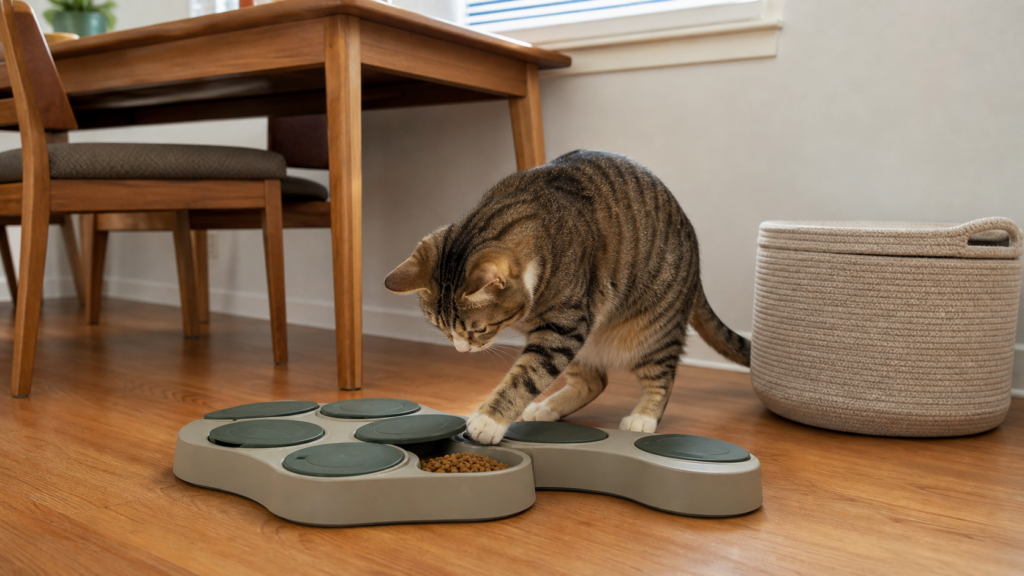
A food puzzle should redistribute food, not silently add calories.
- Measure the full daily amount first.
- Take puzzle food from that amount.
- Use the food type the product is designed to hold.
- Start with an easy layout and increase difficulty gradually.
- Clean the puzzle according to the manufacturer’s instructions.
- Discard wet or contaminated food instead of leaving it out all day.
- In a multi-cat home, confirm which cat is eating each portion.
Ask your veterinarian before changing feeding methods for a kitten, a cat on a prescription diet, or a cat with diabetes, dental pain, mobility problems, food anxiety, or another condition affected by meal timing or access.
Common Mistakes
Treating “interactive” as “safe without supervision”
Interactive only describes how a toy responds. It does not guarantee that every component is appropriate for every cat or for an empty home.
Choosing by automatic shut-off alone
A rest cycle can limit motor activity, but it does not correct a loose attachment, damaged seam, accessible battery, or swallowable piece.
Leaving wand and feather toys accessible
These toys are valuable when a person controls them. Put them in closed storage after play so the cat cannot reach string, ribbon, elastic, or detachable feathers.
Making a puzzle too difficult
If food is impossible to reach, the cat may walk away or become frustrated. Make success obvious first, then increase the challenge in small steps.
Using toys instead of human interaction
Feline environmental guidance includes both opportunities for predatory play and positive, predictable interaction with people. Solo play fills gaps; it does not replace shared play, social contact, scratching, climbing, resting, and observation.
Ignoring sudden behavior changes
A cat that suddenly becomes restless, destructive, withdrawn, aggressive, or uninterested in play may have pain, illness, fear, or stress rather than a simple shortage of toys. Contact your veterinarian when the change is new, persistent, or accompanied by appetite, weight, mobility, grooming, vomiting, or litter-box changes.
Frequently Asked Questions
Can I leave an interactive cat toy out while I am away?
Only after checking the manufacturer’s instructions and observing how your cat uses that exact toy. Even then, use the simplest appropriate design, inspect it before each use, and remove it if any part is loose or damaged. String, ribbon, elastic, wand toys, loose feathers, and accessible batteries should not be left out.
Are electronic toys better than passive toys?
Not automatically. Electronic toys can add motion, but passive tracks and food puzzles are often quieter, simpler, and easier to inspect. The better choice is the design your cat uses safely and consistently.
How many solo-play toys does an indoor cat need?
There is no universal number. A small rotation with different functions is more useful than a floor covered in similar toys. Start with one batting option, one food-based activity, and daily interactive play, then add only what fills a clear need.
Are laser toys suitable for solo play?
Laser play does not provide a physical object to catch. If used, it should be controlled by a person and end with a real toy or food reward the cat can capture. It is not the first choice for unsupervised solo activity.
What if my cat ignores every new toy?
Check the toy type, difficulty, location, sound, and timing. Some cats prefer food puzzles, boxes, window watching, or shared wand play over electronic movement. Sudden loss of interest in all play, especially with other behavior or health changes, warrants veterinary attention.
What is the safest choice for a cat that chews everything?
No commercial toy is automatically safe for a determined chewer. Begin with a large, simple, non-electronic item under direct observation and remove it at the first sign of damage. Repetitive chewing or swallowing of non-food objects should be discussed with a veterinarian.
Final Thoughts
The best interactive cat toys for solo play are not necessarily the most complicated. A good choice matches the cat’s natural play style, stays intact during observed use, fits the available floor space, and can be cleaned and inspected easily.
For most homes, begin with an enclosed ball track or an easy food puzzle. Add a covered motion or rolling electronic toy only after you have tested the cat’s response and prepared a safe play area. Keep strings, ribbons, loose feathers, and wand toys for shared sessions, and continue providing daily human interaction.
A thoughtful three-toy rotation is more useful than a large pile of novelty products. Watch what your cat actually does, follow the current product instructions, and let safety—not marketing language—decide what remains available.
References
- Feline Veterinary Medical Association. 2024 Indoor/Outdoor Lifestyle Position Statement.
- Feline Veterinary Medical Association. Client Education: The Five Pillars of a Healthy Feline Environment.
- American Veterinary Medical Association. Selecting a Cat.
- Catit. Senses Circuits.
- Catit. Senses Treat Puzzle.
- Catit. Senses Ball Dome.
- TRIXIE. Cat Activity Fun Board Strategy Game.
- Cheerble. Wicked Ball M3.