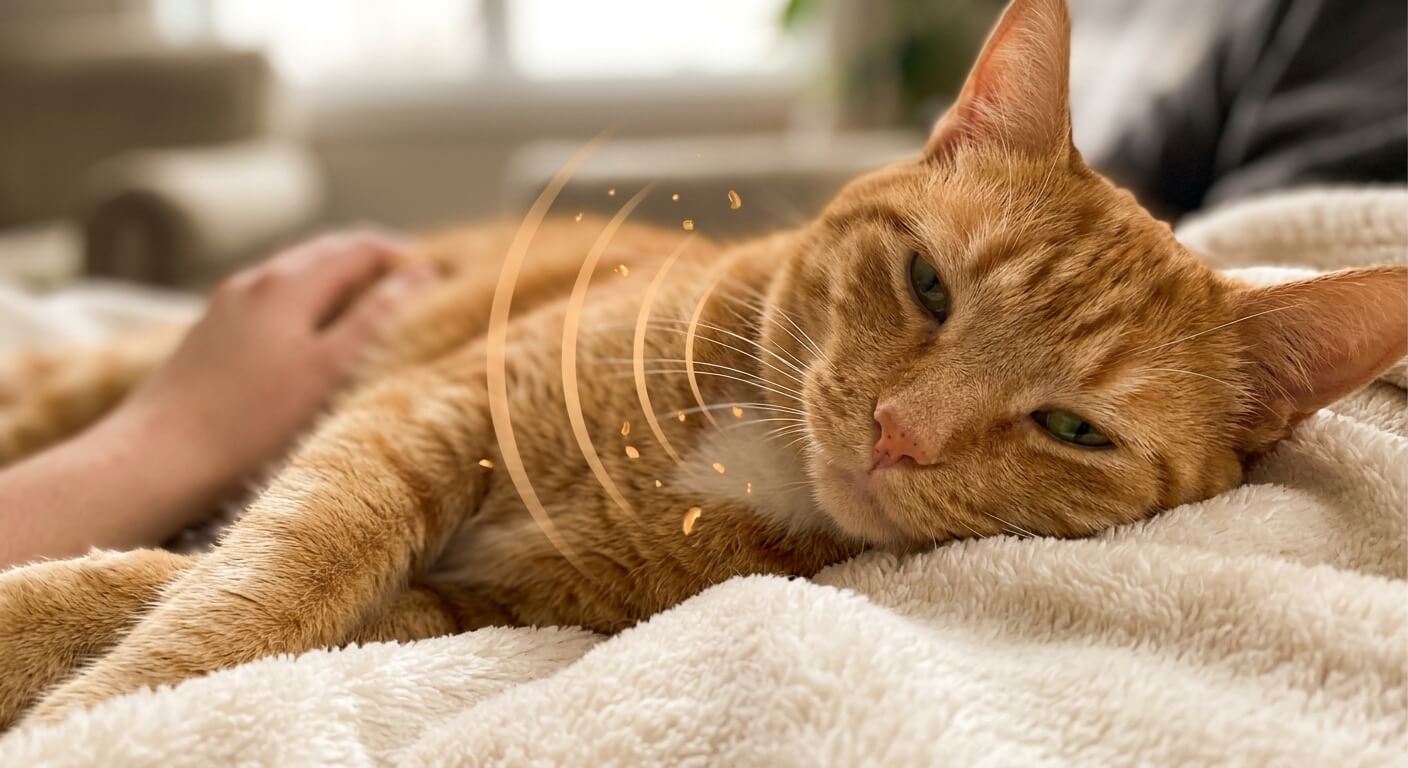
Why do cats purr? Most cats purr during relaxed social contact, but purring is not a guaranteed sign of happiness. Cats may also purr while asking for food, interacting with kittens, coping with stress, or experiencing pain. The safest interpretation comes from the whole cat: posture, breathing, appetite, movement, location, and recent behavior matter more than the sound alone.
Scientists have learned much more about the sound than popular “healing frequency” claims suggest. A 2023 laboratory study showed that the domestic cat larynx can produce purr-like low frequencies through airflow-driven vocal-fold vibration without active nerve signals. That finding updated an older explanation based mainly on rapid muscle contractions, but it did not prove that purring heals bones, treats pain, or substitutes for veterinary care.
This guide explains what researchers can support, what remains uncertain, and how to tell a comfortable purr from one that deserves closer attention.
Quick Answer
Cats purr for more than one reason. Common contexts include comfortable contact, nursing and mother-kitten communication, attention or food requests, and possible self-soothing during stress or discomfort. No single sound reliably identifies the reason. Look for loose muscles, soft eyes, normal breathing, an ordinary appetite, and voluntary contact when deciding whether a purr probably accompanies comfort.
If the purr is new, unusually persistent, or paired with hiding, reduced eating, reluctance to move, a hunched posture, open-mouth breathing, collapse, or obvious distress, contact a veterinarian. Purring should never be used to rule out illness or pain.
5 Evidence-Based Reasons Cats Purr
1. Comfortable Social Contact
The context most people recognize is affiliative contact: a cat curls beside a trusted person, kneads a soft surface, rests with loose muscles, or settles during gentle petting. In that setting, the purr is reasonably interpreted as part of a comfortable social interaction. It may occur alongside slow blinking, a neutral tail, forward or softly angled ears, normal grooming, and an easy willingness to stay or leave.
Even here, respect choice. Stop petting if the tail begins to flick sharply, the skin ripples, the ears rotate back, the head turns toward your hand, or the body becomes tense. A purring cat can still become overstimulated. Our cat body language guide explains how the ears, eyes, whiskers, posture, and tail work together.
2. Requesting Food or Attention
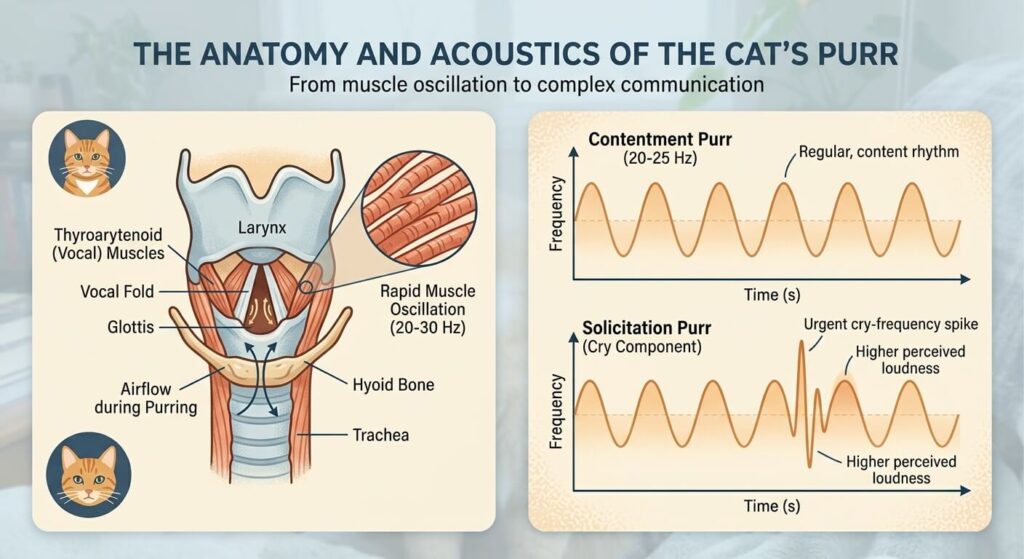
Some cats use a distinct solicitation purr when asking a familiar person for food. A 2009 Current Biology study found that these purrs can contain a higher-frequency voiced component. Human listeners rated solicitation purrs as more urgent and less pleasant than ordinary purrs, even when they did not own cats.
This does not mean every breakfast purr is acoustically identical or that a cat is deliberately “manipulating” a person. A safer conclusion is that domestic cats can modify a familiar affiliative sound in a way that efficiently attracts human attention. The surrounding routine often provides the clearest clue: the cat approaches the food area, looks between the person and bowl, rubs, or purrs shortly before the usual meal.
If repeated purring is paired with pawing, vocalizing, or persistent interruption outside normal routines, consider whether the cat needs play, food, social contact, or a health check rather than rewarding every request automatically. Our guide to cat attention-seeking behavior provides a practical way to separate learned requests from unmet needs.
3. Mother-Kitten Communication
Purring is part of early feline social communication. Kittens begin producing purr-like vocalizations while very young, including during nursing. A mother may also purr around her litter. Because newborn kittens have limited mobility and sensory ability, close-range vibration and sound can accompany nursing, warmth, contact, and location cues.
It is tempting to turn this into a single evolutionary story, but direct evidence for one exclusive function is limited. Early-life purring may participate in more than one process: maintaining contact, signaling activity, and supporting a calm nursing interaction. Adult social purring may retain some features of those early affiliative exchanges.
4. Coping or Self-Soothing
Cats sometimes purr in situations that do not look joyful, including veterinary handling, unfamiliar environments, recovery, labor, or discomfort. Researchers and clinicians therefore caution against treating a purr as a simple happiness meter. One plausible interpretation is that purring can accompany attempts to regulate arousal or seek contact, but the exact internal function cannot be read directly from the sound.
Context distinguishes a likely coping purr from an ordinary relaxed one. Watch for crouching, tucked paws, rigid muscles, flattened or sideways ears, wide pupils, hiding, reduced interaction, or unusual stillness. If a cat purrs while withdrawn under furniture, the behavior deserves a different interpretation than purring while voluntarily stretched across a familiar bed. If withdrawal is the main change, compare the pattern with our guide to why cats hide.
5. Pain, Illness, or Recovery
A cat may purr while painful or ill, so purring cannot confirm that the cat feels well. Veterinary pain guidance lists unexpected purring among the behavioral changes that can accompany pain, especially when it appears with reduced jumping, restlessness, hiding, appetite changes, aggression, altered grooming, or difficulty getting comfortable.
The purr may occur during discomfort without causing or curing the medical problem. Avoid the circular assumption that “the cat is purring, therefore healing.” Instead, treat the sound as one observation and compare it with the cat’s normal baseline. A senior cat that purrs while resting but also moves stiffly, stops using favorite elevated places, or neglects grooming needs a veterinary assessment rather than a frequency-based explanation.
Sleeping more can be normal, but a meaningful change in sleep combined with unusual purring, weakness, appetite loss, or reduced movement deserves attention. See our guide to why cats sleep so much for additional context.
How Do Cats Produce a Purr?
A domestic cat’s purr is a low, rhythmic vocalization generated in the larynx. Unlike an ordinary meow, it can continue through alternating phases of breathing, which helps create the familiar nearly continuous sound. For decades, the leading explanation was that a neural oscillator repeatedly activated muscles in the larynx, opening and closing the space between the vocal folds.
Research published in Current Biology in 2023 added an important piece. In an ex vivo experiment using eight domestic cat larynges, airflow alone produced self-sustained oscillations in the typical purring range. The researchers also identified connective-tissue pads embedded in the vocal folds that may help a small larynx produce unusually low sounds. The study shows that the anatomy can generate purr-like frequencies without active neural input in that laboratory setup.
That does not mean the living cat’s brain and muscles play no role. A living animal still starts, stops, and modifies vocal behavior in context. The most accurate summary is that the physical mechanism appears more complex than the older muscle-contraction-only model, and researchers are still refining it.
What Frequency Is a Cat’s Purr?
The 2023 larynx study produced purr-like sounds around 25–30 Hz, consistent with commonly reported fundamental frequencies for domestic cat purring. A purr also contains harmonics, so recordings can show energy above that fundamental range. Individual cats, recording methods, volume, and context can change what a microphone captures.
Frequency alone does not reveal the cat’s emotional state, and it does not establish a medical effect. Claims that a cat’s purr automatically repairs bones, heals soft tissue, reduces swelling, or treats disease go beyond the available feline evidence. Vibration research in other settings cannot simply be transferred to a purring cat.
How to Read a Purr in Context
| What you observe | More consistent with | What to do |
|---|---|---|
| Loose posture, soft eyes, normal breathing, voluntary contact | Comfortable social purring | Continue gently and let the cat choose when to leave |
| Approaches food area near mealtime, looks at you and the bowl | Food solicitation | Follow the normal feeding plan rather than adding unmeasured food |
| Kneading, settling, normal appetite and movement | Comfort or transition to rest | Observe without assuming the sound has a medical effect |
| Hiding, tense posture, reduced appetite, stiffness, or unusual aggression | Stress, pain, or illness may be present | Contact a veterinarian when the change is new or persistent |
| Open-mouth breathing, blue or pale gums, collapse, marked breathing effort | Medical emergency | Seek emergency veterinary care immediately |
Start with what is different from this cat’s normal behavior. A naturally vocal, social cat may purr frequently without concern. A quiet cat that suddenly purrs continuously while hiding presents a more meaningful change. Record when the purring occurs, what happened immediately before it, and whether eating, drinking, litter-box use, walking, jumping, grooming, or breathing has changed.
Purring or Breathing Trouble?
A purr is a vocal vibration; respiratory distress changes how the cat breathes. Do not rely on sound alone if the chest or abdomen is working hard. Warning signs include open-mouth breathing or panting at rest, exaggerated abdominal effort, an extended neck, inability to settle, collapse, or blue, gray, or very pale gums. These signs require urgent veterinary attention.
Snoring-like stertor, high-pitched stridor, wheezing, congestion, and other airway sounds can be confused with a purr. If you cannot tell whether the sound is vocalization or difficult breathing, treat the situation cautiously and contact a veterinarian. Do not hold the cat tightly, delay care to make a recording, or assume that continued purring proves stability.
Common Purring Myths
Myth: A Purring Cat Is Always Happy
Many relaxed cats purr, but the sound is not exclusive to positive emotion. It may appear during pain, stress, nursing, solicitation, or unfamiliar handling. Read the cat’s body and routine, not the sound in isolation.
Myth: Purring Is Proven to Heal a Cat’s Bones
Cat purr frequencies overlap with frequencies studied in some vibration research, but overlap is not proof that normal purring heals fractures or maintains bone density. The often-cited “healing mechanism” idea remains a hypothesis and should not be presented as veterinary treatment.
Myth: A Veterinarian Can Diagnose the Reason From the Sound
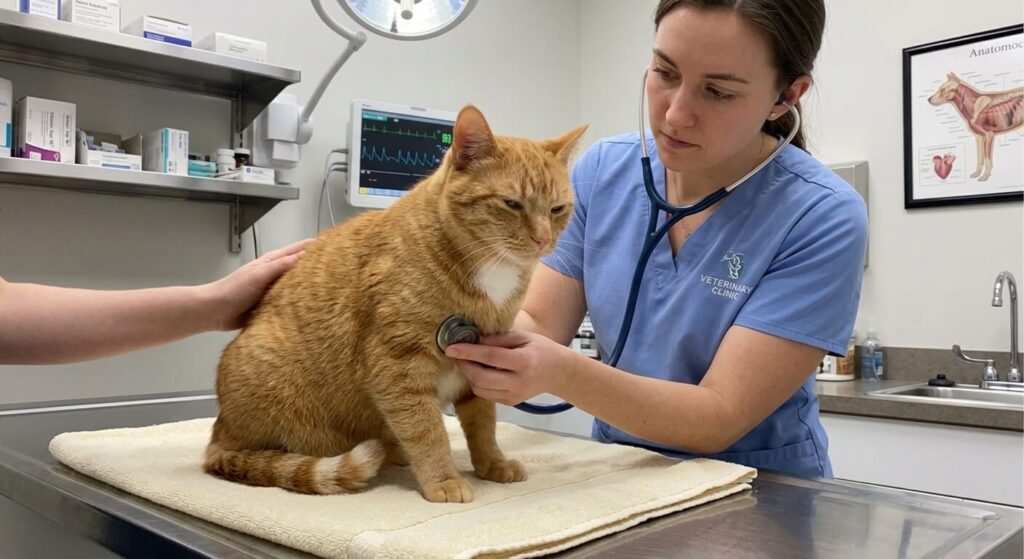
A purr can provide context, but diagnosis depends on history, physical examination, and sometimes testing. Purring can even make heart and lung sounds harder to hear during auscultation. It is not a reliable diagnostic screen for brain function, physiological stability, or emotional state.
A Safe At-Home Observation Plan
When a purr seems different, the goal is not to decode the sound like a word. The goal is to document the surrounding pattern clearly enough to decide whether the cat is behaving normally or needs professional attention. Begin with the circumstances: note the time, location, activity, and what happened immediately before the purring began.
Compare With the Cat’s Baseline
Some cats purr loudly whenever a person enters the room. Others purr mainly during petting, kneading, or feeding. Baseline matters because a familiar pattern carries different information from a sudden one. Ask whether the purr is louder, quieter, longer, more frequent, or occurring in a new location. A cat that normally purrs on a lap but now purrs alone behind a sofa has changed both context and social behavior.
Also compare the cat’s response to choice. A comfortable cat can usually reposition, walk away, settle elsewhere, or request more interaction. A cat that remains unusually still, resists movement, guards one body area, or withdraws after contact may be showing discomfort even if the sound continues.
Check Everyday Functions
Review the functions that commonly change when a cat is unwell: appetite, water intake, litter-box use, jumping, walking, grooming, sleep location, and social interaction. One isolated observation may be harmless, but several changes together create a stronger reason to call the veterinary clinic. For example, unexpected purring plus reduced food intake and hiding is more concerning than purring during an otherwise ordinary nap.
Do not force a physical examination at home. You can observe how the cat rises, walks, turns, uses stairs, and enters the litter box without squeezing painful joints or pressing the abdomen. If touching causes a hiss, bite attempt, sudden retreat, or sharp vocalization, stop and report the response to the veterinarian.
When a Short Recording Helps
A short video can help a veterinarian see posture and hear a sound that does not occur in the clinic. Record from a comfortable distance without delaying care or provoking the cat. Try to include the chest and abdomen so breathing effort is visible. Note whether the sound changes when the cat moves, swallows, meows, or changes position.
A recording is supplementary evidence, not a home diagnostic test. Poor phone audio can distort low-frequency sound, and a video cannot replace examination. If breathing looks difficult, seek care immediately instead of trying to produce a perfect recording.
What Purring Can Mean in Different Situations
Purring Beside You at Night
A cat that climbs onto the bed, settles with a loose body, kneads, and purrs is usually participating in a familiar comfort routine. Warmth, contact, and a predictable resting place may all contribute. If the cat repeatedly wakes the household, however, look beyond the purr. Hunger schedules, reinforced attention, insufficient evening activity, cognitive changes in an older cat, or discomfort may affect nighttime behavior.
Purring Around Meals
Mealtime purring can be part of solicitation, anticipation, or social contact with the person who provides food. Keep portions consistent rather than treating every purr as evidence of hunger. A sudden increase in food-seeking combined with weight loss, increased thirst, vomiting, or restlessness warrants veterinary discussion because appetite changes can have medical causes.
Purring at the Veterinary Clinic
A cat may purr during examination even when tense. The clinic contains unfamiliar smells, handling, sounds, and restraint, so the behavior should not be labeled contentment automatically. Purring can also interfere with listening to the heart and lungs. Veterinary teams use the entire examination—posture, facial expression, respiratory effort, palpation, heart rate, temperature, history, and other findings—rather than treating the purr as a verdict.
Purring After Surgery or Injury
After a procedure, purring may occur during contact, rest, stress, or discomfort. Follow the discharge plan for medication, activity restriction, incision monitoring, feeding, and follow-up. Never reduce prescribed pain relief because the cat is purring. Contact the clinic for worsening lethargy, repeated vomiting, breathing changes, bleeding, wound opening, refusal to eat beyond the clinic’s stated limit, or any concern named in the discharge instructions.
What Purring Research Can and Cannot Tell Us
Good purring research answers narrow questions. The 2023 excised-larynx study tested whether feline laryngeal tissue could generate purr-range oscillations without neural input. It did not test emotion, pain relief, healing, or why a living cat chooses to purr. The 2009 solicitation-purr study tested human responses to purrs recorded in solicitation and non-solicitation contexts. It did not show that every cat uses the same signal or that people can diagnose a cat’s motivation from sound alone.
Sample sizes in bioacoustic studies can be modest, and household contexts vary. Results can establish that a mechanism or acoustic distinction exists without making it universal. That distinction matters because popular summaries often combine separate observations into an appealing story: purrs occur at low frequencies, vibration is studied in medicine, and cats sometimes purr while injured; therefore, purring must be a healing treatment. The conclusion does not follow from those premises.
The responsible position is neither to dismiss purring as meaningless nor to assign it magical properties. It is a flexible feline vocal behavior with measurable acoustic features and several observed social or emotional contexts. Some functions remain hypotheses. Clear language about uncertainty makes the practical advice more useful, because readers can focus on the cat in front of them instead of a dramatic claim.
Frequently Asked Questions
Do Cats Purr When They Are Dying?
Some seriously ill or dying cats may purr, while others do not. The sound cannot tell you whether a cat is comfortable. Use a veterinarian’s quality-of-life guidance and look at pain, breathing, eating, drinking, mobility, grooming, toileting, interaction, and the balance of good and bad days.
Why Does My Cat Purr When I Pet Them?
If the cat approaches voluntarily, remains loose, and shows soft facial features, the purr probably accompanies comfortable interaction. Watch for overstimulation signals and give the cat an easy exit. Not every purring cat wants continuous touching.
Why Does My Cat Stop Purring When I Look at Them?
A shift in gaze, posture, touch, or attention can change the interaction and interrupt the purr. There is no need to invent a special “caught being soft” mechanism. The cat may simply pause, become more alert, or redirect attention.
Can Big Cats Purr?
The answer depends on the acoustic definition and species. Domestic cats and several other felids produce continuous purrs, while roaring cats produce different low-frequency vocalizations. Popular “purr versus roar” rules based only on the hyoid bone are oversimplified; vocal-fold anatomy also matters.
Is It Normal if My Cat Rarely Purrs?
Yes. Cats differ in how often and how loudly they purr. A quiet purr may be easier to feel at the throat or chest than to hear. A lifelong quiet pattern is usually less concerning than a sudden change accompanied by other symptoms.
Final Thoughts
Why do cats purr? The best evidence supports a flexible vocal behavior rather than one universal message. Purring commonly appears during comfortable contact, but it can also accompany requests, early mother-kitten interaction, stress, pain, or illness. Researchers are still refining how the larynx produces the sound and why cats use it in different contexts.
The practical rule is simple: enjoy a relaxed purr, but read the whole cat. Normal breathing, appetite, movement, grooming, posture, and choice are more informative than vibration alone. When purring appears with a meaningful physical or behavioral change, contact a veterinarian instead of relying on a healing-frequency explanation.
References
- Herbst CT, et al. Domestic cat larynges can produce purring frequencies without neural input. Current Biology. 2023.
- McComb K, et al. The cry embedded within the purr. Current Biology. 2009.
- Yeon SC, et al. Only When It Feels Good: Specific Cat Vocalizations Other Than Meowing. Animals. 2019.
- VCA Animal Hospitals. Signs of Pain in Cats.
- VCA Animal Hospitals. Emergencies in Cats.