How to stop cat from running out door safely starts with management, not punishment. Create a second barrier between your cat and the entrance, teach a reward-based waiting station several feet from the door, and use a fixed routine for deliveries, guests, maintenance visits, and moving day. Add current identification and a practiced recovery plan in case prevention fails.
A cat that reaches an open threshold can move faster than a person can react. Training helps, but no cue is reliable enough to replace a closed door, secure barrier, carrier, or separate room during a high-risk event. The safest plan combines physical management with short, positive training sessions.
If your cat is outside right now: do not run after or shout at them. First close other building exits if you can do so safely, ask people to stay quiet, and check the nearest hiding places. The recovery steps later in this guide explain what to do next.
Safety note: A pressure-mounted gate, screen, or trained “wait” is not escape-proof. Cats can jump, climb, squeeze through gaps, or rush past a person. During deliveries, repairs, parties, evacuations, and moves, use a closed room or secure carrier whenever the consequence of escape is high.
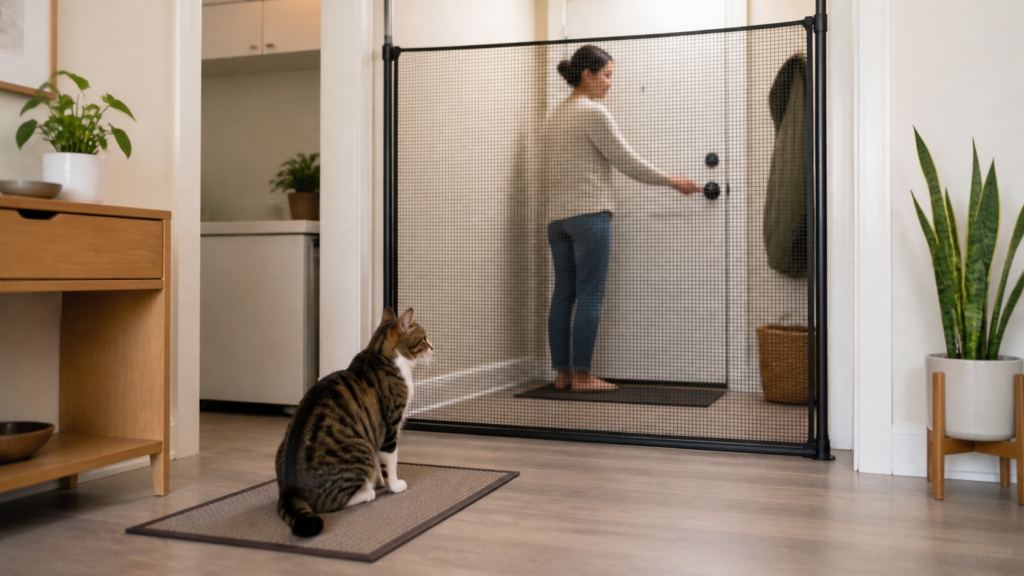
Table of Contents
How to Stop Cat from Running Out Door: Quick Answer
To stop a cat from running out the front door:
- Put a secure second barrier between the cat and the entrance.
- Teach the cat to go to a mat, shelf, or stool away from the door.
- Practice door sounds and movements in tiny, reward-based steps.
- Use a written routine for deliveries, guests, and maintenance workers.
- Move play, food puzzles, and attention away from the entryway.
- Offer controlled outdoor access only if it suits the individual cat and home.
- Keep an ID tag, registered microchip, recent photo, and escape plan ready.
Start with management today. Training develops gradually and can fail when a cat is highly excited or frightened. A person should never test progress by opening the door wide and waiting to see what the cat does.
Why Does My Cat Keep Running Out the Door?
Door dashing is not usually defiance. The entrance predicts novel smells, footsteps, people, other animals, deliveries, and sometimes access to a hallway or outdoors. If rushing the door has ever produced an interesting result—even a few seconds in the corridor—the behavior may become more persistent.
Common reasons include:
- Novelty and exploration. Hallway sounds and outdoor odors change throughout the day.
- A learned pattern. The cat approaches, the door opens, and something interesting happens.
- Social interest. The cat follows a person leaving or greets someone arriving.
- Activity near the threshold. Packages, shoes, bags, and visitors make the area stimulating.
- Household change or stress. A move, new pet, schedule change, or animals visible outside may increase checking behavior.
- Reproductive behavior in an intact cat. Discuss spaying or neutering and any sudden roaming behavior with your veterinarian; do not assume surgery alone will solve an established door-rushing habit.
A sudden change deserves more attention than a long-standing habit. Contact your veterinarian if new door fixation occurs with persistent vocalizing, appetite or litter-box changes, agitation, confusion, pain signs, or another marked behavior change.
The environmental goal is not to make the apartment empty or restrictive. Current feline guidelines emphasize safe places, separated resources, opportunities for play and predatory behavior, and positive, predictable human interaction. A cat whose important needs are met may be easier to redirect, but enrichment alone does not secure an open door.
Step 1: Build a Physical Door Buffer
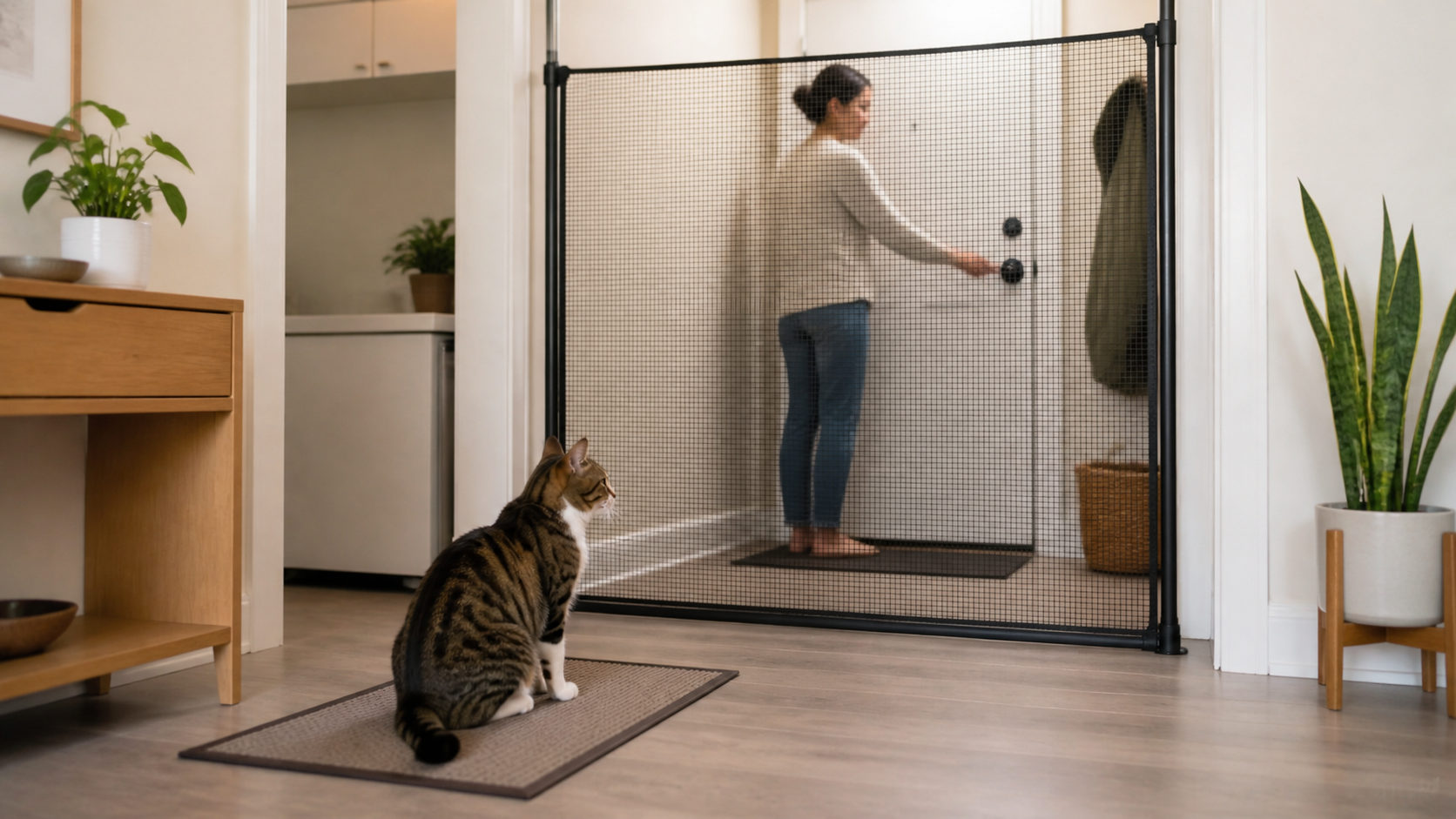
The highest-value change is a second boundary that prevents direct access to the entrance. In an apartment, this can be:
- A closed interior door between the cat and foyer
- A tall, securely fitted mesh or metal pet barrier
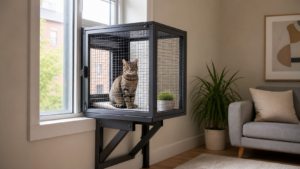
- A freestanding enclosure that cannot tip, slide, or leave side gaps
- A secure room used before the exterior door opens
- A carrier for short, high-risk events such as movers entering repeatedly
Choose the setup for your cat, not for the product label. A low baby gate may slow a senior cat that does not jump, but it can be meaningless to a young climber. Check the top, bottom, sides, latch, and nearby furniture. A shoe bench or console beside the gate can become a launch point.
The buffer should create enough space for a person to enter, close the exterior door, and only then open the inner barrier. That sequence functions like a small airlock:
- Cat remains behind the inner boundary.
- Person opens and closes the exterior door.
- Person visually confirms the exterior door is latched.
- Only then is the inner boundary opened.
If the layout cannot support a gate, use a closed bedroom or bathroom during predictable high-risk events. Put water, a litter box, a comfortable resting place, and a familiar item inside when confinement will last more than a brief delivery. Never place a cat in a room containing an open window, unsecured balcony access, cleaners, tools, or repair hazards.
Check the barrier instead of trusting it
Inspect the barrier after installation and periodically afterward. Confirm that it cannot be pushed at the bottom, climbed around at the side, or dislodged by normal household movement. Follow the manufacturer’s mounting instructions and obtain landlord approval before drilling or making permanent changes.
A screen door can add protection, but ordinary insect mesh is not designed to contain every cat. Claws, loose frames, and sliding-screen latches can fail. Treat a screen as one layer, not the whole safety plan.
Step 2: Teach a Station Away from the Door
A station is a mat, bed, shelf, stool, or cat tree where rewards happen. Place it far enough from the entrance that a person can move through the doorway without stepping over the cat. In a small apartment, even six to ten feet plus a barrier can create a useful working distance.
Positive-reinforcement guidance supports shaping, luring, and target training instead of punishment. You can use a clicker or a brief marker word such as “yes” to identify the exact behavior being rewarded.
Start with the door fully closed
- Put the mat in a quiet location away from the entrance.
- When your cat looks at, sniffs, or steps toward the mat, mark and reward.
- Gradually reward only closer approaches, then one paw, then all four paws on the mat.
- Deliver the treat on the mat so the reward location remains clear.
- After the cat goes to the mat reliably, add a cue such as “mat” or “place.”
- Release the cat with a different cue before the cat wanders away.
Keep sessions short enough that the cat remains interested. Three successful repetitions can be more useful than a long session that ends in frustration. If your cat stops taking treats, leaves repeatedly, crouches, freezes, lashes the tail, or becomes fixated on the door, make the next repetition easier.
Build duration and distance separately
First reward one second on the station, then two or three seconds. Separately practice taking one step away and returning to reward. Do not increase duration, distance, door movement, and visitor distraction at the same time.
The station is an added safety skill, not an invisible fence. Continue using the physical buffer while practicing and during real arrivals.
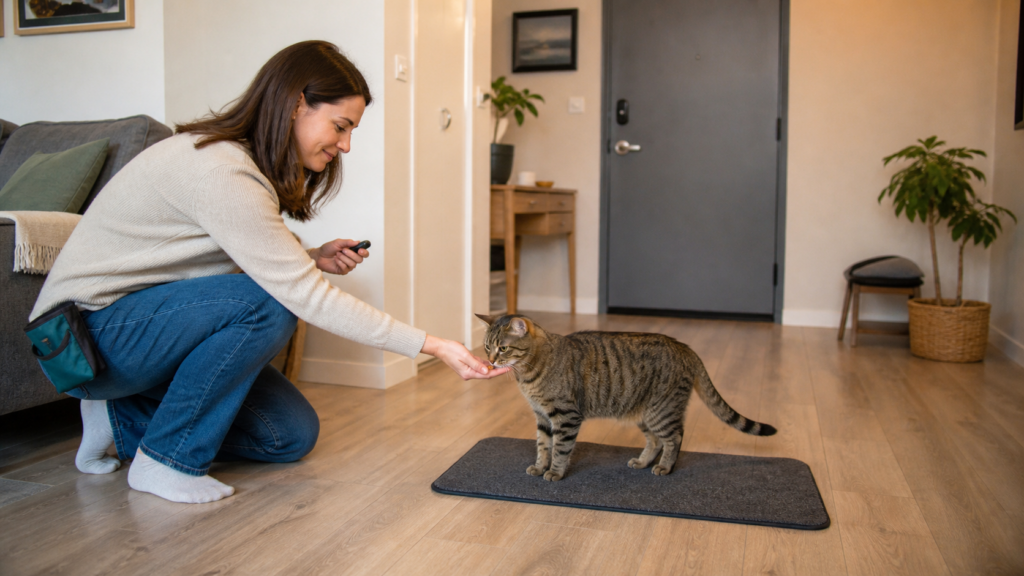
If your cat does not respond to food, try another safe reward the cat values, such as brief wand-toy play or calm attention. Account for training treats within the cat’s normal daily calories. A cat that suddenly loses interest in food should be evaluated by a veterinarian rather than described as stubborn.
Step 3: Practice Door Triggers in Small Steps
Once the cat readily goes to the station with the door closed, introduce one door-related trigger at a time. The goal is for ordinary entry sounds and movements to predict going to the safe station, not charging the threshold.
An example progression is:
- Pick up the keys; reward on the station.
- Put on shoes or a coat; reward on the station.
- Touch the door handle; reward on the station.
- Turn the handle without opening the door; reward.
- Open the door a fraction of an inch while the secure second barrier is closed; reward.
- Open and close it slightly; reward.
- Have a familiar helper stand quietly outside; reward the station behavior.
Move forward only when the current step looks easy. If the cat leaves the station, close the door, reset calmly, and reduce the difficulty. Do not yell, block with a foot, clap, spray water, or use a startling device. Aversive methods can increase fear around the entrance or around the person opening it without teaching a reliable alternative behavior.
Practice with the actual sounds that predict openings: the intercom, elevator, lock, keys, knock, or doorbell. You can begin at a softer volume or greater distance. Keep the exterior door secured and the second barrier closed throughout early practice.
Teach recall as a backup, not the primary barrier
A positive recall cue can help move a cat away from the entrance, but it should not be your only protection. Practice recall in easy indoor settings and reward it generously. Never call the cat and then punish them for approaching. For a separate training sequence, use our guide on how to train a cat to come.
Step 4: Use a Fixed Routine for Deliveries, Guests, and Repairs
Most escapes happen during a real interruption, not a planned training session. Make the safe routine simple enough that every household member can follow it.
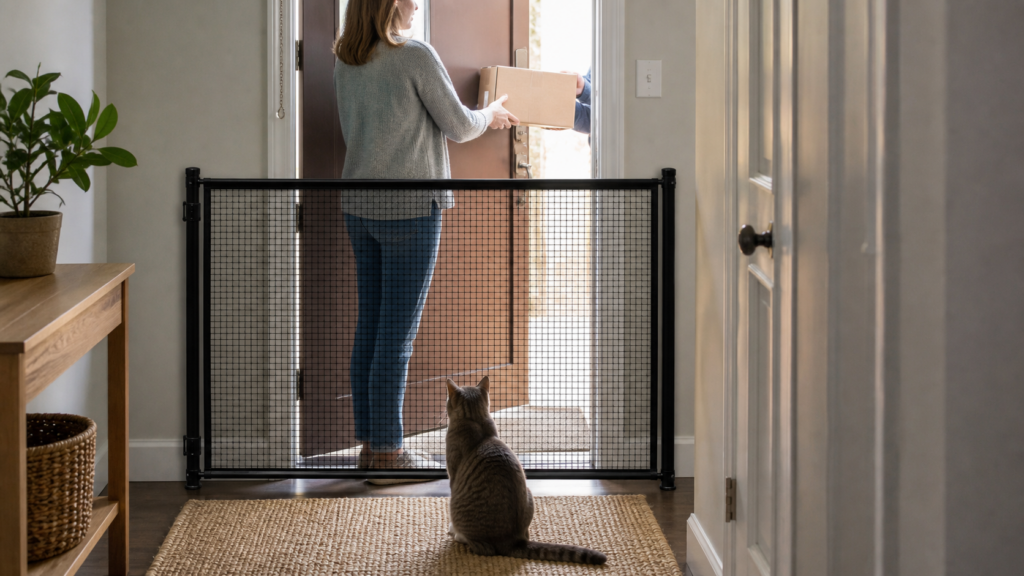
Package delivery routine
- Before opening the door, locate the cat.
- Close the inner barrier or put the cat in the prepared safe room.
- Receive the package with the exterior opening as small and brief as practical.
- Close and latch the exterior door.
- Visually confirm the cat’s location before releasing the inner barrier.
When possible, use delivery instructions asking for packages to be left outside without knocking. This reduces door activity, but it does not replace checking the cat before opening the door.
Guest routine
Tell visitors before they arrive: “Please wait while I secure the cat, then I will open the door.” Do not expect a guest to understand the cat’s speed or your barrier. One household member should be responsible for the cat; another can greet the visitor.
If people will enter and leave repeatedly, use a closed safe room rather than relying on dozens of perfect gate transitions. Add a simple reminder at adult eye level on the inside of the door if needed. Avoid placing loose strings, ribbons, or dangling signs where a cat can chew them.
Maintenance and inspection routine
Workers may prop doors open, carry tools, or move between rooms. Secure the cat before the appointment begins, tell the worker a cat is confined, and place a clear note on the safe-room door asking that it remain closed. Check windows, screens, wall openings, and balcony access before releasing the cat after the work is complete.
Moving-day routine
Moving is a high-risk event because doors stay open and familiar furniture disappears. Confine the cat in a cleared, secure room before movers arrive, or arrange safe off-site care. Keep the cat in a carrier during the final transfer. Our moving with a cat to a new apartment guide covers the larger transition plan.
Step 5: Move Daily Rewards Away from the Entryway
The entrance should not be the only interesting place in the apartment. Build predictable activity in safer zones:
- Schedule interactive play away from the front door.
- Put food puzzles and treat searches in interior rooms.
- Provide a stable perch with a safe view that is not beside the threshold.
- Rotate a small selection of toys instead of leaving every toy out.
- Offer hiding and resting places where the cat will not be disturbed.
- Spread key resources so one narrow area does not become crowded.
Our guide to indoor cat enrichment in small apartments explains how to use vertical space, play zones, and rotation without filling the floor.
You can schedule a short play-and-food routine before a predictable busy period, but do not scatter treats beside an opening door. Place the reward at the station or deeper inside the apartment. The goal is to create distance from the threshold.
Avoid using a laser pointer to lure a cat away during an actual escape risk. The light can move unpredictably, may send the cat toward the door, and gives you no physical control. A trained station, closed barrier, or food reward delivered in a secure area is easier to manage.
Step 6: Make Any Outdoor Access Controlled and Distinct
Some cats may benefit from controlled outdoor access when the individual cat, location, and equipment make it appropriate. Options can include a secure enclosure or carefully conditioned harness-and-leash activity. Current feline guidance describes controlled access as a way to offer stimulation while reducing risks associated with unrestricted roaming.
Outdoor access is optional; it is not a required cure for door dashing. A fearful cat, a cat that panics in a harness, or a cat living beside uncontrolled dogs or heavy traffic may not be a suitable candidate.
If you choose harness time:
- Condition the harness indoors before approaching an exit.
- Check fit every session; a cat may reverse out of loose equipment.
- Carry the cat in a secure carrier through shared hallways if building conditions are unpredictable.
- Use one consistent cue and routine for planned access.
- Never attach a leash to a neck collar.
- Do not leave a harnessed cat tied outside or unattended.
Using a carrier, a specific harness, and a consistent cue can make planned outings look different from ordinary door openings. It does not guarantee that the cat will stop investigating other exits, so keep the same barriers in place. See cat harness and leash options for indoor cats for fit and safety checks.
A balcony counts as outdoor access. Railings, screens, and high floors create serious fall and escape risks; do not assume height will discourage a cat from jumping or squeezing through a gap.
Step 7: Prepare Identification and an Escape Plan
Prevention can fail. Identification and a practiced response improve your ability to act quickly.
Use multiple layers:
- A breakaway collar with a readable ID tag if your cat can wear one safely
- A microchip registered with current phone, email, and address details
- A recent clear photo showing the cat’s face, body, and distinctive markings
- The microchip number and registry contact stored where household members can find it
- A secure carrier kept accessible rather than buried in storage
A microchip is permanent identification, not a GPS tracker. It helps only when the chip is scanned and the registration details lead back to you. Ask your veterinary team to scan it during routine care and update the registry whenever contact details change.
Prepare a one-page household plan with the cat’s usual hiding places, recall cue, preferred food, carrier location, veterinary contact, microchip details, and the people who should be called. Include door control in your apartment cat emergency evacuation plan.
Apartment Door Risk Map
| Situation | Main risk | Minimum management | Better backup |
|---|---|---|---|
| Daily exit or return | Cat waits at your feet and slips past | Locate cat and use the inner barrier | Reward station behavior before touching the handle |
| Food or parcel delivery | Door opens unexpectedly or repeatedly | Secure barrier or closed room | Leave-at-door instructions and a household script |
| Guests or party | Visitors do not know the routine | Secure cat before first guest arrives | Closed safe room during repeated traffic |
| Maintenance visit | Workers prop doors or open windows | Closed prepared room with a door note | Recheck every opening before releasing the cat |
| Moving day | Exterior door remains open for long periods | Closed cleared room or safe off-site care | Carrier transfer after movers finish |
| Fire alarm or evacuation | Fear, hiding, and rushed handling | Accessible carrier and practiced plan | Positive recall plus current ID and microchip |
The more people, noise, and door cycles involved, the less you should depend on training. Use the strongest physical management for the highest-risk event.
A 7-Day Starter Plan
This is a setup week, not a promise that the behavior will be solved in seven days. Repeat an easier stage for as long as your cat needs.
Day 1: Change the environment
Choose and install the second barrier. Remove furniture that creates a jumping route. Pick a safe-room option and check it for windows, balcony access, chemicals, cords, tools, and small gaps.
Day 2: Introduce the station
Reward looking at and approaching the mat. Keep the exterior door closed. End after several easy successes.
Day 3: Reward all four paws
Shape the behavior until the cat steps onto the station. Add a release cue so the cat learns when the repetition ends.
Day 4: Add brief duration
Reward one or two seconds on the mat. Take one small step away, return, and reward. Keep the difficulty low.
Day 5: Add quiet door signals
Pick up keys or touch the handle while the inner barrier is secure. Reward the cat at the station. If the cat rushes forward, reduce the trigger.
Day 6: Rehearse a delivery
Ask a familiar helper to stand outside without entering. Practice locating the cat, closing the barrier, touching the handle, and returning to reward. The exterior door can remain closed for the first rehearsal.
Day 7: Review weak points
Check barrier gaps and household compliance. Decide which events require the closed safe room. Continue training at the cat’s successful level rather than opening the door wider to test them.
After the first week, vary the easy practice gradually: different household members, normal shoes, the intercom at low intensity, and a familiar visitor. Change only one factor at a time.
What to Do If Your Cat Gets Out
Act quickly, but keep the scene calm.
- Do not chase. Running toward a frightened or excited cat can drive them farther away.
- Control other exits. In an apartment building, ask someone to quietly watch the stairwell, elevator, lobby, or exterior door if this can be done safely.
- Search close first. Check the hallway, stairs, under furniture, behind utility items, and other dark or sheltered spaces near the escape point.
- Use a familiar cue. Crouch or sit sideways, speak quietly, and use the practiced recall sound or familiar food. Avoid a crowd surrounding the cat.
- Bring the carrier. An open familiar carrier and bedding may help once the cat is within reach; do not leave food or a carrier where it creates another hazard.
- Notify the right people. Contact building staff, nearby neighbors, local shelters, animal control, and veterinary clinics. Tell the microchip registry the cat is missing.
- Use current photos. Share clear identification and verified contact information through local lost-pet channels.
If the cat is visible but too frightened to approach, do not improvise a dangerous capture near traffic, heights, machinery, or aggressive animals. Ask local animal services, a rescue organization, or a veterinary professional about safe next steps.
When the cat returns, bring them indoors and close the door before handling. Do not punish them. Check for injury, breathing difficulty, limping, bleeding, heat or cold exposure, toxic contact, or other concerning signs and contact a veterinarian when needed.
Common Mistakes That Make Door Safety Less Reliable
Punishing the cat near the entrance
Yelling, spraying water, clapping, or using startling devices may interrupt a behavior in the moment, but it does not teach where the cat should go. It can also create fear of the doorway, visitor, sound, or person. Reward the station and manage the opening instead.
Relying on one low gate
Many cats can jump or climb standard baby gates. Match the barrier to the cat’s physical ability and use a closed room for high-risk events.
Opening the door to test progress
A successful indoor repetition does not prove that the cat will ignore a real hallway odor, dog, delivery cart, or alarm. Training should be practiced behind a secure backup layer.
Letting visitors manage the cat
The resident should secure the cat before opening the door. A guest who has just arrived should not be responsible for interpreting the cat’s behavior or operating an unfamiliar gate.
Picking up a struggling cat at the threshold
A startled cat can twist, scratch, or leap from a person’s arms. Create distance with the barrier and station before opening the door. Use a carrier when secure physical containment is required.
Assuming a microchip prevents escape
A chip does not create a boundary and does not show a live location. Continue using barriers, training, and a current recovery plan.
Frequently Asked Questions
What is the fastest way to stop a cat from running out the door?
The fastest immediate improvement is physical management: place the cat behind a closed interior door, secure tall barrier, or in a carrier before opening the exterior door. Station training is valuable, but it develops over repeated successful sessions and should remain backed by a barrier.
How tall should a cat gate be?
There is no single height that contains every cat. Jumping ability, climbing style, age, mobility, nearby furniture, side gaps, and mounting strength all matter. Choose a tall, secure barrier designed for the opening and evaluate the complete route. Use a closed room for a capable jumper or climber during high-risk events.
Can I teach my cat the word “stay” at the front door?
You can teach a waiting or station behavior with positive reinforcement, but the cue should not replace a physical boundary. A station placed away from the entrance is usually clearer and safer than asking a cat to balance self-control directly on the threshold.
Will a screen door stop my cat from escaping?
It may provide a second layer when the frame, mesh, and latch are strong and secure, but ordinary insect screens can tear or dislodge. Inspect it regularly and do not rely on it as the only barrier.
Should I take my door-dashing cat outside on a harness?
Only if the individual cat is comfortable, the harness is escape-resistant and properly conditioned, and the environment is suitable. Controlled access may provide stimulation, but it can also increase interest in the exit for some cats. Continue door management regardless of whether you offer harness walks.
Does more play stop door dashing?
Play and enrichment can reduce boredom and create rewarding activity away from the entrance, but they do not make an open door safe. Combine them with a barrier, station training, and event routines.
Why did my cat suddenly start trying to escape?
Look for changes such as a move, new people or animals, altered routine, outdoor cats near windows, intact reproductive status, or a new source of noise and scent. A sudden behavior change accompanied by vocalizing, appetite, litter-box, pain, confusion, or sleep changes should be discussed with a veterinarian.
What should I do in a multi-cat home?
Train each cat separately first so rewards and cues remain clear. During a real door event, secure every cat before opening. Do not assume one calm cat means another is behind the barrier. Count and visually confirm all cats before and after guests, repairs, or moving activity.
Final Door-Safety Checklist
- The exterior door has a working latch.
- A secure second barrier or closed-room plan is ready.
- The cat’s station is away from the threshold.
- Every household member knows the delivery and guest routine.
- Maintenance workers are told that a cat is confined.
- High-risk events use physical containment, not a training test.
- The collar ID and microchip registration are current.
- A recent photo and carrier are easy to access.
- The household knows what to do if the cat reaches the hallway or outdoors.
The safest answer to how to stop a cat from running out the door is a layered system. Physical management prevents the immediate opportunity, positive station training gives the cat a clear alternative, and identification plus a recovery plan protects against human error. Start with the barrier, then build the skill.
References
ASPCA. Disaster Preparedness.
Ellis, S. L. H., et al. (2013). AAFP and ISFM Feline Environmental Needs Guidelines. Journal of Feline Medicine and Surgery.
Quimby, J., et al. (2021). AAHA/AAFP Feline Life Stage Guidelines. Journal of Feline Medicine and Surgery.
American Association of Feline Practitioners. (2024). Indoor/Outdoor Lifestyle Position Statement.
Feline Veterinary Medical Association. Positive Reinforcement Techniques to Prevent Unwanted Behaviors.
American Animal Hospital Association. Pet Microchipping FAQs.
ASPCA. Finding a Lost Pet.