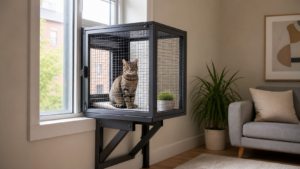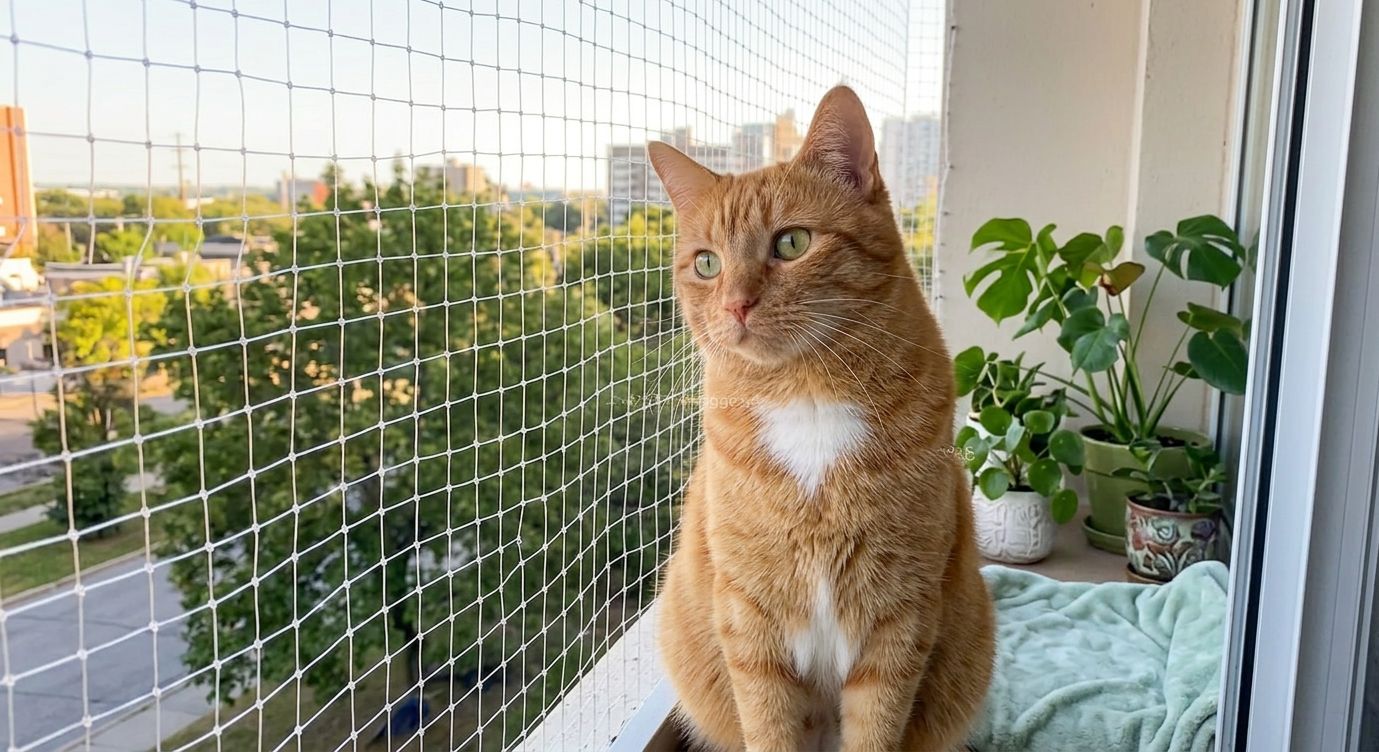
A cat proof balcony apartment setup must prevent both falls and escapes before the cat gets access. The safest options are a professionally installed full-height enclosure or a purpose-built catio that closes every route from floor to ceiling. A low railing cover, ordinary insect screen, harness, or supervision alone is not a complete fall barrier.
Balcony safety is a structural question, not a test of whether your cat is normally calm. A bird, insect, dropped object, loud neighbor, door movement, or sudden startle can change behavior in seconds. If you cannot create a secure enclosure that complies with the lease, building rules, fire-safety requirements, and manufacturer instructions, keep the balcony off limits and provide indoor window enrichment instead.
This guide explains how to inspect the space, compare enclosure options, work within renter restrictions, and decide when a balcony should not be used by a cat at all.
Quick Answer
To cat proof an apartment balcony, block the entire open boundary from the floor to a secure overhead termination, close side and drainage gaps, remove climbable furniture from the perimeter, and control the doorway. Use materials intended for the installation and the cat’s size and behavior; anchor them according to the manufacturer and building requirements. Inspect every attachment before access and supervise even after enclosure.
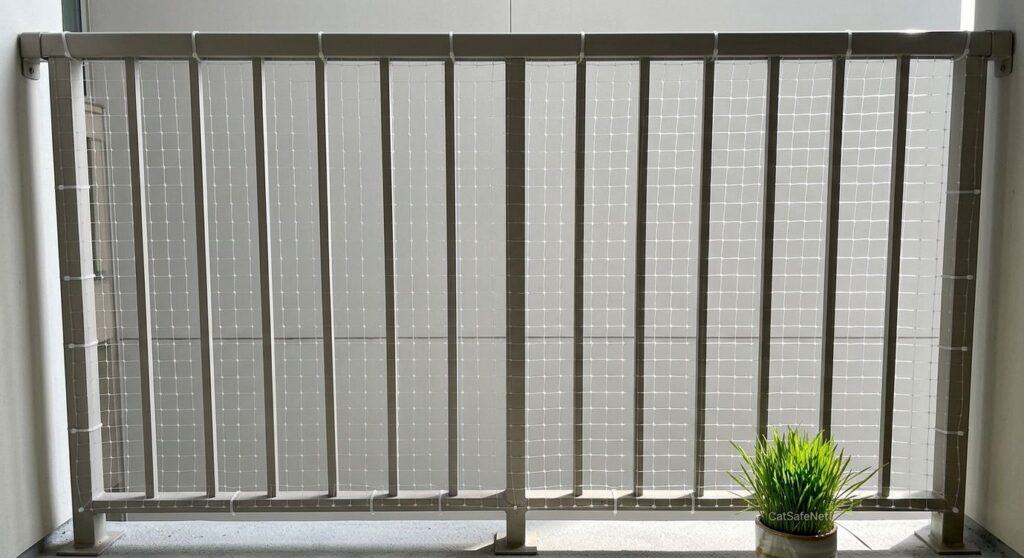
Do not rely on decorative netting, loosely attached mesh, child guards, a standard screen door, or a leash tied to balcony furniture. If the barrier can be pushed aside, climbed over, chewed through, pulled loose, or bypassed at a corner, the balcony is not cat proof.
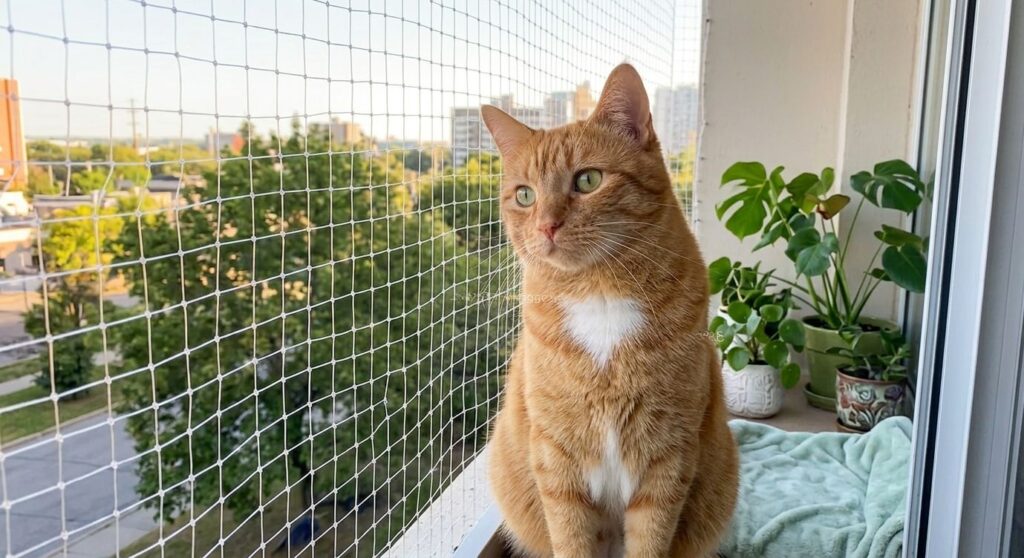
Why an Apartment Balcony Is a High-Risk Space
Cats do not need to deliberately jump to be injured. The ASPCA describes falls from windows, terraces, and fire escapes as high-rise syndrome and notes that cats may lose their balance when focused on a bird or other nearby stimulus. Window ledges, brick, metal, and smooth rail caps may provide less reliable grip than they appear to.
A lower floor is not automatically safe. Any uncontrolled fall can cause trauma, and an escaped cat may land in an unfamiliar area, run, hide, enter traffic, or become difficult to locate. The practical standard should therefore be prevention, not estimating a “safe” floor height.
Balconies add hazards beyond height: rail gaps, open sides, overhead escape routes, hot surfaces, toxic plants, fertilizer, neighboring balconies, maintenance access, wind, and doors that can trap or release the cat. A useful plan treats all of these as one system.
Inspect the Balcony Before Buying Anything
Start with the lease, condominium rules, property manager, and applicable building requirements. Exterior attachments, drilling, facade changes, visible netting, and obstruction of emergency access may be restricted. Written approval is safer than relying on a casual verbal answer. If the balcony is part of an emergency exit route or must remain accessible to building staff, do not build around it without professional guidance.
Then inspect the physical space from floor level, railing level, and the height of every object a cat could climb. Check the front boundary, both sides, the underside of railings, corners, drainage openings, gaps around privacy panels, spaces beside pipes, and the junction between any proposed barrier and the building.
| Risk area | What to check | Required response |
|---|---|---|
| Railing and balusters | Openings a head, shoulder, paw, or body could enter | Use a continuous secure barrier, not isolated patches |
| Floor edge and drainage | Gaps beneath panels or along the slab | Close them without blocking required drainage |
| Side walls and corners | Routes around the end of mesh or panels | Anchor continuously to a stable boundary |
| Top edge | Climb-over or jump-over route | Use full-height enclosure or an engineered overhead termination |
| Door | Rushing, weak screen, damaged latch | Add a controlled entry routine and reliable closure |
| Furniture and planters | Launch points near the perimeter | Move inward or remove |
| Surface and weather | Heat, water, ice, wind, unstable objects | Restrict access whenever conditions are unsafe |
Photograph the empty balcony and measure the complete enclosure area rather than only the railing. Record the widest opening, the smallest attachment surface, the door path, and any movable building component. Measurements help you discuss the project accurately with the property manager, installer, or product manufacturer.
7 Essential Cat Proof Balcony Apartment Rules
1. Enclose the Full Open Boundary
Covering only the rail gaps prevents one route but leaves the top open. Cats can jump onto a rail, climb mesh, or use furniture to reach an unprotected edge. The safest design is a continuous enclosure from the floor boundary to a secure ceiling or overhead frame, with no open sides.
Possible designs include a professionally installed balcony enclosure, a purpose-built catio attached within the balcony, or a manufacturer-approved tension-frame system where the structure and rules permit it. Product suitability depends on the balcony, material, weather exposure, cat, and installation. A label such as “pet net” is not proof that a product is appropriate for every balcony.
2. Choose Material for the Actual Failure Risks
The barrier must resist the ways it may fail: pushing, climbing, chewing, stretching, weathering, UV exposure, and loosening at attachments. Mesh openings should not allow the cat’s head or body through, but an exact universal opening size cannot be recommended without considering the individual cat and product design. Kittens and small cats require special caution.
Metal mesh or rigid panels may offer different advantages from flexible netting, but every material has installation requirements and tradeoffs. Cut edges, protruding wire, brittle plastic, and loose cable ties can create injury or ingestion hazards. Follow the manufacturer’s instructions and use a qualified installer when structural attachment or exterior work is involved.
3. Treat Anchors and Edges as Part of the Barrier
A strong mesh with weak anchors is a weak enclosure. The perimeter should remain secure when pressure is applied at the middle, lower edge, corners, and connection points. Avoid improvising with removable hooks, adhesive strips, or tension rods unless the complete system is specifically designed, rated, and approved for that use.
Do not perform a dangerous “load test” by leaning over the railing or applying force that the building component was not designed to take. Instead, use the product’s installation and inspection procedure and have uncertain structures reviewed by an appropriate professional.
4. Remove Launch Points From the Perimeter
Move chairs, tables, shelving, storage boxes, planters, and outdoor air-conditioning covers away from the rail and enclosure. A cat may use several ordinary objects as a staircase. The safe location is determined by the cat’s ability and the enclosure, not by an arbitrary distance.
If you add perches, place them inside a fully enclosed zone and ensure they are stable. A perch should improve viewing without increasing access to the top, sides, door, or weak sections. Do not attach shelves to balcony glass or railings unless the complete installation has been approved for that structural use.
5. Control the Balcony Door
The doorway can defeat an otherwise good enclosure. A cat may rush through while a person carries laundry, waters plants, or opens the door for ventilation. Use a repeatable routine: locate the cat, check the barrier, open the door only when the cat is waiting away from it, and close it before attention shifts elsewhere.
A standard insect screen is not a reliable cat-containment door. Cats can climb, scratch, push, or dislodge weak screens. If your cat already bolts toward exterior doors, work on that behavior before adding balcony access. Our door-dashing prevention guide provides a separate indoor plan.
6. Supervise Without Treating Supervision as a Barrier
Stay nearby whenever the cat uses the balcony, especially during the introduction period. Supervision helps you notice chewing, climbing, overheating, fear, or a loosened attachment. It cannot reliably stop a fall after the cat has already reached an open edge, so it must supplement a physical enclosure rather than replace one.
End access before cooking, showering, sleeping, leaving the apartment, accepting a delivery, or doing anything that prevents immediate observation. Bring the cat inside during strong wind, storms, maintenance, construction, pesticide use, extreme temperatures, or any condition that changes the safety of the space.
7. Inspect Before Every Session and After Every Change
Check the lower edge, corners, seams, top termination, door, and every attachment. Look for UV damage, rust, cracking, stretched openings, cut strands, loose fasteners, sharp edges, and objects moved by wind or another person. Reinspect after storms, building work, cleaning, furniture changes, or long periods without use.
If any part has changed, close the balcony until it is repaired. “The cat has never tried to escape” is not evidence that a damaged barrier is safe.
Renter-Friendly Options and Their Limits
| Option | Potential advantage | Main limitation |
|---|---|---|
| Professionally installed removable enclosure | Designed around the complete opening | Requires permission, cost, and suitable structure |
| Purpose-built freestanding catio within balcony | May avoid facade attachment | Must not tip, shift, block exits, or leave unsafe transfer gaps |
| Manufacturer-designed tension-frame system | May be removable | Only appropriate where the exact system, dimensions, and surfaces allow it |
| Rigid clear panels along railing | Can close lower gaps without climbable mesh | Does not close the open top and may affect wind loads or building appearance |
| Decorative privacy screen | Visual privacy | Usually not designed as animal containment |
| Harness and leash | Controlled activity for a trained cat | Not a structural fall barrier; escape and entanglement remain possible |
Do not describe a homemade arrangement as “no-drill and safe” without verifying the complete system. Adhesive strength varies with surface, temperature, moisture, age, and load direction. Tension devices can shift. Cable ties can degrade. A renter-friendly solution is useful only when it is also appropriate for the structure and maintained correctly.
For broader lease-safe changes inside the home, see our cat-proof rental apartment guide. If the balcony cannot be enclosed, an indoor window route or cat furniture may provide enrichment without exterior access.
Plants, Weather, and Balcony Supplies
Check every plant by its exact botanical identity. Common names can refer to different species, and a plant labeled “pet friendly” by a retailer may not provide enough information. Use the ASPCA toxic and non-toxic plant database or another authoritative veterinary source, and remove unidentified plants. Lilies are a particularly serious hazard for cats.
Store fertilizer, insecticides, herbicides, slug bait, sharp tools, ties, wire offcuts, and standing water where the cat cannot reach them. A nontoxic plant can still sit in unsafe treated soil, tip from a stand, or create a climbable route. Stable cat grass may be appropriate inside a fully enclosed area, but it does not make the enclosure itself safe. Review our cat-safe apartment plant guide before adding greenery.
Balcony temperatures can change faster than indoor conditions. Sun heats metal, tile, artificial turf, glass, and enclosed spaces; shade moves during the day. Provide indoor access, fresh water, and shade, and close the balcony whenever the temperature, surface, wind, or air quality is questionable. A cat should never be locked outside.
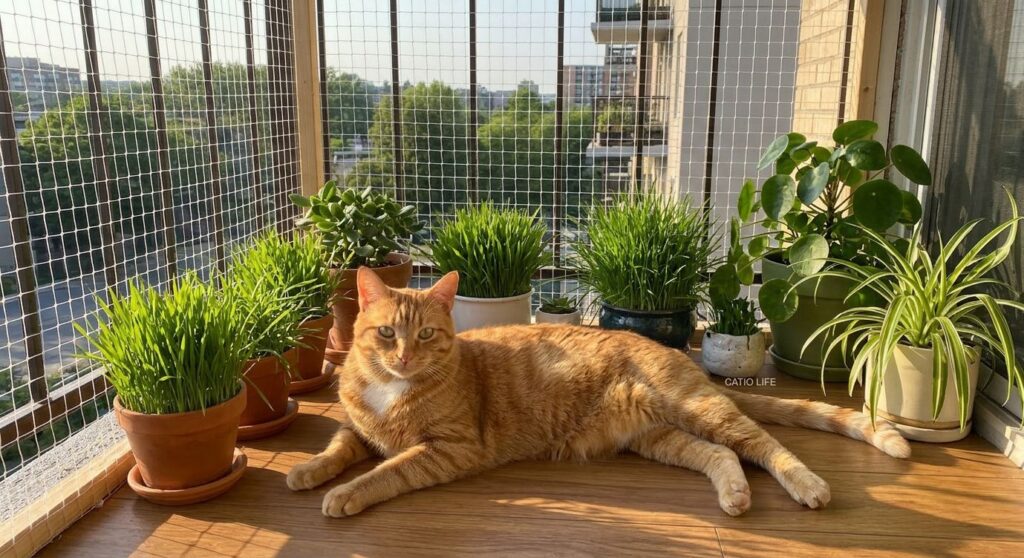
Introduce Balcony Access Gradually
Complete and inspect the enclosure before the cat sees the balcony as available territory. Begin with the door closed so the cat can observe through glass. During the first supervised session, keep the environment quiet and allow the cat to choose whether to approach. Do not carry a frightened cat outside or block the route back indoors.
Use a consistent entry and exit cue. Reward returning indoors, then close the door calmly. Avoid chasing, cornering, or grabbing unless there is immediate danger. Short, calm sessions are more useful than a fixed schedule; end the session when the cat becomes tense, fixates on an edge, climbs the barrier, chews attachments, hides, or refuses to return.
A harness may provide an additional layer for a cat already trained to wear one, but never attach the leash to the balcony or leave the cat tethered. A cat can back out of a poorly fitted harness or become entangled. Our cat harness and leash guide explains fit and indoor acclimation.
Plan the Installation Before Materials Arrive
A safe installation begins with a drawing of the complete boundary. Mark the floor line, ceiling or overhead frame, side walls, railing, corners, door swing, drainage points, pipes, lights, outlets, and any building equipment that must remain accessible. This prevents a common mistake: buying enough material for the front rail while overlooking the upper and side escape routes.
Ask the supplier what surfaces and spans the system is designed for, which fasteners are specified, how environmental exposure affects it, and how often components should be replaced. If the answer depends on drilling into masonry, metal railings, glass, exterior cladding, or the slab, obtain building permission and use an appropriately qualified installer. Do not invent an attachment method from unrelated household hardware.
Plan how the cat moves between the apartment and enclosed zone. The route should not require carrying the cat over an open edge or opening two unsecured barriers at once. A small vestibule or two-step door routine can reduce rushing where space permits. Keep the indoor return route clear so the cat never feels cornered outside.
Installation Handover Check
- Confirm that the installed design matches the approved plan.
- Inspect all sides from both inside and outside where this can be done safely.
- Confirm that the door closes and latches without rubbing or leaving a gap.
- Remove cut wire, packaging, tools, cable ends, and temporary ties.
- Check that drainage, ventilation, and required access remain unobstructed.
- Record the product name, installer, installation date, inspection instructions, and replacement guidance.
- Keep the cat indoors until every correction is complete.
Do not introduce the cat while installers are working or while tools and loose materials remain on the balcony. Building noise and unfamiliar people increase escape risk, and a partly completed enclosure can look more secure than it is.
Seasonal Maintenance and Shared-Household Rules
Assign responsibility for inspections. In a shared apartment, everyone should know that moving a chair, opening a screen, hanging laundry, or storing a box can change the safety system. Visitors and maintenance staff should not be expected to understand the setup without clear instructions. Close the balcony and keep the cat in another room whenever work is scheduled.
Seasonal changes matter. Winter moisture may freeze around tracks or attachments; summer sun can degrade plastics and create hot surfaces; storms can stretch netting or move furniture. Plants grow, pots shift, and balcony storage accumulates. Recheck the original risk map whenever the season or furniture layout changes instead of assuming last month’s setup still applies.
If the property manager, building inspection, or emergency requirement conflicts with the enclosure, remove cat access until the conflict is resolved. Safety is not improved by keeping an installation that blocks a required route or damages the building.
What to Do if a Cat Falls or Escapes
If a cat falls, seek veterinary care immediately even when the cat stands, walks, or initially appears normal. Chest injury, internal trauma, jaw injury, fractures, and shock may not be obvious from a distance. Do not chase a frightened cat into traffic or another hazard. Recruit help, reduce noise, bring a carrier and towel, and contact the nearest veterinary hospital while locating the cat.
Approach slowly because an injured cat may bite or scratch. Avoid compressing the chest or forcing the body into a painful position. If the cat is difficult to reach, ask the veterinary clinic, building staff, local animal services, or an experienced rescue organization for safe assistance rather than climbing after the cat.
After the immediate emergency, close the balcony and investigate the exact failure before restoring access. Photograph the failed point, preserve product information, and involve the installer or manufacturer. Do not patch one opening while leaving the same attachment method elsewhere.
Safer Alternatives When the Balcony Cannot Be Enclosed
Leaving the balcony off limits is a valid decision. A secure window perch behind a properly fitted closed window or sturdy screen can provide visual stimulation. Vertical routes, rotating toys, scent opportunities, food puzzles, and predictable interactive play can expand a small home without introducing a fall hazard.
A purpose-built window or freestanding catio may be an option where the property allows it and the unit can be installed securely. Compare different configurations in our apartment catio ideas guide. Do not place a freestanding pen on an open balcony and assume the surrounding balcony is safe; the transfer path, tipping risk, door, and emergency access still matter.
Final Balcony Safety Checklist
- Written permission and building requirements have been checked.
- The full open boundary is enclosed, including top, sides, corners, and lower gaps.
- The selected product is appropriate for the exact structure and installation.
- Every anchor, seam, edge, and door closure is secure.
- Furniture and planters do not create perimeter launch points.
- Drainage and required emergency access remain functional.
- Plants and gardening supplies have been verified and secured.
- Weather, surface temperature, wind, and air quality are suitable.
- The cat is supervised and can return indoors.
- The enclosure is inspected before access and after any change.
If any item fails, close the balcony. A partial barrier plus confidence in the cat is not equivalent to containment.
Frequently Asked Questions
Is Balcony Mesh Enough to Keep a Cat Safe?
Mesh can be one component of a safe enclosure only when it is suitable for the cat and environment, covers the complete open boundary, and is securely installed and maintained. Loose decorative mesh covering only the railing is not enough.
What Floor Is Safe Without Netting?
There is no floor height at which an uncontrolled balcony fall should be treated as safe. Cats can be seriously injured from different heights, and an escape creates additional risks even without a long fall.
Do Glass Balcony Panels Need Cat Proofing?
Yes, if the balcony remains open above, below, or at the sides. Inspect gaps around the base and panel edges and prevent access to the top. Do not attach materials to glass without manufacturer or professional approval.
Can I Leave My Cat Alone on an Enclosed Balcony?
Supervision remains advisable because weather, building activity, entanglement, damaged attachments, and the cat’s behavior can change. Do not lock a cat outside or leave balcony access open when nobody can monitor the space.
What if My Cat Chews the Netting?
End access and reassess the material and setup. Chewing can weaken containment and create ingestion or mouth-injury hazards. Consult the product manufacturer or an installer rather than applying bitter sprays, essential oils, or improvised coatings.
Can a Fire Escape Be Used as a Cat Balcony?
Generally, do not treat a fire escape or required emergency route as a cat recreation area. Objects and enclosures may obstruct access or violate building and fire rules. Confirm requirements with the property manager and local authority.
Final Thoughts
A reliable cat proof balcony apartment is a complete enclosure plus controlled access, not a single piece of netting. Close every escape route, use an appropriate installed system, move launch points inward, verify plants and supplies, supervise use, and inspect the structure routinely.
If the lease, structure, fire-safety requirements, or available products prevent a secure enclosure, keep the balcony closed. Indoor enrichment is safer than testing whether a calm cat will remain calm near an unprotected edge.
References
- ASPCA. High-Rise Syndrome: Lifesaving Tips for Cat Parents.
- Cats Protection. Are catios good for cats?
- Cats Protection. Keeping Your Cat Safe.
- ASPCA Animal Poison Control Center. Toxic and Non-Toxic Plants List: Cats.