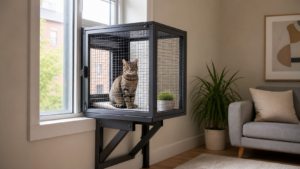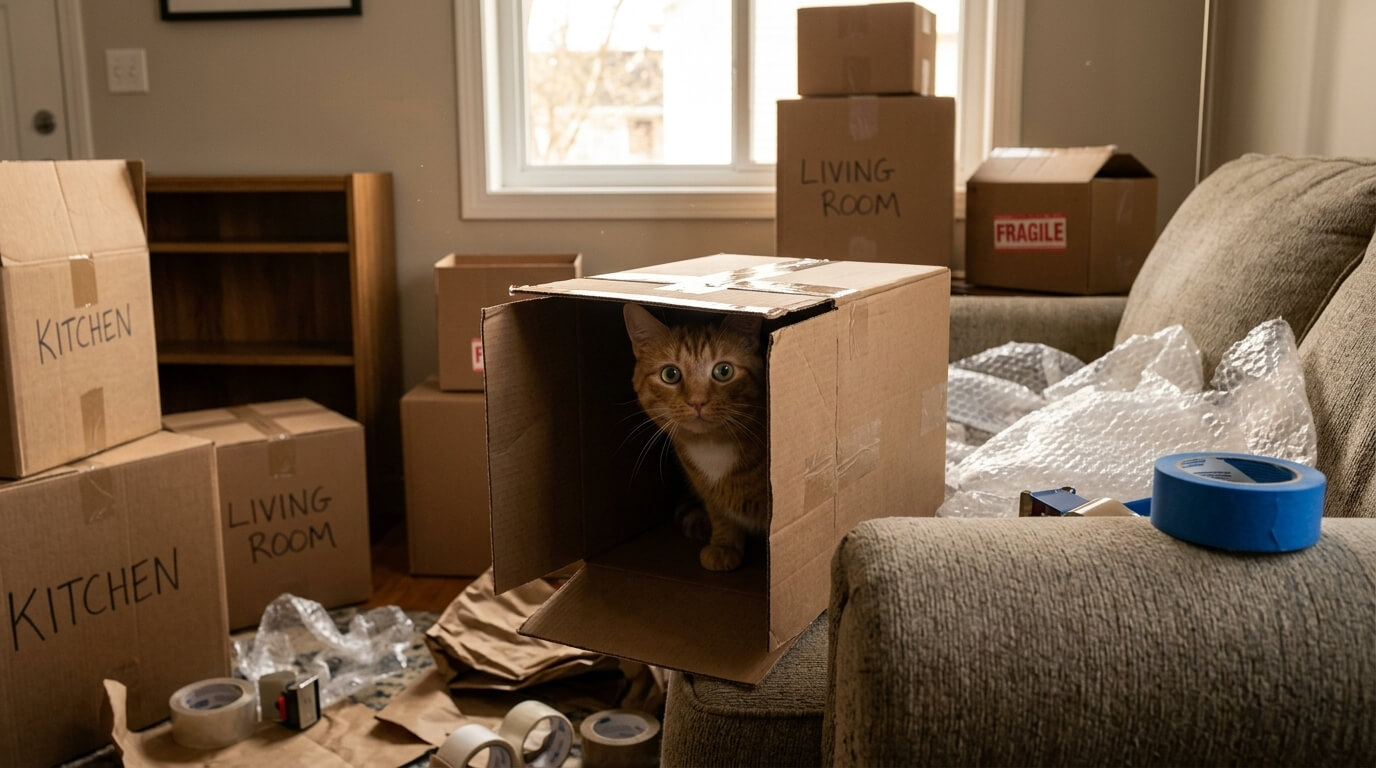
Moving with a cat to new apartment housing is safest when you control three things: doors, transport, and how much unfamiliar space your cat receives at once. Prepare one quiet room before the cat arrives, move the cat only in a closed and secured carrier, and expand access according to the cat’s behavior—not a fixed countdown.
The practical goal is simple: prevent escape, preserve familiar routines, make food and litter easy to find, and notice health changes early. This guide combines the full move into seven steps, from packing week to the first calm days in the new home.
Quick Answer: How Do You Move a Cat to a New Apartment Safely?
Before movers arrive, place your cat in a closed room with a litter box, water, a hiding place, familiar bedding, and a secure carrier. Move the cat after the busiest loading work is finished. In the car, keep the carrier closed and secured so it cannot slide. At the new apartment, take the carrier directly into a prepared safe room and close the room door before opening the carrier.
Keep your cat in that smaller territory until they are eating, drinking, using the litter box, moving with a relaxed posture, and voluntarily interacting or exploring. Some cats are ready for another room quickly; others need more time. A quiet, predictable introduction is more important than following a universal 24-, 48-, or 72-hour rule.
Important Safety Note
This article provides general moving and environmental guidance. It is not a substitute for veterinary care. Ask your veterinarian for an individual plan before the move if your cat has a history of urinary obstruction, severe travel distress, breathing problems, heart disease, seizures, diabetes, kidney disease, chronic pain, or medication needs.
Straining to urinate, repeated litter-box trips with little or no urine, collapse, breathing difficulty, repeated vomiting, or obvious pain needs urgent veterinary attention. Appetite loss also deserves prompt advice, especially in kittens, senior cats, overweight cats, and cats with an existing medical condition.
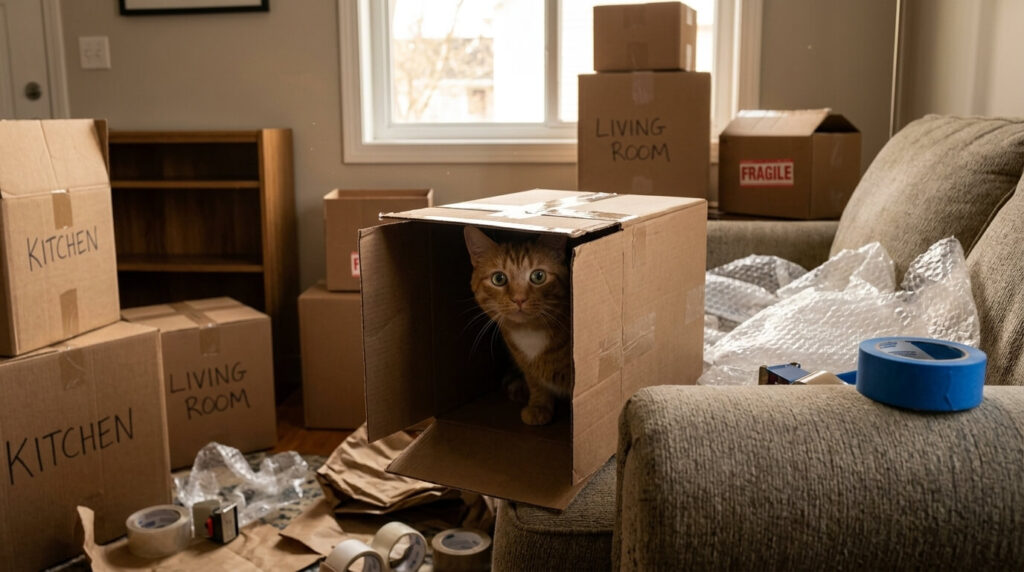
Apartment Moving Risk Map
A move creates several risks at the same time. Planning around them is easier when each risk has one clear control.
| Moving stage | Main risk | Best control |
|---|---|---|
| Packing week | Routine disruption, open boxes, exposed cords, removed hiding places | Keep meals, litter, and one resting area stable |
| Loading day | Open doors, strangers, noise, furniture movement | Use a closed cat-only room with a door sign |
| Car travel | Escape, carrier movement, heat, motion stress | Use a closed carrier secured in the vehicle |
| Arrival | Unfamiliar exits, unsafe gaps, unpacking traffic | Carry the cat directly into a prepared safe room |
| First days | Appetite or litter changes, hiding, rushed exploration | Monitor daily and expand territory gradually |
7 Safe Steps for Moving with a Cat to a New Apartment
1. Prepare the Carrier and Records Before Packing Takes Over
Do not wait until moving morning to bring out the carrier. Leave it open in a familiar room with the door fixed so it cannot swing. Add familiar bedding and occasionally place treats or part of a meal near or inside it. If your cat already fears the carrier, start with the easier stages in our cat carrier training guide.
Check that the carrier closes securely, has adequate ventilation, and is large enough for your cat to turn around and lie down. Replace cracked plastic, loose fasteners, torn mesh, or unreliable latches. A soft carrier may be suitable for some cats, but it still needs a stable base and closures the cat cannot push open.
Update the phone number attached to the microchip registry and identification tag. Save your current veterinarian’s number, the new local clinic’s number, and the nearest emergency clinic. Keep medication, a recent photo, vaccination information, and essential records with you rather than in the moving truck.
2. Preserve Familiar Food, Litter, Routine, and Scent
A move is not the ideal time to introduce a new diet, litter type, litter-box style, or feeding schedule unless a veterinarian has advised the change. Pack enough of the usual food and litter to cover the move and the first settling period.
Keep at least one bed, blanket, carrier pad, or soft item unwashed so it carries a familiar scent. Bring the same bowls and litter box when practical. Familiarity does not remove all stress, but it gives the cat recognizable information in a space that otherwise smells and sounds new.
Maintain normal meal and play times as closely as the move allows. If boxes have removed the cat’s favorite hiding or resting areas, provide a stable replacement such as an open carrier, a cardboard box on its side, or a covered bed. Do not allow access inside reclining furniture, behind appliances, or into wall and cabinet gaps.
3. Use a Closed Room During Loading
Before the front door begins opening repeatedly, move the cat into a quiet room that movers do not need to enter. Add the litter box, water, familiar bedding, a safe hiding option, and the closed transport carrier. Put a clear note on the outside of the door stating that a cat is inside and the door must remain closed.
Tell every person helping with the move. A verbal warning alone is easy to forget during a busy handoff. If the room must be emptied, complete that work before the cat enters or move the cat only after a second secure room is ready.
Cats that rush doors need two layers of control whenever possible: the closed room plus the closed carrier before the room door opens. Review our guide on how to stop a cat from running out the door before moving day if bolting has happened before.
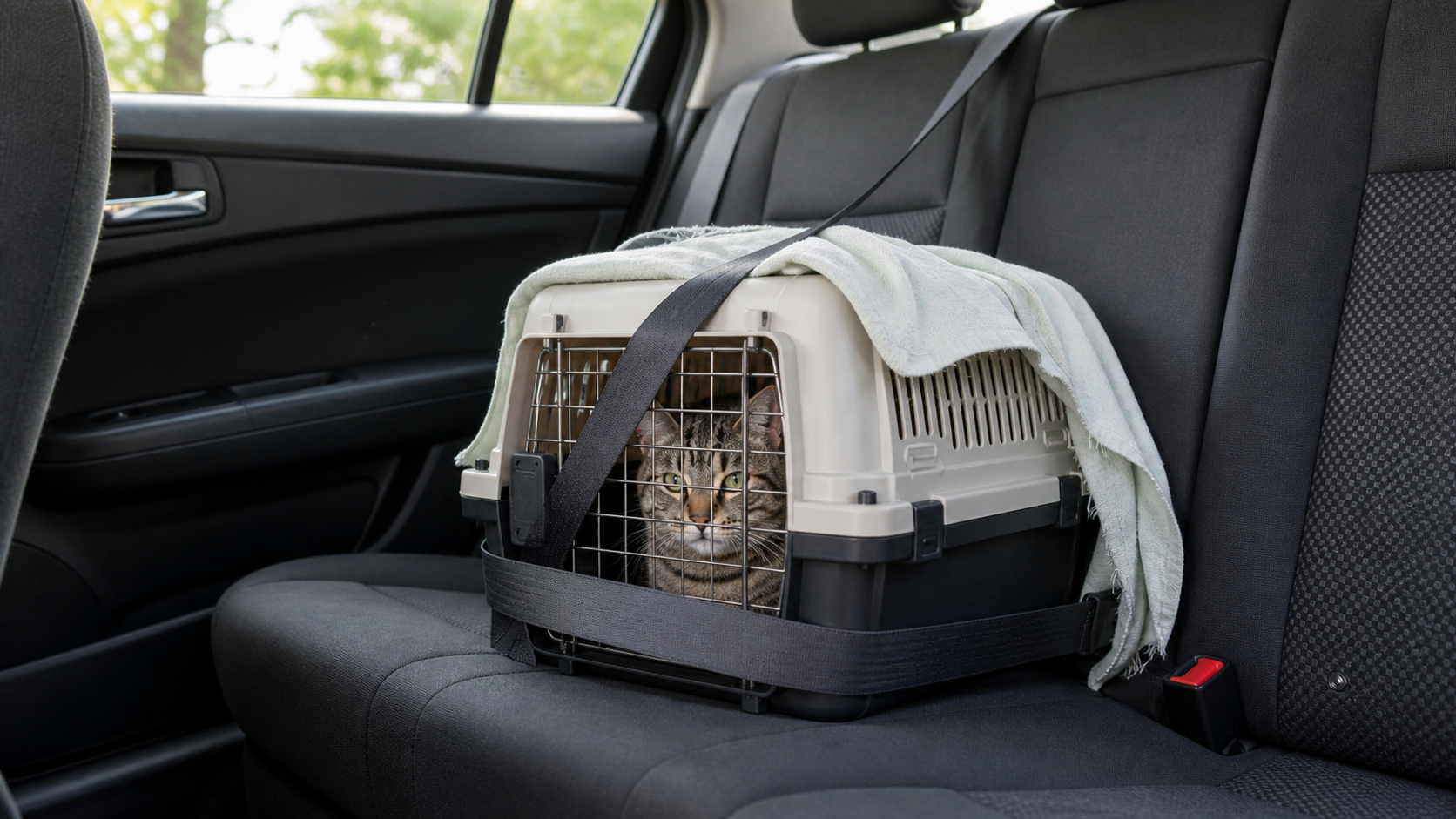
4. Transport the Cat in a Closed, Secured Carrier
Move the cat in the passenger vehicle, not in the moving truck or a cargo area. Keep the carrier closed from the old secure room until it is inside the new secure room. Do not open it in a parking lot, hallway, elevator, rest area, or vehicle—even if the cat is vocalizing.
Place the carrier level and secure it according to the carrier and vehicle instructions so it cannot slide or tip during normal braking. Maintain comfortable ventilation and temperature. A light partial cover may reduce visual stimulation for some cats, but it must not restrict airflow or allow the cat to overheat.
Drive smoothly, keep the cabin quiet, and never leave the cat unattended in a parked vehicle. For longer trips, route planning and rest-stop precautions are covered in our guide to traveling with a cat in a car. If your cat has previously panicked, vomited repeatedly, or shown breathing difficulty during travel, speak with your veterinarian before moving day rather than trying an unreviewed supplement or medication.
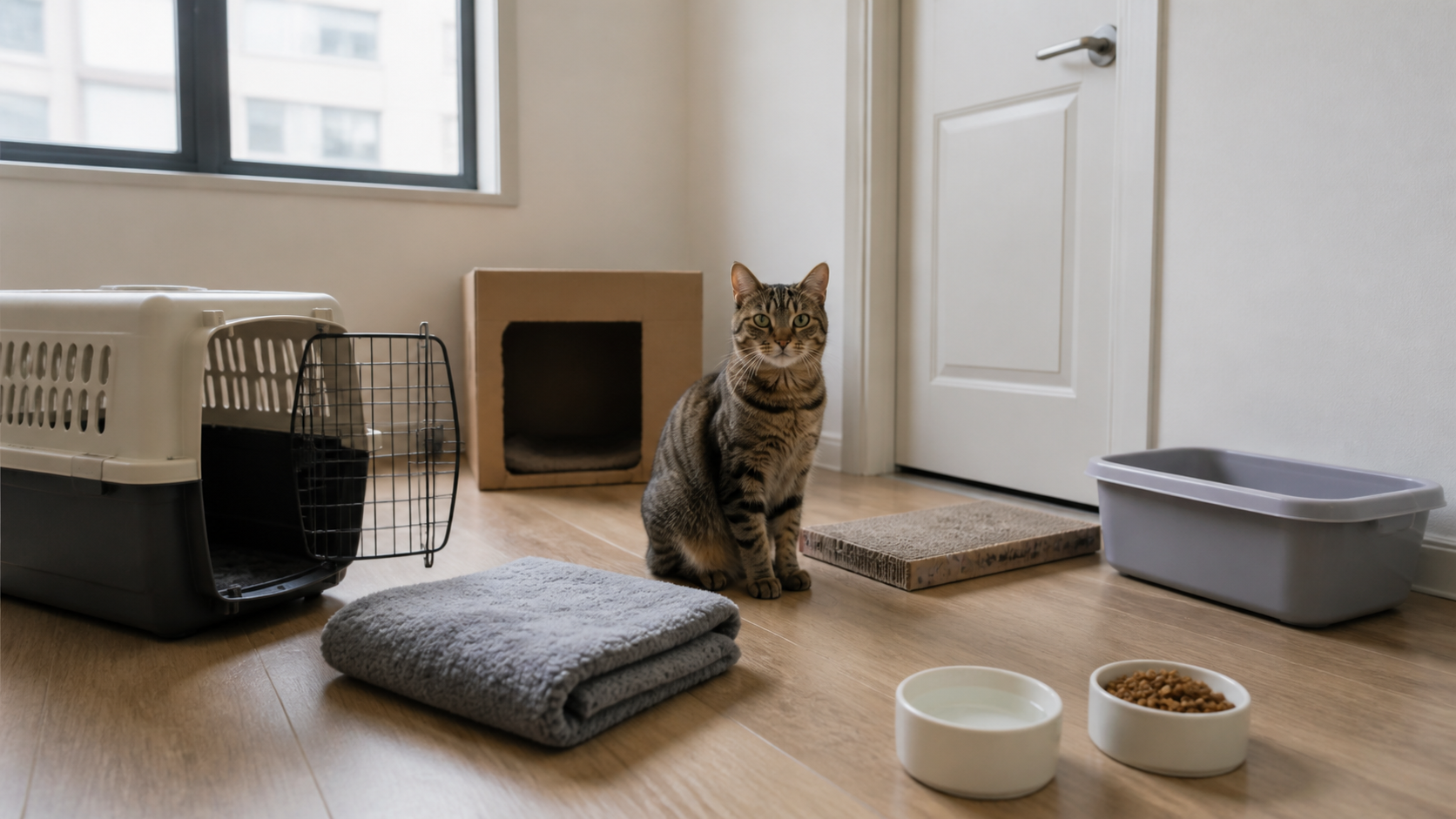
5. Prepare the New Safe Room Before the Cat Arrives
The safe room should be completely ready before the carrier enters the new apartment. A quiet bedroom, office, or bathroom can work if the door closes securely and the room has been checked for escape routes and hazards.
Include:
- the familiar litter box and usual litter;
- food and water placed away from the litter box;
- an open carrier with the door secured open;
- a familiar blanket or bed;
- an accessible hiding box or covered bed;
- a stable scratching surface;
- one or two familiar toys;
- a comfortable temperature and good ventilation.
Close and secure windows. Check window screens, but do not treat an insect screen as fall protection. Block narrow gaps behind appliances or built-in cabinets. Remove exposed cords, cleaners, medicines, toxic plants, breakable objects, string, plastic wrap, and packing straps. If the room is a bathroom, close the toilet lid and confirm that drawers, cabinets, and plumbing access points are secure.
Keep the litter box easy to find. Do not hide it behind stacks of boxes or put food beside it. In a multi-cat household, one small room may not provide enough separation for cats that compete over food, resting places, or litter access.
6. Expand Access According to Behavior, Not a Fixed Clock
Once the carrier is inside the safe room and the room door is closed, open the carrier and allow the cat to exit voluntarily. Do not pull the cat out. Sit quietly, speak normally, and let the cat choose between hiding, watching, eating, or exploring.
Hiding by itself is not failure. It is a normal way to reduce stimulation. What matters is whether the cat gradually begins to eat, drink, use the litter box, groom, rest, and move around the room with less tension.
Consider opening one additional quiet area when the cat:
- eats and drinks close to the normal pattern;
- urinates and defecates normally;
- moves through the safe room without remaining crouched or frozen;
- rests, grooms, plays, or approaches familiar people;
- shows curiosity at the door without frantic escape behavior.
Open only one manageable area at first, after exterior doors and windows are secure and unpacking activity has stopped. Keep the safe room available as a retreat. If the cat becomes overwhelmed, reduce the available space again without punishment.
Some cats show readiness within a day; others need several days or longer. Senior cats, timid cats, cats with impaired vision or hearing, and cats with previous stressful moves may need a slower pace. Compare ongoing changes with our guide to signs an indoor cat is stressed.
7. Monitor Eating, Drinking, Urination, Stool, and Behavior
During the first days, keep a simple written record. Note meals eaten, water use, urine clumps, stool, vomiting, medication, and unusual behavior. A written log is more reliable than trying to remember whether a litter clump appeared yesterday or today.
Check the cat without repeatedly pulling them from a hiding place. Look for gradual improvement: normal grooming, relaxed sleep, cheek rubbing, stretching, play, and voluntary exploration. A cat may still startle at hallway noise or hide when visitors arrive while otherwise adjusting normally.
Do not assume every change is “just stress.” Moving can coincide with urinary disease, gastrointestinal illness, pain, or another medical problem. If the cat urinates outside the box, first confirm that the box is accessible, quiet, familiar, and clean; then review our guide to cat peeing outside the litter box and contact a veterinarian when the change is sudden or accompanied by physical signs.
Moving-Day Checklist
Before Loading Begins
- Feed and medicate according to the cat’s normal plan.
- Confirm microchip and contact information.
- Photograph the cat and keep the photo accessible.
- Place the cat in the closed old-home safety room.
- Add water, litter, hiding, bedding, and the carrier.
- Post a door warning and tell every helper.
- Pack medication, records, food, and litter in the passenger vehicle.
Before Leaving the Old Apartment
- Close and latch the carrier before opening the room door.
- Check closets, cabinets, appliances, box springs, and furniture gaps.
- Confirm the cat is physically inside the carrier.
- Carry the carrier directly to the vehicle.
- Secure it so it remains level and cannot slide.
At the New Apartment
- Confirm the safe room door and windows are closed.
- Check that food, water, litter, hiding, and bedding are ready.
- Carry the closed carrier directly into the safe room.
- Close the room door before opening the carrier.
- Keep movers, visitors, and other pets out.
- Record the first meal and litter-box use.
How to Set Up a Cat Safe Room in a Small Apartment
In a studio, the bathroom is often the only separate room. It can still work if it is dry, comfortably ventilated, and free of chemicals and unsafe gaps. Add a non-slip surface, a box or covered bed, and familiar bedding. Keep the cat away from a hot radiator, a running washer or dryer, and frequently used doors.
If you must use part of the main room, create distance from the entrance and use a secure interior barrier only as an additional layer—not as a substitute for a closed carrier during active moving. Finish carrying large furniture before the cat arrives. Reduce noise and keep one predictable route between the litter box, water, resting place, and hiding place.
The room should be simple enough for the cat to understand. Too many boxes, new toys, scents, and visitors can make a “comfort room” more confusing rather than more reassuring.
Special Moving Plans
Moving Multiple Cats
Use one secure carrier per cat unless your veterinarian or a qualified behavior professional has advised otherwise. Even cats that normally sleep together can react differently when frightened in a moving vehicle.
In the new home, duplicate important resources and spread them apart. Watch for blocking at doorways, litter boxes, food, water, hiding places, and elevated resting areas. Cats that are closely bonded may settle together, but cats with tension or resource guarding may need separate safe rooms and a gradual reintroduction. Our multi-cat apartment guide explains how to distribute resources in limited space.
Moving a Senior Cat
Keep routes short and surfaces non-slip. Use a low-entry litter box if that is already familiar and appropriate. Avoid forcing stairs or high jumps during the first days. Maintain medication and feeding schedules, and ask the veterinarian how to transport a cat with arthritis, kidney disease, diabetes, or cognitive changes.
Moving a Door-Bolting Cat
Use redundant barriers: a closed room, a closed carrier, and a planned handoff between adults. Do not depend on a baby gate alone. Tell building staff and movers that the cat must not be released. At the new apartment, inspect the hallway door, balcony door, windows, damaged screens, utility cupboards, and gaps before the cat leaves the carrier.
Moving a Cat with a Medical Condition
Arrange prescriptions and records early. Identify a clinic near the new home before the move. Keep medication at the correct temperature and carry it with you. Do not change or add medication based only on general online advice; travel and stress plans need to account for the individual cat’s diagnosis and current treatment.
Common Mistakes to Avoid
Giving Full-Apartment Access Immediately
A cat that races through every room may be scanning for exits rather than confidently exploring. Starting small makes food, water, litter, and hiding places easy to locate. It also lets you find hazards before the cat does.
Opening the Carrier During Travel
A frightened cat can move faster than expected and may hide under pedals, escape through an open door, or become difficult to return to the carrier. Keep it closed until both the carrier and the person handling it are inside the closed destination room.
Washing Every Familiar Item
A completely fresh set of bedding may look tidy but removes familiar scent cues. Bring at least one safe, unwashed item unless it is soiled or there is a hygiene or parasite reason not to use it.
Changing Food and Litter at the Same Time
Multiple simultaneous changes make refusal and elimination problems harder to interpret. Keep familiar food and litter stable until the cat is settled, unless the veterinarian has prescribed a change.
Using Strong Fragrance to Make the Apartment Smell Clean
Avoid heavily scented cleaners, air fresheners, essential-oil products, and fragrances around the safe room. Use products according to their labels, ventilate appropriately, and keep the cat away from wet treated surfaces.
Forcing Interaction or Exploration
Pulling a cat from hiding, carrying them from room to room, or repeatedly presenting visitors can slow adjustment. Offer predictable care and allow voluntary contact. If hiding is accompanied by appetite loss, abnormal urination, pain, or other illness signs, contact a veterinarian.
When to Call a Veterinarian After Moving
Seek emergency veterinary care for straining with little or no urine, repeated unsuccessful attempts to urinate, collapse, breathing difficulty, severe weakness, repeated vomiting, or obvious pain. Urinary obstruction can be life-threatening and should not be monitored at home while waiting for it to improve.
Call your veterinarian promptly if your cat is not eating normally, has persistent diarrhea, repeatedly vomits, drinks or urinates much more or less than usual, stops grooming, or shows a sudden and sustained behavior change. Cats can become medically unwell while appearing merely quiet or hidden.
If you cannot confirm whether the cat has eaten or urinated, improve monitoring immediately: use measured meals, check the litter box before adding fresh litter, and separate cats temporarily so each cat’s output can be identified.
Frequently Asked Questions
How long should a cat stay in one room after moving?
There is no universal minimum that fits every cat. Use behavior and basic health signs. The cat should be eating, drinking, using the litter box, resting, and moving more comfortably before receiving additional space. Keep the room available as a retreat after expansion begins.
Should I move the cat first or last?
Prepare the new safe room first, but transport the cat after the busiest loading work is finished. At the old apartment, the cat should remain secured away from open doors. At the new apartment, the cat should go directly into the already-prepared room before general exploration.
Should I let my cat hide after moving?
Yes, provided the hiding place is safe and accessible. Offer a box, covered bed, or open carrier. Block hazardous or unreachable gaps. Monitor meals and litter use rather than repeatedly removing the cat from the hiding place.
Can two cats share one safe room?
Closely bonded cats may be comfortable together, but each still needs access to food, water, litter, resting, and hiding resources. Cats with tension, guarding, or redirected aggression may need separate spaces and a slower reintroduction.
How can I calm my cat in the car?
Use a familiar, closed carrier; secure it level in the vehicle; maintain ventilation and a comfortable temperature; reduce sudden braking and loud sound; and never open the carrier in an unsecured location. Ask your veterinarian in advance if the cat has a history of severe travel distress.
What if my cat will not eat in the new apartment?
Offer the familiar diet in a quiet location and verify that the cat can reach it without passing a frightening doorway, person, or other pet. Do not rely on repeated food changes. Contact a veterinarian promptly if appetite does not return or if the cat has other symptoms, is very young or old, is overweight, or has an existing condition.
Final Thoughts
Moving with a cat to a new apartment works best as a controlled sequence: prepare the carrier, preserve familiar routines, secure the cat before doors open, transport only in a closed carrier, begin with one safe room, expand gradually, and monitor health as well as behavior.
Your cat does not need an elaborate welcome. They need predictable access to familiar essentials, protection from escape, and enough time to build a new map of the home at their own pace.