The best cat carriers for nervous cats are secure, stable, easy to load, and simple for a veterinary team to open without pulling a frightened cat through one small door. For many anxious cats, a hard-sided carrier with front and top access plus a removable upper half is the most practical choice. A structured soft carrier can work for a cat that does not claw, bite, or push against mesh.
This guide compares five current carrier options for vet visits, car travel, apartment storage, and longer waits. The products were assessed from current manufacturer specifications and feline-friendly handling guidance; Indoor Cat Expert did not conduct independent crash, escape, or clinical testing. Always measure your cat and check the exact model and size before ordering.
Disclosure: This article may contain affiliate links. If you buy through them, Indoor Cat Expert may earn a commission at no extra cost to you. Product availability, dimensions, colors, and travel rules can change.
Quick Answer: Which Carrier Is Best for a Nervous Cat?
Choose the Petmate E-Z Load Two Door Kennel when top loading, a rigid shell, and easy cleaning are the main priorities. Choose the Sleepypod Mobile Pet Bed when you want a carrier that can remain open as familiar furniture and you value the manufacturer’s documented vehicle-safety testing. The Sherpa Original Deluxe is the most straightforward soft-sided option for owners who must confirm under-seat airline dimensions, while the SturdiBag Pro 2.0 offers more size choices and flexible height. The PETSFIT Expandable Carrier is useful when extra stationary lounging space matters, but its mesh extensions must be closed before carrying the cat.
No carrier can guarantee a stress-free trip. The right design removes avoidable struggles, while gradual cat carrier training, familiar bedding, careful handling, and veterinary support address the cat’s response to travel.
Carrier Safety Comes Before Convenience
A nervous cat can force open a weak zipper, tear mesh, push through an incompletely latched door, or bolt when the carrier opens. Before every trip, inspect seams, mesh, zipper clips, door pins, screws, latches, handles, the floor board, and any vehicle-restraint routing. Replace a carrier with cracked plastic, bent wire, damaged mesh, separated seams, or unreliable closures.
Keep the carrier closed in parking lots, hallways, elevators, clinic lobbies, and other unsecured spaces. Do not rely on an interior tether as the primary restraint, and never clip one to a collar. Follow the carrier manufacturer’s vehicle instructions and keep the carrier level. A seat-belt pass-through or strap does not automatically mean a product has been independently crash tested.
If a cat is injured, struggling to breathe, collapsing, repeatedly vomiting, unable to urinate, bleeding heavily, or showing severe pain, use the safest available carrier and contact a veterinarian or emergency clinic promptly. Do not delay urgent care to finish carrier training.
Best Cat Carriers for Nervous Cats at a Glance
| Carrier | Access / intended use | Size information to check | Fit limitation |
|---|---|---|---|
| Petmate E-Z Load Two Door | Front and top doors; vet visits | 19-inch model interior: 16.75 × 11 × 9.25 in; 24-inch interior: 21 × 14.5 × 13.5 in (L × W × H) | These are manufacturer interior dimensions, not the outer shell. Check the selected model’s weight limit too. |
| Sleepypod Mobile Pet Bed | Top access and removable dome; bed-to-carrier use | Check usable bed diameter and headroom with the dome closed | Its round shape is not equivalent to a rectangular carrier of the same advertised width. |
| Sherpa Original Deluxe | Top and side entry; soft-sided travel | Select Small, Medium or Large, then confirm usable space with the liner installed | Do not treat an airline size allowance as proof that your cat fits comfortably. |
| SturdiBag Pro 2.0 | Top access; flexible-height travel | Manufacturer lists Medium 15 × 12 × 11.75 in and Large 18 × 11.5 × 11.5 in (D × W × H) | These are listed product dimensions, not verified usable interior dimensions; ask about floor area and headroom. |
| PETSFIT Expandable Carrier | Stationary waiting space with extensions | Confirm the exact one- or two-extension model and the closed carrier dimensions | Expanded resting space does not count as usable carrying space. |
How We Chose These 5 Carriers
We compared features that matter before, during, and after transport rather than relying on “calming,” “escape-proof,” or “airline approved” slogans. The five products remain listed by their manufacturers as of August 20, 2026. We prioritized:
- Secure access: doors and zippers that can be checked before leaving home.
- Low-conflict loading: top entry, a removable top, or an opening large enough for voluntary entry.
- Stable support: a rigid shell or reinforced base that does not fold around the cat.
- Ventilation with containment: airflow without assuming all mesh can resist a panicked cat.
- Cleaning: removable bedding, wipeable surfaces, and access to corners after accidents.
- Practical carrying: a balanced handle, shoulder strap, or manufacturer-specified vehicle routing.
- Apartment use: whether the carrier can remain accessible without becoming an awkward obstacle.
- Current documentation: an active manufacturer page with usable sizing and feature information.
We did not rank carriers by customer star ratings, temporary discounts, or unverified claims. A product that suits a calm 8-pound cat may be wrong for a muscular 15-pound cat that throws its weight against doors. Your cat’s measurements, behavior, mobility, destination, and transport method determine the safest fit.
Measure Your Cat Before Choosing a Size
Measure from the nose to the base of the tail, from the floor to the top of the head or ears in a natural standing position, and around the widest part of the body. Compare those measurements with the manufacturer’s interior dimensions when available. Weight limits alone do not establish fit because two cats at the same weight can have different body lengths and heights.
The cat should be able to enter, reposition, and rest without being compressed by a sagging roof or narrow door. Bigger is not automatically better for car travel: excessive empty space can allow more movement, while an undersized carrier can prevent a comfortable posture. Add only bedding that does not obstruct ventilation or interfere with the door.
1. Petmate E-Z Load Two Door Kennel: Best for Vet Visits
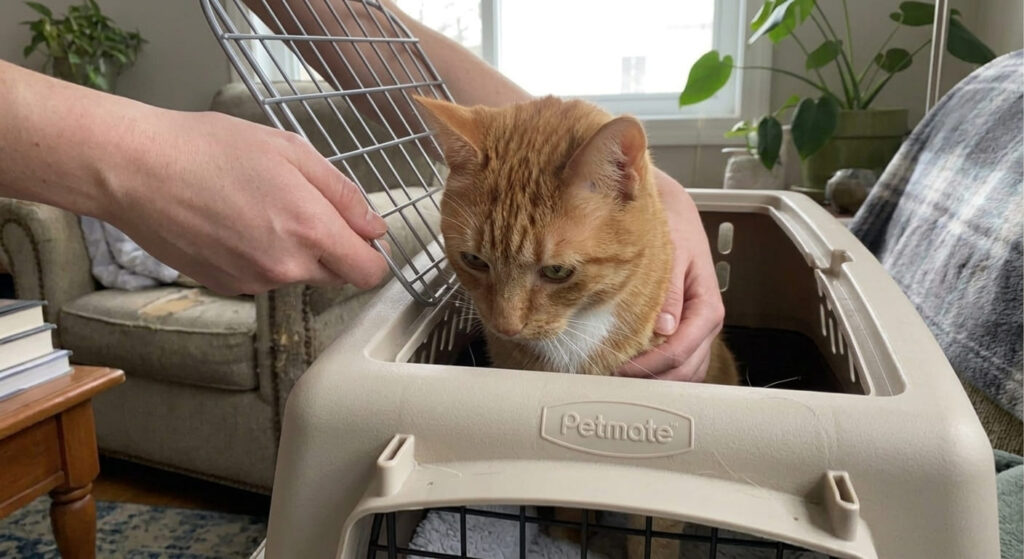
The Petmate E-Z Load Two Door Dog & Cat Kennel is the strongest general-purpose match for many nervous cats because it combines a hard plastic shell with steel-wire front and top doors. The top opening gives an owner another loading route, while the rigid base is easier to support from underneath and clean after an accident.
Petmate currently lists 19-inch and 24-inch versions with different interior dimensions and weight ranges. Measure the individual cat rather than assuming that every adult cat fits the smaller model. Check that both doors are seated correctly and that every latch is fully engaged before lifting.
Best for: vet visits, cats that resist a front-only opening, owners who want wipeable hard surfaces, and cats likely to damage soft mesh.
Not ideal for: extremely limited storage or air travel without separate confirmation. A top door helps loading, but this model’s upper shell is not designed to serve as the same type of fully removable examination top found on some two-piece carriers.
Manufacturer details: Petmate E-Z Load Two Door Kennel.
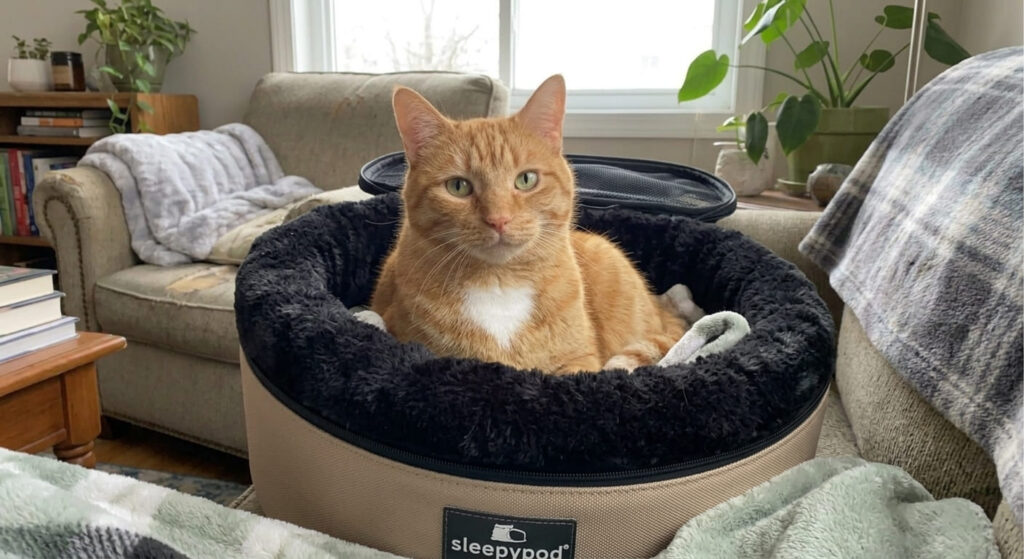
2. Sleepypod Mobile Pet Bed: Best Carrier-and-Bed Design
The Sleepypod Mobile Pet Bed is designed to remain open as a bed at home and convert into a carrier for travel. That dual use is valuable in an apartment because the carrier does not need to disappear into a closet between trips. A cat can investigate, sleep, and receive treats in it without every entry predicting a veterinary visit.
Sleepypod publishes information about static and dynamic testing of its pet passenger restraints, including the Mobile Pet Bed. That documentation distinguishes it from carriers that merely provide a seat-belt strap. Follow the current installation instructions for the exact product; do not improvise routing or assume another Sleepypod model installs the same way.
Best for: owners who can leave a carrier open as a normal sleeping area, cats that benefit from a familiar enclosed base, and car users who want a product with manufacturer-published safety-testing information.
Not ideal for: tight budgets, very small storage areas, or owners who need a conventional rectangular under-seat carrier. The round footprint must fit the home, vehicle position, cat, and intended route.
Manufacturer details: Sleepypod Mobile Pet Bed and the company’s safety research program.
3. Sherpa Original Deluxe: Best Simple Soft-Sided Option
The Sherpa Original Deluxe uses a spring-wire frame, mesh panels, locking zippers, top and side entries, a washable liner, and a luggage strap that also serves as the manufacturer’s seat-belt pass-through. It folds more easily than a hard carrier and is available in multiple sizes.
This option suits a nervous cat only when the cat remains safely contained by soft sides. Watch the cat during practice sessions. Biting zippers, hooking claws into mesh, pushing forcefully at seams, or collapsing the roof are reasons to select a hard-sided alternative rather than trusting the marketing term “escape-proof.”
Best for: cats that already tolerate soft carriers, owners who need a lighter carrier, and travelers willing to confirm current airline and aircraft rules before every flight.
Not ideal for: cats that attack fabric or mesh, situations needing maximum structural protection, or any flight based only on a generic airline claim. Under-seat dimensions and pet rules vary by airline, aircraft, route, fare, and cabin.
Manufacturer details: Sherpa Original Deluxe Travel Bag Pet Carrier.
4. SturdiBag Pro 2.0: Best Flexible Premium Carrier
The SturdiBag Pro 2.0 has top and front access, a structured base, locking zippers with security clips, mesh ventilation, privacy flaps, washable bedding, and flexible height rods. Its range of sizes makes it easier to compare the cat’s measurements with a specific configuration instead of treating one carrier as universal.
Privacy flaps are useful because nervous cats differ: some settle when they can see the owner, while others cope better when unfamiliar movement is partly screened. Keep adequate ventilation open and observe the cat rather than covering every mesh panel automatically.
Best for: frequent travel, owners who need several sizing options, and cats that tolerate a structured soft carrier but benefit from adjustable visual exposure.
Not ideal for: cats that chew or claw through soft materials. The manufacturer states that most sizes are intended to meet many in-cabin requirements, but XL and XXL are excluded from that claim, and every traveler must confirm the exact carrier with the airline.
Manufacturer details: SturdiBag Pro 2.0.
5. PETSFIT Expandable Carrier: Best for Stationary Waiting Space
The PETSFIT Expandable Cat Carrier uses a reinforced soft-sided frame, mesh ventilation, a rigid base under the removable pad, locking zippers, and one- or two-sided expansion depending on the model. The expandable sections give a settled cat more room to change position while waiting in a secured room, parked vehicle with safe temperature control, or destination.
Expansion changes the carrier’s footprint and stability. Close all extensions before lifting the carrier, opening a vehicle door, walking through a lobby, or entering any place where escape would be dangerous. Do not use the extension as a substitute for a secure travel enclosure.
Best for: longer stationary waits, hotel or destination setup, and cats that safely tolerate mesh.
Not ideal for: forceful cats, cramped pathways, or owners who might move the carrier while expanded. PETSFIT limits its airline claims by model and size; verify the selected dimensions directly with the airline instead of relying on product-page logos.
Manufacturer details: PETSFIT Expandable Carrier with two extensions.
Hard-Sided vs. Soft-Sided Carriers for Nervous Cats
A hard-sided carrier is generally easier to clean, resists collapse, and is more appropriate for a cat that pushes, scratches, or bites at soft material. A model that separates into upper and lower halves can also support lower-stress veterinary handling when the clinic can examine the cat in the base.
A structured soft carrier is lighter, easier to store, and may fit some travel situations better. It is suitable only if the floor remains supportive and the cat does not compromise mesh, seams, or zippers. Inspect it closely after every use. “Soft” does not mean comforting to every nervous cat, and “hard” does not mean frightening when the carrier is introduced gradually.
What Features Matter Most?
Top and front access
Two access routes give the owner and veterinary team options. A willing cat can walk through the front; a reluctant cat may be placed through the top when urgent transport is necessary. Loading should be calm and controlled—never drop a cat through an opening or suspend the carrier by an unsecured panel.
A removable upper half
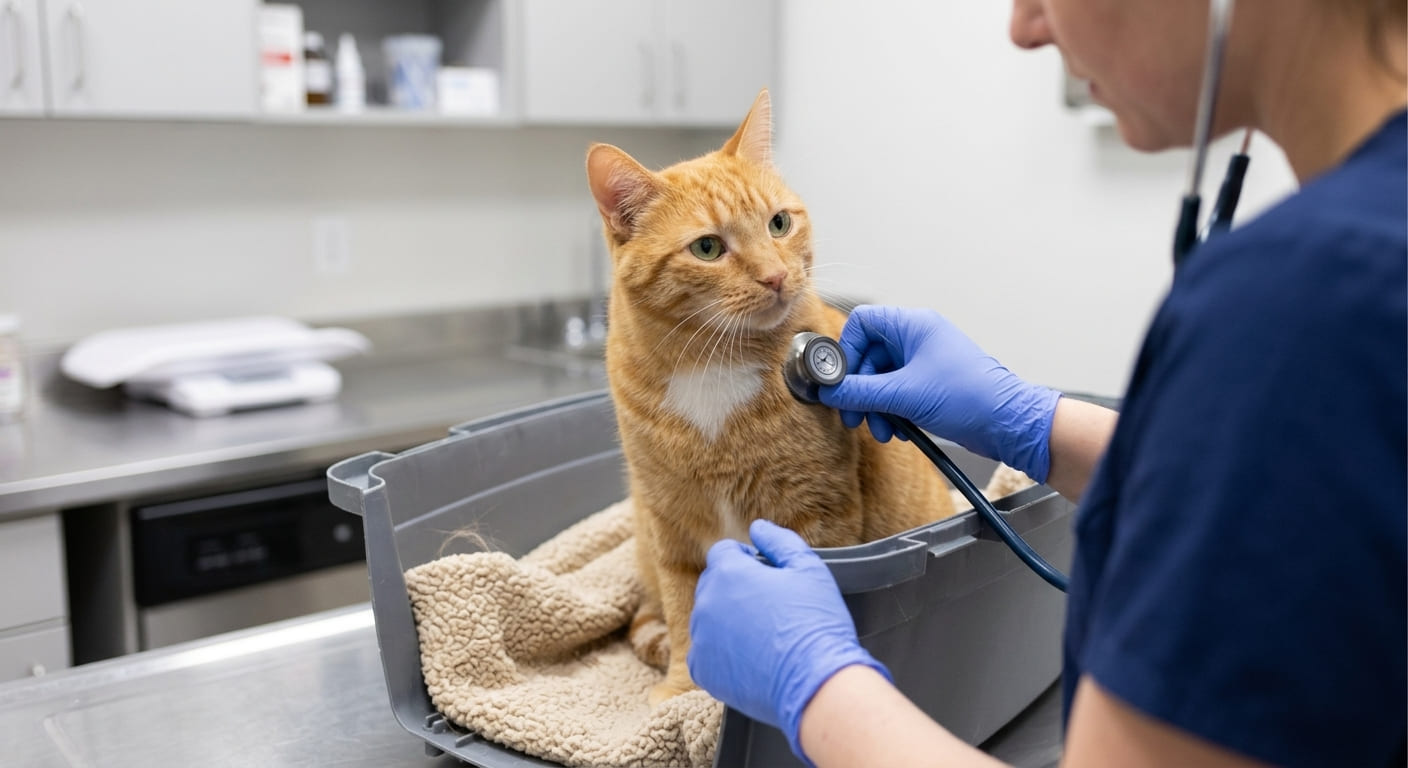
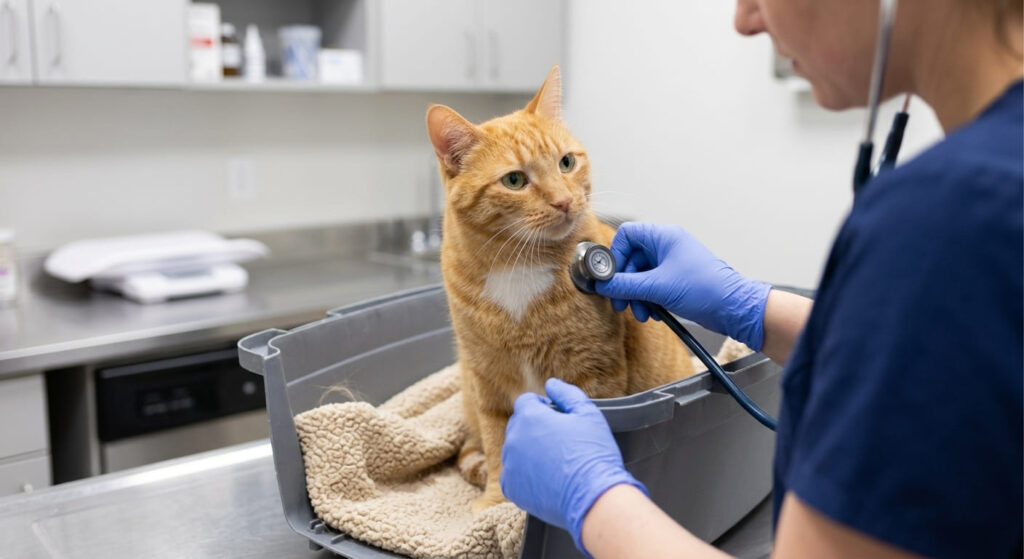
FelineVMA guidance favors carriers that open from the top and front and can separate in the middle. A fearful, anxious, painful, or mobility-limited cat may be examined in the lower half instead of being dragged or dumped out. Top access alone is helpful, but it is not the same as a removable upper shell.
Stable base and secure closures
A sagging base changes the cat’s footing and makes the carrier harder to keep level. Check that a soft carrier has a correctly seated floor board and that a hard carrier’s upper and lower sections are fully fastened. Zipper clips, door pins, and latches work only when the owner uses and checks them.
Adjustable visual exposure
Some cats want to see the owner; others react to dogs, people, or passing scenery. A breathable privacy flap or a light towel can reduce visual stimulation, but never block airflow or allow fabric to overheat the carrier. Observe breathing, posture, vocalization, and attempts to escape.
How to Make Any Carrier Easier to Accept
Keep the carrier accessible before it is needed. Secure the door open or remove it only when the manufacturer allows this safely, add familiar washable bedding, and reward voluntary approaches. Begin with the easiest behavior the cat can perform calmly: looking at the carrier, approaching it, taking a treat near the entrance, or placing one paw inside.
Progress at the individual cat’s pace. Briefly move the door without closing it, then practice short closures, lifting from underneath, carrying a few steps, sitting in a parked car, and taking short drives. Return to an easier step when the cat stops eating, freezes, pants, thrashes, vocalizes intensely, eliminates, or tries to escape. There is no universal one-week or six-week schedule.
For planned appointments involving severe fear, ask the veterinary team well in advance about an individualized transport plan. Do not give sedatives, supplements, or human medication without veterinary direction. Our cat car-travel guide covers temperature, vehicle setup, and arrival planning after carrier practice is underway.
Apartment-Specific Carrier Setup
In a small apartment, store the carrier where it remains reachable without blocking a doorway or becoming a falling hazard. A bed-style model can sit in a quiet corner. A rectangular carrier can fit beneath a sturdy console with its entrance unobstructed. Do not bury the carrier behind boxes; emergencies are exactly when storage becomes hardest to navigate.
Keep one appropriately sized carrier per cat. Label it, check it monthly, and store a washable liner nearby. Include carrier location and loading responsibilities in your apartment cat emergency evacuation plan. For a move, make the carrier part of the secure-room plan described in our guide to moving with a cat to a new apartment.
Common Buying Mistakes
- Buying by weight alone: length, standing height, body shape, door size, and interior space also determine fit.
- Trusting “airline approved” without confirmation: airlines and aircraft have different limits, and approval can never be assumed for a future trip.
- Confusing a strap with crash testing: read the manufacturer’s exact vehicle instructions and evidence.
- Choosing maximum mesh for a forceful cat: ventilation is essential, but soft containment must match the cat’s behavior.
- Ignoring cleaning access: stress-related urine, feces, vomit, and shed hair need to be removed completely.
- Hiding the carrier until appointment day: sudden appearance can become a reliable warning signal.
- Expecting the product to treat anxiety: design can reduce handling problems but cannot diagnose or treat fear, pain, nausea, or illness.
Frequently Asked Questions
What is the safest carrier style for a nervous cat?
For many nervous cats, a sturdy hard-sided carrier with front and top access, secure latches, and an upper half that can be removed is the most versatile design for vet visits. The safest choice still depends on the cat’s size, escape behavior, mobility, vehicle setup, and destination.
Is top loading always less stressful?
No. Top loading provides another option, especially when urgent transport is necessary, but voluntary front entry is preferable during routine training. A frightened cat should be supported and lowered carefully, not dropped or forced through an opening.
Should I choose a carrier with maximum visibility?
It depends on the cat. Some cats settle when they can see the owner; others become more reactive when they see dogs, strangers, or movement. Choose safe ventilation first, then use privacy flaps or a breathable cover to adjust visual exposure while monitoring the cat.
Can I use an expandable carrier in the car?
Use the carrier only in the configuration permitted by its manufacturer and close the expansion sections before moving it. An expanded mesh area may change stability and restraint routing. Never expand it where opening a vehicle or building door could allow escape.
What if my cat panics even with a better carrier?
Stop treating the carrier as the only problem. Pain, motion sickness, previous frightening handling, unfamiliar sights or smells, and learned fear can all contribute. Ask the veterinary team before a planned trip about handling, timing, and whether medical support is appropriate for that individual cat.
Final Verdict
The best cat carrier for a nervous cat is the one that fits the cat, stays securely closed, provides stable support and ventilation, and gives the owner and veterinary team low-conflict access. The Petmate E-Z Load is the most practical hard-sided choice for many vet visits; Sleepypod offers a distinctive bed-style design and published manufacturer testing; Sherpa, SturdiBag, and PETSFIT serve different soft-sided travel needs.
Measure first, verify the exact model, and practice long before the next appointment. A thoughtful carrier purchase removes avoidable obstacles, but familiarity and an individualized travel plan are what turn the carrier from a last-minute battle into a usable safety tool.
References
- 2022 AAFP/ISFM Cat Friendly Veterinary Interaction Guidelines
- FelineVMA position statement on transportation of cats in motor vehicles
- FelineVMA: Visiting Your Veterinarian—Getting Your Cat to the Veterinary Practice
- Petmate E-Z Load Two Door product specifications
- Sleepypod Mobile Pet Bed product specifications
- Sherpa Original Deluxe product specifications
- SturdiBag Pro 2.0 product specifications
- PETSFIT Expandable Carrier product specifications