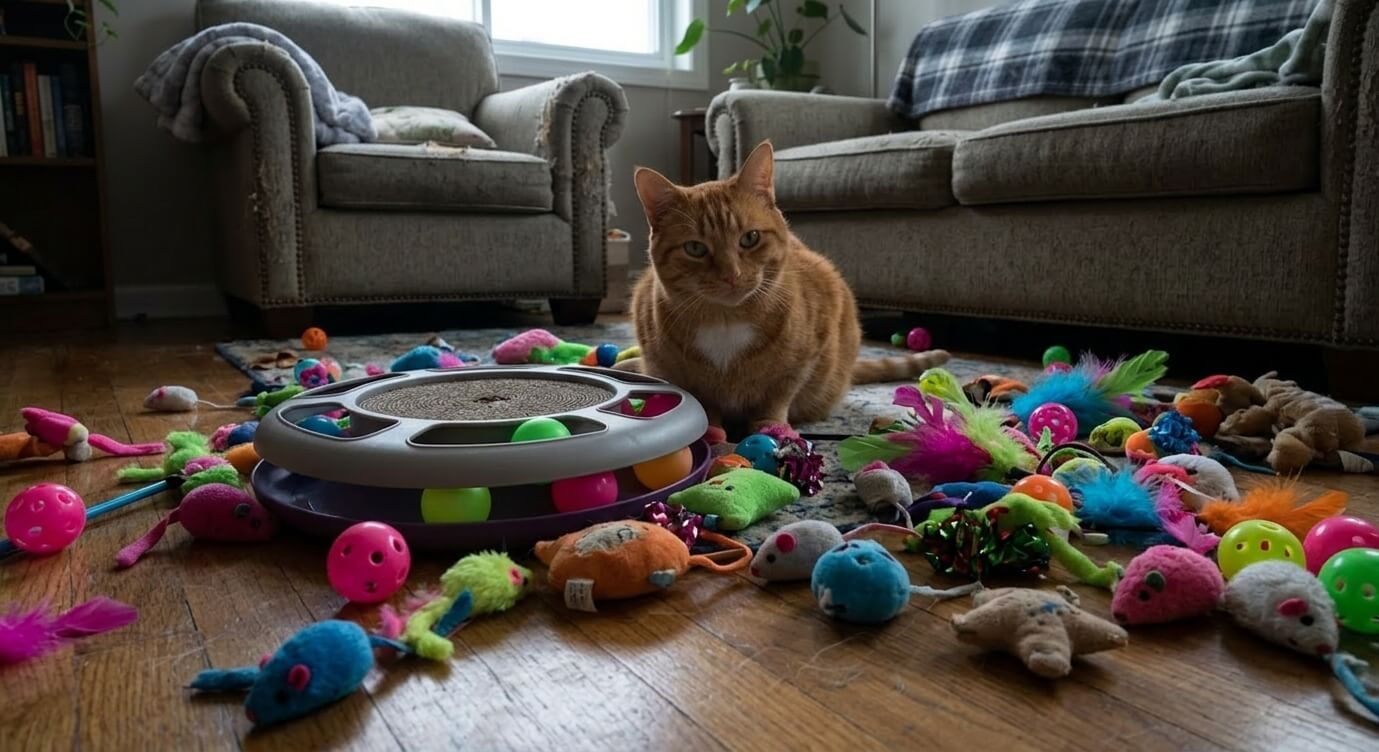
Best cat toys small apartment picks should give your cat satisfying ways to stalk, chase, pounce, kick, or forage without permanently taking over the floor. The smartest options are compact during use, easy to store afterward, or designed to use vertical space instead of adding more clutter.
Our best overall pick is the Cat Dancer Original Cat Toy because it creates active, interactive play but takes up almost no storage space. For independent play, the Catstages Tower of Tracks offers a compact, stable footprint. If your cat loves tunnels, the Frisco 47-Inch Foldable Crinkle Play Tunnel collapses when playtime ends.
Here are our nine picks:
- Cat Dancer Original Cat Toy — best overall
- Catstages Tower of Tracks — best compact solo toy
- Frisco 47-Inch Foldable Crinkle Play Tunnel — best collapsible toy
- Catstages Buggin’ Out Puzzle & Play — best compact food puzzle
- KONG Kickeroo Cuddler — best soft kicker toy
- KONG Connects Angler Door Teaser — best vertical-space toy
- Pet Fit For Life Door Hanging Rope Toy — best rechargeable door toy
- Potaroma Rechargeable Flapping Bird — best motion toy
- Frisco Bee & Flower Interchangeable Teaser Wand — best wand toy
No toy is appropriate for every cat. Strings, elastic cords, feathers, small attachments, and electronic components can become hazards if damaged or swallowed. Inspect toys regularly and supervise any product whose label calls for supervised play.
Best Cat Toys Small Apartment: Quick Answer
If you want to buy only one toy, choose the Cat Dancer Original. It is inexpensive, stores in a drawer or narrow container, and supports interactive chase-and-pounce play.
Our best cat toys small apartment shortlist prioritizes a small storage footprint, useful play value, manageable noise, and parts that owners can inspect easily.
For a toy your cat can bat independently, the Catstages Tower of Tracks uses only about a 10-inch footprint and keeps its balls inside the tracks. For food-motivated cats, the Catstages Buggin’ Out Puzzle & Play is flat enough to store on a shelf while adding a foraging challenge.
Apartment owners should avoid judging a toy only by its packaged size. A tiny robotic toy may need a large clear floor area, while a longer wand may store neatly on a wall hook. Consider both the toy’s active play zone and its storage footprint.rea, while a longer wand may store neatly on a wall hook. Consider both the toy’s active play zone and its storage footprint.
Table of Contents
Comparison Table
| Product | Best for | Space-saving advantage | Supervision |
|---|---|---|---|
| Cat Dancer Original | Interactive chase play | Almost no storage footprint | Yes |
| Catstages Tower of Tracks | Independent batting | Compact vertical design | Follow label; inspect regularly |
| Frisco Foldable Crinkle Tunnel | Running and hiding | Collapses after play | Recommended |
| Catstages Buggin’ Out | Food-motivated cats | Flat puzzle stores easily | Introduce with supervision |
| KONG Kickeroo Cuddler | Wrestling and bunny kicks | Soft and drawer-friendly | Recommended; inspect seams |
| KONG Connects Angler | Door-mounted play | Uses vertical space | Yes |
| Pet Fit For Life Door Hanging Rope Toy | Automated vertical play | Uses a doorway, not floor space | Yes |
| Potaroma Flapping Bird | Motion-responsive play | Small and rechargeable | Yes |
| Frisco Interchangeable Teaser Wand | Owner-led hunting play | Slim storage profile | Yes |
Prices, colors, attachments, and availability can change. Confirm the current product information before purchasing.
How We Chose the Best Space Saving Cat Toys
We evaluated each product using criteria that matter in a small apartment:
- Storage footprint: Can the toy fit in a drawer, basket, closet, or narrow wall holder?
- Play footprint: How much clear floor space does the cat need while using it?
- Vertical use: Does it use a door or upright design instead of occupying more floor?
- Multiple play behaviors: Does it support chasing, batting, kicking, hiding, or foraging?
- Noise: Could the toy disturb neighbors or wake people at night?
- Retrievability: Is it likely to disappear under a sofa or appliance?
- Cleaning: Can hair, food residue, and saliva be removed?
- Replaceable or inspectable parts: Can owners notice damage before a part detaches?
- Supervision requirements: Does it include string, feathers, elastic, batteries, or moving components?
We did not rank toys by the number of electronic features. In a small home, a simple toy that gets used regularly is more valuable than a complicated product that stays in a closet.
1. Cat Dancer Original Cat Toy
Best overall for: Interactive play with almost no storage footprint
The Cat Dancer Original uses springy wire and small cardboard pieces to create irregular movement when a person holds it. It is one of the most minimalist cat toys available: there is no motor, charging cable, large base, or permanent floor setup.
The movement is the main attraction. Small changes in your hand position make the cardboard pieces bounce, pause, and dart in ways that can resemble unpredictable prey.
Why it works in a small apartment
- Stores in a drawer or tall container
- Requires no batteries
- Creates active play in a limited area
- Easy to move from room to room
- Low purchase cost
Limitations
- It is an interactive toy, not an unattended toy.
- The wire and cardboard pieces should be checked for damage.
- Excited cats may jump into furniture if the play route is poorly planned.
- It does not provide a food or puzzle challenge.
Best way to use it
Clear a short path beside a rug or other non-slip surface. Move the toy away from your cat, pause behind a safe obstacle, and let the cat capture it regularly. Avoid making your cat leap toward shelves, televisions, glass, or hard furniture edges.
End the session by slowing the movement and allowing a final catch. Store the toy where your cat cannot chew it without supervision.
Verdict: The best space saving cat toy for owners who can provide short daily interactive sessions.
2. Catstages Tower of Tracks
Best for: Compact independent batting play
The Catstages Tower of Tracks stacks circular ball tracks vertically. Published dimensions are approximately 10 by 10 inches with a height around 5.5 inches, depending on how the dimensions are presented by the retailer.
Its contained balls are useful in apartments because they do not immediately roll under the refrigerator. The vertical layout creates several batting levels without requiring a long track across the room.
Why it works in a small apartment
- Approximately 10-inch floor footprint
- Balls remain in the tracks
- No charging cable
- Nonslip base
- Can be moved onto a shelf when not in use
Limitations
- Plastic balls can be noisy on hard floors.
- Some cats lose interest without toy rotation.
- Hair and debris can collect inside the tracks.
- Determined cats may try to lift or overturn lightweight track toys.
Best way to use it
Place it on a rug or nonslip mat to reduce movement and sound. Rotate it out of the room periodically rather than leaving it available every day.
If your cat paws but cannot comfortably reach the balls, check that the toy is stable and unobstructed. Do not modify the openings or add loose balls that were not designed for the product.
Verdict: A strong compact option for cats that enjoy batting but repeatedly lose loose toys under furniture.
3. Frisco 47-Inch Foldable Crinkle Play Tunnel
Best for: Cats that chase, hide, and ambush
Tunnels provide more than running space. They create a hiding point, a visual barrier, and an ambush route for interactive play. The Frisco 47-inch tunnel includes windows and folds down for storage after use.
A 47-inch tunnel is not small while fully open, but it earns a place on this list because its footprint is temporary. A permanent plastic track of the same length would be far harder to store.
Why it works in a small apartment
- Collapses after play
- Can slide behind furniture or into a closet
- Supports chasing and hiding
- Useful for multi-cat play when cats get along
- Windows allow interactive wand play
Limitations
- Crinkle material may be noisy.
- The open tunnel needs a clear path.
- Internal wires and seams require regular inspection.
- Hanging attachments can be damaged or swallowed.
- Some cats are startled if a lightweight tunnel rolls.
Best way to use it
Open the tunnel for scheduled play, then direct a wand toy past—not into—your cat’s face. Make sure the far exit remains open so the cat never feels trapped.
Fold it only when your cat is completely out. Store it away from chewing pets and inspect the frame ends, fabric, windows, and any hanging toy before the next session.
Verdict: The best collapsible choice when your cat wants a large play experience but you cannot dedicate permanent floor space.
4. Catstages Buggin’ Out Puzzle & Play
Best for: Food-motivated cats and compact foraging enrichment
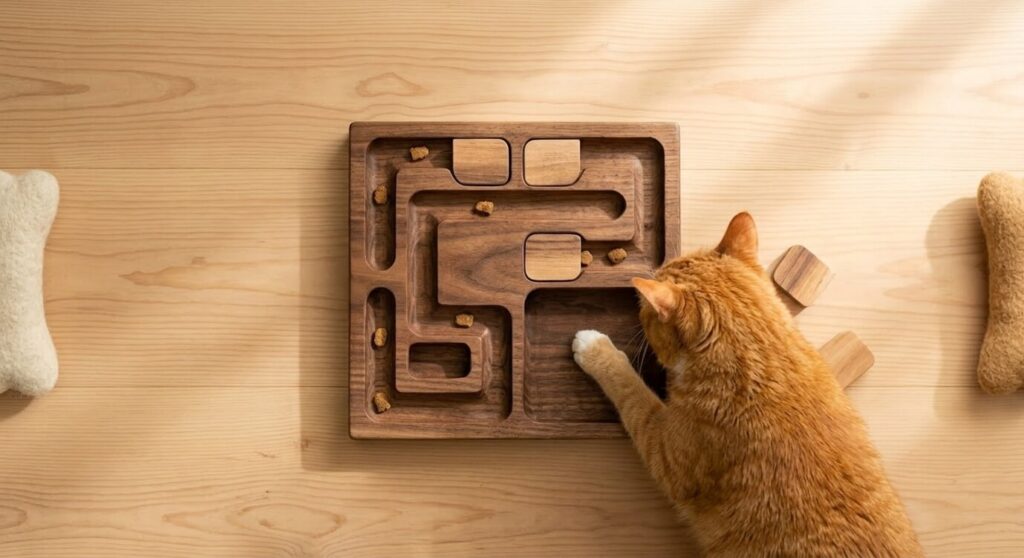
The Catstages Buggin’ Out Puzzle & Play uses cups and sliding covers that a cat moves to reach treats or appropriate dry food. Its flat format is easier to store than a tall feeder or large activity center.
Food puzzles can turn part of a daily food allowance into a structured activity. They are especially useful when an indoor cat eats quickly or needs an alternative to another high-speed chase session.
Why it works in a small apartment
- Flat storage profile
- Food and play combined in one item
- No batteries
- Pieces remain attached to the puzzle
- Can be placed on a nonslip feeding mat
Limitations
- Not designed for every food texture.
- Small food pieces can become trapped around moving parts.
- It needs regular cleaning.
- Some cats need an easier introduction.
- Food used in the puzzle must be included in the cat’s daily intake.
Best way to use it
Start with several compartments uncovered. Let your cat learn that touching the board produces food before adding more difficult sliding steps.
Do not fill every compartment simply to keep the cat busy. Measure the food first and subtract it from the regular meal. Remove old crumbs and wash according to the current product directions.
For more choices and difficulty levels, see our complete guide to the best cat puzzle feeders.
Verdict: The best compact option for adding mental activity to a measured feeding routine.
5. KONG Kickeroo Cuddler
Best for: Wrestling, gripping, and bunny-kicking
Kicker toys are long enough for a cat to grab with the front paws and kick with the hind legs. The KONG Kickeroo Cuddler is a soft toy with a narrow profile that fits easily in a drawer or toy basket.
This type of toy is useful in a small apartment because it channels close-contact wrestling behavior without requiring a running lane. It can also provide an appropriate target for cats that try to grab hands during play.
Why it works in a small apartment
- Soft, narrow shape
- Fits in a drawer or basket
- No batteries or charging cable
- Does not require a large play area
- Supports a different movement pattern from batting toys
Limitations
- Fabric and seams can be damaged by strong kicking.
- Tails, feathers, or trim require inspection.
- Catnip response varies.
- It should be removed if stuffing becomes exposed.
Best way to use it
Move the kicker along the floor and let your cat grab it. Do not push it into the cat’s face or use your hands as the wrestling target.
Inspect the seam after vigorous sessions. Replace the toy if fabric tears, filling emerges, or decorative parts loosen.
Verdict: A drawer-friendly option that adds wrestling play without adding apartment clutter.
6. KONG Connects Angler Door Teaser
Best for: Using vertical doorway space
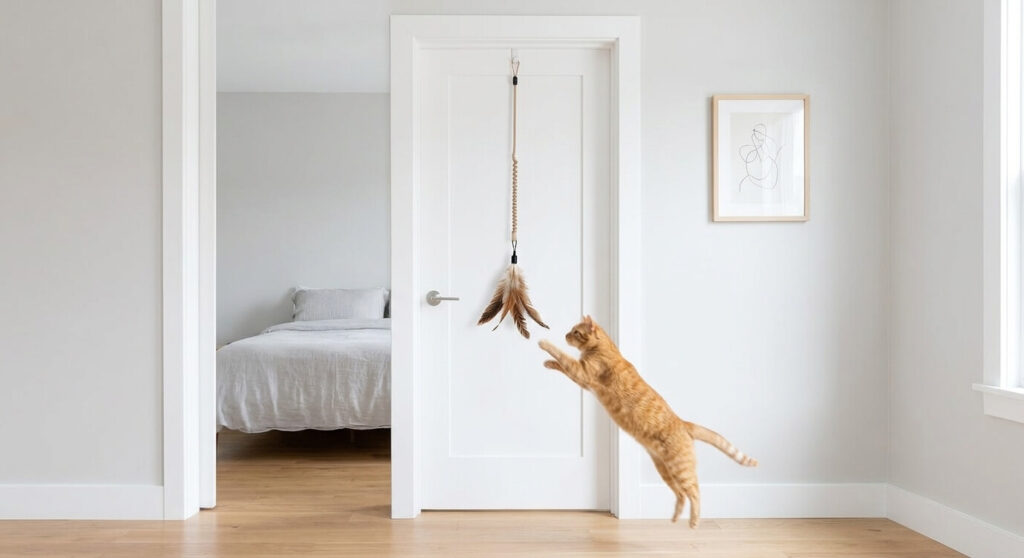
The KONG Connects Angler attaches at a doorway and suspends a teaser for batting. It occupies little or no permanent floor space, making it appealing for renters who cannot mount toys with screws.
The product’s space efficiency does not make it suitable for unlimited unattended use. Hanging cords and teaser attachments can become entanglement or ingestion hazards if damaged.
Why it works for renters
- Uses doorway space
- No large floor base
- Removable
- Easy to rotate out of use
- Encourages reaching and batting
Limitations
- Door shape and clearance affect fit.
- The hanging line requires supervision.
- It may interfere with normal doorway use.
- Strong pulling can loosen the attachment.
- Feathers or fabric parts can wear quickly.
Best way to use it
Install it exactly as directed and test the attachment before introducing your cat. Choose a doorway that is not an emergency route and where nobody will accidentally close a door on the cord.
Remove and store the toy after the session. Check the line, connector, and teaser before every use.
Verdict: A useful no-floor-space toy for supervised sessions in a suitable doorway.
7. Pet Fit For Life Door Hanging Rope Toy
Best for: Rechargeable automated play that uses vertical space
The Pet Fit For Life Door Hanging Rope Toy is a rechargeable system that hangs at a door and moves an attachment vertically. It is designed to occupy doorway space rather than creating another motorized obstacle on the floor.
This can help owners provide variety, but automated movement does not replace observation. A cat can become tangled, chew an attachment, or react fearfully to a moving device.
Why it works in a small apartment
- Uses vertical space
- Rechargeable
- Interchangeable attachments
- Can be removed between sessions
- Does not send a robot under furniture
Limitations
- Cord and attachments require active supervision.
- It needs a compatible door.
- Motor noise may bother sensitive cats or sleeping neighbors.
- Charging performance and attachment durability can vary.
- It should not run when nobody is present.
Best way to use it
Introduce the toy while it is switched off. Let your cat investigate the attachment, then start the slowest suitable setting while you remain nearby.
Stop the session if your cat bites and holds the cord, becomes tangled, or repeatedly pulls the unit away from the door. Remove the product after play.
Verdict: A compact automated option for owners who will remain present and monitor the moving cord.
8. Potaroma Rechargeable Flapping Bird
Best for: Cats attracted to movement and soft prey-shaped toys
The Potaroma Rechargeable Flapping Bird is a small motion toy that responds with flapping movement. It takes up little storage space and does not need a wide track or large play mat.
Electronic toys add inspection requirements that simple kickers do not. The battery compartment, charging port, seams, wings, and any catnip or silvervine pouch must remain secure.
Why it works in a small apartment
- Small storage footprint
- Rechargeable
- Combines movement with a soft toy shape
- Easy to rotate with other toys
- Does not require permanent installation
Limitations
- Electronic components require careful inspection.
- Moving wings may be damaged by strong biting.
- Motor noise can be noticeable.
- It should not be left available after damage.
- Cats should not access it while charging.
Best way to use it
Charge it in a location your cat cannot access. Disconnect and close the charging area completely before play.
Use it on an open section of floor away from stairs, water bowls, fragile objects, and furniture gaps. Supervise the session and remove the toy if fabric or electronic parts become exposed.
Verdict: A compact motion toy for supervised rotation—not a toy to leave running while you are away.
9. Frisco Bee & Flower Interchangeable Teaser Wand
Best for: Owner-led hunting play
A teaser wand is one of the most versatile apartment toys because the same product can support stalking, short sprints, jumping, and pouncing. The Frisco Bee & Flower wand includes interchangeable attachments and has a narrow storage profile.
The play zone depends on how you move it. In a studio apartment, low movements around a rug, tunnel, or cardboard box can create a complete hunting sequence without encouraging dangerous high jumps.
Why it works in a small apartment
- Slim storage profile
- Replaceable play variety through attachments
- Owner controls speed and direction
- Works with boxes and tunnels already in the home
- No permanent floor footprint
Limitations
- String, feathers, and attachments require supervision.
- It needs safe storage after use.
- High, repetitive jumping may not suit every cat.
- Damaged clips or attachments must be replaced.
Best way to use it
Move the toy like prey: away from the cat, behind safe cover, and with pauses. Let your cat catch it frequently.
Avoid spinning your cat in tight circles or directing jumps onto slippery flooring. Put the entire wand—not only the attachment—in a closed closet or container after play.
Verdict: The best option for controlled daily hunting play when storage space is limited.
How to Choose the Right Toy for Your Apartment
For a studio apartment
Start with three complementary toys:
- Cat Dancer Original for interactive play
- Catstages Tower of Tracks for compact solo batting
- KONG Kickeroo Cuddler for quiet wrestling
Together, they support several play behaviors without requiring a permanent tunnel or large electronic track.
For a cat that eats too quickly
Choose the Catstages Buggin’ Out or another appropriately challenging food puzzle. Measure the food and introduce the easiest configuration first.
For a high-energy cat
Use a wand or Cat Dancer for owner-led movement, then finish with a kicker or food puzzle. A product does not need to be large to create an effective sequence.
For a complete plan beyond toys, see our indoor cat enrichment ideas for small apartments.
For a cat that plays at night
Choose quieter soft toys during sleeping hours and put noisy ball tracks, crinkle tunnels, and motorized toys away.
For multiple cats
Avoid forcing cats to share one high-value toy. Use several play stations and watch for blocking, staring, chasing, or guarding.
If one cat repeatedly controls toys, food, or preferred areas, our guide to multi-cat resource guarding solutions can help you reorganize access.
For renters who cannot drill
Prioritize removable toys, but remember that suction cups, door attachments, and adhesives are not automatically damage-free. Follow installation directions and test a suitable area.
The Small-Apartment Toy Rule
Do not ask, “How many toys can I fit?”
Ask:
- Which play behavior does this toy support?
- Where will it be used safely?
- Where will it be stored?
- Does it require supervision?
- What existing toy will it replace?
One wand, one kicker, one compact solo toy, and one rotating puzzle can be more useful than a basket of similar mice.
A Simple Toy-Rotation System
Keep only three or four toys available
Choose different functions rather than different colors:
- One batting or solo toy
- One soft kicker
- One food puzzle
- One interactive toy used with you
Store the rest securely
Use a closed container for:
- Wand toys
- Strings and elastic toys
- Feather attachments
- Electronic toys
- Small loose toys
- Catnip products
Do not use an open basket for toys your cat should not access unsupervised.
Rotate by behavior
Swap a tunnel for a cardboard-box setup. Replace the track toy with a food puzzle. Change the wand attachment rather than buying an entirely new wand.
Retire damaged toys
Do not keep a damaged favorite “for one more session.” Remove toys with:
- Loose string
- Exposed wire
- Torn seams
- Visible stuffing
- Cracked plastic
- Loose bells, eyes, or attachments
- Damaged battery compartments
- Frayed feathers that are detaching
How to Prevent Toy Clutter
Assign every toy a storage location
- Wands: closed closet hook or tall lidded container
- Kickers: drawer or closed basket
- Puzzle feeders: kitchen shelf after cleaning
- Collapsible tunnels: behind a door or inside a closet
- Electronic toys: dry drawer away from water
Use furniture space carefully
Do not create inaccessible piles under beds and sofas. Small loose toys can collect dust, disappear, or become difficult to inspect.
If your cat needs more climbing space, choose stable vertical furniture instead of stacking household objects. Our guide to cat furniture for small apartments compares space-conscious options.
Use one-in, one-out
When you buy a new toy, inspect the current collection and remove one that is damaged, unused, or redundant.
Small-Apartment Toy Safety Checklist
Before play:
- Clear breakable objects.
- Close unsafe windows and balcony doors.
- Check strings, seams, clips, feathers, and batteries.
- Put away plastic packaging and twist ties.
- Confirm that the floor is not slippery.
- Separate cats if they compete over toys.
During play:
- Prevent chewing or swallowing strings.
- Avoid directing jumps toward furniture edges.
- Stop if your cat begins panting, limping, or moving abnormally.
- Let your cat catch the toy regularly.
- Watch automated and hanging toys continuously.
After play:
- Count removable attachments.
- Store string and feather toys securely.
- Turn electronic toys off.
- Keep charging cables inaccessible.
- Clean food puzzles.
- Pick up small toys before using a vacuum or moving furniture.
Frequently Asked Questions
What is the best space saving cat toy?
The Cat Dancer Original is our best overall choice because it creates active interactive play while requiring almost no storage space. The best independent option is the compact Catstages Tower of Tracks.
What are the best cat toys for a small apartment?
Choose toys with different functions: a wand or Cat Dancer, a soft kicker, a compact track toy, and a food puzzle. Add a collapsible tunnel when you can store it after play.
What is the best cat toy for renters?
A removable toy that requires no drilling is usually easiest. Cat Dancer, compact track toys, kickers, puzzles, and collapsible tunnels are renter-friendly when used and stored correctly.
What is the best minimalist cat toy?
Cat Dancer is the most minimalist option on this list. A simple supervised wand and a cardboard box can also create varied play without adding permanent clutter.
How many cat toys should be out at once?
There is no universal number. Three or four toys with different functions are often easier to manage than a large pile. Rotate toys rather than leaving everything out.
Are automatic cat toys good for small apartments?
They can add variety, but check the active play area, motor noise, battery security, and supervision requirements. Small product dimensions do not always mean a small play zone.
For more options, compare our interactive cat toys for solo play.
Are laser pointers good cat toys?
Laser play can encourage chasing, but the cat cannot physically catch the light. Never point a laser at eyes, reflective surfaces, traffic, windows, or balconies. If you use one, keep the session brief and end with a catchable physical toy or food reward.
Can I leave wand toys out?
No. Store wands, strings, elastic cords, ribbons, and feather attachments where your cat cannot access them without supervision.
Are window-mounted toys safe?
Check the suction attachment before every use and never treat a suction-mounted toy as window fall protection. Keep the window securely closed and remove the toy if your cat can chew loose components.
How do I stop toys from going under the sofa?
Use contained track toys, larger soft toys, or furniture-gap blockers. Count small toys regularly and retrieve them before they accumulate dust or become damaged.
Why does my cat ignore new toys?
The toy may not match the cat’s preferred play style, or it may have been introduced too quickly. Try movement that resembles prey, offer short sessions, and rotate the toy out before reintroducing it.
Does my cat need more toys or more playtime?
Often, a cat benefits more from consistent interactive play than from another object. Use the toys you already own in short, predictable sessions and observe which movements hold your cat’s attention.
Final Thoughts
The Cat Dancer Original is the best space saving cat toy for most apartment owners because it offers active play and stores almost anywhere. The Catstages Tower of Tracks is the strongest compact solo option, while the Frisco Foldable Crinkle Tunnel provides a larger play experience that disappears into storage afterward.
Choose the Catstages Buggin’ Out for food-based enrichment, the KONG Kickeroo Cuddler for wrestling, or one of the removable door toys when floor space is extremely limited. The Potaroma Flapping Bird adds compact electronic motion, while the Frisco Interchangeable Teaser Wand gives owners the most control over a safe play route.
The goal is not to fill the apartment with toys. Build a small collection that covers chasing, batting, kicking, hiding, and foraging; rotate it; inspect it; and store supervised toys securely.
References
- Chewy. “Cat Dancer Original Cat Toy.” Product design and intended interactive use.
- Chewy. “Catstages Tower of Tracks Interactive Cat Toy.” Track design, product features, and dimensions.
- Chewy. “Best Cat Tunnels.” Current Frisco foldable tunnel listings and product availability.
- Chewy. “Catstages Buggin’ Out Interactive Enrichment Puzzle & Slow Feeder.” Puzzle layout, feeding use, and product information.
- Chewy. “Pet Fit For Life Door Hanging Rope Toy.” Rechargeable door-mounted design and interchangeable attachments.
- Chewy. “Potaroma Rechargeable Flapping Bird.” Rechargeable motion-toy design and current listing.
- Chewy. “KONG Kickeroo Cuddler.” Kicker design, materials, catnip, and published product length.
- Chewy. “KONG Connects Angler Door Teaser.” Door-mounted teaser design and product information.
- Chewy. “Frisco Bee & Flower Interchangeable Teaser Wand.” Interchangeable attachments and current product listing.