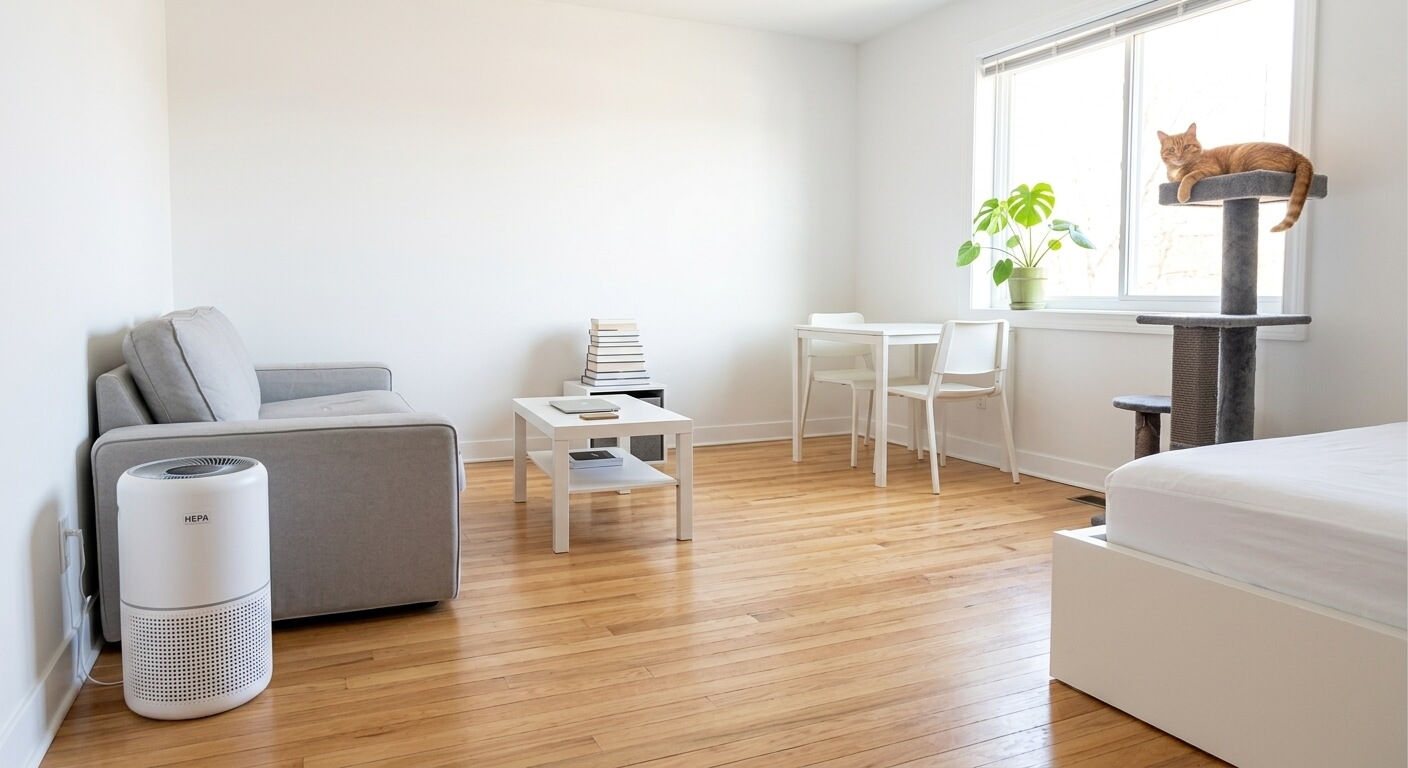
Living with cat allergies in a small apartment takes more than removing visible fur. Airborne particles, bedding, upholstery and daily contact all matter. Some people can manage exposure alongside medical treatment, but no cleaning routine or product guarantees that living with a cat will be safe or comfortable for everyone.
This guide keeps the focus on a workable apartment routine: protect the sleeping area, choose appropriate filtration, clean washable surfaces, and understand the limits of grooming and allergen-reducing food. It is an editorial guide based on the sources below, not a report of personal clinical practice or product testing.
Quick Answer: Can You Live with a Cat if You Have Allergies in a Small Space?
Possibly, but the decision depends on your symptoms and medical assessment. Use several measures together rather than expecting a purifier, a special food or a particular cat breed to solve the problem. If you have asthma, recurring wheeze or symptoms that disturb sleep, discuss continued exposure with an allergist before investing in more products.
Important Human Health Note
This article is general education, not individual medical advice. Severe or rapidly worsening breathing difficulty needs emergency medical help; do not wait for cleaning or an air purifier to work. Follow your prescribed asthma action plan. New or recurrent wheezing, chest tightness or shortness of breath warrants prompt medical assessment.
How Cat Allergens Spread
Fel d 1 is a major cat allergen, but it is not the only one. Allergenic proteins occur in saliva and skin secretions and are carried on hair and dander. Removing shed hair is useful housekeeping; a room that looks hair-free is not necessarily allergen-free.
Particles can settle on fabrics and surfaces, become airborne again during activity, and travel on clothing. This explains why exposure can occur without touching the cat. The Asthma and Allergy Foundation of America (AAFA) describes both airborne exposure and persistent surface reservoirs.
Do not choose a cat on the assumption that coat length, color or a “hypoallergenic” label predicts safety. Individual reactions differ, and no cat breed is guaranteed not to trigger allergy. Testing and your clinical history are more useful than a breed ranking.
Planning for a Small Apartment
A studio often combines sleeping, sitting and cat activity in one room. That makes separation harder, but floor area alone cannot tell you the allergen concentration. Ventilation, furnishings, cleaning, cat access and individual sensitivity all affect the situation. A small flat is not automatically a fixed multiple more allergenic than a larger home.
| Your layout | Practical starting point | Important limitation |
|---|---|---|
| Separate bedroom | Keep the door closed and keep the cat, its bedding and grooming equipment outside. | Allergens can still arrive on clothing or move through the home. |
| Open-plan studio | Keep the cat off bedding, use washable covers and place its resting area away from the pillow area. | A curtain or divider is not a sealed air barrier and does not create an allergen-free bedroom. |
| Rented flat with carpet | Focus on regular HEPA vacuuming and washable covers; discuss larger changes with the landlord. | Cleaning reduces reservoirs but does not guarantee symptom control. |
| No non-allergic helper | Discuss a realistic cleaning and grooming plan with your clinician; consider help for tasks that reliably provoke symptoms. | Protective equipment is not permission to continue a task that makes breathing difficult. |
These are practical planning suggestions, not a tested treatment protocol for every apartment. Record which tasks or locations precede symptoms and bring that information to your appointment.
7 Practical Tips for Living with Cat Allergies in a Small Apartment
Tip #1: Create a Cat-Free Sleep Zone
Start with the place where you sleep. If there is a bedroom, keep it consistently cat-free rather than only excluding the cat at bedtime. Provide an appealing alternative resting place elsewhere. The American College of Allergy, Asthma & Immunology (ACAAI) recommends bedroom exclusion as one exposure-reduction measure, while warning that restricting a cat to one room does not keep all allergens there.
- Keep clean pillowcases and bedding away from cat resting places.
- Wash hands after contact and avoid transferring cat-covered clothing onto the bed.
- Use washable bed covers and clean them regularly.
- In a studio, distinguish “keeping the cat off the bed” from creating a genuinely separate room.
If adequate separation is impossible and symptoms remain troublesome, tell your clinician. Do not interpret the lack of a spare room as a problem that one additional gadget must be able to solve.
Tip #2: Use True HEPA Filtration
A portable HEPA cleaner can help with airborne particles, but it does not remove the reservoir already on the sofa or bedding. Choose by clean-air delivery and the space being treated, not a “medical-grade” slogan alone. Filter efficiency and the amount of clean air delivered by the whole machine are different measurements.
- Room size and CADR: match the unit to the connected space and ceiling height. Check the air-change assumptions behind advertised room coverage.
- Usable fan speed: a high maximum rating is less useful if noise makes you switch the unit off. Compare performance at settings you can tolerate.
- Placement: keep air inlets and outlets clear and follow the manufacturer’s clearance instructions.
- Maintenance: check replacement-filter cost and availability. Wash only parts explicitly marked washable.
- Safety: avoid devices designed to generate ozone. A filter or fragrance does not make ozone exposure safe.
The EPA’s residential air-cleaner guidance treats filtration as a supplement to source control and suitable ventilation, not a way to remove every pollutant. If upgrading an HVAC filter, check which filter the system can accommodate rather than installing a more restrictive one blindly.
For actual models and specification comparisons, use our air purifier buying guide. This article does not claim that those products were tested by us for human allergy relief.
Tip #3: Discuss Allergen-Reducing Food Realistically
Some foods, including Purina Pro Plan LiveClear, use an egg-derived antibody ingredient that targets Fel d 1. This approach concerns allergen activity; it does not stop a cat producing all allergens or make the cat hypoallergenic.
In Satyaraj and colleagues’ 2019 feeding study, 105 cats completed a two-week baseline period followed by ten weeks on the test diet. The reported average reduction in active Fel d 1 on collected hair was 47% by the end of the study. This was a hair-sample endpoint, not a finding that people’s symptoms improved by 47%. The study was funded by Nestlé Purina Research, and all authors were its employees.
Discuss a diet change with your veterinarian, especially if your cat needs a therapeutic diet or has food-related problems. Do not replace a medically necessary diet just to try to reduce human exposure. Follow the appropriate product feeding directions and keep the person’s medical plan separate from the cat’s nutrition plan.
A useful question is: “What was actually measured—active allergen on hair, allergen in the room, or symptoms in people?” Evidence for one endpoint should not be presented as proof of all three. No claim here guarantees benefit or absence of adverse effects for an individual cat or person.
Tip #4: Brush Strategically
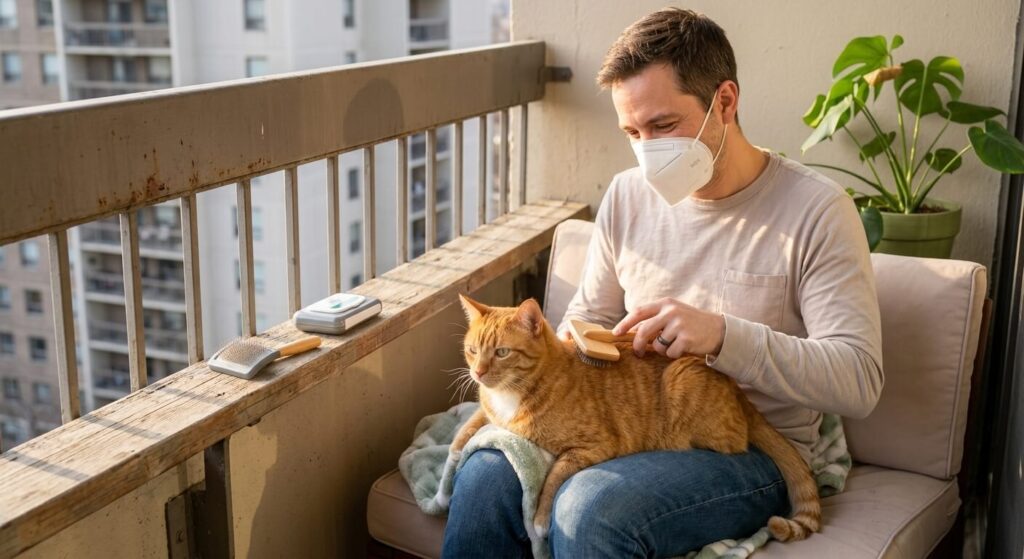
If possible, ask a non-allergic person to groom the cat away from the sleeping area. Grooming can disturb particles, so the goal is a manageable coat-care routine, not aggressive daily deshedding as an allergy treatment.
Use a safe, enclosed location. Do not take an indoor cat onto an unsecured balcony or outdoors solely to reduce exposure. If you must do the grooming yourself, discuss protection and alternatives with your clinician; stop if symptoms develop.
Choose frequency and tools for the coat and the cat’s tolerance. Our small-apartment shedding guide and cat brush comparison cover coat care. Less loose hair does not establish a measured reduction in human allergy symptoms.
Do not assume wipes or sprays reduce allergens by a particular percentage without evidence for that exact product and use. Use only cat-appropriate products as directed; never apply household cleaners or disinfectants to the coat.
Tip #5: Clean Floors and Hard Surfaces Often
Use a repeatable cleaning routine that you can sustain. Damp wiping and suitable vacuuming help collect settled material; do not equate a floor that smells disinfected with reduced allergen exposure. Routine cleaning does not require a promise to chemically “neutralize” Fel d 1.
- Clean visible spills and litter debris when they occur.
- Use a HEPA-filter vacuum for rugs and upholstery, following its instructions and maintaining the seals and filters.
- Wipe hard surfaces with a damp cloth rather than brushing dust into the air.
- Choose a cleaner compatible with the surface and follow dilution, rinsing and pet-access directions. Never mix cleaning products.
Use our cat-safe floor cleaner guide for product-use considerations, not as evidence that a cleaner treats human allergy. Strong scents can also be unwelcome in a respiratory-sensitive household. If cleaning provokes symptoms, arrange help where possible.
Tip #6: Reduce Soft Surfaces
Prioritize items near the sleeping area or where the cat regularly rests. Washable covers are often more practical than replacing all the furniture. Do not remove every comfortable cat resting place; provide alternatives that are easy to clean.
- Start with a washable cover on a frequently used sofa or chair.
- Reduce spare throws and decorative cushions that rarely get washed.
- Choose washable rugs or window coverings when replacements are actually needed.
- Keep clean clothing in closed storage and used cat blankets away from bedding.
Our minimalist cat owner guide can help with layout. The aim is fewer difficult-to-clean reservoirs, not an unsupported rating that one fabric makes a home safe for every allergic person.
Tip #7: Work With an Allergist
Ask whether the cat is the relevant trigger, whether other exposures also matter, and whether asthma needs assessment. A clinician interprets testing alongside your history; a positive test alone does not tell you how well you will tolerate a particular apartment.
Treatment may include appropriate medicines and, for some people, allergen immunotherapy. Discuss suitability, risks, expected benefit and follow-up. Do not self-prescribe a treatment schedule or assume that drops, tablets and injections are interchangeable options for cat allergy in your country.
Bring a brief symptom record: when symptoms occur, whether sleep or breathing is affected, medicines used, and which tasks seem to trigger a reaction. Environmental changes should support the medical plan, not postpone it. Reducing exposure further, including reconsidering cohabitation, may be necessary if symptoms cannot be controlled.
Laundry: Removing Material Without Making Unsupported Promises
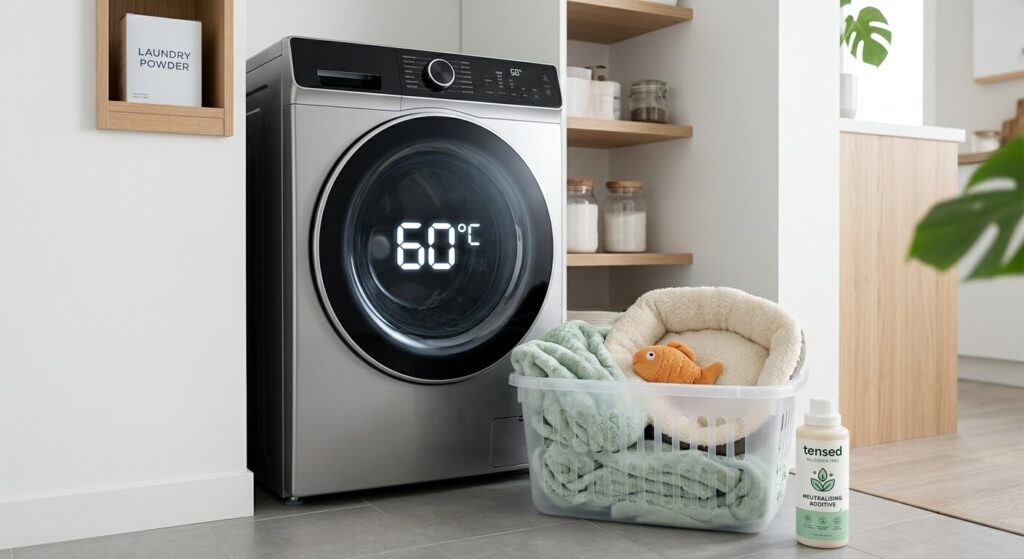
Wash bedding and washable furniture covers regularly. AAAAI’s pet-allergy guidance recommends hot-water bedding washing. Follow the textile and machine care instructions; do not interpret this as proof that every item must reach 60°C or that cooler washing removes nothing.
- Keep used covers contained until washing; avoid shaking dusty bedding around the room.
- Use detergent as directed and a suitable wash cycle. A specialized allergen additive is not automatically necessary.
- Dry thoroughly according to the fabric label.
- Return clean bedding to a protected place rather than the cat’s favorite chair.
Removing material in a wash is different from proving that all allergenic proteins were destroyed. A laundry routine is one part of exposure control, not a guarantee of symptom relief.
What Each Measure Can and Cannot Do
| Measure | What it addresses | What it does not prove |
|---|---|---|
| Cat-free sleeping area | Limits direct access to bedding and sleeping space. | That the room contains no allergens. |
| Appropriately sized HEPA cleaner | Airborne particles passing through the unit. | That settled reservoirs are gone or symptoms will resolve. |
| Cleaning and washable covers | Accumulated material on surfaces and fabrics. | A universal safe exposure level. |
| Anti-Fel d 1 diet | Active Fel d 1 on hair in a feeding study. | Equivalent percentage improvement in a person’s symptoms. |
| Medical assessment and treatment | Individual diagnosis, symptom control and risk management. | That continued exposure is safe for everyone. |
Frequently Asked Questions
What Is the Best Air Purifier for Cat Allergies?
There is no single best model for every studio. Compare CADR, connected room size, tolerable noise, filter replacement costs and ozone-related features. Treat it as a particle-control tool, not a treatment prescription. Our current purifier comparison contains the model-specific information; keeping that list in one guide avoids conflicting recommendations here.
Can I Live with a Cat if I Have Asthma?
This requires individual medical advice. Do not rely on a purifier, cleaning or cat food to protect against asthma attacks. Discuss exposure with your clinician and follow your action plan. Seek emergency help for severe breathing difficulty.
Are Hypoallergenic Cats Real?
No breed can guarantee an allergy-free home. Different cats and people vary, but a short coat or a breed label is not a reliable substitute for clinical advice.
Can I Become Immune to My Cat’s Allergies Over Time?
Do not use repeated exposure as a self-directed desensitization plan. A change in symptoms does not establish immunity. Discuss professionally supervised treatment with an allergist rather than trying to endure reactions.
Does Frequent Bathing Help with Cat Allergies?
Bathing can reduce airborne cat allergen, but it does not eliminate the source or guarantee symptom improvement. Ask your veterinarian whether bathing is appropriate for your cat and use a cat-specific product as directed. Do not force frequent baths on a distressed cat or rely on a universal percentage reduction. A non-allergic helper is preferable when available.
Final Thoughts: Where to Start
First address medical risk. Then make the sleeping area easier to protect, set up sustainable cleaning and laundry, and choose filtration for the actual room. Discuss optional dietary or grooming changes without treating them as cures.
Reassess with your clinician if symptoms persist. Success is not a hair-free photograph, a particular filter label or a research percentage; it is a living arrangement that is medically appropriate for the person and manageable for the cat.
References
- ACAAI: Pet Allergies — exposure management and medical assessment.
- AAFA: Pet Allergy — reservoirs, cleaning and the limits of allergen-reducing food.
- AAAAI: The Truth About Pet Allergies — practical household measures.
- US EPA: Air Cleaners and Air Filters in the Home — filtration selection and limitations.
- Satyaraj et al. (2019): Reduction of active Fel d1 from cats using an antiFel d1 egg IgY antibody, Immunity, Inflammation and Disease, 7, 68–73. doi:10.1002/iid3.244. Manufacturer-funded hair-allergen study, not a human symptom trial.
Sources and wording reviewed October 4, 2026. No personal clinical credentials, laboratory testing by this site or individual treatment outcomes are claimed.