I used to wear exclusively black scrubs to work.
Past tense. Deliberately past tense.
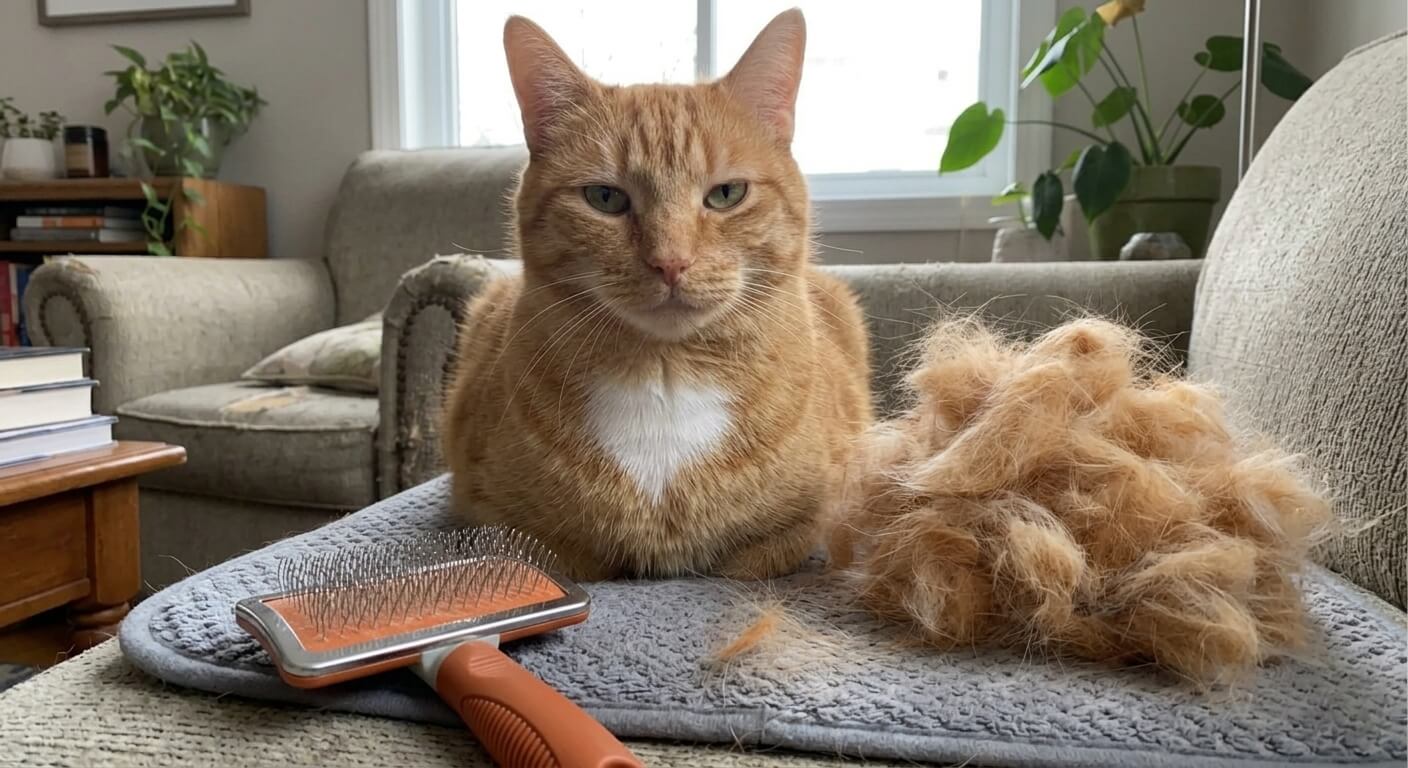
The transition away from black happened gradually, over approximately three weeks after Oliver came home, as I began arriving at the veterinary clinic looking less like a professional and more like I’d been partially consumed by an orange Tribble. Oliver shed with an enthusiasm that I can only describe as generosity—distributing himself evenly across every dark surface in my apartment, including, primarily, me.
The moment that genuinely changed my approach wasn’t the embarrassment. It was a clinical encounter at work: a long-haired Persian came in with what the owner described as “rough patches” on the skin, which turned out to be slicker burn—repetitive microabrasion from the wrong brush applied with too much pressure over months. The underlying skin was raw, the coat was matted at the base, and the cat needed sedation to safely groom the affected areas.
As a vet tech, I’d seen this before, but seeing it again reminded me that finding the best cat brushes for indoor cats is genuinely a medical question, not just a grooming preference. The wrong tool, used incorrectly, does real harm. The right tool, used correctly, does real good.
This guide is the one I wish existed when I started Oliver’s grooming routine from scratch.
Quick Answer: What Is the Best Brush for Your Cat?
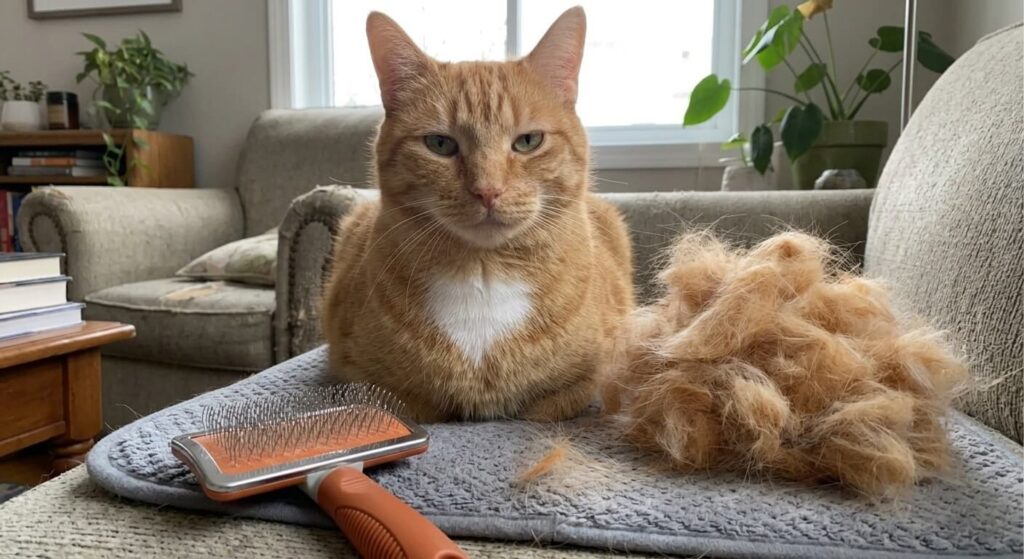
The best cat brushes for indoor cats depend entirely on coat type: a BPA-free rubber curry comb is ideal for short-haired cats to stimulate circulation and capture shed fur, while a long-toothed slicker brush or undercoat rake is necessary for long-haired and double-coated breeds. Always prioritize rounded-tip bristles to prevent slicker burn and skin irritation.
Why Brushing Is More Than Just Aesthetics (The Health Connection)
The single most common response I get when I recommend regular brushing in a clinical context is: “He’s a cat—he grooms himself.”
True. Cats are dedicated self-groomers. They are also remarkably efficient at ingesting the loose fur they remove in the process, which accumulates in the gastrointestinal tract and exits as hairballs—or, in more concerning cases, doesn’t exit at all.
Daily brushing is the single most effective preventive measure for the chronic hairball vomiting issues we see so frequently in indoor cats, and it works by intercepting loose fur before it’s ingested rather than trying to manage it after the fact. [How to Control Cat Hair in a Small Apartment (A Clean-Freak’s Guide)]
The Hidden Health Benefits of Regular Brushing
Skin and coat health beyond hairball prevention:
- Sebum distribution: Brushing distributes the natural skin oils (sebum) from the base of the coat to the tips, which maintains coat luster and waterproofing function
- Circulation stimulation: The mechanical action of brushing increases local blood flow to the skin, supporting follicular health and skin barrier function
- Early lesion detection: Regular brushing is the most reliable way to find lumps, skin changes, parasites, and wounds under the coat before they become significant
- Matting prevention: Mats don’t form overnight—they develop in stages. Regular brushing interrupts the matting process before it reaches the point where grooming requires sedation
What we see clinically when brushing is neglected:
- Mats that pull the skin (causing chronic pain and pressure sores)
- Seborrheic skin changes from disrupted oil distribution
- Undetected abscesses or wounds hidden under coat
- Chronic hairball vomiting requiring medication or intervention
- Flea infestations discovered only when severe
The best cat brushes for indoor cats are, in the most literal sense, preventive medical tools.
Understanding Coat Types: Short, Long, and Double-Coated
Before I recommend a specific brush, you need to correctly categorize your cat’s coat. The same brush that works beautifully on a British Shorthair will be useless—or harmful—on a Maine Coon.
Short Single Coat (Siamese, Cornish Rex, Devon Rex)
Characteristics:
- One coat layer (no undercoat)
- Lies close to the body
- Minimal shedding compared to double-coated breeds
- Skin is more directly accessible
What this coat needs:
- Rubber or silicone grooming tools that grab loose fur and stimulate circulation
- Gentle bristle brushes that smooth and distribute oils
- Shorter, less frequent grooming sessions
What to avoid:
- Stiff slicker brushes (too aggressive for thin coats)
- Undercoat rakes (no undercoat to reach)
- Metal-pin brushes without cushioning (can scratch the skin directly)
Short Double Coat (American Shorthair, British Shorthair, Oliver’s coat type)
Characteristics:
- Dense top coat with a softer undercoat beneath
- Moderate to heavy shedding, especially seasonally
- More bulk means more hidden shed fur
What this coat needs:
- Combination approach: rubber tool for circulation and top layer, then stainless steel pins tool for undercoat
- More frequent grooming during shedding seasons (spring, fall)
What to avoid:
- Grooming only the top coat and missing the undercoat (leaves dead fur accumulating)
- Excessive pressure with metal tools
Long Single Coat (Turkish Angora, Balinese)
Characteristics:
- Long top coat without a dense undercoat
- Flowing, silky texture
- Tangles rather than mats in most cases
What this coat needs:
- Wide-spaced stainless steel pins brush for detangling
- Regular light maintenance to prevent tangle progression
Long Double Coat (Maine Coon, Norwegian Forest Cat, Ragdoll, Persian)
Characteristics:
- The highest maintenance coat category
- Dense, often cottony undercoat beneath a long top coat
- Mats form quickly without regular maintenance
- Seasonal undercoat “blowouts” can be dramatic
What this coat needs:
- Undercoat rake for deep penetration
- Detangling spray for knots
- Consistent daily grooming protocol
- Professional grooming every 6-8 weeks in severe cases
Top 5 Recommendations: Best Cat Brushes for Indoor Cats (2025)
🥇 The All-Rounder Slicker: Hertzko Self-Cleaning Slicker Brush
Price: $14 – $18
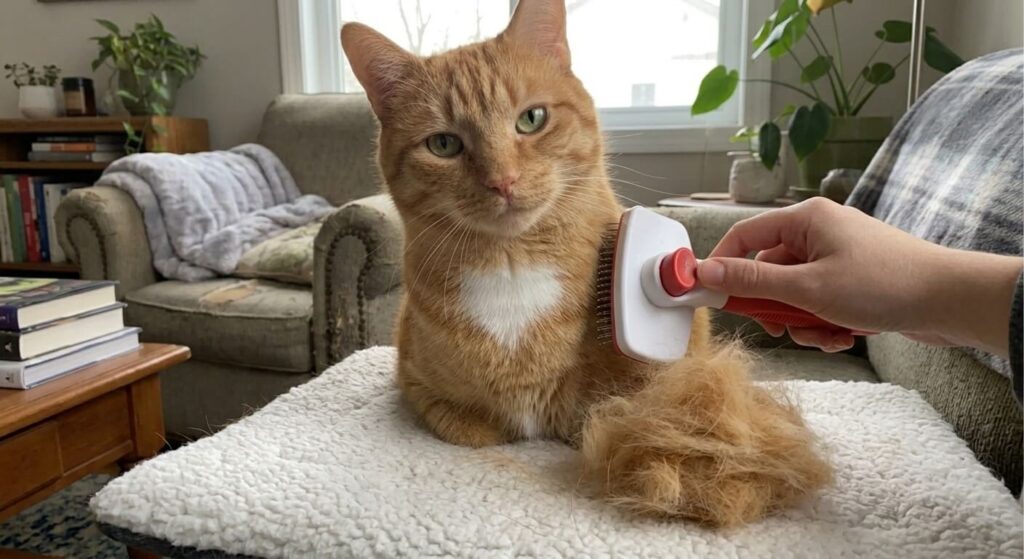
The Hertzko Self-Cleaning Slicker is the brush I recommend most frequently when someone asks about the best cat brushes for indoor cats without specifying a coat type—because it genuinely performs well across short and medium coats with appropriate technique.
Technical specifications:
- Bristle material: Fine stainless steel pins with bent tips
- Pin length: Approximately 0.5 inches (appropriate for short to medium coats)
- Cushion base: Flexible rubber pad that moves with the cat’s body contours
- Self-cleaning mechanism: Retractable bristles via button press
- Handle: Ergonomic non-slip grip
The bent pin design is the safety feature that distinguishes this brush from cheaper slicker alternatives. Straight stainless steel pins contact the skin at 90 degrees—increasing scratch risk. Bent pins contact at an angle, distributing pressure across a wider area and reducing the point pressure that causes slicker burn.
The self-cleaning mechanism earns its price premium in daily convenience: press the button, the pins retract, the collected fur releases cleanly. No picking fur from pin tips after every session.
For Oliver specifically:
Oliver has a short double coat that sheds aggressively. The Hertzko reaches the undercoat better than a rubber tool, captures shed fur more efficiently than a basic bristle brush, and the flexible cushion base follows his body contours without me needing to adjust pressure constantly.
Pros:
- Bent-tip stainless steel pins reduce slicker burn risk significantly
- Self-cleaning mechanism simplifies post-grooming cleanup
- Flexible cushion base follows body contours
- Works on short and medium double coats
- Ergonomic handle reduces user fatigue
Cons:
- Not appropriate for long-haired breeds (pin length insufficient)
- Requires careful pressure monitoring for very short single coats
- Bristles can still cause irritation if excessive pressure is applied
- Some cats are initially anxious about the metal pins
Best for: Short and medium double-coated cats, everyday maintenance grooming, owners who want one effective brush for a non-specialized coat
🖐️ The Gentle Rubber Groomer: Kong ZoomGroom
Price: $8 – $12
For cats who resist brushing, cats with short single coats, and as a first-introduction grooming tool for cats new to the process, the Kong ZoomGroom is the brush I recommend without reservation.
Technical specifications:
- Material: BPA-free rubber (100% natural rubber)
- Bristle type: Flexible rubber nibs (no metal components)
- Shape: Handheld cup design fits palm naturally
- Cleaning: Rinse under water; fur releases easily from rubber
Why rubber changes the grooming dynamic:
A rubber grooming tool doesn’t feel like a brush to most cats—it feels like a hand petting them with slightly more texture. The rubber nibs provide the same circulation stimulation and shed fur capture as a bristle brush without the sensory anxiety that metal pins create in grooming-averse cats.
For cats who initially fight brushing, using a BPA-free rubber tool as the introduction point—then gradually introducing more specialized tools once grooming acceptance is established—is a behavioral protocol that works consistently in practice.
For cats like Oliver, who initially hated any grooming tool near his belly and flanks, using specific desensitization techniques before introducing higher-stimulation brushes made the difference between a grooming session and a bloodletting. [Indoor Cat Grooming: How Often and What You Actually Need]
The shed fur capture:
The static electricity generated by rubber nibs actually attracts loose fur—the ZoomGroom consistently pulls more visible shed fur from short coats than you’d expect from something that feels like a gentle massage tool.
Pros:
- BPA-free rubber construction—zero injury risk from incorrect technique
- Ideal first brush for grooming-anxious cats
- Doubles as a bathing tool
- Easy cleaning (rinse under water)
- Excellent for short single coats
- Gentle enough for sensitive areas (belly, legs)
Cons:
- Limited undercoat penetration for double-coated breeds
- Not appropriate as the primary tool for heavy shedders
- Rubber can perish over time (replace annually)
- Less precise control than handle-style brushes
Best for: Short single-coated cats, grooming-anxious cats, kittens being introduced to grooming, sensitive-skin cats
🔬 The Undercoat Specialist: FURminator Undercoat Deshedding Tool
Price: $25 – $45
The FURminator is simultaneously the most effective and the most misused brush category in the best cat brushes for indoor cats market. Used correctly, it’s transformative. Used incorrectly, it’s the leading cause of slicker burn cases I see in clinical practice.
Technical specifications:
- Blade material: Fine-toothed stainless steel edge (not individual pins—a comb edge)
- Blade spacing: Designed to pass through top coat and catch shed undercoat
- Sizes: XS/S for cats under 10 lbs, M/L for larger breeds
- Safety: Rounded teeth tips; stainless steel edge doesn’t have sharp cutting ability on living coat when used correctly
What the FURminator actually does:
The FURminator passes through the top coat to reach the undercoat layer, where loose shed fur accumulates before it’s groomed out by the cat (and ingested) or shed onto your furniture. The fine-toothed edge captures this undercoat fur on each pass and brings it to the surface.
The volume of fur this tool removes from a double-coated cat in a single session is genuinely remarkable—often exceeding what a conventional slicker captures in weeks of daily grooming.
Why it’s in my “specialist” category rather than “all-rounder”:
The FURminator is not appropriate for:
- Short single coats (no undercoat to reach; tool contacts skin directly)
- Daily use on any coat (removes more fur than the body replaces daily)
- Cats with skin conditions (the edge aggravates inflamed skin)
- Areas with thin coat coverage (inner legs, belly on some breeds)
Appropriate use protocol:
- Once or twice per week maximum for heavy shedders
- Always use gentle, short strokes (never long, heavy pressure passes)
- Stop when resistance is felt (mat forming, or skin surface reached)
- Never use during active skin inflammation
Pros:
- Most effective undercoat removal tool available for home use
- Dramatically reduces shedding when used on correct schedule
- Excellent for Maine Coons, Ragdolls, and other heavy double-coated breeds
- Comfortable grip handle
- Long-term durability
Cons:
- High injury risk with incorrect technique or overuse
- Not appropriate for all coat types
- Higher price point than general brushes
- Requires owner education on appropriate use
Best for: Long and short double-coated breeds, heavy shedding seasons, owners who have already established grooming tolerance in their cats
🧤 The Grooming Glove: Gorilla Grip Pet Grooming Gloves
Price: $12 – $18
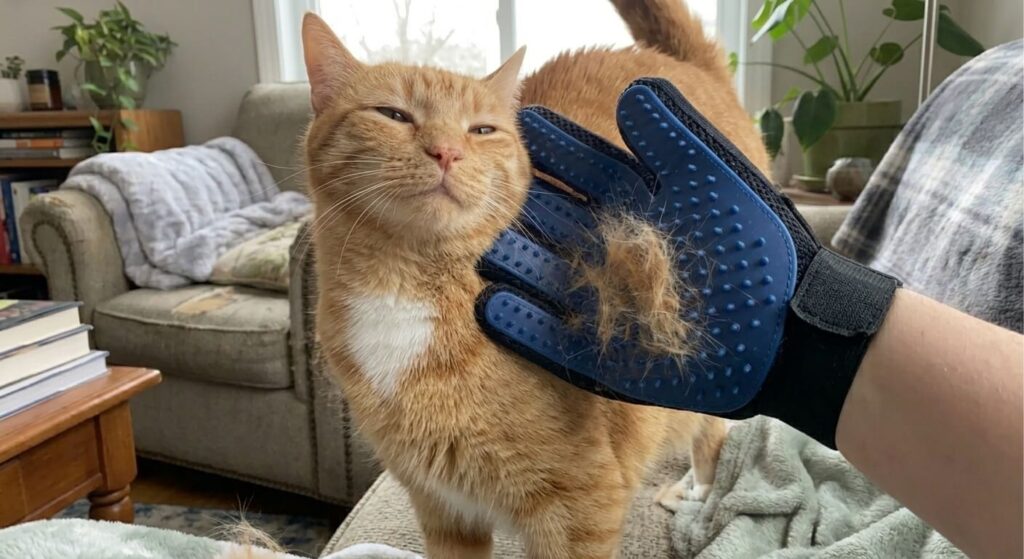
Grooming gloves occupy a specific and valuable niche in the best cat brushes for indoor cats conversation: they’re the tool that works when nothing else does.
Technical specifications:
- Material: BPA-free rubber nodules on mesh fabric backing
- Coverage: Full palm and finger coverage for maximum contact
- Cleaning: Rinse under water or peel fur off nodule surface
- Fit: Adjustable wrist strap (one size fits most)
The behavioral advantage:
From your cat’s perspective, grooming gloves are hands. They feel like being petted. They sound like being petted. The grooming session doesn’t announce itself as a grooming session—it slides in under the cover of normal affectionate contact.
For cats who respond to “the brush is coming” with a strategic retreat to under-the-bed, the grooming glove bypasses the learned avoidance entirely.
The practical limitation:
Grooming gloves are excellent for the top coat and for shed fur capture. They don’t penetrate to the undercoat of double-coated breeds with the efficiency of a slicker or deshedding tool. For heavy shedders, I use the glove as a first pass (warm-up, top layer shed capture) followed by a slicker for the undercoat work.
Pros:
- Feels like petting—lowest anxiety tool in this comparison
- BPA-free rubber construction with zero injury risk
- Covers large surface area quickly
- Excellent for cats who resist all conventional brushes
- Good for final pass to collect floating fur after slicker session
Cons:
- Limited undercoat penetration
- Less precise than handle tools for specific areas
- Some cats dislike the texture on sensitive areas
- Fur collection can be less efficient than traditional brushes
Best for: Grooming-resistant cats, supplementary tool use, older cats who find conventional brushing uncomfortable, short single-coated breeds
💎 The Premium Pick: Chris Christensen Baby G Slicker Brush
Price: $25 – $35
For owners of long-haired and double-coated breeds who want professional-quality results at home, the Chris Christensen Baby G is the best cat brushes for indoor cats option in the premium slicker category.
Technical specifications:
- Bristle material: Stainless steel pins with ball-tip safety ends
- Cushion base: Deep rubber cushion (approximately 1 inch) for maximum flexibility
- Pin length: Approximately 1 inch—appropriate for long and medium coats
- Handle: Professional ergonomic grip
What distinguishes professional-grade from consumer-grade slicker brushes:
The difference is primarily in two specifications: pin quality and cushion depth.
Consumer slicker brushes use pins with inconsistent coating (the ball tips wear off unevenly) and shallow cushions that don’t flex adequately with body contours. Professional brushes use consistent-quality stainless steel pins with durable ball tips and deep cushions that maintain consistent, safe pin contact regardless of the angle of application.
For Maine Coon, Norwegian Forest Cat, and Ragdoll owners specifically, this investment makes a real difference in both safety and effectiveness.
Pros:
- Professional-quality stainless steel pins with durable ball tips
- Deep cushion provides superior safety margin
- Appropriate pin length for long-coat penetration
- Long-term durability (outlasts multiple consumer-grade brushes)
- Excellent for professional finishing after deshedding work
Cons:
- Higher price point than consumer options
- Overkill for short single-coated cats
- Requires the same careful technique as any slicker brush
- Limited availability in physical retail stores
Best for: Long-haired and double-coated breeds, owners who groom daily, households with multiple cats where brush investment is amortized across multiple animals
Vet Tech Pro-Tips: How to Avoid “Slicker Burn”
Slicker burn—the repetitive microabrasion injury from incorrect slicker brush use—is entirely preventable with correct technique. Here’s exactly what to do and what to avoid.
The Four Causes of Slicker Burn
- Excessive pressure: The brush should glide through the coat; you should not be pushing it into the skin
- Repeated passes in the same area: Multiple passes over the same small area concentrates friction
- Wrong pin length for coat type: Short pins on a thick coat contact the skin before penetrating the coat effectively
- Incorrect angle: Pulling the brush parallel to the skin increases pin pressure; the correct angle is approximately 45 degrees to the coat surface
The Safe Brushing Protocol
Pressure test:
Before your first session with a new brush, test it on your own forearm. Apply your intended brushing pressure and make 3-4 passes. If you feel discomfort or see any skin redness after 4 passes, your pressure is too high for your cat’s skin.
The short-pass rule:
Use short strokes (2-3 inches) rather than long full-body passes. Short strokes allow you to:
- Feel for resistance (matting or skin surface contact) before it becomes harmful
- Distribute the grooming session across the coat evenly
- Adjust pressure area by area based on coat density
The thin-coat protocol:
Some areas have thinner coat coverage and require modified technique:
- Inner legs: Use rubber tool only, or your hands
- Belly: Shorter, gentler passes; many cats are sensitive here regardless of coat type
- Armpit areas: Prone to matting; use fingers to separate before any brush
- Face: Never use a slicker; use a soft cloth or your damp fingers only
The session length guideline:
| Coat type | Maximum session length | Frequency |
|---|---|---|
| Short single | 3-5 minutes | 2-3x per week |
| Short double | 5-10 minutes | Daily during shedding; 3-4x/week off-season |
| Long single | 10 minutes | Daily |
| Long double | 15 minutes | Daily |
FAQ
How often should I brush my indoor cat?
Frequency depends on coat type: short single-coated cats can be maintained with 2-3 sessions per week, while long-haired and double-coated breeds like Maine Coons benefit from daily brushing. During shedding seasons (typically spring and fall), increase frequency by one additional session per week regardless of coat type. As a vet tech, I’d rather err toward more frequent, shorter sessions than infrequent longer ones—shorter sessions maintain coat condition more effectively and are better tolerated by cats who aren’t enthusiastic about the process.
Can I use a human hairbrush on my cat?
I’d recommend against it for a few reasons. Human hairbrushes are designed for a coat that grows in one direction from a flat scalp—cat coats are multi-directional and three-dimensional. Human brush pin spacing and cushion depth aren’t calibrated for feline coat structure. The stainless steel pins in human brushes typically have inadequate ball tips for safe animal skin contact. The exception is a wide-toothed detangling comb—these can work for gentle detangling on long-haired cats when you don’t have a cat-specific comb available, but they’re not a substitute for appropriate cat brushes for regular maintenance.
What should I do if my cat hates being brushed?
How do I know if I’m using the best cat brushes for indoor cats correctly for my cat’s specific coat?Start smaller than you think necessary. Begin with just placing the brush near your cat during positive experiences (mealtime, cuddles) without using it. Progress to touching the brush to their coat for one stroke, paired with a high-value treat, then ending the session.
Build up duration over days or weeks rather than forcing tolerance. Switch to a BPA-free rubber grooming glove as the first active grooming tool—most cats accept these significantly better than traditional brushes. If your cat remains genuinely resistant after several weeks of gradual desensitization, a veterinary behaviorist consultation is worth pursuing; some grooming aversion has an underlying pain component that needs clinical assessment.
Scientific References
- Eckstein, R. A., & Hart, B. L. (2000). Grooming and control of fleas in cats. Applied Animal Behaviour Science, 68(2), 141-150. This peer-reviewed study documents the functional role of feline grooming behavior in parasite control and skin maintenance, demonstrating that grooming deficiency (whether from illness, obesity preventing reach, or painful conditions) leads to measurable skin and coat health deterioration—directly supporting the case for supplemental brushing in indoor cats.
- Reinero, C. R. (2009). Feline immunoglobulin E, allergic disease and the link with hypereosinophilic syndrome. Veterinary Immunology and Immunopathology, 132(1), 11-16. This study examines feline skin barrier function and allergen response, with implications for grooming practices that maintain skin integrity—supporting the clinical recommendation that regular brushing (distributing sebum and removing shed fur before skin contact) supports the epidermal barrier function that protects against environmental allergen penetration.