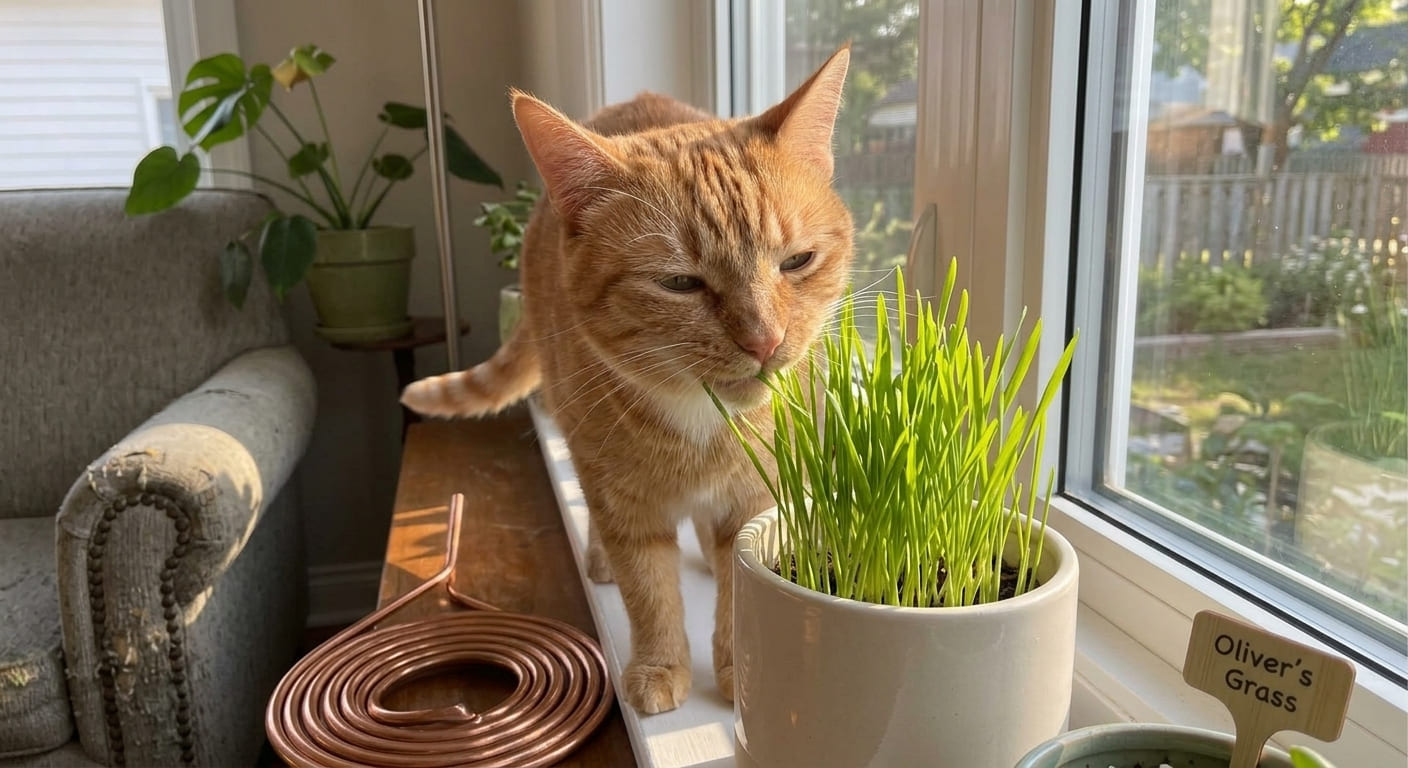
The best cat grass kit gives an indoor cat a clearly identified cereal grass to nibble while making the growing process manageable for the household. Look for named seeds, clean growing media, drainage or controlled watering, a stable container, and refill availability. No kit can guarantee better digestion, prevent hairballs, or stop a cat from chewing other plants.
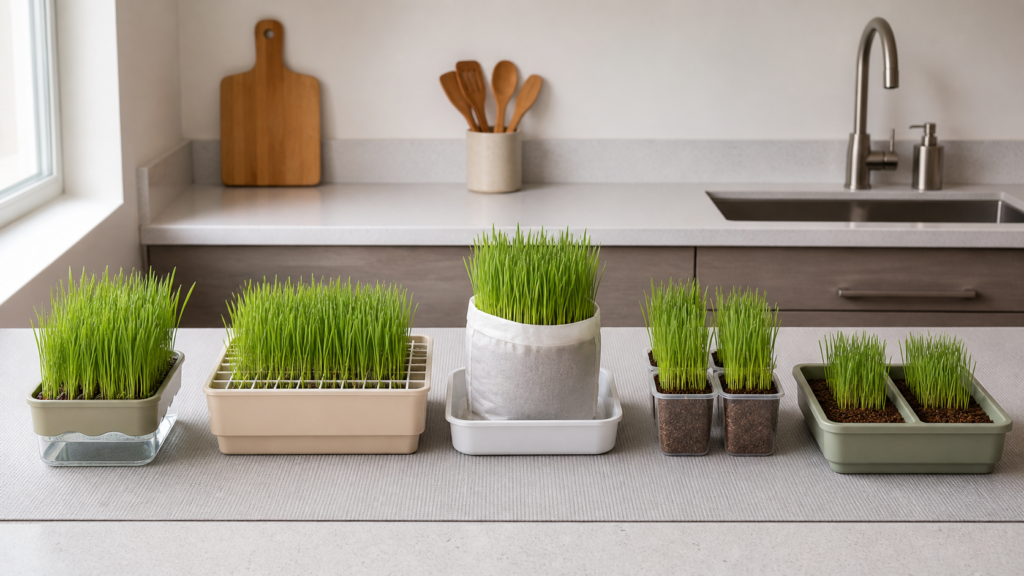
This guide compares five current options for different homes: a compact self-watering kit, a low-and-stable planter, a disposable grow-bag kit, a three-pack starter set, and a divided garden with four cereal grasses. Product availability and package contents can change, so confirm the current label before ordering.
Safety note: Cat grass is not a treatment for vomiting, constipation, hairballs, nutritional deficiency, or compulsive plant eating. Any plant material can cause gastrointestinal upset. Contact a veterinarian if your cat vomits repeatedly, stops eating, becomes lethargic or weak, has blood in the vomit, develops diarrhea, or shows a sudden change in thirst or urination. If a cat may have contacted a toxic plant—especially a true lily—contact a veterinarian or animal poison-control service immediately.
Disclosure: This article may contain affiliate links. Indoor Cat Expert may earn a commission at no extra cost to you. Products are compared by verifiable package contents, container design, growing medium, seed identification, cleanup, and apartment practicality—not by unverified health promises.
Quick Answer
The best cat grass kit for most small homes is the True Leaf Market Organic Self-Watering Cat Grass Kit because it includes a compact wicking tray, organic wheat, oat, and rye seed, coco coir, and supplies for three plantings. Choose the Catit Senses Grass Planter if your cat digs in pots or pulls lightweight containers over; its low base and grid cover are its main advantages.
The Pet Greens Self-Grow Kit is the simplest low-commitment trial because the grass grows directly in the bag. The Cat Ladies Organic Pet Grass Growing Kit provides three separate containers for staggered planting. Pioneer Pet Kitty’s Garden divides the planting area and uses oat, wheat, rye, and barley seed.
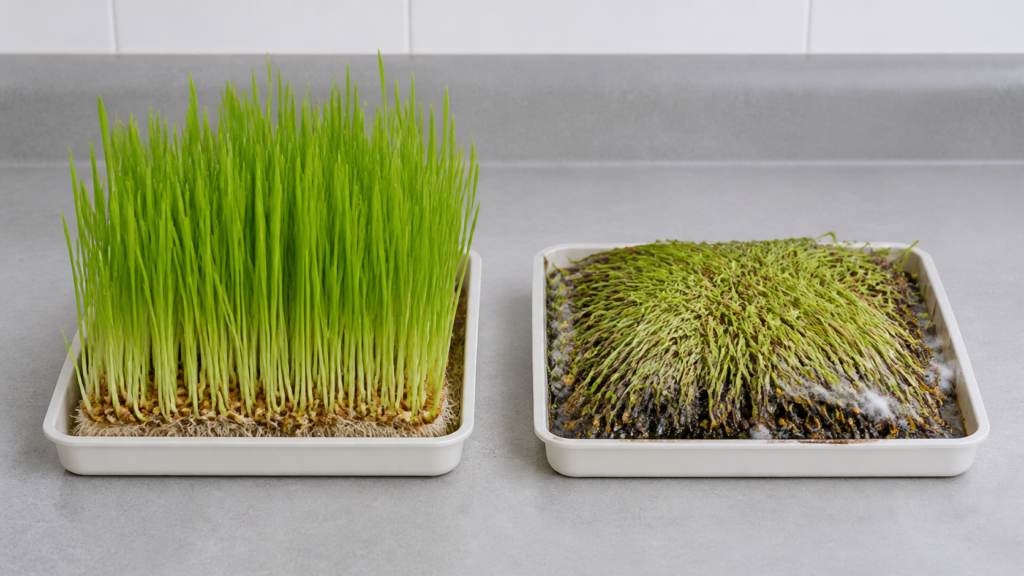
The best cat grass kit for your home is the one you can keep clean, ventilated, and stable. Discard the entire planting if it develops visible fuzzy growth, a musty or sour odor, sliminess, or persistently soggy roots. Do not try to rescue moldy grass by trimming the blades.
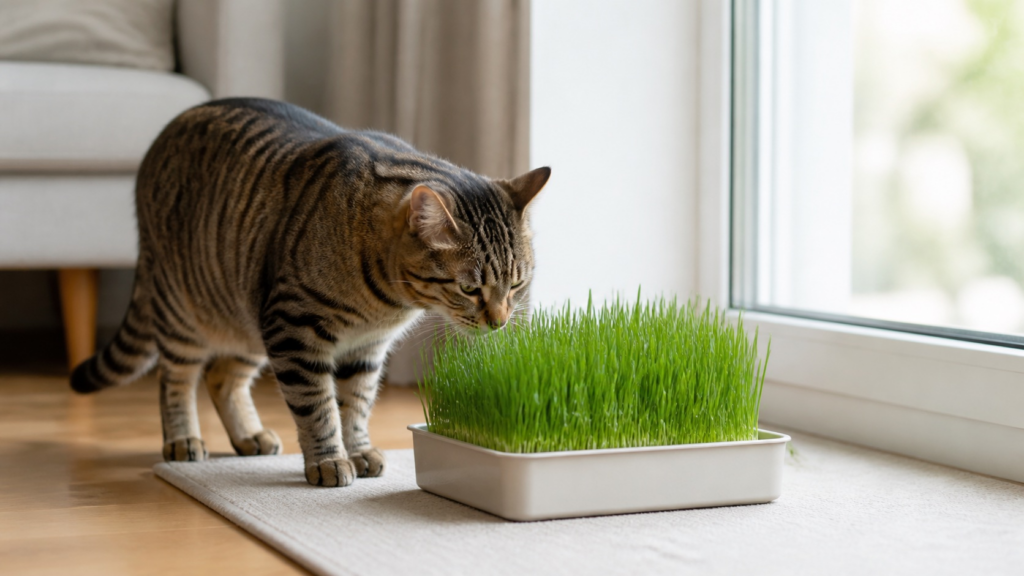
Table of Contents
Best Cat Grass Kit Comparison
| Product | Format | Seeds listed by maker | Growing medium | Best for | Main limitation |
|---|---|---|---|---|---|
| True Leaf Market Organic Self-Watering Cat Grass Kit | Compact wicking tray | Wheat, oats, rye | Coco coir | Small homes wanting less frequent watering | Reservoir still needs checking and cleaning |
| Catit Senses Grass Planter + refill kit | Low planter with grid cover | Barley, wheat | Vermiculite | Cats that dig or pull at grass | Planter and future refills are separate purchases |
| Pet Greens Self-Grow Kit | Grow-in-bag kit | Wheat, or oat/rye/barley medley | Custom soil blend | First-time trial and minimal setup | Disposable format; drainage holes must be added |
| The Cat Ladies Organic Pet Grass Growing Kit | Three small starter containers | Wheat, oats, rye, barley | Soil disks | Staggered batches in an apartment | Small containers can dry or tip more easily |
| Pioneer Pet Kitty’s Garden | Divided reusable tray | Oats, wheat, rye, barley | Peat pellets | Households wanting several grass varieties | More pieces to clean; avoid overwatering pellets |
The table records information shown on current manufacturer pages reviewed in August 2026. It does not verify medical marketing claims or future availability.
How We Chose the Best Cat Grass Kit Options
Clearly identified cereal-grass seeds
“Cat grass” is a general retail term, not one botanical species. Commercial kits usually contain young wheat, oat, barley, or rye grass. A useful label names the seeds rather than saying only “pet greens” or “grass mix.” Identifying the seed does not prove a health benefit, but it helps owners avoid mystery plants and compare refills accurately.
Do not plant lawn seed, decorative grass seed, birdseed, or a packet with an unclear coating for a cat to eat. Outdoor grass can also carry lawn chemicals, animal waste, parasites, sharp plant material, or other contaminants. A kit made for edible indoor grass provides a more controlled option.
Water control and airflow
Cat-grass failures are usually practical: soaked roots, poor airflow, a tray that dries out, or a dense mat that stays wet at the base. Self-watering does not mean maintenance-free. A reservoir can still become dirty, and a soil-free mat can still support unwanted growth when kept saturated.
The strongest designs either allow excess water to drain or make the water level easy to control. Whichever kit you choose, follow its instructions instead of applying one universal watering schedule. Light, temperature, humidity, container depth, and seed density all change how quickly a tray dries.
Stability and mess control
A cat may bite a blade and pull backward, paw at the medium, or stand against the container. For a narrow windowsill, floor-level feeding area, or multi-cat household, a broad base is generally more useful than a tall decorative pot. A cover grid can limit digging, but it must not have damaged or sharp edges.
Place the planter on a washable mat away from electrical cords and breakable objects. Do not balance wet soil or a ceramic pot above a cat’s usual resting place. If the only sunny location is an unsafe ledge, use a safer surface and adjust light rather than accepting a fall hazard.
Honest package contents
Some listings describe a “kit” but include only seed refills; others include seed, medium, and planter. Before buying, check whether you need a separate tray, growing medium, or refill set.
No reliance on therapeutic promises
Manufacturers commonly say cat grass improves digestion, prevents hairballs, supplies vitamins, freshens breath, or redirects houseplant chewing. These statements are not the basis of this ranking. Evidence does not support treating cat grass as a nutritional requirement or dependable remedy. The practical reasons to offer it are controlled plant identification, optional chewing enrichment, and a safer alternative to letting a cat sample unknown outdoor grass or household plants.
1. True Leaf Market Organic Self-Watering Cat Grass Kit — Best Overall
This compact kit combines a self-watering tray with organic wheat, oat, and rye seed and coco coir. The current product page states that the seed blend is certified organic and that the package contains enough seed and medium for three plantings.
Why it stands out
- The seed types and organic certification are identified.
- A wicking system separates stored water from the upper growing surface.
- Coco coir contains loose material better than an open pot of ordinary soil.
- Three plantings let a household test the system before buying bulk refills.
- The compact footprint is easier to place in a small apartment than a wide garden tray.
What to consider
A wick only moves water; it cannot judge whether the tray is already too wet. Check the roots, smell, and water reservoir rather than automatically topping it up. Empty and wash reusable parts between plantings. If the grass base stays wet or develops fuzzy growth, discard the planting.
Put the light tray on a non-slip washable mat if your cat pulls hard on the blades. Several enthusiastic grazers may need a wider system.
Best for
One- or two-cat households wanting a compact, reusable starter system with clearly identified seed and fewer loose-soil crumbs.
2. Catit Senses Grass Planter — Best for Cats That Dig
The Catit Senses Grass Planter has a low base, a deep growing bowl, drainage openings, and a grid cover designed to keep paws out of the growing medium. The matching refill kit contains pre-portioned barley and wheat seed plus vermiculite. Verify the listing carefully: the planter and multi-pack refill may be sold separately.
Why it stands out
- The broad, low shape is harder to tip than a narrow pot.
- The grid separates paws from most of the vermiculite and roots.
- The maker identifies the refill seeds as barley and wheat.
- Pre-portioned seed and medium reduce measuring during setup.
- Replacement refills are available for the reusable planter.
What to consider
The grid does not make the planter spill-proof. Check that all pieces are seated correctly and inspect it for damage before each planting.
Vermiculite is less crumbly than potting soil, but it still requires controlled watering and cleanup. Do not let a cat chew packaging, loose plastic, or spilled growing medium. Follow the current Catit instructions because the planter and refill packaging have appeared in different configurations.
Best for
Cats that paw at soil, households that want a wider base, and owners willing to keep purchasing the compatible refill system.
3. Pet Greens Self-Grow Kit — Best No-Planter Trial
Pet Greens sells a wheatgrass “Garden” kit and an oat, rye, and barley “Medley” kit. The seed and growing medium remain inside the bag, so a separate planter is optional. The manufacturer instructs owners to make drainage holes in the bottom before growing.
Why it stands out
- It is a simple way to learn whether a cat is interested before buying a reusable system.
- The two versions clearly identify either wheat or an oat/rye/barley mix.
- Seed and growing medium are included.
- The bag contains the growing process and can be discarded after use.
- The official instructions explain how to create drainage and when to open the bag.
What to consider
A flexible bag is less stable than a broad rigid planter. Place it inside a low, heavy outer tray that cannot trap drainage water against the bag. Keep cut edges, foil seed packets, and the instruction card away from the cat.
The grow-in-bag format is convenient but disposable. Do not transplant established grass unless the manufacturer supports that step.
Best for
First-time buyers, cats whose interest is unknown, and homes that want a complete short-term trial with almost no equipment.
4. The Cat Ladies Organic Pet Grass Growing Kit — Best for Staggered Batches
The current three-pack kit includes three small containers, three organic soil disks, three seed packets, and instructions. The maker identifies the blend as wheat, oats, rye, and barley and describes the containers as BPA-free.
Why it stands out
- Three separate batches can be started at different times.
- The package includes seed, medium, and growing containers.
- The cereal-grass blend is identified.
- Replacement formats and other planters are sold by the same company.
- Small units are easier to separate between cats than one large tray.
What to consider
Staggering the three containers can reduce waste. Small containers may move when a cat tugs at the grass, so use a stable outer tray or non-slip surface.
The company’s ceramic and wooden-planter kits have different contents from the basic three-pack. Do not copy specifications between versions. If you use a ceramic version, place it where a fall cannot injure a cat or break the planter.
Best for
Owners who want rotating batches, multi-cat homes that benefit from separate pots, and renters who prefer a complete starter pack.
5. Pioneer Pet Kitty’s Garden — Best Divided Garden
Kitty’s Garden uses a divided tray and peat growing pellets. Pioneer Pet identifies the seed as oats, wheat, rye, and barley and sells a refill kit. The divided layout helps distribute seed across a broad tray.
Why it stands out
- Four named cereal grasses are included.
- The tray separates the growing area into sections.
- A matching refill option supports reuse.
- The footprint is lower and wider than many decorative planters.
- The official catalog and FAQ provide current model and seed information.
What to consider
Peat pellets expand and hold moisture, so add water according to the package rather than filling the tray by eye. Drain standing water and provide airflow. The divided insert creates additional corners and seams that need washing between plantings.
The maker’s health claims should be treated as marketing, not a guarantee. Choose this product for its seed identification, divided design, and refill system—not because a tray of grass is expected to balance a cat’s diet.
Best for
Households that want a broad divided tray, several cereal-grass textures, and a reusable system with matched refills.
Why Do Cats Eat Grass?
Cats may chew grass for more than one reason, and research has not established a single universal explanation. Some cats appear to enjoy the texture or the act of biting plants. For an indoor cat, a small tray can also add a novel scent, texture, and foraging-like activity to the environment.
Avoid turning a plausible explanation into a diagnosis. There is not good evidence that a cat seeks grass because its complete commercial diet lacks folic acid, that it deliberately uses grass to “clean” the stomach, or that vomiting afterward proves the grass is working. Grass eating cannot tell you whether a cat has a nutritional deficiency or gastrointestinal disease.
Cornell’s guidance on destructive houseplant chewing lists oat grass, catnip, and catmint as alternatives while emphasizing that access to unsafe plants should be blocked. Offering cat grass may give a cat another plant to investigate, but it does not make toxic plants safe or reliably eliminate the original behavior.
Is Cat Grass Safe for Cats?
Young wheat, oat, barley, or rye grass grown from a clearly labeled kit is generally used as cat grass. “Non-toxic,” however, does not mean that unlimited chewing is risk-free. The ASPCA notes that ingestion of any plant material can cause vomiting or gastrointestinal upset, even when the plant is not expected to be life-threatening.
Start by allowing brief supervised access. Watch whether the cat nibbles blades or tears out mouthfuls of roots and medium. Remove the tray if the cat eats large quantities, swallows growing medium, damages the container, or repeatedly vomits afterward.
Do not add fertilizer, pesticide, herbicide, essential oil, decorative moss, water-retaining crystals, or stones unless a veterinarian and the product label specifically support their use around a cat. Avoid seed with unknown coatings. Use only clean water and the growing medium supplied or recommended by the kit maker.
Wheatgrass vs. Oat, Barley, and Rye Grass
Wheatgrass
Wheatgrass is common in single-seed and mixed kits and usually produces broad upright blades. It is not automatically superior to the other cereal grasses. Choose it when a straightforward, widely available refill matters more than variety.
Oat grass
Oat grass is frequently recommended as an indoor alternative for plant-chewing cats. Its blades may feel different from wheatgrass, which can matter to an individual cat. There is no sound basis for promising that oat grass prevents vomiting or is medically “easier to digest.”
Barley grass
Barley appears in mixed-seed products such as the Catit refill and Kitty’s Garden. Its main practical value in a kit is another blade texture and a clearly identified cereal seed—not a guaranteed enzyme or detoxification benefit.
Rye grass
Rye is included in several organic blends. Confirm the package’s botanical or common-name information and use the intended indoor edible-grass product. Do not substitute an unidentified lawn-grass mixture simply because “rye” appears on the label.
Does variety matter?
A mixed kit may help an owner learn which texture the cat prefers. A single-seed kit makes germination and refill comparison simpler. Neither approach is nutritionally required when a cat already eats a complete and balanced diet.
How to Grow Cat Grass Without Creating a Mold Problem
Follow the kit, not a universal calendar
Some products advertise sprouts within several days, but temperature, light, seed age, and moisture change the result. Use height, root condition, smell, and the manufacturer’s instructions instead of assuming every tray is safe on day five or finished on day fourteen.
Keep the medium moist, not flooded
Drain standing water. If a self-watering tray remains saturated, reduce the reservoir according to the instructions and improve airflow. If a grow bag requires drainage holes, make them before adding water and place the bag in a washable outer tray.
Provide light and airflow after germination
Move sprouted grass to the light level recommended for the product. Avoid a sealed cover after shoots appear unless the instructions specifically require it. Dense wet growth with little airflow encourages deterioration at the base.
Inspect before every access period
Look beneath the blades. Do not offer grass with fuzzy patches, discolored slime, collapsed wet stems, insects, or an unusual musty or sour smell. FDA information on animal-food contaminants explains that some molds can produce mycotoxins and that grains can be susceptible. A household cannot identify a mold or its toxin risk by color alone, so discarding a questionable tray is safer than trimming it.
Clean reusable components
Remove roots and all growing medium. Wash the planter, insert, reservoir, and mat according to the manufacturer’s care instructions; rinse and dry completely before restarting. Replace damaged plastic, cracked ceramic, frayed wicks, or inserts with sharp edges.
Cat Grass Does Not Make Toxic Houseplants Safe
A grass tray should never sit beside toxic houseplants as if the cat will reliably choose the correct one. Keep unknown and toxic plants inaccessible. Use the ASPCA toxic and non-toxic plant database to check the exact botanical name, since common names can be ambiguous.
True lilies in the Lilium group and daylilies in the Hemerocallis group are an emergency concern for cats. Even small exposures, including pollen that a cat later grooms from its fur, can cause severe kidney injury. Do not wait for symptoms after a suspected exposure; call a veterinarian or poison-control service immediately.
Pothos, philodendron, dieffenbachia, and peace lily can cause significant oral irritation and gastrointestinal signs. Their risks differ from true lilies, but a cat-grass planter is not a protective barrier. Remove or securely isolate plants based on their verified identity and your cat’s behavior.
For a complete apartment plant list, use our guide to cat-safe plants for apartments. If your cat already targets leaves, follow the environmental steps in how to stop a cat from eating plants rather than relying on grass alone.
What If My Cat Vomits After Eating Grass?
Do not describe vomiting as intentional, therapeutic, or proof that the stomach has been “cleaned.” Remove access to the grass and observe what happened: how much was eaten, whether roots or medium were swallowed, what the vomit contained, and whether appetite, energy, stool, thirst, or urination changed.
Cornell advises prompt veterinary evaluation for frequent vomiting or vomiting accompanied by lethargy, weakness, reduced appetite, blood, thirst or urination changes, or diarrhea. Contact a veterinarian sooner for a kitten, senior, medically fragile cat, possible obstruction, or suspected toxin exposure.
A single episode still does not prove the grass was harmless. Save the seed package and take a photo of the plant and vomit if veterinary advice is needed. Do not induce vomiting or give a home remedy unless a veterinarian or animal poison specialist directs you.
Apartment Setup Checklist
Before offering a new tray, confirm all of the following:
- The package names the seed or cereal-grass blend.
- The seed is intended for edible indoor grass, not lawn establishment.
- No fertilizer, pesticide, essential oil, decorative stone, or unknown additive was used.
- The planter is stable on a washable, non-slip surface.
- Drainage cannot damage flooring or create standing water.
- The grass base has no fuzz, slime, collapse, or unusual odor.
- The cat cannot reach packaging, cords, fragile objects, or toxic plants nearby.
- Initial access is supervised so you can see whether the cat nibbles or tears up the whole planting.
- The kit instructions and refill details are saved for the next cycle.
Cat grass can be one small part of a broader indoor cat enrichment setup, but it should not replace play, climbing, scratching, hiding, food puzzles, or social interaction.
Frequently Asked Questions
How do I choose the best cat grass kit?
There is no proven healthiest cereal grass. Choose the best cat grass kit for your home by container stability, water control, growing-medium cleanliness, refill availability, and your cat’s behavior rather than claims about vitamins or detoxification.
Is cat grass the same as catnip?
No. Cat grass usually means young cereal grass grown for chewing. Catnip is Nepeta cataria, a member of the mint family that can produce a behavioral response in susceptible cats. They are different plants with different uses.
Can cat grass stop a cat from eating houseplants?
It may provide another plant to investigate, but it is not a reliable deterrent. Block access to unsafe plants, identify every plant by botanical name, adjust placement, and add appropriate enrichment. Never keep a toxic plant accessible because a cat-grass tray is nearby.
How much cat grass can a cat eat?
There is no evidence-based universal serving size. Begin with brief supervised access and remove the tray if the cat gulps large amounts, pulls out roots, eats medium, or develops gastrointestinal signs. Ask your veterinarian about an individual cat with digestive disease or repeated plant eating.
When should cat grass be thrown away?
Discard the planting when it develops visible fuzzy growth, slime, a musty or sour smell, collapsed wet stems, significant yellowing, insects, or damaged medium. Do not depend on a fixed number of days, because growing conditions vary.
Are organic seeds required?
Organic certification can provide clearer production standards and is a reasonable buying preference, but it does not make a wet, moldy, or contaminated tray safe. More important immediate checks are a named edible-grass seed, intact packaging, correct growing medium, clean water, airflow, and prompt disposal when the planting deteriorates.
Can cat grass prevent hairballs?
Do not buy a kit expecting guaranteed hairball prevention. Evidence for a specific clinical benefit is limited, and frequent retching or vomiting may have causes unrelated to hair. Grooming, diet, hydration, and veterinary assessment matter more when hairballs are recurrent.
Final Verdict
The True Leaf Market Organic Self-Watering Cat Grass Kit is the best overall starting point in this comparison for a small indoor home because it combines identified organic seed, coco coir, a compact reusable wicking tray, and three plantings. The Catit Senses Grass Planter is the stronger design for a cat that digs, thanks to its low base and grid cover.
Choose Pet Greens Self-Grow for a simple one-bag trial, The Cat Ladies three-pack for staggered batches, or Pioneer Pet Kitty’s Garden for a divided tray and four-grass blend. Recheck current package contents before buying.
Most importantly, judge a cat grass kit as a controlled indoor planting—not as medicine. Keep it stable, avoid unknown additives, inspect the roots and medium, discard questionable growth, and keep toxic plants genuinely inaccessible.
References
Pioneer Pet — Kitty’s Garden FAQ
ASPCA — Toxic and Non-Toxic Plants Database
ASPCA — Which Lilies Are Toxic to Pets?
Cornell Feline Health Center — Vomiting
Cornell University — Destructive Behavior and Houseplant Chewing
FDA Center for Veterinary Medicine — Chemical Contaminants in Animal Food
True Leaf Market — Organic Self-Watering Cat Grass Kit
Catit — Senses Cat Grass Refill Kit