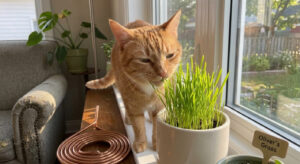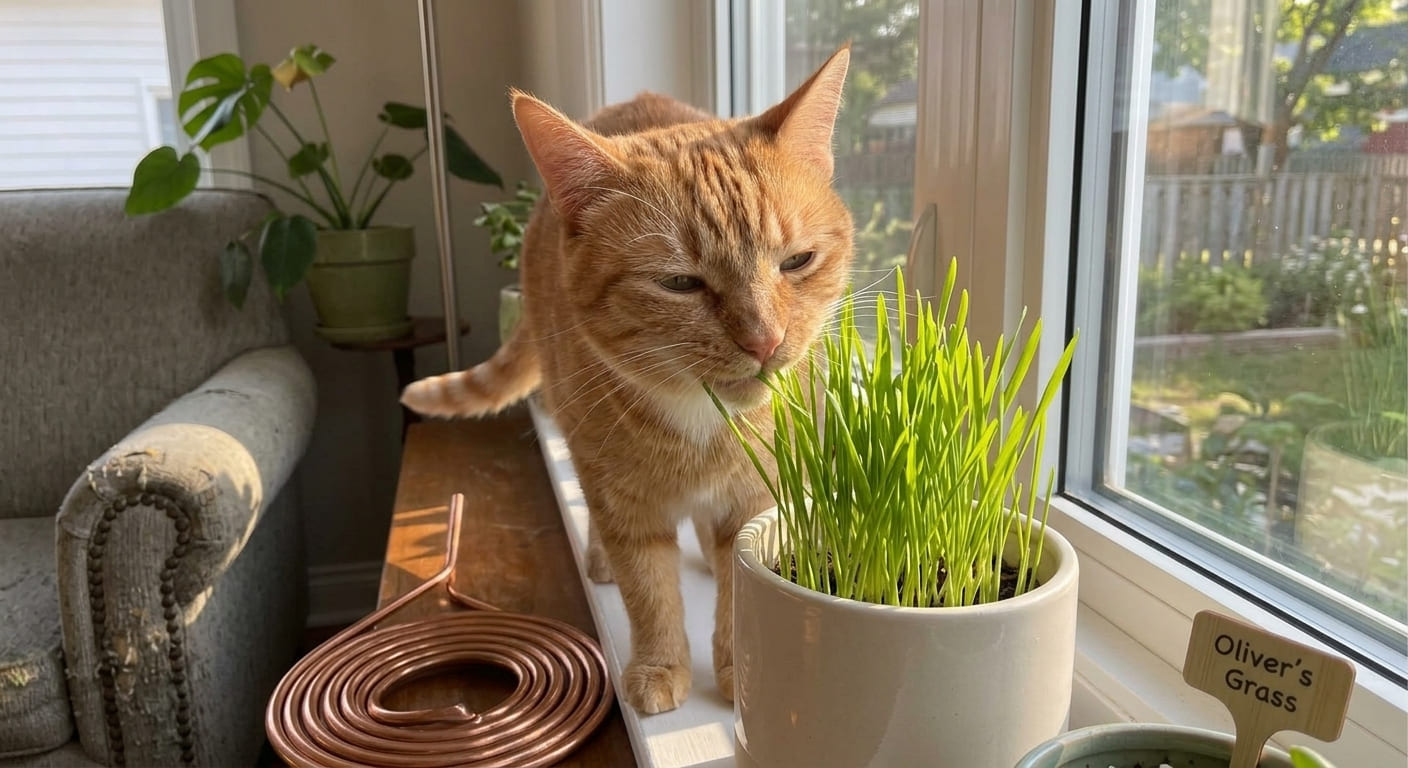
Oliver has expensive taste in houseplants.
Not the cheap ones, not the easy-to-replace ones. The spider plant I’d carefully cultivated for two years on the windowsill—the one with the perfect trailing vines that made my apartment look like a thoughtfully curated urban jungle. That one. He chose that one.
The obsession was persistent and entirely one-directional: Oliver wanted to eat it, I wanted him not to, and neither of us was making progress on convincing the other. I eventually learned that spider plants, while Non-Toxic to cats, aren’t meant to be consumed in the quantities Oliver was attempting. More immediately, I recognized the underlying behavior for what it was: a biological drive to graze that wasn’t being met anywhere else in his environment.
As a veterinary technician, my approach to solving this was clinical before it was aesthetic. I needed Organic Seeds grown without pesticide exposure, a container he could access without knocking anything off a shelf, and grass types that were genuinely beneficial rather than just distracting. Finding the best cat grass kit that met all three criteria—safety, functionality, and apartment practicality—became my next research project.
My spider plant has been untouched for eight months. Oliver has a garden of his own now.
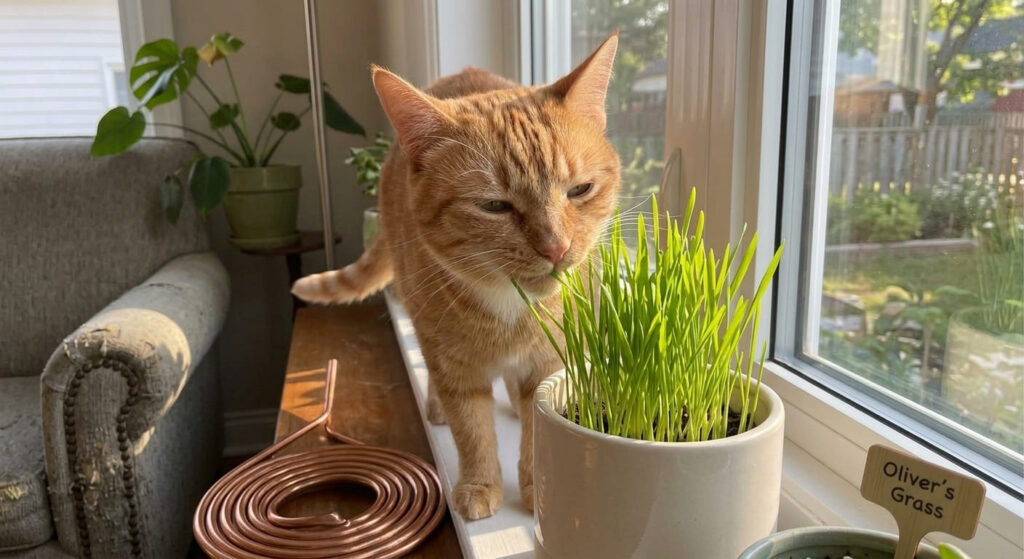
Quick Answer: Why Your Indoor Cat Needs a Cat Grass Kit?
The best cat grass kit provides essential folic acid, aids digestion by facilitating hairball elimination, and delivers genuine environmental enrichment through a safe grazing outlet. Look for Organic Seeds in soil-free or self-watering configurations using wheat, oat, or barley grass to satisfy your cat’s natural grazing instinct without the mess, mold risk, or pesticide exposure of conventional potted grass.
Foraging vs. Houseplant Destruction: The Biological Need for Grass
Before we discuss specific products, I want to establish why this isn’t a quirky cat preference—it’s a biological drive with documented physiological functions.
Why Cats Eat Grass: The Clinical Explanation
Cats are obligate carnivores, which makes their grass-eating behavior appear paradoxical. The research on this is more nuanced than most pet care content acknowledges.
Current evidence supports three primary functions:
Function 1: Gastrointestinal lubrication and hairball elimination
The mechanical action of chewing grass, combined with the indigestible fiber content, stimulates gastric motility and can facilitate the regurgitation of accumulated hair from the digestive tract. This is a self-directed health maintenance behavior—cats who have access to grass engage in this behavior periodically as a form of gastrointestinal self-regulation.
Function 2: Folic acid supplementation
Grass contains folic acid (vitamin B9), which is found in the juice of grass blades. Folic acid is essential for hemoglobin synthesis and cellular metabolism. Wild cat diet includes grass in the stomach contents of prey animals—domestic indoor cats don’t access this through normal feeding.
Function 3: Behavioral enrichment through foraging
The act of grazing—searching for appropriate blades, selecting, biting, and chewing—activates the foraging behavioral sequence. This provides Cognitive Enrichment distinct from hunting or play behaviors, satisfying a behavioral category that most indoor cat enrichment programs don’t address.
The Houseplant Problem
When cats don’t have an appropriate grass outlet, the grazing drive redirects toward available vegetation—which in an indoor apartment means your houseplants.
The danger: many common houseplants are genuinely toxic to cats. Oliver’s spider plant obsession was relatively harmless (spider plants are Non-Toxic though can cause mild GI upset in quantity). The list of plants that are not harmless is long and includes some extremely common houseplant choices: pothos, philodendron, peace lily, dieffenbachia, and numerous others.
A dedicated cat grass setup eliminates this redirection problem at its root—giving the grazing drive an appropriate, safe outlet.
Creating an indoor cat garden is also a core strategy for environmental enrichment in small apartments, adding a sensory and behavioral dimension that vertical structures and puzzle feeders don’t address. [The Small Apartment Cat Survival Guide: 7 Pillars of Indoor Enrichment]
What’s in the Mix? (Wheatgrass vs. Oat Grass vs. Barley)
The best cat grass kit options use varying seed compositions, and the differences between grass types matter for both feline preference and nutritional profile.
Wheatgrass (Triticum aestivum)
Profile:
- Most common in commercial cat grass kits
- Rapid germination (5-7 days to usable height)
- High chlorophyll content
- Sweet flavor that most cats find highly palatable
- Rich in vitamins A, C, E, and folic acid
Clinical note:
Wheatgrass is one of the densest nutritional sources in the cat grass category. If I’m recommending a single-grass option, wheatgrass is the default.
Important clarification: Wheatgrass is grown from wheat seeds but does not contain gluten at the grass stage. Gluten is present in the grain—not in the sprout or grass blade. Cats with grain sensitivities are not at risk from wheatgrass.
Oat Grass (Avena sativa)
Profile:
- Softer blade texture than wheatgrass (preferred by some cats)
- Slightly slower germination (7-10 days)
- Milder flavor profile
- High in vitamin B and protein content
- Easier to digest than wheatgrass for sensitive stomachs
Clinical note:
For cats who have experienced vomiting after wheatgrass consumption, oat grass is the recommended alternative. The softer texture and milder composition is gentler on sensitive GI systems.
Barley Grass (Hordeum vulgare)
Profile:
- Thinner blades than wheat or oat
- Rapid germination (5-7 days)
- High enzyme content (supports digestive function)
- Very high chlorophyll concentration
- Less common as a standalone product; frequently found in mixed kits
Rye Grass (Lolium perenne)
Profile:
- Very fine, delicate blades
- Decorative appearance alongside coarser grass types
- Lower nutritional density than wheatgrass or barley
- Primarily found in mixed kits as a texture element
The Multi-Seed Case
Mixed seed kits provide variety in blade texture, flavor, and nutritional profile. For cats who graze regularly, variety prevents flavor fatigue and provides a broader nutrient spectrum. For initial introduction, single-seed wheatgrass is the most reliable first choice.
Top 5 Cat Grass Kits for 2025
🥇 The Self-Watering Master: Cat Amazing Organic Cat Grass Kit
Price: $18 – $22
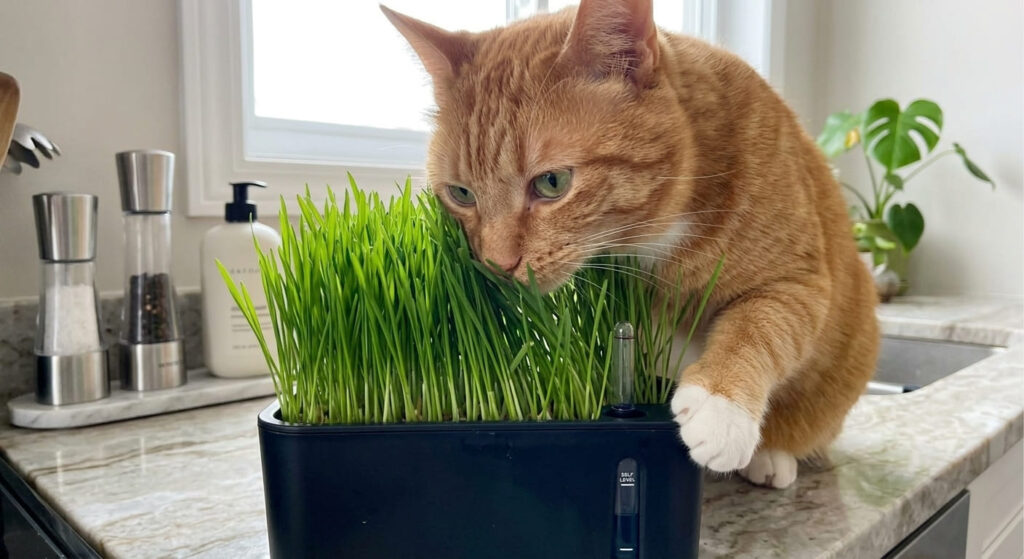
The self-watering mechanism is the feature that makes or breaks a cat grass kit for busy apartment owners. The Cat Amazing kit earns its top position through the combination of a genuinely functional self-watering reservoir and certified Organic Seeds that eliminate my primary clinical concern about pesticide exposure.
Technical specifications:
- Seeds: Certified Organic Seeds (wheatgrass)
- Planter: BPA-free Planter with self-watering reservoir
- Grow medium: Organic coconut coir (soil-free)
- Germination: 5-7 days to usable height
- Full growth: 10-12 days
- Non-Toxic: Yes (all components)
- Refill kits: Available separately
The self-watering mechanism:
The reservoir holds approximately 3 days of water for the grass, which wicks upward through the grow medium via capillary action. This eliminates the most common failure mode of cat grass kits: inconsistent watering that either drowns the grass (mold) or desiccates it (wilting) when the owner’s schedule varies.
For a working apartment cat owner, the 3-day water autonomy means the grass can survive a weekend without attention.
The organic certification:
This is the specification I will not compromise on. Non-organic grass seeds can be treated with fungicides, herbicides, and pesticide coatings that persist into the germinated grass. A cat who grazes daily from non-organic grass is receiving low-level pesticide exposure with every session.
Certified Organic Seeds means no synthetic pesticide application at any stage of seed production. This is non-negotiable for daily-use cat grass.
Pros:
- Self-watering reservoir (3-day autonomy)
- Certified Organic Seeds (pesticide-free)
- BPA-free Planter throughout
- Soil-free coconut coir (clean, minimal mess)
- Refill kits available (sustainable ongoing cost)
- Non-Toxic complete kit
Cons:
- Higher price point than basic seed-and-soil kits
- Reservoir requires cleaning between growth cycles
- Coconut coir produces less-dense grass than soil (some cats prefer denser growth)
- Single grass type (wheatgrass only)
Best for: Primary recommendation for all apartment cat owners, owners who want consistent growth without daily monitoring, cats who graze regularly
🌱 The Soil-Free Clean Kit: The Cat Ladies Organic Cat Grass Growing Kit
Price: $15 – $18
For apartment owners where soil mess is genuinely prohibitive—hardwood floors, no outdoor access for soil disposal, or shared living spaces—soil-free growing systems are a meaningful practical improvement over conventional potted grass.
Technical specifications:
- Seeds: Organic Seeds (wheatgrass + oat grass blend)
- Planter: Plastic tray with drainage layer (BPA-free Planter)
- Grow medium: Hemp fiber grow mat (soil-free)
- Germination: 5-7 days
- Full growth: 10-12 days
- Non-Toxic: Yes
- Mess level: Minimal (hemp mat contains all growth medium)
The hemp mat system:
Instead of loose soil or coconut coir, the Cat Ladies kit uses a compressed hemp fiber mat that expands when wet. The mat contains the grow medium in a flat, clean structure that doesn’t shed particles or create the soil residue that conventional cat grass pots leave on shelves and counters.
Cleanup when the growth cycle ends (typically 2-3 weeks) is a single mat disposal—no soil emptying, no mess.
The dual-seed advantage:
The wheatgrass and oat grass blend provides two blade textures and two flavor profiles simultaneously, which increases palatability for cats who find single-grass kits less interesting after initial exposure.
Pros:
- Soil-free (hemp mat is genuinely mess-free)
- Dual seed blend (variety increases palatability)
- Organic Seeds certified
- BPA-free Planter
- Easy end-of-cycle disposal
- Lower price than self-watering options
Cons:
- No self-watering mechanism (daily watering required)
- Hemp mat growth tends to be less dense than soil
- Single-use mat (not reusable)
- Requires more frequent replacement than refillable systems
Best for: Apartment owners where soil mess is a primary concern, owners who want soil-free growing, households with hardwood floors
🎯 The Multi-Seed Variety Pack: Handy Pantry Cat Grass Seed Variety Pack
Price: $14 – $18 (seeds only, 1 lb)
For owners who already have appropriate planters but want premium Organic Seeds with variety, the Handy Pantry variety pack provides the best seed quality and selection in the category.
Technical specifications:
- Seeds: Certified Organic Seeds (wheat, oat, barley, rye blend)
- Quantity: 1 lb (yields multiple growing cycles)
- Planter: Not included (seeds only)
- Grow medium: Any (soil, coconut coir, hemp mat compatible)
- Non-Toxic: Yes (all seed types)
- Germination: 5-7 days for wheat/barley; 7-10 for oat
The economics of bulk seeds:
A 1 lb bag of mixed Organic Seeds provides approximately 8-10 standard tray plantings, depending on seeding density. At $14-18 per bag, the cost per growing cycle drops to approximately $1.50-2.00—significantly below the $15-22 per single-kit price of packaged alternatives.
For owners who have established a growing system and want to reduce ongoing cost, the seed-only approach is the economically superior option.
The variety rotation:
I use the Handy Pantry seeds to plant single-variety trays in rotation: one week wheatgrass, next oat grass, alternating. This variety prevents flavor fatigue and provides a broader nutritional spectrum across Oliver’s grazing sessions.
Pros:
- Best per-cycle economics (significantly cheaper than packaged kits)
- Four grass varieties in one purchase
- Certified Organic Seeds throughout
- Compatible with any growing system or planter
- Large quantity enables rotation and experimentation
- Long shelf life (store in sealed container)
Cons:
- No planter included (requires separate purchase)
- Requires knowledge of appropriate seeding density
- Larger upfront commitment than single-kit options
- No grow medium included
Best for: Owners who have established a growing system, long-term cat grass growers, owners who want to experiment with variety, budget-conscious buyers
🏺 The Stylish Ceramic Garden: Mkono Self-Watering Ceramic Cat Grass Planter
Price: $25 – $35
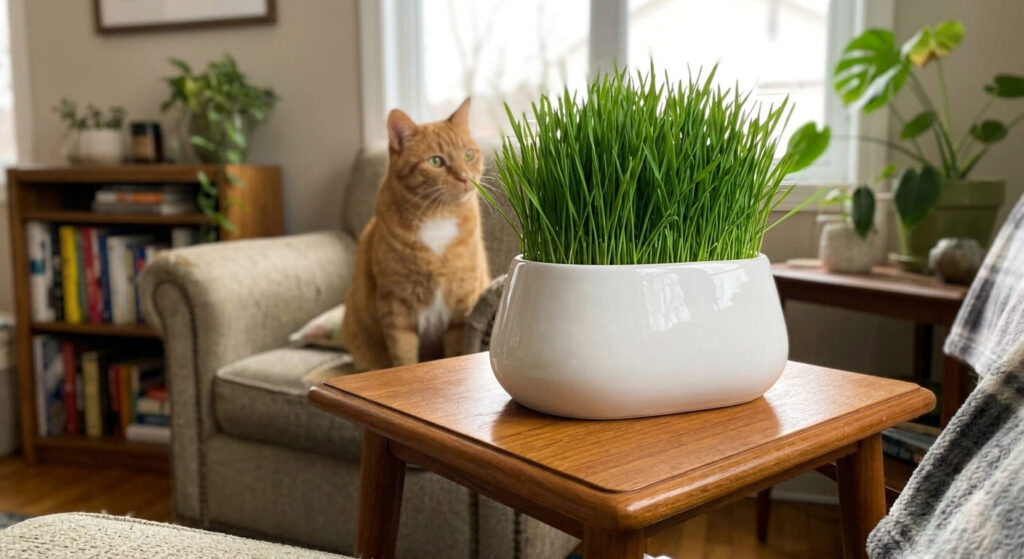
For apartment owners who’ve invested in their interior design and refuse to compromise with plastic planters on their carefully styled shelves, the Mkono ceramic solution resolves the aesthetic problem without compromising on function.
Technical specifications:
- Seeds: Organic Seeds included (wheatgrass)
- Planter: Ceramic with Non-Toxic glaze (BPA-free Planter equivalent)
- Grow medium: Coconut coir (included)
- Self-watering: Yes (reservoir in ceramic base)
- Germination: 5-7 days
- Size: 5″ diameter (compact; suitable for shelves and windowsills)
- Non-Toxic: Yes (lead-free ceramic glaze certified)
The ceramic advantage:
Ceramic planters are naturally Non-Toxic, porous enough to allow some air circulation to the root zone, and lead-free glazes are certified safe for food and pet contact. They’re also significantly more aesthetically integrated with modern apartment decor than plastic alternatives.
The compact 5″ diameter makes this planter appropriate for narrow windowsills where a full-tray grass kit wouldn’t fit—allowing grass placement in the prime window location that maximizes both sunlight for growth and accessibility for the cat.
Tall cat grass positioned near a window or in a corner can also serve a behavioral function for shy cats—the visual cover provided by longer grass blades gives anxious cats a subtle sense of being slightly hidden while they survey the room from their preferred observation spot. [Cat-Safe Plants for Apartments (And Which Ones to Avoid)]
Pros:
- Aesthetically integrated with modern apartment design
- Ceramic construction (Non-Toxic, lead-free glaze)
- Self-watering reservoir
- Compact size (fits narrow windowsills)
- Reusable planter (just purchase seed refills)
- Organic Seeds included in starter kit
Cons:
- Premium price point
- Ceramic can chip or break if knocked off surfaces
- Smaller volume means shorter growth cycle between replanting
- Less grass density than full tray kits (smaller feeding capacity)
Best for: Design-conscious apartment owners, windowsill placement, owners who want an aesthetically integrated solution
🌿 The Budget Starter: Pet Greens Self Serve Cat Grass
Price: $8 – $12
For owners who want to assess whether their cat will actually use cat grass before committing to a premium kit, the Pet Greens Self Serve provides a functional entry point at minimal cost.
Technical specifications:
- Seeds: Pre-grown (arrives as live grass)
- Planter: Basic plastic pot
- Grow medium: Pre-established (no germination wait)
- Ready to use: Immediately upon receipt
- Non-Toxic: Yes
- Organic certification: Not certified (important caveat)
The pre-grown advantage:
The Pet Grass Self Serve ships as already-grown grass—no germination period, no growing setup. It’s immediately accessible to the cat upon arrival.
For initial exposure assessment (will my cat even be interested?), this immediacy is valuable. No two-week investment before discovering whether your cat ignores grass entirely.
The organic certification caveat:
This product is not certified Organic Seeds. The seeds used in pre-grown commercial grass may have received conventional pesticide treatment. For a one-time assessment purchase, this is an acceptable compromise. For ongoing daily grazing, I recommend transitioning to certified organic kits for regular use.
Pros:
- No wait time (immediately usable)
- Lowest price point for initial assessment
- Widely available (grocery stores, pet stores)
- Non-Toxic grass types
Cons:
- Not certified organic (pesticide exposure risk for regular use)
- Non-reusable basic planter
- No growing system (one-time use)
- Shorter usable lifespan than freshly germinated alternatives
Best for: Initial exposure assessment only, determining cat interest before investing in premium kit, convenience purchases
Vet Tech Safety: Identifying Toxic Houseplants to Avoid
This section is the companion to the cat grass guide—because providing a safe grazing outlet is only half of the solution. The other half is removing or relocating the plants that present genuine toxicity risk.
The ASPCA Toxic Plant List: Key Apartment Offenders
Highly toxic (emergency veterinary care if ingested):
| Plant | Toxicity | Clinical Signs |
|---|---|---|
| Lilies (Lilium spp.) | Severe (kidney failure in cats) | Vomiting, lethargy, renal failure within 24-72 hours |
| Sago Palm | Severe (liver failure) | Vomiting, jaundice, coagulopathy |
| Dieffenbachia | Moderate-severe | Oral burning, drooling, swelling |
| Oleander | Severe (cardiac) | Cardiac arrhythmia, GI distress |
Moderately toxic (veterinary consultation recommended):
| Plant | Toxicity | Clinical Signs |
|---|---|---|
| Pothos | Moderate | Oral irritation, vomiting |
| Philodendron | Moderate | Oral irritation, hypersalivation |
| Peace lily | Moderate | Oral irritation, GI distress |
| Aloe vera | Moderate | Vomiting, diarrhea |
The assessment protocol I recommend:
- Inventory every plant in your apartment
- Cross-reference each with the ASPCA Animal Poison Control toxic plant database (aspca.org/pet-care/animal-poison-control/toxic-and-non-toxic-plants)
- Relocate any highly toxic plants to genuinely inaccessible locations (secured rooms, hanging configurations)
- Remove plants in the moderate-toxic category if your cat has demonstrated grazing behavior
The Safe Houseplant List
Replacing toxic plants with Non-Toxic alternatives eliminates risk while maintaining your indoor garden:
- Boston fern
- Spider plant (though limit quantity)
- African violet
- Orchids
- Bromeliads
- Calathea/Maranta varieties
- Peperomia varieties
FAQ
Is cat grass the same as catnip?
No—they are entirely different plants with different mechanisms. Cat grass refers to young cereal grain plants (wheat, oat, barley, rye) grown for grazing and nutritional benefit. Catnip (Nepeta cataria) is a member of the mint family whose active compound, nepetalactone, triggers a neurological euphoria response in approximately 50-70% of cats (genetically determined).
Cat grass produces no euphoric effect—it satisfies a biological grazing drive and provides nutritional benefit. Catnip satisfies a behavioral stimulus response. They can be offered simultaneously as different enrichment categories.
Why does my cat vomit after eating grass?
Vomiting after grass consumption is normal and often intentional. Cats lack the digestive enzymes to fully process grass fiber—they cannot digest it, and their digestive system responds by facilitating regurgitation. This regurgitation function is believed to serve a biological purpose: expelling accumulated fur, feathers, or other indigestible material from the stomach.
If your cat is vomiting exclusively undigested grass without any hairball content and doing so very frequently, switching from wheatgrass to oat grass (softer, easier to process) typically reduces the frequency. Vomiting that includes blood, continues for more than 30 minutes, or is accompanied by lethargy warrants veterinary assessment.
How long does a cat grass kit last?
The usable lifespan of a cat grass kit depends on grass type, growing conditions, and grazing intensity. Freshly germinated grass is typically at optimal quality for 7-14 days post-germination, after which it begins to yellow, develop mold at the base, or become unpalatable. Oliver’s individual trays last approximately 10 days before I replace them.
The best cat grass kit options with self-watering systems extend this by ensuring consistent moisture, which can push usable life to 14-18 days. For continuous availability, I maintain two trays in a staggered germination schedule—one at peak growth while the next is germinating—so there’s always fresh grass available.
Ultimately, providing the best cat grass kit is a simple yet effective way to respect your cat’s wild foraging instincts within four walls.
Scientific References
- Bjone, S. J., Brown, W. Y., & Price, I. R. (2007). Grass eating patterns in the domestic dog, Canis lupus familiaris, and related wolves and canids. Asian-Australasian Journal of Animal Sciences, 20(9), 1443-1449. While examining canine herbivory, this study documents the cross-species prevalence of deliberate grass ingestion for gastrointestinal regulation purposes—the same behavioral mechanism documented in felids—confirming that grass consumption is a functional self-medication behavior rather than a dietary error or nutritional deficiency symptom.
- Raghavendra Rao, M. R., Murthy, K. R., & Madhulika, P. (2011). Folic acid: An overview of biochemistry, physiological roles and clinical significance. International Journal of Pharmacy and Pharmaceutical Sciences, 3(2), 1-7. This review documents the biochemical functions of folic acid (vitamin B9) in cellular metabolism and hemoglobin synthesis, establishing the nutritional basis for grass consumption in cats as a dietary folic acid source—particularly relevant for indoor cats whose commercial diets may not fully replicate the incidental folic acid intake that prey stomach contents provide in wild felid diets.