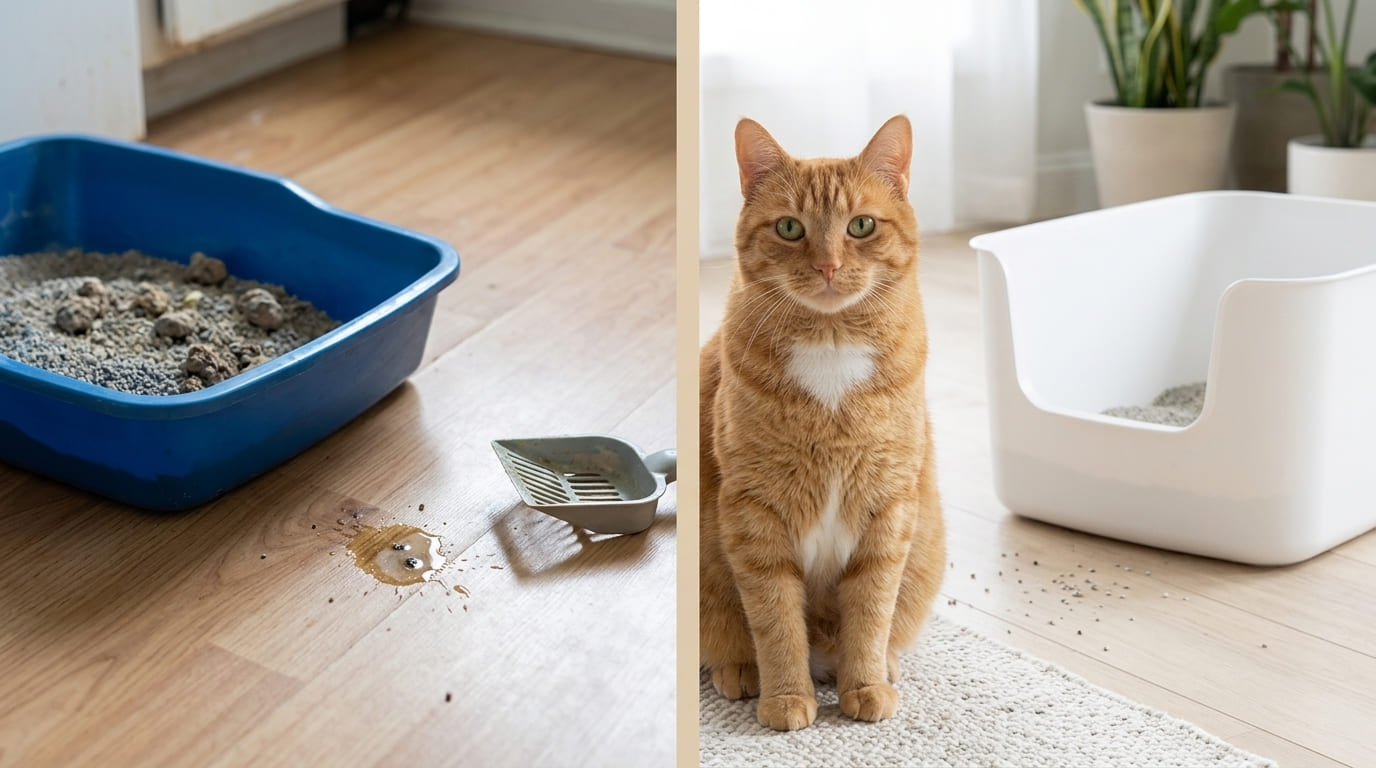
I discovered the problem on a Sunday morning when I noticed a suspicious puddle forming on the baseboard behind Oliver’s litter box in my apartment bathroom. My first instinct — plumbing leak, call the super — was wrong.
My second instinct — as a veterinary technician who should have known better — was embarrassingly slow in arriving. Oliver, my opinionated tabby, had been standing upright in his covered two-piece box and urinating at a near-vertical angle, and the urine had been seeping steadily through the seam where the hood connected to the base, pooling behind the box and quietly threatening my security deposit for what I estimated was several weeks.
The best high sided litter box, I learned that Sunday morning with a mop in my hand, is not the one with the most impressive hood or the most decorative exterior — it’s the one engineered to contain what a cat with an ambitious bladder trajectory can produce.
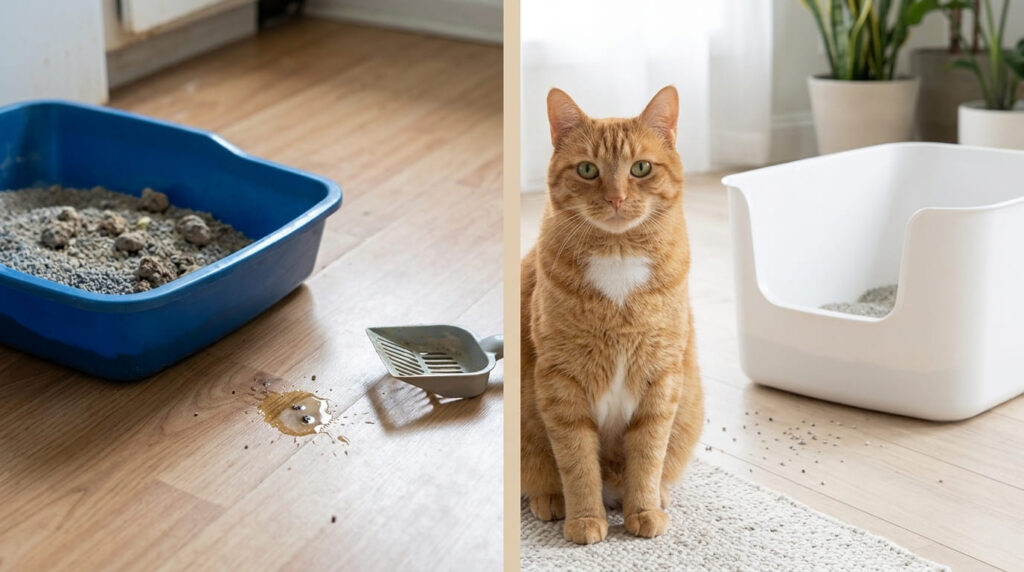
As a vet tech, I have a professional preference for open-top high-sided designs over covered boxes that goes beyond my personal seam-failure experience.
Covered litter boxes trap ammonia, hydrogen sulfide, and volatile organic compounds at nose level for a cat using the box — which is exactly the environment most likely to cause litter box aversion, a behavioral condition in which cats begin eliminating outside the box due to negative associations with it.
The hood that humans find odor-managing is, from a feline perspective, a gas chamber of their own making. High-sided open tops contain scatter and misdirected streams while allowing the airflow that keeps odors from concentrating.
Quick Answer: What Is the Best High Sided Litter Box for High-Peeing Cats?
The best high sided litter box features a minimum of 10–12 inches of vertical wall height and, most critically, seamless one-piece construction that eliminates the seam failure point that ruins two-piece covered boxes. For cats with high urine trajectory, stainless steel or high-polished resin options provide the most durable, non-porous surfaces that resist odor absorption and wipe clean completely between scoopings.
The “Elevated Urination” Struggle: Why Some Cats Pee High
Understanding why your cat urinates at a high angle is the first step toward selecting the right containment solution — and it also rules out medical causes that need veterinary attention before any box upgrade will help.
The behavioral and physiological reasons cats pee high:
Normal Posture Variation
Cats eliminate in a squatting position, but the angle of that squat varies considerably between individual cats. Some cats — particularly larger males and certain naturally upright-posturing females — adopt a near-standing posture with their hindquarters elevated at an angle that directs the urine stream toward the back or side wall of the box rather than downward into the litter.
This is normal feline elimination behavior, not spraying. The distinction matters because spraying (territorial urine marking) is performed standing with a quivering, raised tail and deposits urine on vertical surfaces deliberately. Upright-posture urination is a cat simply going to the bathroom in their natural position — the problem is engineering, not behavior.
Urine Marking vs. High-Posture Elimination
Urine spraying involves a standing cat backing up to a vertical surface and depositing a relatively small amount of urine, often with a characteristic tail-quiver. If you observe this behavior, it may indicate territorial stress, social conflict in a multi-cat household, or anxiety — and warrants veterinary and behavioral consultation.
High-posture elimination involves a cat who enters the box normally, assumes an unusually upright squat, and produces a normal urine volume — it just lands on the wall or exits the box entirely. The fix is containment height, not behavioral intervention.
Medical Conditions to Rule Out First
Before attributing high-peeing behavior to posture alone, certain medical conditions should be ruled out:
- Arthritis — a cat who cannot comfortably assume a deep squat may stand more upright to reduce joint loading
- Interstitial cystitis or FLUTD — conditions causing urgency may alter positioning during elimination
- Urinary tract infections — discomfort during urination can cause postural changes
If the high-peeing behavior is new in a previously normal-posturing cat, a veterinary examination is warranted before purchasing containment solutions.
If high-peeing is accompanied by straining, it may be a sign of compromised indoor cat urinary health. See our full list of FLUTD warning signs.
The “Seam” Problem: Why Two-Piece Boxes Fail
This is the engineering failure that ruined my Sunday morning, and it’s worth understanding specifically so you can identify it in product listings and avoid it.
How two-piece covered litter boxes are constructed:
Standard hooded litter boxes consist of a base tray — typically 4–6 inches deep — and a separate hood component that clips, snaps, or locks onto the rim of the base. The connection point between these two components is a seam, and that seam is the weakest point in the entire assembly when dealing with a high-peeing cat.
Why the seam fails:
- Urine directed at the back or side wall of a covered box travels down the interior surface of the hood and pools at the seam connection point
- Most seam connections are not watertight — they are friction fits, snap connections, or clip systems that hold the hood in position but do not create a sealed barrier
- Urine that pools at the seam will, over time, find the path of least resistance — typically through the connection gap or down the exterior of the base where it pools on the floor, invisible until it’s been accumulating for some time
The mold problem:
A seam that regularly receives urine exposure and is not cleaned — because it’s not visible and owners don’t know it’s occurring — becomes a bacterial and mold culture environment. The structure of most plastic two-piece boxes makes the seam area nearly impossible to sanitize effectively, which means that even “cleaned” two-piece boxes may harbor significant bacterial loads in the seam.
Why seamless construction solves this:
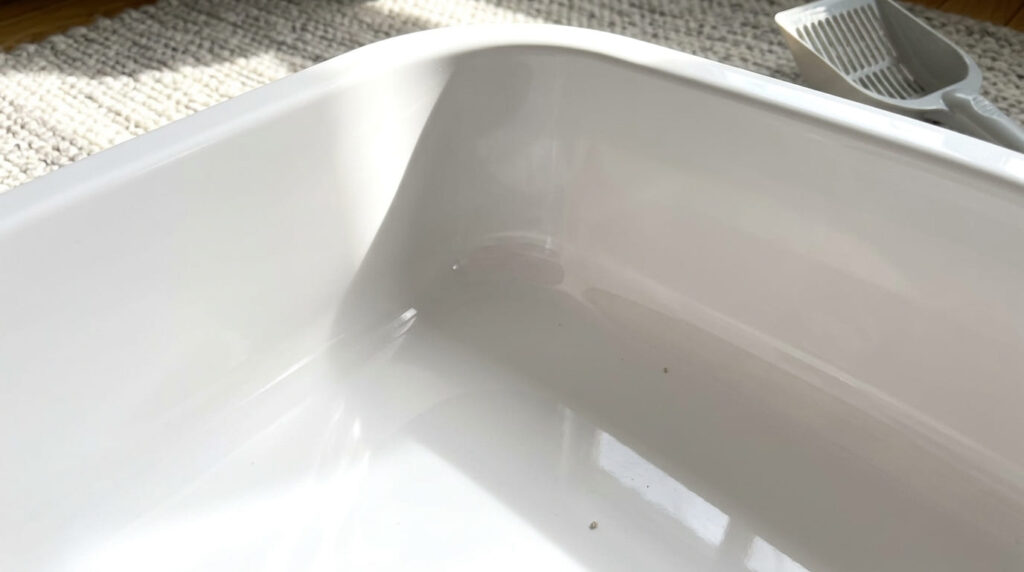
A seamless one-piece high-sided box — whether a bucket-style, a single-mold resin construction, or a stainless steel welded unit — has no connection point for urine to exploit. The urine hits the wall, runs down the interior surface, and reaches the litter. The entire interior is a single, uninterrupted surface that can be cleaned completely.
In small apartment layouts, a high-sided box is a lifesaver for protecting your drywall and expensive flooring from accidental “over-the-edge” misses — [read more about protecting your apartment from pet-related damage][How to Keep Litter Box From Smelling in Small Apartment: 7 Golden Rules].
Top 5 Recommendations: Best High Sided Litter Box (2025)
After testing multiple designs personally and professionally, consulting peer-reviewed feline behavior literature, and considering the practical realities of apartment living, here are the five best high sided litter box options across different categories and budgets.
1. 🥇 The Stainless Steel Gold Standard
Category: Premium, highest durability
Wall Height: 12–14 inches
Construction: Welded seamless stainless steel
Price Range: $80–$140
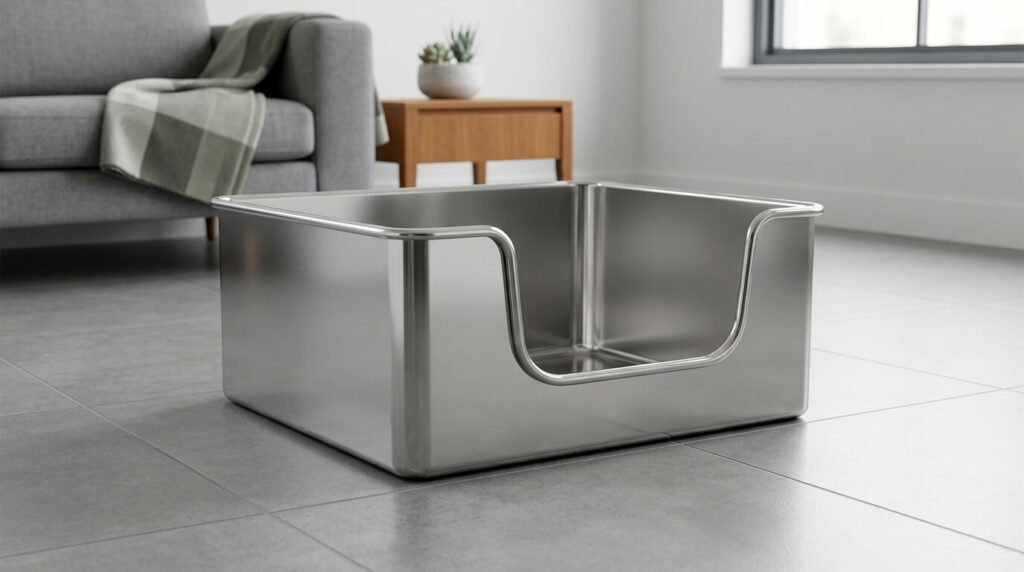
The stainless steel high-sided litter box represents the engineering solution that a high-peeing cat situation genuinely deserves. Surgical-grade or food-grade stainless steel is non-porous at the molecular level — unlike plastic, it does not develop microscopic scratches that harbor bacteria, and it does not absorb odor compounds over time.
The best stainless steel options feature a single-piece welded construction with smooth interior welds (no crevices at corners) and a slightly rolled or finished top edge that prevents sharp contact during cleaning.
Pros:
- ✅ Genuinely non-porous — odor compounds cannot absorb into the surface
- ✅ Welded seamless construction eliminates all seam failure points
- ✅ Lifespan measured in decades, not months
- ✅ Dishwasher safe for complete sanitization
- ✅ Resistant to staining from urine, food dye in wet food, and iron-rich urine
- ✅ Environmentally responsible — one purchase vs. repeated plastic replacements
Cons:
- ❌ Highest upfront cost of any option
- ❌ Heavier than plastic equivalents — less convenient to move during cleaning
- ❌ Some cats initially hesitant at the sound of litter against metal (typically resolves within days)
- ❌ Can feel cold in winter in drafty bathrooms — minor but worth noting for senior cats
Best for: Multi-cat households, cats with a history of repeated seam-failure box incidents, owners who want a permanent solution they’ll never replace.
2. 🥈 The Extra-Deep Resin Choice
Category: High-performance, mid-premium
Wall Height: 11–13 inches
Construction: Single-mold high-density resin or polypropylene
Price Range: $45–$80
High-density resin or thick-wall polypropylene boxes, when manufactured as single-mold units rather than two-piece assemblies, provide the seamless construction benefit at a significantly lower cost than stainless steel. The key distinguishing feature is wall thickness — look for walls at least 4–5mm thick, which resist flexing and maintain their shape over years of use.
The best options in this category feature a smooth, high-gloss interior surface — matte or textured interiors accumulate bacterial biofilm more readily — and a one-piece base-to-wall construction with no separate components.
Pros:
- ✅ Seamless construction in quality single-mold versions
- ✅ Significantly lighter than stainless steel
- ✅ High-gloss interior resists bacterial biofilm accumulation
- ✅ Available in sizes suitable for very large cats (Maine Coons, Norwegian Forest Cats)
- ✅ Price point accessible to most budgets
- ✅ Wide color availability for aesthetic coordination
Cons:
- ❌ Plastic does develop microscopic scratches over time that can harbor bacteria
- ❌ Requires replacement every 2–3 years for optimal hygiene even with proper cleaning
- ❌ Some lower-quality versions have thin walls that flex and may crack
- ❌ Not dishwasher safe in most cases — high heat warps polypropylene
Best for: Owners wanting the seamless construction benefit at a moderate price point, large breed cats who need generous interior dimensions.
3. 🥉 The Senior-Friendly High Sider
Category: Accessibility-focused
Wall Height: 10–11 inches (back and sides); 4–5 inches at entry
Construction: Single-mold with cut-out low entry point
Price Range: $35–$65
Senior cats — typically those over ten years of age — often develop arthritis in the hips, stifles, and spine that makes stepping over a high wall genuinely painful. Litter box aversion in senior cats is frequently caused by the physical discomfort of box entry rather than any behavioral issue, and misidentifying this as a behavioral problem leads to incorrect interventions.
The senior-friendly high-sided design solves this with asymmetric wall heights: the back and sides maintain full 10–11 inch height for urine containment, while the entry point features a cut-out or stepped entry that reduces the step-over height to 4–5 inches. This geometry captures misdirected urine while remaining accessible to cats with reduced joint mobility.
Pros:
- ✅ High back and side walls provide meaningful containment
- ✅ Low entry point accessible for senior or arthritic cats
- ✅ Prevents litter box aversion caused by painful box entry
- ✅ Single-mold construction in quality versions eliminates seam issues
- ✅ Appropriate for post-surgical cats during recovery
- ✅ Useful for overweight cats who struggle with high step-overs
Cons:
- ❌ Low entry point reduces containment on the entry wall — repositioning the box so the entry faces a wall helps
- ❌ Cats who pace before eliminating may exit and re-enter repeatedly, tracking litter through the low entry
- ❌ May not contain urine aimed directly at the entry wall
- ❌ Wall height is lower than ideal for extreme high-peeing cases
Best for: Senior cats (10+), cats recovering from surgery, overweight cats, multi-age households where one cat needs accessibility and another needs containment.
4. The Budget Open-Top High Sider
Category: Accessible budget option
Wall Height: 10–12 inches
Construction: Single-mold basic polypropylene
Price Range: $18–$35
The budget category for the best high sided litter box has improved significantly in recent years, with several manufacturers offering genuinely serviceable single-mold high-sided designs at price points that make the upgrade from a standard shallow tray accessible for any budget.
The key evaluation criteria at this price point: confirm single-mold construction (no separate base and rim), verify wall height is stated in product specifications rather than estimated from photos, and choose smooth interior surface over textured.
Pros:
- ✅ Dramatically lower cost than premium options
- ✅ Single-mold versions available — the key feature
- ✅ Lightweight and easy to maneuver for full cleaning
- ✅ Widely available from major retailers
- ✅ Lower financial commitment for trial before upgrading
- ✅ Appropriate for kittens who will eventually move to larger boxes
Cons:
- ❌ Thinner walls flex more than premium options — potential for cracking over time
- ❌ Surface scratches develop more quickly, harboring bacteria earlier
- ❌ Color and finish quality lower — may discolor with urine exposure over time
- ❌ Replacement needed more frequently — higher long-term cost than appears initially
- ❌ Fewer size options — may not accommodate very large cats comfortably
Best for: Budget-conscious owners, rental situations where a temporary solution is needed, kitten households, owners wanting to trial high-sided format before investing in premium.
5. The Aesthetic Modern High-Wall
Category: Design-forward, apartment aesthetic
Wall Height: 10–12 inches
Construction: Powder-coated steel frame with removable liner, or architectural resin
Price Range: $60–$120
For apartment owners who have invested in their interior aesthetic and cannot reconcile a utilitarian plastic box with their design choices, the modern high-wall category offers genuinely attractive options that function as well as they look.
The best versions in this category feature architectural resin or powder-coated steel in neutral colorways (matte white, slate, warm grey) with clean geometric profiles that read as intentional design objects rather than utilitarian pet accessories. Function must not be sacrificed for form — verify wall height specifications, construction type, and interior surface quality before purchasing any aesthetically-motivated option.
Pros:
- ✅ Apartment-appropriate aesthetics — doesn’t read as institutional pet equipment
- ✅ Available in neutral colorways that coordinate with modern interiors
- ✅ High-wall design provides meaningful containment
- ✅ Some models include removable liners that simplify cleaning
- ✅ Investment in aesthetics often correlates with investment in construction quality
Cons:
- ❌ Some aesthetic designs prioritize appearance over function — verify height specifications
- ❌ Powder-coated steel frames with separate liners reintroduce a seam between liner and frame
- ❌ Complex designs with multiple components are harder to clean thoroughly
- ❌ Higher cost for aesthetic value that doesn’t improve functional performance
- ❌ Custom colors and designs may limit availability for replacement parts
Best for: Design-conscious apartment owners, situations where the litter box is in a visible living area, owners who will pay a premium to integrate pet infrastructure into a considered interior.
Vet Tech Pro-Tips: Cleaning Vertical Surfaces
Cleaning a high-sided box effectively requires technique that standard shallow-tray cleaning doesn’t prepare you for. Here is the protocol I use professionally and at home.
Daily Maintenance
- Scoop twice daily minimum — high-sided boxes are superior for odor management compared to covered boxes as they allow for better airflow and easier daily scooping, as I’ve detailed in [this complete guide to litter box odor management][Best Cat Litter for Odor Control in Apartments (Tested and Ranked)]
- After scooping, wipe the interior vertical surfaces with an unscented baby wipe or damp paper towel to remove urine splash that has dried on the walls
- Pay specific attention to the back wall and corners — these are the areas that receive the most urine contact and dry into concentrated ammonia deposits if not addressed daily
Weekly Deep Clean
- Empty litter entirely
- Rinse the interior with warm water to loosen any dried urine deposits
- Apply an enzymatic cleaner — specifically formulated to break down uric acid crystals — to all vertical surfaces and allow it to dwell for 5–10 minutes
- For stainless steel boxes: use a soft cloth in circular motions along the weld lines at corners
- For resin boxes: use a soft-bristled brush (a dedicated vegetable brush works well) for any textured surfaces
- Rinse thoroughly — enzymatic cleaner residue can deter cats from using a clean box
- Dry completely before refilling — wet surfaces cause litter to clump on contact with the walls, creating wall crust that is harder to remove
Monthly Sanitization
Stainless steel boxes: full dishwasher cycle on high heat, or a 10-minute soak in a dilute bleach solution (1:32 bleach to water), followed by thorough rinsing and complete drying.
Resin boxes: bleach soak as above, with careful attention to any scratches or scuffs on the interior surface where bacteria concentrate. This is the point at which you assess whether the surface degradation has reached the replacement threshold.
The Urine Scale Problem
Hard water areas — which includes much of New York City — deposit calcium and mineral scale on surfaces that receive repeated urine contact. This scale appears as a white or off-white mineral crust on the interior walls and is not removed by enzymatic cleaners or bleach alone.
The solution: Dilute white vinegar (undiluted or 1:1 with water) applied to the scale deposits and allowed to dwell for 15–20 minutes will dissolve the mineral deposits. Follow with a thorough rinse — do not combine vinegar with bleach at any point, as this produces chlorine gas.
Frequently Asked Questions
Why does my cat pee over the side of the litter box?
The most common reason is postural — some cats naturally assume a more upright, near-standing posture during elimination, which directs the urine stream toward the side or back wall of the box rather than downward into the litter. In shallow or standard-depth boxes, this means the urine exits the box entirely.
This is not spraying behavior (which is a deliberate territorial marking behavior performed against vertical surfaces outside the box), and it is not a behavioral problem requiring correction — it’s a containment engineering problem requiring a taller box. Medical causes — particularly arthritis causing postural changes, or urinary discomfort causing rushed elimination — should be ruled out if the behavior is new, especially in cats over seven years of age.
Are high-sided litter boxes better than covered ones?
For most cats and most households, yes — and the reasons are both behavioral and functional. Covered boxes trap odor at nose level for the cat using the box, creating a concentrated ammonia environment that is a leading cause of litter box aversion. They also make daily scooping less convenient, which leads to less frequent cleaning, which compounds the odor problem.
From a containment standpoint, covered boxes fail at the seam — the connection point between hood and base — when a cat urinates against the hood interior. A high-sided open box contains scatter and misdirected streams effectively while allowing the airflow that prevents odor concentration, enabling thorough daily cleaning, and eliminating the seam failure point.
The only functional advantage of a covered box is scatter reduction from vigorous litter burying, which a high-sided box addresses equally well.
How high should the sides be for a high-peeing cat?
The minimum effective wall height for a cat who consistently directs urine toward the box walls is 10 inches measured from the base of the interior — not from the exterior base or the floor. This measurement accounts for litter depth (typically 2–3 inches) and still provides 7–8 inches of vertical containment above the litter surface.
For cats with extreme high-peeing behavior — those who can direct a stream nearly horizontally — 12–14 inch walls provide a meaningful additional safety margin. As a practical reference: if you are currently experiencing urine escape from the box, measure the current interior wall height above the litter surface. If it’s less than 6–7 inches, you have found your engineering problem, and upgrading to a box with 10–12 inch interior walls will resolve it in most cases.
References
- Grigg, E. K., Pick, L., & Nibblett, B. (2013). “Litter box preference in domestic cats: covered versus uncovered.” Journal of Feline Medicine and Surgery, 15(4), 280–284. https://doi.org/10.1177/1098612X12465606
- Ellis, S. L. H., & Wells, D. L. (2010). “The influence of olfactory stimulation on the behaviour of cats housed in a rescue shelter.” Applied Animal Behaviour Science, 123(1), 56–63. https://doi.org/10.1016/j.applanim.2009.12.011
Oliver has used a stainless steel high-sided box for eighteen months. The baseboards behind it are dry. The seam problem, by definition, cannot recur. The Sunday morning mop incident remains my most embarrassing moment as a veterinary technician, and I have made my peace with that.