Indoor cat urinary health can change quickly, and some warning signs should never be watched at home.
Repeated attempts to urinate with little or no urine can signal a urethral obstruction. This requires immediate veterinary attention, especially in male cats, which are at higher risk. Do not wait to see whether the problem resolves on its own.
This guide explains common FLUTD signs, emergency red flags, hydration support, litter box setup, stress reduction, and environmental changes that may help support urinary health in indoor cats. It is not a substitute for veterinary diagnosis or treatment, especially if your cat is straining, unable to urinate, lethargic, vomiting, or in pain.
Quick Answer: How to Maintain Indoor Cat Urinary Health?
Indoor cat urinary health is supported by suitable nutrition, fresh drinking water, accessible clean litter boxes, and a low-stress environment. Wet food can contribute moisture; a fountain is optional. For cats with urinary disease, these measures should fit a veterinarian-guided plan rather than replace diagnosis or treatment.
But support is not the same as treatment. If your cat strains, cries in the litter box, produces little or no urine, has blood in the urine, vomits, collapses, or acts painful, contact a veterinarian or emergency animal hospital immediately. A blocked cat cannot wait.
Safety Note
This guide is for educational purposes only and does not replace veterinary advice.
If your cat has a diagnosed medical condition, sudden symptoms, appetite changes, weight loss, vomiting, urination problems, breathing difficulty, severe pain, poisoning risk, or rapid decline, contact your veterinarian before relying on a product or home-care change.
Indoor Cat Expert articles are created by the Indoor Cat Expert Editorial Team and follow our Editorial Policy.
Urinary warning signs are part of a larger indoor health pattern that includes hydration, stress, weight, litter box changes, and routine monitoring. See our indoor cat health guide for the full prevention framework.
Table of Contents
| Sign or Risk Factor | Why It Matters | What to Do |
|---|---|---|
| Repeated litter box trips | Can signal bladder pain or blockage | Contact a veterinarian promptly; seek emergency care if little or no urine is passing. |
| Straining with little or no urine | Possible emergency, especially in male cats | Go to an emergency vet immediately |
| Blood in urine | Indicates irritation, inflammation, stones, or infection | Schedule same-day veterinary care |
| Dry-food-only diet | May reduce total water intake | Ask your vet about adding wet food |
| Dirty or stressful litter box setup | Cats may hold urine or avoid the box | Scoop daily and use enough boxes |
| Chronic stress or inactivity | Stress may contribute to FIC episodes in susceptible cats; inactivity alone does not identify the cause. | Add play, hiding spots, and routine |
What Is FLUTD in Cats?
FLUTD stands for Feline Lower Urinary Tract Disease — and it is not a single diagnosis. It is a clinical umbrella covering several distinct conditions that share overlapping symptoms but have meaningfully different causes, treatments, and risk profiles.
Understanding what is actually happening inside your cat’s bladder and urethra is the foundation of protecting their indoor cat urinary health long-term.
Urinary prevention also depends on weight, hydration, stress control, routine care, and early warning sign detection. For the bigger picture, use our indoor cat health prevention plan.
Feline Idiopathic Cystitis (FIC)
Feline idiopathic cystitis (FIC) is a common cause of lower urinary tract signs in cats. There is no single routine test that confirms it. A veterinarian diagnoses FIC by assessing the cat’s history and examination findings and excluding other possible causes, such as urinary stones or infection, using appropriate tests.
FIC is a complex condition involving more than the bladder alone. Stress and the cat’s environment can contribute, but describing it simply as “stress damaging the bladder wall” is misleading. Individual susceptibility and changes involving the nervous, hormonal, and immune systems may also play a role.
Management should be tailored by a veterinarian and may combine pain relief, environmental changes, and dietary or hydration support. These measures do not replace assessment of a new episode. A cat repeatedly straining with little or no urine needs immediate veterinary attention, even if it has previously been diagnosed with FIC.
Urinary Crystals
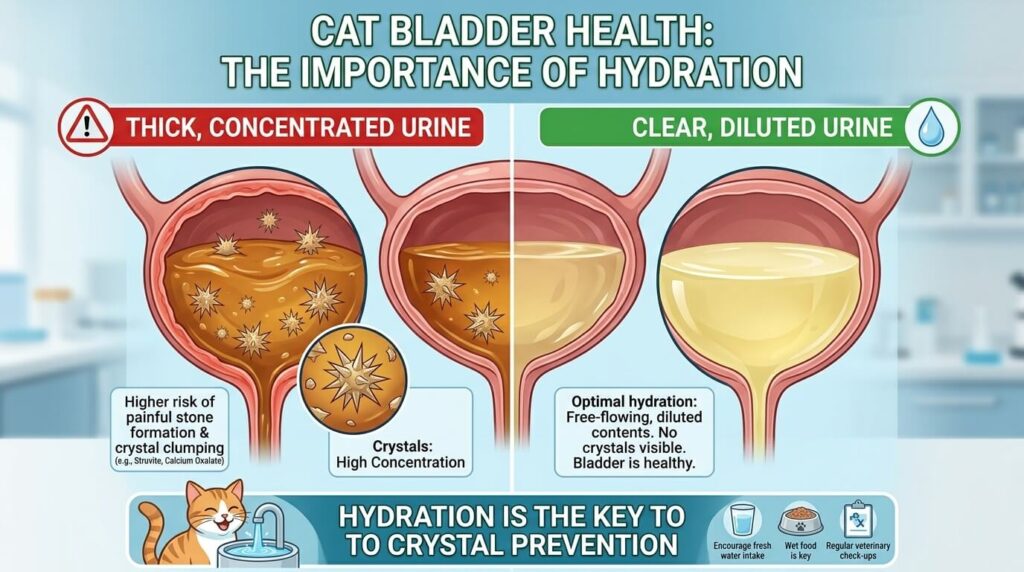
Struvite and calcium oxalate are important urinary crystal types in cats. Crystal formation depends on several factors, including mineral concentrations, urine pH, and diet. Finding crystals does not, by itself, prove that a cat is dehydrated or that dry food caused the problem.
Some crystals can occur in the urine of clinically healthy cats. Sample handling also matters: cooling or delays before examination can affect the crystals present. A veterinarian should interpret the findings alongside the cat’s symptoms, the rest of the urinalysis, and how the sample was collected and stored.
Urinary crystals are not the same as urinary stones. Their presence alone does not establish that stones or an obstruction are present. Ask the veterinarian whether the findings require further investigation or a change in management rather than choosing treatment based only on the crystal name.
Urinary Stones (Uroliths)
Urinary stones are mineral deposits that can develop in the urinary tract. Bladder stones may cause irritation, bleeding, or a blockage if they interfere with urine flow. Symptoms alone cannot identify the stone type or rule out obstruction; veterinary assessment and tests such as imaging may be needed.
Some struvite bladder stones can be dissolved with a veterinarian-prescribed diet and monitoring. Calcium oxalate stones cannot be dissolved through diet, and treatment depends on their location and the problems they cause. Do not choose a urinary diet or supplement as a substitute for diagnosis. Repeated straining with little or no urine requires emergency veterinary care.
Bacterial Urinary Tract Infections (UTIs)
Bacterial urinary tract infections are relatively uncommon in young, otherwise healthy cats, but become more likely in older cats or those with certain underlying conditions. Frequent urination, straining, and blood in the urine cannot distinguish an infection from other urinary problems.
A veterinarian may recommend a urine culture from an appropriately collected sample to help confirm infection and guide antibiotic selection. Improvement after antibiotics does not, by itself, prove that bacteria caused the episode, because some noninfectious conditions fluctuate naturally. Do not give leftover antibiotics or restart a previous course without veterinary advice.
Why Indoor Life Can Affect Urinary Health
Several factors relevant to indoor living—including low activity, excess weight, limited water intake, and stressful changes in routine—are associated with lower urinary tract problems. This does not mean that living indoors inevitably causes urinary disease or that stress explains every urinary symptom.
The practical goal is to provide accessible resources and a predictable, comfortable environment while seeking veterinary assessment for urinary changes. The following sections discuss factors to consider, not a way to diagnose the cause at home.
The Stress-Urinary Axis
Stress can contribute to FIC episodes in susceptible cats, but it is not the sole explanation for every urinary problem. A stressful event does not automatically mean that the bladder lining has been damaged, and urinary symptoms still require veterinary assessment.
For indoor cats, the practical goal is to identify situations that make daily life unpredictable or limit access to safe resting places and essential resources. Environmental changes can help reduce stress and support management of recurrent FIC, alongside the veterinarian’s treatment plan.
Potential stressors to consider, depending on the individual cat’s response, include:
- Changes in household routine — a new work schedule, a new partner, travel
- Multi-cat household tension — resource competition even between cats who appear to “get along”
- Insufficient vertical space and environmental complexity
- Outdoor cat visibility through windows — watching cats they cannot access or retreat from
- Loud or unpredictable noise — construction, frequent parties, building hallway chaos
Sedentary Behavior and Obesity
Regular activity supports weight management and quality of life, but a cat’s activity level alone does not tell you whether it is adequately hydrated. Exercise should not be presented as a way to “flush” the urinary tract or treat urinary disease.
If your cat is overweight or becoming less active, ask the veterinarian to assess body condition and possible barriers to movement, such as joint pain. Use an individualized feeding and activity plan rather than abruptly restricting food or forcing strenuous exercise. Weight loss should be gradual and veterinary-supervised; crash dieting can put cats at risk of serious liver disease.
Dry Food Dependency
Dry food contains much less moisture than canned food, so cats eating mainly dry food obtain less water from their meals. However, food type alone does not establish that an individual cat is dehydrated. Total water intake includes both food moisture and drinking water.
Provide clean, fresh water at all times and discuss diet choices with your veterinarian, particularly if your cat has urinary disease. A suitable complete and balanced wet food can add dietary moisture, but wet food is not a treatment for every urinary condition. If your cat already follows a prescribed diet, consult the veterinarian before changing it.
Red Flags: Signs Your Cat Needs an Emergency Vet Visit
Urinary problems can look similar at home, but a suspected urethral blockage needs immediate veterinary treatment. Passing a few drops does not rule out a dangerous obstruction.
Go to an emergency veterinary hospital immediately
If your cat repeatedly strains to urinate and produces little or no urine, seek emergency care now. Do not wait for 12 hours, for morning, or for vomiting or collapse to develop. Male cats are at higher risk, but any cat with suspected obstruction needs urgent assessment.
Contact your veterinarian promptly for other urinary changes
Blood in the urine, painful urination, frequent litter box visits, or new accidents outside the box also need veterinary assessment. If you are unsure whether your cat is passing urine normally, call an emergency veterinary service immediately rather than trying to distinguish cystitis from blockage yourself.
Tell the veterinary team when you last saw normal urination and what has changed. Do not delay the visit to try a food, fountain, supplement, or home remedy.
Environmental Support: MEMO for Indoor Cats
Multimodal Environmental Modification (MEMO) involves tailoring a cat’s environment and daily care to reduce stressors. It can form part of a veterinarian-guided management plan for feline idiopathic cystitis, alongside any treatment the cat needs.
A 2006 observational study followed 46 indoor cats with recurrent urinary signs and found improvements after MEMO was added to their usual care. The findings support its potential as an additional management approach, but they do not establish a guaranteed percentage improvement or prove that MEMO works better than every medication. Changes should be adapted to the individual cat rather than introduced as a rigid checklist.
The following practical areas can help guide an individualized environmental plan:
1. Safe Spaces and Vertical Territory
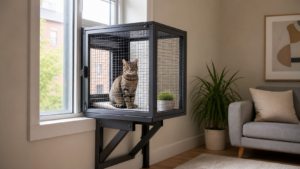
Provide quiet hiding and resting places that your cat can choose freely. Elevated spaces can be useful, but cats with limited mobility also need easily accessible options. A lack of shelving does not, by itself, mean that a cat will develop urinary disease.
Practical options include:
- Offer a sheltered resting space, such as a suitable box or covered bed.
- Provide stable, safely installed perches where appropriate.
- In multi-cat homes, distribute resting places so one cat cannot block another’s access.
- Let cats retreat without being disturbed or forced out.
2. Litter Box Optimization
A clean, accessible litter box encourages comfortable toileting, but avoidance does not reveal whether the cause is medical or environmental. For routine maintenance, see our guide on how often to clean a litter box.
Our cat spraying vs peeing guide explains behavioral differences, but it cannot rule out pain or urinary disease. Seek veterinary advice for new urinary changes rather than relying on a setup change alone.
Practical starting points:
- Aim for one box per cat plus one extra, placed in separate, accessible locations.
- Scoop at least daily and more often when needed.
- Replace litter and wash boxes according to litter type and use; do not wait for a monthly date if a box is already dirty.
- Offer soft, unscented litter and observe your cat’s preferences.
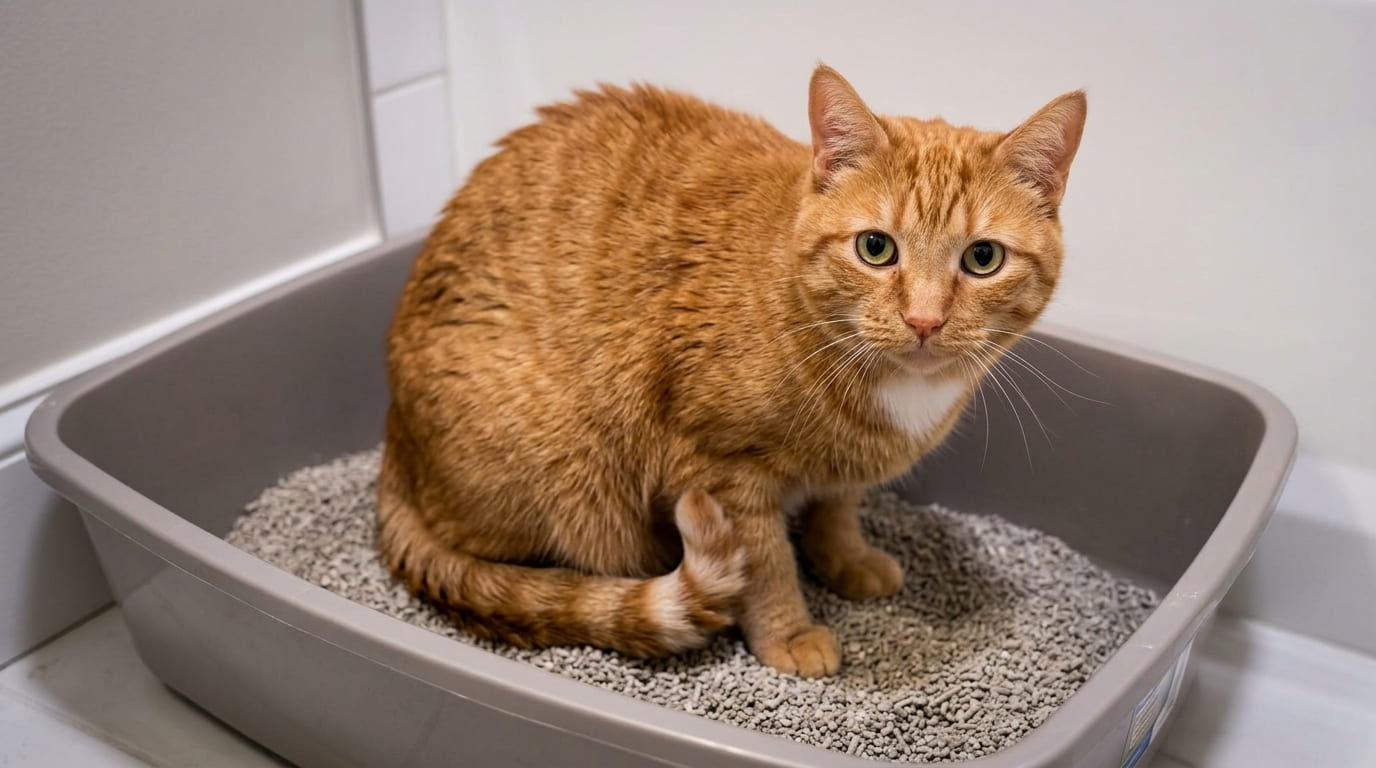
- Choose a roomy box, approximately 1.5 times the cat’s length from nose to tail base, with an accessible entrance.
- Covered versus uncovered preferences vary. Prioritize comfort, cleanliness, and an unobstructed exit.
3. Play and Predatory Activity
Play gives indoor cats opportunities to stalk, chase, and capture, supporting normal behavior and daily activity. It is part of environmental care, not a treatment for an active urinary episode.
Practical options include:
- Offer short play opportunities suited to your cat’s interest, age, and mobility.
- Use interactive toys that allow stalking and occasional successful capture.
- Introduce easy food puzzles if they suit the cat’s feeding plan.
- Adjust toys and difficulty when interest changes rather than following a fixed rotation schedule.
4. Positive Social Interaction
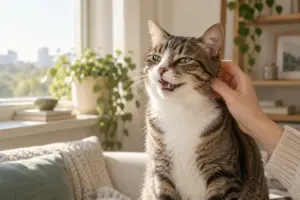
This variable is cat-specific and requires observation rather than assumption. Some cats benefit from increased human interaction; others find it intrusive. The key is offering interaction on the cat’s terms — allowing the cat to initiate contact, terminate contact, and choose proximity.
Avoid forcing optional contact when your cat tries to move away. For necessary care or handling, ask your veterinary team about a low-stress approach suited to your cat.
5. Consistent Routine
Keep feeding, play, and cleaning routines reasonably predictable. When household changes are unavoidable, preserve familiar resting places and resource access where possible. Cats differ in how they respond, so observe the individual rather than assuming that every change will trigger urinary disease.
Diet and Hydration Support for Urinary Health
Dietary support should match the cat’s nutritional and medical needs. A complete and balanced wet food can contribute moisture, but switching every cat to predominantly wet food is not a universal treatment. Discuss changes with your veterinarian, especially if your cat already eats a therapeutic diet.
The Hydration Argument
Water supplied by food depends on both the amount eaten and its moisture content. For example, 100 grams of food containing 75% moisture supplies approximately 75 grams of water. This is a calculation example, not a recommended portion or a daily water target for every cat.
Canned food can contribute substantially to water intake, while cats eating dry food obtain more of their water by drinking. Neither a fixed daily estimate nor food type alone can establish whether a cat is adequately hydrated. For cats with urinary disease, ask the veterinarian how diet and water access should fit the individual treatment plan.
A clean fountain can support better water access, but material and maintenance matter. Compare the best cat water fountains before choosing a stainless steel, ceramic, or smart model.
Practical wet food transition guidelines:
- Agree on a suitable food and transition plan with your veterinarian if your cat has a medical condition.
- Introduce changes gradually at a pace your cat tolerates; do not force acceptance by withholding food.
- Count both old and new foods toward the daily allowance rather than simply adding extra calories.
- Monitor appetite and tolerance. Contact your veterinarian if your cat stops eating or becomes unwell.
Water Fountains: Moving Water Preference
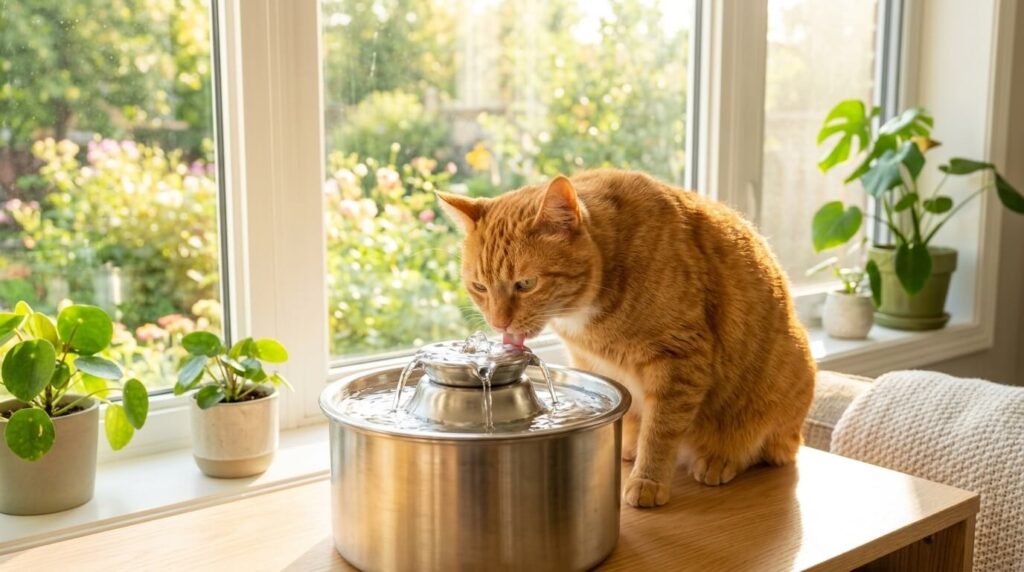
Cats differ in their water-source preferences. Some prefer a fountain, while others prefer still water in a bowl. A fountain should not be presented as a guaranteed way to increase drinking or improve urinary health.
If your cat enjoys moving water, compare practical features in our guide to the best cat water fountains. Keep a familiar bowl available while introducing a fountain, and observe whether your cat actually uses it. Choose an option that is easy to clean and maintain rather than relying on a promised percentage increase in water intake.
Fountain selection criteria for indoor cat urinary health:
- Easy-to-clean design: Choose a fountain that can be disassembled so you can reach the reservoir, drinking surface, tubing, and pump. Material alone does not replace regular cleaning.
- Accessible replacement parts: Check that compatible filters and pump parts are available. Follow the specific model’s cleaning and filter-replacement instructions.
- Suitable flow and noise: Observe whether your cat is comfortable approaching and drinking from the fountain. Adjustable flow may help accommodate individual preferences.
- Manageable capacity: Choose a reservoir you can inspect, refill, and clean consistently. A larger tank does not remove the need to refresh the water.
- Clear maintenance instructions: Follow the manufacturer’s directions for cleaning products, rinsing, and pump care. Keep a separate bowl of fresh water available.
Prescription Urinary Diets
A veterinarian may recommend a therapeutic urinary diet based on the diagnosis, stone type, recurrence history, and the cat’s other health needs. These diets do not all serve the same purpose. Some are used to dissolve struvite bladder stones, while others may be recommended to help reduce recurrence risk. Calcium oxalate stones cannot be dissolved through diet.
Ask your veterinarian which food to use, how to feed it, and what follow-up testing is needed. Do not add urinary acidifiers or supplements, or substitute another food, without discussing the change with the veterinarian. There is no single urine pH target or dietary formula appropriate for every cat with urinary signs.
A diet change does not relieve an acute urinary blockage. Repeated straining with little or no urine requires emergency veterinary care, even if the cat already eats a urinary diet.
FAQ
1. Can stress cause urinary problems in cats?
Stress can contribute to feline idiopathic cystitis in susceptible cats, but not every urinary problem is stress-related. Stones, infection, and obstruction can cause similar signs, so the cause cannot be identified from behavior alone.
A predictable environment, accessible resources, and positive interactions can support a veterinarian-guided FIC management plan. New or recurrent urinary symptoms still need assessment; repeated straining with little or no urine requires emergency care.
2. What is the best food for indoor cat urinary health?
There is no single best food for every cat’s urinary health. Choose a complete and balanced diet appropriate for the cat’s life stage and medical needs. Wet food can contribute dietary moisture, but the right choice also depends on the diagnosis, the cat’s preferences, and any existing treatment plan.
For a cat with urinary stones or recurrent urinary signs, ask the veterinarian whether a therapeutic diet is appropriate and how its effects will be monitored. Provide fresh drinking water, but a fountain is optional—not a requirement or a treatment. Do not replace a prescribed diet solely because another food is labelled “urinary health.”
3. Can I treat cat urinary problems at home?
No. You can support hydration, reduce stress, and improve litter box access at home, but urinary symptoms need veterinary guidance. Straining, blood in urine, frequent trips, crying, vomiting, lethargy, or little to no urine output should be treated as medical warning signs, not a home-care project.
4. Is urinary blockage more common in male cats?
Yes. Male cats have a longer, narrower urethra, which makes obstruction more likely. Any cat repeatedly straining and producing little or no urine needs immediate emergency assessment.
5. How do I know if my cat has a urinary blockage?
You cannot reliably distinguish a urinary blockage from cystitis or other urinary problems at home. Repeated straining with little or no urine is an emergency warning sign, and passing a few drops does not rule out an obstruction.
If your cat shows this pattern, seek emergency veterinary care immediately. Male cats are at higher risk, but any cat with suspected obstruction needs urgent assessment. Do not wait for complete absence of urine, vomiting, weakness, or collapse.
A veterinarian must assess the cause and decide which examinations and tests are needed. Tell the veterinary team when you last observed normal urination, but do not delay seeking care while trying to confirm a diagnosis yourself.
Final Thoughts
Indoor cat urinary health is about prevention where possible, fast recognition when something changes, and urgent veterinary care when red flags appear.
Wet food, fresh water, clean litter boxes, daily play, safe hiding spaces, and predictable routines can all support the urinary system. But no home routine can safely rule out blockage, stones, infection, or painful bladder disease.
If your cat is straining and not producing urine, especially if your cat is male, do not wait. Go to an emergency veterinary hospital.
References
- Buffington, C. A. T., Westropp, J. L., Chew, D. J., & Bolus, R. R. (2006). Clinical evaluation of multimodal environmental modification (MEMO) in the management of cats with idiopathic cystitis. Journal of Feline Medicine and Surgery, 8(4), 261–268. https://doi.org/10.1016/j.jfms.2006.02.002
- Westropp, J. L., & Buffington, C. A. T. (2004). Feline idiopathic cystitis: Current understanding of pathophysiology and management. Veterinary Clinics of North America: Small Animal Practice, 34(4), 1043–1055. https://doi.org/10.1016/j.cvsm.2004.03.002
- Taylor, S., et al. (2025). 2025 iCatCare consensus guidelines on the diagnosis and management of lower urinary tract diseases in cats. Journal of Feline Medicine and Surgery.
- Cornell Feline Health Center. Feline Lower Urinary Tract Disease.
- Cornell University eClinpath. Crystals.
- Cornell Feline Health Center. Feeding Your Cat.
- Feline Veterinary Medical Association. What Your Cat Needs to Feel Secure — September 2025 client education.
- Feline Veterinary Medical Association. Setting Up the Environment for Success.
- Cat Friendly Homes. Everything You Should Know About Litter Boxes.