Oliver turned eleven last spring, and the change I noticed wasn’t dramatic — it never is with cats, who are constitutionally opposed to showing vulnerability. What I noticed was an absence. The top of the bookshelf, where he had slept for nine years with the proprietary satisfaction of a cat who has claimed the highest point in any room, was empty.
He was choosing the floor near the radiator instead — the warm patch of hardwood that caught the building’s heat output on cold mornings. I noticed it for three days before my veterinary technician brain connected what I was seeing: Oliver wasn’t choosing the floor because he preferred it. He was choosing it because getting to the bookshelf had become painful.
The search for the best orthopedic cat bed — one that would give him the joint support, thermal comfort, and low-access entry his aging body now needed — became one of the most personally motivated research projects I’ve undertaken in my professional life.
But how do you know if your cat is in pain? Read our guide on the signs of cat arthritis to catch symptoms before they limit mobility.
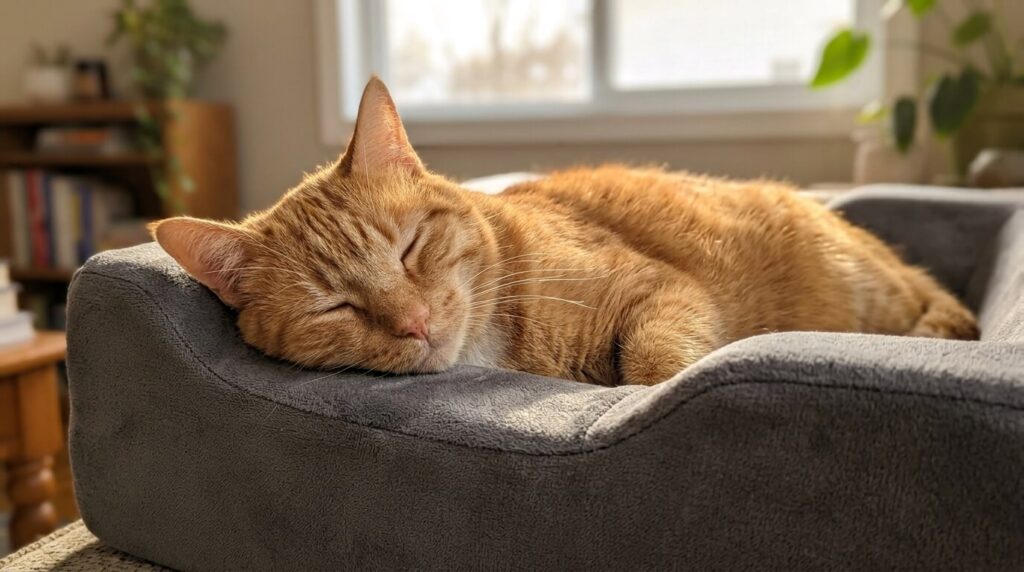
In my years as a vet tech, I have seen more “senior” cats who were actually “painful” cats than I can accurately count. The distinction matters because pain is treatable, and a cat whose quality of life has declined because of unmanaged Feline Osteoarthritis is not an inevitability of aging — it’s a clinical situation with meaningful intervention options.
The right best orthopedic cat bed is one of those interventions, and it’s one that owners can implement immediately, without a prescription, at home.
Quick Answer: What Is the Best Orthopedic Cat Bed for Senior Cats?
The best orthopedic cat bed features Medical-Grade Memory Foam — not egg-crate foam — to eliminate pressure points on arthritic joints, a Low-Profile Entry that doesn’t require a painful step-over, and a consistent, safe heat source to soothe stiff joints. Look for MET or UL-certified heating elements, removable washable covers, and foam depth of at least 3–4 inches for genuine orthopedic support.
Why Standard Cat Beds Fail Senior Joints (Pressure Points)
The difference between a standard cat bed and a genuine best orthopedic cat bed is not marketing language — it is a specific functional difference in how the sleeping surface responds to weight distribution, and that functional difference has direct consequences for a cat with Feline Osteoarthritis.
How standard beds fail:
Most standard cat beds — including the majority of cuddler beds, cave beds, and decorative round beds sold as premium products — are filled with polyester fiberfill, standard foam chips, or batting material. These materials share a critical failure mode: they compress uniformly under weight and do not redistribute pressure away from bony prominences.
The pressure point problem:
A cat in lateral recumbency (lying on their side) distributes their body weight across a limited number of contact points: the hip greater trochanter, the shoulder point, the lateral knee and hock, and the lateral ribcage. In a healthy young cat with adequate muscle mass and pain-free joints, this pressure distribution is managed by postural adjustments during sleep — the cat shifts position as pressure builds.
An arthritic cat cannot make these postural adjustments freely. The positions that relieve pressure on one joint load another that is equally painful, and the cat may remain in a position longer than is comfortable because movement itself is the painful option. The result: increased pressure on bony prominences over time, local tissue compression, reduced circulation to contact areas, and the chronic discomfort that owners observe as “the cat seems stiff when it gets up.”
What Medical-Grade Memory Foam actually does differently:
Medical-Grade Memory Foam — specifically viscoelastic polyurethane foam — responds to both heat and pressure by conforming to the exact contour of the body in contact with it. Rather than compressing uniformly and creating pressure peaks at bony prominences, it distributes weight across the entire contact surface area. This is the same material used in human pressure-relief mattresses for hospital patients who cannot reposition themselves.
The clinical consequence: a cat lying on Medical-Grade Memory Foam experiences significantly lower peak pressure at any individual bony prominence than the same cat lying on fiberfill or standard foam. For a cat with Feline Osteoarthritis of the hip, shoulder, or stifle, this reduced pressure at the periarticular tissues means reduced local inflammation, reduced discomfort during rest, and — critically — easier rising from rest because the joint hasn’t been compressed during sleep.
Why egg-crate foam is not orthopedic foam:
The convoluted “egg-crate” foam pattern — a surface with alternating peaks and valleys — is frequently marketed as orthopedic and is genuinely preferable to flat standard foam. However, it does not replicate the viscoelastic properties of true memory foam.
The peaks compress under weight independently, and body weight is still concentrated on the peaks rather than distributed across the entire surface. It’s a meaningful step up from standard foam; it is not Medical-Grade Memory Foam, and labels using “orthopedic” to describe egg-crate foam are using the term loosely.
Choosing the right bed is essential once you’ve identified the subtle signs of cat arthritis — the hesitation before a jump, the reluctance to use the stairs, the altered grooming patterns — as we’ve outlined in [our complete guide to recognizing feline arthritis signs][Why Does My Cat Sleep So Much? Indoor Cat Sleep Explained].
The Heat Factor: Why Arthritic Cats Seek Warmth
Oliver’s migration to the radiator patch was a clinically meaningful behavior — and understanding the physiology behind it explains why thermal support is not a luxury feature in the best orthopedic cat bed for senior cats. It is a therapeutic one.
Why heat reduces arthritic pain:
Feline Osteoarthritis produces joint pain through several mechanisms: cartilage degradation exposes subchondral bone to pressure, synovial inflammation produces pain mediators, and periarticular muscle tension — the chronic guarding pattern that arthritic cats adopt to protect painful joints — produces secondary musculoskeletal pain. Heat addresses several of these mechanisms simultaneously:
- Vasodilation: Heat increases local blood flow, which clears inflammatory mediators from the joint space more effectively and delivers oxygen and nutrients to healing periarticular tissues
- Muscle relaxation: Heat reduces the tension in periarticular muscle groups that are chronically contracted in guarding patterns, reducing the secondary musculoskeletal pain component
- Neural modulation: Thermal sensation activates specific sensory receptors (thermoreceptors) that compete with pain signal transmission through the gate control mechanism — essentially, warmth “turns down the volume” on pain signals using normal neural physiology
Why cats seek specific warm spots:
The instinctive heat-seeking behavior of arthritic cats is not coincidental. Cats have retained a strong thermotactic drive from their ancestral desert origins and are highly sensitive to environmental temperature gradients. An arthritic cat seeking a radiator patch, a sunny window corner, or a heating vent is responding to a genuine pain-reduction signal — the warmth that spot provides is functionally analgesic.
The problem with uncontrolled heat sources:
The radiator patch, the heating vent, and the sunny window have one significant clinical problem: their heat output is uncontrolled, intermittent, and potentially extreme. A cat sleeping directly on a radiator cover can develop thermal burns from sustained contact with an over-warm surface. A cat who self-regulates to an intermittent heat source gets the benefit only when the source is active.
The best orthopedic cat bed with a controlled, certified heating element — delivering a consistent, body-temperature-appropriate warmth without peaks that risk thermal injury — provides the therapeutic heat benefit continuously, safely, and reliably.
Top 5 Recommendations: Best Orthopedic Cat Bed (2025)
1. 🥇 The Orthopedic & Heated Hybrid
Category: Best overall best orthopedic cat bed for senior cats
Foam Depth: 4 inches Medical-Grade Memory Foam
Heat Element: MET-certified, thermostatically regulated
Low-Profile Entry: Yes (3-inch step-over)
Price Range: $75–$120
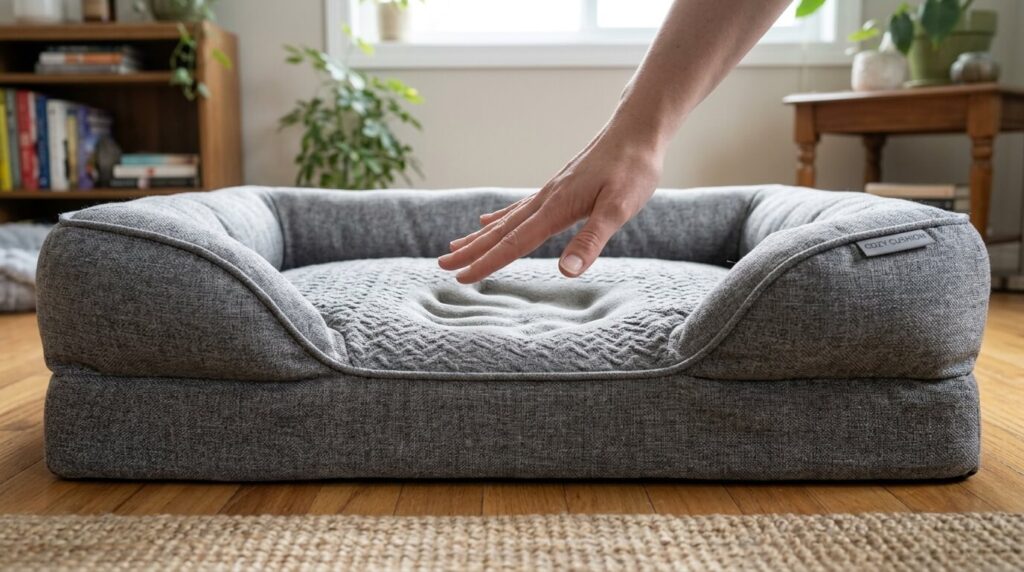
The orthopedic-and-heated hybrid represents the most complete therapeutic solution for Feline Osteoarthritis because it addresses the two primary comfort mechanisms simultaneously: pressure distribution through genuine Medical-Grade Memory Foam and thermal analgesia through a certified, regulated heating element.
The best versions in this category use a thermostatically controlled heating system that warms the surface to approximately 102°F — just above a cat’s normal body temperature — rather than a fixed-temperature element that can overheat. This temperature regulation is both safer and more therapeutically appropriate than maximal heating.
What to verify before purchasing:
- Confirm MET or UL certification for the heating element — these are the independent safety certifications that verify the electrical component has been tested
- Verify the foam is described as viscoelastic or memory foam specifically — “orthopedic” alone is insufficient as a material claim
- Check the Low-Profile Entry height — a step-over above 4 inches begins to present challenges for significantly arthritic cats
Pros:
- ✅ Addresses both pressure and thermal needs simultaneously
- ✅ Medical-Grade Memory Foam provides genuine pressure distribution
- ✅ MET/UL certified heating for safety assurance
- ✅ Thermostatically regulated temperature prevents overheating
- ✅ Low-Profile Entry accessible for arthritic cats
- ✅ Removable, machine-washable cover
- ✅ Most complete therapeutic solution in single product
Cons:
- ❌ Highest price point of any category
- ❌ Electrical cord requires management — some cats chew cords (use cord protectors)
- ❌ Requires outlet proximity — not suitable for all room positions
- ❌ Heating element adds weight — heavier to move for cleaning
- ❌ Some cats require acclimation period to the warmth sensation
Best for: Cats with diagnosed Feline Osteoarthritis, senior cats in cold apartments, cats who have demonstrated heat-seeking behavior, cats post-orthopedic surgery.
2. 🥈 The Medical-Grade Memory Foam Specialist
Category: Premium non-heated best orthopedic cat bed
Foam Depth: 4–5 inches genuine viscoelastic foam
Heat Element: None (self-warming cover option)
Low-Profile Entry: Yes (2–3 inch step-over)
Price Range: $55–$90
For cats in warmer climates, warmer apartments, or households where electrical cord management is a concern, the non-heated Medical-Grade Memory Foam specialist provides the full pressure-distribution benefit without a heating component.
The distinguishing feature at this level is foam quality — the difference between genuine viscoelastic memory foam (which conforms to body contour under heat and pressure) and standard foam sold with orthopedic language is testable: press your hand firmly into the foam surface and hold for five seconds. True memory foam will retain the handprint for two to five seconds after removal. Foam that springs back immediately is not viscoelastic memory foam regardless of labeling.
Pros:
- ✅ Deepest Medical-Grade Memory Foam depth of any category
- ✅ No electrical components — no cord management or safety concerns
- ✅ Suitable for any room position regardless of outlet proximity
- ✅ Typically lighter than heated versions — easier repositioning
- ✅ Low-Profile Entry in quality versions
- ✅ Self-warming cover options available in some models
- ✅ Excellent longevity — quality memory foam maintains properties for 5+ years
Cons:
- ❌ Does not provide the thermal analgesia component
- ❌ Less complete therapeutic intervention for cold-seeking arthritic cats
- ❌ “Orthopedic” labeling is frequently misused — requires careful verification
- ❌ Higher cost than standard beds without full feature set of heated hybrid
Best for: Senior cats in warm environments, households where electrical cords are a concern, cats whose primary symptom is pressure-related discomfort rather than cold-seeking.
3. The Low-Entry Bolster Bed with Memory Foam Base
Category: Accessibility-focused best orthopedic cat bed
Foam Depth: 3 inches memory foam base with bolster surround
Heat Element: Optional self-warming insert
Low-Profile Entry: Yes — front opening at 1.5–2 inches
Price Range: $45–$75
The bolster design — a sleeping surface surrounded on three or four sides by raised walls — addresses a specific comfort need in arthritic cats that flat orthopedic beds do not: the desire to press against something solid while resting. Many arthritic cats actively seek positions where their body contacts a wall, furniture leg, or raised edge — this contact provides proprioceptive input that is reassuring for a cat whose normal spatial awareness is altered by pain-related postural changes.
The best orthopedic cat bed in this configuration combines a genuine memory foam sleeping base with bolster walls substantial enough to provide meaningful contact support, and a front entry opening that sits as close to the floor as possible.
Pros:
- ✅ Bolster surround provides comfort contact that arthritic cats actively seek
- ✅ Memory foam base provides genuine orthopedic support
- ✅ Lowest front entry height of any bolster design
- ✅ Enclosed feeling reduces anxiety in cats who prefer den-like sleeping
- ✅ Bolster walls provide additional thermal retention without heating element
- ✅ Removable cover in quality versions
Cons:
- ❌ Bolster walls may complicate entry for cats with very severe hip or shoulder Feline Osteoarthritis
- ❌ Foam depth typically lower than specialist flat beds
- ❌ Some designs have bolster walls that are too firm — look for bolsters with some give
- ❌ Cleaning the base foam around bolsters requires more effort than flat beds
Best for: Arthritic cats who currently sleep pressed against furniture or walls, cats who prefer enclosed sleeping positions, cats with mild-to-moderate Feline Osteoarthritis.
4. The Budget Self-Warming Pad
Category: Accessible entry-level best orthopedic cat bed
Foam Depth: 1.5–2 inches standard foam with thermal reflective layer
Heat Element: Passive self-warming (reflects body heat)
Low-Profile Entry: Yes (flat pad design)
Price Range: $18–$35
The budget self-warming pad category occupies an important space for owners who need a therapeutic sleeping surface at a price point that reflects financial constraints — and for owners who want to trial the concept before committing to a premium investment.
Self-warming pads use a reflective Mylar or metallic thermal layer within the pad structure to reflect the cat’s own body heat back toward them, creating a warming effect without any electrical component. This is meaningfully warmer than a standard bed but less warm than an electrically heated option.
The foam depth is typically insufficient for genuine Medical-Grade Memory Foam orthopedic support, but a thermal self-warming pad placed over an existing piece of firm furniture (a low side table, a firm sofa cushion) can provide reasonable comfort improvement over cold flooring.
Pros:
- ✅ Most accessible price point
- ✅ No electrical components — zero safety concerns
- ✅ Flat design is the ultimate Low-Profile Entry — ground level
- ✅ Lightweight and portable — can be moved to wherever the cat currently sleeps
- ✅ Suitable as a starter intervention while investigating veterinary options
- ✅ Can supplement a more supportive sleeping surface
Cons:
- ❌ Foam depth insufficient for genuine orthopedic pressure relief
- ❌ Passive warming less effective than active heating for significant arthritis
- ❌ Limited durability compared to premium options
- ❌ Not a complete therapeutic solution for advanced Feline Osteoarthritis
Best for: Budget-conscious owners, initial trial before premium investment, cats with mild joint discomfort, supplementary use alongside other interventions.
5. The Large Breed Specialist
Category: Maine Coon, Ragdoll, and large breed best orthopedic cat bed
Foam Depth: 4 inches Medical-Grade Memory Foam
Heat Element: Optional integrated heating
Low-Profile Entry: Yes (extra-wide opening)
Price Range: $65–$110
Large breed cats — Maine Coons, Ragdolls, Norwegian Forest Cats, and similar breeds — present a specific orthopedic bed challenge. Their body weight is significantly higher than the average domestic cat (15–25 lbs vs. 8–12 lbs), which means standard-sized beds may not provide adequate support along the full body length, and the pressure distributed through a heavier body requires denser foam to prevent full compression.
The best orthopedic cat bed for large breeds specifies foam density in addition to depth — look for foam density of at least 4 lbs per cubic foot, which maintains its viscoelastic properties under the higher loads that large breed bodies produce.
Pros:
- ✅ Sized appropriately for large breed body length — full support along spine
- ✅ Higher density foam maintains orthopedic properties under greater body weight
- ✅ Extra-wide Low-Profile Entry accommodates larger frames
- ✅ Generous surface area allows full lateral extension during sleep
- ✅ Quality versions include Medical-Grade Memory Foam at appropriate density
- ✅ Heating option available in some models
Cons:
- ❌ Larger footprint — requires more floor space
- ❌ Heavier — less convenient to reposition or move for cleaning
- ❌ Higher cost due to material volume
- ❌ Fewer design and color options than standard-size versions
- ❌ Washable covers more difficult to launder due to size
Best for: Maine Coons, Ragdolls, Norwegian Forest Cats, and other large breeds with Feline Osteoarthritis or age-related joint changes.
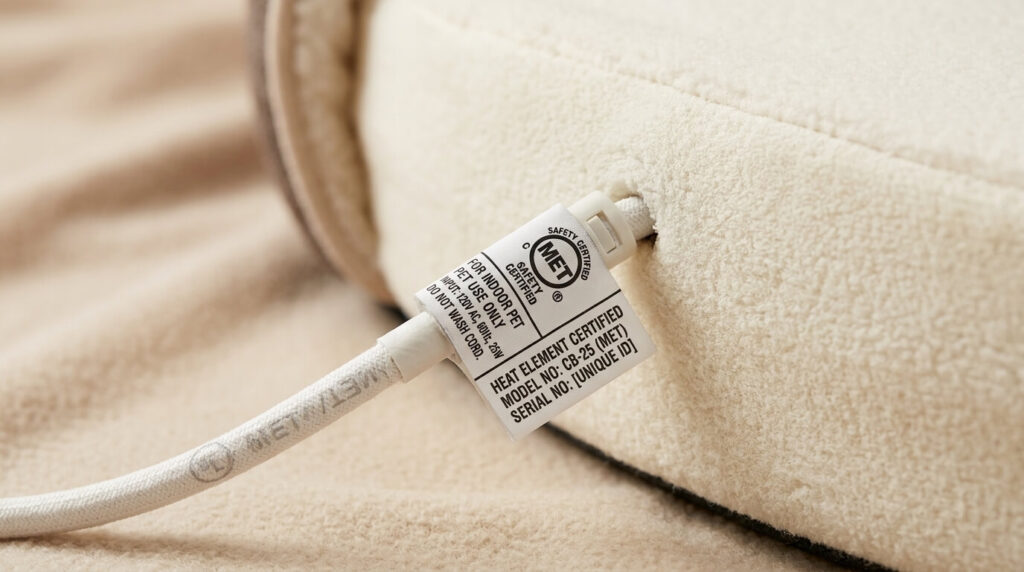
Vet Tech Safety: Checking for Heating Safety Labels
This section addresses the aspect of heated cat beds that most product reviews skip entirely, and it is the area where product quality varies most significantly and where the safety consequences of a poor choice are most serious.
Why heated cat beds require specific safety certification:
An electrically heated pet bed is a low-voltage heating device that operates continuously, often for extended periods, in close contact with an animal who cannot verbally report discomfort, cannot reliably escape an overheating surface, and whose compressed body weight on a heating element creates different thermal dynamics than the device produces when unloaded.
These conditions create specific electrical safety requirements that not all products on the market meet.
What to Look For
MET Certification:
MET Laboratories is a nationally recognized testing laboratory (NRTL) accredited by OSHA to test and certify electrical products to North American safety standards. A MET certification mark on a heated pet bed indicates the heating element, cord, controller, and temperature limits have been independently tested and verified.
UL Certification:
Underwriters Laboratories is the most widely recognized NRTL. UL certification on a heated pet bed’s electrical components indicates the same independent safety verification as MET.
What these certifications specifically verify:
- Maximum surface temperature limits that prevent thermal burns
- Cord construction and insulation integrity
- Controller safety under continuous operation conditions
- Behavior of the heating element under weight compression
Red Flags to Avoid
- No certification mark — a heated bed without MET, UL, or equivalent NRTL certification should not be used with a cat who may not reposition off an overheating surface
- “CE Mark” only — CE marking indicates EU compliance with EU directives and is not equivalent to NRTL safety certification for North American electrical safety standards
- No thermostat — a fixed-temperature heating element without a thermostat cannot respond to ambient temperature changes that affect the actual surface temperature delivered
- Damaged or exposed cord — any heated pet bed with cord damage should be discontinued immediately; cats with dental disease or chewing behavior should have cord protectors installed as a precaution
Temperature Verification at Home
After purchasing any heated cat bed, use an inexpensive infrared thermometer to verify the surface temperature after 30 minutes of operation. The surface temperature should be between 100°F and 104°F — above ambient but below the threshold for thermal injury on sustained contact. A surface reading above 108°F on continuous contact warrants discontinuing use of that product.
An orthopedic sleeping surface with verified safe heating is a cornerstone of the senior cat environmental modifications we recommend for long-term quality of life, including ramp access, elevated food stations, and litter box modifications — all covered in [our complete senior cat home adaptation guide][Senior Indoor Cat Care: How to Keep Older Cats Happy and Healthy].
Frequently Asked Questions
What is the difference between an orthopedic bed and a regular cat bed?
The term “orthopedic” should indicate a specific functional property: the ability to distribute body weight across the sleeping surface to reduce peak pressure at bony prominences. In practice, the term is used loosely by many manufacturers, and not every product labeled “orthopedic” delivers genuine orthopedic benefit.
The meaningful difference is in the core material: a genuine orthopedic cat bed uses viscoelastic memory foam — identifiable by its hand-impression retention test — that conforms to body contour and distributes weight. A regular cat bed uses polyester fiberfill, standard foam, or batting that compresses under weight without redistributing it.
For a healthy young cat, this distinction is minor. For a cat with Feline Osteoarthritis or significant age-related joint changes, the distinction directly affects pain levels during and after rest.
Do cats really need heated beds?
Not all cats, but arthritic cats benefit from them significantly and in a way that is physiologically well-understood. The thermal analgesia mechanism — heat reducing pain signal transmission and relaxing periarticular muscle guarding — is documented in veterinary literature for feline degenerative joint disease.
The clinical observation that arthritic cats actively seek warm spots is consistent with this: they are self-medicating with available heat sources because warmth reduces their pain. A certified, thermostatically regulated heated bed provides this benefit safely and continuously rather than intermittently and from potentially unsafe heat sources.
For a cat who shows no heat-seeking behavior and no signs of Feline Osteoarthritis, a heated bed is a comfort enhancement rather than a clinical necessity. For a cat who has migrated to the radiator patch or the sunny floor — as Oliver did — it’s a genuinely therapeutic intervention.
How do I clean an orthopedic cat bed without ruining the foam?
The key distinction is between cleaning the cover and cleaning the foam core — these require different approaches and should never be combined. The removable cover of a quality best orthopedic cat bed should be machine washable in cold or warm water with a pet-safe, fragrance-free detergent — avoid hot water cycles that can shrink fabric or damage waterproof backing.
The foam core should never go in a washing machine or dryer — agitation damages the viscoelastic cell structure, and high heat permanently alters the foam’s conforming properties. To clean the foam core, use a mixture of cold water and a small amount of pet-safe enzyme cleaner, apply with a cloth, and allow to air dry completely — typically 24–48 hours — before replacing the cover.
Never compress the foam core for storage or transport, as sustained compression can permanently deform the memory foam structure. If the foam core develops persistent odor despite cleaning, it is at the replacement threshold — most quality memory foam cores maintain their properties for two to three years of normal cat use.
Ultimately, investing in the best orthopedic cat bed is the kindest thing you can do for a cat who has spent a decade jumping for your joy.
References
- Lascelles, B. D. X., Henry, J. B., Brown, J., Robertson, I., Sumrell, A. T., Simpson, W., Wheeler, S., Hansen, B. D., Zamprogno, H., Freire, M., & Pease, A. (2010). “Cross-sectional study of the prevalence of radiographic degenerative joint disease in domesticated cats.” Veterinary Surgery, 39(5), 535–544. https://doi.org/10.1111/j.1532-950X.2010.00708.x
- Bennett, D., & Morton, C. (2009). “A study of owner observed behavioural and lifestyle changes in cats with musculoskeletal disease before and after analgesic therapy.” Journal of Feline Medicine and Surgery, 11(12), 997–1004. https://doi.org/10.1016/j.jfms.2009.09.005
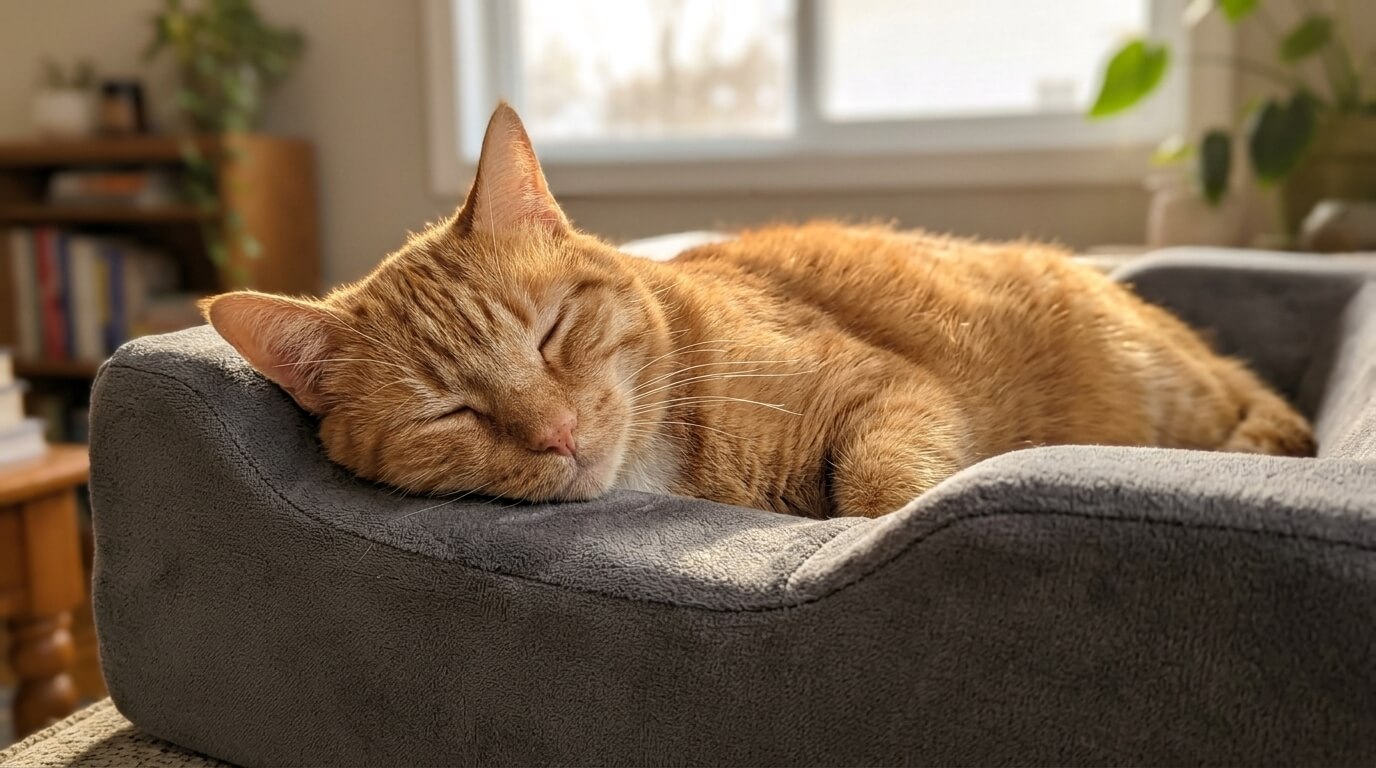
Oliver has slept on the same heated orthopedic hybrid bed for seven months. The bookshelf is still empty — I don’t expect him to return to it, and I’m not encouraging him to try. But he moves through the apartment with noticeably more ease than he did the winter he started choosing the radiator patch. He jumps to the sofa without hesitation. He grooms his back leg with the flexibility of a cat who isn’t managing chronic pain through every movement. The bed cost more than I initially wanted to spend. It was the most straightforward clinical decision I’ve made for him in eleven years.