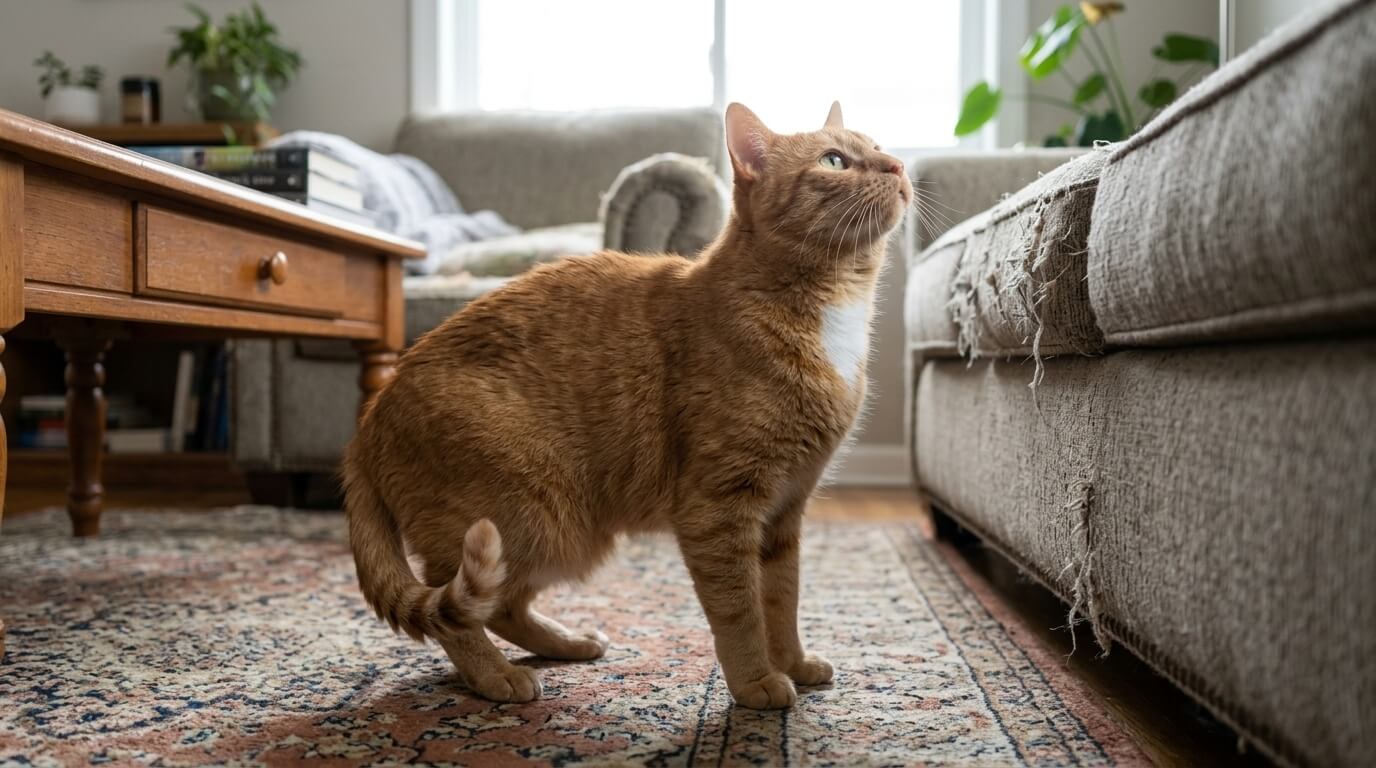
Signs of cat arthritis are often subtle. Many cats do not limp dramatically. They hesitate, avoid jumps, groom less, sleep lower, or quietly change their routine.
A pause before a familiar jump can be easy to dismiss. Note whether this is a repeated change from your cat’s usual behavior and tell your veterinarian.
This guide explains seven common signs of cat arthritis, how to observe mobility changes at home, and what apartment modifications may make daily life easier. It cannot diagnose arthritis, and it should not replace a veterinary exam, especially if your cat is painful, suddenly less active, avoiding the litter box, or reacting when touched.
For a broader aging-care checklist, read our senior indoor cat care guide.
Quick Answer: What Are the Most Common Signs of Cat Arthritis?
The most common signs of cat arthritis include hesitation before jumping, choosing lower resting spots, reduced play, stiffness after rest, changes in grooming, litter box difficulty, and irritability when touched around the hips, back, or legs.
Cats often hide pain, so arthritis may look like a gradual lifestyle change rather than an obvious limp. If you notice repeated mobility changes, schedule a veterinary exam. Arthritis pain can be managed, but cats need cat-safe treatment plans, not human pain medication.
Arthritis signs often appear alongside weight changes, grooming changes, litter box difficulty, and senior health shifts. For the broader prevention plan, see our indoor cat health prevention guide.
| Sign | What It May Look Like | Why It Matters |
|---|---|---|
| Jump hesitation | Pausing before the sofa, bed, or window perch | Jumping loads hips, knees, elbows, and spine |
| Grooming changes | Messy lower back or tail base | Pain may limit flexibility |
| New irritability | Hissing or swatting when touched | Handling may trigger joint pain |
| Sleeping lower | Avoiding high beds or cat trees | Climbing may feel harder |
| Bunny-hop movement | Hind legs move together on stairs | Can suggest hind limb discomfort |
| Litter box avoidance | Missing the box or avoiding high sides | Entry and squatting may hurt |
| Less play | Watching toys instead of chasing | Fast turns and jumps may be uncomfortable |
Safety Note
This guide is for educational purposes only and does not replace veterinary advice.
If your cat has a diagnosed medical condition, sudden symptoms, appetite changes, weight loss, vomiting, urination problems, breathing difficulty, severe pain, poisoning risk, or rapid decline, contact your veterinarian before relying on a product or home-care change.
Indoor Cat Expert articles are created by the Indoor Cat Expert Editorial Team and follow our Editorial Policy.
Table of Contents
Why Cat Arthritis Is Hard to Spot
Cats may show pain through changes in everyday behavior rather than a clear limp. This can make discomfort difficult to recognize at home.
Look for changes from your cat’s own normal routine, rather than comparing them with another cat.
Subtle changes should not automatically be attributed to age. Illness, injury, stress and pain can produce overlapping signs.
What makes feline arthritis uniquely difficult to detect:
- Cats with arthritis may not show an obvious limp.
- Changes can be gradual or sudden; a sudden decline needs prompt veterinary advice.
- Changes in activity are not proof of normal aging or arthritis.
- Cats reduce activity before they show overt signs — the absence of behavior is harder to notice than the presence of an abnormal behavior
- Owners normalize the gradual changes because they live with the cat daily and do not perceive the cumulative shift
Degenerative joint disease involves damage to joint tissues and can cause persistent pain. It may affect several joints. A veterinarian must assess the cause and treatment needs; appearance alone cannot measure pain.
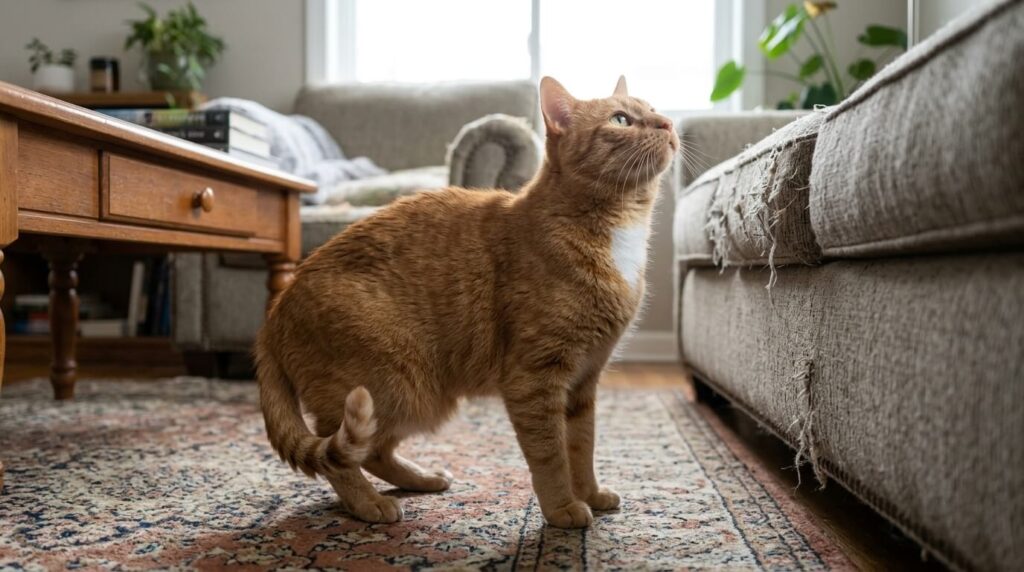
7 Subtle Signs of Cat Arthritis
Sign 1: The Jump Hesitation
Hesitating before a familiar jump, jumping less often or choosing a lower route can signal discomfort. These changes are not specific to arthritis.
What to watch for:
- Pausing before a familiar jump more often than usual
- Taking a longer approach run than usual before jumping
- Refusing previously routine jumps entirely — choosing to walk around rather than over
- Landing and immediately shaking out a paw or limping briefly before settling (this transient lameness often disappears within seconds)
Record a short video of naturally occurring movement if you can do so without encouraging a painful jump. Do not make your cat jump to test for arthritis.
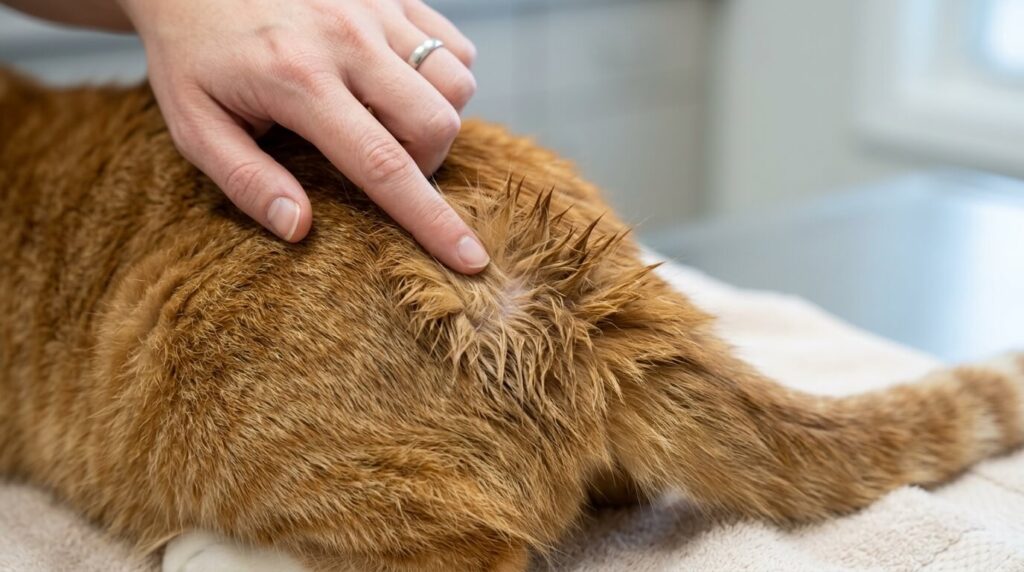
Sign 2: The Unkempt Back and Tail Base
Pain or reduced flexibility may make grooming difficult, including around the back and tail base.
What to watch for:
- Coat that looks dull, matted, or rough in the lower back and tail base region specifically
- New flaking or changes in coat condition
- Repeated licking of an area; this can also have skin or other causes
- New mats around the back or tail base
A grooming change alone cannot diagnose joint disease. Dental disease, skin problems and other illnesses can also affect grooming.
Sign 3: The Grumpy Cat
New hissing, swatting or avoidance during handling may indicate pain, fear or stress. Stop handling if your cat reacts and arrange veterinary advice.
What to watch for:
- Negative reactions to touching the lower back, hips, or hind legs specifically
- Flinching or tensing when touched in areas that were previously unproblematic
- Growling, hissing, or swatting during previously accepted activities like brushing
- Avoiding human contact that requires them to be held or restrained
- Do not bend joints or press painful areas to look for grinding or other signs.
Tell your veterinarian where and when the reaction occurred. Do not repeat the touch to reproduce a painful response.
Sign 4: The Sleeping Location Shift
A cat with reduced mobility may choose an easier-to-reach resting place. Changes in sleeping location can also have other explanations.
If your cat is choosing lower sleeping spots or avoiding favorite perches, compare our guide to the best orthopedic cat bed options for senior cats before changing the whole room setup.
What to watch for:
- Abandonment of previously favored high sleeping spots
- New preference for floor-level or low-furniture sleeping locations
- Choosing to sleep on soft surfaces rather than firm favorites — memory foam and blankets cushion inflamed joints
- Sleeping in the same spot for significantly longer periods — moving hurts, so they move less
A comfortable, accessible bed can be one part of home support. When choosing the right orthopedic cat bed, consider easy entry and your cat’s preferences; a bed does not replace pain assessment.
Sign 5: The Bunny Hop
A new hopping or otherwise altered gait is worth reporting. The movement pattern alone does not identify which joint is painful or establish an arthritis diagnosis.
What to watch for:
- Both hind feet landing simultaneously when descending or ascending stairs
- Reluctance to use stairs at all — choosing to stay on one floor rather than navigate inclines
- A rocking or swaying motion in the hindquarters during walking
- Shortening of the hind limb stride compared to the forelimb stride — cats with hip pain take shorter hind steps
If possible, record the change without making your cat use stairs. Seek prompt care for sudden weakness, severe pain or inability to walk.
Sign 6: The Litter Box Avoidance
High sides and difficult access may trouble a cat with mobility problems. However, urinating or defecating outside the box also has medical and behavioral causes; do not assume arthritis.
What to watch for:
- New elimination outside the litter box in a previously house-trained cat
- Entering the box and immediately exiting without eliminating
- A new change in movement when entering or leaving the box
- Elimination near but not inside the box
- Posture changes during elimination — a cat who cannot flex comfortably may squat incompletely, leading to urine on the rim or outside the box
Offer an accessible low-entry box and seek veterinary assessment. Repeated straining with little or no urine is an emergency, not a reason to wait for a different litter box.
Sign 7: The Reduced Play Response
Reduced interest in play can accompany pain or other illness. Compare with your cat’s usual activity and report a persistent change.
You should modify play sessions to keep them at floor level to avoid the high-impact jumping that aggravates inflamed joints — For lower-impact play ideas, use our indoor cat exercise routine and keep games close to the floor.
What to watch for:
- Play sessions that are shorter than they used to be, with no other obvious explanation
- Preference for play types that do not require jumping or rapid direction changes
- Playing from a resting position — batting at toys without standing up
- Stiffness or slower movement after activity
How to Observe Your Cat’s Mobility at Home
Home observations can help your veterinarian, but they cannot diagnose arthritis. Keep brief notes or videos without provoking pain.
Mobility Notes:
1. Usual movement
Watch voluntary movement on familiar surfaces. Do not lure your cat into a jump or repeat a difficult movement.
2. Stair use
Notice changes only if your cat normally uses stairs. Do not carry them to stairs for a test.
3. The Grooming Observation
Watch a complete grooming session. Note: which areas the cat reaches comfortably, whether the lower back and tail base are groomed, and whether grooming sessions are shorter than they used to be.
4. Responses during normal contact
Note avoidance or discomfort during ordinary gentle contact. Do not palpate the spine, manipulate joints or press sore areas; leave examination to your veterinarian.
5. The Activity Log
Record meaningful changes in usual movement, rest, grooming and play. There is no validated home diagnosis based on how many times a cat moves in two hours.
Record changes when you notice them and contact your veterinarian rather than waiting months to build a log.
Apartment Changes That May Help Arthritic Cats
Accessible resources and comfortable resting places can support a veterinary treatment plan. They do not replace assessment or prescribed pain relief.
Mobility support is part of caring for aging indoor cats. Tailor changes to your cat’s needs with veterinary guidance.
Ramps and Step Systems
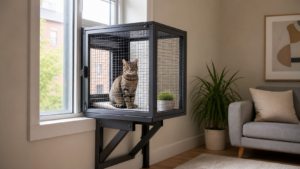
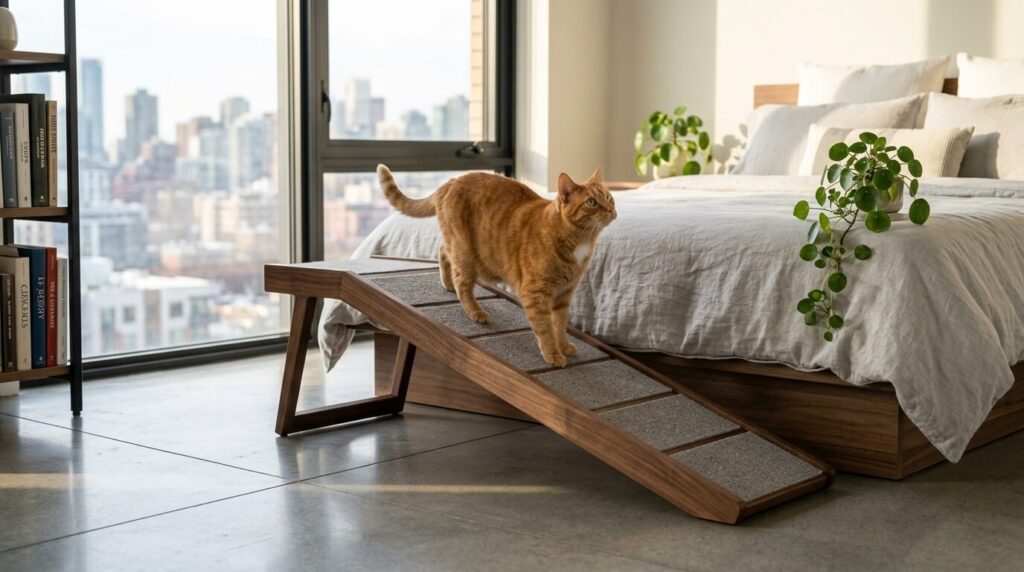
Replace vertical jumps with inclined ramps or step systems wherever your cat needs elevation access.
Implementation:
- Use stable ramps with secure, non-slip surfaces and a gentle incline your cat can manage.
- Place stable, low steps beside frequently used furniture; there is no single step height suitable for every cat.
- Secure non-slip coverings so they cannot bunch up or detach.
- Place ramps at the specific locations you have observed your cat hesitating — not where you think they should need them
Low-Entry Litter Boxes
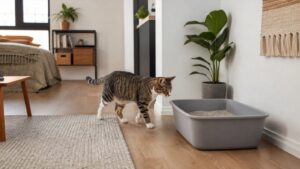
Offer a roomy low-entry litter box in an easily accessible location; keep familiar options available while checking what your cat can use comfortably.
Options:
- Choose an entry low enough for your cat to step over comfortably.
- Modified standard boxes — cut a U-shaped entry in one side with scissors and sand the edges smooth
- Large storage totes with a cut entry — the wide floor area gives arthritic cats more room to adjust their posture during elimination without stepping on the rim
Food and Water Station Elevation
Keep food and water easy to reach. If your veterinarian recommends raising a bowl, choose a stable height suited to your cat rather than a fixed height for all cats.
Heated Sleeping Surfaces
Offer a warm, padded resting place. If using a pet heating product, follow its instructions, inspect it regularly and ensure your cat can move away. Ask your veterinarian before using heat for a cat with limited mobility or sensation.
FAQ
Does my cat need a vet for arthritis?
Yes. Arrange an examination for persistent mobility or behavior changes. Treatment aims to improve comfort and function; it should not be presented as a guaranteed way to reverse or slow structural joint damage.
Your veterinarian may recommend medication, weight management and changes at home according to your cat’s health. Discuss the evidence and safety of supplements before using them.
Not all supplements require a prescription, but that does not establish safety or benefit. Your veterinarian will decide whether imaging or other tests are appropriate.
Can I give my cat human pain medicine for arthritis?
No. Do not give cats human pain medicine unless your veterinarian specifically tells you to. Ibuprofen, acetaminophen, naproxen, aspirin, and many leftover pet medications can be dangerous or fatal to cats. Arthritis pain needs a cat-safe veterinary plan.
Is slowing down always arthritis in cats?
No. Slowing down can be caused by arthritis, injury, dental pain, obesity, neurological problems, illness, stress, or other conditions. The pattern matters, but a veterinary exam is needed to identify the cause and choose safe treatment.
Can indoor cats get arthritis early?
Yes. Younger and indoor cats can also develop joint problems. Age, previous injury and developmental conditions can be relevant; indoor living alone does not establish the cause.
Maintaining an appropriate body condition is part of mobility care. Do not predict an individual cat’s arthritis onset from their weight or age alone.
Seek veterinary advice about persistent movement changes at any age.
What is the most overlooked sign of cat arthritis?
Grooming changes can be easy to overlook, but there is no single sign that diagnoses arthritis. A newly unkempt coat should be discussed with your veterinarian.
Note grooming changes alongside mobility, appetite and litter-box use rather than assuming that coat changes prove advanced joint disease.
The Feline Veterinary Medical Association’s arthritis guide lists changes in grooming, jumping, stair use and handling responses as reasons to contact your veterinarian.
Regular wellness exams matter because mobility changes are easy to miss at home. See why an annual vet visit for indoor cats is still important.
Final Thoughts
Signs of cat arthritis are often quiet. A missed jump, a lower sleeping spot, a messy tail base, or a shorter play session may be your cat’s way of adapting around discomfort.
The goal is not to diagnose arthritis at home. The goal is to notice patterns early, make daily life easier, and bring useful observations to your veterinarian.
With ramps, low-entry litter boxes, soft resting spots, weight control, gentle play, and veterinary pain management when appropriate, many arthritic cats can stay comfortable and engaged for years.
References
- Hardie, E. M., Roe, S. C., & Martin, F. R. (2002). Radiographic evidence of degenerative joint disease in geriatric cats: 100 cases (1994–1997). Journal of the American Veterinary Medical Association, 220(5), 628–632. https://doi.org/10.2460/javma.2002.220.628
- Lascelles, B. D. X., Henry, J. B., Brown, J., Robertson, I., Sumrell, A. T., Simpson, W., Wheeler, S., Hansen, B. D., Chumbley, H., Toth, L., & Hardie, E. M. (2010). Cross-sectional study of the prevalence of radiographic degenerative joint disease in domesticated cats. Veterinary Surgery, 39(5), 535–544. https://doi.org/10.1111/j.1532-950X.2010.00708.x
For veterinary background on joint disease and the need to rule out other causes, see Cornell’s guide to slowing down and joint pain.