By a cat parent who turned a bare apartment into a feline paradise — one item at a time.
When I brought Oliver home, my apartment had exactly one cat-specific item in it: a litter box. No cat tree. No scratching post. No window perch. No puzzle feeder. Just a litter box, a food bowl, and the naive confidence of someone who didn’t yet understand what a seven-pound ball of predatory instinct actually needed to thrive in a 650-square-foot apartment.
Within three weeks, Oliver had chewed through one charging cable, developed a habit of running at full speed from the bedroom to the living room at 2 AM, and started biting my ankles when I sat still for too long. He wasn’t a difficult cat. He was a profoundly bored one. Everything I’ve learned since then — from veterinary behavioral guidelines, from feline enrichment research, from years of testing products and watching what Oliver actually uses versus what I thought he’d use — is distilled into this indoor cat enrichment checklist.
This is my complete system, room by room, day by day, and I’m sharing it because I genuinely wish someone had handed it to me the week before Oliver came home.
Quick Answer
A complete indoor cat enrichment checklist addresses five core pillars: vertical climbing territory, appropriate scratching outlets, interactive hunting play, cognitive puzzle feeding, and olfactory stimulation. Systematically auditing your apartment against these five requirements and addressing each one eliminates the behavioral problems caused by feline boredom — cord chewing, night zoomies, aggression, over-grooming — and creates a genuinely satisfying indoor environment for your cat.
Why You Need a Systematic Approach to Enrichment
The reason a checklist works better than ad-hoc enrichment purchases is that feline behavioral needs are specific, interconnected, and easy to accidentally address only partially.
Most cat owners provide some enrichment. Very few provide enrichment that systematically addresses all five behavioral need categories, at the right frequency, with appropriate novelty management. The result is a cat who has a cat tree and a toy mouse but still chews cords and bites ankles — because the specific need those behaviors are compensating for isn’t being met by the specific enrichment that’s been provided.
The AAFP Five Pillars of Feline Environmental Needs
The American Association of Feline Practitioners’ Feline Environmental Needs Guidelines (Ellis et al., 2013) provide the evidence-based framework that this checklist is built around. The five pillars are:
1. Safe Space
Cats require access to safe, secure locations where they feel completely protected and can retreat from stressors without being followed or disturbed.
2. Multiple Separate Resources
Food, water, litter, resting spaces, scratching surfaces, and play areas should be provided at multiple locations — not concentrated in a single area where resource competition (in multi-cat homes) or spatial anxiety can develop.
3. Opportunity for Play and Predatory Behavior
The complete predatory sequence — stalk, chase, pounce, catch, subdue — must be regularly engaged through interactive play. This is neurologically necessary, not optional.
4. Positive, Consistent, and Predictable Human-Cat Interaction
Social engagement on terms that respect the cat’s preferences and signals builds behavioral health and trust.
5. An Environment That Respects the Cat’s Senses
Olfactory, auditory, and visual environments should be managed to provide stimulation without overwhelming.
This checklist addresses all five pillars systematically.
This checklist is designed as the actionable, condensed companion to our comprehensive deep-dive masterclass on indoor cat enrichment and vertical territory — where we cover the behavioral science behind each requirement in full detail. [Read our complete indoor cat enrichment masterclass here → The Small Apartment Cat Survival Guide: 7 Pillars of Indoor Enrichment]
Part 1: The Environmental Setup Checklist
This is your apartment audit — the physical infrastructure that makes everything else possible. Work through each item and check it off as you implement it. These are the permanent, ongoing elements that your cat lives with every day.
Vertical Territory
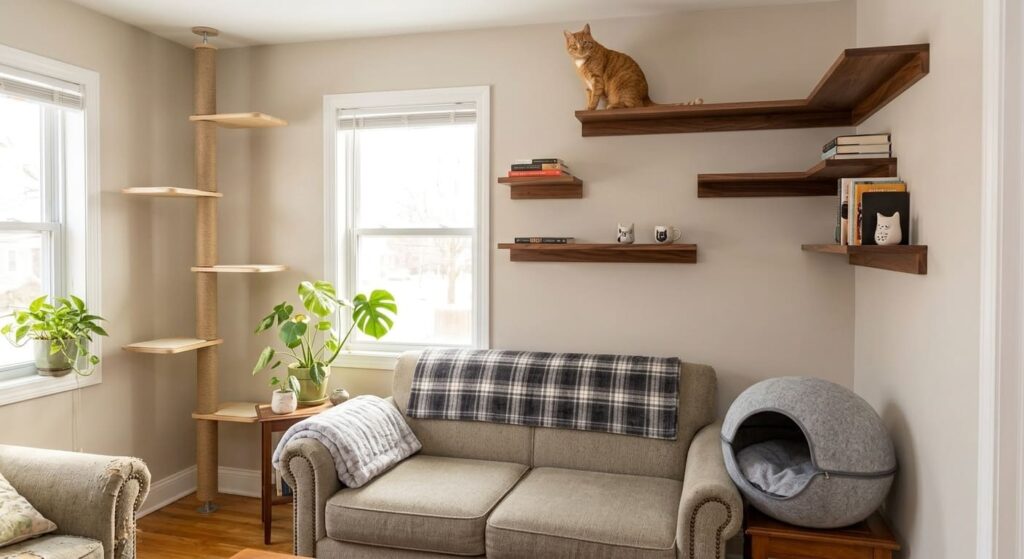
- ☐ At least one tall cat tree or tension-mounted floor-to-ceiling pole reaching a minimum of five feet — positioned near the primary social area where you spend most of your time
- ☐ Cat tree placed adjacent to a window — height plus outdoor view is the maximum enrichment combination; the location determines how much the structure gets used
- ☐ Multiple platform levels on the cat tree, with at least three distinct resting heights
- ☐ A second elevated option in a different room — wall-mounted shelving, a second smaller cat tree, or a tension pole creates a multi-room vertical territory
- ☐ Platforms wide enough for full-body lying — minimum 12×14 inches for average cats; narrow platforms are used as stepping stones, not resting spots
- ☐ The top platform accessible — if your cat cannot comfortably reach the highest point, the vertical territory value of the structure is significantly reduced
Safe Spaces and Hiding Spots
- ☐ At least two enclosed hiding options — cave beds, covered cat beds with single openings, boxes with blankets; one per main living area
- ☐ One elevated hiding spot — a cat tree top platform with partial enclosure, a wall shelf with sides; height plus enclosure is the premium safe space combination
- ☐ At least one hiding spot in each room your cat regularly occupies
- ☐ All hiding spots respect the “don’t follow” rule — you and all household members commit to not reaching into or disturbing the cat when they are using these spaces
- ☐ Hiding spots scented with familiar bedding — your worn clothing or the cat’s existing bed material makes new hiding spots immediately comfortable
Scratching Infrastructure
- ☐ At least one tall vertical scratching post (minimum 28 inches) that allows full-body stretch — this is the non-negotiable scratching outlet; insufficient height means the behavior goes to furniture or door frames
- ☐ Sisal rope or sisal fabric surface on the primary scratching post — most cats prefer sisal to carpet for scratching; the resistance of the fiber engages the nail-shedding behavior effectively
- ☐ The scratching post is stable — press the top firmly; if it tips or rocks, your cat will abandon it after one unstable experience
- ☐ Post positioned at a territory boundary — near a room entry, beside the sofa, at the bedroom door; cats scratch at territorial markers, not in isolated corners
- ☐ A horizontal scratching option in addition to vertical — corrugated cardboard scratchers placed flat on the floor; some cats are primarily horizontal scratchers
- ☐ Multiple scratching surfaces in different rooms — the scratching need arises throughout the territory, not just in one room
Sleeping and Resting Infrastructure
- ☐ An enclosed donut or cave bed in the primary social room — the enclosed design with a raised rim satisfies the security-seeking behavior cats show at rest
- ☐ A thermal self-heating mat or warm-surface sleeping option — particularly important in winter; cats seek warm sleeping surfaces instinctively
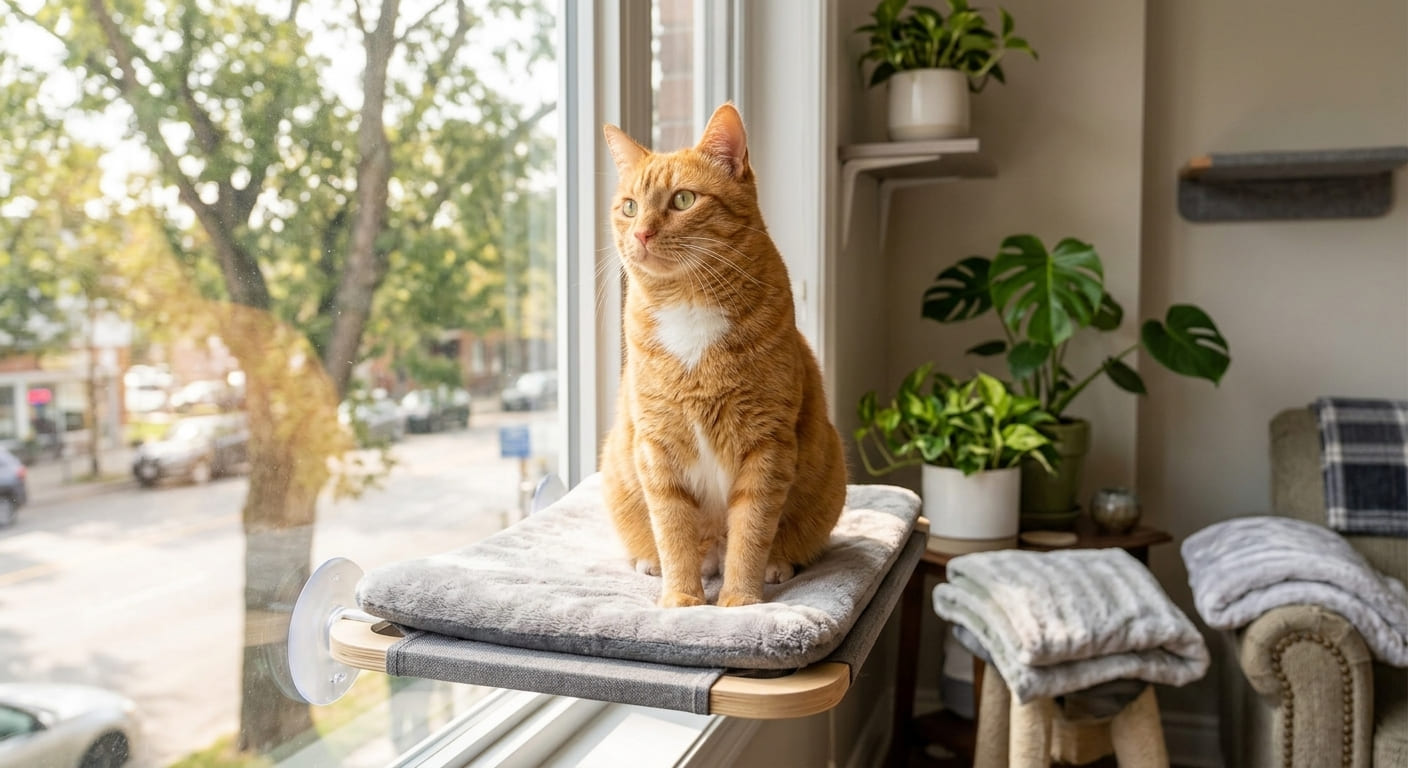
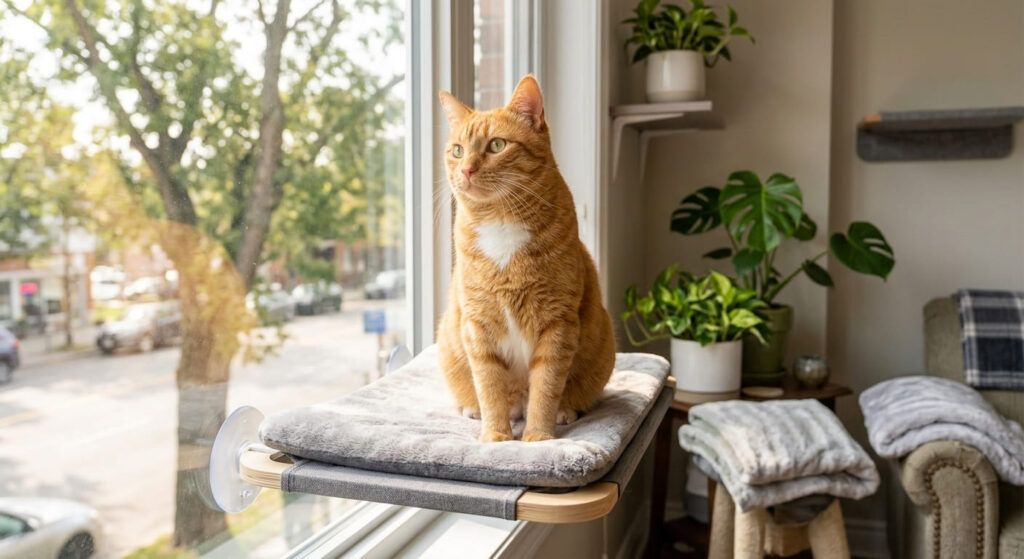
- ☐ A window perch at the primary bird-watching window — this serves both as a resting spot and a sensory enrichment platform; Oliver uses his window perch three to four hours daily
- ☐ At least one bed or sleeping option on each floor level — floor level, furniture height, and elevated; cats rest at different heights throughout the day
- ☐ Beds in quiet locations away from high-traffic paths — a sleeping cat who is repeatedly disturbed by household movement gets less restorative rest
Resource Placement
- ☐ Food and water in separate locations — cats instinctively avoid drinking near their food (in the wild, still water near prey may be contaminated); separation increases water intake
- ☐ N+1 litter boxes (N = number of cats) — one cat minimum two boxes; two cats minimum three; positioned in different locations
- ☐ No resource clustering — litter box, food, and water should not all be in the same small area; spread resources across the apartment
- ☐ Water fountain running — flowing water increases voluntary intake; positioned away from food
Part 2: The Daily Mental and Physical Routine Checklist
This section is where environmental setup meets active management. These are the things you do consistently — the daily and weekly behaviors that make the difference between a cat who has enrichment available and a cat who is actively enriched.
Daily Interactive Play (Non-Negotiable)
- ☐ Morning play session: 15 minutes using a telescopic wand toy — complete the full predatory sequence (stalk → chase → catch → subdue → wind down)
- ☐ Evening play session: 15 minutes — positioned in the late afternoon or early evening when your cat’s crepuscular activity peak aligns naturally
- ☐ Gradual wind-down at the end of each session — slow the wand toy movement progressively over the final three minutes; an abrupt end leaves your cat in unresolved arousal
- ☐ Wand toy stored completely out of reach between sessions — a wand toy that’s always accessible loses its status as a special event; supervised use only
- ☐ Session timing noted — if your cat is waking you at 3 AM, the evening play session is not late enough or intense enough; adjust timing before bedtime
Puzzle Feeding
- ☐ At least one meal per day served in a puzzle feeder rather than a flat bowl — converts a thirty-second passive eating event into a ten to twenty-minute active foraging behavior
- ☐ Puzzle difficulty appropriate to your cat’s current skill level — Level 1 for beginners; graduate to Level 2 only when Level 1 is solved quickly; a puzzle too difficult produces frustration, not enrichment
- ☐ Variety in puzzle types — a flat wooden board one day, a tower puzzle the next; different puzzle structures engage different problem-solving approaches
- ☐ Puzzle feeders cleaned after every use — food residue in puzzle compartments grows bacteria; a puzzle feeder is a food contact surface
Independent Toy Access
- ☐ Two to three floor toys available at any time — one natural fiber kicker toy, one crinkle ball or batting toy, one over-the-door bungee (zero floor space)
- ☐ Toy rotation every five to seven days — stored toys reintroduced feel novel; continuous availability eliminates novelty; rotate from the closed toy library basket
- ☐ High-value treat scattered or hidden once daily — scatter-feeding (placing small treats in several locations around the apartment) activates foraging behavior and encourages exploration of the full territory
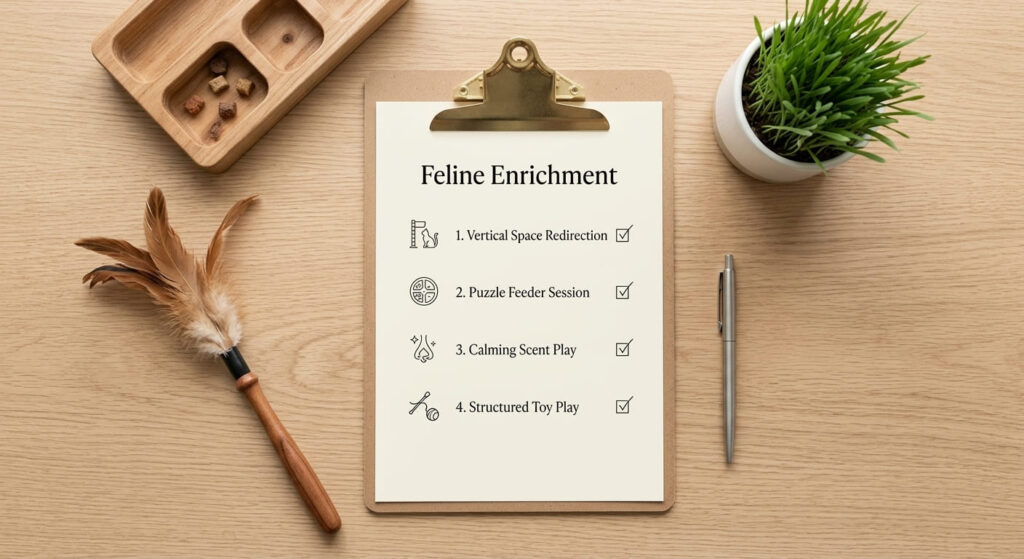
Part 3: Sensory and Olfactory Enrichment Checklist
This section addresses the enrichment category most consistently overlooked by cat owners — and the one that research suggests has profound effects on feline wellbeing and stress baseline.
Olfactory Enrichment
- ☐ Cat grass growing and accessible — a pot of wheat grass or oat grass at floor level that your cat can investigate and chew; rotate two pots so one is always fresh and vibrant
- ☐ Catnip or silver vine introduced weekly — a pinch of dried catnip on a toy or floor mat; for cats who don’t respond to catnip, silver vine produces a response in 75–80% of non-catnip responders
- ☐ Novel scent introduction monthly — a small amount of a new safe scent placed on a piece of fabric for investigation; dried lavender (place in fabric, not direct contact), a pine cone from outside, a piece of driftwood; novel olfactory stimuli activate the same investigative behavior as novel objects
- ☐ Foraging scent trail weekly — rub a high-value treat along several surfaces in a trail that ends at the treat location; engages nose-down tracking behavior rarely used in an indoor environment
Visual Enrichment
- ☐ Bird feeder installed outside the primary watching window — this single addition often provides more consistent daily visual enrichment than any purchased toy; multiple bird visits per hour during active feeding periods
- ☐ Window perch positioned for maximum sightline — the view, not just the sun, determines enrichment value; a perch facing a blank wall provides warmth but not stimulation
- ☐ Fish tank or bird cage as visual enrichment — a fish tank with active fish provides continuous movement stimulation; ensure the tank is secured against a determined cat’s access attempts
- ☐ Cat-specific video content available during long alone periods — videos of birds, squirrels, and fish produced specifically for cat viewing are available on streaming platforms; some cats engage intensely, some ignore entirely; trial determines value
Auditory Enrichment
- ☐ Ambient audio during alone periods — a radio, podcast, or television on a talk channel provides continuous auditory stimulation that partially addresses the acoustic emptiness of an alone-period apartment
- ☐ Cat-specific calming music playlist identified and tested — music composed around frequencies known to engage feline auditory processing; available on several streaming platforms
- ☐ Outdoor audio accessible via an open (screened) window when weather permits — bird song, wind, rain, and ambient outdoor sounds provide a rich auditory environment at zero cost
Pheromone and Chemical Enrichment
- ☐ Synthetic facial pheromone diffuser running in the primary living area — supports baseline anxiety reduction, particularly in multi-cat households or high-activity environments
- ☐ Diffuser refill schedule maintained — a spent cartridge provides no benefit; set a calendar reminder for replacement per manufacturer guidance
- ☐ Catnip-stuffed toys rotated through the active toy selection — catnip potency diminishes with repeated exposure; a catnip toy stored in an airtight bag retains potency longer
The Outdoor Sensory Experience
- ☐ Window open (with secure screen) daily when weather permits — even thirty minutes of outdoor air access significantly expands the olfactory environment
- ☐ Cat grass or safe herbs on the windowsill — positions olfactory enrichment at the point of maximum air exchange
- ☐ Catio or window box catio installation considered — for cats showing intense window-watching behavior, a catio provides the full outdoor sensory experience safely
Part 4: Social and Cognitive Enrichment Checklist
Human Interaction Quality
- ☐ Daily unstructured social time — not play, not feeding, just coexistence in the same space with low-key availability; cats are comforted by proximity even without active interaction
- ☐ Slow blink communication practiced — the slow blink is a documented friendly signal in feline social communication; Oliver’s response to a slow blink directed at him is visible and immediate
- ☐ Petting interaction follows the cat’s signals — interactive engagement initiated and ended by the cat, not the human; respecting early overstimulation signals prevents bite incidents and builds trust over time
- ☐ Name recognition and recall practiced with high-value treats — not obedience training in the dog-training sense, but a reliable name response that is useful for safety and builds positive human-cat association
Training as Enrichment
- ☐ One trick or behavior being actively trained — cats learn through positive reinforcement with remarkable effectiveness; target training (touching a target stick with their nose), sit, and high-five are all achievable; the cognitive engagement of training sessions is genuinely enriching independent of the specific behavior learned
- ☐ Short training sessions (two to three minutes maximum) — cats have shorter operant conditioning attention windows than dogs; frequent brief sessions are more effective than infrequent long ones
- ☐ Clicker or marker word used consistently — consistency in the marker signal accelerates learning and clarifies communication
How to Use Your Free Printable Indoor Cat Enrichment Checklist
The complete checklist in this guide is formatted to be printed and used as a physical audit tool — check off what you have already implemented, circle what needs to be added, and use it as a shopping and project list.
How to Approach the Audit
Step 1: Print and do a first pass honestly. Go through every item and mark what is currently in place. Most people discover they are strong in one or two pillars and significantly under-provided in others.
Step 2: Identify your lowest-scoring pillar. If you have zero puzzle feeders and only one floor toy rotated monthly, cognitive and hunting enrichment are your priority regardless of how excellent your vertical territory is. Address the weakest pillar first.
Step 3: Implement in order of behavioral impact. Interactive play sessions first — this has the highest immediate behavioral impact. Vertical territory second. Puzzle feeding third. Sensory enrichment fourth.
Step 4: Reaudit monthly for the first six months. The checklist is most valuable as an ongoing monitoring tool, not a one-time exercise.
If your budget is limited, reassure yourself that meeting many of these enrichment requirements costs nothing or very little — cardboard boxes, paper bags, DIY puzzle feeders from muffin tins, and open windows are free. [Read our complete guide to DIY cat enrichment ideas that cost almost nothing here → 15 DIY Cat Enrichment Ideas for Small Apartments (Under \$20)]
The Toy Rotation Strategy: Creating Endless Novelty
This deserves its own section because it is the strategy that amplifies the value of every toy you own — and it is the reason a small, curated toy collection can provide continuous enrichment without continuous purchasing.
The Science Behind Novelty
Cats habituate to familiar objects rapidly through a process called stimulus-specific habituation — repeated exposure to the same object in the same state reduces the neural response it produces until the object is effectively invisible to their behavioral system.
A toy that has been on the floor for three days is neurologically dead prey. The same toy, stored for three weeks and reintroduced, produces a genuine novelty response — elevated investigation, predatory engagement, and behavioral arousal — almost identical to a brand new toy.
The Rotation System in Practice
Active inventory (always available):
- Two floor toys maximum
- One over-the-door bungee toy (zero floor space)
- Interactive wand toy stored away, brought out for play sessions only
Stored inventory (in a closed basket):
- All remaining toys, organized by type
- Rotated into active inventory every five to seven days
Rotation protocol:
- Remove the two current floor toys and return them to storage
- Select two toys from storage — ideally from different categories than the previous two
- If possible, add a small amount of catnip or a drop of silver vine tincture to the reintroduced toys to amplify novelty response
- Place in slightly different locations than previous toys — spatial novelty adds an additional layer
The result: Oliver’s engagement with each toy when it reappears after three weeks in storage is indistinguishable from his engagement with a brand new toy. The rotation strategy has eliminated the need for continuous toy purchasing to maintain engagement, and it keeps my apartment tidy because only two floor toys are visible at any time.
Your Monthly Enrichment Audit
Use this brief monthly check to maintain the system over time:
Structural check:
- ☐ Cat tree stable — no wobble or loose platforms
- ☐ Scratching post sisal intact — replace if compressed or shredded beyond effective use
- ☐ Window perch suction cups re-pressed or mounting checked
- ☐ Pheromone diffuser refill cartridge checked
Behavioral check:
- ☐ No new behavioral issues since last month (biting, pacing, night zoomies, inappropriate elimination)
- ☐ Oliver using all major enrichment structures regularly
- ☐ Toy rotation happening weekly
- ☐ Play sessions happening daily
Health intersection check:
- ☐ No changes in appetite, water intake, or litter box patterns
- ☐ Coat condition maintained
- ☐ Weight stable (weigh monthly)
- ☐ No new hesitations in mobility that might indicate joint changes
FAQ
1. Is there a simple indoor cat enrichment checklist version for beginners who feel overwhelmed by this guide?
Yes — and starting small is genuinely better than doing nothing while feeling overwhelmed. If you are completely new to cat enrichment, begin with these five highest-impact items from this indoor cat enrichment checklist, in this order:
One tall stable scratching post positioned at a territory boundary (immediately reduces furniture scratching),
one fifteen-minute wand toy play session every evening (immediately reduces night zoomies and ankle biting),
one puzzle feeder for at least one daily meal (immediately adds cognitive engagement),
one window perch at your cat’s preferred window (immediately provides passive enrichment during your absence),
and a toy rotation practice (immediately multiplies the value of every toy you own).
These five items address four of the five behavioral need pillars and cost less than $100 combined — often significantly less. Add remaining checklist items progressively over the following months as budget and time allow.
2. How much time per day does cat enrichment actually require from me?
The active time investment is thirty to forty-five minutes per day, concentrated in two fifteen-minute play sessions and five to ten minutes of puzzle feeder preparation and toy rotation management. The environmental setup — the cat tree, the scratching posts, the window perch — requires zero daily time once in place. The toy rotation takes approximately two minutes weekly.
The passive enrichment elements (bird feeder outside the window, cat grass on the sill, pheromone diffuser running) require no daily attention. The time-intensive elements are the interactive play sessions, and these genuinely cannot be reduced below fifteen minutes twice daily if you want to meaningfully address a cat’s predatory behavior needs.
The return on that daily thirty minutes — a calm, behaviorally healthy cat who doesn’t bite your ankles, chew your cords, or wake you at 3 AM — makes it the highest-return thirty minutes in your cat ownership day.
3. My cat seems happy and doesn’t have behavioral problems. Do I still need to use an indoor cat enrichment checklist?
This is a genuinely good question, and the honest answer has two layers. The first: behavioral problems are often the late, visible symptom of enrichment deficiency — by the time a cat is obviously bored enough to act out, they’ve typically been under-enriched for months.
The absence of behavioral problems is not the same as the presence of positive enrichment. The second: even a cat who appears content may be operating below their optimal quality of life — a kind of low-level resignation that reads as calm but is actually suppressed behavioral drive. The enrichment checklist is not primarily a behavioral problem treatment; it is a quality-of-life framework.
A cat who has everything on this list isn’t just less problematic — they are genuinely happier, more engaged, more cognitively active, and more physically healthy than a cat who happens not to be acting out despite under-enrichment. The goal is not to stop problems. The goal is to provide a life that matches what an intelligent, physically capable, behaviorally complex animal actually needs.
References
- Ellis, S. L. H., et al. (2013). AAFP and ISFM feline environmental needs guidelines. Journal of Feline Medicine and Surgery, 15(3), 219–230. https://journals.sagepub.com/doi/10.1177/1098612X13477537
- Herron, M. E., & Buffington, C. A. T. (2010). Environmental enrichment for indoor cats. Compendium: Continuing Education for Veterinarians, 32(12), E1–E5. https://www.ncbi.nlm.nih.gov/pmc/articles/PMC3922041/
Disclaimer: This article reflects the personal experience of a cat owner and draws on published veterinary behavioral guidelines from the American Association of Feline Practitioners and peer-reviewed feline enrichment research. It is intended as a practical enrichment guide and does not replace individualized veterinary or behavioral assessment. If your cat is showing behavioral problems that persist despite comprehensive enrichment implementation, please consult a licensed veterinarian or board-certified veterinary behaviorist.