By a cat parent who got a serious bite from the sweetest boy he knew — and needed to understand why.
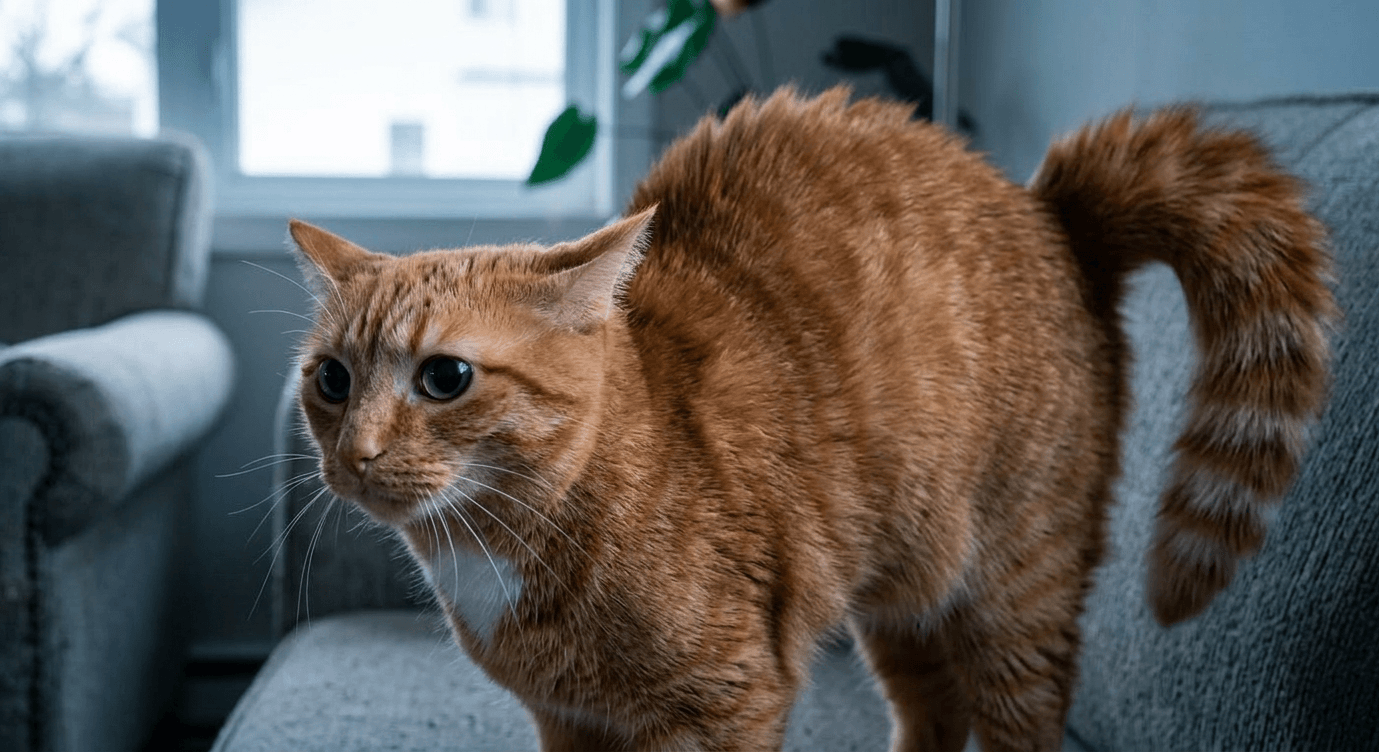
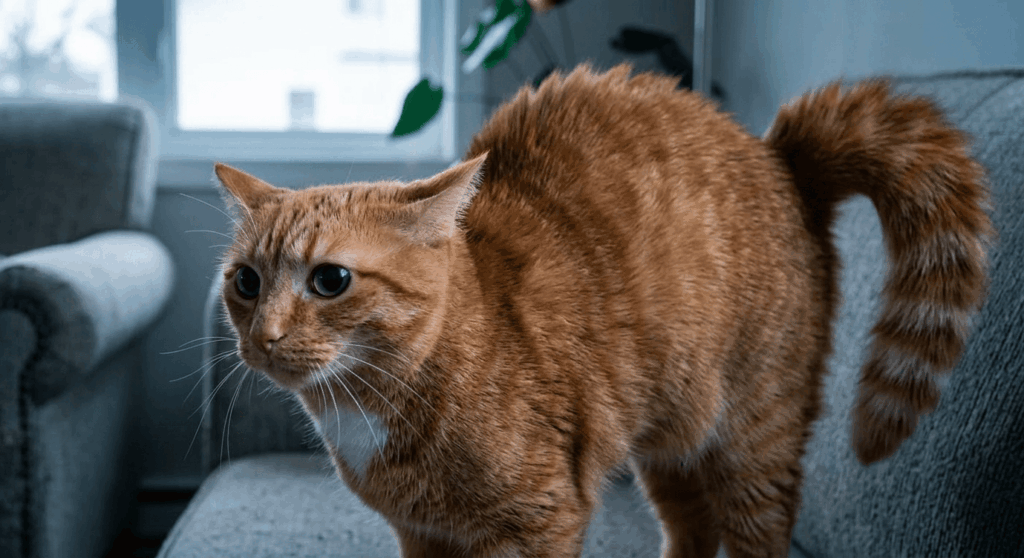
It happened on a Tuesday evening. I was walking through the living room in socks, completely relaxed, when Oliver launched off the couch and attacked my ankle with a ferocity I had never seen from him in four years. Not play-biting. Not the gentle, warning nip he gives when he’s had enough petting. This was a full commit — claws, teeth, the works. I pulled back, genuinely shaken. Oliver retreated behind the armchair, tail puffed to twice its normal size, eyes fixed on the window.
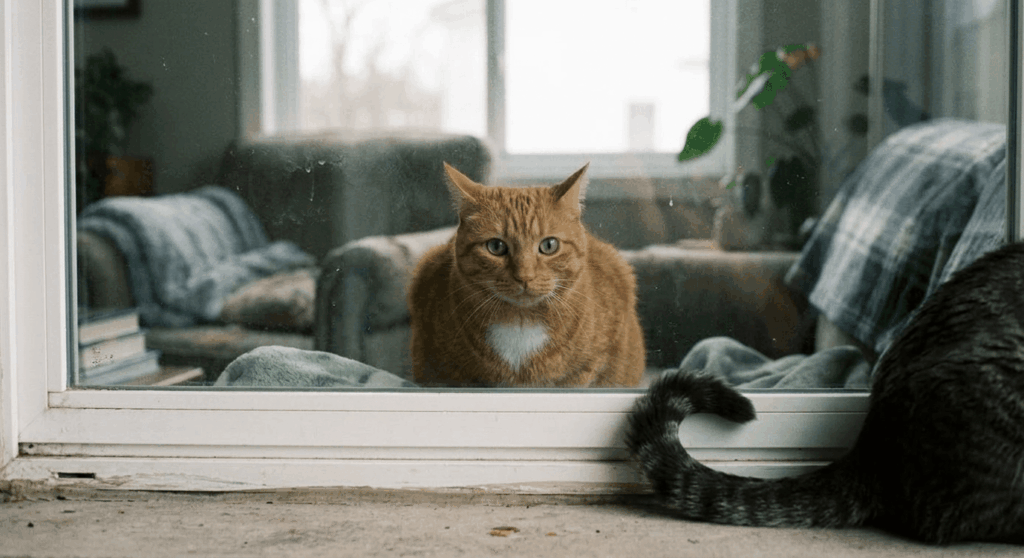
That’s when I noticed it: a large grey stray cat sitting on the porch railing, staring directly into our apartment. Oliver hadn’t attacked me. He had attacked the only moving thing within reach while his nervous system was completely flooded with threat response. If you’ve landed here because your indoor cat suddenly aggressive behavior has left you scared, hurt, or heartbroken — I want you to know that what you’re feeling is completely valid, and that your cat almost certainly isn’t broken, mean, or dangerous in the way you might fear right now.
Quick Answer
When an indoor cat suddenly aggressive behavior emerges without obvious provocation, the leading causes are undetected physical pain, redirected aggression from an outdoor visual trigger, or petting-induced overstimulation. Always rule out medical causes with a vet first. Never punish the cat. Identify the specific environmental stressor and address it systematically — aggression is always communication, never spite.
First: Your Cat Is Not Trying to Hurt You
Before we go anywhere else, I need to say this clearly.
Cats do not act aggressively out of malice, revenge, or spite. This is one of the most persistent and damaging myths in feline ownership, and it causes people to respond to aggression with punishment — which makes everything dramatically worse.
When a cat bites or scratches, something in their internal or external world has exceeded their capacity to cope. They are communicating — loudly, physically, and urgently — that something is very wrong. The message might be “I am in pain,” or “I am terrified,” or “my nervous system is so overwhelmed right now that I cannot regulate my behavior.”
Understanding which message your cat is sending is the entire job. And it starts with one non-negotiable step.
Rule Out Pain First: The Vet Visit
This is the step people most commonly skip, because the aggression seems behavioral — triggered by something external, following a recognizable pattern. But pain is a silent and invisible driver of feline aggression, and cats are evolutionarily programmed to hide it.
In the wild, a cat who visibly displays pain or weakness becomes a target. So domestic cats suppress pain signals with impressive effectiveness — right up until the moment someone touches the wrong spot, and the response is explosive.
Medical conditions commonly linked to sudden-onset aggression include:
- Dental disease — tooth resorption and abscesses are extraordinarily painful and often completely invisible without X-rays
- Arthritis and joint pain — especially in cats over seven; being touched, lifted, or approached from behind triggers defensive aggression
- Hyperthyroidism — causes neurological irritability and dramatically lowers the aggression threshold
- Neurological conditions — including brain lesions or seizure activity that may present as sudden behavioral episodes
- Skin conditions or parasites — hyperesthesia (feline rolling skin disease) causes painful skin sensitivity, where a simple touch feels like an electric shock
- Urinary tract disease — a cat who associates pain with their environment may redirect that distress outward
If your cat’s aggression appeared suddenly and without a clear trigger, please see a vet before doing anything else. A behavioral problem cannot be resolved if an underlying physical one is driving it.
When Oliver had his first dental cleaning at age five, the vet found two teeth that needed extraction. She told me afterward that the level of infection in those roots suggested months of chronic pain. I thought about every time he’d pulled away from face pats. I had misread his pain response as antisocial personality for months.
Cause 1: Redirected Aggression (The Most Misunderstood Type)
This is what happened with Oliver and the stray on the porch — and it is, in my experience and in the behavioral literature, the most commonly misunderstood form of feline aggression.
How Redirected Aggression Works
Here is the neurological sequence:
- Your cat perceives a genuine threat — a stray cat outside, a loud noise, a dog walking past the window, a confrontation between cats in a multi-cat household
- Their sympathetic nervous system activates fully — adrenaline, cortisol, the whole threat-response package
- The actual threat is inaccessible — on the other side of glass, in another room, already gone
- Your cat’s arousal state is at maximum but has nowhere to discharge
- You walk by. You are moving. You are available. You become the outlet.
This is not personal. This is neurology.
The particularly dangerous aspect of redirected aggression is the time lag. Your cat may remain in a heightened arousal state for twenty minutes to several hours after the triggering event has passed. So you might walk into the room forty-five minutes after the stray cat left, see Oliver apparently calm, go to pet him — and get bitten, with no visible trigger in sight.
Signs Your Cat Is Still Aroused (Do Not Approach)
- Pupils fully dilated
- Tail lashing or fully puffed
- Skin twitching along the back
- Low vocalizations — growling, yowling under breath
- Unusual stillness combined with intense focused stare
- Refusing treats they would normally immediately accept
If you see these signs, give your cat a minimum of 30 minutes of complete, undemanding space. Do not try to comfort, redirect, or engage them. Close a door between you if needed — for their decompression and your safety.
Addressing the Root Cause
For Oliver, the solution required both short-term and long-term management:
Short term:
- I put frosted window film on the lower panels of the living room window — Oliver can still see sky and birds, but ground-level intruder cats are no longer visible
- I identified which window the stray most frequently appeared at and shifted Oliver’s favorite perch away from that sightline
Long term:
- I contacted my building’s management about the feral cat colony being fed near our entrance
- I invested in a Feliway Classic diffuser near the primary trigger window — the synthetic feline facial pheromone has good evidence behind it for reducing baseline anxiety
Cause 2: Petting-Induced Overstimulation (When Love Becomes Too Much)
This one is deeply counterintuitive, and it trips up even very experienced cat owners.
Your cat comes to you, headbutts your hand, drops into your lap, and begins purring. You start petting. Everything is blissful. Then, completely without warning — or so it seems — they grab your hand, rake your forearm, and leave.
The Neuroscience of “Too Much”
Cats have a far lower threshold for tactile overstimulation than dogs or humans. Repetitive stroking — particularly in certain locations — generates a neurological response that begins as pleasurable and tips, gradually, into genuinely painful or aversive.
Think of it like this: if someone kept tapping the same spot on your arm for four minutes without stopping, the sensation would eventually become intensely irritating, regardless of how gentle the tapping was.
High-risk petting zones for most cats:
- The base of the tail (highly sensitive nerve concentration)
- The belly (an exposure that feels vulnerable to many cats)
- Prolonged petting of the same area in a repetitive rhythm
Reading the Warning Signs
Cats almost always telegraph overstimulation before they act on it. We miss the signals because we’re relaxed and focused on how much we’re enjoying the contact.
Watch for:
- Skin twitching or rippling along the back
- Tail beginning to move — first a slow sweep, then faster
- Ears rotating backward or flattening slightly
- Pupils dilating despite ambient light not changing
- Head turning to look at your hand
When you see any two of these signals together, stop petting immediately. Let your cat leave or simply sit quietly with them. Do not try to “soothe” them with more touching — this escalates rather than resolves the state.
The goal over time is to map your individual cat’s tolerance window — how many minutes, in which locations, in which contexts. Oliver tolerates about four minutes of back-petting when he’s in a calm state. Five minutes is where things get risky. I now keep that window firmly in mind.
Cause 3: Fear and Environmental Changes
Fear-based aggression is defensive, not offensive. A frightened cat does not want to fight — they want to escape. Aggression only occurs when escape is impossible or perceived to be impossible.
The behavioral term for this is fear-induced aggression, and the cat’s body language tells the whole story: crouched low, ears back, pupils dilated, weight shifted to back legs ready to flee. If cornered, they will strike — not because they want to, but because they have no other perceived option.
Common Environmental Triggers
- New people in the home — houseguests, workers, new partners
- New animals — a second cat or dog introduced without a proper gradual protocol
- Rearranged furniture — cats map their territory in three dimensions; significant changes disrupt their sense of spatial security
- Loud or unpredictable sounds — construction, a new appliance, changes in the sonic environment of the apartment
- Your own absence or disrupted routine — this one surprises people
Sudden changes in your schedule — like leaving them alone over a weekend trip — can disrupt their established territorial routine and create anxiety-driven behavioral changes upon your return that owners often misread as the cat being “angry” at them for leaving. [Read our complete guide to preparing your cat for your absence here → How to Introduce a Second Cat in a Small Apartment (Step-by-Step Guide)]
The Role of Vertical Territory
One of the most effective environmental interventions for fear-based aggression is often overlooked: vertical space.
Height equals safety in feline psychology. A cat who has access to an elevated position can observe threats from a position of advantage, which dramatically reduces their perceived need to respond defensively with aggression.
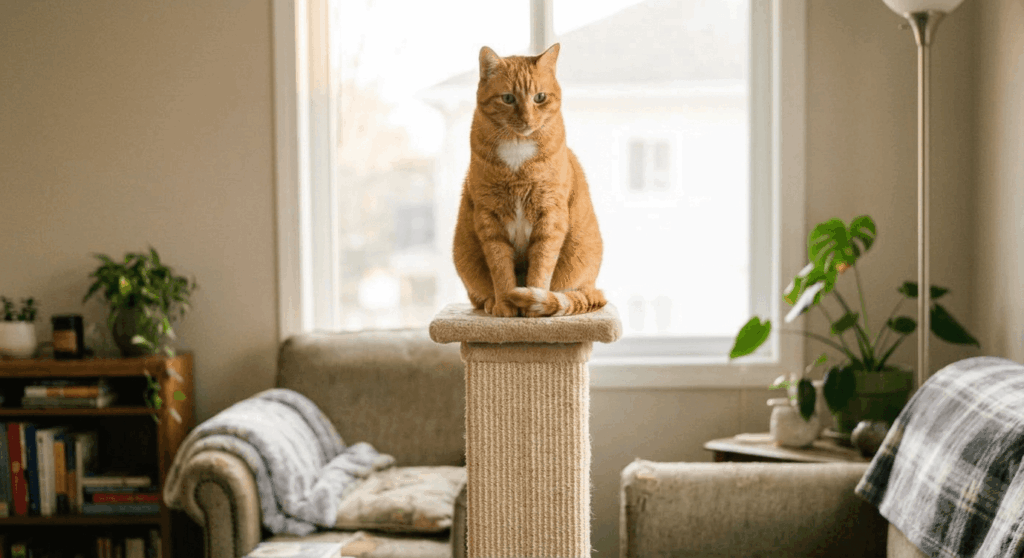
Aggressive or fearful cats especially need vertical territory to feel secure — an elevated cat tree serves as a genuine observation deck where they can process environmental stressors and de-escalate their own arousal without intervention from you. [See our full guide to creating enriching vertical territory for indoor cats here → The Small Apartment Cat Survival Guide: 7 Pillars of Indoor Enrichment]
Practical additions for a fear-prone cat:
- Cat tree positioned with sightlines to the main room entry points
- Wall-mounted shelving that creates elevated walkways
- A dedicated “safe room” — a quiet space with their bed, litter box, and water — where they can retreat without being followed
Cause 4: Inter-Cat Aggression in Multi-Cat Homes
If you have more than one cat, the aggression you’re witnessing may not actually be directed at you at all — you may simply be in the wrong place at the wrong time, as I was with Oliver.
Status and resource conflicts between cats in a shared home are among the leading causes of chronic aggression. And because cats’ social hierarchies are subtle and fluid, the conflict may have been building for months before it becomes visible to you.
Warning signs of inter-cat tension:
- One cat consistently blocking another’s access to food, litter, or water
- Staring contests that don’t resolve
- One cat spending increasing time in isolated locations
- Stress behaviors — over-grooming, hiding, inappropriate elimination — in the subordinate cat
The baseline resource rule: In a multi-cat home, you need N+1 of every resource — litter boxes, feeding stations, and water sources — where N equals the number of cats. This eliminates resource competition as a driver of tension.
How to De-escalate an Angry Cat: Step by Step
When Oliver is in a heightened state, I have learned exactly what to do — and critically, what not to do.
What TO Do
- Freeze and become boring — stop all movement immediately. Fast movement triggers predatory or defensive response.
- Look away — direct eye contact is a threat signal in feline communication. Avert your gaze and let your body language go completely passive.
- Back away slowly — create distance without turning your back fully until you have enough space between you.
- Provide an exit route — ensure the cat has a clear path away from you. A cornered cat has no choice but to escalate.
- Close a door between you — give them a room with their resources and complete quiet. No checking on them for at least 30 minutes.
- Log what happened — time of day, what preceded the incident, any environmental factors. Patterns will emerge.
What NOT To Do
- Never yell, spray with water, or physically punish — this confirms that you are a threat and guarantees future aggression escalates
- Never try to hold or restrain an aroused cat — this will result in injury and deepens their fear response
- Never follow them when they retreat — retreat is self-regulation; allowing it is the kindest and most effective thing you can do
- Never use your hands as play objects — this teaches cats that human skin is an appropriate target for predatory behavior
A note on ThunderShirts and pheromone products: Feliway Classic diffusers and Zylkene (a natural calming supplement) have reasonable evidence supporting their use for anxiety reduction. They won’t resolve the root cause alone but can meaningfully lower baseline arousal while you address the underlying trigger.
When to Involve a Professional
Most cases of redirected or overstimulation-based aggression resolve with environmental management and behavioral awareness. But some situations warrant professional support:
- Aggression that is escalating in frequency or severity despite your interventions
- Multiple types of aggression presenting simultaneously
- Any aggression that has broken skin — cat bites are medically significant and carry infection risk
- Aggression in a multi-cat home that is causing injury to other animals
Ask your vet for a referral to a board-certified veterinary behaviorist (DACVB) — not a general trainer, not a “cat whisperer.” A DACVB is a licensed veterinarian with advanced residency training in animal behavioral medicine, and they can prescribe medication alongside behavioral protocols when indicated.
FAQ
1. Is my indoor cat suddenly aggressive because of something I did wrong?
When your indoor cat suddenly aggressive behavior appears, it almost never means you did something wrong in a fundamental sense. It means a specific trigger — medical, environmental, or social — has exceeded your cat’s coping capacity. That said, reviewing recent changes is worth doing honestly: new schedule, new person in the home, new animal, a change in their feeding routine, or a new cat visible outside. Cats are exquisitely sensitive to environmental change, and something that seems minor to you can be significantly disruptive to them. The response is never personal, and it is always solvable with the right approach.
2. Should I put my aggressive cat in a time-out?
The concept of a “time-out” carries punishment connotations that simply don’t apply to cats — they lack the capacity to link confinement after an incident to the behavior that caused it. However, voluntary separation is genuinely useful. If you close your cat in a quiet room with their resources and give them thirty to sixty minutes of complete calm and darkness, you are not punishing them — you are giving their nervous system the recovery time it needs. The key distinction: the space should feel safe, not aversive. No shouting before closing the door, no forcibly carrying them. Guide them gently or allow them to retreat there naturally.
3. Do water fountains or feeding changes affect cat aggression?
Indirectly, yes. Chronic pain from urinary issues, hunger stress, or dietary nutrient deficiencies can all lower a cat’s aggression threshold. A cat who is in subtle physical discomfort — perhaps from concentrated urine causing bladder irritation — is operating with a much smaller emotional buffer before they react. Ensuring your cat is optimally hydrated with a fountain, fed appropriate portions of high-quality food, and regularly monitored for health changes are all part of a comprehensive behavioral health strategy. The body and the behavior are not separate systems.
References
- Amat, M., Manteca, X., Mariotti, V. M., Ruiz de la Torre, J. L., & Fatjó, J. (2009). Feline aggression towards family members: A territorial and dominance issue? Journal of Veterinary Behavior: Clinical Applications and Research, 4(2), 91–96. https://doi.org/10.1016/j.jveb.2008.06.004
- Overall, K. L., & Dyer, D. (2005). Enrichment strategies for laboratory animals from the viewpoint of clinical veterinary behavioral medicine: Emphasis on cats and dogs. ILAR Journal, 46(2), 202–215. https://doi.org/10.1093/ilar.46.2.202
Disclaimer: This article is written from the lived experience of a cat owner and is informed by published veterinary behavioral medicine research. It does not replace the assessment of a licensed veterinarian or board-certified veterinary behaviorist. If your cat’s aggression is causing injury to people or other animals, please seek professional veterinary behavioral support promptly.