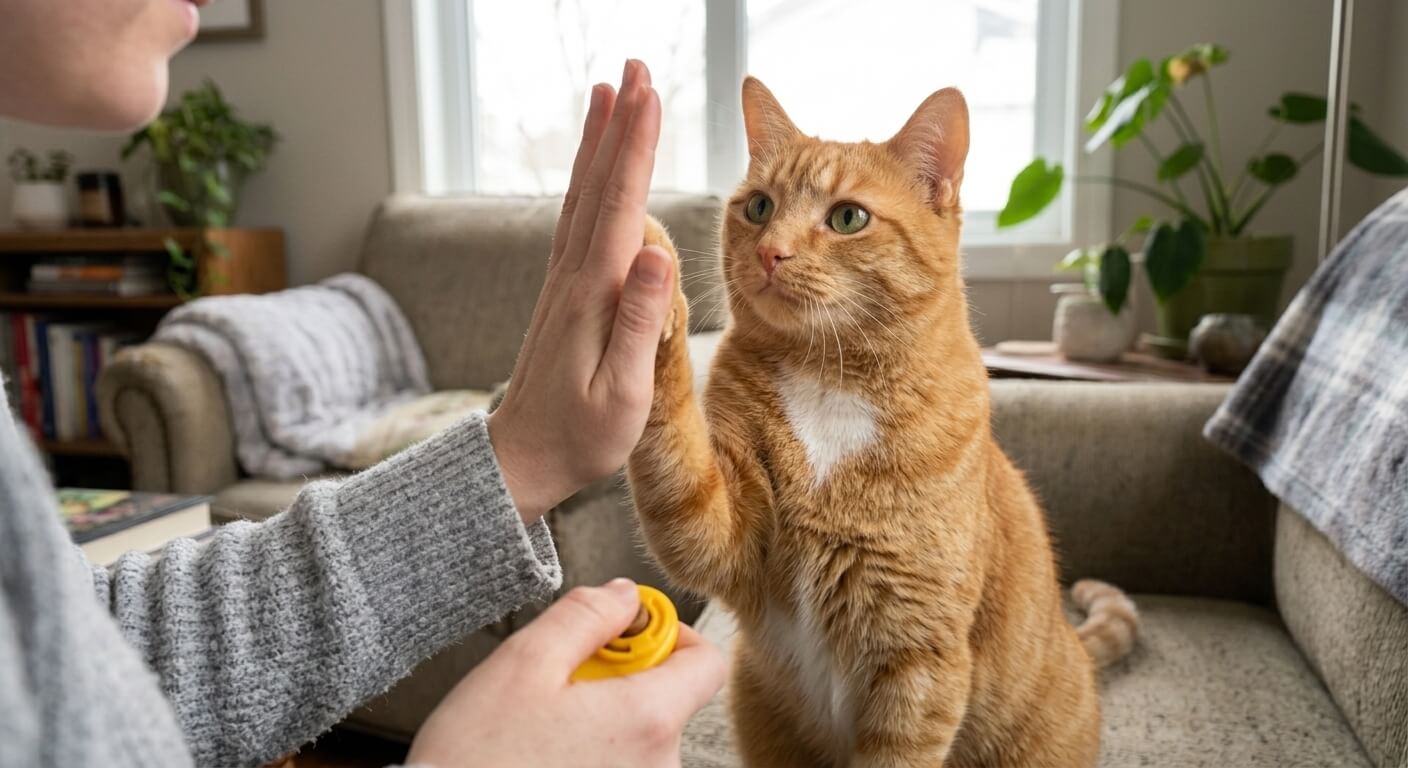
Learning how to clicker train a cat does not require a professional setup, expensive gear, or long training sessions. With Oliver, it started with a simple clicker, a few tiny treats, and five quiet minutes on the living room floor.
By the third day, he was touching a target stick with his nose. By the second week, he could follow the target, sit briefly, and walk toward his carrier with far less hesitation. The point was not to make him perform tricks. The point was to give an indoor cat structured mental work, clearer communication, and a safer way to practice useful behaviors.
This guide shows you how to clicker train a cat in five practical steps: charging the clicker, introducing a target stick, shaping simple behaviors, adding cues, and practicing in real apartment situations.
Quick Answer: How to Clicker Train a Cat?
To clicker train a cat, start by pairing one click with one tiny treat until your cat expects a reward after the sound. Then use the click to mark the exact moment your cat does something you want, such as looking at a target stick, touching it with their nose, sitting, or stepping into a carrier.
Keep sessions short: 2 to 5 minutes is enough for most cats. Use small, high-value treats, train before meals when motivation is higher, and stop before your cat gets bored. Clicker training should feel like a clear, low-pressure game, not a command battle. For a lone kitten who targets hands or ankles, combine marker training with the toy boundaries and enrichment steps in our single kitten syndrome guide.
Training Safety Note: Do not train a cat who is painful, frightened, hiding, sick, or too stressed to eat. Clicker training works best when the cat can choose to participate. If your cat shows sudden aggression, severe fear, appetite loss, limping, or major behavior changes, address the medical or stress issue before starting training.
Clicker training works best when it supports the larger behavior picture. For related guides on confidence, fear, biting, and indoor routines, see our indoor cat behavior guide.
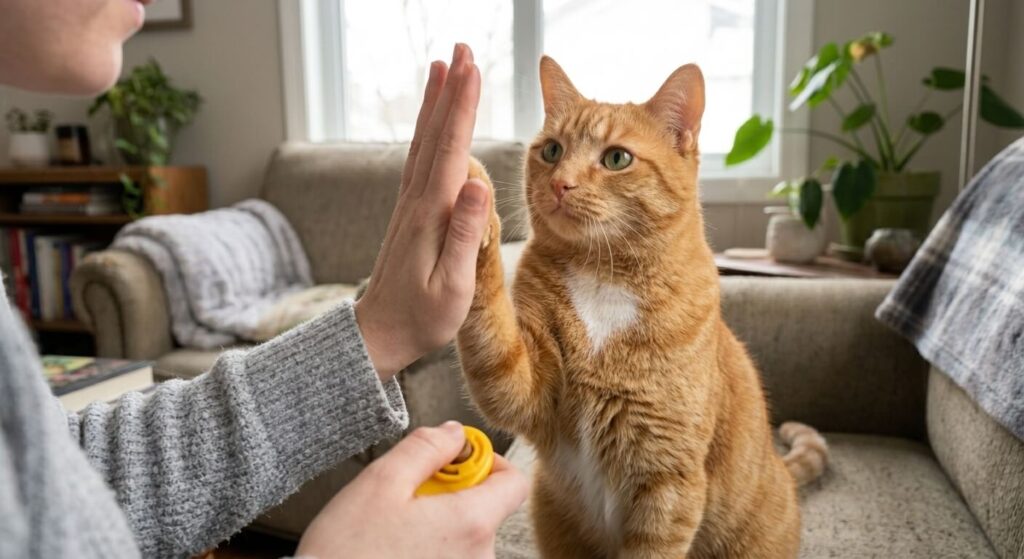
Table of Contents
The Science of the ‘Click’: Why Markers Work Better than Praise
Before we get into the practical protocol for how to clicker train a cat, I want to spend time on the neuroscience — because understanding why the clicker works so dramatically better than verbal praise alone is what separates trainers who get results from those who give up after three sessions.
The Timing Problem with Praise
When you say “good boy” to your cat after a desired behavior, several things happen:
- Your voice takes approximately 300–500 milliseconds to produce and 300–500 milliseconds for the cat to process
- By the time the cat neurologically registers “good boy,” they may have already shifted their posture, moved to a new location, or initiated a different behavior
- “Good boy” sounds similar to dozens of other things you say throughout the day — it has low acoustic distinctiveness and therefore weak associative salience
The result is that verbal praise, delivered even by a highly attentive trainer, is imprecise — it reinforces a cluster of behaviors that occurred in the 1–2 seconds around the praise, not the specific microsecond of correct behavior.
The Bridging Stimulus Solution
A Bridging Stimulus is a distinctive, consistent signal that “bridges” the gap between the moment of correct behavior and the delivery of the reward. The clicker is the most common Bridging Stimulus in animal training because:
- It is acoustically distinctive: The click sound is unlike any other sound in the cat’s environment — it has no ambiguity and creates no confusion with other auditory events
- It is brief: The click lasts approximately 50–100 milliseconds — a precise acoustic marker rather than a sustained sound
- It is consistent: Every click sounds identical — unlike the human voice, which varies with emotion, volume, and context
- It can be delivered with precision timing: An experienced trainer can mark a behavior within 200–300 milliseconds of its occurrence
The Neuroscience of Marker-Based Learning
When the clicker becomes a conditioned reinforcer through the charging process (Step 1 of our protocol), it activates the dopaminergic reward pathway in the cat’s brain — specifically the nucleus accumbens and ventral tegmental area — producing a genuine neurochemical reward signal.
Research in comparative psychology demonstrates that precise marker-based training produces:
- Faster initial learning: Behaviors are acquired in significantly fewer trials compared to reward-only training without a marker
- Stronger stimulus discrimination: Animals trained with precise markers show better ability to distinguish correct from incorrect responses
- More durable retention: Behaviors reinforced with precise marking are retained over longer intervals without practice
This is why how to clicker train a cat produces results that surprise even experienced cat owners — the precision of the marker creates learning efficiency that general reward-based interaction simply cannot match.
During training, eye contact is a tool. But why is your cat doing it outside of sessions? If your cat stares during training, learn how to read the context in our guide to why cats stare at their owners.
Why Not a Verbal Marker?
Verbal markers — typically the word “yes” delivered at the moment of correct behavior — are a legitimate and effective alternative to the clicker. They have several advantages: you always have your voice with you, and they eliminate the need to hold a clicker during training.
Their limitation is consistency. Human vocal production varies with emotional state, fatigue, and context in ways that a mechanical click does not. For beginning trainers, the clicker’s acoustic consistency produces faster initial results. Once you understand the timing principles, transitioning to a verbal marker is entirely viable.
The Vet Tech’s Training Kit: Clickers, Treats, and Targets
Good news: the total investment required to learn how to clicker train a cat is modest. Here is exactly what I use with Oliver, and what I recommend to clients.
The Clicker
Box clicker (i-Click or similar): My preferred option for cats. The softer click of the i-Click is less startling for sound-sensitive cats than the louder traditional metal-strip clicker. Features to look for:
- Soft, non-startling sound: Some cats are sensitive to loud mechanical clicks — a quieter clicker reduces flinching responses that interrupt training
- Ergonomic single-hand operation: You need one hand for the clicker and one for the treat — the clicker should operate with minimal fine motor effort
- Consistent click quality: Test before purchasing — the sound should be identical on every depression
Alternatives to a physical clicker:
- A retractable pen (click the top) — acoustically distinctive and always available
- A tongue click — free, always available, requires practice for consistency
- A small bell — effective but slower to produce than a click
My recommendation: Start with a physical clicker for the training period covered in this guide. Once you understand the timing principles, transitioning to a verbal or physical alternative is simple.
Choosing Treats Your Cat Actually Wants
Treat selection is the variable that most dramatically separates successful from unsuccessful attempts at how to clicker train a cat. The treat must be:
High-value: Something your cat finds significantly more desirable than their regular food. If you train with the same food they eat from their bowl, the motivational differential is insufficient.
Small: Each treat should be pea-sized or smaller — the cat should consume it in 1–2 seconds and be immediately ready for the next repetition. Large treats interrupt the training flow and risk filling the cat up too quickly.
Soft/fast-eating: Crunchy treats take longer to eat and create noise that can interfere with marker timing in subsequent repetitions.
My tested hierarchy for Oliver:
| Treat | Oliver’s Response | Notes |
|---|---|---|
| Freeze-dried chicken breast | ⭐⭐⭐⭐⭐ | Fastest response; highest focus |
| Freeze-dried salmon | ⭐⭐⭐⭐⭐ | Equal to chicken |
| Churu lickable puree | ⭐⭐⭐⭐ | Excellent; requires lick delivery technique |
| Commercial training treats | ⭐⭐⭐ | Acceptable; variable quality |
| Dry kibble (regular food) | ⭐ | Insufficient motivation for most cats |
The Churu technique: Squeeze a small amount of Churu onto a chopstick or the tip of your finger for lick-delivery. This keeps the cat’s nose near the correct position and maintains training proximity without the cat losing focus while chewing.
Pre-session preparation:
- Train before meals, not after — a hungry cat is a motivated cat
- Pre-portion treats into a small bowl or treat pouch for rapid delivery without fumbling
- Keep sessions to 10–15 treat repetitions maximum — treat volume adds up quickly in small cats
The Target Stick
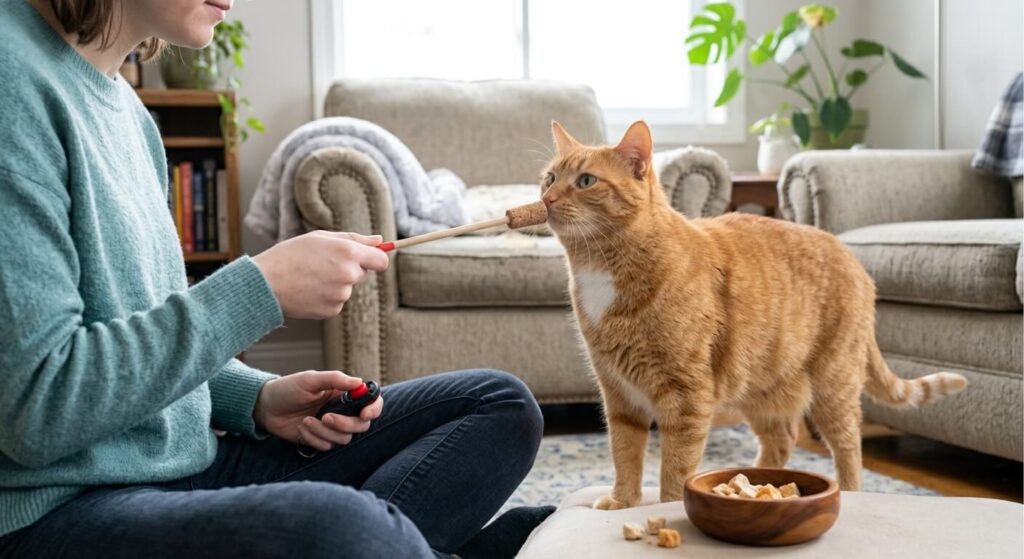
A target stick is a simple tool — a stick with a distinctive end that the cat learns to touch with their nose on cue. It is the most versatile tool in the how to clicker train a cat toolkit, because once the cat understands “touch the target,” you can use the target to guide them into virtually any position or location.
DIY target stick options:
- A chopstick with a small rubber tip or piece of tape on one end
- A wooden dowel with a cork on the end
- A retractable back-scratcher
- A commercial target stick (available at pet training supply retailers for $5–$15)
The target end should be visually distinctive — the cat needs to identify it consistently across different angles and distances.
How to Clicker Train a Cat in 5 Easy Steps
This is the complete protocol I use — both with Oliver and when I teach clients in the clinic. Follow these steps in sequence, and do not rush advancement between steps. Each stage builds the cognitive foundation for the next.
Step 1: Charge the Clicker (The Association Phase)
Duration: 1–2 sessions of 3–5 minutes each
Goal: The cat learns that click = treat is coming, unconditionally
“Charging the clicker” means building the conditioned association between the click sound and the arrival of a treat. At this stage, you are not asking for any behavior at all. You are simply programming the cat’s nervous system to recognize the click as a reliable predictor of reward.
The protocol:
- Sit with your cat in a quiet, low-distraction environment
- Wait until the cat is calm and oriented toward you
- Click once
- Deliver a treat within 1 second of the click
- Pause 3–5 seconds
- Click once
- Deliver a treat within 1 second
- Repeat for 10–15 repetitions
How you know charging is complete:
The cat’s ears prick forward, or their head turns toward you, or they take a step toward you at the sound of the click — before the treat appears. This behavioral response confirms that the click has acquired conditioned reinforcer status. The cat’s brain is now generating a dopaminergic anticipation response to the click itself.
Common mistakes at Step 1:
- Clicking and treating simultaneously — the click must precede the treat to function as a predictor
- Clicking multiple times for one behavior — one click, one treat, always
- Sessions that are too long — 15 repetitions maximum; stop before the cat disengages
Step 2: The Target Stick (The Navigation Tool)
Duration: 2–4 sessions of 3–5 minutes each
Goal: The cat reliably touches the target end of the stick with their nose on presentation
Once the clicker is charged, introduce the target stick. This step teaches the cat that interacting with an object produces the click-treat sequence — laying the foundation for directing all future behaviors.
The protocol:
- Hold the target stick approximately 2–3 inches from the cat’s nose
- Wait
- The cat’s natural investigative curiosity will drive them to sniff or touch the target end — cats investigate novel objects; this is biology working in your favor
- The moment their nose makes contact with the target end: Click
- Deliver the treat immediately
- Remove the target stick from view (put it behind your back) for 3–5 seconds — this “resets” the behavior
- Represent the target stick and repeat
Building duration and distance:
Once the cat is reliably touching the target on presentation (typically within 2–3 sessions), begin extending the challenge:
- Hold the target slightly further away — 4 inches, then 6 inches, then a body-length away
- Hold it at different heights — at nose level, then slightly above, then at ground level
- Move it slightly so the cat must take one step, then two steps, to reach it
The target stick as a directional tool:
Once this foundation is established, the target stick becomes your primary behavioral guidance system. You can:
- Move the cat from one location to another by leading the target
- Guide the cat into a “sit” by raising the target above their nose (they lower their hindquarters to track it)
- Guide the cat onto a scale, into a carrier, or onto a specific surface — all enormously useful for veterinary visits
Once your cat understands target work, you can use the same principles to keep a cat off kitchen counters without punishment.— Once your cat reliably follows the target stick, you have unlocked the gateway to a wide range of advanced trained behaviors. Our advanced cat training guide covers specific trained skills including Targeting to specific objects, Recall training (coming when called), and carrier conditioning — all built on the target stick foundation established in this step.
The ultimate application of your clicker skills is the recall. For recall work, build from this foundation into our guide on how to train a cat to come.
Step 3: Shaping Behavior (Building Complexity)
Duration: Variable — one behavior may take 3–10 sessions
Goal: Use successive approximations to build a complete, complex behavior
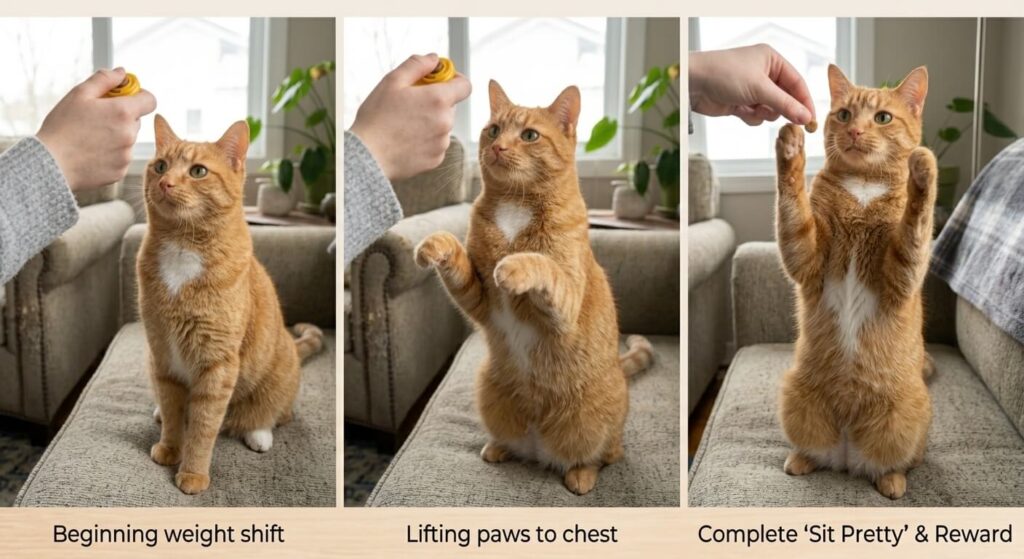
Shaping is the technique of reinforcing successive approximations toward a target behavior — rewarding steps in the right direction rather than waiting for the complete behavior to appear spontaneously.
Once your marker is established, you can use the same voluntary-training principles when you teach your cat to use a puzzle feeder.
This is how I taught Oliver to high-five:
Shaping the high-five — the approximation sequence:
- Approximation 1: Click and treat any lifting of the right paw — even a slight weight shift
- Approximation 2: Click and treat only when the paw lifts noticeably off the ground
- Approximation 3: Click and treat only when the paw lifts to hip height or above
- Approximation 4: Hold my palm in the air; click and treat when the paw makes contact with my palm
- Approximation 5: Raise criteria — click and treat only for deliberate, fully extended paw contact with my palm
Each approximation may take 5–10 repetitions before the cat reliably offers it — move to the next approximation only when the current one is consistent (approximately 80% success rate across 10 repetitions).
The 80% rule:
Never advance to the next approximation until the cat is succeeding at the current level approximately 80% of the time. Moving too fast produces frustration and confused animals. Moving at the right pace produces confident, engaged learners.
Shaping is the most technically demanding aspect of how to clicker train a cat — it requires the trainer to observe carefully, set achievable approximations, and resist the urge to either click too liberally (accepting approximations that don’t advance toward the goal) or too strictly (waiting for perfection before clicking).
Behaviors well-suited to shaping:
- Sit
- Sit pretty (hindquarters down, paws raised)
- High-five
- Spin (turn in a circle)
- Touch a specific object
- Go to a designated mat or bed
Step 4: Adding a Verbal Cue (The Label)
Duration: 5–10 sessions per cue
Goal: The cat performs the behavior on hearing a specific word, before the physical prompt is given
This step is where the behavior becomes a named trick — where “sit” means sit, and “high-five” means high-five. Many people make the mistake of adding the verbal cue too early. The cue should only be introduced after the cat is reliably offering the behavior through shaping or target guidance.
Why timing matters for cue introduction:
If you say “sit” while the cat is still learning what “sit” means through shaping, the word becomes associated with confusion and partial behaviors — not the completed behavior. The verbal cue should be introduced when it will be immediately paired with the correct behavior, creating a clean association.
The cue introduction protocol:
- Wait for the cat to be in position to perform the behavior (use target or established shaping)
- Say the cue word clearly, once: “Sit” — “High-five” — “Touch”
- Immediately prompt the behavior using the target stick or hand signal
- Click and treat at the moment of behavior completion
- Repeat: Cue word → behavior prompt → click → treat
After 20–30 repetitions of this sequence across multiple sessions, begin testing: say the cue word and wait — without giving the physical prompt. Does the cat perform the behavior on the word alone?
If yes: The cue is established. Click and treat with high enthusiasm — the first time a cat responds to a verbal cue alone is worth a jackpot reward (several treats delivered in rapid succession).
If no: Return to the cue-then-prompt sequence for another 15–20 repetitions before testing again.
Step 5: Generalization (Teaching Reliability)
Duration: Ongoing — generalization is never “complete”
Goal: The cat performs the behavior in different locations, with different people, and with varying levels of distraction
This is the step that most training protocols overlook — and the step that explains why a cat who can high-five perfectly in the kitchen may appear to have completely forgotten the behavior when a visitor is present.
Cats do not automatically generalize trained behaviors across contexts the way humans might assume they would. A behavior trained exclusively in the kitchen, on the kitchen floor, with you sitting in your usual chair, is specifically associated with all of those contextual elements. Change any one element — move to the living room, stand instead of sit, have a different person present the cue — and the behavior may temporarily disappear.
The generalization protocol:
Systematically vary one contextual element at a time:
- Change location: Train the behavior in every room of the apartment
- Change your position: Sitting → crouching → standing → facing away
- Change the background distraction level: Quiet → TV on → visitor present
- Change who gives the cue: You → another household member → a familiar visitor
- Change the presentation: Normal → wearing a hat → with something in your other hand
At each new contextual variation, briefly drop your expectations to the level of the first approximation — make the behavior easy to succeed at in the new context, then build back to the full behavior. This prevents frustration and builds genuine behavioral flexibility.
Generalization is what transforms a party trick into a genuinely useful trained behavior — a cat who will come when called, sit for examination, or enter a carrier on cue regardless of context is a cat whose training has real-world veterinary and safety value.
Why Mentally Tired Cats Are Better Behaved Cats
This section addresses the deeper “why” behind how to clicker train a cat — the clinical reason I recommend training to virtually every indoor cat owner I work with, regardless of whether they care about tricks.
The Cognitive Load Principle
Physical exercise and mental exercise both produce fatigue — but through different mechanisms. Physical exercise depletes glycogen stores and produces physical fatigue through muscle metabolic processes. Mental work — problem-solving, learning, pattern recognition — produces neural fatigue through sustained activation of prefrontal cognitive circuits.
Both types of fatigue promote rest. But in a small apartment where physical exercise space is limited, cognitive fatigue is often easier to produce than physical fatigue.
A 5-minute clicker training session that requires the cat to actively problem-solve — “what does this human want from me right now, and how do I produce the click?” — generates genuine cognitive load. A cat emerging from a focused training session often grooms and then settles for a 30–60 minute rest. Contrast this with a cat who has been lying on the sofa all day — they are physically rested and cognitively understimulated, and their evening energy will express itself in ways that may not align with your preferences.
Clicker training works best as part of a broader indoor cat enrichment plan for small apartments.— Mental engagement through structured training is a cornerstone strategy for indoor environmental enrichment in apartments where physical space for running is simply not available. Our comprehensive indoor enrichment guide covers how to layer cognitive enrichment with physical activity to produce the behavioral outcomes associated with well-exercised outdoor cats — in a studio apartment.
Cognitive Reserve and Long-Term Brain Health
Cognitive Reserve is the term used in neuroscience to describe the brain’s resilience to age-related decline — the accumulated neural connections and cognitive capacity that allow the brain to compensate for neurodegeneration before functional impairment becomes apparent.
In human medicine, higher Cognitive Reserve (associated with education, cognitive engagement, and mentally demanding work throughout life) correlates with delayed onset and reduced severity of dementia symptoms, even in the presence of significant neuropathological changes.
Emerging veterinary research suggests similar principles apply to domestic cats. Cats who receive regular cognitive stimulation throughout their lives appear to maintain behavioral flexibility, environmental interest, and problem-solving capacity into older age longer than cognitively understimulated cats.
While we cannot yet state with certainty that clicker training prevents Feline Cognitive Dysfunction, the behavioral and neurobiological principles are sound: Positive Reinforcement-based training provides regular, structured cognitive engagement that builds and maintains neural connectivity. Given that FCD affects an estimated 28–50% of cats over age 11, the investment in cognitive engagement throughout life is rational and clinically defensible.
The Behavioral Benefits — What You Notice Immediately
Beyond the long-term neuroprotective argument, the immediate behavioral benefits of regular training sessions are measurable and significant:
- Reduced play aggression: A cat whose predatory intelligence is channeled into training problem-solving has less unmet cognitive drive to redirect toward your ankles
- Reduced nighttime activity: Mental fatigue contributes meaningfully to settling, particularly in the pre-bedtime training protocol
- Reduced anxiety: Regular, predictable positive interactions with the owner build a secure attachment that reduces anxiety-driven behaviors
- Improved veterinary compliance: A cat who has practiced target work, carrier entry, and gentle handling may be less stressed during veterinary visits. — which directly improves the quality of their medical care
- Improved human-animal bond: Training sessions are reliable, positive shared activities that deepen the mutual understanding between cat and owner
Common Training Mistakes to Avoid
Having taught how to clicker train a cat to numerous clients and refined my own technique with Oliver, these are the errors I see most consistently:
Mistake #1: Sessions That Are Too Long
The mistake: Running 20–30 minute sessions because the cat “seems interested.”
Why it fails: Cats have a working attention span for focused cognitive tasks of approximately 3–7 minutes. Beyond this, focus degrades and the cat begins offering random behaviors, wandering, or disengaging entirely. Long sessions also exhaust motivational drive — the treats lose their value as the cat’s appetite satiates.
The fix: 3–5 minutes maximum. Multiple short sessions across the day (2–3 sessions) outperform one long session every time. End the session before the cat disengages — always end on a success.
Mistake #2: Clicking Without Immediately Treating
The mistake: Clicking at the correct moment but then fumbling for the treat, dropping it, or taking 3–4 seconds to deliver.
Why it fails: The Bridging Stimulus bridges a gap of approximately 1–2 seconds. Beyond 2 seconds, the associative connection between click and treat begins to weaken. Beyond 5 seconds, the reinforcement is essentially disconnected from the marked behavior.
The fix: Pre-portion treats. Practice treat delivery smoothly before beginning sessions. Use a treat pouch worn at the waist for rapid, consistent delivery.
Mistake #3: Clicking Multiple Times
The mistake: Clicking two or three times for a particularly good response — “double-clicking for emphasis.”
Why it fails: One click = one event = one treat. Multiple clicks create acoustic confusion and undermine the precision of the marker signal. The click is an information signal, not an enthusiasm indicator.
The fix: One click, one treat, every time. Your enthusiasm can be expressed through jackpot rewards — delivering 3–5 treats in rapid succession for an exceptional response.
Mistake #4: Training When the Cat Is Disinterested
The mistake: Attempting training sessions when the cat has just eaten, is sleepy, or is in a low-arousal state.
Why it fails: Motivation is the fuel of Positive Reinforcement training. A sated or sleepy cat has minimal food motivation and minimal cognitive engagement drive. Sessions initiated in this state are frustrating for trainer and cat alike.
The fix: Train before meals. Train when the cat is in an alert, mobile state. If the cat walks away in the first 2 minutes of a session, close the session — they are telling you this is not the right moment.
Mistake #5: Inconsistent Criteria
The mistake: Clicking for a partial high-five one session, then holding out for a full extension the next, then accepting partial again when progress stalls.
Why it fails: The cat is doing exactly what you’re teaching. If the criteria for the click shift between sessions without a systematic shaping plan, the cat cannot build a coherent behavioral picture — they are learning “unpredictable things produce clicks sometimes,” which is both confusing and demotivating.
The fix: Write down your shaping plan before beginning. Know exactly what approximation level you’re working on and maintain it consistently within the session. Advance criteria deliberately, not impulsively.
Mistake #6: Using the Clicker as a Calling Device
The mistake: Clicking to call the cat to you, or clicking to get the cat’s attention.
Why it fails: The clicker is a marker — it communicates “the thing you just did is correct.” Using it to summon or direct the cat destroys its marker function and confuses the entire conditioning process.
The fix: Use the cat’s name or a specific verbal recall cue to call the cat. Reserve the click exclusively for marking correct behaviors.
Frequently Asked Questions
1. What Is the Best Age to Start Clicker Training?
The honest answer: the earlier, the better — but it is never too late.
Kittens (8 weeks – 6 months):
This is the sensitive period for feline social and behavioral development. Kittens during this phase have heightened neuroplasticity — they form associations and generalize experiences faster than at any other developmental stage. A kitten who learns how to clicker train a cat fundamentals at 10–12 weeks will be a dramatically more cooperative, less anxious adult cat.
Kitten training specifics:
- Sessions should be 2–3 minutes maximum — attention spans are shorter
- Use especially small treats — kitten caloric needs don’t accommodate large treat volumes
- Focus on foundational skills: name recognition, target touching, carrier entry
- Socialization-adjacent training (accepting handling, being touched in different locations) has enormous long-term veterinary value
Adult cats (1–7 years):
Excellent training subjects. Fully developed attention spans, established food preferences (useful for identifying high-value treats), and the behavioral problems that motivate training (play aggression, nighttime waking, litter box issues) are often already present — providing strong practical motivation for the owner.
Senior cats (8+ years):
Absolutely trainable — the neuroplasticity argument for senior cat training is particularly compelling from a Cognitive Reserve standpoint. Older cats may:
- Require lower-intensity sessions (2–3 minutes)
- Need higher-value treats to compensate for potentially reduced appetite motivation
- Take longer to acquire new behaviors — this is normal and not a reason to stop
- Benefit enormously from the cognitive engagement relative to the cognitive decline risk
The only contraindication to starting training at any age is concurrent medical illness — a cat in pain or systemic distress is not a candidate for training sessions. Resolve the medical issue first.
2. What If My Cat Is Not Food Motivated?
This is the most common objection I hear when teaching how to clicker train a cat, and in the vast majority of cases, it reflects one of three solvable problems rather than a genuine absence of food motivation.
Problem 1: The treats aren’t high-value enough
If your cat turns their nose up at training treats, they are not “unmotivated” — they are discriminating. Conduct a treat hierarchy test: offer your cat a selection of different treats simultaneously and note which they eat first, fastest, and most enthusiastically. That is your high-value treat. In my experience, freeze-dried single-ingredient proteins (chicken, salmon, duck) are the most reliable high-value option across a wide range of cats.
Problem 2: The cat is not hungry enough
A cat who has free-fed all day on dry kibble has minimal food motivation at any hour. Transition to scheduled meal feeding (2 meals daily, with measured portions) and conduct training sessions before the meal. Hunger is not cruelty — it is motivation management.
Problem 3: The environment is too distracting
A cat who appears “unmotivated” in a noisy, stimulating environment may be motivated but overwhelmed. Begin training in the quietest, lowest-distraction environment available — often a bathroom or bedroom — and build environmental complexity gradually.
Genuinely non-food-motivated cats:
A small percentage of cats are relatively indifferent to food as a reinforcer. For these cats:
- Play as reinforcement: The click is followed by a brief (10-second) wand toy play session rather than a treat. This requires more logistical management but is entirely effective.
- Social reinforcement: Some cats find brief, specific affection (chin scratch, head bump) reinforcing. This is less precise than food delivery but can be effective.
- Environmental reinforcement: Access to a window, a specific resting spot, or a puzzle feeder as the reward for a correct response.
3. How long should a cat clicker training session be?
Most cat clicker training sessions should last 2 to 5 minutes. Cats learn better from short, successful sessions than from long sessions that end in boredom or frustration. For kittens, seniors, shy cats, or cats new to training, even 60 to 90 seconds can be enough at first. Stop while your cat is still interested, give a final easy win, and return later. Two or three tiny sessions across the day usually work better than one long session.
4. Can Clicker Training Help With Aggression?
Yes — with important clinical caveats depending on the type and severity of the aggression.
Play aggression:
Clicker training is highly effective for redirecting and reducing play aggression. Training provides a legitimate outlet for predatory problem-solving drive, reduces accumulated energy and frustration, and builds a Positive Reinforcement-based relationship that improves the cat’s impulse control in interactions with the owner. Teaching the cat to “sit” or “touch a target” on cue gives you a behavioral alternative to redirect toward when predatory arousal begins to build.
Fear aggression:
Clicker training — specifically the process of building positive conditioned associations with previously fear-triggering stimuli — is a component of systematic desensitization and counter-conditioning protocols for fear-based aggression. This is more advanced behavioral work and ideally should be guided by a certified veterinary behaviorist or veterinary technician with behavioral specialization.
Redirected aggression:
Clicker training does not directly address redirected aggression episodes, which occur in a state of full arousal where cognitive function is significantly compromised. However, training that reduces overall anxiety and stress, and that establishes reliable behavioral alternatives for arousal discharge, reduces the frequency and intensity of redirected aggression over time.
Important limitations:
Severe aggression — aggression that results in significant injury, redirected aggression occurring frequently, or aggression with an apparent fear or pain basis — should be evaluated by a veterinarian before training intervention. Pain-based aggression, in particular, requires medical resolution before behavioral modification is appropriate or effective.
Clicker training works best as a preventive and maintenance tool for mild to moderate behavioral challenges. For severe or sudden-onset aggression, how to clicker train a cat is one component of a comprehensive behavioral plan — not the complete solution.
Final Thoughts
Oliver can now high-five, sit pretty, spin clockwise on cue, touch a target stick, and — most usefully — walk into his carrier voluntarily when I set it out and ask him to.If carrier stress is one of your goals, pair this training with a dedicated cat carrier training plan. That last behavior has made every veterinary visit measurably less stressful for both of us.
None of this happened because Oliver is exceptional. He is a perfectly ordinary cat who responded to clear communication, appropriate motivation, and a trainer who understood the principles of how to clicker train a cat well enough to apply them consistently.
The $5 clicker sitting on my bookshelf has generated more genuine behavioral improvement in this household than any piece of cat furniture I’ve ever purchased. It has given Oliver a job — something to figure out, something to succeed at, something that produces a reliable and satisfying reward. It has given me a cat who is cognitively engaged, behaviorally cooperative, and meaningfully less likely to use my face as a springboard at 4 AM.
The click is the language. The treat is the motivation. The patience is the practice.
Start with five minutes. Start tomorrow. Your cat is considerably smarter than they’ve been given credit for.
References
- Adventuros, S., & Gourkow, N. (2012). Effect of cognitive enrichment on behavior and welfare of shelter cats (Felis silvestris catus). Applied Animal Behaviour Science, 143(1), 11–17. https://doi.org/10.1016/j.applanim.2012.10.001
- Vitale Shreve, K. R., & Udell, M. A. R. (2015). What’s inside your cat’s head? A review of cat (Felis silvestris catus) cognition research past, present and future. Animal Cognition, 18(6), 1195–1206. https://doi.org/10.1007/s10071-015-0897-6
-300x169.png)