
Before Oliver became confident in my apartment, he spent his first two days behind a guest room dresser. I could see only two green eyes in the dark. He came out when I was asleep, ate quietly, used the litter box, and disappeared again.
Learning how to socialize a scared cat starts with accepting that fear is not stubbornness. A scared cat is trying to stay safe. If you rush, reach, stare, pull them out, or force contact, you may confirm exactly what their nervous system already believes: humans are risky.
This guide shows a slower and safer approach: set up a quiet room, become a predictable presence, use slow blinking and scent, pair yourself with good things, invite play, read body language, and let the cat choose when contact begins.
Quick Answer: How to Socialize a Scared Cat Successfully?
To socialize a scared cat, start with a small safe room, predictable routines, and very low-pressure contact. Sit quietly nearby, avoid direct staring, use slow blinks, offer food without reaching, and let the cat approach on their own timeline.
Do not pull a scared cat from hiding, chase them, force petting, or flood them with the whole apartment too soon. Progress should be measured by behavior, not by the calendar: eating while you are present, relaxed body posture, voluntary approach, play, and eventually contact. If the cat is not eating, shows aggression, seems painful, or is hiding constantly, involve a veterinarian or qualified behavior professional.
Safety Note: A scared cat should always be allowed to retreat. Do not force handling unless there is a medical emergency. If your cat has not eaten for 24 hours, is hiding with illness signs, or becomes dangerously aggressive, contact your veterinarian promptly.

Table of Contents
The 3-3-3 Rule: Setting Realistic Expectations
The most important thing I can give you before we discuss the practical steps of how to socialize a scared cat is an honest, research-informed timeline — because unrealistic expectations cause more socialization failures than almost any other single factor.
What the 3-3-3 Rule Describes
The 3-3-3 Rule is a framework for understanding the decompression arc of a newly rehomed cat — the progressive adjustment from acute fear through gradual comfort to genuine trust. Originally developed in the rescue and shelter medicine community, it describes three distinct phases:
The First 3 Days: Acute Decompression
The cat is in a state of maximum stress. Their Amygdala Response is fully activated — the threat-detection system is operating on high alert in an unknown environment with unknown smells, sounds, and people.
During these first three days:
- The cat may not eat, drink, or use the litter box while you are visible
- They will seek the most concealed, secure location available and remain there
- Any direct approach from you will be experienced as a threat
- Vocalization may be absent (the cat is hiding) or continuous (the cat is actively distressed)
Your role in days 1–3: Do almost nothing. Place the cat in their Safe Room. Provide food, water, and a litter box. Leave. The most powerful thing you can do in the first three days is demonstrate that you are not a threat through the simple act of leaving.
The First 3 Weeks: Environmental Familiarization
The acute threat response has begun to downregulate. The cat begins cautiously expanding their awareness of the environment — initially through smell (investigating while you sleep), then through brief visual exposure (peeking from the hiding spot), and eventually through limited, self-initiated investigation.
During these first three weeks:
- The cat begins eating and drinking reliably
- They may begin emerging briefly when you are present but stationary
- They are beginning to build a scent map of the Safe Room
- Trust is fragile — setbacks (sudden movements, loud noises, direct approaches) can reset progress significantly
Your role in weeks 1–3: Begin the passive presence protocol. Be in the room, doing your own activities, without directing attention toward the cat.
The First 3 Months: Social Trust Building
The cat begins engaging with the new environment as a genuine home rather than a threat zone. Social bonding with household members begins — initially through proximity tolerance, then through voluntary approach, and eventually through active solicitation of interaction.
During the first three months:
- The cat begins approaching on their own terms
- Play drive reactivates — this is a major milestone, as play requires sufficient safety to express
- Physical contact may begin — initially brief, cat-initiated
- Full integration into household life may be approaching but is not yet complete
Your role in months 1–3: Follow the seven steps below. Be consistent, patient, and responsive to regression.
Why This Timeline Is Not Accelerable
I’ve had clients tell me they’ve had their scared rescue for two weeks and they “should be comfortable by now.” The 3-3-3 framework is not a rigid schedule — some cats move faster, some take longer — but it represents the biological arc of Feline Decompression that cannot be meaningfully compressed through effort or will.
The Amygdala Response does not respond to logic, reassurance, or good intentions. It responds to time, consistency, and the repeated, reliable experience of safety. Understanding this prevents the most common mistake in how to socialize a scared cat: trying to accelerate the process through increased contact, which consistently produces the opposite of the intended effect.
The ‘Safe Room’ Protocol: Why Your Whole Apartment Is Too Much
The single most impactful structural decision in how to socialize a scared cat is made before the cat even arrives: establishing a Safe Room rather than releasing the cat into the full apartment.
Why the Full Apartment Fails
A cat’s cognitive map of their territory is built incrementally — from a secure core outward. A scared cat released into a full apartment faces an overwhelming quantity of uncharted space, unknown smells, unpredictable sounds, and no established safe anchor point. The result is typically one of two outcomes:
- Paralytic hiding: The cat finds the most inaccessible location in the apartment (behind appliances, inside furniture) and doesn’t emerge for weeks — with no progress toward socialization because there is no contained, manageable space to begin building safety associations
- Panic: The cat runs blindly through the space, injuring themselves, becoming more traumatized, and establishing a fear memory that is harder to overcome than the original arrival fear
The Safe Room Specification
A Safe Room should be:
Small and manageable: A bedroom, bathroom, or dedicated office space — ideally 80–150 square feet. Small enough for the cat to develop a complete scent map quickly; large enough to contain all necessary resources plus one or two hiding spots.
Equipped with all essentials:
- Litter box (low-sided if the cat is senior or fearful of deep boxes)
- Food and water stations (positioned away from the litter box)
- At least two hiding options at different heights (a box on the floor, a covered bed on a low shelf)
- A soft sleeping surface with a worn piece of your clothing
- A pheromone diffuser (Feliway Classic) running continuously
- Low ambient sound — soft music or white noise helps buffer startling external sounds
Consistently yours to control: You should be the primary person entering the Safe Room. Limit exposure to additional household members initially — each new person represents a new threat assessment that the cat must process.
Hiding spots that you can observe from:
The hiding spots should be accessible enough that you can confirm the cat is present, eating, and using the litter box without having to disturb them. A box tucked under a bed, a cat bed on a low shelf, an enclosed cube — all visible from the doorway without requiring you to approach.
The Safe Room Timing
The cat remains in the Safe Room until:
- They are eating reliably with you present in the room
- They are voluntarily approaching you during passive presence sessions
- They are playing with a wand toy at a distance
- They show curiosity rather than fear when you enter the room
This may take 2 weeks for some cats and 8 weeks for others. The metric is behavioral confidence, not calendar time.If you are socializing after a move, the safe room becomes even more important; use our guide to moving with a cat to a new apartment alongside this plan.
How to Socialize a Scared Cat in 7 Safe Steps
These seven steps are the protocol I followed with Oliver, the protocol I teach in the clinic when coaching adopters, and a sequence that can help many fearful cats build trust over time in cats whose fear responses range from mild shyness to severe trauma history.
Step 1: Passive Presence
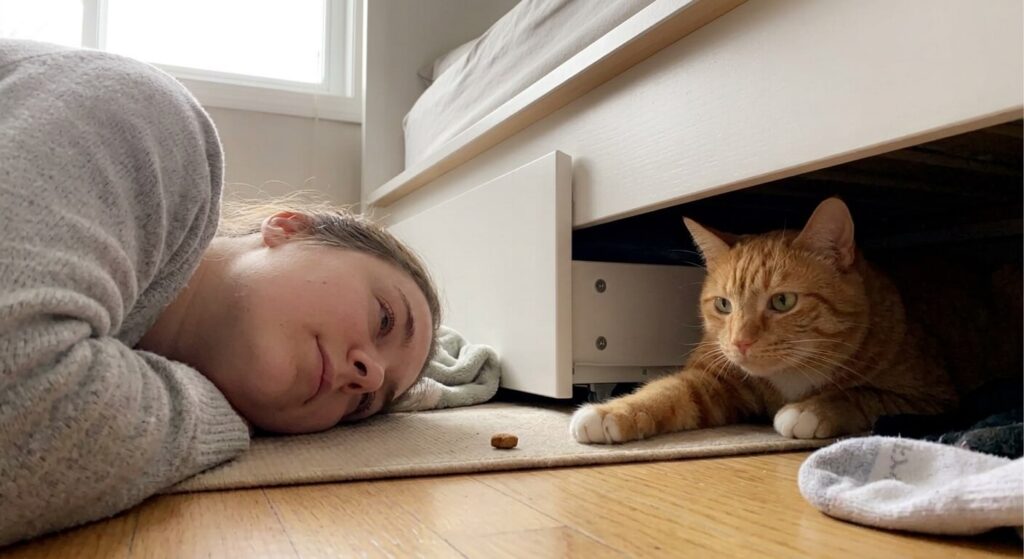
The first step in how to socialize a scared cat requires resisting every instinct you have as a person who loves animals: you are going to enter the Safe Room and completely ignore the cat.
What passive presence looks like:
- Bring a book, laptop, or activity into the Safe Room
- Sit or lie on the floor — lower positions are less threatening than standing or sitting on elevated furniture
- Do not look directly at the cat
- Do not speak to the cat
- Do not make movements toward the cat
- Remain for 15–30 minutes, then leave without interacting
Why it works:
The Amygdala Response habituates — it downregulates — in the presence of a stimulus that repeatedly fails to produce harm. Each passive presence session is a data point: “This human was here. Nothing bad happened.” Accumulate enough data points and the threat assessment begins to shift.
The floor position specifically matters: standing over a cat activates the predator-overhead response. Lateral floor position mimics the non-threatening body orientation of a resting animal — it is biologically communicating “I am not hunting.”
The timeline of passive presence:
Week 1: The cat may not emerge at all. Continue anyway.
Week 2: The cat may emerge briefly while you’re there, then retreat. This is progress.
Week 3: The cat begins spending time in the open while you’re present. This is significant progress.
Step 2: Use the Slow Blink
The Slow Blink is the most clinically validated non-contact communication tool available for how to socialize a scared cat — and it is supported by peer-reviewed research.
What the Slow Blink communicates:
In feline body language, sustained direct eye contact is a threat signal — it communicates dominance assertion and potential aggression. A slow blink — where eye contact is briefly made, then eyes are slowly closed and reopened — deliberately breaks this threatening stare pattern and replaces it with the affiliative signal that bonded cats exchange.
Research by Humphrey et al. (2020) in Scientific Reports demonstrated that cats respond to human slow blinking with increased affiliative behavior — they are more likely to approach a human who slow blinks than a human who maintains a neutral expression, and they reciprocate slow blinking in response.
The technique:
- When the cat is visible (not when they’re hiding), make brief, gentle eye contact
- Slowly close your eyes — taking about 1–2 seconds
- Hold with eyes closed for 1–2 seconds
- Slowly reopen your eyes
- Look away — breaking eye contact after the slow blink is as important as the blink itself
What to look for:
If the cat reciprocates — slow blinking back at you — this is one of the clearest signs that your presence has moved from threat to neutral or positive in their assessment. It’s a small thing and an enormous thing simultaneously.
Oliver first slow blinked back at me on day eleven. I noted it in my socialization log with considerably more emotion than a veterinary technician should probably admit.
Step 3: Build Familiarity With Scent
Smell is the cat’s primary sense for environmental assessment — and building positive scent associations with yourself before physical contact creates a neurological foundation for trust.
Scent exchange methods:
Worn clothing: Place an item of worn clothing (a T-shirt, a worn sock) near or slightly inside the cat’s primary hiding spot. Your scent, in a non-threatening context (you are absent), allows the cat to investigate your olfactory profile without the arousal of your physical presence.
Hand scent offering: During passive presence sessions, place your hand (palm up, not extended toward the cat) on the floor between you. Allow the cat to investigate your hand’s scent if they choose. Never reach toward them — the hand is an offering, not an approach.
Carrier/bedding scent exchange: If you have another cat or pet in the household, scent-swapping their bedding before the cats have visual access helps normalize each other’s presence without the stress of direct encounter.
The progression:
Scent investigation typically precedes visual tolerance. A cat who approaches your worn T-shirt and rubs their face on it is performing Positive Reinforcement of their own attachment to your scent — they are voluntarily creating an olfactory bond with you. This behavior is a reliable predictor of subsequent social approach.
Step 4: Pair Your Presence With Food
Food-based interaction can help some scared cats build a safer association with your presence — because it creates the most fundamental possible association: this human’s presence often predicts something good.
The protocol:
Begin by placing food slightly closer to your sitting position than to the cat’s usual eating location. Each meal, move the bowl incrementally closer to you — by inches, not feet.
When the cat is eating within 2–3 feet of you, begin offering small amounts of high-value food from an extended hand or from a long spoon:
- Use freeze-dried chicken, tuna flake, or lickable treat (Churu)
- Extend the food offering without extending your arm — keep the movement minimal
- Allow the cat to approach the food rather than bringing the food to the cat
Why this works at a neurochemical level:
Food triggers dopamine release in the nucleus accumbens — the brain’s reward center. When your presence is the consistent antecedent stimulus to this dopaminergic reward, your presence itself begins acquiring positive conditioned value through classical conditioning. The Amygdala Response — which was associating you with threat — begins competing with a dopaminergic reward signal that associates you with food.
Over time, the reward association can outcompete the fear association — particularly if the food is genuinely high-value and the sessions are consistent.
The patience requirement:
A cat who is hand-feeding is not yet a cat who trusts you. But a cat who hand-feeds consistently has shifted from “this human is a threat” to “this human is associated with good things” — and that is the foundation everything else is built on.
Step 5: Invite Play Without Pressure
The reactivation of play drive is one of the most reliable clinical indicators that Feline Decompression is genuinely underway — because play requires the cat to be in a sufficiently safe psychological state to express predatory behavior.
A cat who is in active fear suppresses play completely — their nervous system is in threat-management mode, not prey-simulation mode. When a scared cat begins responding to a wand toy, they are telling you their nervous system has downregulated enough to allow the predatory circuit to activate.
The play protocol for scared cats:
- Use a long wand toy — the maximum distance between your hand and the feather end creates the safest interaction zone
- Keep movements subtle initially: gentle, ground-level movement that doesn’t startle
- Do not make the toy come toward the cat — let it move away from and past them (prey runs away, predators approach)
- Allow the cat to retreat between interactions without chasing the toy toward their hiding spot
- End every play session before the cat disengages — leaving them wanting more maintains the positive motivation
The distance threshold:
Begin play at the maximum distance the cat will engage from. Each session, allow the cat to set how close they are to you during play — they will naturally decrease the distance as confidence increases. Do not artificially reduce the distance by moving toward them.
Play as a socialization diagnostic:
Track the distance at which your scared cat will play over time. Consistent decrease in play distance is a reliable metric of socialization progress — more reliable than visual presence tolerance alone, because the cat is actively choosing to be closer to you in a state of arousal.
Step 6: Watch the Cat’s Threshold
The sixth step in how to socialize a scared cat is not a technique — it is a skill: the ability to read the cat’s behavioral signals and stop before crossing the threshold that produces a setback.
Why thresholds matter:
Every scared cat has a behavioral threshold — a point of arousal or pressure beyond which their Amygdala Response escalates rather than habituates. Pushing past that threshold in any single session doesn’t accelerate socialization; it produces a negative experience that the cat must recover from before the next session can continue progress.
Pre-threshold signals (approaching the limit):
- Ear rotation — rotating backward from forward position
- Tail twitching — beginning to lash or stiffen
- Skin twitching along the back
- Dilated pupils that were previously normal-sized
- Breaking eye contact and looking toward the hiding spot
- Cessation of eating or play despite food/toy being offered
At-threshold signals (time to disengage immediately):
- Hard, sustained stare
- Ears flat against skull
- Full body freeze
- Low growl or hiss
- Crouching lower or pressing body against the floor
The disengagement protocol:
When you observe at-threshold signals:
- Stop whatever you are doing immediately — no abrupt movements
- Avert your gaze — look away from the cat
- Slowly, without rushing, shift your body position to face away from the cat
- Allow the cat to retreat without any pursuit
- End the session for that day
Positive Reinforcement of threshold awareness:
Every time you correctly read and respond to a threshold signal by disengaging, you are teaching the cat something profoundly important: this human stops when I ask them to. This communication of respect for the cat’s limits is itself one of the most powerful trust-building events in the socialization process.
Step 7: Let Contact Happen on the Cat’s Terms
The final and most sustaining principle in how to socialize a scared cat is the one that is hardest for humans who love cats to consistently apply: never initiate physical contact.
What respecting agency means in practice:
- Physical contact is initiated by the cat — always
- If the cat approaches and rubs against you, you may briefly reciprocate — then pause and observe whether the cat continues to engage
- If the cat retreats after a brief contact, do not follow
- If the cat solicits petting (head bunting, rubbing), offer 3–5 seconds of contact, then pause — allow the cat to choose whether to continue
- Never reach for the cat, even when they are nearby
Why this is so powerful:
The cat who is afraid has experienced a loss of agency — in a shelter, a previous home, or through their history, they have had interactions imposed on them that they did not choose. Demonstrating that all contact is genuinely optional and cat-initiated is a fundamentally different relational experience than any they may have had previously.
This is not passive — it is active respect. And it is what transforms a cat from “this human is safe” to “this human is chosen.” The distinction between being tolerated and being chosen is the entire goal of socialization.
The multi-pet household consideration:
If another cat is involved, use a separate introduction plan before expecting social progress; start with our guide on how to introduce a second cat in a small apartment. — When socializing a scared cat in a multi-pet household, managing resource guarding between existing pets and the newcomer is essential. A new rescue navigating the challenges of decompression should not simultaneously be experiencing resource competition or intimidation from existing pets — this significantly impedes socialization progress and can create lasting inter-cat relationships that compromise both cats’ welfare.
Decoding Fear Signals: Reading the Ears and Pupils
Knowing how to socialize a scared cat requires fluency in their primary communication system — body language. Cats communicate their emotional state with extraordinary precision through facial and postural signals that most humans have not been taught to read.
The Fear Communication Hierarchy
Pupils:
| Pupil State | Emotional State | Action Required |
|---|---|---|
| Narrow slit in normal light | Relaxed, content | Continue current approach |
| Oval, partially dilated | Alert, mild arousal | Monitor; proceed cautiously |
| Fully dilated in normal light | High arousal — fear, excitement, or pain | Stop; create space |
| Asymmetric pupils | Neurological concern | Veterinary assessment |
Note: Pupil dilation is not only a fear signal — it also occurs with high-arousal positive states (excitement, play). Assess pupils in context with other body language signals.
Ears:
| Ear Position | Meaning | Response |
|---|---|---|
| Forward-facing, relaxed | Interested, content | Positive sign |
| Slightly rotated outward | Mild alertness or uncertainty | Proceed slowly |
| Flattened sideways (“airplane ears”) | Fear, anxiety | Back off; reduce pressure |
| Fully flattened against skull | High fear or defensive threat | Immediate disengagement |
Whiskers:
- Forward: Curiosity, engagement, positive arousal
- Relaxed sideways: Content, at ease
- Pulled back flat against face: Fear, defensiveness
Body posture:
| Posture | Meaning |
|---|---|
| Tall, with slight forward weight shift | Confident, potentially assertive |
| Normal relaxed stance | Comfortable |
| Crouching, weight back | Fearful, preparing to flee |
| Pressed flat against surface | Maximum fear — immobility response |
| Rolled to side exposing belly | Depends on context — either maximum trust or defensive threat display (read other signals) |
Tail:
- Upright, tip slightly curved: Friendly greeting, affiliative intention
- Low or tucked: Fearful, submissive
- Puffed (piloerection): High arousal — fear or aggression
- Lashing rhythmically: Building arousal — approach threshold
The Composite Reading
Individual signals must be read as a composite, not in isolation. A cat with slightly dilated pupils and forward ears who is approaching the food hand is showing arousal with positive approach motivation. A cat with slightly dilated pupils and flattened ears who is crouched and still is showing fear. The pupil state is the same; the behavioral meaning is opposite.
Developing composite reading ability takes time and observation. Keep a socialization log — noting the signals you observed and your response, and whether the session progressed or regressed. This builds the pattern recognition that makes you a better socializer over time.
Trust building is a silent conversation. To read ears, pupils, tail position, and posture more accurately, use our cat body language meaning guide.
When to Consult a Professional: Fear Aggression Red Flags
The protocol above addresses the vast majority of how to socialize a scared cat cases — including genuinely traumatized cats with significant fear histories. But there are presentations that exceed what owner-managed socialization can safely address, and recognizing them is as important as knowing the steps.
Red flags requiring professional behavioral consultation:
Sustained, escalating fear aggression:
Fear aggression — biting and scratching not during play but during any handling or proximity attempt — that is not improving after 6–8 weeks of appropriate socialization protocol warrants referral to a certified veterinary behaviorist (DACVB) or certified applied animal behaviorist (CAAB).
Redirected aggression toward the owner:
A cat in a fully activated Amygdala Response who redirects onto the owner — biting or scratching with force when an external trigger (sound, sight of another animal through the window) produces arousal — requires professional assessment.
Complete feeding refusal beyond 72 hours:
A cat who is not eating in the Safe Room after 72 hours warrants veterinary assessment — hepatic lipidosis risk begins at 48–72 hours of significant caloric restriction, particularly in overweight cats.
Signs of illness masquerading as fear:
If fear is part of a wider behavior pattern, compare it with the signs your indoor cat is stressed. — For older rescue cats, what presents as fear-based withdrawal can sometimes be masking the cognitive or physical vulnerabilities we’ve explored in our senior cat health guide — including cognitive dysfunction, arthritic pain, or systemic illness. A senior rescue cat who is hiding persistently should have a veterinary examination to rule out medical causes alongside behavioral socialization protocols.
Self-directed trauma:
A cat who is self-harming — excessive grooming to the point of skin damage, repetitive stereotypic behaviors, or other signs of severe psychological distress — warrants immediate veterinary and behavioral assessment.
Pharmacological support:
For cats with significant fear histories, pharmacological support from a veterinarian — anti-anxiety medications (gabapentin, trazodone, fluoxetine, buspirone) used alongside behavioral modification — can reduce the neurological intensity of the fear response sufficiently to allow the socialization protocol to produce results that behavioral modification alone cannot achieve. This is not “medicating away” the cat’s personality — it is reducing the amplitude of an Amygdala Response that is preventing the cat from experiencing the safety signals that would naturally reduce their fear.

Frequently Asked Questions
1. How Long Does It Take to Socialize a Scared Cat?
The honest answer: anywhere from three weeks to twelve months, depending on a constellation of variables that cannot all be controlled.
Factors that shorten the timeline:
- The cat’s age at the fear onset (younger cats generally have more neuroplasticity for new association formation)
- A limited fear history (one adverse experience vs. sustained adverse conditions)
- High food motivation (makes Positive Reinforcement protocols faster and more effective)
- A patient, consistent owner who follows the protocol without shortcuts
- A quiet, low-stimulus environment during decompression
Factors that extend the timeline:
- Sustained early-life fear (feral birth, extended shelter time, history of abuse)
- Low food motivation (makes hand-feeding protocols harder)
- A busy, noisy household with multiple people and pets
- A history of forced interaction attempts that have entrenched the fear response
- Medical comorbidities (pain, illness) that compound the fear state
- Senior cat neurobiology — older cats form new associations more slowly
The milestone-based rather than calendar-based assessment:
Rather than tracking calendar time, track behavioral milestones:
- Eating reliably with you present: early progress
- Slow Blink reciprocation: meaningful progress
- Approaching your hand voluntarily: significant progress
- Playing within 3 feet of you: major progress
- Initiating physical contact: breakthrough milestone
Each milestone reached is a more meaningful progress indicator than days elapsed. Some cats reach all milestones in six weeks. Oliver took eleven weeks from dresser gap to lap cat. Both timelines were correct for each individual cat.
2. Can a Cat Be Too Old to Socialize?
No — but the timeline, the techniques, and the realistic outcome goals may differ from those for a kitten.
The neurobiological facts:
The sensitive period for primary socialization in cats — the developmental window during which social bonding forms most readily — is approximately 2–7 weeks of age. Cats who received positive human contact during this window have a neurological foundation for social bonding that makes adult socialization significantly easier.
Cats who did not — feral-born cats, late-weaned kittens, cats with early trauma histories — are working without that foundation. This does not mean adult or senior socialization is impossible; it means the process is creating new neural pathways rather than activating existing ones, which takes longer.
Adult cats (1–7 years):
Fully capable of socialization. The techniques above work — the timeline is typically measured in weeks to months. Many formerly feral adult cats become genuinely affectionate companions with appropriate time and technique.
Senior cats (8+ years):
Capable of socialization, with the important caveat that neuroplasticity decreases with age — new association formation takes longer and may not reach the same depth as younger cat socialization. Realistic outcome goals for a senior rescue cat may be “comfortable in the household and not in active fear” rather than “lap cat who seeks contact.” That outcome is still profoundly valuable for the cat’s quality of life.
The senior medical caveat:
As noted, senior cats who present as fearful require medical assessment before socialization protocols are the primary focus. Pain, illness, and cognitive dysfunction all produce behavioral presentations that look like fear. Treating the underlying condition may produce dramatic behavioral improvement independent of socialization work.
3. Should I Pet a Cat While They Are Hiding?
No — and this is one of the most important boundaries to maintain in the socialization process.
Here is the clinical reasoning:
The hiding spot is the cat’s safety zone. When a scared cat is in their hiding spot, their nervous system has identified that location as the one place in the environment where they are safe from threat. Reaching into the hiding spot to pet them violates this safety zone — and the message it sends is the opposite of what you intend: “Nowhere is safe. Even my refuge can be invaded.”
The physiological consequence:
A cat who is touched while in their hiding spot activates the Amygdala Response from within their only safe space. This can produce:
- Defensive biting or scratching (the cat has no retreat option)
- Extended hiding duration after the intrusion
- Increased hypervigilance even within the hiding spot
- In severe cases, abandonment of the hiding spot entirely — leaving the cat without a safe anchor point
What to do instead:
- Sit near (but not blocking) the hiding spot entrance
- Speak softly to the space in general — not directed at the cat, just present
- Place a high-value treat just outside the hiding entrance and withdraw
- Allow the cat to emerge on their own terms
The exception — veterinary necessity:
If a medical emergency requires you to retrieve the cat from hiding, use a towel wrap approach and do it calmly, with minimum stress, maximum speed. Afterward, allow additional recovery time before resuming socialization sessions — the intrusion will have been experienced as threatening and requires additional passive presence sessions to re-establish safety.
The hiding spot is sacred during Feline Decompression. Respecting it is respecting the cat’s fundamental need for safety — and that respect is the foundation of everything that follows.
4. What should I do if a scared cat will not eat?
If a scared cat will not eat, reduce pressure immediately. Make the room quieter, leave food near the hiding area, avoid staring or reaching, and step out so the cat can eat without being watched. Offer familiar food or a highly appealing wet food, but do not force-feed unless your veterinarian instructs you. If your cat does not eat for 24 hours, or sooner if they are very young, overweight, sick, or weak, contact your veterinarian. Cats can become medically unstable when they stop eating.
Final Thoughts
Oliver found my lap on day forty-three.If your cat purrs during early trust-building, read the rest of their posture too; our guide to why cats purr explains why purring can mean more than simple happiness. Not because I did anything differently on day forty-three than on day forty-two — but because forty-two days of data points had accumulated in his nervous system and the calculation had finally come out positive. This human sits quietly. This human looks away. This human has food. This human stops when I ask. This human is safe.
He walked across the room, stepped onto my lap with the deliberate care of a cat who has made a considered decision, turned in a circle, and settled. And then he purred — the full, engine-room purr that I now know contains Folic Acid and therapeutic frequencies and a dozen other scientifically interesting things, but that sounded, in that moment, primarily like relief.
Learning how to socialize a scared cat is not about techniques. The techniques exist to operationalize the one thing that actually works: genuine, sustained, respectful patience. The cat is not withholding trust to be difficult. They are protecting themselves from a threat that their biology has not yet been persuaded is imaginary.
Your job is to make safety predictable enough that trust can grow. Not today. But eventually, if you’re consistent.
Day forty-three.
References
- Crowell-Davis, S. L. (2007). Cat behavior: Social organization, communication and development. In I. Rochlitz (Ed.), The Welfare of Cats (pp. 1–22). Springer. https://doi.org/10.1007/978-1-4020-3227-1_1
- Kry, K., & Casey, R. (2007). The effect of hiding enrichment on stress levels and behaviour of domestic cats (Felis sylvestris catus) in a shelter setting and the implications for adoption potential. Animal Welfare, 16(3), 375–383. https://doi.org/10.1017/S0962728600027573